



Oakland Agenda Watch provides summaries of upcoming public meeting agenda items that catch our attention. In this installment, we take a closer look at today’s special meeting of Oakland city council.
More broken promises
Oakland city council special meeting, Jun. 12, 2026, agenda item #5.
Oakland city council is set to formally declare a ‘severe and unanticipated financial event’ for the fourth year in a row.1
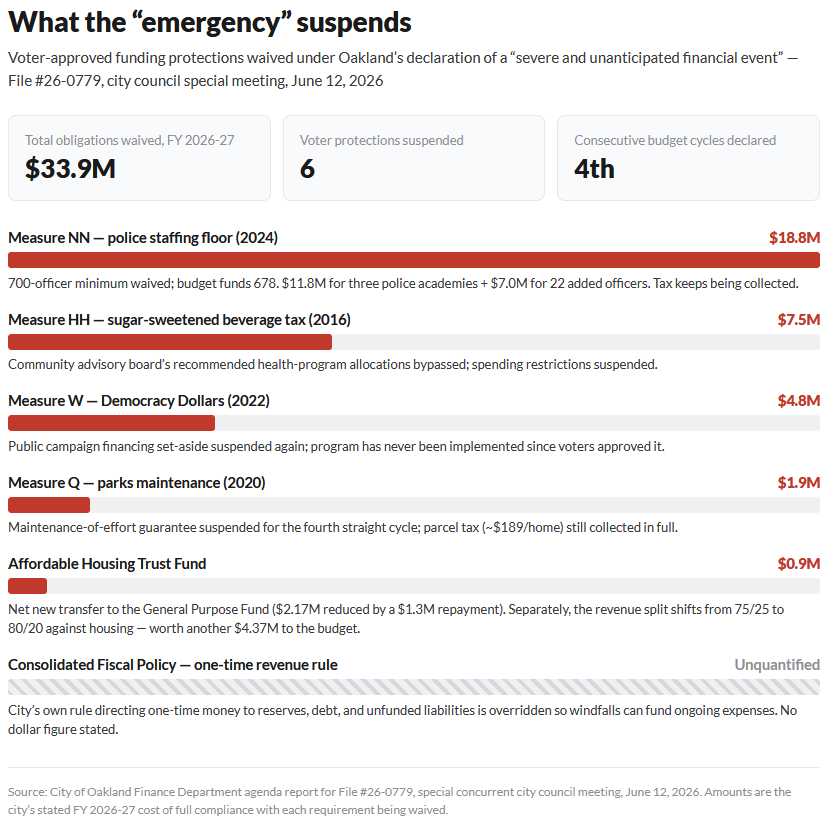
If the council declares a ‘severe and unanticipated financial event,’ it will again suspend voter-mandated requirements for the use of multiple tax funds — and allow the mayor and council to divert those restricted funds to other purposes.
With today’s resolution, the mayor and city council appear set to break the following legal, financial, and political promises:
The 700-officer minimum police staffing requirement of Measure NN (2024)
The ‘Democracy Dollars’ public campaign financing of Measure W (2022)
The parks maintenance guarantee of Measure Q (2020)
The ‘Sugar-Sweetened Beverage Tax’ spending restrictions and advisory board requirements of Measure HH (2016)
Divert money from the Affordable Housing Trust Fund
Use one-time revenues for ongoing expenses in violation of the city’s Consolidated Fiscal Policy.
According to the city staff report, approximately $33.9 million in restricted funding would be diverted.
The staff report warns that without the declaration, the mayor’s proposed budget “would not be legal to adopt.”
The vote will come ten days after Oakland voters rejected Measure E, the $34-million-per-year parcel tax that Mayor Barbara Lee, the city council, and a coalition of city employee unions had presented as necessary to sustain multiple basic city services.
Mayor Lee also stated that Measure E was needed to keep the promises the city previously made to voters in past tax measures, most notably Measure NN.2
Read this related article:

As of the most recent tally, Measure E was failing with 54% of voters opposed. Mayor Lee has conceded the measure will not pass.3
As Oakland Report previously reported, the roughly $34 million per year that the Measure E parcel tax would have charged Oakland residents and businesses is almost exactly the same amount as the $33.9 million the city now says it needs to divert from previous voter-approved tax measures.4
Measure E was styled as a grassroots ‘citizen-sponsored’ initiative, but it bore many hallmarks of an ‘astroturfing’ effort,5 engineered to exploit a change in election law that allows a special tax to pass with a simple majority of votes instead of the usual two-thirds otherwise required by state law.
As Oakland Report reported in October, the city council worked extensively in committee to develop a new public safety-focused tax measure to charge another $40 million per year to Oakland residents and businesses.6
But shortly after the committee completed the draft text of the proposed tax measure, it dropped off the committee schedule and never advanced to the full council.
There appears to be no public record of the committees or council formally voting or directing city staff to abandon the measure.
Read this related article:

A few months later, the proposed parcel tax reappeared as a ‘citizen-sponsored’ measure prepared and funded by the city’s public employee unions — most notably Service Employees International Union (SEIU) Local 1021, International Federation of Professional and Technical Engineers (IFPTE) Local 21, and International Association of Fire Fighters (IAFF) Local 55.
The political committee that qualified and promoted Measure E, “Oaklanders for a Safe, Clean & Healthy City,” raised over $1.1 million — most of it from city unions — and spent an estimated half a million dollars on paid signature-gatherers to qualify the measure for the ballot.78
Notably, the same city unions that funded the Measure E campaign were and are significant donors to the political campaigns of the elected officials who negotiate union contracts on behalf of the city — and who will cast today’s vote on the resolution to divert voter-approved restricted tax funds to the general fund.
See this related video:
Councilmember Janani Ramachandran, who chairs the council’s finance committee, confirmed in a media interview that the council plans to vote on the ‘unanticipated financial event’ declaration so the city can keep collecting an estimated $47 million from the previous Measure NN parcel tax without complying with the measure’s 700 police officer minimum.
Ramachandran attributed the shortfall to a “recruitment and retention issue.”9
Oakland Report has extensively reported on the city’s use of ‘extreme fiscal necessity’ and ‘severe and unanticipated financial event’ declarations to evade voter-mandated restrictions on the use of dedicated tax funds.10111213
What follows is an examination of what the council is about to declare, what it has declared before, and why the word ‘unanticipated’ is worthy of additional scrutiny.
1. Override fiscal policy and use one-time money for ongoing costs
The first component of the resolution overrides the city’s Consolidated Fiscal Policy.14 The policy was adopted in part because of Oakland’s history of using one-time money to cover ongoing costs.
Put in household terms, this is something akin to selling your car to pay for next month’s rent.
The Consolidated Fiscal Policy requires the council to direct one-time money toward paying existing debts (such as municipal bonds), reducing pension liabilities, correcting negative fund balances, and replenishing emergency budget reserves.
The policy expressly prohibits using one-time money to cover ongoing costs such as payroll and routine services.
However, the council may override this fundamental fiscal policy by resolution — which it has done repeatedly.

2. Another ‘unanticipated financial event’ – and another broken promise
The resolution declares a ‘severe and unanticipated financial event’ and asserts that the city cannot budget for the 700 sworn police officers required by Measure NN, the $47-million-per-year parcel tax and parking surcharge voters approved in 2024.15
The city has yet to honor the 700-officer requirement. Its current midcycle budget funds only 678 officers, and around 60 of those police officer positions currently are vacant. Due to worker’s compensation and other forms of leave, the actual number of police officers on active duty is even lower: around 500.
City staff calculate that in order to meet the 700-officer requirement, three additional police academies — which the report says is not feasible — would be needed at a cost of $11.8 million. An additional $7.0 million would be needed in ongoing costs for the additional officers, totaling $18.8 million.
Read this related article:

3. Suspending parks maintenance requirements, again
The resolution also suspends Measure Q’s park maintenance requirement. Voters approved that 20-year parcel tax in 2020 — currently nearly $189 per single-family home — on the promise that the money would preserve and enhance parks services, not replace existing funding.
The midcycle budget exceeds the measure’s 55 percent cap on using parks revenue for pre-existing operational costs.
According to the staff report, meeting the legal requirements voters approved in Measure Q now will cost an additional $1.9 million.
4. ‘Democracy Dollars’ on hold, again
The council also will be voting to suspend the minimum budget set-aside for the ‘Democracy Dollars’ public campaign financing program.
The ‘Democracy Dollars’ program was approved and funded by Oakland voters in 2022 with Measure W. The program was never implemented.
The staff report says that meeting the requirements in Measure W now will cost an additional estimated $4.8 million.
5. Soda tax restrictions stripped
The resolution suspends both the requirement to consult the Sugar-Sweetened Beverage Tax Community Advisory Board before appropriating Measure HH revenues and the restrictions on how those revenues are used.
According to the staff report, following the board’s recommended allocations would require another $7.5 million.

6. Affordable Housing Trust Fund money diverted
The resolution also would authorize the city to divert Affordable Housing Trust Fund money — a set-aside from former Redevelopment Agency funds — to balance the general fund budget.
The city intends to modify the share of affordable housing fund revenues from the current 75 percent for the General Purpose Fund and 25 percent for the affordable housing fund, to 80 percent and 20 percent, respectively.
This would divert approximately $4.4 million away from the affordable housing fund to the general fund.
Additionally, the city intends to make a one-time transfer of roughly $2.2 million (reduced to about $859,000 after a partial repayment under the city’s “Roadmap to Fiscal Health”).
7. A promise to ‘prioritize’ restoring the funds later
Notably, the resolution conveys the council’s intention to ‘prioritize’ restoring the diverted funds if new money appears later.
However, this non-binding promise comes with a broad list of exceptions including: projected deficits, maintaining current staffing, legal restrictions, or conflicts with labor agreements.

What the city says was ‘unanticipated’
Multiple voter-approved tax measures come with restrictions on the use of funding that can be waived only upon a council declaration establishing “the existence of a severe and unanticipated financial or other event.”
This leads to a question: what was the ‘unanticipated’ event?
The staff report asserts that there were three such events:
1. Lower-than-hoped Real Estate Transfer Tax revenue
Real Estate Transfer Tax is collected by the city every time a property is sold. It is widely-known best practice in municipal finance to regard this revenue as highly volatile, because it is subject to the often unpredictable ebbs and flows of real estate sales in any given year.
According to the staff report, this funding source ‘fell’ from $138.4 million in fiscal year 2021-22 to a forecasted $72.0 million in fiscal year 2026-27.
The report attributes this change to high inflation and interest rates, and to permanent post-pandemic changes in economic activity.
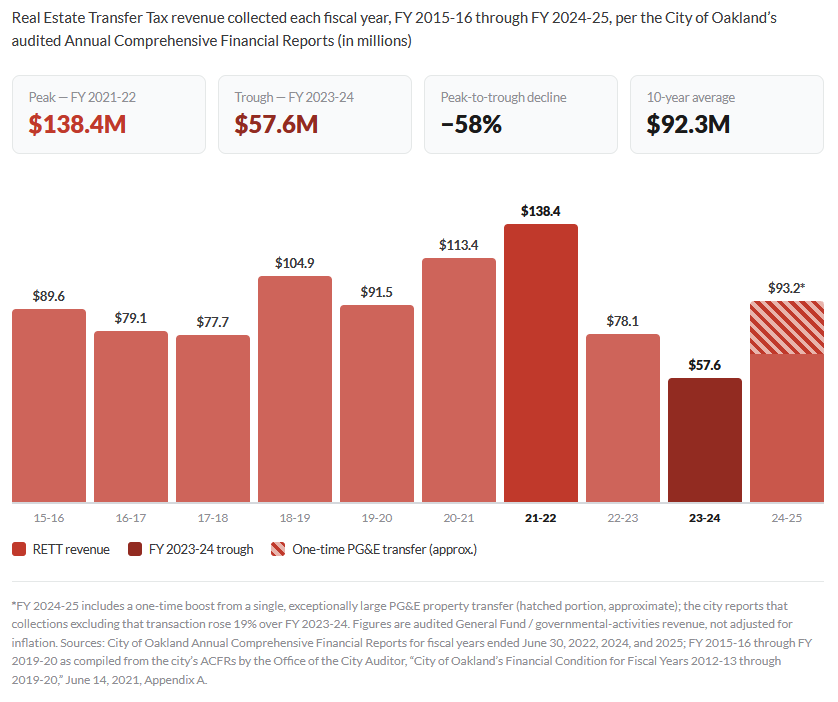
In fact, the $138.4 million figure from fiscal year 2021-22 was a high-water mark for this type of revenue. That year, the city’s adopted budget anticipated only $94.6 million in Real Estate Transfer Tax revenue. So it actually came in over 46 percent higher than the projection.
Conversely, the city anticipated $110.4 million in fiscal year 2023-24, but it actually collected only $57.6 million — over 47 percent lower than anticipated.
Over the past ten years, the city has collected anywhere from a low of $57.6 million to a high of $138.4 million.
Notably, this source of revenue actually increased in the two years that immediately followed the COVID-19 pandemic. In the most recently completed fiscal year 2024-25, this revenue exceeded the ten-year average of approximately $92 million.
Responsible municipal finance practice dictates that governments should not overestimate its forecasts for this revenue source, nor depend on it too heavily for ongoing operating costs.
The city is aware of this volatility, thus it included in its Consolidated Fiscal Policy that the real estate transfer tax should be expected to fund no more than 15% of its General Purpose Fund.
2. Rising pension and medical costs
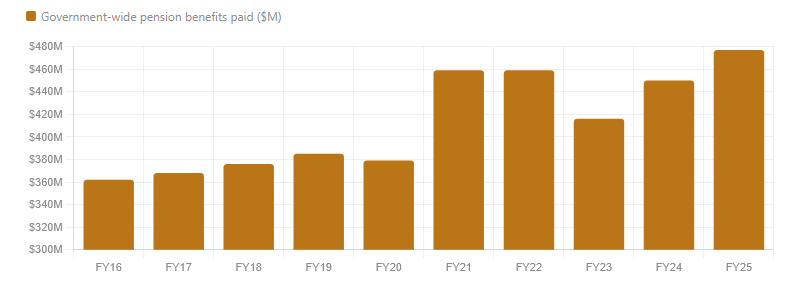
According to the city’s financial reports, the city’s annual pension benefit payments grew from $362 million in 2016 to $477 million in 2025, a 32% increase in nine years.
The city’s combined net pension liability — meaning total debt — exceeded $1.85 billion as of fiscal year 2023.
The city’s five-year financial forecast projects continued $100 million-plus annual budget deficits through the end of the decade — driven largely by pension obligations that are locked in by labor agreements and will compound regardless of future hiring decisions.16
The city’s own Roadmap to Fiscal Health projected that pension costs will rise another $70 million by 2031. The pension administrator, California Public Employees Retirement System (CalPERS) publishes contribution schedules years in advance.
These are among the most foreseeable — and challenging — cost increases in municipal finance.
3. The Oakland Coliseum payment that wasn’t
The city council in fiscal year 2024-25 irresponsibly budgeted $100 million from the sale of its share of the Oakland Coliseum Complex, despite not having secured the money.
As has been widely reported, the hoped-for $100 million in payments never materialized, and only $5 million has been paid to date.
The report notes that the hoped-for $100 million from the Coliseum sale equals roughly one-eighth of annual General Purpose Fund spending, and claims that the resulting revenue gap when the payments were not timely made “was not known at the time Measure NN legislation was drafted for signature collection.”
Read this related article:

The city saw it coming
The staff report concludes that the three above-noted events are the greatest pressure on city resources since at least the 2008 financial crisis, and that the pressure they created is ‘severe, unanticipated, and ongoing.’
However, it stands to reason that such events — which were easily foreseeable and documented in the city’s own financial reports for years — cannot be simultaneously ‘unanticipated’ and ‘ongoing’ for four years straight.
The report’s opening sentences confirm this seemingly self-contradictory reasoning when it cites “the continuing impact from severe and unanticipated financial events stemming from prior budget cycles.”
It is reasonable to assert that a financial shortfall that stems from prior budget cycles over multiple years is not unanticipated.
It also is reasonable to believe that Oakland’s budget problems are now its baseline condition, fully documented in the city’s own five-year forecasts, which have consistently projected structural deficits of $115 million to $135 million annually through 2030.
A permanent emergency, declared annually
As Oakland Report wrote last month, the phrase, “severe and unanticipated financial event” can be reasonably construed as meaning unprecedented calamities like the Great Recession of 2008 or the pandemic crash of 2020 — sudden, external shocks that no reasonable budget could absorb.
However, the record of the city’s past declarations suggests that the financial events that precipitated them were foreseen and largely avoidable.
June 2023 — parks maintenance suspended.
The council declared extreme fiscal necessity to suspend Measure Q’s parks maintenance requirement, acknowledging that the proposed budget simply did not meet the measure’s 55% threshold.The cited “events” were: a $360 million two-year deficit that emerged after federal pandemic relief ran out (of which there was ample advance warning); the city misjudged its transfer tax revenues; and the city council signed generous pay raises and benefits for its workforce during a period of remarkably high inflation.17
Additionally, Measure Q had by that time accumulated nearly $22 million in unspent funds because the city had failed to perform the promised work. Furthermore, homelessness carry-forwards exceeded allowable limits — findings later documented by the city auditor.
In the same period, the city fell short of Measure C’s minimum library support in that measure’s very first year of collection, and again declared a ‘severe and unanticipated financial event’ to evade the legal requirements and keep collecting that tax too.July 2024 — Oakland Coliseum payments fail to materialize.
The council again declared a state of extreme fiscal necessity, this time citing a $177 million deficit — while simultaneously adopting a budget that was premised on the Oakland Coliseum sale revenue, which was not actually secured and ultimately did not materialize.18June 2025. The council declared again — this time invoking, for the first time, Measure NN’s waiver to budget only 678 officers against the measure’s 700-officer minimum. The council’s action came just seven months after voters approved the measure on the explicit promise of maintaining at least 700 officers.
Additionally, the council approved a budget that closed a $265 million two-year budget shortfall partly by assuming roughly $40 million per year from a new tax that had not been written, placed on the ballot, or approved by voters. That tax later became Measure E.
Once again, the budget was balanced on revenue the city did not have; once again the fallback was the emergency declaration.June 2026. Today, the mayor and council are set to make their broadest declaration yet, suspending six voter protections in one resolution — after the speculative revenue (Measure E) failed, as the speculative revenue (the Oakland Coliseum payments) failed before it.
Help us reach our goal of 10,000 subscribers.
The financial mismanagement behind the “emergency”
The deeper problem with the “unanticipated” loophole is that nearly every component of Oakland’s fiscal distress was either predicted in the city’s own documents or directly caused by the city’s own choices.
An embarrassment of riches
Oakland is not a poor city government. Total governmental revenues have nearly doubled since 2013 and now exceed $1.6 billion per year, growing at roughly 4.7% annually — faster than inflation — even as the city projects nine-figure budget deficits.
Oakland collects the highest taxes per capita in the state among comparable cities, according to some reports. Since 2020 alone, voters have approved roughly $150 million in new annual taxes. Yet the city’s deficit continued to grow.
Even with that record-high revenue base, a recent audit found the city failed to collect approximately $12 million in business taxes it was owed.19
Spending goes up while services stagnate
The city, like all municipal governments, is a service organization, and therefore rightly spends most of its money on personnel. The structural deficit is, at bottom, a personnel cost problem.
Yet the city council has repeatedly chosen to increase the city’s personnel spending at precisely the moments it claimed ‘severe and unanticipated’ financial emergencies.
The cost-of-living adjustments (that is, employee pay raises and benefits) the city council approved during the post-pandemic inflation spike were identified by multiple observers as a direct contributor to the $360 million deficit declared in 2023.
By 2023, average total compensation (wages plus benefits) for a full-time City of Oakland employee had reached approximately $237,000 — a 79% increase over ten years, far outpacing peer cities, driven largely by a benefits load worth 72% on top of base salary.
Read this related article:

Next week, the city council will vote whether to approve a charter reform proposal that, among other things, would raise city council pay by an estimated up to 125% — which would be among the highest council compensation in the nation.20
The council is set to vote on the proposed charter reform measure and council pay raises during a time when a fiscal emergency declaration is in effect and the finance department forecasts nine-figure budget deficits through 2030.
Meanwhile, Oakland carries roughly 840 vacant, unfrozen positions. This budget capacity is worth up to $136 million per year — a figure that nearly matches the projected annual structural deficit. These unfilled, unspent positions artificially inflate the claimed deficit and, with it, the severity of the purported ‘extreme fiscal necessity.’
Video clip 1. Mayor Barbara Lee presented her proposed budget to the city council on June 1, stating that it is “built only on revenue that we can reliably project” and “does not include any layoffs for our city staff.” (Source: City of Oakland)
Mayor Barbara Lee ruled out the most valuable budget leverage from the start
Mayor Lee assured the public that her FY 2026-27 budget proposal — the budget today’s emergency declaration exists to legalize — was “balanced and responsible,” “built only on revenue that we can reliably project,” and “does not include any layoffs of our city staff.”
As noted above, personnel costs are rightly the city’s largest expense category by far, and the line item the city’s own forecasts identify as the biggest expense-side driver of the structural deficit.
A budget that rules out personnel cost reductions in advance — including concession bargaining, eliminating vacant positions, and layoffs — announces that the dominant cost driver is untouchable.
The city’s elected leaders, including the mayor, ostensibly represent the voters, and are the city’s fiduciary board of directors that negotiates with the city’s unions on behalf of the city.
By taking layoffs off the table in this context, at a time when the city is actively negotiating new labor agreements with its unions, the mayor is sending a clear message to those unions that the balancing will come from everywhere else: from parks maintenance voters paid for, from the affordable housing fund, from the police staffing voters were promised, and from the campaign finance program voters enacted.
Declaring “no layoffs” during labor negotiations, in the midst of a ‘severe and unanticipated’ fiscal emergency is a mirror image of the emergency declaration itself: the one commitment the mayor treats as binding is one voters never voted on.
Help us continue to hold the city accountable. Donate to support our nonprofit work.
Raiding restricted funds: the broken piggy bank
Given the evidence, financial data, and substantive context around the declaration, it is reasonable to state that this appears not to be an ‘unanticipated’ financial situation, in the commonly understood sense of the phrase.
Rather, it appears to be the continuation of a long-running practice: when the General Purpose Fund runs short due to the city’s chronic financial mismanagement, the city council routinely diverts funds that were previously placed off-limits by Oakland voters, sound accounting practices, and potentially, the law.
Read this related article:

In every case noted above, the primary intent of suspending the funding restrictions appears to be to evade the city’s obligations while continuing to collect the taxes voters approved for those obligations.
Each individual maneuver is presented as temporary, regrettable, and legally authorized.
Taken together, they lead to an impression of a city government that treats every restriction on its spending — mandated by voters, by the city’s own fiscal policy, or by responsible financial management — as merely a suggestion to be evaded at the city council’s discretion.
Oakland Report is by no means comprehensive in our coverage of public meetings in Oakland. The scope and frequency of public meetings are far more than we can presently cover. You can see the full June 12 city council special meeting agenda and reports at the city’s meeting calendar.

WE ARE 100% SUPPORTED BY YOU
Oakland Report provides accurate, unflinching, data-driven reporting and analysis that you will find nowhere else.
If you value our work, please donate. All contributions go directly to sustaining and growing our 501(c)(3) nonprofit work:
City of Oakland. “FY 2026-27 execution of maintenance of effort waivers and use of one-time revenues to balance the midcycle budget.” Oakland City Council special meeting, Jun. 12, 2026. https://oakland.legistar.com/LegislationDetail.aspx?ID=8057097&GUID=27F5385B-B445-4E76-9D0C-5203E69AD044
Reinhart, Sean S. “Mayor Barbara Lee says meeting Measure NN’s minimum police staffing requirement now depends on voters approving a second parcel tax: Measure E.” Oakland Report, May 17, 2026. https://www.oaklandreport.org/p/mayor-barbara-lee-says-meeting-measure
DeBenedetti, Katie. "Oakland's Measure E tax is failing, threatening a push to boost ailing city services." KQED, Jun. 9, 2026. https://www.kqed.org/news/12086350/oaklands-measure-e-tax-in-trouble-threatening-a-push-to-boost-ailing-city-services
Citizens Oakland contributors. “Broken promises: Oakland’s parcel taxes.” Citizens Oakland, May 7, 2026. https://www.citizensoakland.org/broken-promises
Wikipedia contributors. "Astroturfing." Wikipedia, The Free Encyclopedia, accessed Jun. 12, 2026. https://en.wikipedia.org/wiki/Astroturfing
Reinhart, Sean S. “Death and taxes: Oakland city council is the one who knocks.” Oakland Report, Oct. 27, 2025. https://www.oaklandreport.org/p/death-and-taxes-oakland-city-council
Wolfe, Eli and Darwin Bondgraham, "Oakland's Measure E parcel tax fight is hot — and pricey." The Oaklandside, May 21, 2026. https://oaklandside.org/2026/05/21/measure-e-parcel-tax-coakland-unions-realtors/
Hicks, Tony. "Oakland voters asked to approve new parcel tax, small business tax holiday on June ballot." Local News Matters, May 1, 2026. https://localnewsmatters.org/2026/05/01/oakland-june-ballot-measures-e-c-tax
Ibid. DeBenedetti, Katie.
Reinhart, Sean S. "Oakland set to declare 'extreme fiscal necessity' again, coordinate with unions to increase property taxes." Oakland Report, Feb. 10, 2026. https://www.oaklandreport.org/p/20260210-oakland-declare-extreme-fiscal-necessity
Gardner, Tim. "Oakland's quarterly financial report is delayed until March, amplifying budget risks." Oakland Report, Dec. 24, 2025. https://www.oaklandreport.org/p/20251224-oaklands-quarterly-financial-report
Oakland Report contributors. “Oakland’s surplus mirage sets the stage for a $34 million tax increase.” Oakland Report, Feb. 28, 2026. https://www.oaklandreport.org/p/oaklands-surplus-mirage-sets-the
Reinhart, Sean S. "The city of Oakland has broken its promises to voters in three of the last four parcel tax measures." Oakland Report, Apr. 8, 2026. https://www.oaklandreport.org/p/20260408-oakland-broke-its-promises
City of Oakland. “Consolidated fiscal policy webpage.” Accessed Jun. 12, 2026. https://www.oaklandca.gov/Government/Finance-Budget/Financial-Reporting/City-of-Oakland-Consolidated-Fiscal-Policy
Ballotpedia contributors. “Oakland, California, Measure NN, Police and Violence Reduction Parcel Tax Measure (November 2024).” Ballotpedia website, accessed Apr. 8, 2026. https://ballotpedia.org/Oakland,_California,_Measure_NN,_Police_and_Violence_Reduction_Parcel_Tax_Measure_(November_2024)
City of Oakland. “Receive the Annual Comprehensive Financial Report (ACFR) and the auditor’s required communication to city council (management letter) for the year ended June 30, 2025.” Finance and management committee meeting, Feb. 10, 2026. https://oakland.legistar.com/LegislationDetail.aspx?ID=7801578&GUID=4EC97BF2-6575-4692-8C61-06802D8EEAB8&Options=&Search=
Mukherjee, Shomik. “City underspending Measure Q funding.” The Mercury News, Jan. 3, 2024. https://www.mercurynews.com/2024/01/02/oaklands-measure-q-money-going-unspent-as-fire-danger-at-parks-worsens/; https://archive.is/5lK6x
Bailey, Crystal. "Oakland City Council approves mayor's budget to close $177M deficit." KTVU, Jul. 2, 2024. https://www.ktvu.com/news/oakland-city-council-approves-mayors-budget-close-177m-deficit
Reinhart, Sean S. "Oakland failed to collect $12 million in taxes: 'they did not know what was happening.'" Oakland Report, May 11, 2026. https://www.oaklandreport.org/p/oakland-failed-to-collect-12-million
Montana, Alex. “City council seeks a pay raise of up to 125% – which would be among the highest in the nation.” Oakland Report, Mar. 26, 2026. https://www.oaklandreport.org/p/20260326-city-council-seeks-a-pay-raise-of
Measure NN, like Measure E was a "citizen-led" ballot measure that was drafted and approved outside of city government. Since its adoption, the language has shown multiple conflicts with the City Charter. The 700 officer requirement was thus adopted as a city ordinance even though it wasn't drafted or sponsored by the city. It's these citizen-led ballot measures that I am extremely critical about now - because there is no way to reconcile whether they are realistic or not since they don't go formal legal or audit review prior to being placed on the ballot (other than cursory review by the City Attorney and financial review by the City Auditor).
The 700 officer requirement was unrealistic from the get-go, given that internal reports showed that we wouldn't be at that level for years to come - definitely not by the July 2026 Measure NN deadline. Measure NN also drastically increased the allocation of funds to non-profit organizations compared to the Department of Violence Prevention (and it was sponsored by many of those same non-profits).
It's this complicated process that makes it virtually impossible for a regular voter to determine what is feasible and credible - and leads to further dysfunction.
Lawsuit time!