



Editor’s note: This is a developing story. The complaint, filed April 30 in Alameda County Superior Court, focuses on Measure E — the $34 million-per-year parcel tax appearing on the June 2, 2026 ballot — and the City’s response (or non-response) to a series of Public Records Act requests aimed at uncovering how the measure came to be.
Today the Alameda County Taxpayers’ Association (ACTA) and Oakland attorney Marleen L. Sacks filed a verified petition for writ of mandate against the City of Oakland and the Oakland City Council.
The lawsuit alleges that the City has unlawfully concealed records relating to Measure E and engaged in a “coordinated and deeply troubling effort” to evade the two-thirds vote that California law would otherwise require for the parcel tax now on the June 2 ballot.1
Read the lawsuit:
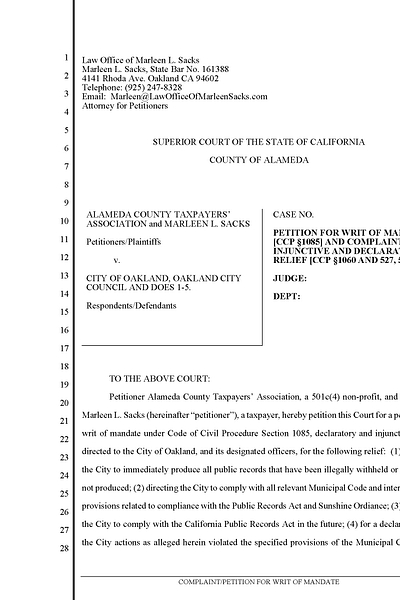
The 26-page complaint lays out a detailed chronology in which the City Council adopted a $4.2 billion two-year budget in June 2025 that depended on $40 million in new parcel tax revenue — before any such tax measure had been drafted, agendized, or approved.
Then, after months of staff reports and polling, allowed the measure to “suddenly” appear in November 2025, drafted and submitted not by the City, but by the City’s largest public-sector union, SEIU Local 1021.
In simple terms, the lawsuit alleges that Measure E is a city tax masquerading as a ‘citizen-sponsored’ initiative — designed to reduce the approval threshold from two-thirds to a simple majority.
The alleged scheme
Under California law, a parcel tax placed on the ballot by a city council is a “special tax” requiring two-thirds voter approval. But per recent court decisions, a tax measure qualified for the ballot through the citizens’ initiative process needs only a simple majority.
Oakland Report reported this loophole in detail throughout the spring, including in our April 8 exposé documenting that the city of Oakland has broken its promises to voters in three of the last four parcel tax measures.2
ACTA’s petition now alleges what some observers have suspected: that the citizens’-initiative posture of Measure E was a deliberate tactic to lower the voter approval threshold.
The lawsuit walks through a timeline to support the allegation:
June 11, 2025 — Council adopts a balanced budget premised on a not-yet-existing $40 million parcel tax in 2026.
August 30, 2025 — The council Finance Committee discusses tax structures; city finance director Bradley Johnson tells the committee the City is already working with a polling firm to gauge voter support for a June ballot tax measure.
September 22, 2025 — Deputy city administrator Monica Davis submits an “informational report” laying out parcel tax options to raise the targeted $40 million.
October 16, 2025 — A supplemental “informational report” expands the menu of tax options, including a new parcel tax. The report says the existing PFRS pension override is “winding down” but does not say it is “expiring” in 2026.
November 18, 2025 — Without the Council ever agendizing or approving any ballot measure, a fully drafted parcel tax measure — the “Oakland Public Safety, Cleanliness and Public Accountability Act of 2026” — is delivered to the City Clerk. The cover letter is from SEIU Local 1021’s Director of Research, Caitlin Prendiville. The contact attorney is Richard Rios of Olson Remcho — the same firm that represented the City in the Measure AA litigation, in which the trial court called the tax “a fraud on the voters” before being reversed on appeal on the citizens’-initiative theory.3
See this related article:

The complaint also notes that the staff contact listed on the October 16 informational report — Revenue and Tax Administrator Nicole Welch — is herself a member of SEIU Local 21. Whether Welch communicated with SEIU Local 1021 about the measure is one of the central factual questions that ACTA’s records requests are designed to answer.
“The timing, structure, and provenance of the measure strongly indicate a deliberate strategy to convert what would otherwise be a City-sponsored parcel tax requiring a two-thirds vote into a so-called ‘citizens’ initiative,’ thereby lowering the threshold for passage to a simple majority.”
— Petition for Writ of Mandate, ¶ 1
What the City has produced (and what it hasn’t)
The records portion of the lawsuit raises additional questions about the city’s conduct with regard to transparency.
Between Dec. 29, 2025 and Feb. 23, 2026, ACTA and Sacks submitted five separate California Public Records Act (CPRA) requests through Oakland’s NextRequest portal, each progressively narrower than the last, each seeking communications that — if they exist — would document coordination between City staff and SEIU on the parcel tax.
According to the lawsuit:
The first request (Dec. 29, 2025) yielded four documents on January 12, 2026 — three days after the statutory deadline — and a handful more in late January and February. Multiple councilmembers, the Mayor’s office, and the City Administrator’s office have all uploaded responses claiming to possess no responsive records at all.
The second request (Feb. 3, 2026) was, as of late April, still sitting in the City Clerk’s office with no documents produced and no indication that the Clerk had even forwarded the request to other departments.
The third request (Feb. 12, 2026), seeking polls and polling-related communications, had received zero documents and zero status updates more than two months after submission.
The fourth request (Feb. 19, 2026), seeking documents supporting Measure E’s claim that an “expiring” property tax would be “replaced,” had also produced nothing as of the end of April.
The fifth request (Feb. 23, 2026), seeking communications to and from Nicole Welch and other City staff regarding SEIU Local 1021 and the parcel tax, was likewise unanswered.
The lawsuit characterizes the “no responsive records” claims from councilmembers and the Mayor’s office as not credible, given that the budget approved in June 2025 expressly depended on a parcel tax that materialized five months later in a form drafted by SEIU.
This is not the City’s first irregularity with public records requests. A local online media outlet’s investigative review of nearly 180 public records requests filed with current and former councilmembers in October 2025 found that, in only 13 cases out of 91 filed with sitting councilmembers, did an official respond within the legally required 10-day window.4
And less than two weeks before ACTA’s lawsuit was filed, the same outlet reported that the Oakland Police Department is now violating the terms of a prior class-action settlement requiring it to comply with the Public Records Act — with the outlet’s attorney warning the City Attorney that he is prepared to return to court.5
A pattern, not an isolated incident
ACTA’s complaint goes to some lengths to establish that Oakland’s noncompliance with the CPRA is not a series of isolated lapses but an institutional practice:
Case No. RG20078708 — In February 2024, Judge Stephen Kaus ordered the City to produce roughly 450 documents that former Mayor Libby Schaaf had been routing through her personal email account in connection with Measure AA. The case settled in February 2025 with the City agreeing to revise Administrative Instruction 106 (its internal CPRA compliance policy) and pay over $200,000 in attorney’s fees.
Case No. 23CV027685 — Settled May 2025, with the City paying another $200,000-plus in attorney’s fees.
Case No. RG 20071657 — City lost on the merits in April 2021 and paid $125,204.50 in fees.
Case No. RG 20072029 — Settled December 2021 for $127,500 in fees; the City is now alleged to be violating that settlement, too.
Public Ethics Commission, May 2021 — The Commission’s Spotlight on Oakland’s Public Records System report concluded that Oakland repeatedly and regularly fails to comply with the CPRA and its own Sunshine Ordinance.
April 2026 — A wrongful-termination lawsuit filed by former mayoral staffer Leigh Hanson reportedly alleges that City employees, including council president Kevin Jenkins, communicated about City business via Signal — an encrypted messaging app whose use, the petition argues, can have only one purpose: thwarting the Public Records Act.
The new Administrative Instruction (AI) 106 — negotiated as part of the 2025 settlement — explicitly forbids using personal devices, personal email, or messaging apps “to willfully avoid compliance” with the CPRA, and requires department directors to monitor outstanding requests and ensure overdue responses are addressed.
The lawsuit alleges that none of these ministerial requirements have been complied with in connection with the five Measure E records requests.
See this related video:
What the lawsuit asks for
The complaint pleads six causes of action, including a CCP § 526a taxpayer-waste claim, a writ to compel CPRA compliance, declaratory and injunctive relief under the Sunshine Ordinance and AI 106, and a separate cause of action for the Public Ethics Commission’s failure to commence mediation within the 10-day window required by Oakland Municipal Code § 2.20.27(c).
The Commission’s mediation coordinator, Jelani Killings, told Sacks on March 10 that the office was “operating with limited staff” and could not address the backlog of mediation requests.
ACTA is asking the court to order immediate production of withheld documents, and to:
Issue declaratory relief that the City is out of compliance with the CPRA, the Sunshine Ordinance, and AI 106;
Require the City to meet CPRA deadlines on all requests going forward, not just the Petitioners’;
Order regular compliance reports to the court;
And appoint a court monitor to oversee compliance.
The monitor request in particular reflects the Petitioners’ position — supported by the California Supreme Court’s recent decision in City of Gilroy v. Superior Court (2026) 19 Cal.5th 38, which the complaint cites — that declaratory relief is appropriate where a declaration “would resolve an ongoing dispute regarding the parties’ rights and obligations in a manner that has some likelihood of affecting future requests for public records or future conduct relating to such requests.”
In plain English: ACTA is asking the court to find that the City’s pattern of CPRA violations is severe enough that ad hoc, lawsuit-by-lawsuit enforcement is no longer adequate.

The bigger picture for Measure E
Whatever happens in this litigation, the records dispute is now entangled with the substantive questions voters will face on June 2. Three of those questions stand out:
Did the City coordinate with SEIU to dodge the two-thirds vote? That is the central factual question the records would answer. The City’s “no responsive records” assertions are, on their face, difficult to reconcile with the documented chronology — and ACTA’s brief catalogs the indirect evidence: the budget assumption made before any measure existed, the polling commissioned while the Council had taken no formal action, the staff contact at SEIU Local 21, the SEIU Local 1021 cover letter on the November filing, and the law firm shared with the prior Measure AA litigation.
Is Measure E’s “lower taxes” claim accurate? Measure E’s text declares that it will “replace” an “expiring” property assessment and “reduce taxes for a majority of Oakland homeowners.” The City’s own October 16 informational report described the PFRS override as “winding down” — not expiring — and projected that it would continue in some form “in future years.”
Notably, Measure E would be in addition to, not in place of, Measure NN (the 2024 public safety parcel tax).
See this related article:

The city of Oakland has broken its promises to voters in three of the last four parcel tax measures
Where would the money go? As Oakland Report documented in February, 44% of Measure E’s revenue would be absorbed by public-sector union raises — which increase the city’s costs in every year going forward — in contracts the City and unions signed in September 2025.6 Measure E itself contains no guaranteed minimum staffing levels, no guaranteed shelter beds, and no enforceable service standards.
ACTA’s petition is, in the end, a request that voters and the court be allowed to see the documents that would let them evaluate those three questions for themselves.
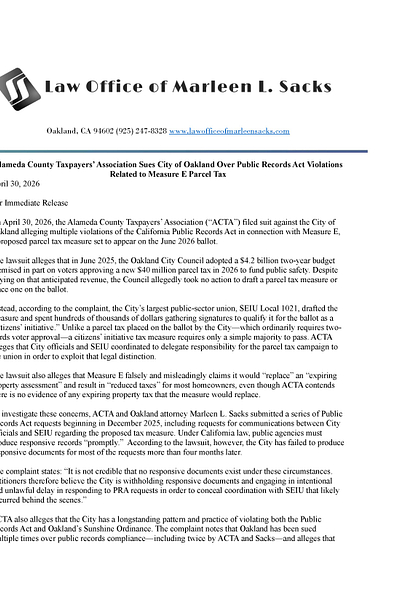
Read the press release:
Oakland Report provides accurate, unflinching, data-driven reporting and analysis that you will find nowhere else. If you value our work, please donate. All contributions go directly to sustaining and growing our nonprofit work:
Petition for Writ of Mandate and Complaint for Injunctive and Declaratory Relief, Alameda County Taxpayers' Association and Marleen L. Sacks v. City of Oakland, Oakland City Council, et al., Alameda County Superior Court, filed April 30, 2026, ¶¶ 1–4.
Reinhart, Sean S. “The city of Oakland has broken its promises to voters in three of the last four parcel tax measures.” Oakland Report, Apr. 8, 2026. https://www.oaklandreport.org/p/20260408-oakland-broke-its-promises
Petition ¶¶ 23–26. On the Measure AA reversal, see Jobs and Housing Coalition v. City of Oakland, in which the Court of Appeal reversed Judge Ronni MacLaren’s trial-court ruling on the ground that the measure qualified as a citizens’ initiative requiring only simple-majority approval.
Wolfe, Eli and Natalie Orenstein. "Oakland councilmembers flagrantly violate CA Public Records Act." The Oaklandside, Oct. 16, 2025. https://oaklandside.org/2025/10/16/oakland-cpra-council-public-records-requests-act/
Wolfe, Eli. "Oakland police illegally keep information from those who request it, says attorney." The Oaklandside, April 21, 2026. https://oaklandside.org/2026/04/21/oakland-police-department-violating-california-public-records-act/
Oakland Report. “Oakland’s surplus mirage sets the stage for a $34 million tax increase.” Oakland Report, Feb. 28, 2026. https://www.oaklandreport.org/p/oaklands-surplus-mirage-sets-the
A logical continuation of the past twenty years. The Oakland City Government has become a wholly owned subsidiary of SEIU 1021 and adjacent public employee unions. The only question is whether it was a hostile takeover or simply a merger and acquisition.
First they came for the 'Landlords' and I didn't speak up because I wasn't a landlord. Then they came for large corporations and I didn't speak up (and they all moved out of Oakland!) Then they came for the small business owners and I didn't speak up because I wasn't a small business owner. Then they came for homeowners like me and there was nobody left to speak up.
It's unfortunate that this group has a bad name among many urban Bay Area voters. Bad branding, bad marketing, bad associations (Jarvis, for example.). But that doesn't take away from the validity of their complaint here.