



PART ONE IN A SERIES
Editors’ note
Oakland Report exists because we believe that Oakland is a beautiful place, filled with extraordinary people, and it has virtually unlimited potential to become a thriving city for all people from every background and walk of life.
We know it is possible for a city government to be well-run, efficient, accountable, equitable, and—perhaps most importantly—an honest and responsible steward of the public trust.
We also know that our form of government only functions when everyday people pay attention to what the city is doing and consistently hold it accountable for its actions—even when that means speaking honest, unflinching, accurate criticisms that city leaders and advocates may prefer not to hear.
Holding the city accountable helps the city serve people better, and incentivizes city leaders to make more meaningful progress and become better public servants.
In that spirit, Oakland Report will be taking an extended look at the many taxes the City of Oakland charges its residents and businesses: what the taxes were intended to pay for, how they were actually used, and whether the city kept the promises it made to voters.
This first installment provides an introduction and overview of the key points we will explore in the coming days, starting with one category of taxes the city relies on heavily for basic services: parcel taxes.
Future installments in this series will take deeper dives into the city’s performance with specific taxes, their impacts to Oaklanders and the city overall.
We’ll explore the full extent of the tax burden the city of Oakland places on the community, in addition to the many taxes also charged by the county, schools and regional districts.
We’ll examine how much Oaklanders’ taxes have increased in recent years compared to taxes in other cities and the cost of living—and importantly, whether Oakland’s increased taxes have actually resulted in improved services and quality of life for its residents.
The series will culminate later this month with a study guide on Oakland’s taxes and key considerations for Oakland voters about Measure E, the new parcel tax the city is asking voters to approve on the June 2 ballot.1
We want to hear from you, our readers, what you think about Oakland’s taxes and the services Oaklanders receive in return. We also want to hear what you think about this series. Write a comment, send us a note, and share this article with others.
Most importantly, subscribe to our mailing list, share our stories, and please consider giving a tax-deductible donation to help us continue our nonprofit work:
Introduction
Taxes are necessary for a safe, functioning society. That fact is not up for serious debate.
The government collects taxes in order to pay for services that most people agree the government should provide. This is a foundational aspect of our country, and a reasonable arrangement that most reasonable people agree with, ourselves included.
But when the government fails to provide the services it promised in exchange for the taxes it collects — as has happened in Oakland multiple times now — then what?
In Oakland, the city’s answer routinely is to collect even more taxes.
New tax measures have appeared on ballots in virtually every election cycle in recent years, often for basic municipal services like police and parks and libraries, and Oakland voters have dutifully approved them.
After years of cumulative tax increases, Oakland now collects some of the highest taxes per capita in the state compared to similar cities.2
Oakland’s high taxes add significantly to the cost of living in one of the most expensive regions in the nation.
Many of the city’s taxes, especially parcel taxes are regressive,3 meaning that they disproportionately burden low-income and disadvantaged people, which accelerates the displacement of long-time residents out of Oakland.
Yet even as record-high tax revenues flow into to the city’s bank accounts,4 Oakland’s streets and sidewalks continue to be clogged with trash,5 its police force continues to be woefully understaffed,6 and its political leaders’ financial decision-making continues to be most charitably described as questionable at best.7
A recent survey of Oakland residents found that 70% of people surveyed said that the taxes they pay are not worth it—a result that climbed to 75% among Black residents surveyed.8
A similarly high percentage of Black survey respondents—and indeed all survey respondents—indicated that the city cannot be trusted to spend their tax dollars wisely.
The survey also registered significant levels of concern from Black residents about being displaced from their homes and out of Oakland due to Oakland’s high and increasing cost of living.
With the city’s proposed new ‘public safety’ parcel tax, Measure E, on the ballot this June, the issue Oakland voters will face is not whether more taxes are needed to support basic services, but whether the city can be trusted to act responsibly and keep its promises about how taxes will be used.
In the coming days, this series will explore all of the above considerations and more, with data and evidence to support assertions and give readers the opportunity to see and decide for themselves.
In this first installment, we take a brief look at the city of Oakland’s parcel taxes— just one subset among many taxes Oaklanders pay.
Part 1
The city of Oakland has broken its promises to voters in three of the last four parcel tax measures
According to the city’s own reports, Oakland has demonstrated a consistent pattern of financial mismanagement and failure to keep the promises it made in order to convince voters to approve new taxes.
The city’s top appointed official, Oakland city administrator Jestin D. Johnson issued a report on Feb. 10, 2026, titled, “Multi-year plan to meet voter-mandated staffing and service levels.” The report was prepared in response to concerns that the city has failed to comply with minimum staffing and service requirements promised in previous voter-approved tax measures.9
The city administrator’s report examined a total of 21 tax measures and legal agreements across multiple city funds. The report affirmed that the city has failed to meet minimum requirements in seven of 21 cases overall, including three of the last four parcel tax measures approved by voters:
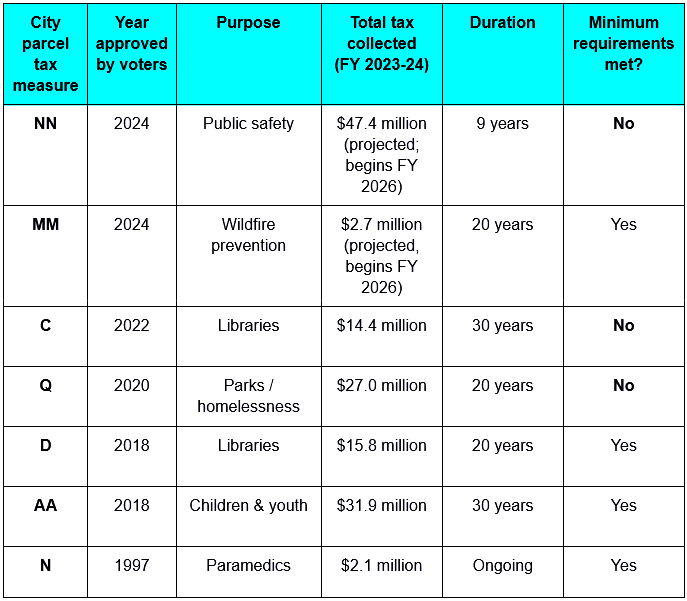
The city administrator’s report then says that in order to fulfill all of the minimum requirements and promises made to voters, the city would need “new ongoing revenue sources or reallocation of existing services”—at an estimated new cost of $38.8 million per year.
Notably, voters have already approved taxes for the city to fulfill those minimum requirements and promises. Yet the city now says it needs more tax money in order to keep those promises.
Perhaps more notably, the city administrator’s $38.8 million estimate is roughly the same amount that the city council added to the city’s current fiscal year budget for an unidentified new tax measure.10
The city administrator’s estimate also is roughly equivalent to the amount the city’s proposed new ‘public safety’ parcel tax, Measure E, now aims to collect from Oakland homeowners and businesses.11
The Measure E parcel tax, if approved by voters this June, would be in addition to, not replacing the Measure NN parcel tax that voters approved for ‘public safety’ two years ago.
Broken promises and the ‘extreme fiscal necessity’ loophole
The City of Oakland has used declarations of ‘extreme fiscal necessity’ to evade key requirements in voter-approved measures—in some cases while simultaneously declaring a multi-million dollar budget surplus.
Measure NN (2024). The city has consistently failed to fulfill the promise that the city would employ a minimum of 700 sworn police officers since the measure passed in 2024. The city currently has approximately 618 sworn officers, only around 500 of whom are on active duty. The city council has declared a continuous state of ‘Extreme Fiscal Necessity’ for the past nearly two years as justification to bypass the minimum staffing requirement and collect the tax.12
Measure C (2022). In the very first year of this tax measure, the city fell short of the minimum General Fund support it is required to provide to the city’s libraries in order to collect the tax. In order to bypass that requirement and continue to collect the tax, the city council quickly declared a “Severe and Unanticipated Financial Event.”13
Measure Q (2020). The city council passed a resolution in June 2023 to suspend the parks maintenance requirement, effectively voiding the baseline level of service promised to voters when the Measure Q tax was approved. In addition, the city failed to carry out the promised work in a timely manner. Measure Q had accumulated nearly $22 million in unspent funds by June 2023, and homelessness carry forward funds exceeded allowable amounts due to the city’s lack of progress on performing the work.14
Summaries of city parcel tax measures
Measure NN (2024) - Public safety
Measure NN (2024) is a 9-year tax that collects $198 for single-family parcels, alongside a 10% parking surcharge.15 It is projected to generate approximately $47.4 million annually. The measure stipulates that 60% of the tax revenues will go to police services and 40% to ‘violence prevention’ programs. The measure’s main promise is that the city will maintain a minimum of 700 sworn police personnel; however, the city council waived this promise shortly after voters approved the tax by declaring a state of “extreme fiscal necessity.”
Measure NN replaced Measure Z (2014), a 10-year parcel tax approved by voters in 2014 for police, fire, and violence prevention programs. Rates for Measure Z ranged from $51 to $100 per unit, plus an 8.5% parking surcharge, and was projected to generate $27–$30 million annually.
Measure MM (2024) - Wildfire prevention
The Wildfire Prevention Financing Act of 2024 established a 2-year tax to fund a Vegetation Management Plan within a defined wildfire prevention zone. Rates are $99 for single-family parcels and $65 per multi-family unit, capped at a 5% annual increase. It is projected to generate around $2.7 million per year.
Measures D (2018) and C (2022) - Library services
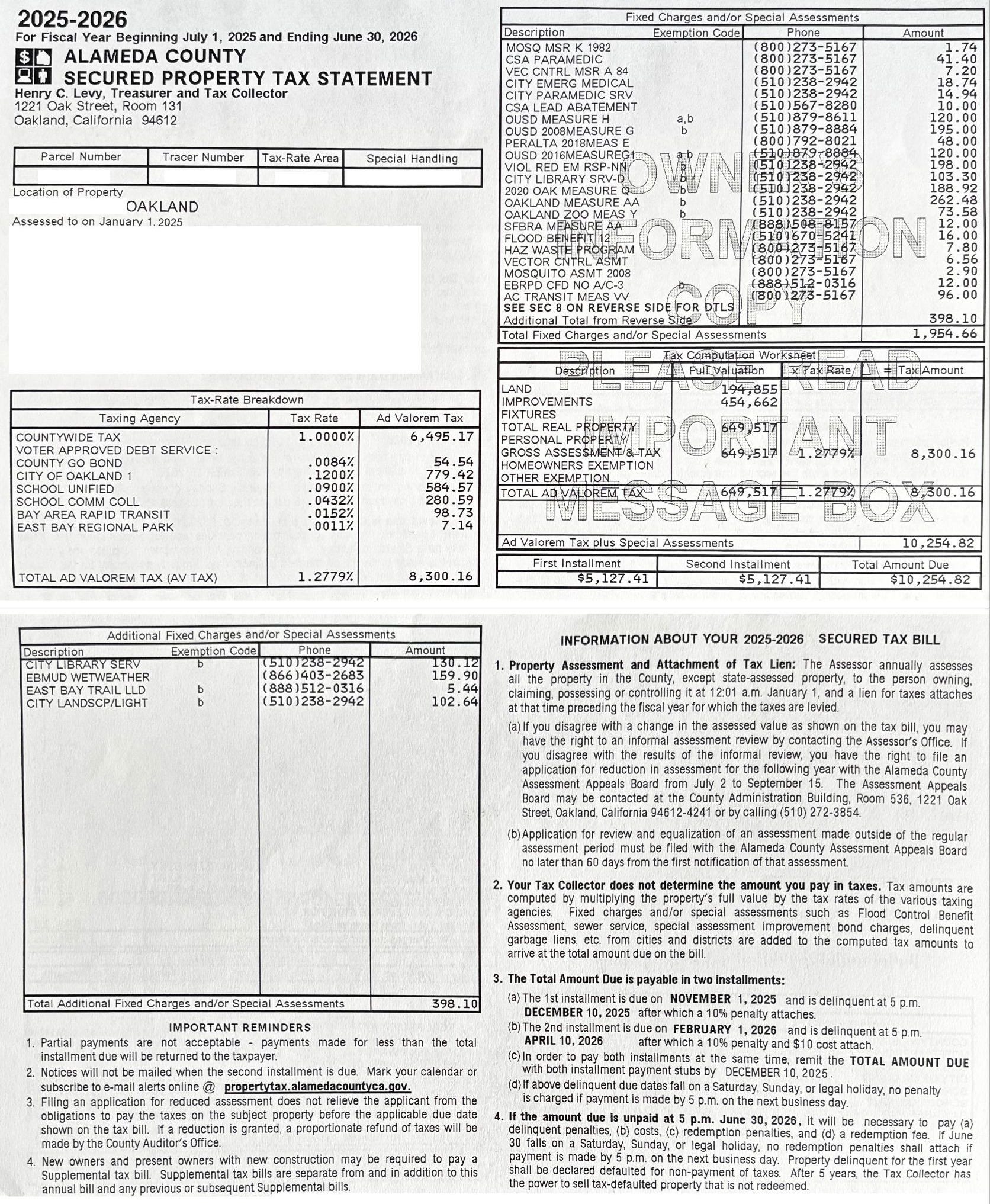
Measure D (2018), the Oakland Public Library Preservation Act is a 20-year parcel tax intended to maintain and improve basic library services, including library open hours and purchasing books and other materials.16 The initial rate was $75 for single-family parcels, adjusted annually for inflation and now over $103 in FY 2025-26. Measure D includes a clause requiring the city to budget at least $13.0 million from the general fund to its libraries each year.
Measure C (2022) is a 30-year parcel tax initially set at $114.50 for a single-family home, with annual adjustments for inflation.17 Measure C was projected to generate approximately $18 million per year. In the first year of the new tax, the city mistakenly collected $112,000 from 300 property owners who were exempt from the tax. More concerningly, the city failed to meet the minimum general fund appropriation requirement, jeopardizing the city’s authority to collect the tax at all. The city evaded consequences for this error by quickly declaring an “Severe and Unanticipated Financial Event.”
Measure C renewed and amended the previous Measure Q focused on libraries (2004), not to be confused with another, more recent Measure Q that was passed for parks and homelessness in 2020.
Measure Q (2020) - Parks and homelessness support
The Oakland Parks and Recreation Preservation, Litter Reduction, and Homelessness Support Act is a 20-year parcel tax.18 The single-family rate was initially set at $148 in FY 2020-21, and has increased to nearly $189 in FY 2025-26. Revenue is allocated at 64% for parks maintenance, 30% for homelessness services, 5% for stormwater, and 1% for audits. A city audit of Measure Q found significant underspending, with the fund balance growing to nearly $22 million by June 2023, and carryforwards for homelessness services that exceeded allowed amounts. The city council declared an “extreme fiscal necessity” in June 2023 to suspend the parks maintenance provision, breaking the promise made to voters and diverting funds intended for park services.
Measure AA (2018) - Children & youth
The Children’s Initiative of 2018 is a 30-year tax funding early education, the Oakland Promise Fund, and ‘oversight’.19 The rate was initially set at $198 for single-family parcels, and has increased to over $262 since then. The measure was delayed for several years by lawsuits disputing the voter approval threshold—a subject we will explore in an upcoming installment in this series.
Measure N (1997) - Paramedics
The Paramedic Services Act of 1997 funds paramedic and emergency medical response. Initial rates were $7.18 for single-family parcels, adjusted annually for inflation.20 City reports indicate that these funds have been spent in accordance with the measure’s purpose, however, audits in 2008 and 2011 flagged a consistently growing fund balance ($2.1 million by 2011) due to the lack of a formal long-term spending plan and reserve policy.

A look ahead
Part 2 in this series will take a deeper dive into Measure NN, the public safety parcel tax approved by Oakland voters in 2024. We will examine the city’s ongoing use of an “extreme fiscal necessity” declaration—while simultaneously declaring a multi-million dollar budget surplus—to evade Measure NN’s fundamental promise of maintaining a minimum of 700 sworn police officers. Part 2 also will compare Measure NN to the city’s new proposed ‘public safety’ parcel tax on the ballot this June: Measure E.
Part 3 in the series will examine how Oakland’s taxes have increased in recent years compared to taxes in other cities, and compared to the rising cost of living. We also will take a closer look at the regressive nature of Oakland’s parcel taxes, and the disproportionate burden these taxes place on low-income and disadvantaged residents.
Future installment will explore and expand on the other points outlined in the above introduction—along with other points that our readers may propose as we move through the series.
In closing Part 1, we acknowledge that taxes are necessary to provide public services, and we recognize that the city of Oakland uses many of its tax dollars effectively to provide services and improve people’s lives. Much has been said and written in other outlets about those positive aspects of Oakland’s taxes and services—not to mention by government officials eager to put a positive spin on the city.
This series does not seek to duplicate that well-rehearsed chorus, but to help the city instead to identify and correct the false notes that hold it back from achieving its full potential.
BECOME A MEMBER OF OAKLAND REPORT
We rely on financial support from everyday readers like you. Your donation in any amount helps us to continue our nonprofit work.
Please help us keep Oakland Report going by donating now.
See these related articles about taxes in Oakland:


Ballotpedia contributors. “Oakland, California, Measure E, create parcel tax to fund public safety programs measure (June 2026).” Ballotpedia website, accessed Apr. 8, 2026. https://ballotpedia.org/Oakland,_California,_Measure_E,_Create_Parcel_Tax_to_Fund_Public_Safety_Programs_Measure_(June_2026)
Neditch, Nicole et al. “Balancing Oakland’s budget: Nine recommendations for closing the city’s structural deficit to move toward fiscal solvency and economic growth.” San Francisco Bay Area Planning and Urban Research Association, May 2025, p. 17. https://www.spur.org/sites/default/files/2025-05/SPUR_Oakland_Budget.pdf
Wikipedia contributors. "Parcel tax." Wikipedia, The Free Encyclopedia, accessed Apr. 8, 2026. https://en.wikipedia.org/wiki/Parcel_tax
Johnson, Bradley et al. “Annual consolidated financial report for the year ended June 30, 2025.” City of Oakland finance department, Dec. 30, 2025, p. 164. https://www.oaklandca.gov/files/assets/city/v/1/finance/documents/financial-reporting/annual-comprehensive-financial-reports/2025-city-of-oakland-acfr_final-123025.pdf
Soumya Karlamangla, “How a City Awash in Garbage Is Trying to Take Out the Trash.” New York Times, Oct. 8, 2025. https://archive.is/yI4dO
Reinhart, Sean S. “Police overtime report shows $16.9 million over budget halfway through the fiscal year.” Oakland Report, Mar. 10, 2026. https://www.oaklandreport.org/p/police-overtime-report-shows-net
Reinhart, Sean S. “Oakland set to declare ‘extreme fiscal necessity’ again, coordinate with unions to increase property taxes.” Oakland Report, Feb. 10, 2026. https://www.oaklandreport.org/p/20260210-oakland-declare-extreme-fiscal-necessity
Taylor, Loren. “75% of Black Oakland residents surveyed say the taxes they pay are not worth it.” Oakland Report, Mar. 21, 2026. https://www.oaklandreport.org/p/20260321-75-percent-black-residents-taxes-not-worth-it
City of Oakland. “Receive an informational report addressing the Oakland Roadmap To Fiscal Health’s objective of presenting a phased, multiyear plan to move the city toward compliance with voter mandated staffing, service levels and other agreements.” Finance and management committee meeting, Feb. 10, 2026, agenda item #6. https://oakland.legistar.com/LegislationDetail.aspx?ID=7803529&GUID=45C4B727-1AE6-490F-8CC6-25E3BD2FF85A&Options=&Search=
Reinhart, Sean S. “‘Death and taxes’ - Oakland City Council is the one who knocks.” Oakland Report, Oct. 27, 2025. https://www.oaklandreport.org/p/death-and-taxes-oakland-city-council
Reinhart, Sean S. “Oakland: $34 million property tax increase appears headed for June ballot.” Oakland Report, Mar. 3, 2026. https://www.oaklandreport.org/p/20260303-34-million-property-tax-increase
Reinhart, Sean S. “Oakland set to declare “extreme fiscal necessity” again, coordinate with unions to increase property taxes.” Oakland Report, Feb. 10, 2026. https://www.oaklandreport.org/p/20260210-oakland-declare-extreme-fiscal-necessity
Houston, Michael. “Audit of library parcel taxes for Fiscal Year (FY) 2019-20 through FY 2022-23.” Oakland City Auditor’s office, June 13, 2024. https://www.oaklandauditor.com/wp-content/uploads/2024/06/20240613_Audit-of-Library-Parcel-Taxes-FY-2019-20-FY-2022-23.pdf
Houston, Michael. “Budget transparency, performance management, and stronger oversight needed to ensure Oaklanders benefit from the 2020 Parks and Recreation Preservation, Litter Reduction, and Homelessness Support Act.” Oakland City Auditor’s office, Dec. 21, 2023. https://www.oaklandauditor.com/wp-content/uploads/2024/03/20240312_Final_Measure-Q-Audit-Report-with-Administrations-Response-1.pdf
Ballotpedia contributors. “Oakland, California, Measure NN, Police and Violence Reduction Parcel Tax Measure (November 2024).” Ballotpedia website, accessed Apr. 8, 2026. https://ballotpedia.org/Oakland,_California,_Measure_NN,_Police_and_Violence_Reduction_Parcel_Tax_Measure_(November_2024)
Ballotpedia contributors. “Oakland, California, Measure D, Parcel Tax for Library Services (June 2018).” Ballotpedia website, accessed Apr. 8, 2026. https://ballotpedia.org/Oakland,_California,_Measure_D,_Parcel_Tax_for_Library_Services_(June_2018)
Ballotpedia contributors. “Oakland, California, Measure C, Library Funding Parcel Tax (June 2022).” Ballotpedia website, accessed Apr. 8, 2026. https://ballotpedia.org/Oakland,_California,_Measure_C,_Library_Funding_Parcel_Tax_(June_2022)
Ballotpedia contributors. “Oakland, California, Measure Q, Parcel Tax (March 2020).” Ballotpedia website, accessed Apr. 8, 2026. https://ballotpedia.org/Oakland,_California,_Measure_Q,_Parcel_Tax_(March_2020)
Ballotpedia contributors. “Oakland, California, Measure AA, Education Parcel Tax Charter Amendment (November 2018).” Ballotpedia website, accessed Apr. 8, 2026. https://ballotpedia.org/Oakland,_California,_Measure_AA,_Education_Parcel_Tax_Charter_Amendment_(November_2018)
City of Oakland. “Resolution submitting, on the Council’s own motion, a proposed ordinance, entitled, ‘Ordinance creating a special tax to fund paramedic services,’ to be submitted to the electors at the June 3, 1997 special election; directing the City Clerk to fix the date for submission of arguments and to provide for notice and publication in accordance with the June 3, 1997 special election.” City Council Resolution No. 73312, Feb. 25, 1997. https://cao-94612.s3.amazonaws.com/documents/73312-CMS.pdf
Thank you for an excellent article. Taking the Wayback Machine a bit further: in 2004 voters passed Measure Y which set a minimum police staffing level of 803. The city misspent those funds (estimate is $15M) and was sued. From Ballotpedia:
"In March, 2010, Ms. Sacks filed a second lawsuit, alleging that by failing to appropriate funding for police academies, the City had failed to comply with the requirements of Measure Y. Measure Y requires that the City, at a minimum, at least "appropriate" sufficient funding to "maintain" non-Measure Y police staffing at 739 officers. Ms. Sacks argued that because annual attrition is over 50 officers a year, the City's failure to budget for or schedule police academies since the fall of 2008 was inconsistent with the need to "maintain" the threshold staffing and appropriation requirements, and therefore, the City was prohibited from collecting Measure Y taxes for 2009/10 and 2010/11. Ms. Sacks' second lawsuit also alleged violations referred to in the City Auditor's report, and failure to comply with the California Public Records Act. Following the layoffs of 80 police officers in July, 2010, the City discontinued the collection of Measure Y taxes, but placed a new measure on the November ballot to eliminate the threshold requirements."
https://ballotpedia.org/Oakland_Parking_Lot_and_Parcel_Tax,_Measure_Y_(November_2004)
Oakland's government views us as revenue sources and has no qualms about blatantly lying in order to get additional taxes and fees. They have cooked the books with a fake surplus to justify doling out salary increases and bonuses to staff (not to mention the blatantly corrupt self-dealing of more than doubling city council pay). And at the same time, we have a Financial Crisis that they use to justify not staffing the police department up to grossly inadequate, minimal levels. Both things cannot be true: we have either a Financial Surplus (hence do not need a new parcel tax) or we have a Financial Crisis (and cannot justify any raises of bonuses).
The third option is that we do have a Financial Crisis and need to reduce city spending down to a breakeven level while funding the top priorities of Oakland residents: public safety (more police), remove homeless encampments (reducing the risk of medieval diseases and crime), and maintaining proper and functioning infrastructure (including getting rid of illegal dumping).
Oakland will never achieve its potential until it provides the proper basic services for which we pay. Business will not invest here. People will continue to move out. The apparent business model of replacing productive taxpayers with more and more government dependents in depressing hive-like high density buildings is a cynical agenda of padding the voter roles. It may win elections, but it is sending the city into a death spiral. Bankruptcy is an increasing likelihood. DC and CA are not going to bail us out. Doubling down on a structural deficit while failing in their duties to the public is malfeasance.
These are the vital, serious, non-ideological stories Oakland has been going without for years. Oaklandside ignores them out of ignorance, inability, or pure amateur doctrinal notions of "Journalism." The EB Times, run by a salary-slashing hedge fund, struggles to find its voice. The Chronicle doesn't even bother anymore to report real news stories (i.e. didn't even note the massive bike arrests on the Bay Bridge a week or two ago) and has become, at best, the new SF Bay Guardian. If you care at all about quality news, accountability, and the future of Oakland, please support Oakland Report – and spread the word.