



EDITOR’S NOTE: Oakland Agenda Watch provides short summaries of key items on upcoming public meeting agendas that catch our attention. Today we take a look at the Oakland city council meeting agenda on March 3, 2026
Oakland property tax increase appears headed for June ballot
City council meeting, Mar. 3, 2026, agenda item #S6.9
As Oakland Report reported in February, the city and its public employee unions are preparing a $34 million parcel tax increase for the June 2 ballot.1
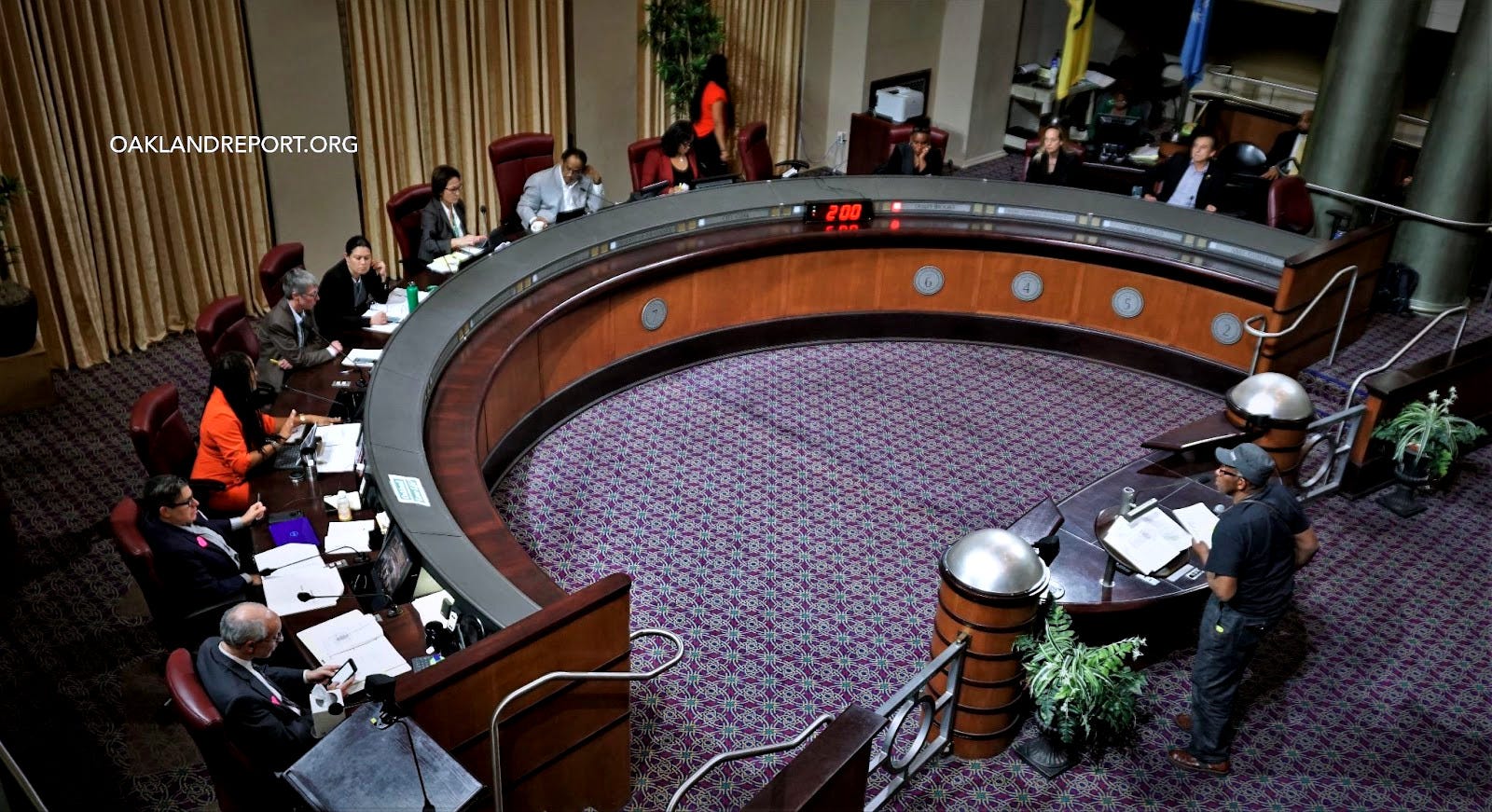
Oakland city council is set to take formal action at its March 3 meeting to accept the signatures and place the tax increase on the ballot in the June 2 municipal election.
If the measure is approved by Oakland voters, nearly half ($14.9 million) of the $34 million tax increase would go to union payouts in the first year, with that portion increasing if unions gain further raises in their future negotiations with the city council when the current contracts expire on June 30.2
Watch our video explainer and read our exposé on the proposed parcel tax increase here:
$14.9 million in raises is just the beginning
The March 3 action item was placed on the city council consent calendar, which is designed for the city council to vote on the parcel tax measure, with no public discussion, along with 18 other agenda items in one motion.
The parcel tax measure was previously listed on the February 26 council rules and legislation committee meeting agenda. That committee also approved the item and advanced it to the March 3 city council meeting with no public discussion.3
The increased cost to Oakland taxpayers wouldn’t land in just one fiscal year. If the city declares a surplus for the current fiscal year ending June 30 (more about the timing of that below), the “triggered” union pay raises would be paid and continue every year essentially into perpetuity.
The raises would amount to a cumulative total $134 million in added expense to taxpayers over the nine years until the tax sunsets — if not renewed.
City has set the stage to forecast a “surplus” before the fiscal year is completed
Per the September 2025 contract between the unions and the city, the raises are contingent on the city declaring a budget surplus based on a city-produced forecast at the third quarter of the fiscal year (i.e., later this spring), before the fiscal year is completed and before final financials are available.4
We note that accurate forecasting of budget outcomes is specious at best — particularly given that the city’s finance director, Bradley Johnson told Oakland Report in December that they had withheld last year’s financial reports for 8 months after the year ended because they were prioritizing “accuracy over speed.”5
Video clip 1. Finance director Bradley Johnson tells the council finance and management committee, “This year, given the great deal of focus that we’ve had around our finances… we wanted to deliver for you a fully baked, audited financial number that’s consistent with your ACFR [annual consolidated financial report]... to really represent that final year-end result.” Feb. 10, 2026. (Source: City of Oakland)6
Now the city plans to make a nearly $15 million decision to increase employee costs based on budget projections three months before the fiscal year has even ended.
Thus the declaration of surplus is merely a city decision, not one grounded in the actual budget outcomes. That decision is made more politically palatable if the city can demonstrate at least a hopeful basis for any surplus declaration. As such, the addition of a tax measure, and its more likely passage under a 50 percent + 1 voter approval threshold, gives the city more ammunition to make a preemptive declaration of a surplus months before the year-end financials are available.
By all appearances, this is why the unions are funding and leading the parcel tax campaign as a “citizen-led” initiative, which requires only a simple majority vote. The union-led parcel tax campaign will be well underway by the time the surplus declaration is set to be made this spring. And even if the parcel tax fails in June and true year-end financials show a deficit, it won’t matter. The city will have already declared a surplus and granted the raises. It will be too late to rescind the pay raises.
A precedent for financial maneuvering by the city has been established in the past few years as it raided restricted funds, overrode voter mandates, engineered interdepartmental transfers to free up more restricted funds, and leveraged one-time revenue sources to compensate for deficit spending — and even claimed a surplus announced last month. Meanwhile, the city’s own five-year forecast shows structural budget deficits between $115 million and $130 million over the next five years.7
The city could easily replicate this process when it forecasts the year-end financials in the next few months, with even more latitude than in the past since it will not even be based on year-end actuals data.
Thank you for reading Oakland Report. Subscribe to receive new articles in your inbox.
See this related article:

Other notable agenda items on March 3, 2026
Oakland police surveillance technology report. City council will receive annual reports on several police surveillance technology systems currently in use, including automated license plate readers (ALPRs, commonly known by the current vendor’s name, Flock Safety); unmanned aerial systems (UAS, also known as drones); crime lab biometrics and DNA analysis; forward-looking infrared; and other systems. Agenda item #S6.17
Disparity in city contracting report. City council will receive a long-delayed study on city contracting practices as they relate to minority- and women-owned local businesses. The study was prepared by consulting firm Mason Tillman Associates, to whom the city awarded $600,000 in February 2022 to perform the study. Agenda item #5.2
$860,000 legal settlement from Oakland Unified School District. The city sued the school district contending that the district did not reimburse the full costs to the city for administering the 2022 school board elections. City council will consider settlement terms in which the district will pay the city $860,000 and commit to fully funding its election costs in future elections. Like other Oakland elections, the school district’s ballots use ranked-choice voting, and the district also allows minors to cast votes, both of which increase election costs compared to the standard election processes used in most other cities. Agenda item #6.5
Oakland Report is by no means comprehensive in our coverage of public meetings in Oakland. The scope and frequency of public meetings are far more than we can presently cover. You can see the full March 3 city council agenda and meeting materials on the city’s meeting calendar.

BECOME A SUPPORTING MEMBER
We rely on our readers’ financial support to continue our work.
Your contributions are tax-deductible.
We are a 501(c)(3) charitable nonprofit based in beautiful Oakland, California. Our mission is to make truth more accessible to all Oakland residents.

Oakland Report contributors, “Oakland’s surplus mirage sets the stage for a $34 million tax increase.” Oakland Report, Feb. 28, 2026. https://www.oaklandreport.org/p/oaklands-surplus-mirage-sets-the
Reinhart, Sean S. “44% of Oakland’s proposed $34 million tax increase would go to union payouts.” Oakland Report, Feb. 22, 2026. https://www.oaklandreport.org/p/20260222-parcel-tax-union-payout
City of Oakland. “Accepting the certification of the results of the initiative petition; Oakland Public Safety, Cleanliness and Community Accountability Act of 2026.” Council rules and legislation committee meeting, Feb. 26, 2026. https://oakland.granicus.com/player/clip/7317?meta_id=633107
City of Oakland. “Approve the MOU between the City of Oakland and miscellaneous unions.” Special concurrent meeting of the Oakland Redevelopment Successor Agency/City Council, Sept. 15, 2025. https://oakland.legistar.com/LegislationDetail.aspx?ID=7651498&GUID=6F11D3DD-ED6C-4B32-9825-7C4FEF4C0966&Options=&Search=
Gardner, Tim. “Oakland’s quarterly financial report is delayed until March, amplifying budget risks.” Oakland Report, Dec. 24, 2025. https://www.oaklandreport.org/p/20251224-oaklands-quarterly-financial-report
City of Oakland. “Receive The Annual Comprehensive Financial Report (ACFR) And The Auditor’s Required Communication To City Council (Management Letter) For The Year Ended June 30, 2025.” Finance and management committee meeting, Feb. 10, 2026, agenda item #4. https://oakland.legistar.com/LegislationDetail.aspx?ID=7801578&GUID=4EC97BF2-6575-4692-8C61-06802D8EEAB8&Options=&Search=
City of Oakland. “Fiscal Year 2026-30 five-year financial forecast.” Concurrent meeting of the Oakland Redevelopment Successor Agency/City Council, June 3, 2025, agenda item #9. https://oakland.legistar.com/LegislationDetail.aspx?ID=7399425&GUID=59FCB8D8-076B-4ADD-83D4-C76B8B893563&Options=&Search=
How can this be a citizen-led initiative when it’s passage is already included in the budget?
Thank you for this article. It is clear the SEIU leadership and the City Council and Mayor are running a smoke and mirror operation against the people of Oakland. We do not need another Parcel Tax, we need a full outside audit of the entire Oakand financial system, NGO's and Non-Profits. This corrupt leadership is destroying this city and bankrupting the people of Oakland. In addition to the full audit, we need to increase the real revenue of Oakland. Bring back industry, manufacturing and protect our small and medium businesses. These are the giant steps that are needed to rebuild Oakland. Mindy Pechenuk candidate for Oakland Mayor in 2026