



Editor’s note: Oakland Report is taking a closer look at the City of Oakland’s many property-based taxes — what they are for, how much they cost, what they promised, how they were spent, and how they have changed. Subscribe to Oakland Report to receive new articles, and join us as a donating member to help us continue our nonprofit work.
City’s claimed budgetary surplus sets the stage for millions of dollars in pay raises for the unions
In their four-months overdue financial report on February 10, the City of Oakland claimed a $73.6 million budgetary surplus in the midst of “extreme fiscal necessity.”1
This comes after years of large structural budget deficits including a recently projected $55 million deficit.2 In the same report the city posted a surplus, they argued the need to continue the current declaration of “extreme fiscal necessity.”3
To the average person, this makes no sense. How can this city swing from $55 million negative to $73.6 million positive in four months? How can you have a large surplus and a state of fiscal emergency at the same time? If the finances are now so positive, why is the city claiming insufficient resources in multiple service areas, such as managing homeless encampments?4
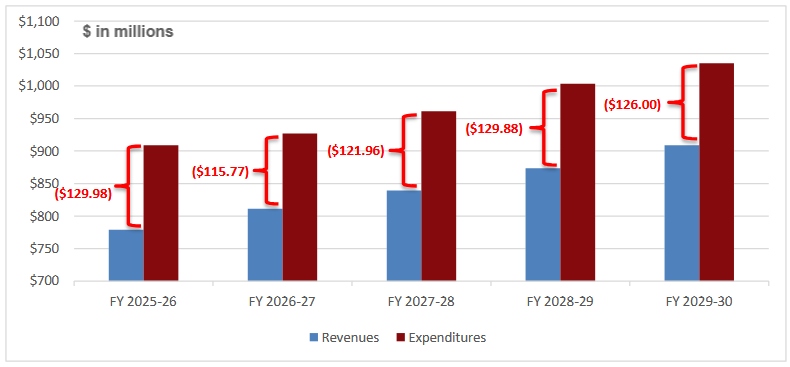
The claimed surplus is essentially a mirage constructed by financial engineering and accounting gimmicks. 31% of the surplus was obtained by raiding restricted funds and overriding voter mandates — a practice that requires continued declaration of “fiscal necessity.” 60% of the surplus came from one-time revenue sources. Meanwhile, ongoing structural deficits are forecast to be $115 million to $130 million annually through 2030.5
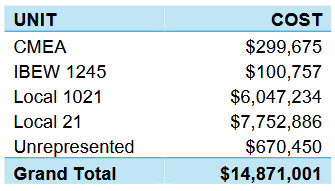
Why would the city go to such absurd lengths to manufacture a surplus? It appears that city leaders want to satisfy public employee unions and incentivize them to help the city raise taxes — again. Oakland City Council approved multiple union contracts in September 2025 that promise up to $14.9 million in “triggered” pay raises if the city ends the fiscal year with higher-than-budgeted revenue.6
In addition, the new one-year contracts immediately awarded the unions cash bonuses up to $3,000 per employee, costing taxpayers a total of $10.2 million up front.
As Oakland Report reported last week, the city’s public employee unions are now spending hundreds of thousands of dollars to put a $34 million parcel tax increase on the June 2026 ballot and to campaign for Oakland voters to approve it.
The promised pay raises will consume 44% of the new parcel tax increase annually. And combined with the September bonuses, equate to 75% of the annual amount of the tax increase.
If the city’s hoped-for parcel tax increase is not approved by voters, it is a near-certainty that the city will find itself in an even deeper deficit position — but by then it will be too late to rescind the “triggered” raises promised in the union contracts.7

Unions are bankrolling a campaign to increase parcel taxes, and have donated over $400,000 to the effort so far
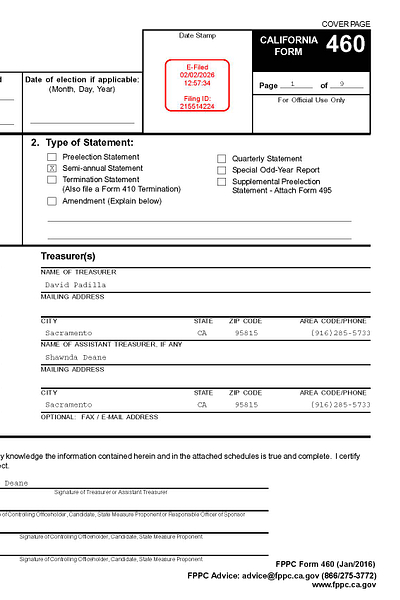
Service Employees International Union (SEIU) Local 1021 is the largest contributor to the “citizen-sponsored” campaign committee — called “Oaklanders for a Safe, Clean and Healthy City, Sponsored by Labor Organizations” — to put the parcel tax increase on the June 2026 ballot.8
SEIU has contributed $200,000 to the campaign.
The International Association of Fire Fighters (IAFF) Local 55 has contributed $150,000.
The International Federation of Professional and Technical Engineers (IFPTE) Local 21 has contributed $50,500.
PG&E has contributed $50,000.
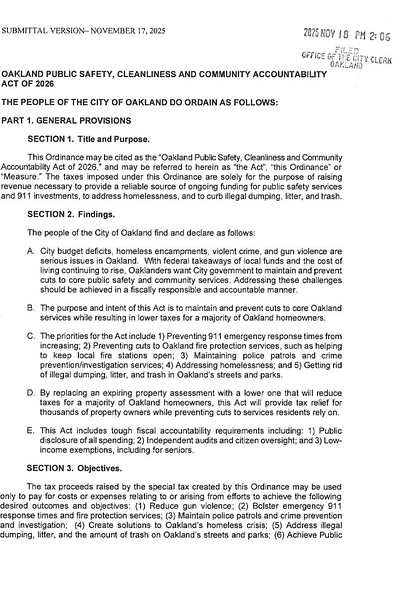
The formal campaign statement submitted by the unions says that the parcel tax increase would collect approximately $34 million per year from Oakland property owners to, “maintain operations and support key systems such as 911 dispatch, IT infrastructure, and public safety.”
“Oakland Safety/ Cleanliness Measure. Shall the measure to prevent longer 911 response times; keep fire stations open; prevent cuts to fire protection, police patrols, crime prevention/ investigation; address homelessness, dumping, litter/trash by levying a parcel tax of $192 on single-family and other parcels as specified, resulting in lower taxes for most homeowners, with low-income exemptions, including seniors, raising approximately $34,000,000 annually for 9 years, public disclosure, citizen oversight, independent audits, be adopted?”
— from “Oakland Public Safety, Cleanliness and Community Accountability Act of 2026,” submitted by Oaklanders for a Safe, Clean & Healthy City, Sponsored by Labor Organizations
The union-led campaign aims to exploit Oaklanders’ concerns about public safety — the same strategy that the city identified in its plan for the tax increase,9 and it aims to collect roughly the same dollar amount the city council added to its budget for the new tax.10
Also, stating that the tax increase will “result in lower taxes for some homeowners,” is a disingenuous rhetorical sleight-of-hand that seems intended to obscure the incontrovertible fact that Measure E would be in addition to, not replacing Measure NN, the 2024 tax voter approved on the same promise of stopping cuts to “public safety.”11
If the union succeeds in getting the measure passed, it will represent over 3600% one-year return on investment ($14.9 million returned on $400,000 invested) — a financial no-brainer that beats anything that the stock market, bitcoin, or private equity could ever dream of returning for its investors and power-players.

Is the city coordinating with public employee unions to lower the voter approval threshold from two-thirds to a simple majority?
Why are the unions putting up hundreds of thousands of dollars to put a parcel tax increase on the June ballot — something which the city council has the power to do on its own and has already committed to making happen?
Notably, a “citizen-sponsored” ballot initiative such as the one the public unions are leading requires only a simple majority of Oakland voters (50% plus 1) to pass. If the new tax was placed on the ballot by the city council as a special tax as required by state law, the approval threshold would be much higher at two-thirds (66.67%).12
In addition, the two unions that have contributed the most to the campaign — SEIU Local 1021 and IFPTE Local 21 — stand to gain up to $13.8 million total in pay raises, on top of the $9.6 million in cash payouts they received upon signing the contracts in September.13
Contract negotiations between public employee unions and the city take place in city council “closed sessions” that are held out of view of the public.
Taxpayers are effectively paying the unions to raise their own taxes
Unions receive nearly 1% of city employees’ salaries in the form of union dues that are automatically deducted from employees’ paychecks along with other withholdings such as health and retirement benefits. These union dues withholdings amount to about $6 million per year of taxpayer money.
Oakland-based public employee unions spend over $4 million per year on political activities. See here for a summary of financial filings; and for example the SEIU filing, here.
BECOME A DONATING MEMBER

We rely on our readers’ financial support to continue our work.
Your contributions are tax-deductible.
We are a 501(c)(3) charitable nonprofit based in beautiful Oakland, California. Our mission is to make truth more accessible to all Oakland residents. Learn more
Thank you!
See these related articles:


Note: This article was updated to more accurately reflect the specific terms and timing of the “triggered” raises in the September 2025 union contracts.
City of Oakland. “Receive an informational report on Fiscal Year (FY) 2024-25 fourth quarter (Q4) audited results for the General Purpose Fund (GPF 1010), and select funds.” Finance and management committee meeting, Feb. 10, 2026, agenda item #3. https://oakland.legistar.com/LegislationDetail.aspx?ID=7801622&GUID=C51C149A-AA8D-41C8-8AFE-53CFFE5031DF&Options=&Search=
City of Oakland. “A list of options to raise an additional ongoing $40 million in General Purpose Fund revenues via an ordinance to adopt or increase a tax effective July 1, 2026, to provide ongoing resources for public safety services and to maintain key equipment, IT systems, and 911 investments.” Finance and management committee meeting, Oct. 28, 2025, agenda item #3. https://oakland.legistar.com/LegislationDetail.aspx?ID=7682816&GUID=99E7DA17-0010-4166-956C-916DD82AF7CC&Options=ID%7CText%7C&Search=List+of+Options
Reinhart, Sean S. “Oakland set to declare ‘extreme fiscal necessity’ again, coordinate with unions to increase property taxes.” Oakland Report, Feb. 10, 2026. https://www.oaklandreport.org/p/20260210-oakland-declare-extreme-fiscal-necessity
Stringer, Grant and Shomik Mukherjee. “Oakland mayor seeks to scale back homeless encampment sweeps as others push crackdown.” The Mercury News, Feb. 15, 2025. https://archive.is/pq87a
City of Oakland. “Fiscal Year 2026-30 five-year financial forecast.” Concurrent meeting of the Oakland Redevelopment Successor Agency/City Council, June 3, 2025, agenda item #9. https://oakland.legistar.com/LegislationDetail.aspx?ID=7399425&GUID=59FCB8D8-076B-4ADD-83D4-C76B8B893563&Options=&Search=
City of Oakland. “Approve the MOU between the City of Oakland and miscellaneous unions.” Special concurrent meeting of the Oakland Redevelopment Successor Agency/City Council, Sept. 15, 2025. https://oakland.legistar.com/LegislationDetail.aspx?ID=7651498&GUID=6F11D3DD-ED6C-4B32-9825-7C4FEF4C0966&Options=&Search=
Notably, the union contracts state that the year-end surplus will be determined based on the city’s forecast at the third quarter of the fiscal year — before the fiscal year is completed, and before the final financials are available. However, the parcel tax campaign will be well underway by that time, and even if the parcel tax fails and the true year-end financials — which won’t be reported until months after the fiscal year ends — it will be too late to rescind the pay raises.
California Form 460. “Recipient committee campaign statement.” Oaklanders for a Safe, Clean and Healthy City, Sponsored by Labor Organizations. Feb. 2, 2026. https://public.netfile.com/Pub2/RequestPDF.aspx?id=Sy9QR0VYY29ha2tqUnIwTVFMY3JMQT09&aid=COAK
Johnson, Jestin D. “Multi-year plan to meet voter-mandated staffing and service levels.” Jan. 12, 2026. https://oakland.legistar.com/View.ashx?M=F&ID=15158124&GUID=8FE10C8F-603D-4D5B-99EA-69C33E88B6BC
City of Oakland. “Adopting the biennial budget for Fiscal Years 2025-27.” Special concurrent meeting of the Oakland Redevelopment Successor Agency/City Council, June 11, 2025. https://oakland.legistar.com/LegislationDetail.aspx?ID=7427724&GUID=569DF799-E0D2-4682-84D3-D36714D9E0DE&Options=&Search=
The proposed parcel tax includes some exemptions for seniors and low-income homeowners, which is typical for parcel taxes.
Fracassa, Dominic. “Judge says SF correct in passing two tax measures on simple majority vote.” San Francisco Chronicle, July 5, 2019. https://archive.is/HFpA5
Ibid. City of Oakland. “Approve the MOU between the City of Oakland and miscellaneous unions.”
@Eric - Thank you for your additional comment. That's not what the new contract says (that the pay raise is actually a cost-of-living increase). What it says is that the promised pay raises are tied to the city achieving budget surplus by the end of this fiscal year -- after the vote on the proposed parcel tax increase.
By comparison, SEIU's previous three-year contract in 2022 awarded a total of 14% in cost-of-living-adjustments (5% the first year, 5% the second year, and 4% the third year) that were not contingent on the city achieving budget surpluses, nor on any other contingency. It also awarded a "pandemic service stipend" in the form of five new vacation days, enhanced benefits, and $1.5 million more to covert part-time staff to full-time.
Those raises capped off twelve years of compensation increases that added $411 million in costs to the city budget since 2013. The raises also exceed inflationary cost of living adjustments (COLA) by $184 million. As a result, Oakland city employees became paid far more than similar-sized California cities as well as San Francisco.
The current one-year contract is none of those things. It is a straight cash bonus up front, and the promise of another pay raise if the city increases revenues to close the budget deficit by the end of the year, primarily by passing the new parcel tax the unions are now campaigning for (and that SEIU has donated $200,000 toward so far).
Thank you again for the discussion; it is appreciated!
@Eric, thank you for your comment. As noted in our article, the union pay raise is characterized in the new contract as a "triggered wage increase" that is contingent on the city achieving a budget surplus by June 30. Nothing in the contract ties the pay raises to the cost of living or inflation. The "triggered" pay raises financially incentivize unions to campaign for the new parcel tax in order to help achieve the surplus by raising taxes -- which they are now doing.