



BY LOREN TAYLOR
Editor’s note: This commentary was originally published by Black Action Alliance on March 18, 2026 under the title, “What the data actually says about Oakland’s Black community.” We are publishing it with citations added for Oakland Report readers to review and comment on.
We invite counterpoint commentaries from other leading voices in Oakland. Do you have something to say on this issue or others? Visit our About page for more information.
What new polling data says about Oakland’s Black community
Every few months, a poll drops in Oakland and the conversation immediately turns to who’s winning or losing politically.
At the Black Action Alliance, we read poll data differently. We read it as a community report card — a measure of whether Black Oakland is being heard, whether its needs are being met, and whether the systems meant to serve our community are actually doing their jobs.
This month, the East Bay Polling Institute released its Q1 2026 Survey of Oakland voters, conducted February 12–18, 2026 by EMC Research (n=700).1 Embedded in that survey is a cross-tabulation data set that allows us to isolate the views of Black and African-American respondents who reflect the lived reality of our community.2
What they told pollsters is striking, sobering, and in some ways clarifying.
This is not a partisan analysis. It is not an endorsement of any candidate or ballot measure. It is a community accountability document — a clear-eyed look at what Black Oakland said, what it means, and what it demands of the institutions, leaders, and systems that claim to serve us.

A community feeling the full weight of Oakland’s failures
The clearest finding in this data is that Black Oakland is carrying a disproportionate burden from the city’s dysfunction. Across virtually every issue tested in the survey, Black respondents expressed higher alarm than the city’s overall voter population — not marginally higher, but significantly so.
When asked to rate how “extremely concerning” various issues were, the Black community separated itself from the broader electorate on issue after issue. The chart below tells the story:
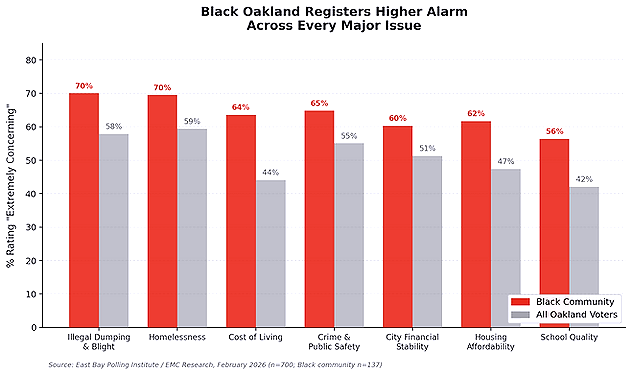
The Black community registered significantly higher alarm on cost of living (+19.5 percentage points above the citywide average), school quality (+14.4 points), housing affordability (+14.3 points), illegal dumping and blight (+12.1 points), and homelessness (+10.1 points). This is not the voice of a community that has given up. It is the voice of a community that is paying attention, feeling the consequences, and demanding better.
On virtually every issue tested, Black Oakland registers higher urgency than the city at large. They are not disengaged — they are acutely aware that things are not working.
It is also a rebuke of the false narrative that Black residents are politically passive or difficult to engage. In fact, 78% of Black respondents say they follow the Oakland city government closely — 4.7 points higher than the overall electorate. They are engaged. And they are frustrated.

Displacement is the defining crisis
Perhaps no finding in this data set is more urgent than this: 38.4% of Black respondents said they are likely to leave Oakland, compared to 33.8% of the overall electorate. And when asked why they would move, the top reason for Black residents diverged sharply from everyone else.
The overall electorate cited crime and public safety as the top reason to leave (35.7%).
For Black respondents, crime was still cited (32.7%) — but it was essentially tied with cost of living and affordability, cited by 30.2% of Black respondents. That is 16 percentage points higher than the citywide average of 14.2%.
What keeps Black Oaklanders here: homeownership and housing stability (20.9%) and personal history and roots (11.1%). These are people rooted in this city by choice and by legacy. But the economic ground beneath that rootedness is eroding in real time. An anti-displacement strategy is not a nice-to-have. It is the single highest-urgency issue the data reveals for the Black community.

A crisis of trust that precedes any conversation about revenue
Oakland is currently considering asking voters to approve additional taxes to fund city services.3 Before that conversation can meaningfully proceed, any honest observer must reckon with what this poll reveals about trust.
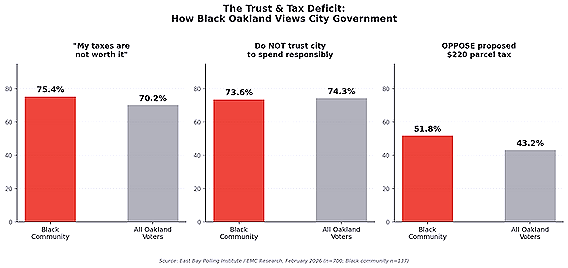
73.6% of Black respondents disagree that the City of Oakland can be trusted to spend their tax dollars responsibly. 75.4% say the taxes they currently pay are not worth it. And 67.5% rate the city’s financial management as “Poor,” with 84% rating the city’s overall fiscal health as negative.
75% of Black Oakland says their taxes are not worth it. That is not opposition to public investment. It is a demand that accountability come before new asks.
It is worth stating plainly: this is not reflexive anti-tax sentiment. This is a community with a long memory of paying taxes into systems that have not served them — and a clear-eyed assessment of whether current leadership has earned the right to ask for more. The data suggests the answer, right now, is no.
The Black Action Alliance has long held that accountability must precede investment. Commitments without dollar amounts are not commitments. Timelines without enforcement mechanisms are not timelines. The community data affirms this principle. Any new revenue proposal must include specific, measurable, enforceable accountability conditions. Full stop.

Oakland’s schools are failing the community that needs them most
The survey data on public education is among the most striking in the entire poll, and speaks directly to the intersection of institutional failure, fiscal crisis, and community trust that defines the current moment in Oakland.
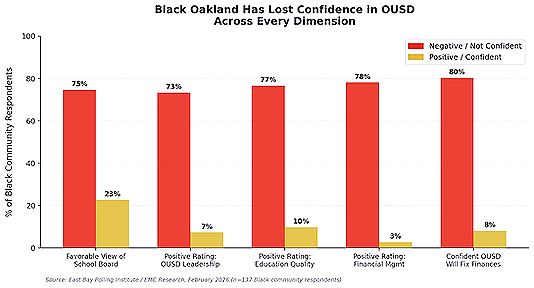
Black respondents rated OUSD poorly across every dimension tested.
74.6% view the school board unfavorably.
73.4% give OUSD leadership an overall negative rating.
76.6% rate the quality of education in Oakland public schools as negative.
78.1% rate OUSD’s financial management as negative, with 80.3% expressing no confidence in OUSD’s ability to resolve its budget challenges.
For Black Oakland, which has more children enrolled in OUSD public schools than any other group (42.7% of Black respondents with children), these numbers are not abstract. They are a daily reality: parents watching schools struggle with overcrowded classrooms, teacher turnover, and a district administration that cannot manage its own finances.

The survey also asked a forced-choice question: Is it better to keep neighborhood schools open, or consolidate them to improve district finances and educational quality? Black Oakland was more divided than the overall electorate on this question — 46.3% for consolidation, 43.1% for keeping schools open, with 10.6% undecided.
That ambivalence is instructive. This community is not opposed to hard decisions. It is waiting for leadership that makes those decisions honestly, transparently, and in genuine partnership with the families most affected.
Black Oakland has not given up on public education. It has lost confidence in the specific leaders currently running the system. Those are very different problems with very different solutions.

Safety: what the Black community actually wants
The data on public safety offers a nuanced portrait that defies easy political categorization. 92.1% of Black respondents said crime and public safety are “concerning” — the highest concern level of any group for any issue. Nearly one in three (32%) personally knows someone who was a victim of violent crime in the last 12 months.
On policing levels, 71.2% of Black respondents said policing should be increased.
On surveillance technology to address crime, 66.1% said they support it.
88.9% agreed that homeless encampments should be cleared from public parks and sidewalks — 10 percentage points higher than the citywide average.
These numbers push back against narratives that suggest Black Oakland is uniformly opposed to law enforcement investment. The community wants safety.
Help us reach our goal of 10,000 subscribers.
What the data makes clear is that it also wants accountability, transparency, and assurance that those investments will be managed competently and equitably.
There is a wide gap between what the Black community is asking for and what it is receiving. Closing that gap requires leadership that is willing to be honest about how wide it is.
What the data demands of our institutions
A poll is only as valuable as the use to which it is put. The Black Action Alliance is committed to using data like this not as political ammunition, but as a community accountability tool — a mirror held up to the systems and leaders that claim to represent and serve Black Oakland.
What this mirror shows is a community that is:
More financially stressed and at risk of displacement than any other group in the city.
More alarmed about the failures of city government, the school district, and quality of life.
Deeply skeptical that existing leadership will manage resources responsibly.
More politically engaged and attentive than the city’s overall electorate.
Clear about what it wants — safety, stability, accountability, and schools that actually work.
Become a supporting member of Oakland Report. We rely on our readers to provide financial support to continue our nonprofit work.
What this community deserves — and what the Black Action Alliance will continue to demand — is leadership and institutions that meet that urgency with equivalent seriousness. Not rhetoric. Not vague commitments. Specific plans, dollar amounts, timelines, and accountability mechanisms.
That is the standard we hold ourselves to. That is the standard we hold our elected officials to. And that is the standard the data in this poll confirms Black Oakland is ready to demand.
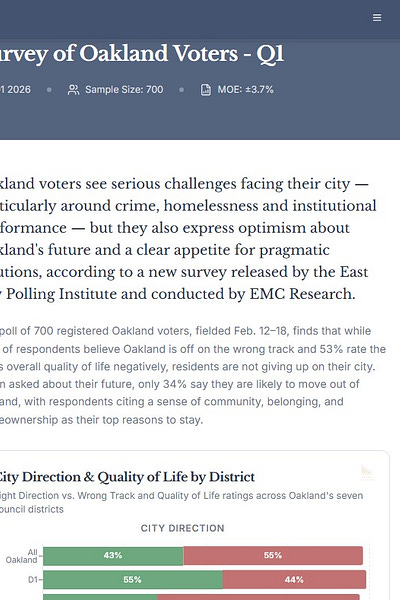
Read the complete survey results and cross-tabs:
ABOUT THE AUTHOR
Loren Taylor is a third-generation Oaklander who brings his background as an engineer, management consultant, and community leader to improve outcomes in communities across the country. He served on the Oakland City Council representing District 6 from 2019-2023, and is an elected delegate to the Alameda County Democratic Central Committee.
Loren founded Empower Oakland, a civic engagement and community empowerment organization, and currently leads Custom Taylored Solutions, LLC, a social impact consulting firm where he guides mission-driven for-profits, nonprofits, and government agencies in better delivering on their visions for social change.
The views expressed in our Commentaries do not necessarily reflect the editorial views of Oakland Report or its contributing writers
East Bay Polling Institute. “Survey of Oakland Voters - Q1 2026.” February 12-18, 2026. https://www.eastbaypollinginstitute.org/polls/oakland-q1-2026
Black Action Alliance analyzed cross-tabulation data from the East Bay Polling Institute Q1 2026 Survey of Oakland voters, conducted February 12–18, 2026 by EMC Research (project #26-9847). Total sample: n=700 registered Oakland voters, effective n=476, margin of error ±3.7 percentage points. The African-American/Black community cross-tab includes n=137 respondents. All percentages are from weighted data. https://www.blackactionalliance.org/post/what-the-data-actually-says-about-oakland-s-black-community
Reinhart, Sean S. “Oakland: $34 million property tax increase appears headed for June ballot.” Oakland Report, Mar. 3, 2026. https://www.oaklandreport.org/p/20260303-34-million-property-tax-increase
OAKLAND REPORT
WE NEED YOUR SUPPORT
We rely on you, our readers, to donate to Oakland Report to financially support our work. Please join us as a subscribing member by signing up with a monthly or one-time donation.
We are a 501(c)(3) charitable nonprofit based in beautiful Oakland, California. Our mission is to make truth more accessible to all Oakland residents. Your donation is tax-deductible.

Most Oaklanders do not support the Authoritarian agenda imposed on us by the One-Party Progressive regime that has taken over the town. The issue is not race, it is that the city does not provide the services (public safety, sanitation, functional and well-maintained infrastructure) for which we are repeatedly taxed. The money is increasingly diverted to fund the one-party machine. This will not change without voting reform: Voter ID, no mail in ballots except for the exceptions prior to the Covid era, In-person voting in neighborhood precincts, same day count of ballots, no late ballots included, and no ranked-choice voting.
Thank you for sharing this data. This aligns with the feedback I receive from people in D6/D7. On Friday, I spent some time with the Oakland NAACP talking about the longstanding disparity issue in the Town. I run a fairly large department that provides a number of services to the public as well as delivers capital projects for public benefit. I suppose one could say I represent the problem, but I’m seeking solutions. The imbalance can’t be denied. You can see it visually. In Atlanta, I spent a lot of time in the “SWATS” helping residents understand how the city sausage was made. It’s time to do that in Oakland.