



Oakland Agenda Watch provides summaries of key items on upcoming public meeting agendas that catch our attention.
A total systems failure in tax collection
Council finance and management committee, May 12, 2026, agenda item #3.
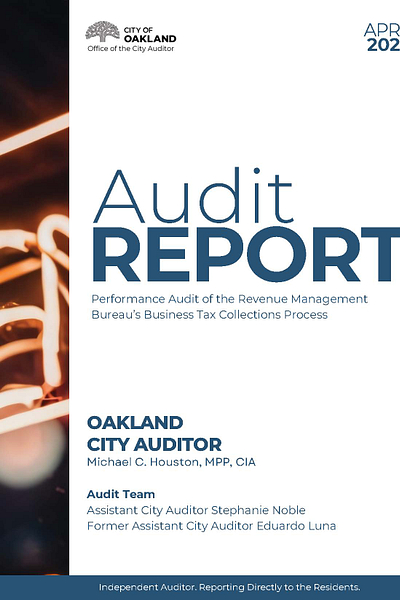
The council’s finance and management committee will review a new report from the Oakland City Auditor that examined the city’s business tax collections process.1 The audit found what amounts to a total systems failure: the city failed to collect an estimated $9 million to $12 million in business taxes due to the city.2
The city’s leadership conceded that the audit’s central findings were true, indicating that they “generally agreed with the report’s findings and recommendations.”
The auditor’s report on the city’s organizational dysfunction comes at a time when the city is simultaneously:
Collecting the highest amount of tax revenue in its history.
Sitting on 840 vacant staff positions worth an estimated $136 million per year.
Asking voters to let the city forgive an estimated $2.2 million in revenue through a business tax holiday (Measure C).
Asking voters to increase taxes on homeowners through a new $34 million annual parcel tax (Measure E) to ‘save’ fire stations and public safety services.
In this context, the audit’s findings raise a question: if the city apparently can’t be bothered to collect the taxes it is already owed; or fill the staff positions it already has on the books; or balance its budget despite record-high revenues — then why should voters trust it with even more taxes?
City failed to collect up to $12 million in business tax revenue due to mismanagement
The audit reviewed business tax collection practices across three fiscal years, and compared Oakland’s performance to ten benchmarked municipalities, including Los Angeles, San Diego, San Francisco, and San Jose.
Auditors found that the city’s Tax Compliance Division — the unit responsible for researching delinquent business tax accounts and handing them off to collections — essentially stopped working in late 2022.
Over the three-year audit period, the Tax Compliance Division sent only two batches of delinquent accounts to collections: 407 accounts totaling $1.5 million in 2022, and 4,187 accounts totaling $14 million in 2024.
Zero delinquent accounts were sent to collections in 2023. Some delinquencies from 2020 remained unprocessed as of June 30, 2024.
The audit estimates that in a normal year the city should refer $9 million to $12 million in delinquent accounts to collections — money the city was simply leaving on the table, uncollected.
City failed to research 97% of delinquent business tax liens
According to the audit, zero delinquent business tax lien proposals were brought to the city council for 19 months. During that time, the share of liens involving delinquencies more than two years old nearly doubled from under 12% to over 21%.
In California, business taxes carry a three-year statute of limitations.3 Every month a delinquent account lingers without action moves that revenue closer to becoming permanently noncollectable.
When the 2024 batch of 4,187 accounts finally landed in collections, the audit found that over 97% had not been researched, no contact attempts had been made, no notes were attached, and no supporting documentation accompanied them.
The Collections Division — already responsible for every type of collection in the city — had to do the Tax Compliance Division’s work over again. As of May 2025, Collections had worked through only about 1,000 of them — less than a quarter of the backlog.
City lacks performance management and monitoring systems
“Members of [Revenue] Bureau leadership stated that they did not know what was happening in the Tax Compliance Division. Regular meetings with the Tax Administrator all but ceased.”
— Michael C. Houston, Oakland City Auditor, Apr. 1, 2026
The audit found that the city’s revenue bureau had no meaningful performance management or monitoring systems in place, leading to multiple systems failures including:
Systemic lack of adequate internal controls or segregation of duties.
The city stopped using California Franchise Tax Board data and stopped doing field inspections in 2023.
Nearly 75% of manual adjustments to amounts owed were entered by non-supervisory staff, with no required second-person approvals. $2.7 million in manual adjustments were made under these deficient conditions.
Business discovery activities — the systematic identification of businesses operating in Oakland that have not registered to pay business taxes — dropped 48% from 2023 to 2024.
Management tracked only total revenue collected, and apparently did not examine the underlying figures. According to the audit, that lead to a failure to detect the collapse in collections because Measure T, the 2022 progressive business tax increase, was driving the topline up even as the collections process broke down.
More money left on the table: the city’s vacant payroll
The city’s systems failures extend beyond revenue collection from tax bills.
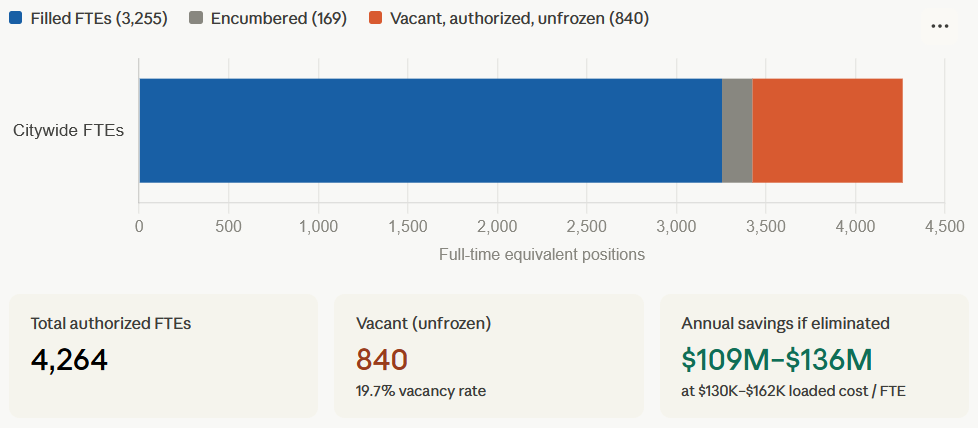
As of February 1, the city was sitting on 840 vacant employee positions worth up to $136 million per year — nearly 20% of its budgeted workforce of 4,264 full-time-equivalent (FTE) positions.4
A citywide staffing report in February revealed that the city had 3,255 filled positions, 169 “encumbered” positions (held for overtime, temporary staffing, underfilled positions, or acting assignments), and 840 vacant positions.
This is not a one-time bottleneck. The city’s vacancy rate has, with brief interruptions, remained consistent at roughly 18% to 20% for over four years. These are positions the city has been budgeting payroll for, year after year, while not delivering the services those positions exist to provide — and while artificially driving up the city’s claimed budget deficit and “extreme fiscal necessity.”
The city’s 2025-27 budget eliminated approximately 400 positions to close roughly $65 million in two-year deficit, an average loaded cost of about $162,000 per eliminated position.5
According to the city’s own figures, this means that the city’s 840 vacant, unfrozen positions are worth up to $136 million per year in budget capacity — a range that nearly matches the city’s own projected structural deficit of $115 million to $135 million per year through 2030.
Despite booming tax revenues, the city declared “extreme fiscal necessity” and went back to the voters for more taxes
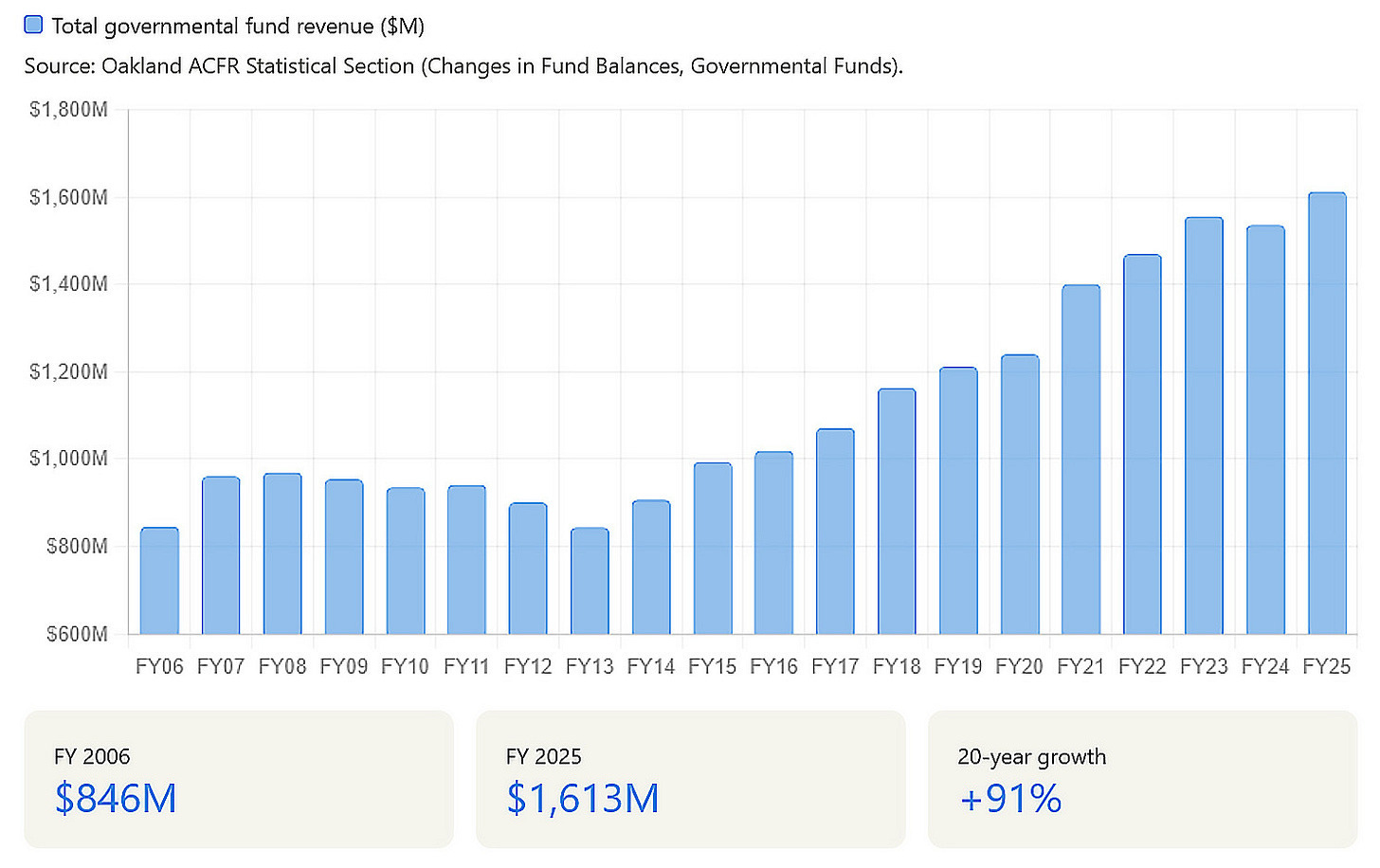
Over the last 20 years, Oakland’s governmental fund revenue has grown 91%. In 2025 the city collected over $1.6 billion in governmental fund revenue, the highest amount in its history.
Yet while it collects more revenue than ever before, the city has projected ongoing structural deficits of $115 million to $135 million annually through 2030.6 It has declared a state of “extreme fiscal necessity” for nearly two years — a declaration that allows the council to override voter-approved spending mandates on restricted-fund measures like Measure NN.7
The point is not that Oakland’s finances are healthy in every respect; they are not. The point is that voters are being asked to accept the framing that the city has a revenue problem when in fact the ten-year picture shows revenue at record highs and rising at 4.7% annually.
Now this new audit documents that even within that already-growing revenue base, the city was not collecting taxes already due under existing law.
Businesses good, homeowners bad: Oakland City Council
It is in this context that the city is now asking Oakland voters to approve two tax-related measures on the June 2 ballot: one that rewards businesses, and one that penalizes homeowners.
Measure C is being promoted as relief for business owners and a way to stimulate the city’s moribund business economy. It would suspend the gross receipts tax for one year in 2027 (renewable for up to three years by the city council) for existing small businesses earning under $1 million annually and for up to $1 million in receipts for any new business opening in Oakland.
The city’s failure to follow up on delinquent accounts put $9 million to $12 million per year at risk — and now Measure C is asking voters to forgo another $2.2 million in these taxes.8
Measure E is being promoted as necessary to ‘save’ fire stations and public safety services like 911 dispatch. Notably, these services were supposedly ‘saved’ two years ago when voters approved the very similar Measure NN.9
Measure E would charge homeowners approximately $34 million annually for nine years. It would be in addition to, not replacing the Measure NN tax.
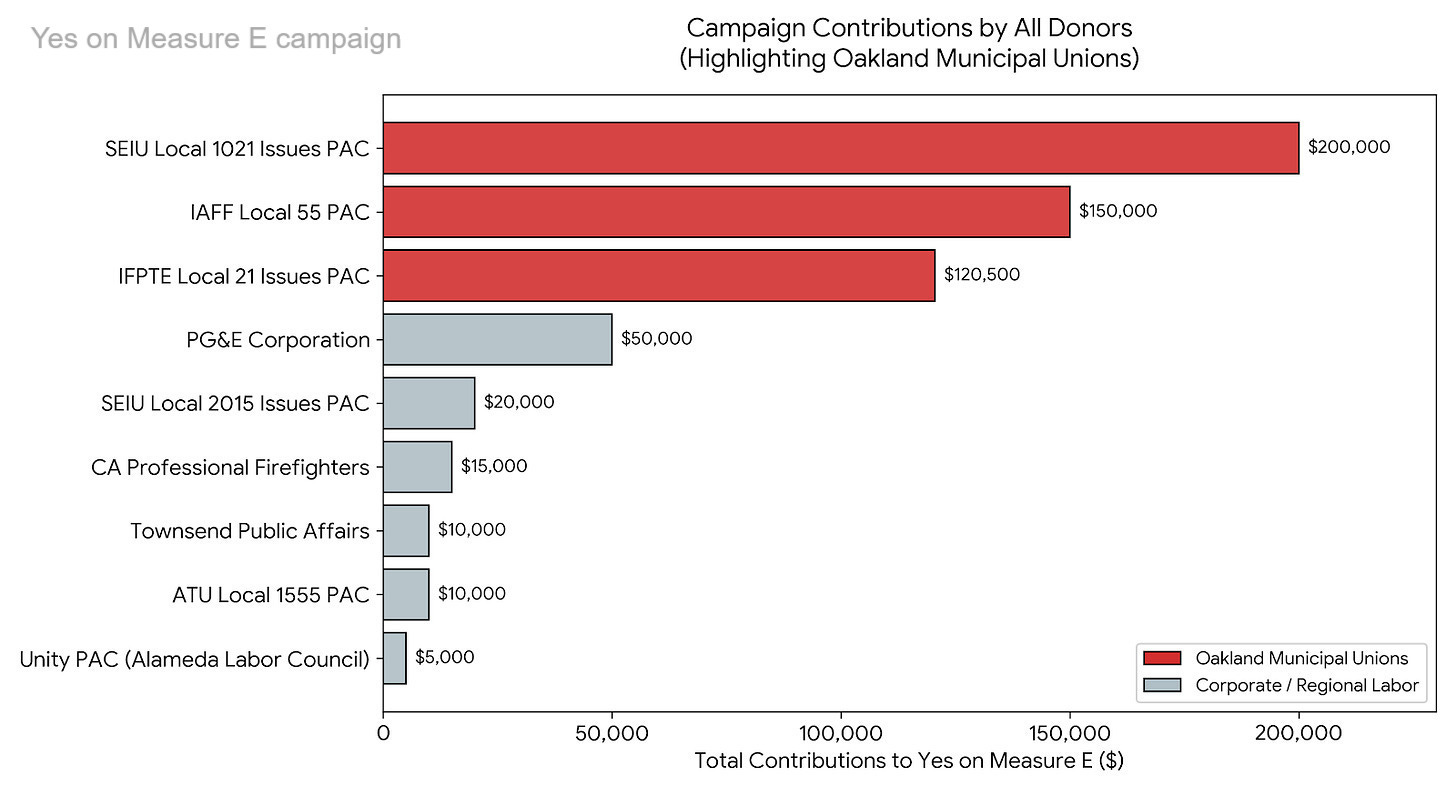
As Oakland Report has documented, up to $14.9 million per year of the revenue from Measure E — roughly 44% — will be absorbed by union pay raises in every year going forward.10 The city’s public employee unions are campaigning heavily for the measure, spending nearly half a million dollars on signature-gatherers and advertising.11
Measure E essentially would penalize homeowners for the city’s financial failures — in a city that was recently reported to have the worst housing market in the nation.12

Voters are asked to fix problems the city created for itself – again
Oakland Report has extensively documented Oakland’s habit of using the ballot box as a cash machine to compensate for the city’s fiscal dysfunction, including:
Approving pay raises that exceed the rate of inflation and cost-of-living.13
Raiding voter-approved restricted funds.14
Selling public assets to cover operating costs.15
Using one-time revenues to “buy time” while ignoring the structural deficit.16
The new audit adds another category to that list — leaving money on the table that the city was already owed under existing law.
The audit lists ten recommendations for the city to improve, including written policies and procedures, standardized status codes, two-person approval for adjustments, reinstated field inspections and data sharing, public-facing certificate lookup tools, and — most fundamentally — actual performance metrics tracked and reported to the Director of Finance or to a council committee on a regular basis.
These are not innovations. They are baseline practices that the cities Oakland was benchmarked against already perform — including its Bay Area neighbors. The audit’s recommendations are, in effect, a list of what the city should have been doing all along.
Oakland voters will be asked on June 2 to accept a smaller tax base (Measure C) and to pay a new parcel tax (Measure E) to close a deficit that the audit shows was deepened, in part, by the city’s own failure to administer the taxes already on its books.
Meanwhile the city carries 840 vacant FTEs whose fully-loaded cost — estimated up to $136 million per year — almost exactly equals the city’s structural budget deficit.
The council finance and management committee will receive the audit report on May 12. What council members do with it beyond “receiving” it as informational — and whether they will take meaningful steps to hold the city administration accountable to fix its own deficiencies before asking taxpayers to bail the city out again — remains to be seen.
Read this related article:

Oakland Report is by no means comprehensive in our coverage of public meetings in Oakland. The scope and frequency of public meetings are far more than we can presently cover. You can see the full list of upcoming meetings agenda and meeting materials at the city’s meeting calendar.
SUPPORT OUR NONPROFIT WORK
If you like our work, please consider donating. We are a volunteer-run, 501(c)(3) charitable nonprofit organization based in beautiful Oakland, California.
Your donation of any amount helps us continue our work to produce articles like the ones our readers wrote about in this column.
Thank you.
City of Oakland. “Receive an informational report from the City Auditor on the audit of the Revenue Management Bureau’s business tax collections process.” Finance and Management Committee meeting, May 12, 2026, agenda item #3 (File 26-0580). https://oakland.legistar.com/LegislationDetail.aspx?ID=7981147&GUID=E11A07F7-A825-4F9E-BDD6-845A31F5CBD5
Houston, Michael C. “Performance Audit of the Revenue Management Bureau’s Business Tax Collections Process.” Office of the Oakland City Auditor, Apr. 1, 2026. https://oakland.legistar.com/View.ashx?M=F&ID=15427174&GUID=D4E896B6-31A4-4201-A824-B8190AFDFC79
California Code of Civil Procedure § 338. http://leginfo.legislature.ca.gov/faces/codes_displaySection.xhtml?lawCode=CCP§ionNum=338; see also Oakland Municipal Code § 5.04.410 (formerly § 5.04.240). https://library.municode.com/ca/oakland/codes/code_of_ordinances?nodeId=TIT5BUTAPERE_CH5.04BUTAGE
City of Oakland Human Resources Management Department. “Informational Report on City-Wide Staffing - February 2026.” Special Concurrent Meeting of the Oakland Redevelopment Successor Agency/City Council, April 14, 2026 (File 26-0467). https://oakland.legistar.com/LegislationDetail.aspx?ID=7926651&GUID=FB04CE81-90FD-4BF1-8EC8-32C0B7047CCB
City of Oakland. "Learn about the 2025-2027 budget." May 5, 2025. https://www.cbsnews.com/sanfrancisco/news/oakland-interim-mayor-delivers-2025-27-budget-proposal-268m-deficit/
City of Oakland. "Fiscal Year 2026-30 Five-Year Financial Forecast." Concurrent meeting of the Oakland Redevelopment Successor Agency/City Council, June 3, 2025, agenda item #9. https://oakland.legistar.com/LegislationDetail.aspx?ID=7399425&GUID=59FCB8D8-076B-4ADD-83D4-C76B8B893563
Reinhart, Sean S. “Oakland set to declare ‘extreme fiscal necessity’ again, coordinate with unions to increase property taxes.” Oakland Report, Feb. 10, 2026. https://www.oaklandreport.org/p/20260210-oakland-declare-extreme-fiscal-necessity
Ballotpedia contributors. “Oakland, California, Measure C, Authorize One-Year Business Tax Exemption for Certain Small and New Businesses Measure (June 2026).” Ballotpedia, accessed May 11, 2026. https://ballotpedia.org/Oakland,_California,_Measure_C,_Authorize_One-Year_Business_Tax_Exemption_for_Certain_Small_and_New_Businesses_Measure_(June_2026)
Citizens Oakland contributors. “Broken promises: Oakland’s parcel taxes.” Citizens Oakland, May 7, 2026. https://www.citizensoakland.org/broken-promises
Reinhart, Sean S. “44% of Oakland’s proposed $34 million tax increase would go to union payouts.” Oakland Report, Feb. 22, 2026. https://www.oaklandreport.org/p/20260222-parcel-tax-union-payout
California Form 460. "Recipient Committee Campaign Statement." Oaklanders for a Safe, Clean and Healthy City, Sponsored by Labor Organizations. Feb. 2, 2026. https://www.oaklandreport.org/api/v1/file/58b6b8a0-7e5c-413b-b98a-67afbe124b42.pdf
Leonard, Christian. “Oakland home values continue to fall — at one of the fastest rates in the nation.” San Francisco Chronicle, May 10, 2026. https://www.sfchronicle.com/realestate/article/oakland-home-prices-22244894.php; https://archive.is/xKwGz
Ubell, Michael and Tim Gardner. “Oakland employee compensation grew 2.5 times faster than inflation, far outpacing other cities.” Oakland Report, Jul. 9, 2024. https://www.oaklandreport.org/p/oakland-employee-compensation-grew
Ibid. Reinhart. Feb. 10, 2026.
Neditch, Nicole, Karen Boyd, and Maeve Skelly. “Balancing Oakland’s Budget: Sound Fiscal Policy, Structural Change, Economic Growth.” SPUR, May 2025. https://www.spur.org/sites/default/files/2025-05/SPUR_Oakland_Budget.pdf
Taylor, Loren and Tim Gardner. "Oakland faces an unprecedented financial crisis that was years in the making." Oakland Report, April 4, 2024. https://www.oaklandreport.org/p/oakland-faces-an-unprecedented-financial
You gotta ask why you don't see these stories in OaklandSuicide, or the Comical. (The former has complicit political agenda, the latter is a "beloved" restaurant review with no East Bay coverage. EB Times doesn't have the $ or ability.)
It’s unbelievable how badly Oakland is run, and the worst part is that none of it is surprising anymore. And even worse is that both of the measures will most likely pass. 🤬