



PART THREE IN A SERIES
Editors’ note
Oakland Report is examining the many taxes the City of Oakland charges its residents and businesses: what the taxes were intended to pay for, how they were actually used, and whether the city kept the promises it made to voters.
The first two installments in this series examined how the city repeatedly broke its promises in past tax measures, and how the city has repeatedly used threats of fire station closures and other public safety cuts to convince voters to increase taxes.
We want to hear from you, our readers, what you think about Oakland’s taxes and the services they fund, and what you think about this series. Write a comment, send us a note, and share this article with others.
Most importantly, subscribe to our mailing list, share our stories, and please consider donating to help us continue our nonprofit work — accurate, unflinching, evidence-based reporting that you will find nowhere else.
Thank you for reading Oakland Report. Your donation in any amount helps us continue our nonprofit work:
Part 3
The price is going up
Shrinkflation is the practice of quietly reducing the size of a product while keeping its price the same — or raising it — in order to increase profit at the consumer’s expense.
Oakland’s city government has been doing the fiscal equivalent of shrinkflation for two decades.
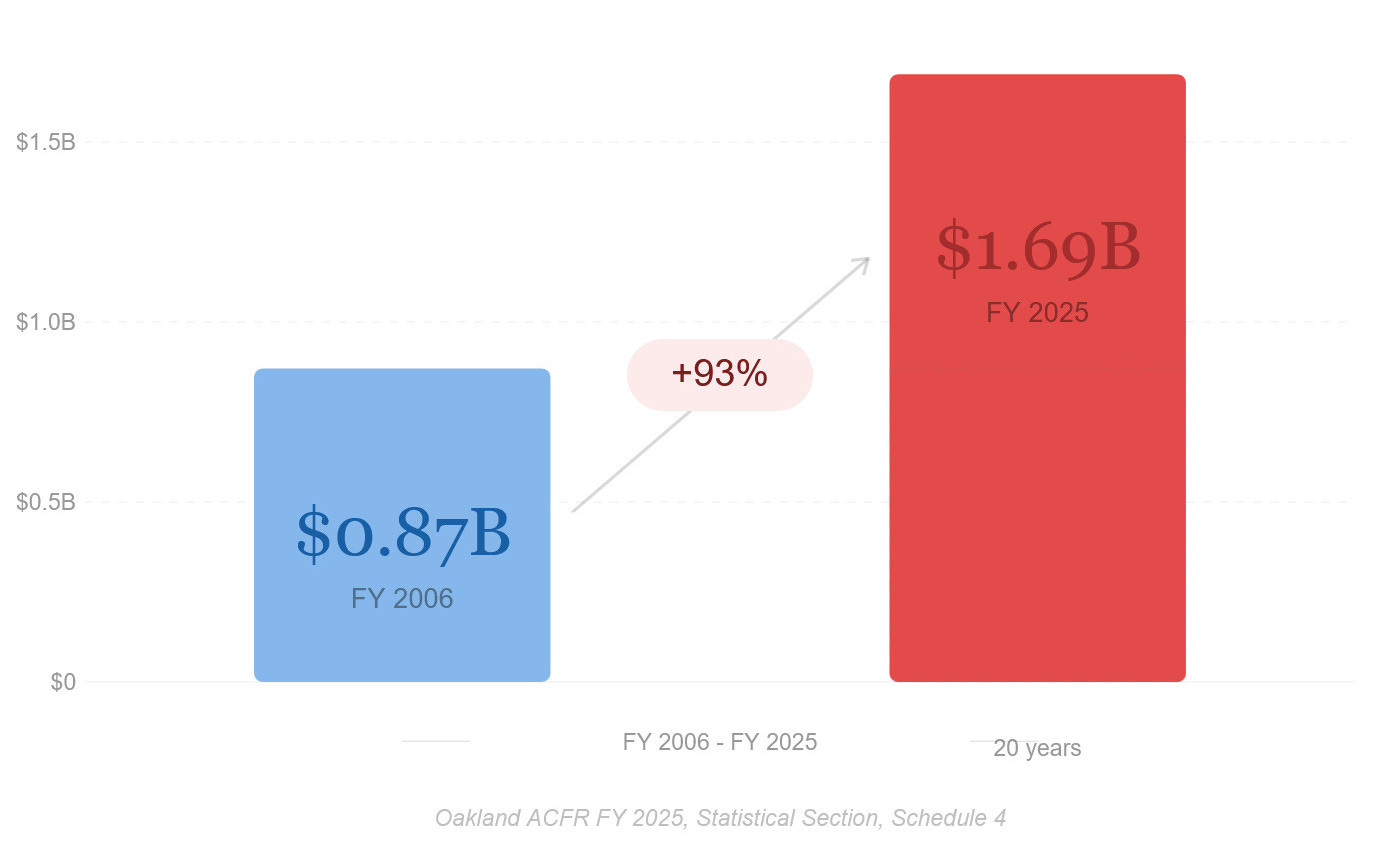
The city’s total governmental fund spending has nearly doubled over the past 20 years — from $0.87 billion in fiscal year 2006, to $1.69 billion in fiscal year 2025.1
Meanwhile, the tax burden the city put on its residents’ shoulders grew even heavier still.
Voter-approved special taxes surged 379% over the past 20 years — from $31.7 million in 2006 to $152.1 million in 2025.
That’s over 6 times higher than the increase in the cost-of-living, as measured by the consumer price index, over that same period.2
This remarkable increase was due to new tax measures layered on in nearly every election cycle over the past decade.3
Oakland residents now pay the highest taxes per capita in the state compared to similar cities.4
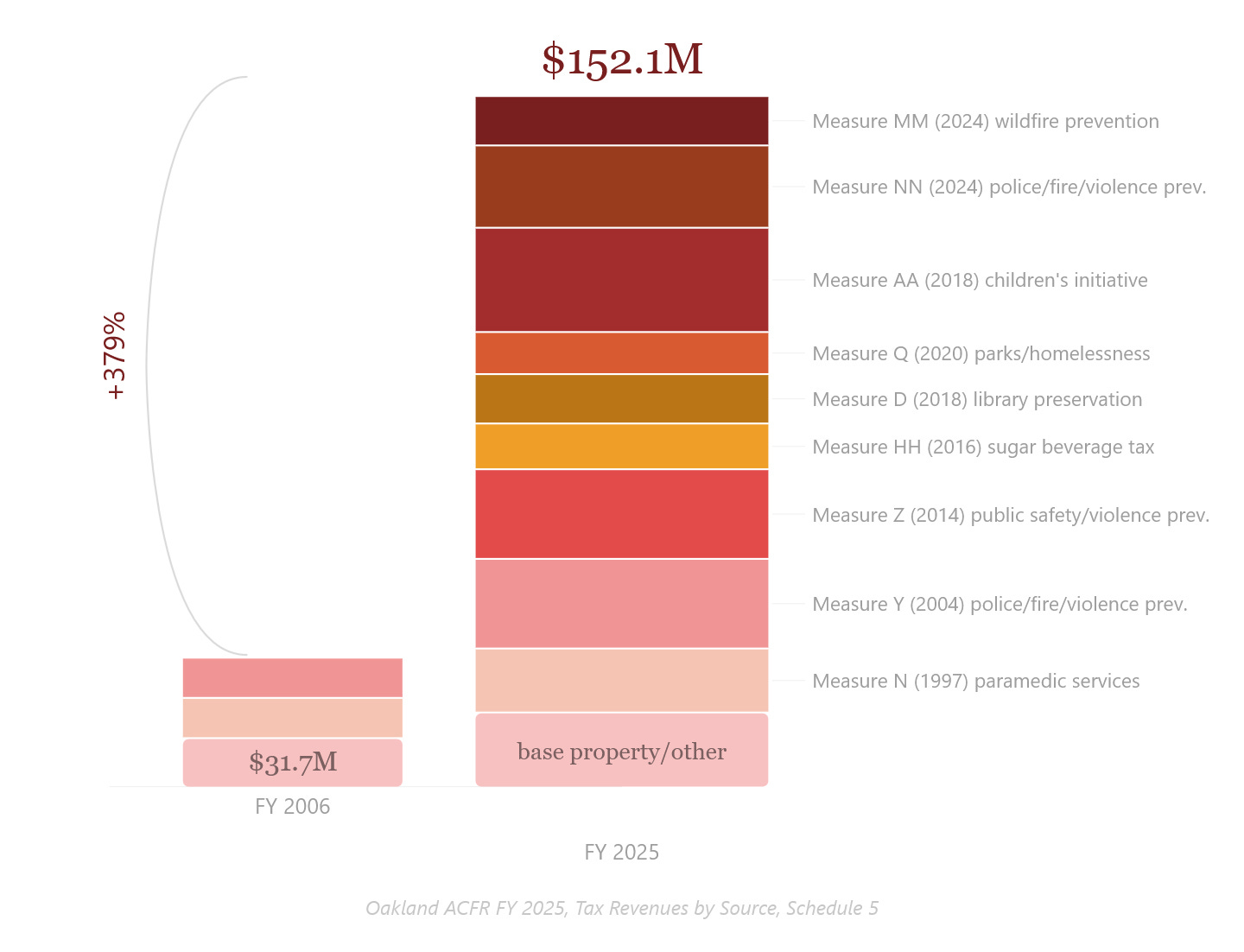
Notably, the 379% increase in tax burden only accounts for city taxes — it does not include the numerous county, school and regional tax increases also approved by voters and charged to Oakland residents.
The package is shrinking
The city Oakland today has fewer workers than it did 20 years ago.
In 2006, the city had 3,614 full-time equivalent (FTE) workers. In 2025, it had 3,487 FTE workers — a 4% decrease.5
That relatively small decrease masks a more striking decline in the city’s most fundamental responsibility: public safety.
Sworn police officers fell from a peak of 837 in 2008, to 678 in 2025 — a 19% decrease, and below the minimum of 700 sworn officers the city promised voters who approved Measure NN in 2024.
The city temporarily closed two fire stations and proposed closing four more in January 2025,6 just weeks after voters approved Measures NN and MM on the promise that the new taxes would fund fire and public safety.

Despite a 93% increase in spending, the city’s own data shows little increase in basic service outcomes
The city annually reports operational outcomes in its Annual Consolidated Financial Reports (ACFRs).7 A review of this data over the past 20 years reveals short-term fluctuations in any given year — but scant long-term increases in basic public safety outcomes like emergency dispatch responses:
Police dispatched calls fluctuated between 222,000 and 341,000 per year, with no clear long-term increase or trend.
Fire emergency responses remained static at 50,000–60,000 per year for the past 20 years.
9-1-1 response times have consistently been among the worst in California, with the city failing to meet state standards for over a decade.8
One public safety outcome that did show a significant long-term change:
Physical arrests fell from 14,908 in 2007 to 6,338 in 2025, a 57% decrease.
The ACFRs also report various non-public safety metrics which are useful for long-term trend comparisons. While a comprehensive review of every single outcome is beyond the scope of this article, a sample of common city services — such as building permits, new dwelling units authorizations, and pothole repairs — is useful for gaining insight:
Building permit issuances fluctuated year-to-year depending on a volatile real estate market, but like public safety metrics, they exhibited no clear long-term increases or trend. Permit issuances fell from 15,674 in 2006 to a low of 11,812 in 2020, and have recovered only partially to 13,694 in 2025 — still 13% fewer than 20 years ago.
Authorized new dwelling units collapsed from 1,641 in 2016 to just 472 in 2025, a 71% decline, reflecting both reduced demand and a city planning apparatus that has not kept pace.
Potholes repaired showed a genuine improvement in recent years, jumping from a baseline of 8,000–14,000 per year from 2007 to 2022, to nearly 58,500 in 2025 — a fourfold increase. However, this late surge comes only after decades of under-investment in street maintenance and repair, and only after voters approved tax increases to finance bond issuances (Measures KK and U) to do the work. Additionally, a grand jury report found that the city delayed issuing the bonds for years due to the city’s chronic fiscal mismanagement.9

Where the increased spending is going: public employee compensation
The city’s data indicates that little of Oakland’s overall spending growth has gone to tangible service improvements. Instead, the city’s spending has been increasingly consumed by public employee pay and benefit costs that have consistently risen over the past 20 years, far outpacing the growth in inflation and the incomes of everyday Oakland residents.
In 2023, the average total compensation (salary and benefits) for a single full-time Oakland city employee was $237,000 — a 10-year increase of 79%.10
This is significantly higher than the median Oakland household income of approximately $102,000 — a figure that typically reflects multiple earners — and which only increased approximately 45% over the same 10-year period.11
(Approximately 55% of non-governmental full-time workers in Oakland also receive employer-paid benefits valued at approximately $25,000 to $30,000 per year.)1213
By comparison, the city of Sacramento’s average total compensation for its full-time employees rose 57% to $163,000. The city of Long Beach rose 70% to $196,000. And San Francisco (which is both a city and a county) rose 50% to $190,000.14
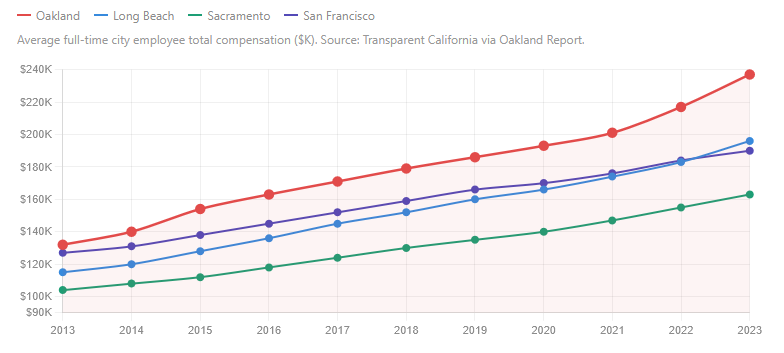
Oakland’s relatively high employee compensation is driven not by base salary, which is roughly comparable to peers, but by benefits that add 72% on top of base pay, compared to only 41% in Long Beach, 31% in Sacramento, and 33% in San Francisco.
The city’s ACFRs routinely cite “increases in personnel costs” as the primary factor behind expenditure growth across virtually every city function.
Oakland’s employee pay and benefits — including all the compensation increases outlined in this article — were negotiated by the city and its labor unions, and approved by city councils.
Notably, campaign finance disclosures have shown that the city’s public employee unions have routinely donated to city council members’ election and re-election campaigns over the past 20 years.
A debt that no amount of new taxes can solve
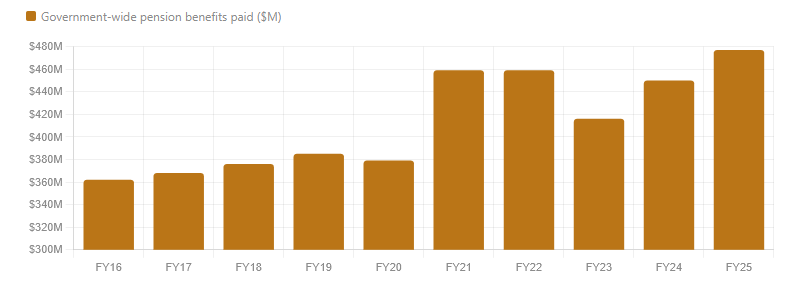
According to the city’s financial reports, the city’s annual pension benefit payments grew from $362 million in 2016 to $477 million in 2025, a 32% increase in nine years. The city’s combined net pension liability — meaning debt — exceeded $1.85 billion as of FY 2023.
The city’s five-year financial forecast projects continued $100 million-plus annual budget deficits through the end of the decade — driven largely by pension obligations that are locked in by labor agreements and will compound regardless of future hiring decisions.15
No amount of new taxes can resolve a gap this large. As a result of the city’s past financial decisions — which appear to be continuing into the present — city services continue to erode, while the tax burden on Oakland residents continues to increase as more resources are diverted into ever-growing personnel costs and long-term debt.
The city’s 2025 ACFR, while reporting a budget ‘surplus’ for the year, simultaneously warned that rising costs related to insurance, medical benefits, and pension contributions are expected to “re-emerge in future periods,” and recommended that the city continue to declare a state of “extreme fiscal necessity” in order to evade minimum public safety staffing requirements.16
Oakland’s shrinkflation is not the result of a lack of resources.
It is the mathematical consequence of a compensation structure that for decades has outpaced the city’s revenue base, the cost of living, peer cities, and the incomes of the residents who fund it.
See these related articles:

The city of Oakland has broken its promises to voters in three of the last four parcel tax measures


A look ahead
In closing Part 3, we acknowledge that taxes are necessary to provide the services people need and deserve. The issue at hand is whether the city is managing its resources appropriately and acting as responsible stewards of the public trust.
We believe that every Oakland resident — indeed, every person — who works full-time their entire lives deserves to have a living wage, generous health benefits, and stable retirement, like Oakland city employees enjoy.
Unfortunately, most workers who are not government employees do not have those benefits themselves — yet they are continuously asked to pay more toward those benefits for public employees.
Much has been said and written in other outlets about the many positive aspects of Oakland’s taxes and its public employees — not to mention by government officials eager to put a positive spin on the city.
This series does not seek to duplicate that well-rehearsed chorus, but to help the city instead to identify and correct the false notes that hold it back from achieving its full potential.
DONATE TO OAKLAND REPORT
Please help us continue this series by making a tax-deductible donation today.
Correction: The original version of this article omitted employer benefit data for non-governmental workers. A parenthetical sentence with two citations has been added to the article to provide the data.
City of Oakland. “Annual Comprehensive Financial Report, Fiscal Year Ended June 30, 2025.” Schedule 4: Changes in fund balances: governmental funds. https://www.oaklandca.gov/files/assets/city/v/1/finance/documents/financial-reporting/annual-comprehensive-financial-reports/2025-city-of-oakland-acfr_final-123025.pdf
U.S. Bureau of Labor Statistics. “Consumer price index.” Webpage accessed April 13, 2026. https://www.bls.gov/cpi/
Ibid. City of Oakland. ACFR, Schedule 5: tax revenues by source.
Neditch, Nicole et al. “Balancing Oakland’s budget: Nine recommendations for closing the city’s structural deficit to move toward fiscal solvency and economic growth.” San Francisco Bay Area Planning and Urban Research Association, May 2025, p. 17. https://www.spur.org/sites/default/files/2025-05/SPUR_Oakland_Budget.pdf
City of Oakland. “Comprehensive Annual Financial Reports.” Statistical sections: FTE by Function/Program; Operating Indicators; Changes in Fund Balances; Tax Revenues by Source. https://www.oaklandca.gov/Government/Finance-Budget/Financial-Reporting/Annual-Comprehensive-Financial-Reports
Roselyn Romero. "As Oakland shutters fire stations, firefighters ramp up campaign opposing cuts." Oaklandside, Jan. 6, 2025. https://oaklandside.org/2025/01/06/oakland-firefighters-union-fire-station-brownouts/
Ibid. City of Oakland. ACFRs, 2006-2025.
Houston, Michael. “Inadequate 9-1-1 Staffing and Outdated Beat Boundaries Lead to Slow and Inequitable Police Emergency Response Times.” Office of the City Auditor, Oct. 10, 2025. https://www.oaklandauditor.com/wp-content/uploads/2025/10/20251008_9-1-1-Emergency-Response-Times-Audit.pdf
Reinhart, Sean S. “Oakland can’t sell infrastructure bonds approved by voters due to fiscal mismanagement, Grand Jury reports.” Oakland Report, Nov. 3, 2025. https://www.oaklandreport.org/p/oakland-cant-sell-infrastructure
Ubell, Michael and Tim Gardner, "Oakland employee compensation grew 2.5 times faster than inflation, far outpacing other cities," Oakland Report, Jul. 9, 2024. https://www.oaklandreport.org/p/oakland-employee-compensation-grew
U.S. Census Bureau. “American Community Survey 1-Year Estimates (2006–2024).” Website accessed Apr. 15, 2026. https://www.census.gov/quickfacts/oaklandcitycalifornia
Data USA. “Oakland profile, ACS 2020–2024 5-year estimates.” Accessed Apr. 15, 2026. https://datausa.io/profile/geo/oakland-ca/#health
U.S. Bureau of Labor Statistics. “Employer costs for employee compensation for the regions — December 2025.” Accessed Apr. 15, 2026. https://www.bls.gov/regions/southwest/news-release/employercostsforemployeecompensation_regions.htm
Transparent California. “California public pay and pension database.” Accessed Apr. 15, 2026. https://transparentcalifornia.com/agencies/salaries/
City of Oakland. “Receive The Annual Comprehensive Financial Report (ACFR) And The Auditor’s Required Communication To City Council (Management Letter) For The Year Ended June 30, 2025.” Finance and management committee meeting, Feb. 10, 2026, agenda item #4. https://oakland.legistar.com/LegislationDetail.aspx?ID=7801578&GUID=4EC97BF2-6575-4692-8C61-06802D8EEAB8&Options=&Search=
Oakland Report contributors. “Oakland’s surplus mirage sets the stage for a $34 million tax increase.” Oakland Report, Feb. 28, 2026. https://www.oaklandreport.org/p/oaklands-surplus-mirage-sets-the
Iris, thank you for your comment. As others have mentioned, this analysis does factor in the increase to the cost of living over time -- and the data shows that city's employee compensation has increased at a much higher rate, in addition to now being more than double the median income of everyday Oaklanders.
Regarding your comment that city staff reports were only 5 pages long back in 1992 -- let's assume for the sake of discussion that is true. That was before the era of widespread word processing, electronic file storage, the internet, cloud computing, and a host of other revolutionary productivity improvements that have dramatically reduced the time and effort it takes to research and prepare documents. I would add that writing staff reports is hardly a fundamental or significant portion of public service delivery like emergency response or filling potholes are.
Finally, the analysis does consider the impact of public employee compensation -- of which police compensation is a part. That is, in fact, one of the article's main points, supported by extensive evidence.
Thank you again for your comment; the discussion is appreciated.
Kyle, thank you for your comment, and for pointing out that the article omitted employer benefit data for non-governmental workers.
According to data from the U.S Bureau of Labor Statistics and the Census, approximately 55% of non-government full-time workers in Oakland receive employer-paid benefits valued at approximately $25,000 to $30,000 per year.
So, an apples-to-apples comparison would put adjusted Oakland household total compensation closer to $130,000–$140,000, at least for the roughly half of households that have employer-paid benefits.
The fundamental finding that city employee compensation significantly exceeds and has grown faster than resident incomes overall remains true, but the magnitude is somewhat smaller than the article originally stated. We have added that information along with a correction. Thank you again for your comment; the discussion is appreciated.