



PART TWO IN A SERIES
An embarrassment of riches
Oakland Report is taking an extended look at the many taxes the City of Oakland charges its residents and businesses: what the taxes were intended to pay for, how they were actually used, and whether the city kept the promises it made to voters.
Part 1 in this series provided an introduction and examined how the city of Oakland broke its promises to voters in three of the last four parcel tax measures.
As we noted then, taxes are necessary for a safe, functioning society. That fact is not up for serious debate.
But what happens when the government fails to provide the services it promised in exchange for new taxes — as has happened in Oakland multiple times now?
In Oakland, the city’s answer routinely is to collect even more taxes.
See this related article:

The city of Oakland has broken its promises to voters in three of the last four parcel tax measures
After years of cumulative tax increases, Oakland collects the highest taxes per capita in the state compared to similar cities.1
This past year, Oakland collected a record-high level of total revenue — more than $1.6 billion.2
You read that correctly: If the City of Oakland was a person, it would be a billionaire.
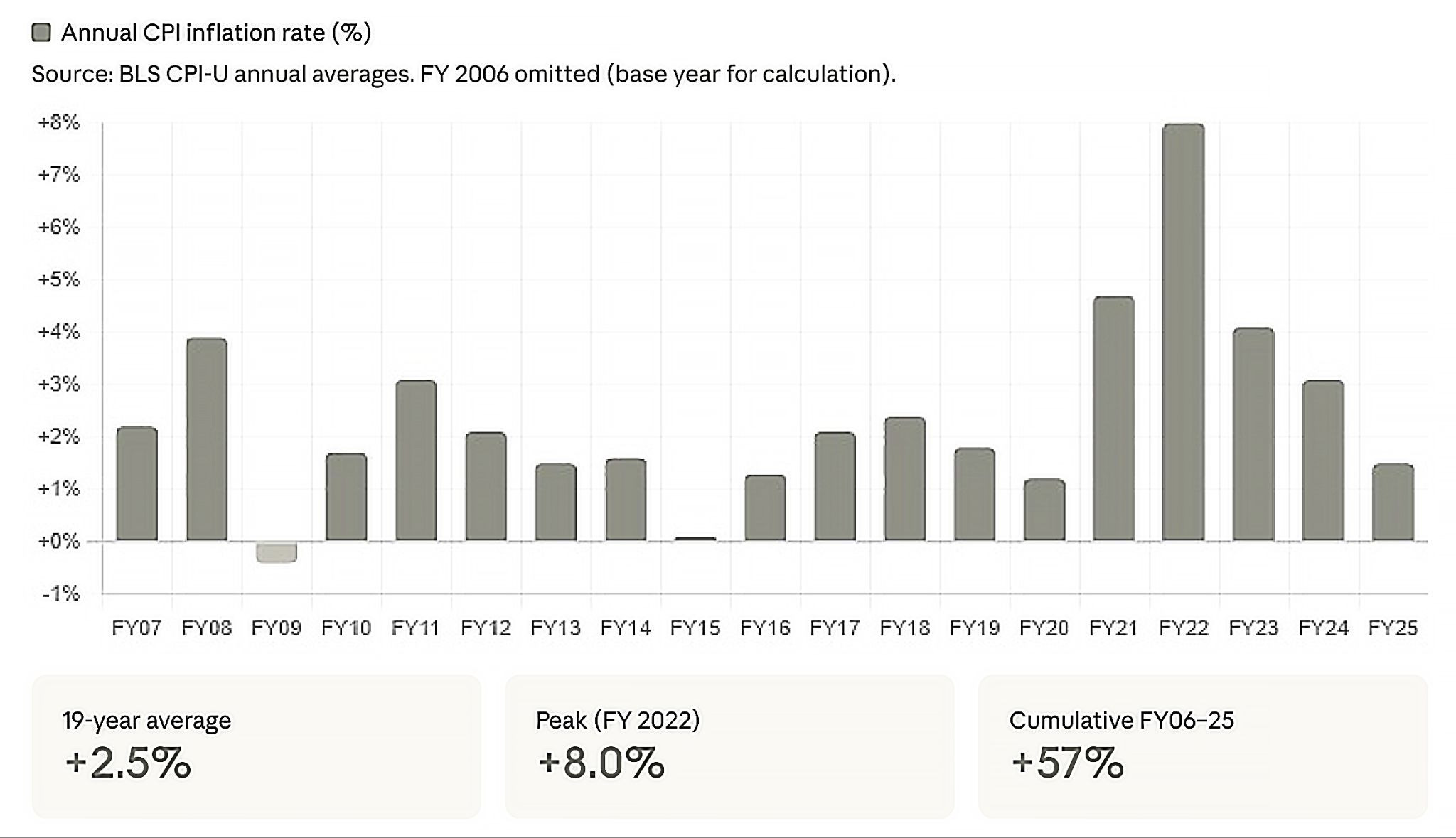
And like many billionaires, the city’s income has increased substantially in recent years— significantly more than inflation and the cost of living— powered by an evergreen, ever-growing source of income: taxes.
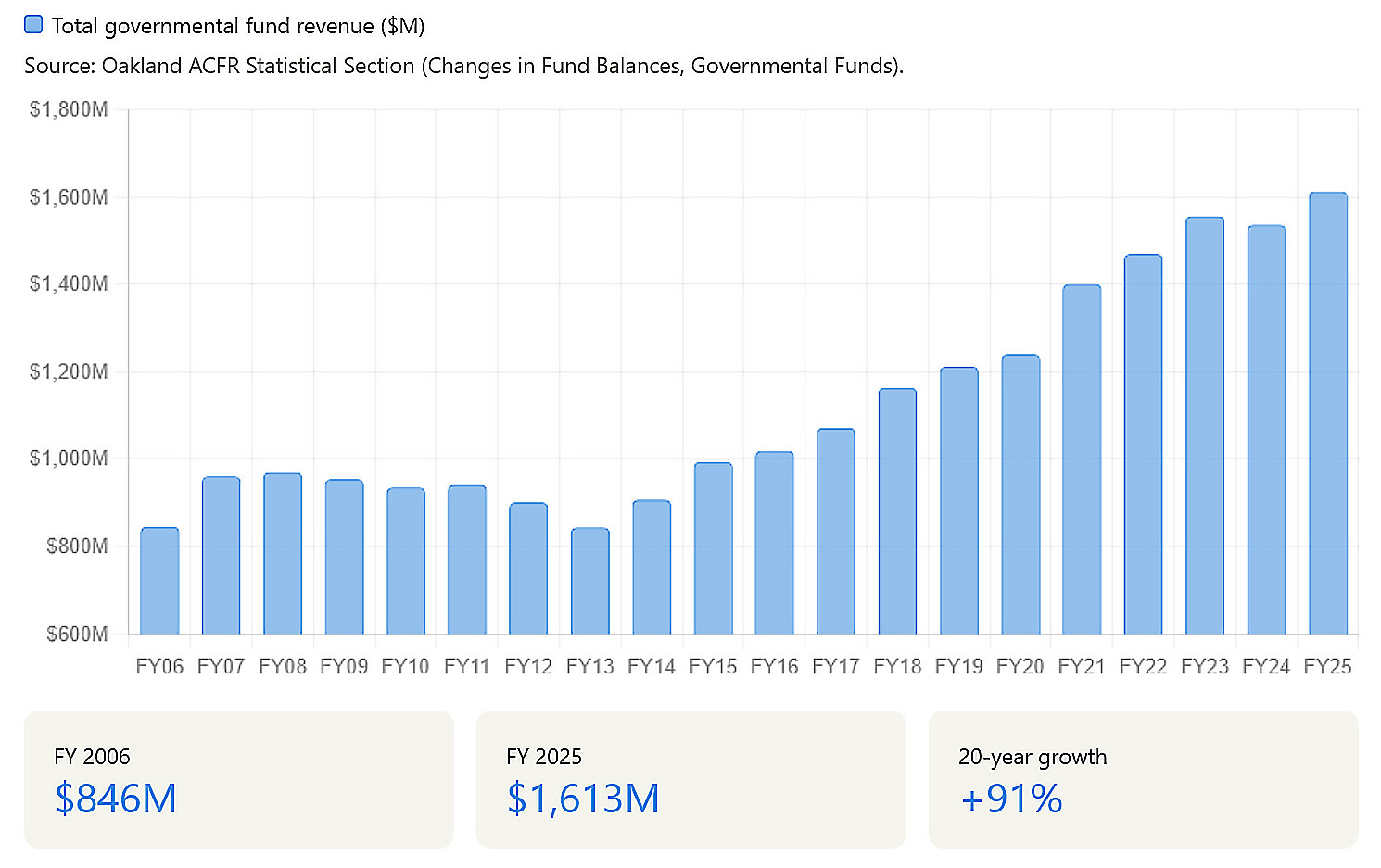
In recent years, Oakland has accelerated its total revenue growth by successfully convincing voters to approve multiple new taxes— many of them on the promise of maintaining and improving police and fire services.
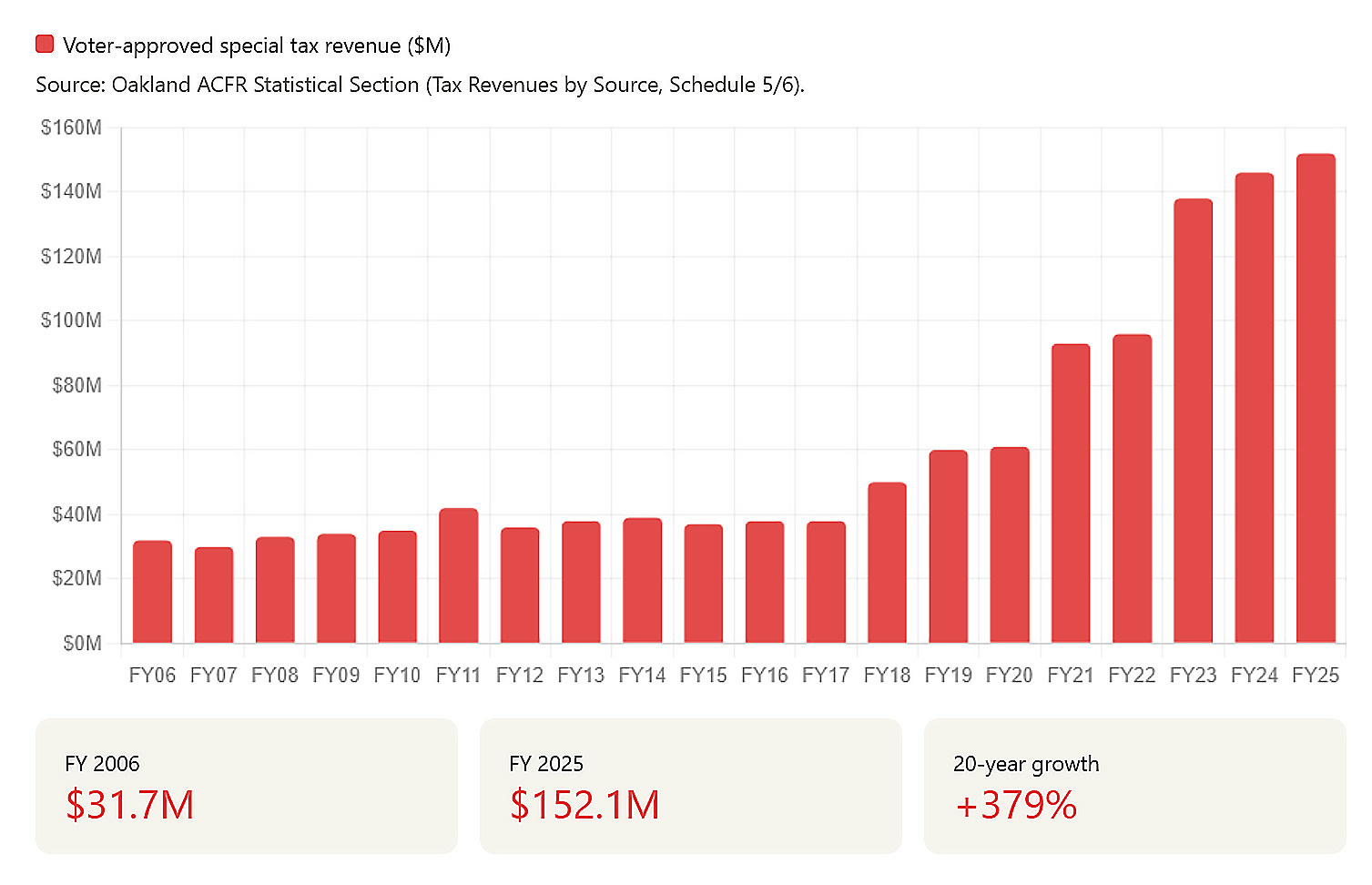
The city’s revenues from voter-approved special taxes have increased by 379% compared to 20 years ago.3
That’s over 6 times higher than the cumulative change in inflation over that same period.4
This commentary takes a closer look at the city’s pattern of leveraging fire department service cuts to convince voters to approve tax increases.
We also will examine the influence of Oakland’s firefighters union on the political campaigns to pass those measures— a pattern that continues with the proposed tax increase on the ballot this June: Measure E.5
We want to hear from you, our readers, what you think about Oakland’s taxes and the services Oaklanders receive in return. We also want to hear what you think about this series. Write a comment, send us a note, and share this article with others.
Most importantly: subscribe to our mailing list, share our stories, and please consider giving a tax-deductible donation to help us continue our nonprofit work:
Part 2
A twenty-year cycle of alarms, mismanagement, and broken promises
The City of Oakland has demonstrated a decades-long pattern of using public safety cuts to manage chronic budget shortfalls.
Notably, these cuts— and threats of additional cuts— also have served as powerful catalysts in political campaigns aimed at convincing Oakland voters to approve tax increases.
A review of city financial statements, audits, and court rulings shows a consistent pattern in which the city collects voter-approved taxes promised for fire and police services, then fails to deliver the services it promised.
The resulting gaps in fire and police services then set the political stage for the city to ask voters to approve even more tax increases in order to ‘save’ and ‘maintain’ those services— even as overall tax revenues increase over time, significantly outpacing inflation.
The city has followed this playbook with fire services— and refined it considerably— over the past twenty years:
Announce that cuts to fire services are necessary to close budget deficits
Convince voters to approve tax increases by promising to ‘save’ and ‘maintain’ fire services
Mismanage and divert the tax revenues to other purposes, resulting in new budget deficits and announcements that fire services must face cuts again
Use the threat of fire station closures to urge voters to approve more tax increases.
The city is not alone in executing this playbook. Oakland’s firefighters union, International Association of Fire Fighters (IAFF) Local 55, has long played a significant supporting role.
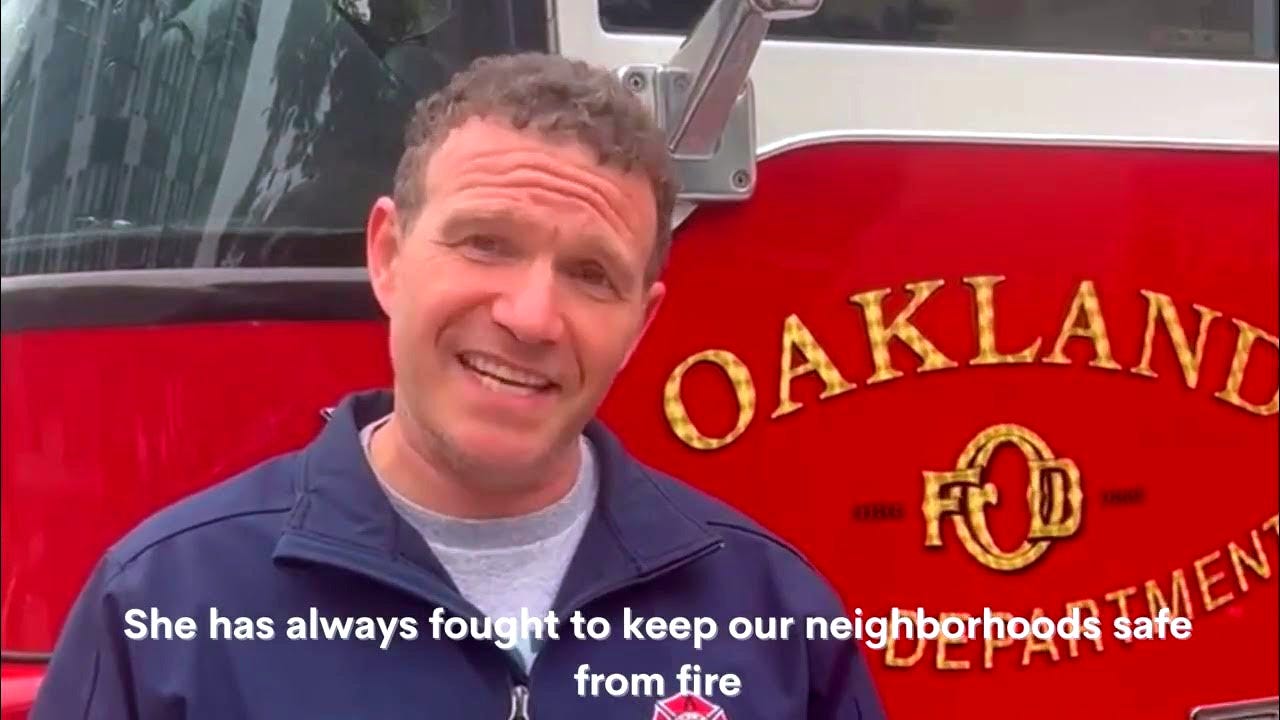
The influence of Oakland’s firefighters union
A review of political campaigns in Oakland over the past two decades shows IAFF Local 55 routinely leveraging voters’ high esteem for firefighters— as well as the substantial resources the union collects, both in monetary dues and boots-on-the-ground political activism from firefighters— to influence public opinion in the political sphere.
The union’s influence includes supporting and donating to the political campaigns of city council members, who then approve the fire department budget, firefighter salaries and benefits, and labor contracts with the firefighters union.
Perhaps its biggest recent success in this area is the election of former IAFF Local 55 president, Zac Unger to the city council in 2024.6
The union’s influence also extends to financially supporting and campaigning for tax increases to collect more funding from Oaklanders for fire services.
IAFF Local 55 has repeatedly used political rhetoric that frames fire station closures and service cuts as severe threats to public safety in order to urge voters to approve tax increases over the past two decades, including Measures Y (2004), BB (2010), Z (2014), NN (2024), and A (2025).
However, an evaluation of these measures reveals a consistent record of misleading claims and broken promises.
The city has declared “extreme fiscal necessity” on multiple occasions to suspend voter-approved spending requirements on police and fire services— a legal escape hatch that has become a routine tool of budget management rather than a genuine emergency measure.
Measure Y funds were improperly used, leading to litigation, while Measure BB weakened key accountability provisions. Even after passing Measures Z and A, the city continued to face fiscal crises leading to further fire station brownouts, directly contradicting implicit promises to voters that new revenues would secure fire services. (See below for more details.)
This cycle appears to be repeating with Oakland’s Measure E, the $34 million per year parcel tax increase on the ballot this June.
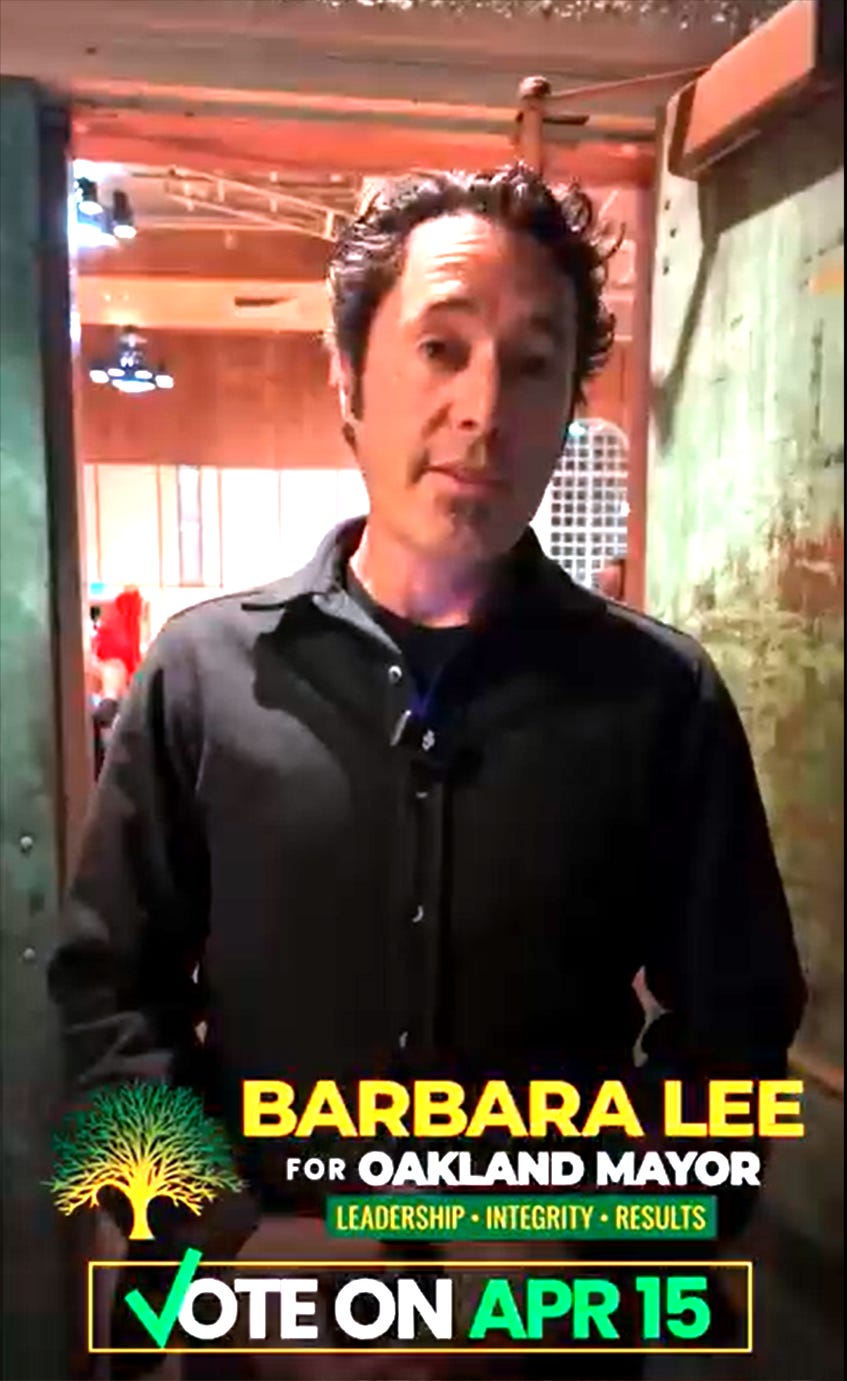
Firefighters union boss threatens fire station closures unless voters approve Measure E – despite record-high tax revenues
The city and its firefighters union are again asking taxpayers for a new tax by pitching it as an essential measure to ‘save’ fire stations and other public safety services from cuts.
Notably absent from their pitch is how the city came to be in such dire financial straits as to need another bailout from taxpayers in order to provide fundamental municipal services like fire fighting— despite passing multiple new taxes in recent years resulting in record-high levels of revenues.
The city’s public employee unions, including IAFF Local 55, are backing the proposed Measure E tax increase, and have donated over $400,000 in contributions to the Yes on E campaign.7
According to campaign finance disclosures, most of the money the unions donated to the campaign appears to have been spent toward paid signature-gatherers in order to qualify the measure for the ballot— a form of political “astroturfing.”8
It appears that this approach was taken in order to qualify the measure for the June 2 ballot as a ‘citizen initiative’ that only requires a majority vote to pass instead of the two-thirds vote usually required for parcel taxes.9
Oakland Report has obtained a copy of the Argument in Favor of Measure E that was submitted by political supporters of the Measure E tax to appear on the June ballot.
The lead signatory to the argument in favor is Seth Olyer, the president of the Oakland firefighters’ union.
The opening sentence in the argument asks voters to “save our essential services,” followed by a prominent bullet point asking voters to “keep fire stations open” by approving the Measure E tax.
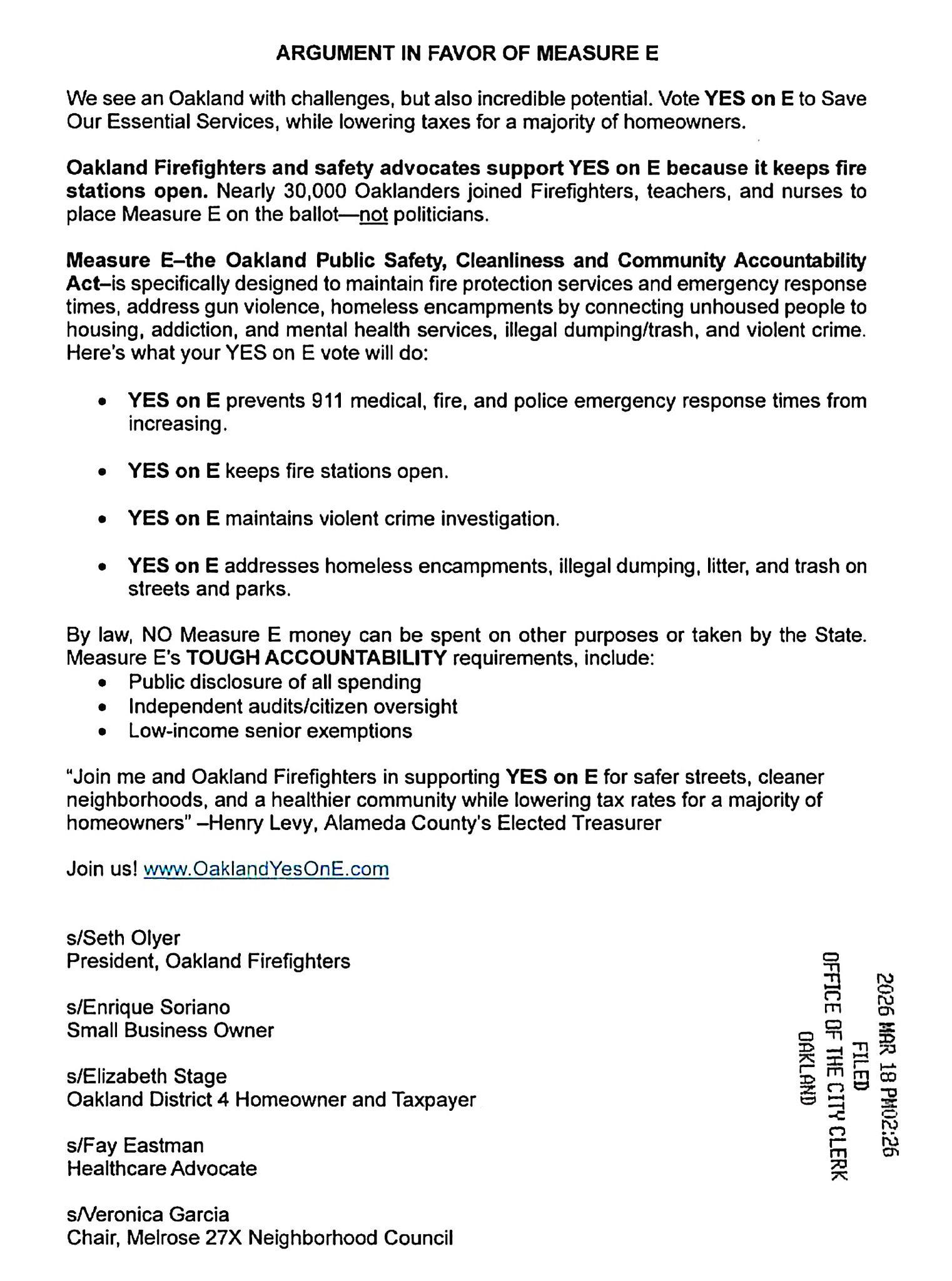
That combination of rhetoric — “save our essential services” and “keep fire stations open” — can be reasonably construed as an implicit threat that if Measure E does not pass, then ‘essential services’ like keeping fire stations open will not be ‘saved.’
There are other questionable claims in the argument in favor of the measure— such as that the measure will lower taxes for most homeowners, and that the money can’t be spent on other purposes. Oakland Report will examine those claims in a future article.
In this commentary, we take a closer look at the role of fire station closures in Oakland’s tax measure campaigns over the past two decades.
Twenty years of taxes, broken promises, and repeat asks
Since 2004, Oakland voters have approved a long succession of public safety tax measures — each one presented as essential to maintaining fire services, each one backed by IAFF Local 55, and nearly all followed by failures to fully deliver what was promised:
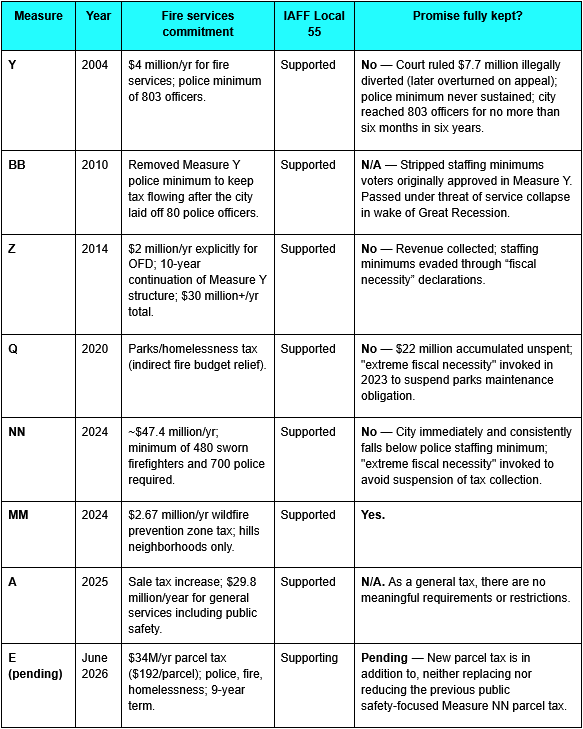
The taxes voters approved — and where the money actually went
Measure Y (2004): A court rules the city broke the law
Oakland voters approved Measure Y in November 2004 with nearly 70% in favor, directing $4 million annually to fire services and funding at least 63 additional police officers above the existing 739-officer baseline for a total minimum of 802 sworn officers. The city collected more than $20 million per year.10
Then-mayor Ron Dellums and the city council redirected $7.7 million of that money to recruit and train officers who were not assigned to the Measure Y community policing positions the tax was designated to fund.
An Oakland resident sued the city, and an Alameda County Superior Court Judge ruled in April 2009 that Oakland’s diversion of Measure Y funds was illegal. The city admitted $11–12 million had been improperly spent. The plaintiff’s attorney estimated the figure was closer to $15 million. (The judge’s decision was later overturned on appeal.)11
Local attorney Marleen Sacks sued again in 2010, citing ongoing failure to maintain the required officer count while still collecting the parcel tax.
Despite the ongoing legal challenges, from 2004 to mid-2010 the city continuously failed to meet the required 803-officer minimum, except for a brief six-month window— while continuing to collect over $100 million in Measure Y taxes over that same period.
Measure Y’s fire services requirement ($4 million/year) was maintained, but the city’s overall failure to deliver on the measure’s core promise of minimum staffing levels— and the willingness of the firefighters union to continue to lend its credibility to the city’s promises in the future— established a template the city would follow in subsequent cycles.
Measure BB (2010): Evading accountability by erasing the rules
After Oakland laid off 80 police officers in July 2010 — dropping below the 739-officer threshold that legally triggered a ban on collecting Measure Y taxes — the city placed Measure BB on the ballot. Rather than restore officers, Measure BB simply erased the minimum staffing requirement, allowing continued tax collection regardless of staffing levels in public safety departments.12
Arguments in favor of Measure BB focused heavily on violence prevention programs and claims that budget shortfalls caused by the Great Recession of 2008 made it impossible to fund the minimum number of officers required in Measure Y— but the city still needed the money.
The Oakland Tribune editorial board recommended a “no” vote, writing at the time that Measure BB would “abolish Measure Y minimum-staffing requirements altogether yet allow the city to continue collecting some $20 million a year.”13 Voters approved it anyway — under implicit threat of lost fire and police services if they did not.
Measure Q (2020): “Extreme fiscal necessity” used to void parks promise
Oakland voters approved Measure Q in 2020, a 20-year parcel tax for homeless support, parks maintenance, litter cleanup and related services. The city council declared an “extreme fiscal necessity” in June 2023 to suspend the parks maintenance provision of Measure Q — a 20-year parcel tax voters had approved in 2020. By June 2023, the measure had accumulated nearly $22 million in unspent funds because the city had simply failed to do the promised work. A city auditor’s report confirmed extensive under-spending and budget carry-forward amounts that exceeded allowable limits.14
FY2024–25 budget: Over $30 milion in ballot measure funds redirected
In the FY 2024–25 budget approved by City Council in June 2024, the city diverted over $30 million of voter-approved ballot measure funds to pay operating expenses, suspending the city improvements voters had intended those funds to support. This was the second consecutive year the city suspended voter-approved use of tax measure funds.15
Simultaneously, the city cut 72 fire department positions (including 9 fire inspectors) and 100 police positions. The city also exhausted its final $93 million in pandemic relief funds and spent down remaining ballot measure fund balances.
Budget Advisory Commission chair Jane Yang warned at the time: “We have the second highest revenue per capita in California amongst cities with 250,000 to 750,000 residents. There’s only so much we can continue to tax our fund base.”16
Measure NN (2024): Accountability was evaded almost immediately
Voters approved Measure NN in November 2024 with over 70% support. A major selling point of the measure was that it requires the city to maintain at least 700 sworn police officers by July 2026 and 480 firefighters — with the tax automatically suspended if those minimums aren’t met.17
The city, already below those minimums with roughly 675 officers budgeted, quickly invoked a declaration of ‘unanticipated extreme fiscal necessity’ to bypass the minimums and keep collecting the tax while continuing to fall short on police staffing. At the same time the city declared it was in a state of ‘extreme fiscal necessity,’ the city also announced it had a multi-million dollar budget surplus for the fiscal year.18

Public anxiety about fire station closures as political lever: a 20-year timeline
In every major Oakland budget cycle for two decades, the threat of fire station closures has been one of the city’s most reliable tools for motivating voter tax approval, even after the city repeatedly broke promises that past tax measures would prevent such closures. The sequence is consistent: announce a deficit, propose drastic fire cuts, deploy firefighters and union officials to warn of imminent crisis, then use the public anxiety to drive approval of the next ballot measure:
2003 — Fire Station No. 2 closes for 17 years.
Jack London Square’s Fire Station No. 2 is shuttered due to budget cuts. It would not reopen until 2020 — a 17-year gap. The closure establishes the city’s willingness to sacrifice fire capacity to balance budgets, setting the pattern for future events.2004 — Measure Y: fire funding as the sell.
Measure Y placed on ballot with $4 milion/year fire services funding as a key selling point. Voters were told the tax would prevent further fire station closures. The measure passed with nearly 70% of the vote. The city then collected over $100 million over six years while failing to meet Measure Y’s minimum police staffing requirements.2010 — Measure BB: evading minimum staffing requirements.
City lays off 80 officers, dropping below the Measure Y threshold that barred tax collection. Rather than restore staffing, the city passed Measure BB to remove the minimum altogether. Fire station brownout rotations began systemically in 2012, with all stations (except airport) participating in the rotation.2014 — Measure Z: warning of fire cuts drives renewal tax campaign.
Measure Z renewal campaign warns of severe fire service cuts if the measure fails. IAFF Local 55 campaigned vigorously for its passage. Measure Z earmarks only $2 million/year for the fire department — half of Measure Y’s fire allocation, despite a higher total revenue base. Passes by two-thirds majority.2021 — Rotating brownout of three engines — equivalent to closing three stations.
City implements rotating brownout of three fire engines for six-day periods, functionally eliminating three stations at any given time. No new tax is required yet, but the move maintains the public’s sense of fragility in fire services.2023 — FY2023-25 budget browns out one engine, delays another.
Then-mayor Sheng Thao’s proposed budget browns out one fire engine and delays a previously approved new engine rollout. Fire department averts deeper cuts by winning a $27.4 million federal grant covering 35 firefighter salaries for three years — a temporary federal bailout that bought time without addressing the structural deficit.19Oct. 2024 — Keller Fire: officials invoke L.A. wildfires to warn against cuts.
After the Keller Fire burns in the Oakland hills, city officials and fire union leaders use the Los Angeles-area Palisades and Eaton fires as a cautionary backdrop, warning that cutting fire stations would be “catastrophic.”20 Voters approve both Measure NN and Measure MM by wide margins weeks later.Jan. 2025 — Seven stations threatened; real closures implemented.
Fire stations are closed after the hoped-for sale of the Oakland Coliseum is delayed and $60 million in revenue the city council prematurely budgeted from the sale does not materialize, triggering ‘contingency’ budget cuts.21 The city proposes closing a total of seven stations, representing 30% of OFD’s capacity. IAFF Local 55 holds press conferences warning of life-threatening response time delays.22 After intense public pressure, the council finds money to reverse some closures.232026 — Measure E: same playbook, next iteration, fewer safeguards.
Station closure threats serve as the primary justification for Measure E. The city’s FY 2025-2027 budget includes plans to brown out two fire stations on a rotating basis.24 IAFF Local 55 president Seth Olyer leads the campaign in favor of Measure E, stating, “We want to keep Oakland firehouses open.”25 The new Measure E tax would be in addition to, not replacing the Measure NN tax approved less than two years ago, has no minimum public safety service requirements, and no legally binding restrictions on how the funds may be used, aside from a political promise.
A look ahead
Future installments in this series will examine how Oakland’s taxes have increased in recent years compared to taxes in other cities, and compared to the rising cost of living. As mentioned above, we also will delve deeper into the claims being made by proponents of Measure E.
We also will take a closer look at the regressive nature of Oakland’s parcel taxes, and the disproportionate burden these taxes place on low-income and disadvantaged residents.
Additionally, we will explore the other side of the city’s ledger— expenditures— to better understand how the city continues to find itself in a deficit position despite record-high tax revenues that rank among the highest per capita in the state.
In closing Part 2, we recognize that firefighters are rightly regarded as heroes, deserving of gratitude and respect for dedicating their lives to dangerous work to help keep all of us safe.
That is all the more reason to question the city’s repeated failures to keep the promises it made for taxes that voters approved for fire services. It also is cause to examine the firefighters union’s participation in the political machinations that appear to have helped perpetuate Oakland’s decades-long cycle of financial mismanagement, fire service reductions, alarms, and broken promises.
BECOME A MEMBER OF OAKLAND REPORT
We rely on financial support from readers like you. Your donation in any amount helps us to continue our nonprofit work.
We are a 501(c)(3) charitable nonprofit organization based in beautiful Oakland, California. Our mission is to make truth more accessible to all Oakland residents. Your donation is tax-deductible.
ABOUT THE AUTHOR
Sean S. Reinhart is a former library director, now retired after 26 years in local government. He served as library and community services director for the cities of Hayward and Menlo Park for a combined 16 years, where he helped build Hayward’s new main library and Menlo Park’s new multi-service community center. His post-retirement endeavors include serving as the managing editor of Oakland Report.
Sean has lived in Oakland for 15 years. He grew up in nearby Hayward. Sean enjoys exploring California’s world-renowned coastline, valleys, deserts and mountains. His creative pursuits include writing, printmaking, carpentry, music and visual arts. He enjoys meeting new people, reading, hiking, gardening, and spending time with his family.

The views expressed in our Commentaries do not necessarily reflect the editorial views of Oakland Report or its contributing writers
Neditch, Nicole et al. “Balancing Oakland’s budget: Nine recommendations for closing the city’s structural deficit to move toward fiscal solvency and economic growth.” San Francisco Bay Area Planning and Urban Research Association, May 2025, p. 17. https://www.spur.org/sites/default/files/2025-05/SPUR_Oakland_Budget.pdf
Johnson, Bradley et al. “Annual consolidated financial report for the year ended June 30, 2025.” City of Oakland finance department, Dec. 30, 2025, p. 164. https://www.oaklandca.gov/files/assets/city/v/1/finance/documents/financial-reporting/annual-comprehensive-financial-reports/2025-city-of-oakland-acfr_final-123025.pdf
City of Oakland. “Annual consolidated financial reports.” Finance department webpage, accessed Apr. 13, 2026. https://www.oaklandca.gov/Government/Finance-Budget/Financial-Reporting/Annual-Comprehensive-Financial-Reports
U.S. Bureau of Labor Statistics. “Consumer price index.” Webpage accessed April 13, 2026. https://www.bls.gov/cpi/
Ballotpedia contributors. “Oakland, California, Measure E, Create Parcel Tax to Fund Public Safety Programs Measure (June 2026).” Ballotpedia. Accessed Apr. 13, 2026. https://ballotpedia.org/Oakland,_California,_Measure_E,_Create_Parcel_Tax_to_Fund_Public_Safety_Programs_Measure_(June_2026)
International Association of Fire Fighters contributors. “Oakland, CA Local 55 president running for Oakland City Council.” IAFF, May 23, 2024. https://www.iaff.org/news/oakland-ca-local-55-president-running-for-oakland-city-council/
California Form 460. “Recipient Committee Campaign Statement.” Oaklanders For A Safe, Clean & Healthy City, Sponsored By Labor Organizations. Feb. 2, 2026. https://public.netfile.com/Pub2/RequestPDF.aspx?id=Sy9QR0VYY29ha2tqUnIwTVFMY3JMQT09&aid=COAK
Wikipedia contributors. “Astroturfing.” Wikipedia, The Free Encyclopedia. Accessed Apr. 13, 2026. https://en.wikipedia.org/wiki/Astroturfing
Reinhart, Sean S. "44% of Oakland's $34 million parcel tax would go to union payouts." Oakland Report, February 22, 2026. https://www.oaklandreport.org/p/20260222-parcel-tax-union-payout
Ballotpedia contributors. “Oakland Parking Lot and Parcel Tax, Measure Y (November 2004).” Ballotpedia. Accessed Apr. 13, 2026. https://ballotpedia.org/Oakland_Parking_Lot_and_Parcel_Tax,_Measure_Y_(November_2004)
California Court of Appeal, First Appellate District. “Sacks v. City of Oakland (2010).” FindLaw / California Court of Appeal, 2010. https://caselaw.findlaw.com/court/ca-court-of-appeal/1547960.html
Ballotpedia contributors. “Oakland Measure BB, Proposed Revision of 2004’s Measure Y (November 2010).” Ballotpedia. Accessed Apr. 13, 2026. https://ballotpedia.org/Oakland_Measure_BB,_Proposed_Revision_of_2004%27s_Measure_Y_(November_2010)
Oakland Tribune editorial board. “Oakland Tribune editorial: No on Oakland Measures X, W, BB.” Oakland Tribune, Sept. 23, 2010. https://www.eastbaytimes.com/2010/09/23/oakland-tribune-editorial-no-on-oakland-measures-x-w-bb/
Houston, Michael. “Budget transparency, performance management, and stronger oversight needed to ensure Oaklanders benefit from the 2020 Parks and Recreation Preservation, Litter Reduction, and Homelessness Support Act.” Oakland City Auditor’s office, Dec. 21, 2023. https://www.oaklandauditor.com/wp-content/uploads/2024/03/20240312_Final_Measure-Q-Audit-Report-with-Administrations-Response-1.pdf
Gardner, Tim. “Oakland’s 2024-2025 budget squanders the city’s future.” Oakland Report, Jun. 18, 2024. https://www.oaklandreport.org/p/oaklands-2024-2025-budget-squanders
Wolfe, Eli. “Oakland budget cuts finalized on eve of big leadership changes.” Oaklandside, Dec. 18, 2024. https://oaklandside.org/2024/12/18/oakland-budget-cuts-finalized-on-eve-of-big-leadership-changes-sheng-thao-2024/
Ballotpedia contributors. “Oakland, California, Measure NN, Police and Violence Reduction Parcel Tax Measure (November 2024).” Ballotpedia. Accessed Apr. 8, 2026. https://ballotpedia.org/Oakland,_California,_Measure_NN,_Police_and_Violence_Reduction_Parcel_Tax_Measure_(November_2024)
Reinhart, Sean S. “Oakland set to declare ‘extreme fiscal necessity’ again, coordinate with unions to increase property taxes.” Oakland Report, February 10, 2026. https://www.oaklandreport.org/p/20260210-oakland-declare-extreme-fiscal-necessity
Troy, Ansel. “Oakland Fire Department avoids massive cuts amid local budget deficit.” Oakland Voices, Nov. 15, 2023. https://oaklandvoices.us/2023/11/15/oakland-fire-department-budget-cuts/
Rhoades, Callie. “‘It would be catastrophic’: After Keller Fire, Oakland officials caution against OFD cuts.” Oaklandside, Oct. 22, 2024. https://oaklandside.org/2024/10/22/oakland-budget-cuts-firefighters-keller-fire/
DeBenedetti, Katie. “Oakland pushes Coliseum sale to next year, delaying funds yet again.” KQED, Apr. 15, 2025. https://www.kqed.org/news/12036060/oakland-pushes-coliseum-sale-next-year-delaying-funds-again
Ko, Kevin. “2 Oakland fire stations closed because of budget shortfall; firefighters warn of life-threatening delays.” CBS News, Jan. 6, 2025. https://www.cbsnews.com/sanfrancisco/news/oakland-closed-fire-stations/
Kukura, Joe. “Oakland reopens those three fire stations they had to shut down because of their budget deficit.” SFist, Sept 24, 2025. https://sfist.com/2025/09/24/oakland-reopens-those-three-fire-stations-they-had-to-shut-down-because-of-their-budget-deficit/
Russell, Kiley. “Oakland voters will decide June parcel tax measure to fund police, fire and city services.” Bay City News, Mar. 5, 2026. https://localnewsmatters.org/2026/03/05/oakland-voters-will-decide-june-parcel-tax-measure-to-fund-police-fire-and-city-services/
Wolfe, Eli. “New Oakland budget would slash unfilled jobs to avoid public safety cuts.” Oaklandside, May 5, 2025. https://oaklandside.org/2025/05/05/oakland-budget-would-slash-jobs-avoid-public-safety-cuts-2025/
NO MORE TAXES!!!! It's time for a TAXPAYER REVOLT!
Pull back the dirty curtain O.R.