


Oakland Report continues its coverage of Oakland’s broken promises and deceptive practices with its parcel taxes. Read the full series.
Mayor Barbara Lee asks Oaklanders to pay twice for the city’s broken promises— and the same services
Late Friday afternoon, Mayor Barbara Lee released her ‘mid-cycle’ budget proposal for fiscal year 2026-27, accompanied by a spending plan for Measure E, the $34-million-per-year parcel tax that voters will decide on June 2.1
In a windy press conference held Thursday before her budget proposal was released, the mayor described the plan as “honest” and “fiscally responsible,” stating that the proposed budget is balanced, contains no layoffs, and no longer assumes that the city will have Measure E revenue.2
However, the details of the mayor’s proposed budget and spending plan— which include options if Measure E passes or if voters reject it— show that the city would use Measure E funds to charge Oaklanders twice for obligations the city had promised would be funded by previous tax measures.
Three notable areas of concern are evident in the mayor’s proposal:
1. Mayor Lee’s proposal says that meeting Measure NN’s minimum police staffing requirement now depends on voters approving a second parcel tax: Measure E.
Oakland voters approved Measure NN in 2024, a $47-million-per-year parcel tax for ‘public safety,’ based on its requirement that the city would use the funding to maintain a minimum of 700 sworn police officers. Mayor Lee’s proposal says that the city’s ability to meet Measure NN’s 700-officer requirement now depends on voters approving another $34-million-per-year parcel tax on June 2: Measure E. (Notably, the Measure E parcel tax would be in addition to, not replacing Measure NN.)
2. ‘Saving’ services that supposedly were ‘saved’ by previous tax measures
According to the mayor’s proposed spending plan, Measure E funds would provide no new services. It would only ‘save’ and ‘maintain’ existing services— like 911 response times and emergency responders— which previous tax measures, including Measure NN, the city promised voters would ‘save’ and ‘sustain’ those same services.
3. Diverting Measure NN funds to fire equipment— while failing to keep Measure NN’s core promises for police staffing
In the mayor’s proposed spending plan, Measure NN funds would be diverted to fire equipment that is not specifically authorized in the measure— while simultaneously saying that Measure NN is insufficient to meet its clearly stated and specific requirements around minimum police staffing.
These concerns are not about whether the police department or fire department are more deserving or more in need of additional funding above and beyond the significant amounts Oaklanders already pay for these fundamental services. The concerns center around the city’s apparent inability or unwillingness to meet its own clearly stated obligations and keep the promises it made to voters who were led to believe they had already ‘saved’ these services with previous tax measures.

Mayor Lee says that Measure NN-funded police staffing now depends on voters approving another parcel tax: Measure E
Measure NN, the $47-million-per-year parcel tax approved by Oakland voters in November 2024 on a promise of ‘public safety,’ requires the City to “budget for, hire and maintain a minimum of seven hundred (700) sworn police personnel” by July 1, 2026.3
Under the terms of Measure NN, if the City fails to budget for 700 officers, the city’s collection of the Measure NN parcel tax revenue would be suspended for that fiscal year (and an associated parking tax surcharge for twelve months), unless the city council declares an “extreme fiscal necessity” exception— as it has done repeatedly in past tax measures.4
The City is currently out of compliance with Measure NN’s minimum staffing requirement. The city’s 2025-27 two-year budget— approved by City Council last June, after Measure NN passed— funds only 678 sworn officers.
A report from city administrator Jestin D. Johnson estimated in February that keeping the promise the city made in Measure NN would now cost Oaklanders an additional approximately $18.6 million: $11.6 million for three additional police academies and $6.9 million for the additional officers.5
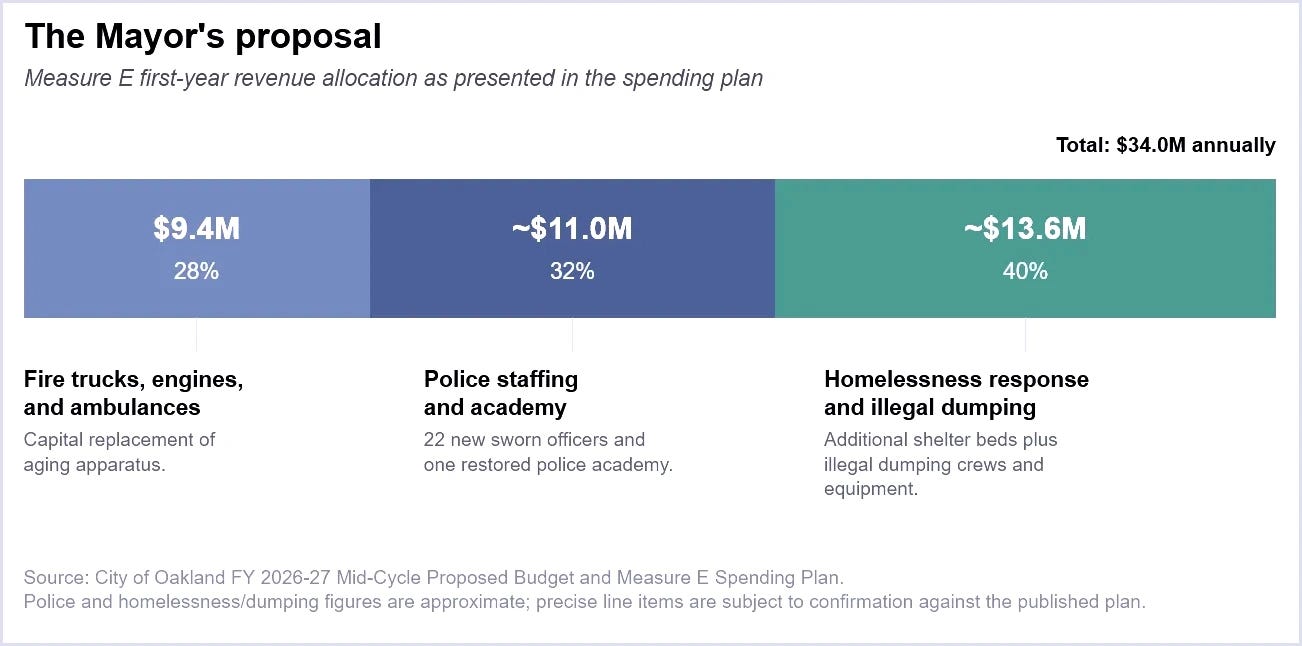
The mayor’s new ‘mid-cycle’ budget proposal does not propose to solve this problem using the Measure NN funds approved by voters for that purpose, nor by using the city’s General Purpose Fund. Instead, the mayor’s spending plan would fund the 22 additional sworn positions and another police academy from the hoped-for new parcel tax, Measure E.
In other words, the mayor’s proposed path to comply with Measure NN’s central voter-approved requirement— the 700-officer staffing minimum— runs through a different, additional tax.
Notably, if Measure E fails on June 2, the mayor’s proposal offers no plan to meet the 700-officer budget requirement, and the city council would presumably need to invoke Measure NN’s “extreme fiscal necessity” loophole for a third consecutive year.
The “extreme fiscal necessity” exception was meant for severe and unanticipated financial events— for example, the Great Recession of 2008, or the global pandemic and economic crash of 2020. Using it to absorb a foreseeable, structural budget gap— one the city’s own reports have identified for years— appears to stretch the exception well beyond its plain meaning.
The mayor’s transmittal letter acknowledges the bind without naming it directly, conceding that the budget “sustains the police department’s staffing levels”— not increases them— and warning of “longer emergency response times, reduced patrol presence, [and] delayed investigations” as a result.

‘Saving’ services that supposedly were ‘saved’ by previous tax measures
A second concern is evident in the mayor’s new plan for spending Measure E parcel tax funds, if voters approve the measure on June 2.
According to the mayor’s plan, roughly $9.4 million of Measure E’s first-year revenue would be directed to the purchase of fire trucks, fire engines, and ambulances.
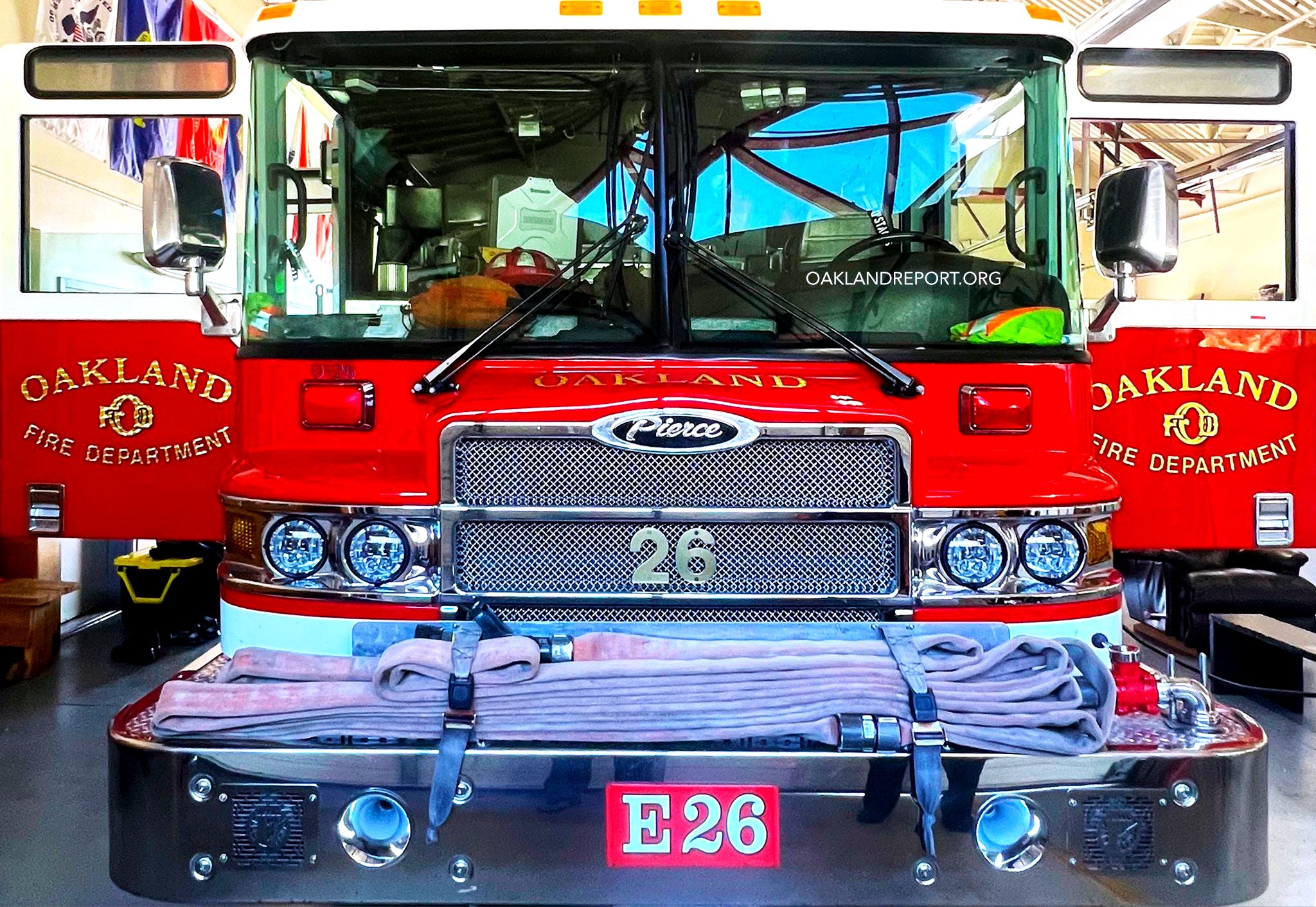
At Thursday’s press conference, city administrator Jestin D. Johnson and mayor Lee stood in front of a 29-year-old fire engine that, according to Oakland Fire Department has been in operation roughly twice as long as national replacement standards recommend.6
The mayor’s transmittal letter links these older yet still-in-service vehicles to an implicit threat that the city has used multiple times over the past 20 years as a tactic to spur voters to approve new taxes: “Our fire engines and trucks are well beyond their useful lives and are in danger of failure. If the City does not have operating engines and trucks, we will be forced to close firehouses.”
Read this related article:

Buying replacement equipment is not the same as expanding or even ‘saving’ service. The Measure E spending plan does not add fire companies, does not add or reopen fire stations, and does not add firefighters. The $9.4 million instead would be for capital expenditures to replace equipment that is aging but still in active use.
The premise of the mayor’s proposal appears to be that once delivered, registered, equipped, and put into service— often a multi-year process for fire apparatus— the fire department would then continue operating its existing stations at existing staffing levels. That is a service baseline, not a service increase nor arguably even ‘saving’ fire services, a refrain voters have heard many times in election seasons past.
The Yes on E campaign has consistently described the measure as “designed to maintain fire protection services and emergency response times.”7 The mayor’s proposed spending plan says funds will “protect 911 fire and emergency medical response times by keeping fire stations open, equipped, and fully operational.”
Voters reading those sentences may consider what, precisely, they are getting that they do not already have, or have not already paid for in multiple past tax increases?
The answer, for the largest fire-related line in the spending plan, is this: the equipment replacements the city claims are necessary to keep what exists from collapsing.
That may be a defensible use of city resources— aging fire apparatus is a genuine concern— but it is materially different from improving response times or expanding service.

Diverting Measure NN funds to unauthorized uses
The third and potentially most significant concern with the mayor’s proposal is evident in the overall (non-Measure-E) portion of the proposed ‘mid-cycle’ budget.
According to the mayor’s proposal, the city would use Measure NN funds to purchase additional fire equipment (fire helmets, turnout gear, defibrillators and CPR machines) above and beyond what the city now is saying Measure E will cover.8
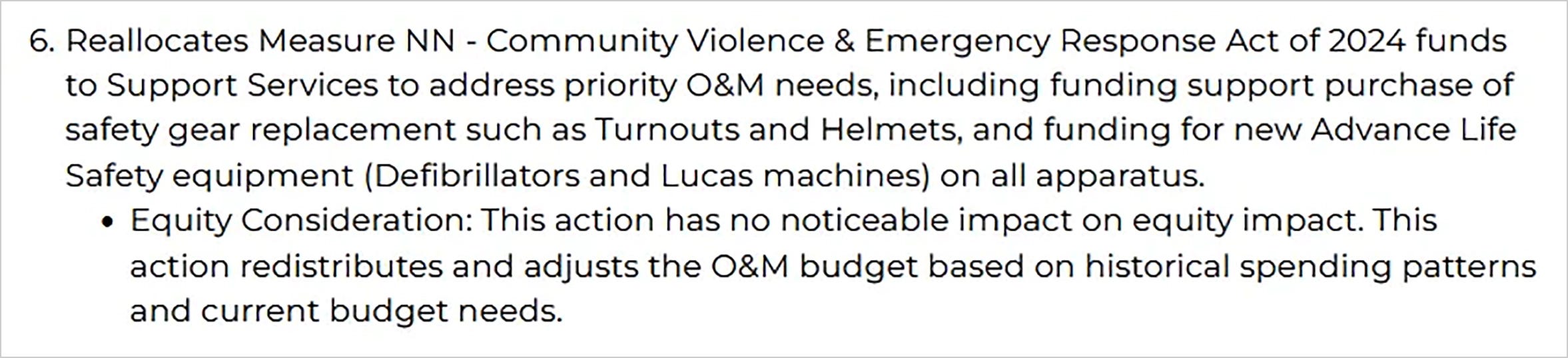
This appears to be a violation of the permissible uses of Measure NN revenue.
The text of Measure NN is unambiguous on this point. Section 3 of the measure limits the use of tax proceeds to costs “relating to or arising from efforts to achieve the following desired goals”:
Reducing homicides, robberies, car jackings and break-ins, domestic violence, and gun-related violence.
Improving emergency 911 response times and quality of response.
Reducing the incidence of human trafficking including the sexual exploitation of minors.
Administrative expenses associated with furthering (1)-(3) above.
Section 5 then enumerates the specific permissible uses:
911 dispatch and emergency responders
Community ambassadors
Community policing
Crime lab operations
Crime reduction teams
Domestic violence intervention
Group violence intervention
Hospital-based violence intervention
Mental health services
Mobile crisis responders
Violence interruption
Violent crime investigations
Similar programs.
Fire equipment is not specified on that list. Nor does it appear to be reasonably inferred from it, except perhaps by stretching the meaning of “emergency responders” to include gear like fire helmets and jackets.
Measure NN already allocates $3 million per year for “the Oakland Fire Department and associated administrative expenses”— an amount that increases according to the Consumer Price Index, a common measurement of inflation. That allocation is explicitly tied to the “emergency responders” objective noted elsewhere in the measure’s text.
Meanwhile, as noted above, the mayor’s proposal states that Measure NN funds are insufficient to fulfill the measure’s very specific promise/requirement of maintaining a minimum 700 sworn police officers.
Why the mayor, city administrator, and finance director did not account for this apparent violation of the Measure NN requirements in their budget proposal and spending plan is unclear.
Read this related article:

Implications for Measure E
If voters approve Measure E on June 2, Oakland homeowners will be charged a third, overlapping, $34-million-per-year parcel tax to ‘save’ public safety services— on top of Measure NN’s $47-million-per-year parcel tax, and Measure MM’s $2.7-million-per-year parcel tax that applies only in certain elevated-wildfire-risk zones.
If voters reject Measure E, the $40 million budget gap that was created when the city council irresponsibly budgeted that revenue without actually having an approved tax measure would, according to the mayor’s alternate spending plan, result in “longer emergency response times, reduced patrol presence, [and] delayed investigations.”
Alternatively, the city could seek to close the gap by reallocating previously committed resources from the city’s General Purpose Fund, or by invoking the “extreme fiscal necessity” loophole for a third consecutive year.
Mayor Lee’s transmittal letter is right that “the City must earn the trust of the Oaklanders we serve.” Trust, in this context, means honoring the conditions voters attached to the last measure before asking them to approve the next one.
The mid-cycle budget asks Oaklanders to approve a new tax to fix the city’s self-inflicted tax compliance problem— and, in the same package, proposes diverting the previous tax to items it does not specifically authorize.
The City Council begins budget deliberations on Monday, June 1— one day before the June 2 election when voters decide Measure E. The deadline for city council to adopt the budget is June 30.
📖
Editors’ note: Oakland has an embarrassment of riches
As we have noted throughout this series, taxes are necessary for a safe, functioning society. That fact is not up for serious debate.
But what happens when the government fails to provide the services it promised in exchange for new taxes— as has happened in Oakland multiple times now?
In Oakland, the city’s answer routinely is to collect even more taxes.
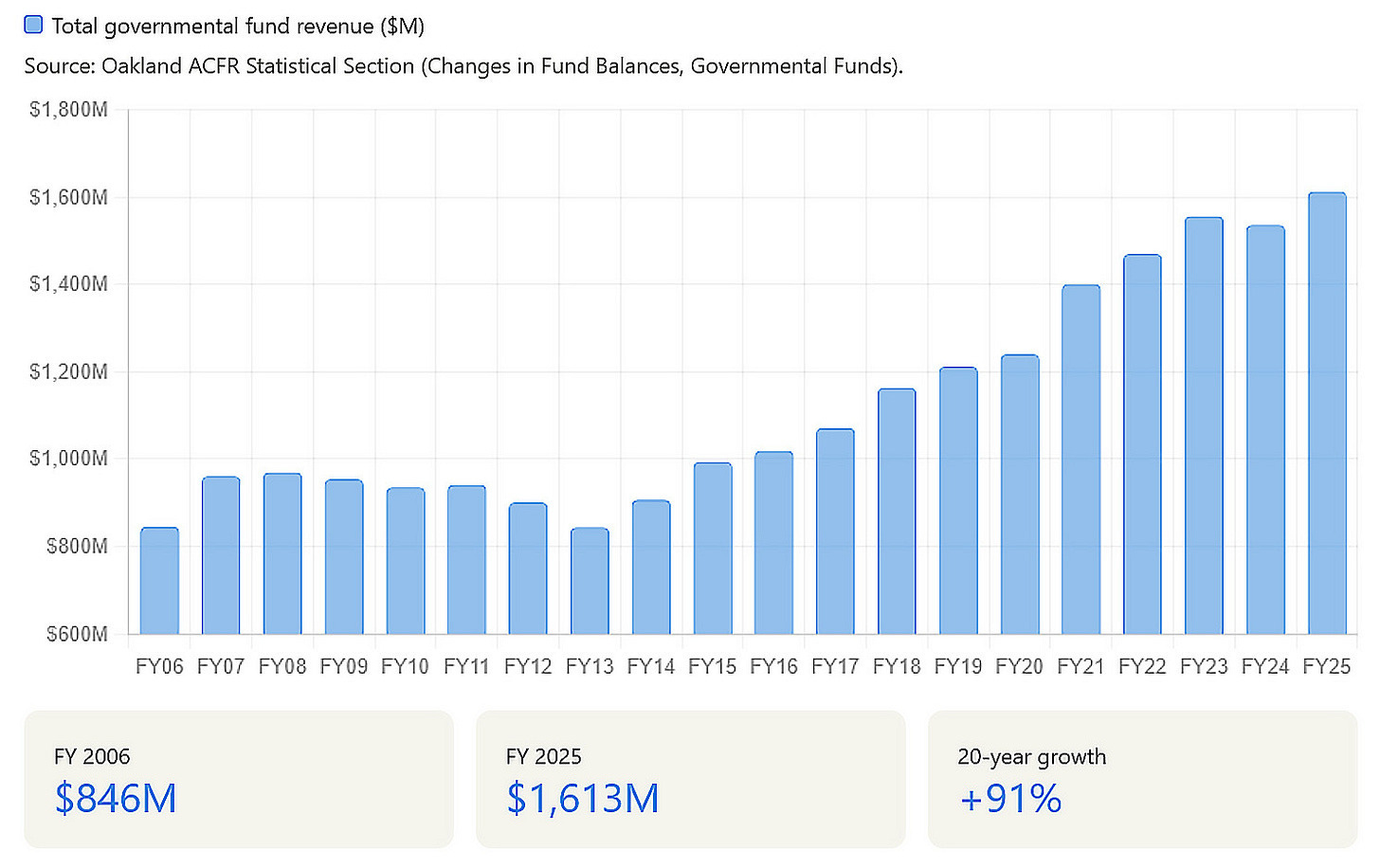
After years of cumulative tax increases, Oakland charges the highest taxes per capita in the state compared to similar cities.9
This past year, Oakland collected a record-high level of total governmental revenue— more than $1.6 billion.10
In recent years, Oakland has dramatically increased its revenue by convincing voters to approve multiple new taxes— many of them on the promise of maintaining and improving police and fire services.
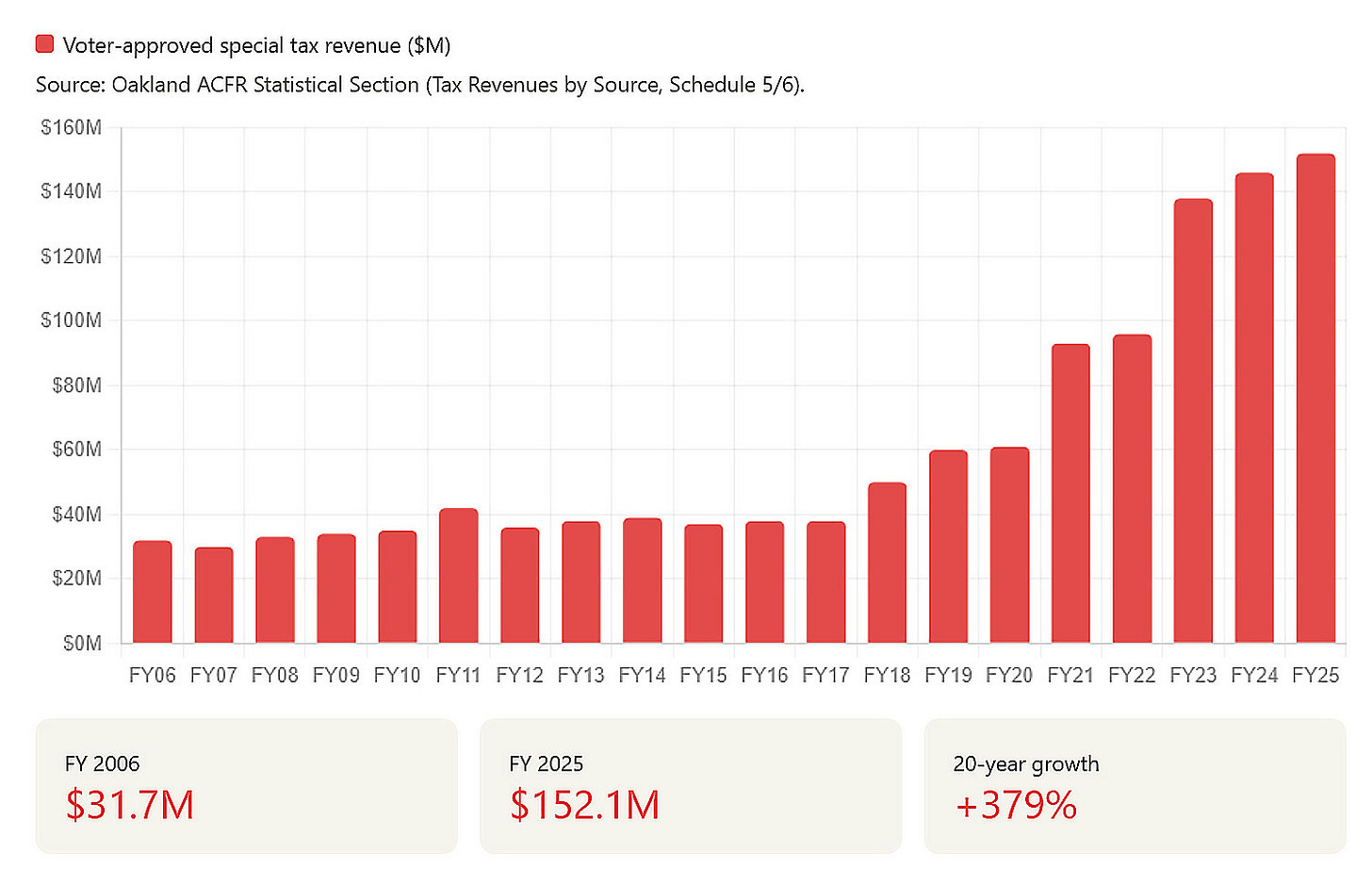
The city’s revenues from voter-approved special taxes have increased by 379% compared to 20 years ago.11 That’s over 6 times higher than the cumulative change in inflation over that same period.12
The city’s financial problems are not unlike those now faced by Oakland Unified School District (OUSD), which is deep in the throes of its own multimillion-dollar budget deficit, and appears to be on the brink of state receivership— again.
Alameda County superintendent of schools Alysse Castro, who oversees the school district’s finances, has issued multiple warning letters to the school board about its chronic fiscal mismanagement. Castro’s most recent letter, issued on April 16 stated her professional perspective in simple and clear terms:13
“This is not a revenue problem— it is a decision-making problem.”
We want to hear from you, our readers, what you think about Oakland’s taxes and the services Oaklanders receive in return. We also want to hear what you think about this series. Write a comment, send us a note, and share this article with others.
Most importantly: subscribe to our mailing list, share our stories, and please consider giving a tax-deductible donation to help us continue our nonprofit work.
WE ARE 100% SUPPORTED BY YOU
Oakland Report accepts no advertising or “sponsored content.” We rely on you, our readers and subscribers, for the financial support we need to produce news stories like this one.
Your donation in any amount helps Oakland Report continue our 501(c)(3) charitable nonprofit work:
Read our comprehensive report on Oakland’s parcel taxes:

Lee, Barbara. "Oakland Mayor releases mid-cycle budget & Measure E spending plan." City of Oakland news release, May 15, 2026. https://www.oaklandca.gov/News-Releases/Oakland-Mayor-Releases-Mid-Cycle-Budget-Measure-E-Spending-Plan
City of Oakland. “On Thursday, May 14, Oakland Mayor Barbara Lee was joined by City officials at a press conference.” Instagram video, May 14, 2026. https://www.instagram.com/reel/DYVpULMhPet
City of Oakland. “Oakland Community Violence Reduction and Emergency Response Act of 2024 (Measure NN).” Alameda County Registrar of Voters, Nov. 5, 2024. https://acvote.alamedacountyca.gov/acvote-assets/02_election_information/PDFs/20241105/en/Measures/32%20-%20Measure%20NN%20-%20City%20of%20Oakland%20-%20Citywide%20Violence%20Reduction%20Services.pdf
Reinhart, Sean S. “Oakland set to declare “extreme fiscal necessity” again, coordinate with unions to increase property taxes.” Oakland Report, Feb. 10, 2026. https://www.oaklandreport.org/p/20260210-oakland-declare-extreme-fiscal-necessity
Johnson, Jestin D. "Multi-year plan to meet voter-mandated staffing and service levels." Council finance and management committee meeting, agenda item #6, Feb. 10, 2026. https://oakland.legistar.com/LegislationDetail.aspx?ID=7803529&GUID=45C4B727-1AE6-490F-8CC6-25E3BD2FF85A
Orenstein, Natalie. "At vague preview of Oakland budget, officials pledge no layoffs or service cuts," The Oaklandside, May 14, 2026. https://oaklandside.org/2026/05/14/barbara-lee-budget-proposal-oakland-measure-e/
SEIU Local 1021 contributors. “Help us pass Oakland’s Measure E.” SEIU Local 21 webpage, April 11, 2026. https://www.seiu1021.org/article/help-us-pass-oaklands-measure-e
City of Oakland. “FY 2026-27 proposed midcycle budget.” City of Oakland budget portal, accessed May 17, 2026. https://stories.opengov.com/oaklandca/19b471db-2b9a-4092-824d-e529490f5fa7/published/8B9CYPUKU?currentPageId=69c1b6d39da5d5cff33e4fe8
Neditch, Nicole et al. “Balancing Oakland’s budget: Nine recommendations for closing the city’s structural deficit to move toward fiscal solvency and economic growth.” San Francisco Bay Area Planning and Urban Research Association, May 2025, p. 17. https://www.spur.org/sites/default/files/2025-05/SPUR_Oakland_Budget.pdf
Johnson, Bradley et al. “Annual consolidated financial report for the year ended June 30, 2025.” City of Oakland finance department, Dec. 30, 2025, p. 164. https://www.oaklandca.gov/files/assets/city/v/1/finance/documents/financial-reporting/annual-comprehensive-financial-reports/2025-city-of-oakland-acfr_final-123025.pdf
City of Oakland. “Annual consolidated financial reports.” Finance department webpage, accessed Apr. 13, 2026. https://www.oaklandca.gov/Government/Finance-Budget/Financial-Reporting/Annual-Comprehensive-Financial-Reports
U.S. Bureau of Labor Statistics. “Consumer price index.” Webpage accessed April 13, 2026. https://www.bls.gov/cpi/
Oakland Report contributors. “‘A decision-making problem’: County schools chief warns Oakland Unified is at risk of running out of money.” Oakland Report, Apr. 21, 2026. https://www.oaklandreport.org/p/20260421-ousd-at-risk
Yes, we are forming and Oakland Taxpayers Alliance and filing a lawsuit against the city over NN violations. Enough is enough
Is there any legal recourse that powerless Oakland residents have to obstruct this fraud? This budget clearly documents the intent to violate the conditions of Measure NN. I'm not a lawyer, just a simple retiree. It is beyond frustrating to see this looting happening in plain sight.