

BY BEN GOULD
Editor’s note: Oakland Report’s charter reform series is exploring Oakland’s city charter and how it potentially could change — a question that Oakland voters are being asked on November’s ballot with Oakland’s Measure EE. We invited Ben Gould, Oakland Budget Advisory Commission member and organizer of Oakland Residents for Good Government to offer his commentary for our readers to consider. We have invited a commentary from Measure EE supporters as well. Other installments in our charter reform series share counterpoint perspectives from other prominent participants in the charter reform debate.
Measure EE would give sweeping new powers to one person.
Measure EE, the “strong mayor” charter amendment, is presented as a way to fix Oakland’s governance problems. But voters should look carefully at how it proposes to fix those issues, and ask whether it’s really the right solution.
Measure EE would grant the mayor a sweeping array of new powers — ultimately granting them more power than almost any other mayor in California. The mayor would gain the power to hire, oversee, and fire not only the city administrator, but also almost every department director responsible for the delivery of core city services.
The mayor would be responsible for recommending contracts for the council to approve — not city staff. And the mayor would also gain a powerful veto, including budgetary line-item veto power, letting them block most Council actions and even practically rewrite the Council’s adopted budget.
Subscribe to Oakland Report (it’s free).
Measure EE opens the door to corruption.
Clearing bureaucratic imbroglio is an admirable goal — but Measure EE would go a step further, and swing the doors of City Hall wide open for corruption.
Just look at the corruption trial of former Mayor Sheng Thao. Federal prosecutors argue that she tried to make a handpicked appointment (Larry Gallegos) to a powerful department role in order to award lucrative city contracts to her political friends and allies.1
Normally, that would be illegal — but not under Measure EE. Measure EE explicitly empowers the mayor to:
Appoint department directors, in most cases with no checks or oversight, and
Recommend contracts for the City Council to approve.
In fact, Measure EE not only makes this kind of corruption legal — it even empowers the mayor to veto the City Council if they try to award a contract to a non-corrupt bidder.
Measure EE would make City Hall less accountable, not more.
At the same time as Measure EE invites corruption, it would make City Hall less transparent and accountable to the public.
Right now, the City Administrator goes to every Council meeting. Any Councilmember can ask them about how the city is being run, or what the status is of some project or initiative, and expect an answer from the city’s chief executive then and there, on the dais, in public, on live television, and get an answer.
But under Measure EE, the City Administrator wouldn’t have the insight into most departments. They’d only be responsible for Human Resources and Finance — not the Police, Fire, Public Works, Transportation and other city departments people rely on for direct services every day.
Instead, the mayor would be the person who oversees the main city operations — but under Measure EE, the mayor would not be required to attend city council meetings. They wouldn’t have to answer any questions in public if they didn’t want to, and Council — and by extension the public — would have no way to know what’s actually going on inside City Hall.
Accountability means being held to account — to speak to your actions and to face consequences for misconduct. But if the mayor isn’t expected to speak at council meetings, and gets to choose the time and place that they answer questions — and even who asks the questions — is that really accountability?
If the only way to ensure the mayor faces consequences is to hold a multi-million dollar recall election, then the only people who can truly hold a mayor accountable are the ones with millions of dollars to spend in local politics: groups like Revitalize East Bay and the city employee unions like SEIU — not the neighborhoods or local communities.
Ultimately, Measure EE would make City Hall responsive to deep-pocketed wealthy donors, not the community.
Share this article with someone you know.
Oakland’s district-based system is designed to ensure every community has an equal voice in City Hall.
The intent behind Measure EE is not new. We’ve seen this before. Fifty years ago, we switched from at-large to district-based city council elections specifically in order to ensure that our Black and Brown communities in West and East Oakland would have fair representation in City Hall.
We already know that there are huge turnout disparities in voting today: nearly half of the votes in the Oakland mayor’s race come from North Oakland and the hills (Districts 1 and 4), even though they represent less than one third of Oakland’s residents.2
Measure EE would make City Council almost powerless.
Our district-based system is designed to level the playing field and ensure every community has an equal voice in City Hall.
Measure EE would take that away from us. It would make City Council almost powerless, leaving the Mayor focused on the interests of wealthy donors and the North Oakland residents (predominantly white homeowners) who show up to vote.
We also already tried a “strong mayor” system, in 1998, but voted against extending it just four years later (2002 Measure CC). Jerry Brown’s watered-down amended version was extended in 2004, leaving us with the mess we’re in today.
Mayor Lee will be in office for the next four years — but then what? If Measure EE passes, we’re stuck with this system for all the mayors who come after Barbara Lee, whoever they might be.
There’s another, better way.
Measure EE isn’t the only option for Oakland. Every other Bay Area city, except San Francisco, uses what’s called a “council-manager” form of government, as exemplified in the Model City Charter put forth by the National Civic League.3
Related story:

Under the council-manager form of government, the mayor serves as chair of the Council — as Council President — and the mayor and council together hire and oversee an experienced, professional City Manager who runs the city departments, combining strong and visible political leadership with steady, effective management.
In fact, over 400 cities in California use a council-manager form of government, while just four cities use a so-called “strong mayor” system like Measure EE. Of those four, only one (San Diego) is as flexible and open to corruption as Measure EE.
Even San Francisco has more constraints on the mayor’s power than Measure EE proposes.
City Council didn’t actually approve Measure EE.
That’s why the City Council actually didn’t approve this measure to go on the ballot. Four of the eight Councilmembers — Zac Unger, Janani Ramachandran, Noel Gallo, and Ken Houston — all voted no on placing this measure on the ballot.
In fact, a clear majority of the City Council would have been thrilled to see a council-manager option on the ballot — they just weren’t willing to put something up against the mayor’s own proposal.
Ultimately, the only reason Measure EE is on the ballot at all is because the mayor’s handpicked committee recommended it, the mayor’s staff wrote it, and then the mayor herself cast the tie-breaking vote to put it on the ballot.
Related story:

Measure EE is wrong for Oakland.
It risks corruption, reduces transparency and accountability, and doesn’t reflect our diverse communities.
There’s a better option: in just two years, we can say yes to a responsive, efficient, transparent government managed by experienced professionals, not politicians.
No on EE is endorsed by Alameda County Supervisor Nate Miley, former Councilmembers Loren Taylor and Nancy Nadel, and many more community members and leaders.4
Join us in saying YES to good government and vote NO on Measure EE. Learn more at www.OaklandNoOnEE.com
— Ben Gould, Budget Advisory Commission Member and Organizer, Oakland Residents for Good Government
The views expressed in our Commentaries do not necessarily reflect the editorial views of Oakland Report or its contributing writers.
See these related articles about charter reform:


BECOME A DONATING MEMBER
We rely on our readers’ financial support to continue our work. Your contributions are tax-deductible.
We are a 501(c)(3) charitable nonprofit based in beautiful Oakland, California. Our mission is to make truth more accessible to all Oakland residents. Learn more.
Thank you!
Wolfe, Eli and Natalie Orenstein. “Thao trial opens with fiery allegations, strenuous disavowals.” The Oaklandside, Oct. 14, 2026. https://oaklandside.org/2026/10/14/sheng-thao-trial-andre-jones-duong-oakland-opening-statements/
Falk, Steven et al. “Oakland voters should reject the inadequate “strong-mayor” proposal.” Oakland Report, Mar. 2, 2026. https://www.oaklandreport.org/p/20260302-oakland-voters-should-reject-mayor-working-group
National Civic League contributors. “Model City Charter, 9th Edition.” NCL, 2021. https://www.nationalcivicleague.org/resources/model-city-charter-9th-edition/
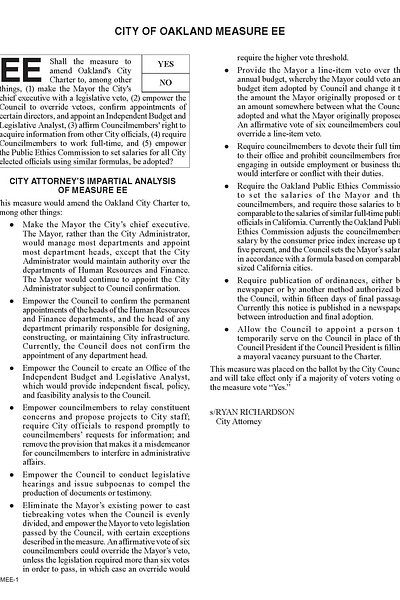
Alameda County Registrar of Voters. “Voter Information Guide: Oakland Measure EE.” Nov. 3, 2026 general election. https://docs.oaklandreport.news/Measure-EE-voter-information-guide_nov2026_eng.pdf
Thank you Oakland Report for this article. We must stop Measure EE from passing this November. We need the mayor to be back on the city council. Mindy Pechenuk for Oakland Mayor 2026
I fully agree that Oaklanders need to look beyond just our current mayor, Barbara Lee when making the decision. While we trust her, Oakland has proven that it is likely we will occasionally get a mayor who would do significant damage if they had more power with less checks and balances… exactly what this measure would enable.