

BY STEVEN FALK, BEN GOULD, AND NANCY FALK
Editor’s note: Oakland Report’s charter reform series is exploring Oakland’s city charter and how it potentially could change — a question that Oakland voters may be asked on the ballot in 2026. We invited the Oakland Charter Reform Project to offer its counterpoint to the Mayor’s Working Group on Charter Reform’s recommendations. Other installments in this series share counterpoint perspectives from other prominent participants in the charter reform debate.
Late last month, Mayor Barbara Lee’s Working Group on Charter Reform released its long-awaited set of recommendations.1 Not surprisingly, the Mayor’s hand-picked team of advisors2 recommends giving more power and authority to the Mayor.
In our previous commentary for Oakland Report, we explained why Oakland should return to the Model City Charter.3 This template for organizing city government is used by almost every city in California—because it delivers results. Compared to the strong-mayor system proposed by the Mayor’s Working Group, the Model City Charter is 57% less likely to have corruption4 and 10% more efficient.5 A 10% efficiency gain could save Oakland north of $100 million annually—virtually eliminating the City’s structural deficit.6
Thank you for reading Oakland Report. Subscribe to receive new posts in your inbox.
We also believe the Charter Reform Working Group’s methodology is seriously flawed. The report neglects key considerations and issues in its analysis (detailed below), and those omissions result in final recommendations that Oakland voters should reject.
A strong-mayor system can’t provide accountability without transparency and oversight
Voters want greater accountability from their city administration. But the “strong-mayor” system proposed by the Mayor’s Working Group would actually provide less accountability to voters than the Model City Charter, or even Oakland’s current flawed system.
Accountability is the obligation of the city administration to account for its actions and face consequences: whoever is in charge of the city must stand before voters (or their representatives), inform them of their past or future actions and decisions, justify those actions, and face consequences for poor performance.7
Under both the Model City Charter and Oakland’s current charter, the official responsible for overseeing city administration—the City Administrator/City Manager—is required to attend every City Council meeting. Every two weeks, they are accountable to the voters’ elected representatives. At any point during a meeting, any Councilmember can ask the City Administrator/Manager to explain or defend the City’s performance in full view of the public and the press. Under the Model City Charter, if the City Administrator/Manager’s performance is unsatisfactory, the City Council can remove them at any time.
By contrast, the Working Group’s proposed changes would leave the person responsible for overseeing the administration exempt from the obligation to attend council meetings and stand before the public. Unlike almost every other city in California, Oakland residents would rarely or never have the chance to hold their chief executive to account at regular meetings of the City Council.
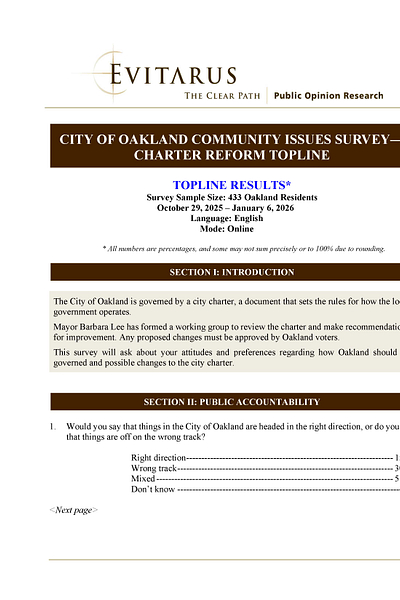
This is directly at odds with what Oaklanders want. In the Working Group’s own survey of over 400 Oaklanders, 83% said they wanted the City Council to have more direct ways to hold the city administration accountable for performance.8 Instead, the Mayor’s Working Group effectively recommends reducing the City Council’s ability to hold the city administration accountable for performance, thus making it among the weakest in California.
The Model City Charter has another key advantage over the proposed strong-mayor system: if the head of the administration (the City Administrator/Manager) is not performing, Council can remove them—and many other cities have done so, including at least five Bay Area cities in the past five years.9
Legislative authority to remove government executives is common in many systems: in our federal government, Congress can remove the President from office, and in other countries, parliaments can hold votes of no confidence to replace their prime ministers. The Working Group’s proposal, however, provides no comparable mechanism for the Council to initiate the removal of its recommended chief executive—i.e., the Mayor. Instead, it would insulate a failing administration from meaningful consequences. Rather than strengthening the Council’s role in evaluating executive performance, the proposal weakens oversight and could allow a bad executive to harm the city for years.
As proposed, the Working Group’s strong-mayor system would reduce day-to-day accountability and transparency in city government. While voters would decide whether or not to elect a mayor for a second term (if the mayor chooses to run again), they would have little insight into the administration’s routine operations and have no practical remedy for poor performance short of a costly, multi-million-dollar recall campaign.

A strong-mayor system is not designed to represent Oakland’s diversity
As noted by the Mayor’s Working Group, Oakland has deep racial, wealth, and geographic inequities. These inequities are a major reason why Oakland moved to a district-based system in the 1980s.10 Oakland’s district-based elections are intended to ensure that disadvantaged communities with lower voter turnout still get equitable representation (because district boundaries are drawn by population). In a Model City Charter-style government, in which the City Council directly oversees the city administrator, each equal-population district has equal say in budget decisions, setting city policy, and overseeing the city administration.
Unfortunately, instead of giving every community an equal voice as proposed by the Model City Charter, the Mayor’s Working Group’s reforms would instead empower only that subset of voters who show up in the midterm elections. These voters are not representative of Oakland residents overall: they are disproportionately residents of North Oakland and the Oakland Hills, which tend to be white, wealthy, college-educated homeowners. Based on geography alone, these highly engaged voters will likely skew the issues any citywide elected mayor hears about and feels compelled to address.
For example, in the 2022 mayoral election, Districts 1 and 4 alone made up 45% of the vote, despite accounting for less than 30% of the population.
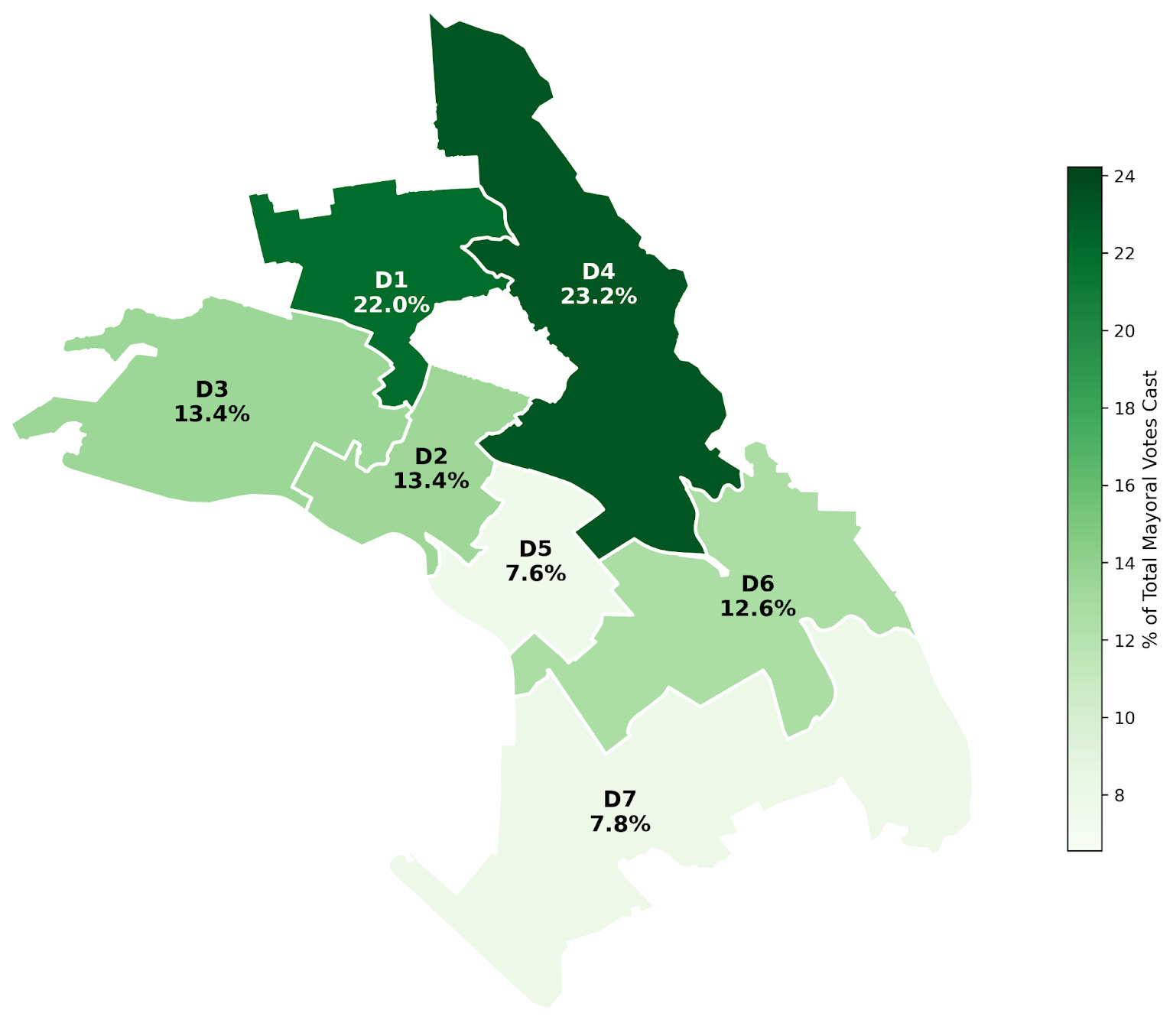
Oakland’s diversity and geography suggest that even moving the mayoral election to presidential election years—when turnout tends to be higher—wouldn’t be a panacea. In the 2024 election, Districts 1 and 4 still accounted for 41% of citywide votes. These wealthier districts have larger numbers of eligible voters, larger rates of voter registration, and higher voter turnout—even though their total populations are nearly identical to those of other districts.
These geographic voting disparities will inevitably drive disparities in the priorities and issues that the mayor hears about. Gun violence in West Oakland, sex trafficking on International Boulevard, and illegal dumping in East Oakland are serious issues, but the people who bear the brunt of those problems are the ones who live and do business in those neighborhoods. Meanwhile, nearly half of Oakland’s voters live in neighborhoods where the biggest local problem might instead be the installation of two traffic diverters,11 or whether a neighborhood peacock is a noise violation.12 Under the proposed strong-mayor system, an incumbent mayor seeking reelection will have an incentive to focus disproportionately on the concerns of the people who show up in greater numbers to vote—North Oaklanders—and be more likely to deprioritize the pressing health and safety issues of West and East Oakland.
It’s precisely because these issues are hyper-local that a district-based council-manager form of government, as recommended by the Model City Charter, is best suited to address them. Each neighborhood selects a district representative who is responsive to the community’s local needs, allowing for the priorities to be balanced—on a per-person basis—across the city.
Moving to the strong-mayor system proposed by the Mayor’s Working Group would be a step backwards for the decades of work aimed at achieving equity in Oakland.

Other gaps in the Working Group’s recommendations
These aren’t our only concerns about the proposed strong-mayor recommendations. Numerous other unanswered questions and issues remain, leaving us concerned that the report was produced without sufficient consideration for the details and complexities of Oakland’s government.
For instance, the Mayor’s Working Group recommends creating an independent legislative and budget analysts office to support the City Council. Presumably—though the report does not specify—this office would at least partially replace the current system in which each Council office employs two or three legislative staffers, often performing overlapping budget and policy analysis. We favor this more efficient, professionalized model—but it doesn’t require a charter change to make it happen. The Oakland City Charter already allows Council to set the city’s structure: they could create and fund this office when passing the June 2026 midcycle budget, without any action required by the voters.
Furthermore, the Mayor’s Working Group was silent on what the actual role of Council would be. If its recommendations are approved, the City Council would no longer be responsible for constituent services (that would fall under the Mayor’s purview) or for writing legislation (that would go to the legislative analysts’ office), while also denying them the ability to hold the city administration accountable. Yet, just as the proposal is stripping the City Council of these responsibilities, the Mayor’s Working Group proposes to change Councilmembers’ status to full-time and significantly increase councilmember pay. This makes no sense.
The proposal also fails to address several fundamental operational questions. It does not explain, for example, how department heads would be hired or fired—whether that authority would rest directly with the Mayor, remain with the City Administrator, or be delegated to other mayoral appointees. Nor does it clarify whether the City Council would retain any oversight role in department-level or deputy mayor appointments.
The proposal is similarly silent on whether the City Administrator (who, under the Working Group’s plan, would have limited oversight over a limited number of departments) would still be required to attend every Council meeting, and whether any deputy mayors would have a comparable obligation. It does not address how the Mayor’s office would manage the volume of constituent service requests that are currently handled across seven council districts. And it leaves unanswered what recourse, if any, the Council would have in the event of a “pocket veto,” where a Mayor declines or fails to implement policies or priorities adopted by the Council.
In short: the Mayor’s Working Group appears to have made a set of recommendations without fully considering or offering the all-important details. As it stands, the recommendations cannot be adopted as-is.

We still believe in the Model City Charter—because it delivers results
The Model City Charter, on the other hand, has had over 100 years of experience with these details, and real-world testing in thousands of cities across America. It addresses many of the issues that the Mayor’s Working Group identified as its priorities, and in many cases does so better than the proposed strong-mayor form of government.
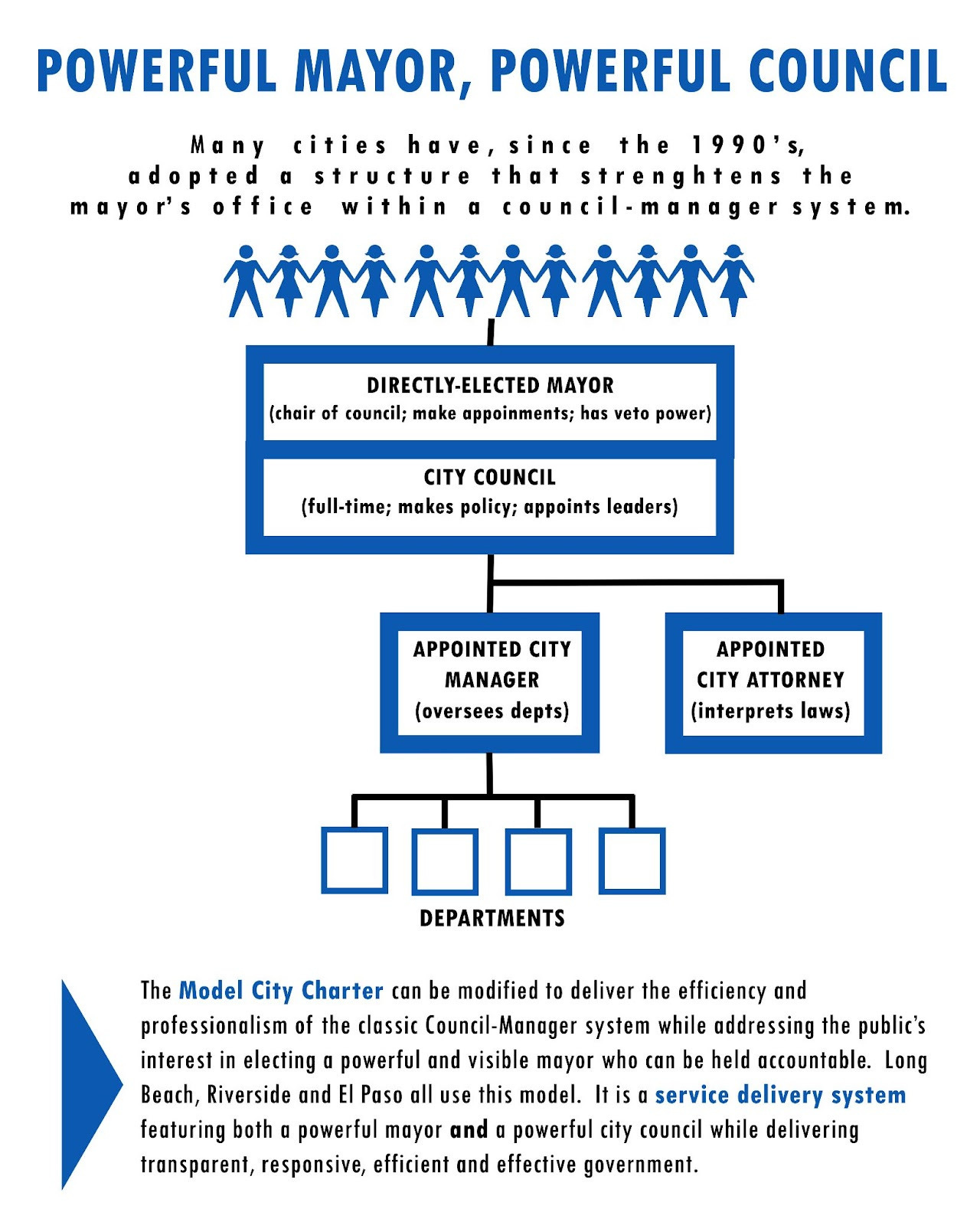
The core feature of the Model City Charter is that the city administration is run by a professional city administrator/manager, appointed by the Council as a whole (which is chaired by the Mayor). The city administrator/manager is responsible for ensuring that service delivery is aligned with the majority of the Council. Their career and professional reputation is on the line, every day, to ensure operational success and accountability for Oaklanders.
In practice, the Council-wide oversight structure in the Model City Charter encourages Councilmembers and the Mayor to negotiate and compromise in order to establish a shared strategic direction for the City. This also insulates the administration from the push-and-pull of politics: city staff can focus on delivering excellent services without worrying about the shifting priorities of individual elected officials.
The Model City Charter also has the benefit of being flexible and customizable to meet the needs of the community. Building around the core system of a unified, directly-elected City Council, led by the Mayor, overseeing a professional city administrator/manager, Oakland has the option to adopt a modified version that incorporates many of the stated goals of the Mayor’s Working Group while still retaining the benefits of professional and non-political oversight of the administration:
The Mayor can be given veto authority (like in Long Beach and other cities), which the Mayor’s Working Group believes would promote fiscal discipline.
The City Council (including the Mayor) could benefit from a new, professional legislative and budget office to provide enhanced legislative capacities.
The Mayor could be given primary responsibility for coordinating and responding efficiently to constituent service requests, working in partnership with the City Administrator’s office. Councilmembers, meanwhile, could focus primarily on developing policy and providing oversight.
This approach would meet the goals of the Mayor’s Working Group. It would better define the roles of elected officials by clarifying the distinction between the Mayor and Councilmembers. It would empower citywide leadership to address geographic disparities, provide visible executive accountability for service delivery, and simplify the administrative chain of command—while preserving professional management across city operations.
Oakland residents deserve an effective, efficient, and ethical city government. The record is clear: council-manager cities, based on the Model City Charter, are consistently found to be more efficient and responsive, have less internal conflict, and more transparency and accountability to voters than strong-mayor cities.1314
The City Council can still make a great choice that is right for Oakland. Let’s adopt a version of the Model City Charter that meets our community’s needs.
The views expressed in our Commentaries do not necessarily reflect the editorial views of Oakland Report or its contributing writers.
See these related articles about Charter Reform:


BECOME A DONATING MEMBER

We rely on our readers’ financial support to continue our work.
Your contributions are tax-deductible.
We are a 501(c)(3) charitable nonprofit based in beautiful Oakland, California. Our mission is to make truth more accessible to all Oakland residents. Learn more
Thank you!
Mayor Barbara Lee’s Working Group on Charter Reform. “Strengthening Oakland’s governance structure: recommendations for a clearer, more accountable, and more effective city government.” Jan. 29, 2026. https://www.mayorbarbaralee.com/_files/ugd/c00cba_4967c2d882694cfbaa17fe21388a74cb.pdf
Mayor Barbara Lee. “Charter reform modernization: members of the working group.” Accessed Mar. 1, 2026. https://www.mayorbarbaralee.com/charter-reform#:~:text=Members%20of%20the%20Working%20Group
Falk, Steven, et al. “Commentary: Oakland Should Return to the Model City Charter.” Oakland Report, Dec. 22, 2025. https://www.oaklandreport.org/i/182267479/oaklands-current-governmental-structure
National Civic League. “Study shows less corruption in city-manager systems” (2019): https://www.nationalcivicleague.org/study-shows-less-corruption-in-city-manager-systems/
IBM. “Smarter, Faster, Cheaper: An Operations Efficiency Benchmarking Study of 100 American Cities” (2011): https://icma.org/sites/default/files/303182_IBM%20Report%20-%20Smarter%2C%20Faster%2C%20Cheaper.pdf
Oakland’s combined general purpose and non-general purpose funds, less non-departmental expenses, are roughly $1.8 billion dollars in the FY 2026-27 budget.
See City of Oakland. “Adopted FY 2025-27 Policy Budget Expenditures by Department” June 11, 2025. https://stories.opengov.com/oaklandca/3ce39ec8-ff7a-4ac4-9b21-3d6501715f3c/published/ua7_mOgX9?currentPageId=686ea3412dc9751cf6e6ee47
The city’s finance director projects that the city’s ongoing structural deficits are forecast to be $115 million to $130 million annually through 2030. See City of Oakland. “Fiscal Year 2026-30 five-year financial forecast.” June 3, 2025. https://oakland.legistar.com/LegislationDetail.aspx?ID=7399425&GUID=59FCB8D8-076B-4ADD-83D4-C76B8B893563&Options=&Search=
Adapted from Schedler (1999) “Conceptualizing Accountability.” https://www.scribd.com/document/656169227/4-PDFsam-Schedler-1999-Conceptualizing-Accountability
Mayor’s Charter Reform Working Group. “City of Oakland community issues survey—charter reform.” January 6, 2026. https://www.oaklandreport.org/api/v1/file/365f4600-84a1-4b35-8bd1-76c06127fa83.pdf
Google Gemini query. “City manager fired California Bay Area.” Accessed Mar. 1, 2026. https://share.google/aimode/erU7yCmD3EdGpiglx
Bondgraham, Darwin. “District elections: the surprising history explaining how we vote in Oakland.” Oaklandside, Sept. 29, 2020. https://oaklandside.org/2020/09/29/district-elections-the-surprising-history-explaining-how-we-vote-in-oakland/
Fermoso, Jose. “North Oakland slow streets project is postponed after local outcry.” Oaklandside, Dec. 6, 2024. https://oaklandside.org/2024/12/06/north-oakland-slow-streets-project-is-postponed-after-local-outcry/
Roth, Rob. “Peacock polarizes Oakland neighborhood with shrill shriek.” KTVU Fox 2, July 15, 2020. https://www.ktvu.com/news/peacock-polarizes-oakland-neighborhood-with-shrill-shriek
Carr, “What Have We Learned about the Performance of council-manager Government? A Review and Synthesis of the Research” (2015). https://www.researchgate.net/publication/280915640_What_Have_We_Learned_about_the_Performance_of_council-manager_Government_A_Review_and_Synthesis_of_the_Research
Lowatcharin and Menifield, “Determinants of Internet-enabled Transparency at the Local Level: A Study of Midwestern County Web Sites” (2015). https://www.jstor.org/stable/24639088
The elephant in the room is the Public Employee Unions whose agendas override the interests of the taxpayers who foot the bill. None of these reforms will matter unless we dissolve union power. As it stands now, Oakland politicians and unions are on the same side of the negotiating table and rig the system for their benefit. Case in point: the corrupt measure to jack up property taxes based on the fraudulent financial fiction of a surplus budget.
I want to compare charter options with some use cases.
Currently, the city administrator is planning to reorganize parking without approval of council, moving parking enforcement from Transportation to Finance, and moving abandoned from Transportation to Police. City administrator states that council approval is not required, even though the current organization was determined by council.
As this post says, the council has the power to demand an informational report, which it has done so. When the first report was inadequate, further questions were asked, and another report is being prepared.
Good news is that council can continue pushing.
If council has the will, it could amend the municipal code so that the organization is specified, but council seems to believe that this is an extreme step.
Under strong mayor model, would council still have the ability to demand information report? If the mayor does not take an interest in specific city administrator's actions, what are the options? A recall seems extreme for policy disagreements.
Under Model City Charter, what would be the steps if the council does not approve of city administrator's actions? Are there council actions short of firing the city administrator?
I saw some other problems.
The working group does not seem to know how the current council and staff works. At one of the meetings, a group member stated that council members do not have staff devoted to policy. This is false. Mostly council members do have a staff member devoted to policy.
However, there were some good ideas. Strengthening council is interesting. Increasing council salary and prohibiting outside employment might be a good way to increase council involvement. Increasing money for council staff. This may be a good idea whether we go with strong mayor or Model City Charter.