



PART ONE OF A SERIES
Oakland Beat provides information and commentary on local issues that catch our attention.
Oakland Beat is written exclusively for Oakland Report supporting members, but this installment is being made available to all readers.
Become a member of Oakland Report today to receive future installments of Oakland Beat, straight to your inbox. (If you have already donated to Oakland Report: thank you.)
Join now to support our nonprofit work.
Oakland Unified School District (OUSD) is sliding back toward receivership, less than 12 months after exiting two decades of state control. Despite widespread media coverage and public discussion about OUSD’s crisis, few observers seem willing to name the political force that helped drive it to the brink: Oakland Education Association (OEA), the teachers union that has spent years donating to and campaigning for school board members friendly to its financial interests.
These same school board members — some of whom hail from union ranks and leadership themselves — now oversee OUSD’s labor contract negotiations with OEA, then approve the resulting contracts.
Reason dictates that this arrangement presents a clear conflict of interest, but OUSD and OEA are by no means outliers. This practice is routine among elected officials and the public unions that donate to their campaigns.
Notably, public employee unions get much of their funding from union dues paid by public employees through automatic deductions from those employees’ paychecks — meaning that a primary source of OEA’s income is public money provided by taxpayers.
A curious blind spot
Much has been said and written by media outlets, politicians, unions, district staff, and political commentators about the alarmingly dire state of OUSD’s finances. Some have recognized the school board’s apparent unwillingness to do the hard but necessary work of digging Oakland’s schools out of the deep budget hole they now are in.
Yet virtually all of these influential voices have declined to directly acknowledge the elephant in the room: OEA’s outsized political and financial influence on the school board, and its direct connection to the board’s reckless financial decision-making. Instead there are carefully-worded allusions that hint at, but ultimately obscure this connection, even as it sits in plain sight.
We can only speculate as to why virtually no one in a position of influence directly calls out this connection. However, it seems likely that several factors are in play:
Some influential voices may fear being labeled ‘anti-teacher’ and ‘anti-union’ — despite the fact that it is possible, and even healthy, to support teachers and unions while also insisting on fiscal accountability.
Some — especially politicians — depend on the union for financial support, not to mention the union’s considerable power to deploy its army of members to knock doors and advocate for politicians’ campaigns.
Others — such as journalists — may feel they need to maintain relationships and access to the union and its supporters in order to get information and quotes for their stories.
Some may fear potential negative repercussions to their careers and reputations — and even to their emotional and physical well-being — should the union decide to direct its considerable power and public influence against them.
See this related article:

Here we pause to make one point absolutely clear: we believe unions are important and valuable organizations for protecting workers’ interests.
Collective bargaining empowers workers to negotiate for fair compensation and safe, supportive working conditions. The list of workplace improvements labor unions have created throughout history is long, and worthy of gratitude and respect.
We also believe that teachers are part of a noble profession, held in very high regard that is well-earned through centuries of education and enlightenment to which they have dedicated their professional lives.
These are all good things that we agree with.
However, it also is a fact that no organization — indeed, no person — is immune from the corrosive effects of outsized power, disproportionate wealth, and overwhelming influence over public affairs.
Numerous studies provide examples of powerful and influential organizations — including corporations,1 local governments,2 and public employee unions3 — that abuse their power to the detriment of others, and sometimes ultimately themselves and the ideals they once held.
Proven antidotes to these corrosive effects include public scrutiny, strong and responsible oversight, sound leadership, regulatory checks, and an unwavering commitment to the highest ethical standards throughout the organization and every person involved in it.
Many organizations do have these guardrails in place, which serve to rein in the innate tendency for power to corrupt an organization.
Unfortunately, some do not.
One tactic such organizations employ is to use their outsized power and influence to remove or render meaningless the guardrails that otherwise might check their worst tendencies.
In an attempt to better understand how this situation came to pass in OUSD — and its profound effect on Oakland’s schools — we will take a closer look at the elephant in the room.
Don’t miss a beat. Become a supporting member of Oakland Report. Your donation helps us continue our nonprofit work:

Part 1
Oakland Education Association has spent over $239,000 to elect union-friendly school board members — including a former OEA leader who is now the school board president
“There is no conflict of interest between the Board and the teachers union.”
— OUSD board president Jennifer Brouhard, Jun. 24, 2025.4
“OEA stands behind the leadership of Board President Brouhard and Directors Bachelor, Latta, and Williams, whose vision reflects the moral, accountable, and responsible governance that Oakland’s students, families, Education, and communities deserve.”
— Oakland Education Association statement after the April 2025 firing of longtime superintendent Kyla Johnson-Trammell.5
Once upon a time, school board races were low-key, low-dollar affairs, typically featuring grassroots candidates who focused mainly on the nuts-and-bolts, often boring work of steering a school district’s administrative decisions.
Those days are long gone.
Today, Oakland’s school board elections are awash in special-interest money, routinely running into the hundreds of thousands of dollars.
Oakland Education Association is not the only special interest involved in these races, but OEA is unique among them for two important reasons:
OEA’s membership — nearly 3,000 teachers and other credentialed staff — form a built-in standing army of volunteers with deep personal, professional and emotional ties to everyday Oaklanders. These volunteers can do the heavy lifting of widespread in-person and social media campaigning — a critical component of any political campaign, especially in a city as large and complex as Oakland.
The school board members who accept OEA’s financial support to get elected and re-elected are in a unique position of power to directly and materially influence the financial compensation these OEA members receive — and by extension, the union dues OEA receives. This unique power is exerted through the school board’s authority over labor contract negotiations, district funding decisions, and union contract approvals.
These realities exist in many other government agencies, but they are particularly relevant to OUSD’s current budget crisis.
Over the past two school board election cycles (2022 and 2024), OEA has spent over $239,000 to help elect union-friendly school board members.
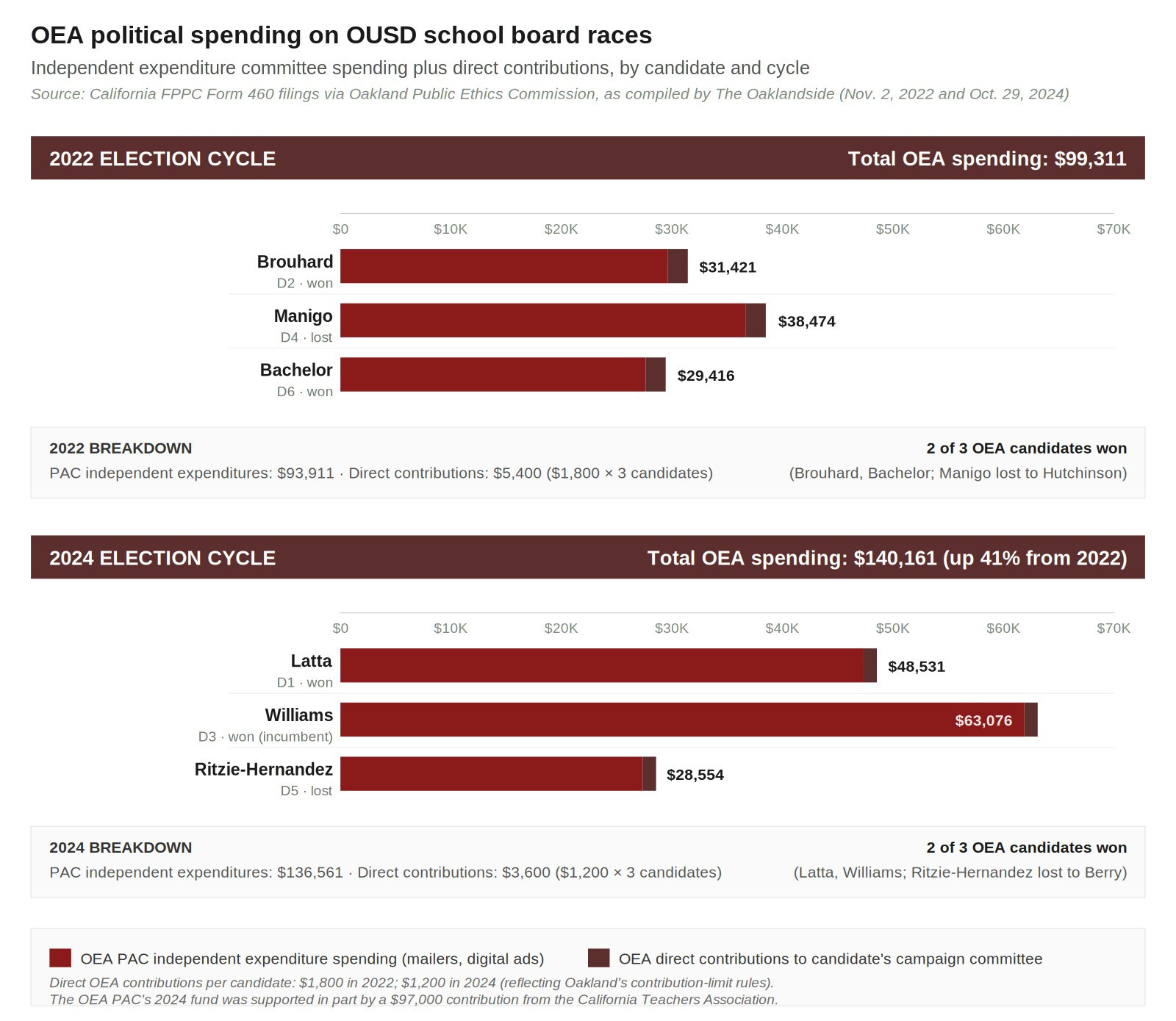
The most influential beneficiary of OEA’s support is board president Jennifer Brouhard. Before her election to the school board in 2022, Brouhard held prominent leadership roles in OEA, including three terms on the OEA executive board and one term as OEA secretary, in addition to many years as an OEA school site representative.6
According to multiple reports, Brouhard was instrumental in firing former longtime superintendent Kyla Johnson-Trammell, who successfully steered OUSD out of state receivership during her tenure7 — and installing interim superintendent Denise Saddler in her place.8
Before Saddler was named interim superintendent, she served six years as the president of OEA.9

‘A decision-making problem’
“The District does not have a revenue problem, it has a decision-making problem.”
— Alameda County Superintendent of Schools Alysse Castro, Apr. 16, 2026.10
Alameda County Superintendent of Schools Alysse Castro has repeatedly, but carefully warned the OUSD board that the district’s finances are in a profound and unsustainable budget hole that needs immediate course-correction (i.e., stop digging).
But the OEA-sponsored board majority has repeatedly ignored these warnings, most recently by promising significant pay and benefit increases to OEA members with no plan to fund those increases, seemingly inviting a return to state receivership and a loss of local control over Oakland’s schools.
Earlier this month, Castro sent OUSD an official letter written in careful, technocratic prose, warning that the district may soon be unable to pay its bills.11
Castro’s letter was a formal “Going Concern Notice” — a regulatory step that precedes a formal state takeover — signaling to the seven elected members of the OUSD board that the district’s financial situation needs immediate, drastic change.
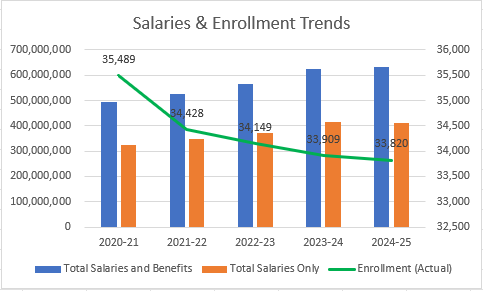
Castro’s letter says that OUSD’s main problem is that the board continues to make exorbitant financial promises with no clear plan how to fund them.
But Castro — herself an elected official — does not directly connect the district’s multi-million-dollar budget deficit to OEA’s political contributions and its extraordinary influence over OEA-backed school board members.
Even the board’s reckless approval of a new tentative labor agreement that would award teachers raises of up to 13% over two years — against the recommendations of a neutral arbiter12 that recommended raises of only 6% — did not register a direct objection from Castro.
She instead focused on the district’s lack of a sustainable plan to find the money, followed by a statistic that implied that the district has the resources to find it, despite an existential budget deficit.
“The issue is not the raises themselves, but the absence of a Board-approved, sustainable plan to support them. At over $800 million in revenue serving 34,000 students, OUSD is among the highest-funded urban districts in California.”
– Alameda County Superintendent of Schools Alysse Castro, Apr. 16, 2026.
This is not Castro’s first warning to OUSD that it is on a path to insolvency. Nonetheless, the OEA-sponsored board majority continues to ignore her warnings.
See this related article:

A flood of rhetoric and reporting – with a key blind spot
Local media outlets have widely reported Castro’s multiple warnings about OUSD’s declining enrollment and rising costs, its alarming and untenable budget deficit, and the real and present threat that the school board could forfeit local control over Oakland’s schools once again.
Media outlets have reported the board’s consistent refusal to seriously consider closing and consolidating some of its 77 severely under-enrolled school sites that could save the district up to $82.9 million in outstanding facilities needs,13 if the district were to follow its own efficiency analysis that suggested the district should only operate 46 sites.14
They have reported the board’s recent surprise backroom decision to suspend the search for a permanent superintendent after previously announcing a national search and hiring an expensive recruiting firm, preferring instead to keep the interim superintendent — herself a former OEA leader — through the fall.
See this related article:

Local media outlets have published detailed reports of the district’s financial shortfalls, while simultaneously publishing — but not challenging — quotes from school board president Brouhard saying she is “confident” the district will balance its budget yet providing no details how that will be achieved.15
They have published quotes from OEA union president Kampala Taiz-Rancifer calling the budget crisis “manufactured” — without questioning that assertion or seeking credible evidence to support it.16
Aside from a few isolated hints, neither the local media outlets covering OUSD nor other influential voices have directly addressed the materially significant connection that sits in plain view: the bloc of four school board members who were elected with OEA’s substantial financial and organizational backing.1718192021 None have fully described, nor even explored why these OEA-backed school board members continue use their authority to negotiate, fund, and approve substantial new financial benefits to OEA, driving OUSD even deeper into financial ruin.
📖
Part 2 of this series will take a deeper dive into the local media coverage, school board actions, and politicians’ rhetoric about the OUSD budget crisis — all of which carefully describe the various parts of the crisis while gliding past what is arguably its largest and most impactful element. We also will examine the tactics used by OEA and OEA-backed school board members to preserve their outsized power over OUSD. Future installments will similarly examine the role of public employee unions in Oakland City Council elections.
Don’t miss a beat. Oakland Report provides accurate, unflinching, data-driven reporting and analysis that you will find nowhere else. If you value our work, please donate. All contributions go directly to sustaining and growing our nonprofit work:
See these related articles:


Powell, John A. and Stephen Menendian. “Beyond public/private: Understanding excessive corporate prerogative.” Othering and Belonging Institute at UC Berkeley, Sept. 6, 2012. https://belonging.berkeley.edu/beyond-publicprivate-understanding-excessive-corporate-prerogative
Butler, Alexander. “Corruption and municipal finance.” SSRN, Nov. 28, 2004. https://ssrn.com/abstract=576601
McGinnis, John and Max Schanzenbach. “The case against public sector unions.” Hoover Institution, Aug. 1, 2010. https://www.hoover.org/research/case-against-public-sector-unions
Jones, Velena. "Concerns mount over Oakland Unified School District's Board of Education." NBC Bay Area, Jun. 24, 2025. https://www.nbcbayarea.com/news/local/oakland-unified-school-board-concerns/3900319/
Russell, Kiley. “Oakland school board ousts superintendent as district emerges from state receivership.” Local News Matters Bay Area, Apr. 26, 2025. https://localnewsmatters.org/2025/04/26/oakland-school-board-ousts-superintendent-as-district-emerges-from-state-receivership
Ballotpedia contributors. “Jennifer Brouhard.” Ballotpedia website, accessed Apr. 29, 2026. https://ballotpedia.org/Jennifer_Brouhard
Lee, Amber. “Oakland school board ends contract with superintendent as district exits receivership.” KTVU Fox 2, Apr. 23, 2025. https://www.ktvu.com/news/oakland-school-board-ends-contract-superintendent-district-exits-receivership
Schiavo, Christine. “OUSD names interim superintendent; outgoing leader cautions about rapid shifts at the top.” Oakland North, May 30, 2025. https://oaklandnorth.net/2025/05/30/ousd-names-interim-superintendent-outgoing-leader-cautions-against-rapid-shifts-at-the-top/
Corry, Melanie. “OUSD names former union president as interim superintendent.” CBS News, May 30, 2025. https://www.cbsnews.com/sanfrancisco/news/ousd-names-interim-superintendent
Oakland Report contributors. “‘A decision-making problem’: County schools chief warns Oakland Unified is at risk of running out of money.” Oakland Report, Apr. 21, 2026. https://www.oaklandreport.org/p/20260421-ousd-at-risk
Castro, Alysse. “Qualified Certification of 2025-26 Second Interim Budget Report with Going Concern Notice.” Alameda County Office of Education, Apr. 16, 2026. (PDF) https://www.oaklandreport.org/api/v1/file/7cbcafb5-27a3-4c65-82aa-d99af49433fc.pdf
California Public Employee Relations Board. “Factfinding report and recommendation: In the matter between Oakland Education Association, CTA/NEA and Oakland Unified School District.” Factfinding panel, Feb 19, 2026. https://perb.ca.gov/wp-content/uploads/2026/03/FR0904-1.pdf
Oakland Unified School District. “Staff report on Resolution No. 2223-0036 - Rescission of school consolidations for 2022-2023.” Board of Education special meeting, Jan. 23, 2023. https://ousd.legistar.com/LegislationDetail.aspx?ID=6004483&GUID=5D5932C3-2176-4E60-98C2-28ECAC43EB6B
DeBenedetti, Katie. “Oakland’s school merger plan has stalled, and the district’s huge deficit remains.” KQED, Dec. 12, 2024. https://www.kqed.org/news/12017719/oaklands-school-merger-plan-stalled-districts-huge-deficit-remains
Katsuyama, Jana. “Student opposition to cuts, as OUSD faces June 30 budget deadline.” KTVU Fox 2, Apr. 22, 2026. https://www.ktvu.com/news/student-opposition-cuts-ousd-faces-june-30-budget-deadline
CBS News contributors. “Oakland Unified School District budget woes prompt county intervention.” CBS News, Jan. 24, 2025. https://www.cbsnews.com/sanfrancisco/news/oakland-unified-school-district-budget-woes-alameda-county-intervention/
McBride, Ashley. “Oakland Unified school board’s new leadership faces a tumultuous year ahead.” The Oaklandside, Jan. 7, 2025. https://oaklandside.org/2025/01/07/oakland-unified-school-board-2025-brouhard-bachelor/
McBride, Ashley. “Oakland school board re-elects leadership as senior staff exit in contentious departures.” The Oaklandside, Jan. 5, 2026. https://oaklandside.org/2026/01/05/ousd-board-leadership-election-senior-staff-departures/
DeBenedetti, Katie. “Oakland schools, teachers union reach deal, avert strike.” KQED, Feb. 267, 2026. https://www.kqed.org/news/12074794/oakland-schools-teachers-union-reach-deal-avert-strike
Tucker, Jill. “Oakland teacher strike averted after union, school district reach tentative deal.” San Francisco Chronicle, Feb. 27, 2026. https://www.sfchronicle.com/eastbay/article/oakland-school-board-teacher-strike-21943885.php; https://archive.is/OPWAI
Mukherjee, Shomik. “Amid budget troubles, Oakland Unified quietly suspends search for a new superintendent.” East Bay Times, Apr. 21, 2026. https://www.eastbaytimes.com/2026/04/21/amid-budget-troubles-oakland-unified-quietly-suspends-search-for-a-new-superintendent/; https://archive.is/G4Fy4
People in the Bay Area complain incessantly and with justification about the outsized influence of billionaires on politics but, as a practical matter, it is the money and resulting influence of the public employee unions that are the cause of many of the problems of public entities like the OUSD in CA.
So grateful for Oakland Report naming the “ elephant in the room” . Hoping your next series can address “ how to bring change” to this outsized power dynamic harming Oakland’s school children.