



Our Oakland Agenda Watch column provides short summaries of key items on upcoming public meeting agendas that catch our attention. This week, we take a look at the agenda of the Oakland Unified School District (OUSD) board of education on Wednesday, December 10. The meeting starts at 4:00 p.m. at La Escuelita Education Center, 1050 2nd Avenue.
The OUSD board of education needs to close $100 million budget shortfall
OUSD board of education meeting, Dec. 10, 2025, agenda item #S.2
The Oakland Unified School District (OUSD) is confronting a projected $100.2 million structural budget deficit for the 2026-27 fiscal year, a significant increase from a prior $78 million estimate. The reduction is necessary if OUSD is to avoid sliding into state receivership and a loss of local control over spending decisions.
As Oakland Report reported on December 2, OUSD’s structural budget deficit is caused by spending more than it takes in, primarily due to operating more schools than its enrollment can support.1
At its December 10, 2025 meeting, the OUSD board of education is set to decide between two new strategies to address its $100 million budget deficit.2
The board previously directed $27 million in emergency cost reduction strategies for the current fiscal year 2024-25 (Scenarios 1 and 2) on November 19, including a $10 million hiring freeze, a six-week freeze on new contracts and expenditures, and a $7 million reduction in school site and central office budgets.3
To achieve the full reduction target in fiscal year 2025-26, the new scenarios (Scenarios 3 and 4) entail a workforce reduction of over 640 full-time equivalent employees (FTEs), a reduction of approximately 16.4%.
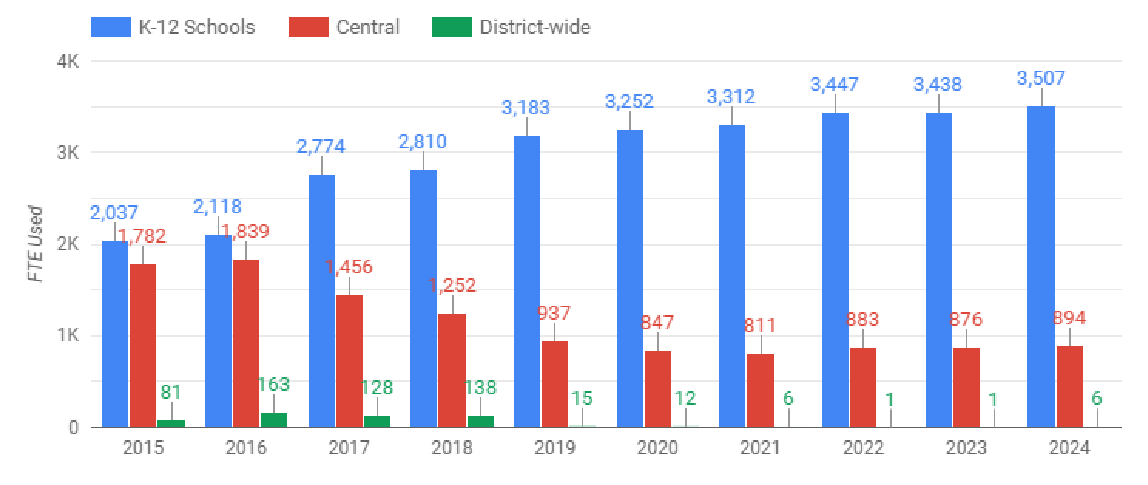
Scenario 3 proposes $103.2 million in savings through deep, organization-wide reductions, including substantial cuts to central office and school site budgets, a 10% reduction in special education, and hoped-for revenue generation from increased student attendance.
Scenario 4 incorporates the possibility of external borrowing (loans) to temporarily bridge the fiscal gap. This would delay the most severe immediate cuts but would still require district restructuring and labor negotiations to achieve long-term savings, and could prove more costly in the long run as debts are repaid over time and budget deficits pile up due to overspending.
A task force is proposed to identify strategies to increase student attendance by 2% to generate an additional $10 million in revenue from state of California education funding distributed to school districts based on attendance. This strategy was included based on board direction that, “An increase of 1% in attendance would yield approximately $5.25 million.”4
The staff report is careful to note that basing budget solutions on yet-to-materialize attendance increases that are not supported by historical data is not sound fiscal practice:
While the District continuously improves our attendance efforts, it is not a sound budgeting practice to include any desired Average Daily Attendance (ADA) increases as part of the budget solutions until the increased revenue from improved student attendance is real... Staff efforts to stabilize and increase enrollment continue, though like ADA, enrollment projections for the 2026-27 budget cannot be based on any goals we hope to achieve. To be fiscally sound, such projections need to be based on historical and demographic data.
– Dr. Denise Saddler, OUSD interim superintendent5
No school closures or consolidations – for now
Notably, neither scenario directly proposes reducing the number of school sites, but rather proposes deep cuts to existing school sites through such measures as “decreases in per-pupil allocations, and cuts to school-based program budgets such as athletics, clubs, and library services.”
The report also proposes cuts to “wellness initiatives, employee recognition events, and retirement celebrations… recruitment and employee support programs, including teacher residencies, apprenticeships, and other pipeline investments… academic internships, mentorships, and apprenticeship opportunities… specialized instructional programs, family engagement initiatives, and leadership development offerings.”
The report keeps the door open to to potential school closures or consolidations in the future:
“As part of longer-term structural adjustments, the district may consider facility closures, co-locations, or consolidations based on utilization and enrollment trends, accompanied by updates to facilities rental rates and fee structures.”
– Dr. Denise Saddler, OUSD interim superintendent6
The staff report proposes a district restructuring process that would be developed during the first six months of 2026. The process would culminate in a board vote on a comprehensive multi-year financial plan in June 2026.
Will educators continue to act like school bullies?
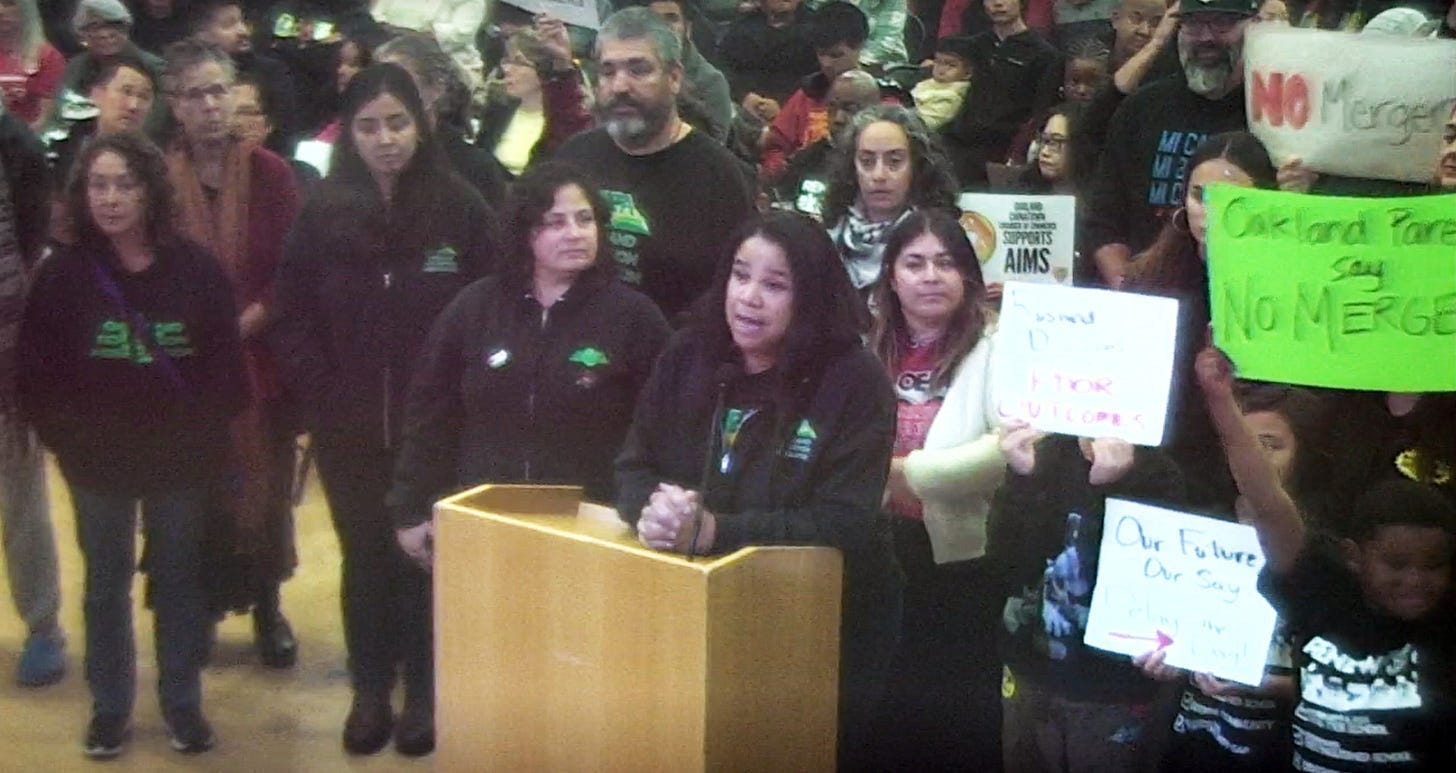
Teachers union Oakland Education Association (OEA) advocates appear dead set on derailing discussions about cost reductions that include closing or consolidating schools (which would entail teacher staff reductions) to keep the school district solvent.
Oakland Report earlier this week reported a pattern of harassment and bullying directed at people who offer public comments to consider school closures at OUSD board meetings.7
At one recent meeting, public commenters were heckled by OEA advocates with jeers and shouts of “closer” and “privatizer.” Some meeting attendees anonymously reported receiving threats of physical violence.
The advocates’ leader, OEA president Kampala Taiz-Rancifer, was a key instigator of the bullying, audibly egging it on with exclamations such as, “yeah, that’s right” and similar remarks while public commenters were being heckled.
The problem appears to be in-house at schools as well. Back in May, Oakland school principals lodged complaints that they also were experiencing harassment, intimidation and threats of retaliation from OEA members, including from the OEA president.8
One agenda is worth 1.55 million words – and 108 hours of reading
OUSD board of education meeting, Dec. 10, 2025
It would take an average adult reader 108 hours to read every word in the OUSD board of education’s December 10 agenda packet.
According to an analysis by Oakland Report, the December 10 board meeting agenda packet contains 199 distinct agenda items with a combined total of 1.55 million words. The average adult reads approximately 238 words per minute.9
A very fast reader with college-level reading comprehension can read up to 400-500 words per minute. Such readers, at 500 words per minute, might be able to read the entire agenda packet of 1.55 million words in 51.6 hours.
Speed readers who use techniques such as “chunking” and other techniques to achieve speeds of 1,000 words per minute or more might be able to read the whole agenda packet in 25.8 hours.
Many of the agenda materials include boilerplate language, headers and footers, and other rote passages that do not require close scrutiny for those who are familiar with the format and content. Let’s generously say that 50% of the December 10 agenda packet consists of such material that can be skimmed or passed over.
Even removing 50% of the words, it would still take a college-level, very fast reader 25.8 hours to read all the agenda materials for the December 10 meeting of the OUSD board of education.

The agenda itself – the document listing just the titles of the 199 agenda items – has 34,600 words. At 283 words per minute, the average adult reader would need 2.42 hours just to read the agenda, not including the 199 individual staff reports listed therein.
The December 10 agenda packet contains many substantial items on which the OUSD board will be making decisions, including:
126 legally binding contracts or agreements
38 separate budget appropriations
30 sets of formal board meeting minutes going back to February 26, 2025
A massive $100 million budget savings plan with far-reaching implications for the future of OUSD.
One wonders if any one person, including board members and staff, has actually found the time and attention to read the agenda packet in its entirety before these items are approved. If so, we commend them.
However, the time demands of everyday life, not to mention the laws of physics, suggest that this is unlikely.
Oakland Report is by no means comprehensive in our coverage of public meetings in Oakland. The scope and frequency of public meetings are far more than we can presently cover. You can review the full OUSD board agenda and all 199 items on deck for the December 10, 2025 OUSD board meeting on OUSD’s meeting calendar.
See these related articles about OUSD’s budget crisis:


Do you have a tip about an Oakland agenda item that you think should get a closer look? We want to hear about it! Contact us at oaklandreport@citizensoakland.org.
Borek, Bob. “Oakland schools budgeting 101: how OUSD spends money.” Oakland Report, Dec. 2, 2025. https://www.oaklandreport.org/p/oakland-schools-budgeting-101-how-d33
Saddler, Denise. “Update on Resolution 2526-0177A: Directing the Preparation of Budget Scenarios to Address OUSD’s Structural Deficit.” OUSD Board meeting agenda. Oakland, California, Dec. 10, 2025, agenda item S-2. https://ousd.legistar.com/View.ashx?M=F&ID=15013996&GUID=117A3C7C-93A7-4ADF-A5A2-51DB42216A48
Ibid. Saddler, Denise.
Brouhard, Jennifer and Valerie Bachelor. “Resolution Directing the Preparation of Budget Scenarios to Address District’s Projected Fiscal Years 2026-27 and 2027-28 Structural Deficit.” OUSD Board meeting agenda. Oakland, California, Sept. 24, 2025. https://ousd.legistar.com/View.ashx?M=F&ID=14956506&GUID=E8F470CF-C0B1-4051-8189-35D3D277AE84
Ibid. Saddler, Denise, p. 5
Ibid. Saddler, Denise, p. 14
Reinhart, Sean S. “Commentary: When educators become school bullies.” Oakland Report, Dec. 7, 2025. https://www.oaklandreport.org/p/20251207-when-teachers-become-school-bullies
DeBenedetti, Katie. “In Oakland Schools, Hostility Spirals Between Teachers Union and Principals.” KQED, May 14, 2025. https://www.kqed.org/news/12039972/oakland-schools-hostility-spirals-between-teachers-union-principals
Brysbaert, Marc. “How many words do we read per minute? A review and meta-analysis of reading rate.” Science Direct, vol. 109, December 2019. https://www.sciencedirect.com/science/article/abs/pii/S0749596X19300786