



Our Oakland Beat column provides updates and commentary on recent events that catch our attention. It is distinct from Agenda Watch which focuses on communication and analysis of the Oakland City Council agendas
The other day I had lunch with a colleague who recently took the reins of a long-running student-run newspaper in the area. As we regaled each other with the wild tales we have encountered in local government, they asked me — why do Oaklanders put up with their government being such a dumpster fire?
I replied that it’s because Oaklanders have lived with governmental incompetence and craziness for decades. It’s our upbringing – the only world we know. We cook our hot dogs on that dumpster fire.1 Our kids grew up with that dumpster fire.2 It’s become an Oakland institution and a main attraction, like sideshows3 and dumping trash.4
People have built entire careers around Oakland’s dumpster fire government – journalists, politicians, nonprofits, not to mention the government employees themselves. Its light and heat and energy sustain an entire ecosystem, including Oakland Report. I joked but in all seriousness, if Oakland’s government did a better job at providing the fundamental services it exists to perform – safety, cleanliness, stewardship of the public trust – there would be no need for Oakland Report.
When teachers become school bullies
Oakland Unified School District (OUSD) is facing an over $100 million budget shortfall caused by spending more than it takes in, primarily due to operating more schools than its enrollment can support.5
At an OUSD board of education meeting on November 19 to discuss the budget deficit, parents who offered public comments to consider school closures were heckled by teachers union Oakland Education Association (OEA) advocates with jeers and shouts of “closer” and “privatizer.”
The advocates’ leader, OEA president Kampala Taiz-Rancifer, was a key instigator of the bullying, audibly egging it on with exclamations such as, “yeah, that’s right” and similar remarks while public commenters were being heckled.
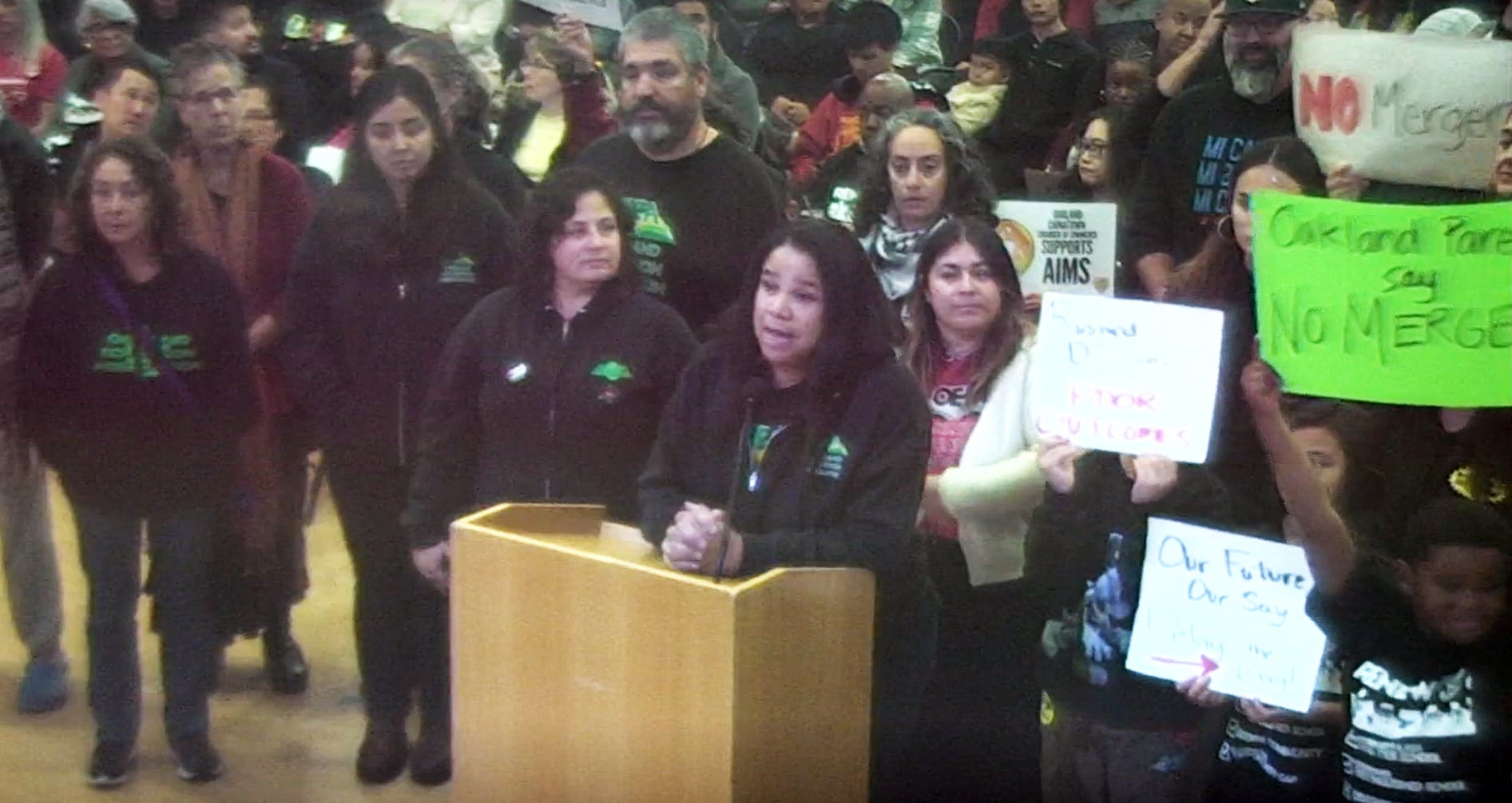
One parent who regularly attends school board meetings contacted Oakland Report anonymously. When they spoke in support of cost reductions through school closures, one of the OEA advocates sat directly behind them and repeatedly uttered physical threats to them, such as that they would slap them in the face if they turned around.
When the parent reported this behavior in an email to board president Jennifer Brouhard, her response was that she “will be taking steps” to address the behavior in the future – a virtually identical response to one Brouhard gave to the parent in January when they reported a similar incident they experienced at a school board meeting. (Brouhard did offer a few rote remarks at a subsequent meeting asking people to maintain decorum.)
As of this writing, three other community members have independently reported to Oakland Report that they experienced similar threatening encounters with OEA advocates at Oakland public meetings, about which officials did nothing material.
The problem appears to be in-house at schools as well. Back in May, Oakland school principals lodged complaints that they, too, were experiencing harassment, intimidation and threats of retaliation from OEA members, including from the OEA president.6

Dialed out: Mayor Barbara Lee refuses to cast a tie-breaking vote
As we reported on November 4, the city council is set to amend the Council’s Rules of Procedure for meetings, most notably by allowing non-consent agenda items to start earlier than 5:00 p.m.
This change, if implemented would allow the council to take votes on issues or decisions that are controversial, or that require in-depth discussion, or that may attract significant public interest during standard daytime work hours when it is more difficult for working people to attend and participate in the meetings.
The city’s stated intent for this change is to make the council meetings more “orderly and efficient,” presumably because numerous public comments, combined with the extended rhetoric of council members and staff often can stretch council meetings late into the night.
The issue is controversial for obvious reasons. The city council has so far held five separate meetings in attempts to push the change over the finish line, but deadlocked when the issue came up for a final vote on November 4. This meant that mayor Barbara Lee would need to cast a tie-breaking vote.
That tie-breaking vote was set to be cast by the Mayor on December 2. But rather than perform one of the few jobs of substance the office requires, she balked. According to the meeting minutes, “The Mayor declined to break the tie.”7
When city council asked if the mayor would be casting a tie-breaking vote as planned, the mayor did not appear in the council chamber. After a pause, the mayor’s deputy chief of staff Preston Kilgore appeared to offer these remarks:
“The mayor requested me to come down and share that she does not intend to vote on the pending motion… The mayor prefers to defer to the city council on their own rules of procedure and therefore will not be weighing in today, but thank you all for now.”
— Preston Kilgore, deputy chief of staff to Mayor Barbara Lee8

Orinda leaves Oakland in the dust on fixing potholes
It takes a certain special skill to safely navigate Oakland’s streets. One must always be alert to wayward pedestrians, kamikaze cyclists, piles of trash, broken down vehicles and makeshift shacks spilling into the right-of-way, not to mention potholes big enough to roast a pig in.
I take it as a personal failure when I let my mind wander for a moment, only to be jarred painfully back to reality by the sickening thump of my car tire slamming into an asphalt crevasse at 35 miles per hour.
But whose fault is it, really?
By one estimate, the city of Oakland paid out over $35 million in legal settlements for its dangerous road conditions between 2013 and 2023 – the most of any Bay Area city.9
Since then, the city has continued to suffer big financial hits from road-related lawsuits. These include a $2.95 million settlement to a teenager who was struck by a car while in a marked crosswalk,10 and a $7 million settlement to a bicyclist who was injured after being upended by a pothole.11
To look at the impacts of the city’s legal losses from another perspective, the $35 million Oakland paid in road-related settlements could otherwise have been spent to completely repave approximately 35 miles of Oakland’s total 831 miles of roads.12
According to an Alameda County Grand Jury report, the City of Oakland fixed around 53,000 potholes in fiscal year 2023-24. This was a marked improvement over its past performance of fixing only around 80,000 potholes in the entire ten-year period from 2008-2018.13
But despite this improvement above the dismal, Oakland’s pothole problems remain deep and persistent,14 and work on fixing them has recently slowed due to the city’s fiscal mismanagement and inability to issue the infrastructure bonds voters approved to fund the repairs.15
See this related article:

Road conditions are graded according to a standardized 100-point scale known as the Pavement Condition Index (PCI). A rating of 100 indicates a well-constructed, freshly paved road. A rating below 50 is “Poor” – the academic equivalent of a failing grade, and a real-world hazard to life, limb and property.
From 2005 to 2023, Oakland’s average PCI rating consistently fell within the “At Risk” range between 50 to 59 — a condition in which rapid road deterioration takes hold, and is far more difficult and costly to correct.
In 2021, Oakland’s PCI rating was 52 — barely above the “Poor” range. Two years later in 2023, after an intense burst of repaving funded by hundreds of millions of dollars in voter-approved tax increases on Oakland property owners, Oakland’s PCI rating had improved to 57 – better, but still in the “At Risk” range.
By comparison, in 2023 most other Alameda County cities had PCI ratings between 70 and 79 — in the “Satisfactory” range. Alameda County as a whole had an average PCI rating of 67 — in the “Fair” range.16
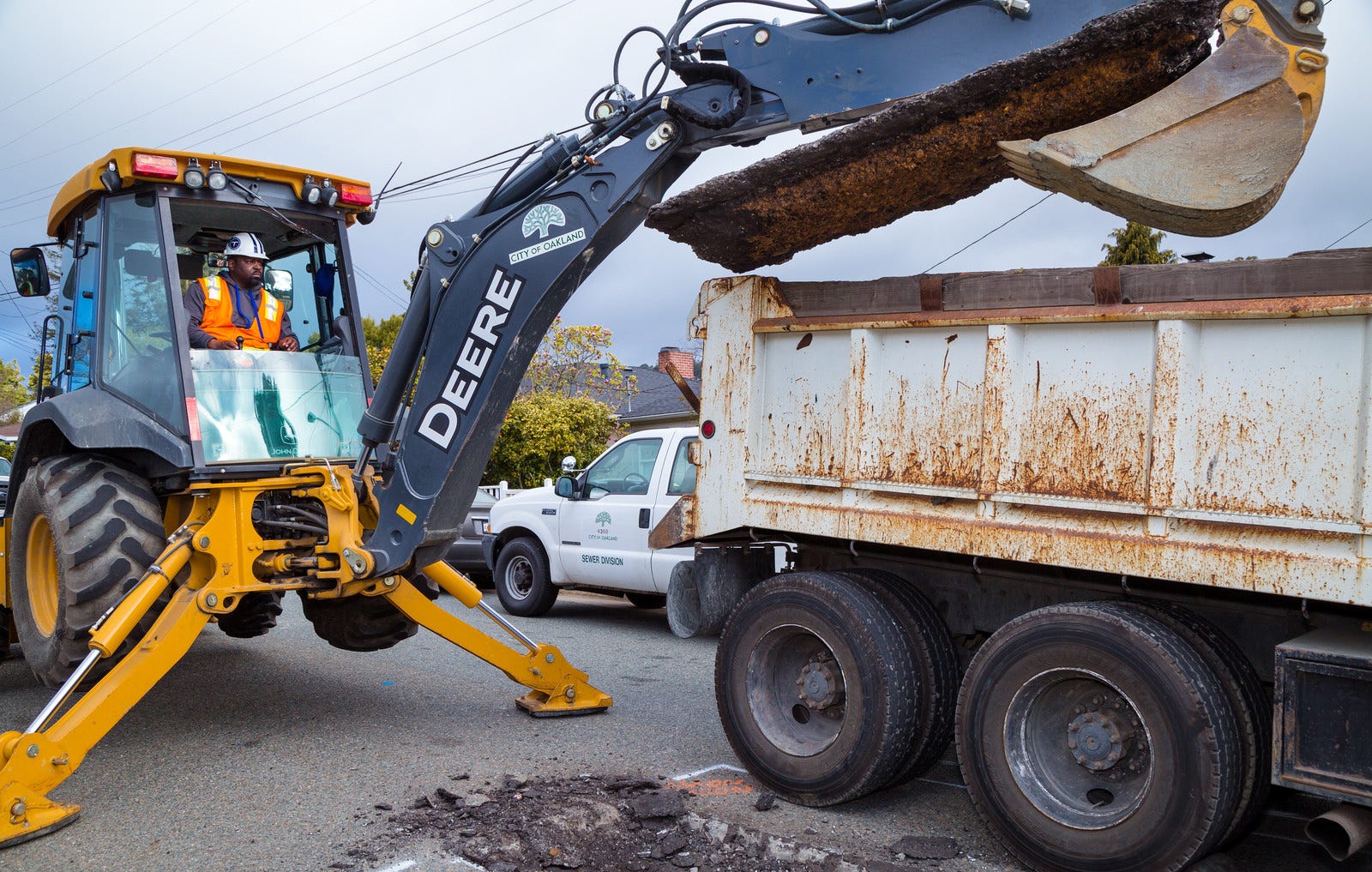
Meanwhile in neighboring Orinda: Back in 2012, Orinda’s PCI rating was even worse than Oakland’s at a dismal 48 — in the “Poor” range. But a decade later in 2023, Orinda’s PCI rating had vastly improved to 84 — in the “Good” range.
This was due to a decade of committed and sustained effort by that city to fulfill the promise it made to its voters who approved sales tax and property tax increases to fix Orinda’s public roads.17
If Orinda can do it, why can’t Oakland? It can’t just be the difference in median income and tax revenue between the two cities. The City of Orinda’s operating budget is a fraction of Oakland’s. Orinda’s total operating expenditures in FY 2023-24 were a paltry $27.9 million18 compared to Oakland’s $1.66 billion.19
Oakland is a city of stunning beauty, rich culture, and mesmerizing craziness. I love it dearly. I can’t imagine living anywhere else but Oakland, California, and I hope I never leave it.
Even when teachers become bullies who appear dead set on derailing serious discussions about keeping our school district solvent and sustainable for Oakland’s children.
Even when the mayor decides not to cast an important tie-breaking vote and doesn’t even bother to appear in person to explain why.
Even after a heavy rain opens up hundreds of new potholes, requiring me to expand my mental map of Oakland’s road hazards yet again.
Even when I receive a whopping bill to repair my car’s suspension, on top of the hefty tax bill I receive to fix the streets that contributed to the damage.
I remain, like so many other Oaklanders. And I probably always will. This is our home, and for many of us it is the only home we know. I just move my chair a bit further upwind, break out the hot dogs and warm myself by the fire yet again.
The views expressed in our Commentaries do not necessarily reflect the editorial views of Oakland Report or its contributing writers
ABOUT THE AUTHOR
Sean S. Reinhart has 25 years of experience in local government, including 15 years in executive roles serving the cities of Hayward and Menlo Park. He spent his professional career working to improve people’s lives through civil service. Prior to his government career, he edited and published underground magazines, most notably The Free Press Death Ship and Spunk: the Journal of Spontaneous Creativity. He enjoys exploring California’s world-renowned coastline, valleys, deserts and mountains. His creative pursuits include writing, printmaking, carpentry, music and visual arts. A librarian by profession, he spends most of his days in close proximity to books.
Reinhart, Sean S. “‘Death and Taxes’ - Oakland City Council is the one who knocks.” Oakland Report, Oct. 27, 2025. https://www.oaklandreport.org/i/177138269/death-and-hot-dogs
Borek, Bob. “Oakland Unified School District must cut at least $115 million in the next two weeks to avoid state receivership.” Oakland Report, Oct. 26, 2025. https://www.oaklandreport.org/p/oakland-unified-school-district-must
Russell, Kiley, “Car set on fire during weekend sideshow in Oakland.” NBC Bay Area, Aug. 25, 2025. https://www.nbcbayarea.com/news/local/weekend-sideshows-oakland/3938252/
Karlamangla, Soumya. “How a city awash in garbage is trying to take out the trash.” New York Times, Oct. 8, 2025. https://www.nytimes.com/2025/10/08/us/oakland-california-trash-garbage.html
Borek, Bob. “Oakland schools budgeting 101: how OUSD spends money.” Oakland Report, Dec. 2, 2025. https://www.oaklandreport.org/p/oakland-schools-budgeting-101-how-d33
DeBenedetti, Katie. “In Oakland Schools, Hostility Spirals Between Teachers Union and Principals.” KQED, May 14, 2025. https://www.kqed.org/news/12039972/oakland-schools-hostility-spirals-between-teachers-union-principals
City of Oakland, Concurrent Meeting of the Oakland Redevelopment Successor Agency and the City Council. “Meeting Minutes, November 4, 2025.” Adopt A Resolution Amending And Restating The Council’s Rules Of Procedure In Their Entirety In Order To (1) Assure Council Meetings Run In And Orderly And Efficient Manner; (2) Allow For Non-Consent Items To Be Heard Earlier In The Meeting; (3) Create An Additional Presiding Officer Position To Serve As Presiding Officer In The Absence Of The Council President; And (4) Make Non-Substantive Technical Edits. Oakland, California, November 4, 2025, p. 19, item 9. https://oakland.legistar.com/View.ashx?M=M&ID=1350392&GUID=23CCF235-57F8-4873-8071-A4DBA1584C83
City of Oakland, Concurrent Meeting of the Oakland Redevelopment Successor Agency and the City Council. “Meeting Video, November 4, 2025,” 2:37:21 - 2:38:00. Oakland, California, agenda item 9. https://oakland.granicus.com/player/clip/7152?meta_id=625299
Fernandez, Lisa. “Oakland to pay bicyclist $7M in record pothole settlement.” KTVU Fox 2, Sept. 30, 2025. https://www.ktvu.com/news/ty-whitehead-oakland-pays-bicyclist-7m-record-pothole-settlement
City of Oakland. “Letter from City Attorney Barbara Parker to City Council.” Tyler Phal by and through his Guardian Ad Litem, Roeuth Phal v. City of Oakland, Liu Weilin, and DOES 1-100 Alameda County Superior Court Case No. RG21115007 City Attorney File No. 34586 (Department of Transportation – Dangerous Condition). Oakland, California, July 16, 2024. https://oakland.legistar.com/gateway.aspx?M=F&ID=8b856844-c309-4c3b-9c60-717a58c0e722.PDF
City of Oakland. “Letter from City Attorney Ryan Richardson to City Council.” Ty Whitehead v. City of Oakland, County of Alameda, State of California, and Does 1-100 Alameda County Superior Court Case No. RG18896233 City Attorney File No. 32322 (Oakland Department of Transportation – Dangerous Condition). Oakland, California, Oct. 7, 2024. https://oakland.legistar.com/View.ashx?M=F&ID=14818675&GUID=AA8273C5-A18A-4E25-B86D-718B10F6C773
Anthony, Laura. “Oakland launches ‘The Great Pave’ funded with $100 million from Measure KK.” ABC 7 News, Aug. 22, 2019. https://abc7news.com/post/oakland-launches-the-great-pave/5486250/
2024-2025 Alameda County Grand Jury Final Report. Alameda County Superior Court. Oakland, California, June 20, 2025. https://grandjury.acgov.org/wp-content/uploads/2025/06/2024.2025-Alameda-County-Grand-Jury-Final-Report.pdf
Gardner, Tim. “The inequitable equity of Oakland paving.” Oakland Report, Mar. 11, 2024. https://www.oaklandreport.org/p/the-inequitable-equity-of-oakland
Reinhart, Sean S. “Oakland can’t sell infrastructure bonds approved by voters due to fiscal mismanagement, Grand Jury reports.” Oakland Report, Nov. 3, 2025. https://www.oaklandreport.org/p/oakland-cant-sell-infrastructure
Ibid. Alameda County Grand Jury Report 2024-25.
Biggs, David. “A decade of work means good roads in Orinda.” Contra Costa Herald, Oct. 17, 2023. https://contracostaherald.com/a-decade-of-work-means-good-roads-in-orinda/
City of Orinda. “Annual Comprehensive Financial Report For the Fiscal Year Ended June 30, 2024.” Orinda, California, p. 24. https://www.cityoforinda.gov/ArchiveCenter/ViewFile/Item/160
City of Oakland, “Annual Consolidated Financial Report, 2024,” p. 25. City of Oakland. https://www.oaklandca.gov/files/assets/city/v/1/finance/documents/financial-reporting/annual-comprehensive-financial-reports/2024-city-of-oakland-acfr_final-121324.pdf
Sean, I think you are shining a spotlight on a very troubling trend, especially here in Oakland. How political special interest forces like a teacher's Union act like a violent mob perpetuating their own incompetence and disturbing agenda.
Hi Seneca— you have a point about the mayor’s non-action not necessarily being related to Oakland’s odd governance structure, although I think your point would have been stronger had you not followed up with a personal attack that seems more likely to result in people pulling back from the conversation than engaging in it :)