


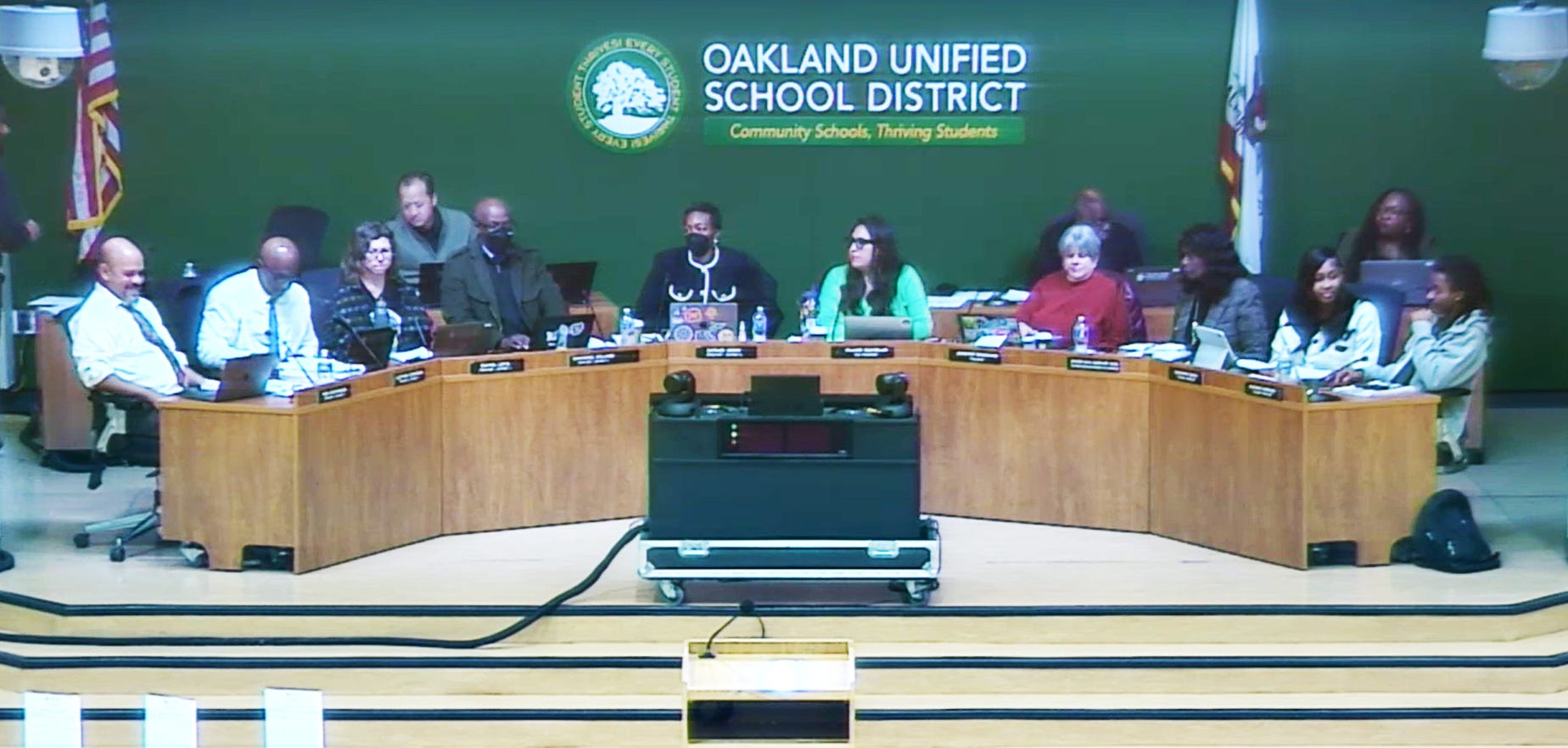
Oakland Report is covering the Oakland Unified School District (OUSD) board of education’s efforts to close an over $100 million budget deficit and avoid a slide back into state receivership. In this installment, we review the OUSD board meeting on December 10.
The Oakland school board pushed through a contentious budget reduction scenario on a 5-2 vote late Wednesday night, with dissenting members pushing for more financial details and concrete timelines for implementation that ultimately were not approved.1
The board approved “Scenario 3”, which plans to identify budget cuts totaling $102.5 million, including $32 million in reductions to school site budgets, corresponding to 7.5-10% expenditure reductions across school sites. The exact nature of those reductions are yet to be determined.
Scenario 3 includes hoped-for new revenues of $10 million by increasing attendance by 2%, despite the superintendent’s report warning that this is not sound financial practice. And it includes more than $12 million in accounting moves that shift unrestricted costs to restricted funds.
The dissenting board members (Mike Hutchinson and Patrice Berry) objected to the lack of financial detail, and expressed concerns about the risks of implementing cuts without a granular plan and a concrete timeline. Hutchinson introduced an amendment pushing for more financial details and concrete dates, but he did not succeed in persuading a majority of the board to support his motion.
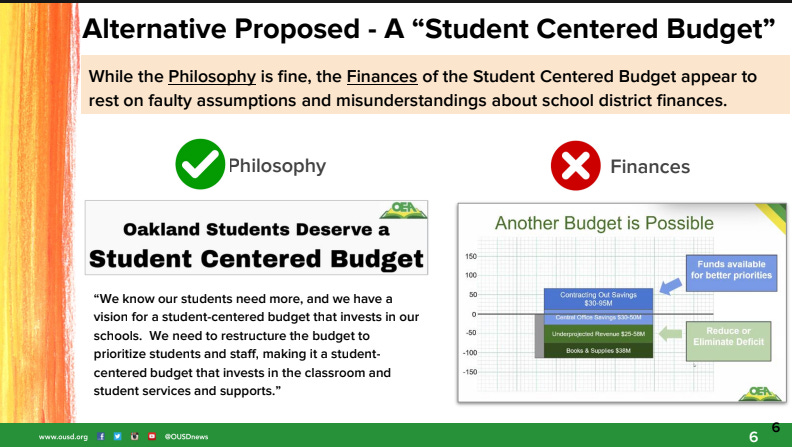
Prior to the meeting, teacher’s union Oakland Education Association (OEA) sent an email to its members claiming that “there is no structural deficit” and accusing the school district’s chief business officer Lisa Grant-Dawson of “blatant insubordination” for preparing a December 3 presentation explaining that while the OEA’s push for a “student centered budget” promotes a valid philosophy, the math doesn’t add up.2
Board makes forward progress, but details are scant
At the November 19 board meeting, budget staff identified $21 million in potential reductions to the central office – far short of the $100.5 million reduction target – and the board directed interim superintendent Denise Saddler to prepare additional scenarios that include reductions beyond the central office.3
In response, Saddler and her staff proposed two new scenarios on December 10: one focused on significant reductions across OUSD (“Scenario 3”); and one that included external borrowing (loans) to temporarily bridge the fiscal gap (“Scenario 4”).
Video clip 1. OUSD staff Troy Christmas presents the budget scenarios prepared at the board’s direction:
Scenario 3 was approved 5-2, with Hutchinson and Berry dissenting due to its lack of detail or concrete timelines. Board member Clifford Thompson echoed these concerns, but ultimately voted with the union-backed majority4 of the board.
The details of the cuts are to be determined in collaboration with school communities and school site leaders. Saddler and her staff indicated that the cuts will represent 7.5-10% reductions in school site budgets.
In addition to the cuts to school sites — while keeping all current schools open — Scenario 3 proposes finding an additional 15-20% of reductions from the central office beyond the $21 million previously identified on November 19.
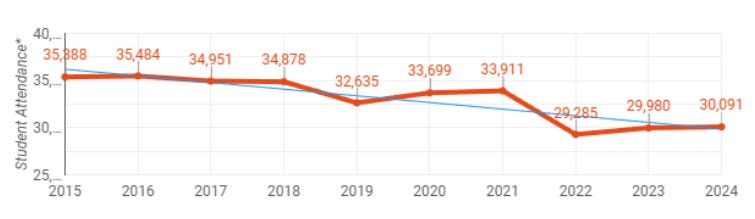
Consistent with the direction provided by the board on November 19, it also proposes generating $10 million in additional revenue by increasing attendance by 2%, although the superintendent’s report warns that this is not sound budgeting practice because it is not supported by historical and demographic enrollment data.
More than $12 million in general fund savings will come from shifting expenses from unrestricted into restricted categories, which on paper reduces the burden on the unrestricted general fund. Saddler’s report points out that shifting expenses to restricted funds has been a consistent historical accounting practice that has reached “a point of saturation” and doesn’t address the structural deficit.
In addition to laying out the two scenarios requested by the board, Saddler recommended developing a broader restructuring process from January through June 2026, during which time the district would seek extensive community engagement to culminate in a board vote on a multi-year restructuring plan in June 2026. The board took no action on this recommendation.
The board minority pushed unsuccessfully for more detail and specific timelines
Hutchinson introduced an amendment calling for detailed plans to be presented to the board at their next meeting on January 14 for how to achieve the $27 million in savings identified for fiscal year 2025-2026, and at the meeting on January 28 to address the over $100 million fiscal year 2026-2027 shortfall.
Video clip 2: Board member Mike Hutchinson presents his amendment to identify specific timelines:
Berry and Thompson voiced support for Hutchinson’s amendment. Berry noted that the proposed scenario is “vague” and expressed concern that once the superintendent and her staff get into the details of implementation, they might realize that this approach is “not feasible.” Hutchinson’s amendment failed on a 4-3 vote.
Teacher’s union OEA sent an email to its members claiming that there is no structural deficit
OEA sent an email to its members before the board meeting claiming that “OUSD does not have a structural deficit.” The union said that OUSD is overstating the deficit by $80 million by over-projecting expenditures and under-projecting revenues, which OEA said it has verified through “in-depth analysis.”5
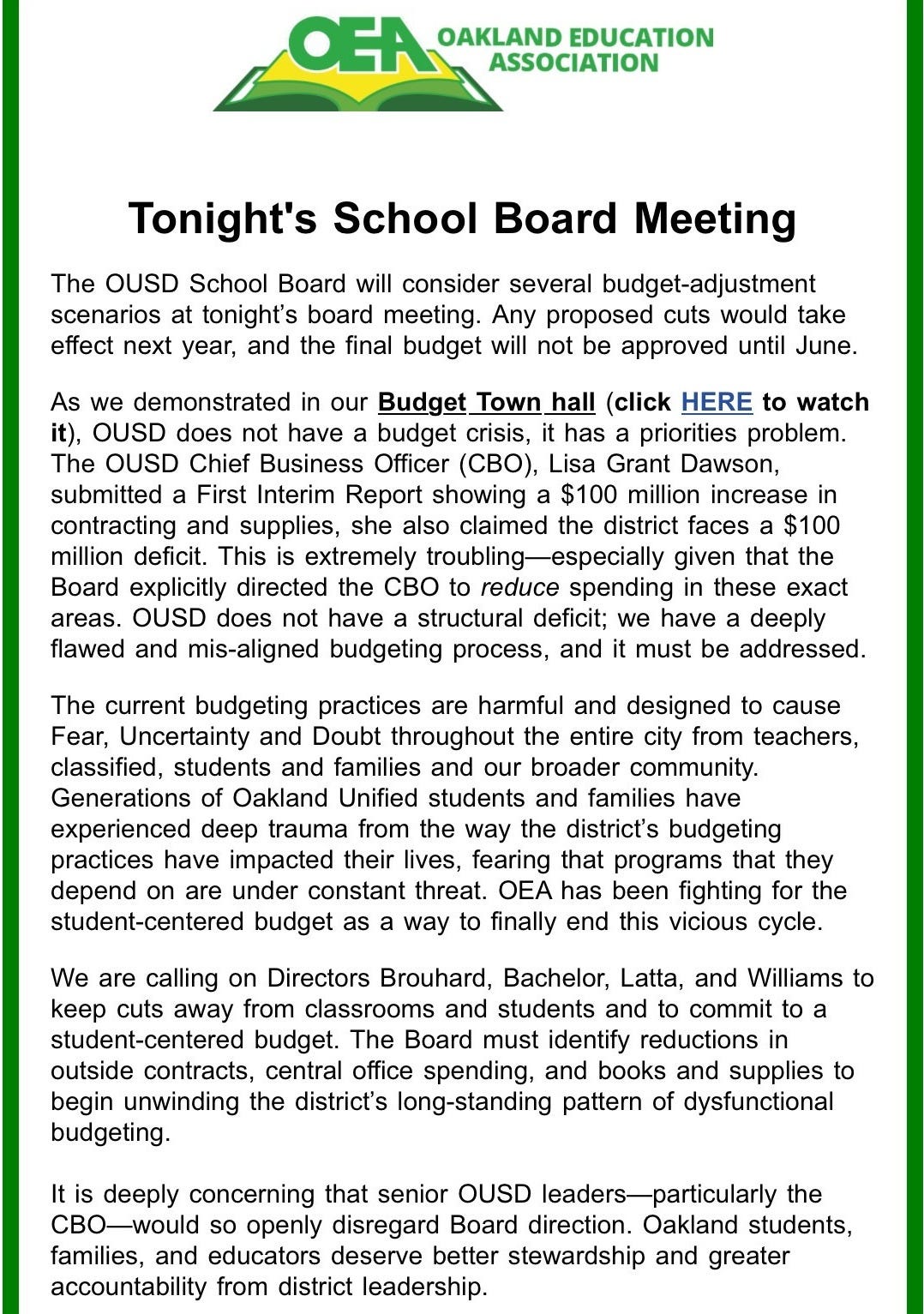
The OEA email alleged that Grant-Dawson “committed an act of blatant insubordination against the democratically elected leadership of the OUSD school board” by preparing a presentation for the December 3 board meeting, which ultimately was cancelled, that was not aligned to OEA’s proposal encouraging deeper cuts to the central office instead of to school sites.
See this related article:

Grant-Dawson’s cancelled December 3 presentation outlined how OEA’s push for a “student centered budget” is based on a valid philosophy, but rests on faulty assumptions and a misunderstanding of school district finances. Among other things, the presentation stated that OEA’s “student centered budget” mistakenly assumes that savings from restricted and supplemental funds can reduce the unrestricted deficit, and that re-characterizing expenses changes total spending.
The “student centered budget” put forward by OEA also proposed cutting 75% of management at OUSD, which Grant-Dawson characterized as “likely unrealistic.”
Grant-Dawson never gave the December 3 presentation and the analysis in the presentation was not shown at Wednesday’s board meeting.
While OEA did not comment during the December 10 board meeting, its language was echoed from the dais by board members Jennifer Brouhard and Rachel Latta, who referenced a “care-centered budget.”
In an expression of frustration, board member VanCedric Williams claimed that Hutchinson did not address the budget deficit during Hutchinson’s time as board president in 2023, and that Hutchinson opposed school closures in 2022 that might have helped to alleviate the deficit — a retort to Hutchinson’s current position that OEA advocates have repeated on multiple occasions.6 Echoing the OEA email, Williams claimed that Hutchinson’s current debate technique is to create “fear, uncertainty, [and] doubt.”
The board’s next meeting is on January 14, 2026.
You can support our work by donating to Oakland Report.
We are a nonprofit charitable 501(c)(3) organization.
Our mission is to provide reasoned, evidence-based, and well-sourced analyses and critiques of the policies, actions, and inactions of our local government.
Your donation in any amount helps us continue to produce more articles like this one.
Thank you.
Oakland Unified School District. “OUSD board of education meeting.” Presentation By The Superintendent Of Schools, Or Designee, And Discussion With The Board Of Education, And Possible Further Direction (Votes Or Otherwise) By Board, Scenarios, Without Restriction, That Will Result In The District’s Budgets For Fiscal Years 2025-2026, 2026-2027 Being Balanced, As Required By Resolution No.2526-0177a, As Amended. Oakland, California, Dec. 10, 2025, agenda item #S-2. https://ousd.legistar.com/LegislationDetail.aspx?ID=7774308&GUID=56790DE6-2E1E-4AC1-AAC5-B350DE16B3D7&Options=&Search=
Oakland Education Association. “OEA Updates.” Email to OEA members. Dec. 10, 2025.
Oakland Unified School District. “OUSD board of education meeting.” Presentation of Budget Scenarios - OUSD Structural Deficit - Fiscal Years 2025-2026; 2026-2027. Oakland, California, Nov. 19, 2025, agenda item H-1. https://ousd.granicus.com/player/clip/2794?meta_id=1019365
DeBenedetti, Katie. “OUSD just got control of its finances back from the state. It’s already in major trouble.” KQED, Sept. 19, 2025. https://www.kqed.org/news/12055977/ousd-just-got-control-of-its-finances-back-from-the-state-its-already-in-major-trouble
Oakland Education Association. “OEA Updates.” Email to OEA members. Dec. 10, 2025.
Karlamangla, Soumya. “Oakland district weighs closing schools amid budget shortage.” New York Times, Feb. 2, 2022; updated Feb. 7, 2022. https://www.nytimes.com/2022/02/02/us/oakland-unified-school-closures.html