



Editor’s note
Oakland Report readers have often asked, how many Oakland city employees actually reside in Oakland? This information is relevant to Oaklanders for several reasons, not the least of which being that city workers are public servants who ultimately work for us.
But perhaps the most important reason why the residency of Oakland city workers is relevant at this moment is this: the city’s public employee unions are spending heavily on a political campaign to increase taxes on Oakland residents, again.
See this related article:

The city of Oakland does not provide comprehensive data about the number of city employees who live in Oakland— and therefore how many city workers pay taxes here, own or rent housing here, and spend more of their income in our community. Any such disclosure would be voluntary on the part of the city, as state law shields this information from public view. (Some jurisdictions voluntarily release this information.)
Despite the absence of public data, internal city policies confirm that Oakland residency is actively tracked and incentivized. Memorandums of Understanding (MOUs) with major unions, such as SEIU Local 1021, explicitly outline residency preference points for hiring examinations, and establish committees to encourage local residency among city workers.12
Furthermore, the city maintains precise workforce denominators, tracking budgeted Full-Time Equivalent (FTE) positions across various bargaining units as of early 2026.3
In the absence of comprehensive, transparent data from the city to address the question of how many city employees actually live in Oakland, this analysis takes a closer look at the available data across multiple authoritative sources to find an answer.
We invite the City of Oakland to produce its own report on this important question, perhaps through the Office of the City Auditor. Meanwhile, until the city does so, let this analysis stand as the best available estimate of how many city employees actually live in Oakland.
Why residency matters: the fiscal, service, and community stakes
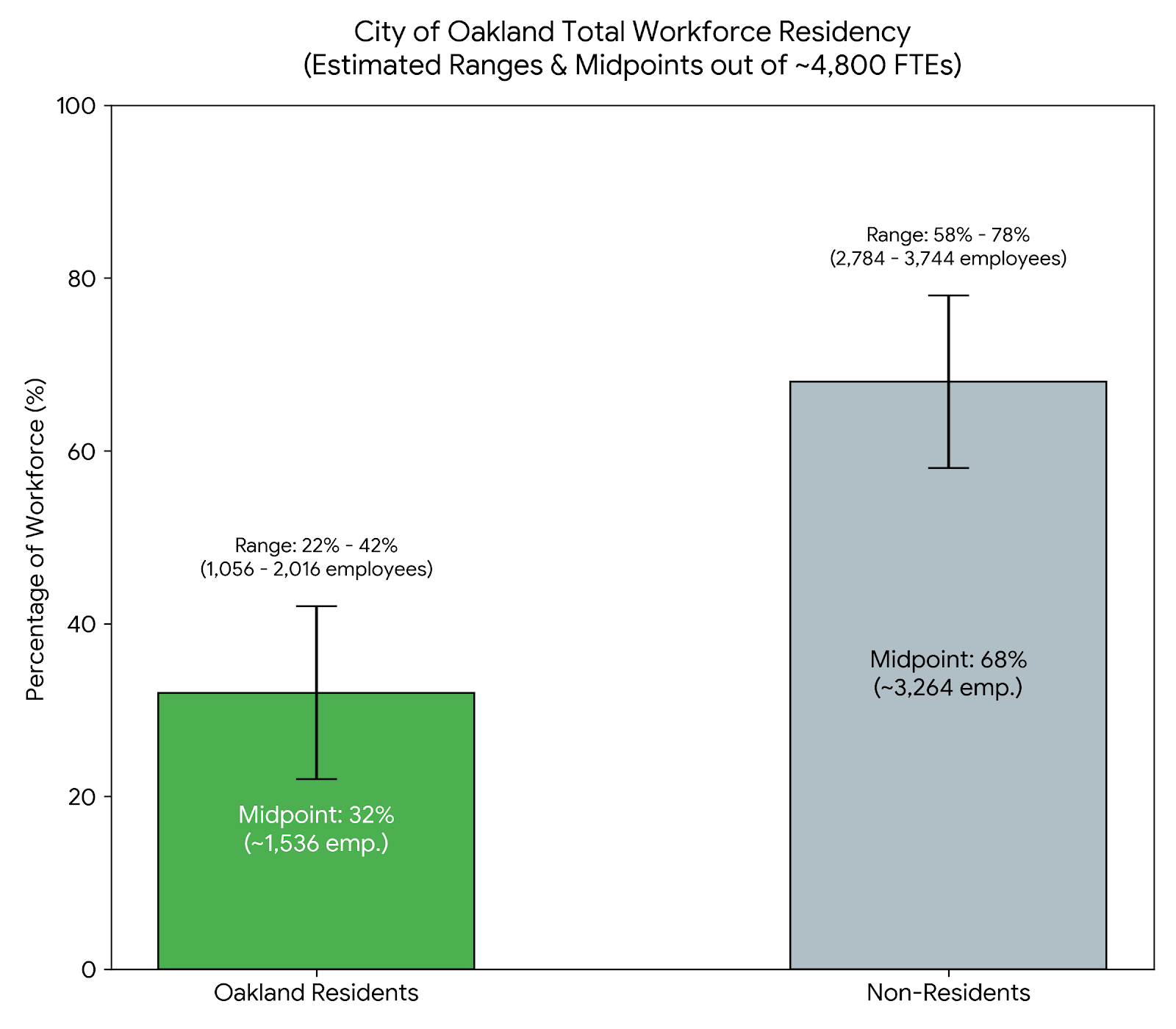
According to an analysis of the available data, only an estimated 32% of Oakland’s city workers reside within the Oakland city limits.
This means that an estimated 7 in 10 city employees are non-residents who commute in from other cities.
Yet the labor unions representing these employees routinely campaign for local tax increases that their members, by virtue of living elsewhere, largely will not have to pay.
Employee residency is a critical metric that shapes economic recirculation, emergency responsiveness, investment in the community, and alignment between a municipal workforce and the community it serves.4
When city employees reside locally, a larger portion of the municipal payroll is reinvested into the local economy through housing, retail, and tax contributions.
Furthermore, in emergency scenarios, the geographic proximity of essential personnel— such as sworn police, fire, and public works staff— can substantively impact response capabilities.
Share this article:
Currently, the public narrative surrounding Oakland’s workforce is heavily focused on staffing shortages. Recent media coverage has highlighted a nearly 20% vacancy rate across city departments.5
However, without disaggregated city worker residency data from the City of Oakland, policymakers and the public lack a complete picture of the city workforce’s geographic distribution.
Establishing a baseline residency rate by bargaining unit and job function is essential for evaluating the effectiveness of existing residency incentives— and for making data-driven decisions regarding recruitment, retention, and community alignment.
The right to choose where one lives
It is important to acknowledge that where an individual chooses to live is a personal decision and a personal right. City employees, like all workers in the Bay Area, face a complex personal and financial calculus when deciding where to establish a home.
Factors such as housing affordability, proximity to extended family, public school quality, municipal service delivery, public safety, and lifestyle preferences all play legitimate roles in these choices.
See this related article:

For many working families, the cost of housing in Oakland that suits their needs presents a barrier to entry, prompting some to seek housing in more affordable communities in the suburbs and exurbs.
Other workers, in particular higher-paid workers who can afford more expensive communities and commutes, or whose jobs allow work-from-home, may seek residency in other cities that offer a higher quality of municipal services and infrastructure, lower crime, better public schools, and other amenities where Oakland performs poorly relative to other cities in the region.
California state law (Government Code Section 50083) explicitly protects the right of public employees to reside wherever they deem best for themselves and their families, prohibiting local agencies from mandating residency as a condition of employment. However, cities may require emergency personnel and other critical positions to reside within a defined geographic radius.6
Tax campaigns and the commuter workforce
Early in the 2026 election cycle, labor unions representing city workers invested heavily in campaigning for local revenue measures, most notably Measure E, a proposed citywide parcel tax that is promoted primarily as a means to sustain and ‘save’ public safety services, like fire station operations and 911 dispatch.
Because parcel taxes are levied exclusively on property owners within the City of Oakland, the approximately 68% of the municipal workforce that lives outside the city limits is insulated from the financial impact of these taxes.
See this related article:

If approved, Measure E would bring the number of City of Oakland parcel taxes to 7 separate citywide parcel taxes, plus 1 parcel tax that only applies to specific geographic areas of the city. In addition, Oakland Unified School District (OUSD) levies 3 of its own citywide parcel taxes.7
The stated goal of Measure E is to bring additional revenue into the city’s general fund to maintain and enhance municipal services, most notably public safety. The majority of general fund revenues from the tax increase would be spent on employee salaries, pensions, and benefits.8
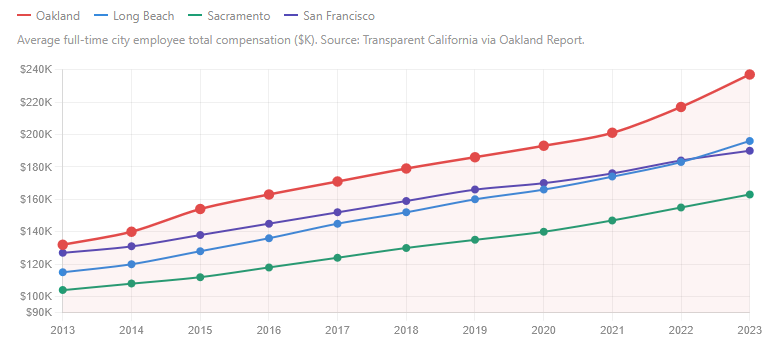
In recent collective bargaining agreements, the city’s public employee unions have successfully negotiated salary and benefit increases that have significantly outpaced the regional rate of inflation.9
Consequently, local taxpayers are asked to absorb the cost of increased public employee compensation— which is more than double the median area income in Oakland— for a workforce that predominantly resides in and pays taxes to other jurisdictions.
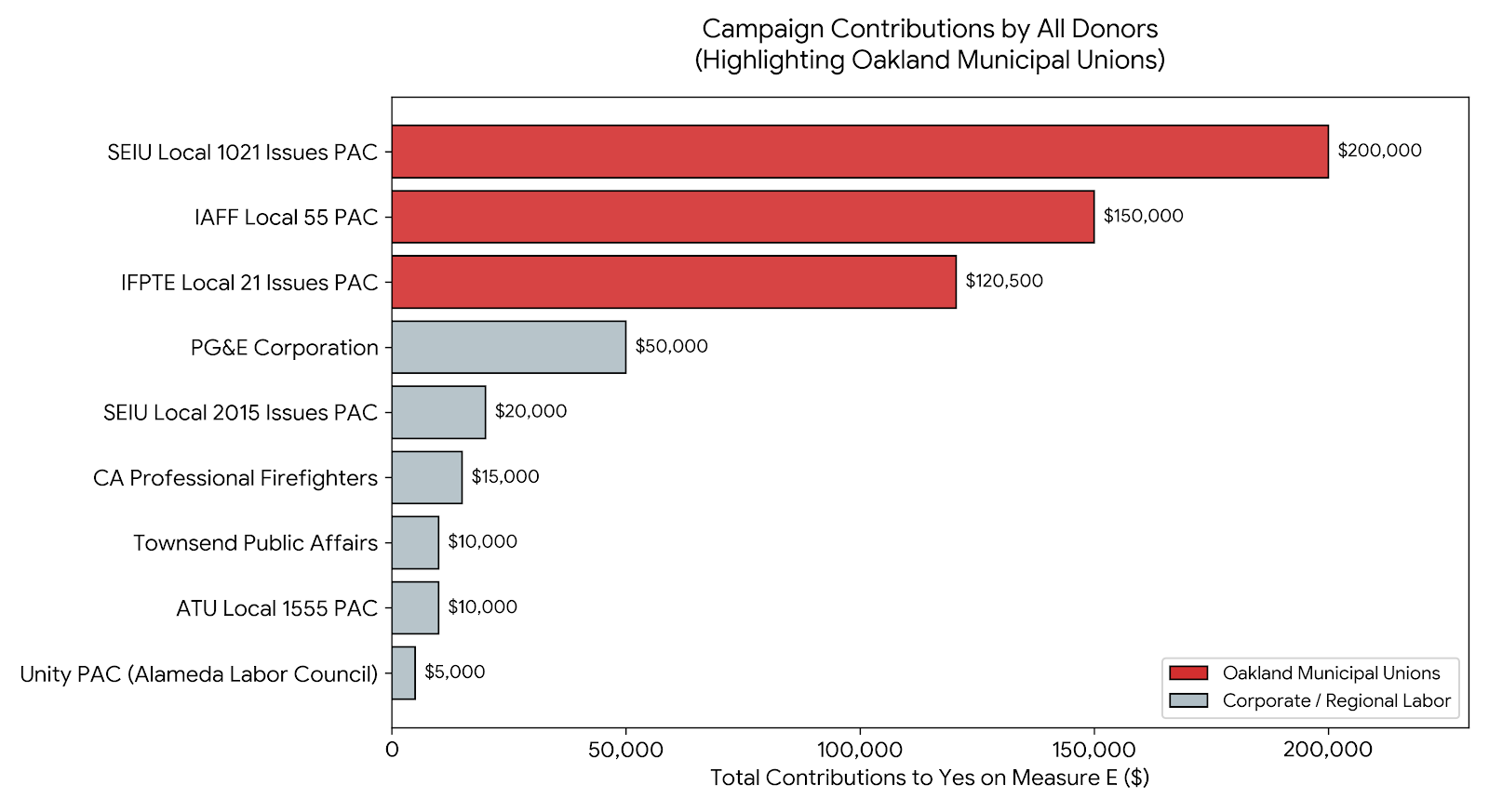
Oakland’s public sector unions have donated $470,500 to increase local parcel taxes through Measure E
The above chart lists campaign contributions to “Oaklanders for a Safe, Clean & Healthy City, Sponsored by Labor Organizations” (Yes on E).10
Three of the city’s public sector unions have donated a combined total $470,500 to the Yes on E campaign (shaded red in the above chart):
Service Employees International Union (SEIU) Local 1021 has donated $200,000
International Association of Firefighters (IAFF) Local 55 has donated $150,000
International Federation of Professional, Technical and Engineers (IFPTE) Local 21 has donated $120,500.
The list of campaign donors also includes regional labor groups, statewide union political action committees (PACs), and corporate interests.
ATU Local 1555 represents BART workers. SEIU 2015 represents long-term care workers. Alameda Labor Council is the regional central labor body in Alameda County, representing 135+ unions in healthcare, transportation, and education.
PG&E is a utility company headquartered in Oakland. Townsend Public Affairs is a lobbying, grant writing, and policy advocacy firm that performs contract work for the City of Oakland.
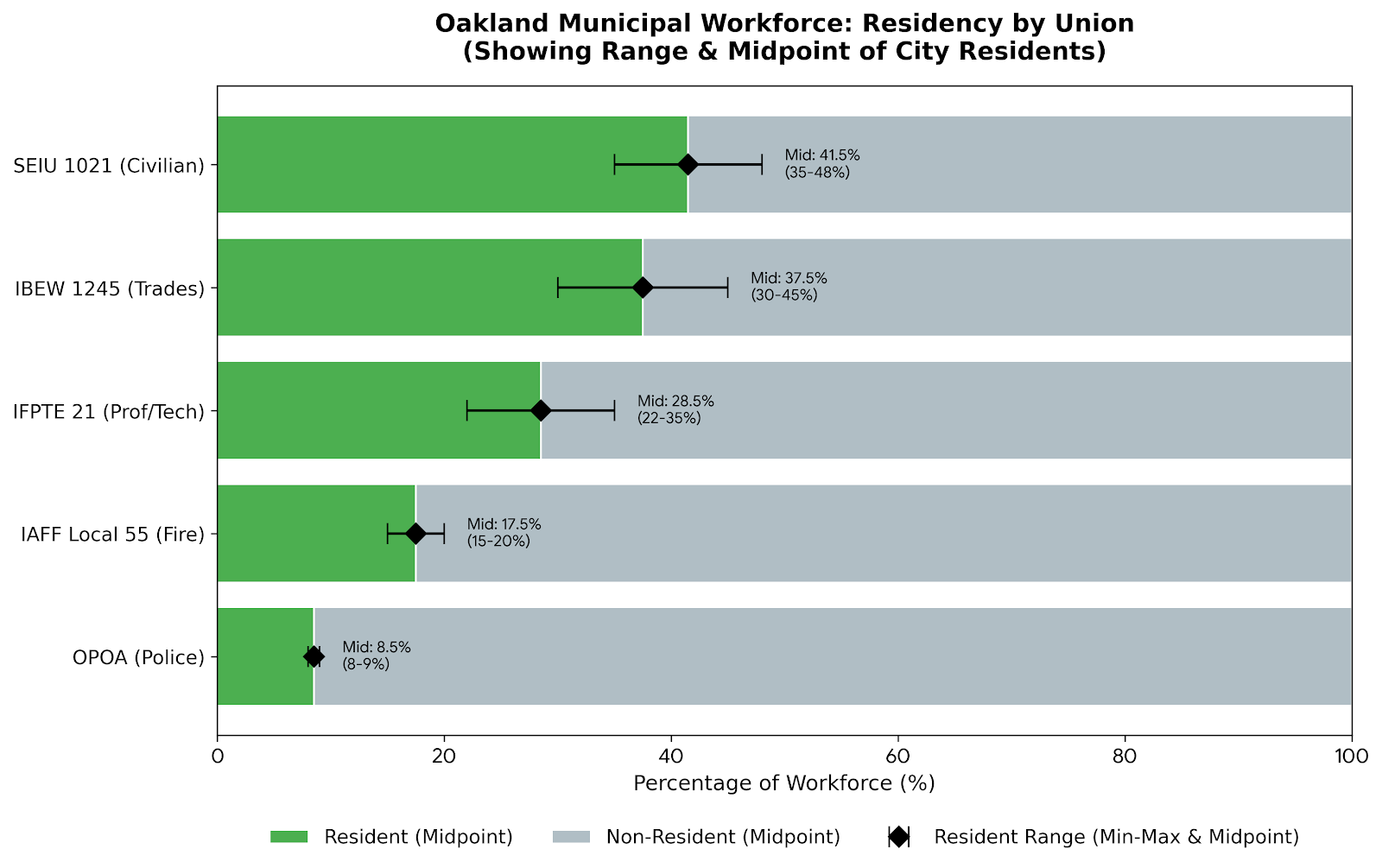
None of City of Oakland’s public sector unions have a majority of workers who live in Oakland
The residency of city employees varies significantly depending on their specific labor union— a proxy for their professional classification.
SEIU Local 1021 — estimated 6 in 10 members don’t live in Oakland
SEIU Local 1021 represents roles ranging from public works maintenance to library assistants and administrative personnel. SEIU maintains the highest estimated residency rate among the city’s unions, but only around 42% of SEIU members live in Oakland. Historically, these are among the lowest-paid positions in the city government, and have drawn heavily from the local community. Nonetheless, most of this bargaining unit resides outside the city, attributed in part to the displacement of low- and middle-income workers due to high housing costs.
See this related article:

IBEW Local 1245— estimated 6 in 10 members don’t live in Oakland
The International Brotherhood of Electrical Workers (IBEW) Local 1245 represents specialized tradespeople, including electricians and technical maintenance workers. This group has an estimated residency rate of approximately 38%. The city relies on this regional workforce to maintain its critical electrical and public works infrastructure. Skilled trades workers are in high demand across the Bay Area’s construction and infrastructure sectors, and the city frequently hires journeymen who hail from more affordable suburban and exurban communities. Notably, there is no record of IBEW contributing to the Yes on Measure E campaign efforts.
IFPTE Local 21 — estimated 7 in 10 members don’t live in Oakland
IFPTE Local 21 represents the city’s civil engineers, financial analysts, and mid-level management staff. This bargaining unit has an estimated residency rate of 29%. Because these roles frequently require specialized degrees and technical expertise, the city recruits from a highly competitive, region-wide labor pool. As a result, many of these employees have established residences in other cities where the housing market aligns more favorably with their compensation and lifestyle preferences.
IAFF Local 55— estimated 8 in 10 members don’t live in Oakland
IAFF Local 55 has the second-lowest residency rate, estimated at 18%. While firefighters face similar high-stress occupational realities as police officers, their commuter dynamics are influenced by departmental shift structures. The traditional firefighter work schedule—often involving 48-hour continuous shifts followed by 96 hours off—makes long-distance commuting significantly more viable. A firefighter may only need to commute into Oakland a handful of times per month, allowing them to reside in more distant, affordable, high-service housing markets without the burden of a daily rush-hour commute.
See this related article:

OPOA— estimated 9 in 10 members don’t live in Oakland
The lowest rate of local residency across all the major municipal unions is found within the Oakland Police Officers Association (OPOA). Data indicates that residency for sworn officers is approximately 9%. This is partly attributable to the demanding, high-stress nature of law enforcement in an urban environment that frequently leads sworn law enforcement personnel to seek geographical distance from their primary work jurisdiction during off-duty hours. For many officers, establishing a residence in other cities provides a desired separation between their professional duties and personal lives, in addition to the relatively lower cost of housing in the suburbs and exurbs around Oakland. Notably, there is no record of OPOA contributing to the Yes on Measure E campaign efforts.
Don’t miss a beat. Become a supporting member of Oakland Report. Your donation helps us continue our nonprofit work:
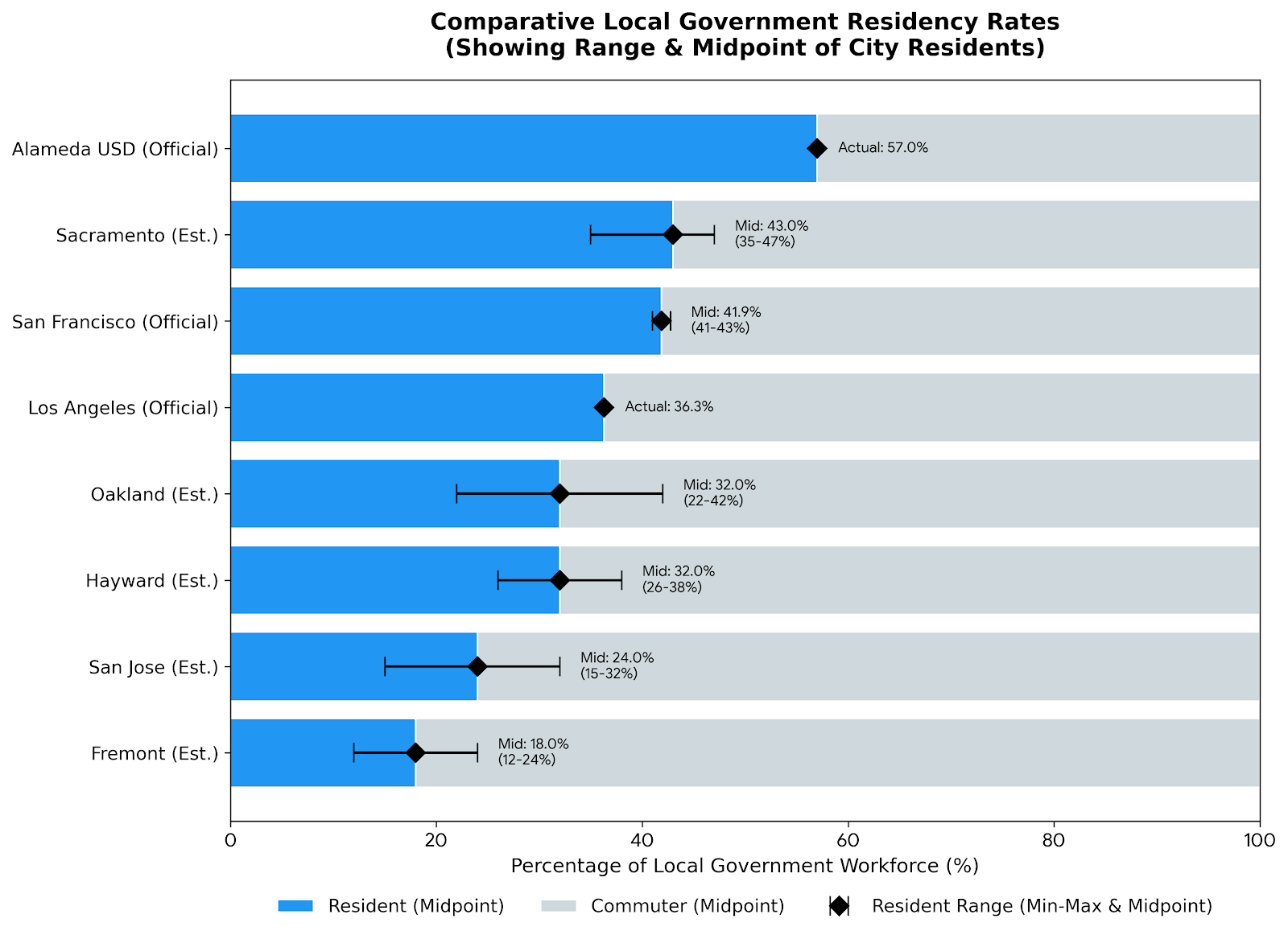
Comparisons to other local governments
Oakland’s high percentage of workers who don’t live in the city is not uncommon, but rather part of a common theme among California’s major metropolitan areas.
By comparing Oakland to other cities like San Francisco, San Jose, Sacramento, and Hayward, a pattern emerges, partly driven by the ratio of local government wages to local housing costs, and by jobs-to-housing imbalances.
San Francisco has a notably higher rate of city employee residency than Oakland— despite far higher housing costs
According to a recent City and County of San Francisco’s Department of Human Resources Workforce Report, approximately 42% of its roughly 34,000 employees reside within city limits.11 While still a minority, this is notably higher than Oakland’s 32%. However, similar to Oakland, San Francisco’s public safety personnel have lower residency rates than other city workers, with roughly 21% of sworn SFPD officers living in the city. The higher overall residency rate in San Francisco can be partially attributed to its legacy housing protections (such as rent control), unique geography, and dense public transit infrastructure.
Los Angeles makes its employee residency data public – and has similar employee residency percentages as Oakland
Los Angeles, despite its sprawling geographic footprint, reports residency numbers comparable to the Bay Area’s core cities. According to a 2022 payroll analysis by the City Controller, 36% of its roughly 50,000 municipal employees reside within the city limits.12 The remaining 64% commute from surrounding jurisdictions in Los Angeles County, the Inland Empire, and beyond. These data demonstrate that housing affordability issues drive a large commuter workforce even in California’s largest metropolitan area.
San Jose, Hayward, and Fremont: the commuter corridors
In Silicon Valley and the East Bay suburbs, the data reflect a residency crisis driven partly by a jobs-to-housing imbalance. The City of San Jose, which has some of the highest housing costs in the nation, relies heavily on a workforce commuting from the Central Valley and deeper into southern Santa Clara County. Regional transit authorities note extreme “super-commuting” among essential public workers. Similarly, cities like Hayward and Fremont operate as employment hubs where local housing availability outpaces local jobs. A Hayward displacement study highlights that as the city’s housing supply becomes less affordable, essential workers are moving to more affordable regions and commuting back to serve the city.13
Alameda: the neighboring island is an anomaly
The neighboring city of Alameda presents a unique demographic profile. A 2020 Housing Affordability and Displacement report identified that approximately 57% of Alameda Unified School District employees live within the city.14 While significantly higher than Oakland’s rate, the figure still indicates that 43% of the workforce commutes onto the island, reflecting the pervasive nature of the regional jobs-to-housing imbalance even in the smaller, relatively more affluent city just across the estuary.
Sacramento illustrates the effects of wage-housing parity on employee residency
Sacramento maintains a much higher estimated rate of local municipal residency. In part because the median home price in Sacramento has historically aligned more closely with civil service salaries, a much larger percentage of municipal and state employees can afford to purchase homes within or immediately adjacent to the city limits. This relative parity reduces the economic leakage that more expensive housing markets typically experience.

Conclusion
The methodology used in this analysis resulted in a reasonably accurate estimate of Oakland city worker residency (32% of all city workers), with a confidence interval of ±10%. Learn more about the methodology used here.
Ideally, the City of Oakland would voluntarily produce its own data and analysis of city worker residency in response to repeated questions from Oaklanders about this topic— as the cities of Alameda, San Francisco, and Los Angeles have done.
Such an analysis could be prepared by way of an independent report produced by the Office of the Oakland City Auditor, which presumably would have access to the city’s personnel data for a more precise analysis.
In the absence of official data and reporting from the City of Oakland, and because no other studies of city worker residency yet exist, this analysis serves as a reasonably accurate estimate— and its findings are consistent with the known data produced by other cities.
If the City of Oakland produces a report based on actual employee residency data in the future— and we encourage the city to do so— then we will update and republish our analysis accordingly.
Share this article:

Oakland Report provides accurate, unflinching, data-driven reporting and analysis that you will find nowhere else. If you value our work, please donate. All contributions go directly to sustaining and growing our nonprofit work:
City of Oakland and Service Employees International Union Local 1021. “Memorandum of Understanding, July 1, 2025 through June 30, 2026.” City of Oakland and SEIU Local 1021, July 1, 2026. https://www.oaklandca.gov/files/assets/city/v/3/human-resources/documents/working-for-oakland/unions/seiu/seiu-mou-2025-2026-final-202603.pdf
Port of Oakland and Service Employees International Union Local 1021. “Memorandum of Understanding, July 1, 2022 through Sept. 30, 2025.” Port of Oakland and SEIU Local 1021, July 1, 2022. https://www.portofoakland.com/wp-content/uploads/2024/03/SEIU-Local-1021-and-The-Port-of-Oakland-MOU-July-1-2022-September-30-2025-signed.pdf
City of Oakland. “Informational Report On City-Wide Staffing - February 2026.” Oakland City Council meeting, Apr. 14, 2026. https://oakland.legistar.com/LegislationDetail.aspx?ID=7926651&GUID=FB04CE81-90FD-4BF1-8EC8-32C0B7047CCB
Vinezeano, Steven. “Residency recommendations: local impacts of employee location.” Public Management Magazine, Intenational City-County Managers Association, Nov. 27, 2017. https://icma.org/articles/pm-magazine/residency-recommendations
Nguyen, Candace. “Oakland staffing report shows nearly 1,000 city jobs vacant.” NBC Bay Area, Mar. 26, 2026. https://www.nbcbayarea.com/news/local/oakland-staffing-report-city-jobs-vacant/4058811/
Justia contributors. “California Constitution Article XI - Local Government Section 10.” Justia website, accessed May 4, 2025. https://law.justia.com/constitution/california/article-xi/section-10/
Reinhart, Sean S. “Oakland union boss threatens fire station closures unless voters approve tax hike – despite the city’s past broken promises.” Oakland Report, Apr. 13, 2026. https://www.oaklandreport.org/p/oakland-union-boss-threatens-fire
Ballotpedia contributors. “Oakland, California, Measure E, Create Parcel Tax to Fund Public Safety Programs Measure (June 2026).” Ballotpedia. Accessed Apr. 13, 2026. https://ballotpedia.org/Oakland,_California,_Measure_E,_Create_Parcel_Tax_to_Fund_Public_Safety_Programs_Measure_(June_2026)
Ubell, Michael and Tim Gardner. “Oakland employee compensation grew 2.5 times faster than inflation, far outpacing other cities.” Oakland Report, Jul. 9, 2024. https://www.oaklandreport.org/p/oakland-employee-compensation-grew
Oakland Public Ethics Commission. “All Filings by Filer: Oaklanders for a Safe, Clean & Healthy City, sponsored by labor organizations.” Netfile public portal, accessed May 4, 2026. https://netfile.com/public/COAK/campaign/filingsByFiler/214936612-Oaklanders%20for%20a%20Safe,%20Clean%20&%20Healthy%20City,%20sponsored%20by%20labor%20organizations
Sumida, Nami. “Most S.F. government workers don’t live in the city. Here’s where they reside.” San Francisco Chronicle, May 23, 2025. https://www.sfchronicle.com/bayarea/article/sf-city-government-employee-20329218.php; https://archive.is/iR1V8
Mejia, Kenneth. “2022 City of LA Payroll Employee Residence Analysis.” Office of the Los Angeles City and County Controller, 2022. https://controller.lacity.gov/landings/2022-employee-residence-analysis
City of Hayward. “Displacement study final report.” City of Hayward, April 2021. https://www.hayward-ca.gov/sites/default/files/documents/Hayward-Displacement-Study-w-Appendix.pdf
City of Alameda. “2020 Housing Affordability and Displacement Report.” City of Alameda, December 2021.https://www.alamedaca.gov/files/assets/public/v/3/departments/alameda/econ-dev-amp-comm-services/city-of-alameda-housing-affordability-and-displacement-report.pdf
What do I get for paying more taxes? Certainly NOT law and order. NOT clean streets and parks. The sad thing is, the same people who constantly complain about the cost of housing, will vote for more property taxes every time, because they don't understand that THEY will ultimately pay it, and the Unions stuff their pockets.
There is another factor to consider - how much work gets outsourced. I run a little department that if you ask the general public exists to fix potholes. There is very little that we deliver that cannot be done with in house resources. Boosting the percentage of Oakland residents employed with the city begins with things like internships and apprentice programs and a commitment to do the work with city staff. The engineering and construction industry has invested very little in talent development over my 30 year career. We are a transient bunch and go where the work is. We are also a shrinking talent pool and in high demand. The solution is to bring more people into the game, train them, and provide an excellent work environment. That likely means catching them in high school. Here is a real world situation. Oakland needs a city surveyor. We have searched far and wide. The candidate feedback is twofold - the pay is not enough; folks don’t want to move to Oakland. Personally, I moved my family 2,300 miles to Oakland to serve this beautiful city. In return, I was the target of a false and fraudulent ethics complaint from a council member because I’m not FROM Oakland and was being “shown how we do things in Oakland.” The city’s response was non-existent - nada, zero. It might come as a surprise, but people in the industries mentioned in the article watch things like this and talk to each other. Oakland does not have a good reputation as an employer. I would venture to say many folks see it as too much risk to work and live in Oakland.