



PART FIVE IN A SERIES
Editors’ note
Oakland Report is examining the many taxes the City of Oakland charges its residents and businesses: what the taxes were intended to pay for, how they were actually used, and whether the city kept the promises it made to voters.
Previous installments examined how the city repeatedly breaks its promises in tax measures, threatens fire station closures unless voters approve new taxes, charges residents more while giving them less, and disproportionately burdens East Oakland neighborhoods.
This installment examines the financial impact of parcel taxes — including Oakland’s latest proposed parcel tax, Measure E — on Oakland’s rental housing and the 6 in 10 Oakland residents who rent.
Oakland Report provides accurate, unflinching, data-driven reporting and analysis that you will find nowhere else. If you value our nonprofit work, please subscribe, share, and donate.
Thank you for reading Oakland Report. Your donation in any amount helps us continue our nonprofit work:
Part 5
Two-thirds of Oakland’s rental housing is exempt from ‘rent control’
The City of Oakland’s Rent Adjustment Program (commonly known as ‘rent control’) states that “property tax is not considered a housing service cost.” This means that landlords of rent-controlled housing can’t directly add a parcel tax increase to tenants’ rents.1
But nearly two-thirds of Oakland’s rental housing is excluded from this rule.
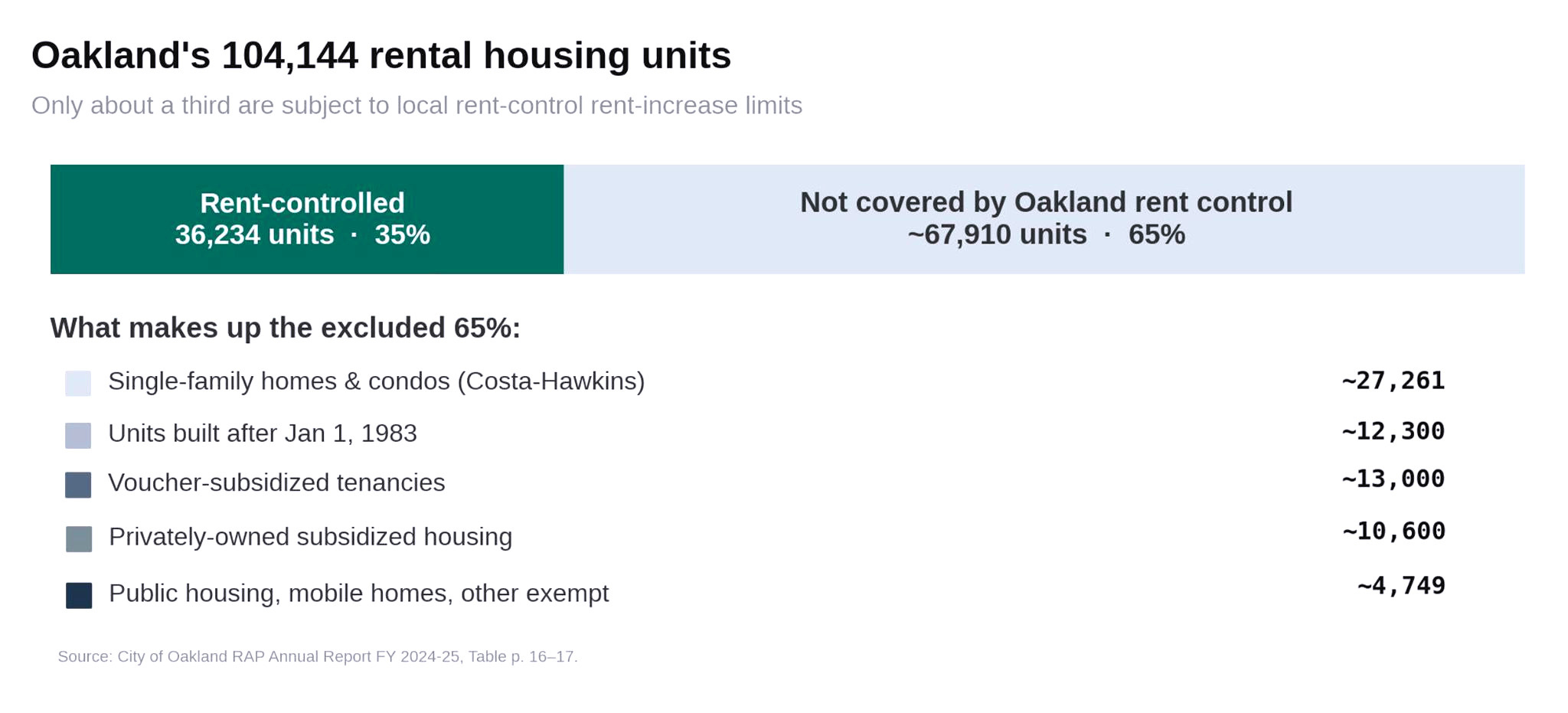
Oakland is home to approximately 104,144 rental housing units. Of those, only 36,234 units — about 35% — are subject to the Rent Adjustment Program’s limits on rent increases. The other roughly 68,000 units are exempt from rent control.2
For the 68,000 rental housing units that are excluded from local rent control, there is no specific rule against increasing rents to cover parcel tax increases. California state law AB 1482 caps annual rent increases at 5% plus inflation or 10% — whichever is lower — but within that ceiling a landlord can raise the rent to recover whatever costs they deem necessary, including parcel taxes.3
Even in rent-controlled housing, rents can be raised in order to pass landlords’ costs to tenants
Oakland’s ‘rent control’ rules cover a much smaller slice of the rental market than most people realize — and the rules include various mechanisms to pass increased costs to renters by raising rents, including:
Vacancy decontrol. Under California’s Costa-Hawkins Act, when a tenant moves out, the landlord can reset the unit’s rent to whatever the market will pay.4 Over time, excessive taxation creates upward financial pressure and incentivizes landlords to turn over units that fall below market rates, in order to recover rising costs.56
Fair-return petitions. A landlord who can show that the city’s 0.8% annual rent increase cap does not let them earn a reasonable profit can petition the Rent Board for a bigger increase. Property taxes (including parcel taxes) are counted as an expense in that calculation. These petitions are rare — only 8 were filed citywide in fiscal year 2024-25 — but they are an option for landlords to recover cost increases.7
Capital improvement pass-throughs. Landlords can petition to pass up to 70% of building improvement costs to tenants. This is not a direct tax pass-through, but it provides another mechanism for raising rents above the local rent control cap.
Studies have shown that property taxes, including parcel taxes are substantially passed through to renters. This effect is particularly relevant in Oakland, where approximately 58% of households rent.
A 2025 Federal Reserve Bank study using comprehensive unit-level rental housing data from Berkeley—Oakland’s immediate neighbor and a nearly identical rental market—found that landlords pass through $0.50 to $0.89 of every $1 in building-level property tax increases to new tenants.8
A U.S. Census Bureau study examining small multifamily buildings (1–5 units) found a short-term pass-through rate of roughly 14%, confirming measurable upward rent effects even for small tax changes.9
A German market study found that real rents fully absorbed property tax increases within approximately three years — meaning long-term pass-through approaches 100% in supply-constrained markets.10
Oakland’s Measure E aims to increase parcel taxes on rental housing by 26% – and most of the burden will ultimately land on renters
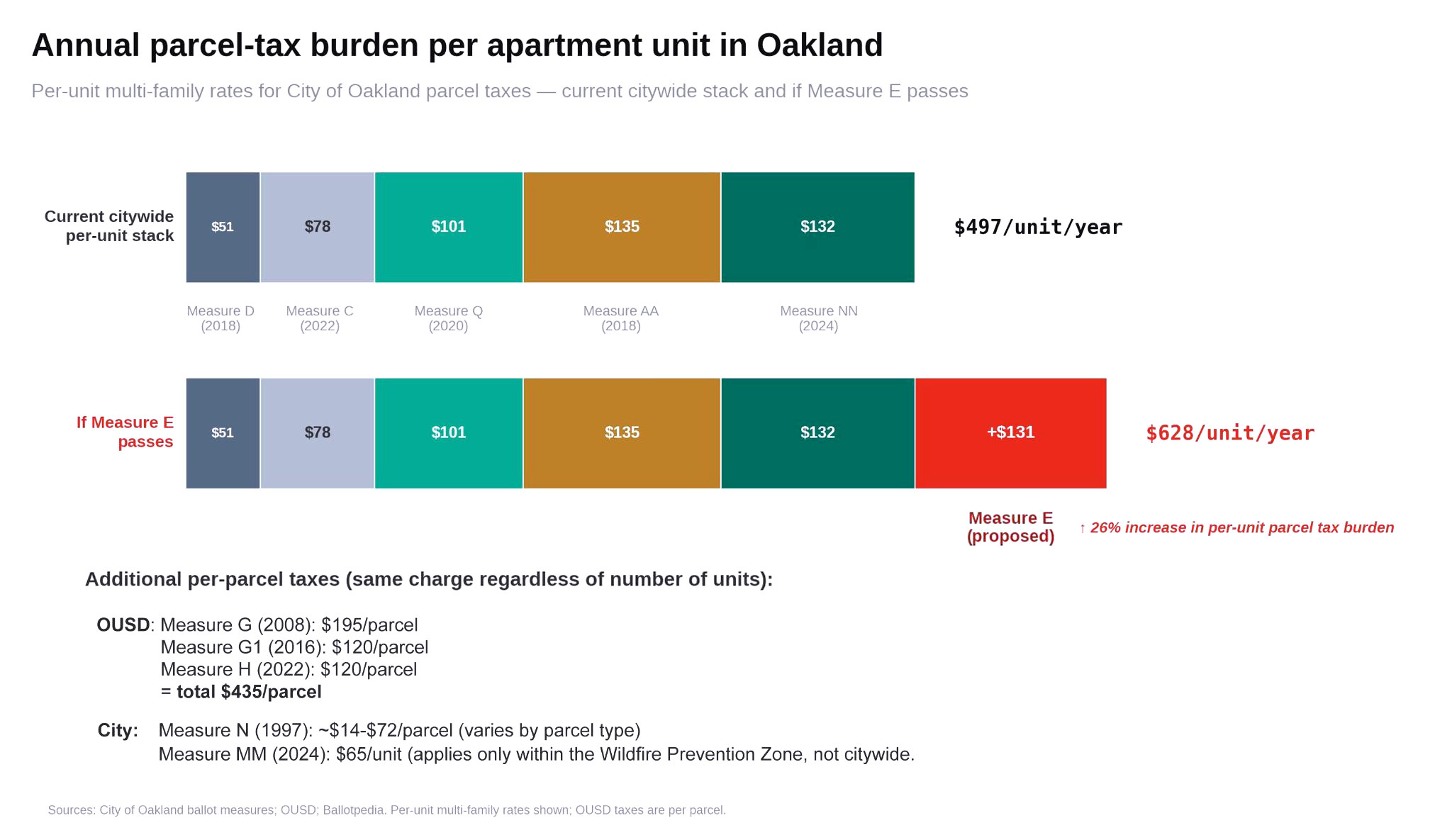
Oakland’s Measure E, if approved by voters on June 2, would tax rental housing at $131 per unit, per year, to fund public safety services. Notably, Measure E would be in addition to, not replacing Measure NN (2024), which was also promised to fund public safety services.1112
Measure E would push the total citywide per-unit parcel tax burden on rental housing from $497 to $628 per unit per year — a 26% increase. But that is only part of the total parcel tax burden on rental housing.
In addition, every multi-family parcel also owes $435 in OUSD school-district taxes (Measures G, G1, and H).
Rental housing also pays a City of Oakland paramedic services parcel tax under Measure N (1997), which ranges from roughly $14 to $72 per parcel depending on building type.
Properties in the Oakland Hills Wildfire Prevention Zone pay an additional $65 per unit under Measure MM (2024).
For a typical four-unit apartment building, the current citywide per-unit parcel tax stack alone totals $1,988 per year ($497 × 4 units), plus $435 in OUSD per-parcel taxes — over $2,400 annually. If Measure E passes, that will climb to about $2,950 per year in parcel taxes alone.
Supporters of Measure E, and of parcel taxes in general, assume that Oakland’s rent-control rules prevent the increased tax burden from being passed on to renters. However, that protection only applies to a fraction of rental housing in Oakland, and the economic evidence shows that upward financial pressure on landlords created by high taxation erode that protection, even for rent-controlled housing. As a result, the tax increase that a landlord absorbs today is likely to reappear as higher rent tomorrow.
A look ahead
In closing Part 5, we again acknowledge that taxes are necessary to provide the public services people need and deserve. This series is focused on whether the city is managing its resources appropriately, and whether city leaders are acting as responsible stewards of the public trust.
We believe that every Oakland resident — indeed, every person — deserves to have a stable home with housing costs that do not exceed 30% of their income.
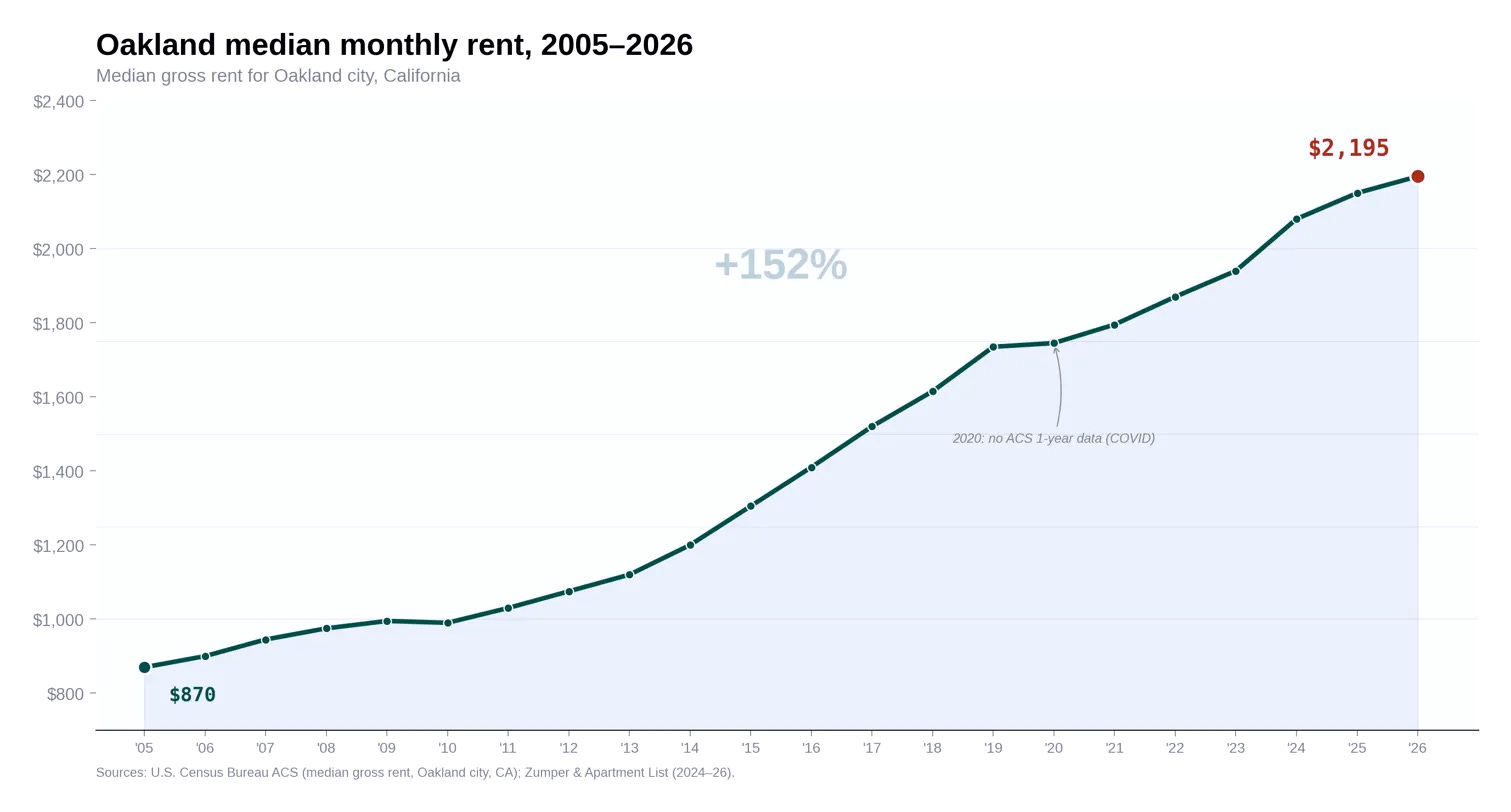
Unfortunately, most Oakland residents are heavily burdened by the high and increasing cost of housing in Oakland and the region. Nearly half of Oakland households are burdened by spending over 30% of their income on housing. Over 20% of Oakland residents are severely cost-burdened.13
The city and its advocates have long argued that the city’s financial challenges require the residents to give more through higher taxes. We do not refute the fact that the city’s expenses consistently exceed the resources with which it has been entrusted.
However, the evidence suggests that the city’s latest proposed solution to that problem — another parcel tax on top of an already very tall stack — will impact Oakland’s already cost-burdened renters, only one-third of whom have rent control, and whose rents are likely to increase anyway in response to the increased tax burden the city is proposing to put on their housing.
Thank you for reading this series. Please consider donating to Oakland Report today, as we prepare the culminating study guide for this series, including key considerations for Oakland voters about Measure E. Your donation in any amount helps us to continue our nonprofit work.
DONATE TO OAKLAND REPORT
Please help us continue this series by making a tax-deductible donation today.
See these related articles:

The city of Oakland has broken its promises to voters in three of the last four parcel tax measures


City of Oakland. “Rent Adjustment Program regulations, § 8.22.070(C)(1)(c).” Dec. 5, 2023. https://www.oaklandca.gov/files/assets/city/v/1/housing-comm-dev/documents/rap/ordinance/oakland-rent-adjustments-regulations-w-rent-registry-regulations-3.28.2024_2024-03-28-185402_eaxp.pdf
City of Oakland. “Rent Adjustment Program annual report fiscal year 2024-25.” Oct. 21, 2025. https://oakland.legistar.com/LegislationDetail.aspx?ID=7666836&GUID=4F4BAE59-C60B-4C0C-872D-A78683877230&Options=&Search=
California State Legislature. “AB-1482 Tenant Protection Act of 2019.” Oct. 08, 2019. https://leginfo.legislature.ca.gov/faces/billTextClient.xhtml?bill_id=201920200AB1482
California Civil Code § 1954.52 (Costa-Hawkins Rental Housing Act). https://leginfo.legislature.ca.gov/faces/codes_displaySection.xhtml?sectionNum=1954.52.&lawCode=CIV
Institute for Housing Studies. “Exploring the impacts of rising property taxes in changing neighborhoods.” Jan. 27, 2023. https://housingstudies.org/blog/exploring-impacts-rising-property-taxes-changing-n/
Diamond, Rebecca. “What does economic evidence tell us about the effects of rent control?” Brookings, Oct. 18, 2018. https://www.brookings.edu/articles/what-does-economic-evidence-tell-us-about-the-effects-of-rent-control/
Ibid. City of Oakland RAP Annual Report FY 2024-25, Table 10, p. 14.
Baker, Sarah. “Property tax pass-through to renters: a quasi-experimental approach.” Federal Reserve Bank of Philadephia, December 2025. https://www.philadelphiafed.org/consumer-finance/consumer-credit/property-tax-pass-through-to-renters-a-quasi-experimental-approach
Schwegman, David and John Yinger. “The Shifting of the Property Tax on Urban Renters: Evidence from New York State’s Homestead Tax Option.” Center for Economic Studies (CES), December 2020. https://www2.census.gov/ces/wp/2020/CES-WP-20-43.pdf
Löffler, Max and Sebastian Siegloch. “Welfare Effects of Property Taxation.” CESifo, Mar. 2021. https://www.cesifo.org/en/publications/2021/working-paper/welfare-effects-property-taxation
Ballotpedia contributors. “Oakland, California, Measure E, create parcel tax to fund public safety programs measure (June 2026).” Ballotpedia website, accessed Apr. 8, 2026. https://ballotpedia.org/Oakland,_California,_Measure_E,_Create_Parcel_Tax_to_Fund_Public_Safety_Programs_Measure_(June_2026)
Ballotpedia contributors. “Oakland, California, Measure NN, Police and Violence Reduction Parcel Tax Measure (November 2024).” Ballotpedia website, accessed Apr. 8, 2026. https://ballotpedia.org/Oakland,_California,_Measure_NN,_Police_and_Violence_Reduction_Parcel_Tax_Measure_(November_2024)
City of Oakland. “2023-2031 Housing Element update: Appendix B: housing needs assessment.” January 2023. https://www.oaklandca.gov/files/assets/city/v/1/planning-amp-building/documents/sp/gp/housing-element/appendix-b-housing-needs-assessment-1.12.23-clean.pdf
Thank you again for the clarity and accessibility of this series. For me, you have removed the fog of partial understanding, excuses and moral flexibility that typically prevents real action to fix the system. Frankly, it's a shame that Oakland and this area are effectively a monopoly for a greedy Democratic Party that is run by elites and billionaires, just like the other one!
Yes, “the rules include various mechanisms to pass increased costs to renters by raising rents..”. However, please dig deeper into the realities. ‘Fair return’ and ‘Capital improvements’ rent increases require petitioning the Rent Board, a group of diehard activists. How many of these have been approved in the past TWENTY years. No surprise: ZERO!
Real solutions require good faith negotiations between stakeholders. Radical rhetoric from 19th century economic theory has made that impossible.
Rental economics is a complicated subject involving more than basic math. It seems that both sets of skills are undeveloped in our society. Not encouraging.