


Editor’s note: Our thanks and appreciation to news anchor Andre Senior and KTVU for having us on their Take 2 in the Morning show on April 17, 2026. Video courtesy of KTVU.
Transcript
KTVU - “Take 2 in the Morning”
April 17, 2026
ANDRE SENIOR:
We’ve all talked about it: Where is my tax money going?
People drive around their towns. They know they pay taxes. They’re not necessarily opposed to it because that is how your local government operates. But in Oakland, one Oakland resident has been tracking how your tax dollars are being spent. In other words, people are being asked to approve these measures that come up on the ballots, and they vote for them to improve roads or do whatever the case is. But then it seems as though an audit was done and some of the tax money, the promises that were made, where this money was going to be spent, is not necessarily ending up doing the job that it’s doing in the time that people would like to see it.
Sean Reinhart with Oakland Report, he joins me now. He is a resident of Oakland and, of course, a concerned citizen and a former city worker himself in another city. So, of course, he keeps track of all these things. Sean, thank you so much for joining us this morning.
SEAN REINHART:
Thank you for having me, Andre.
ANDRE SENIOR:
All right, so, Sean, we’re kind of getting to the bottom of this here. There’s some numbers that came out that looked at, hey, voters approved these measures to tax, to use that money to be spent on certain things. And a report came out that shows that there has been a shortfall. What did you find?
SEAN REINHART:
Yes, well, actually, this was the city’s own report. Back in February, the city administrator of Oakland issued a report called, “Multi-Year Plan to Meet Voter-Mandated Staffing and Service Levels.” And what that report basically confirmed was that the city of Oakland broke its promises in three out of the last four parcel tax measures, including the most recent one passed in 2024, Measure NN, which was passed on the promise of providing improved public safety, in particular police officers.
Measure NN required the city to maintain a minimum number of 700 sworn police officers. However, the city immediately violated that minimum. The city currently only budgets 678 police officers. Because of administrative leaves and other things, currently the city’s down to an active force of about 500 officers. So the city broke its promise there. And actually, there’s a history of that going back around 20 years, and this is all according to the city’s own reports. We have it all on our website for folks to have a look at, to be informed about what is really happening with these tax dollars.
ANDRE SENIOR:
We were just showing a description. You listed out one, two, three, four, five, six, seven of the measures that were approved by voters. I want to make it a little bit bigger so our viewers can see it.
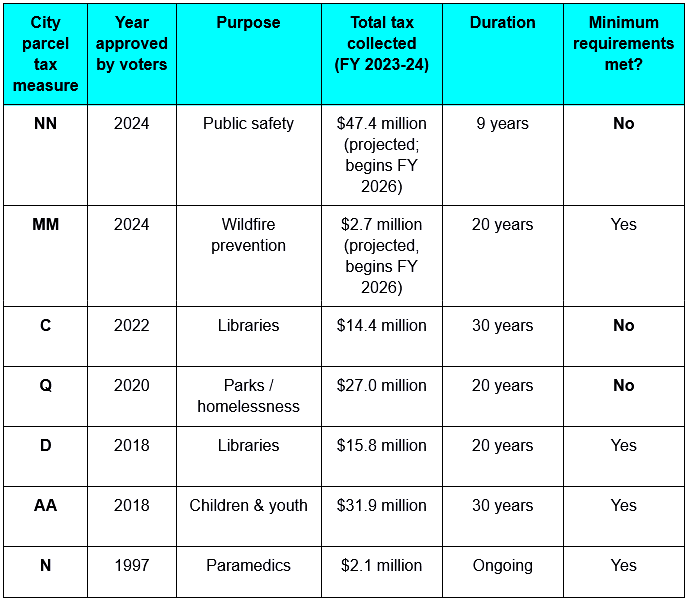
Measure NN, public safety measure approved by voters in 2024: minimum requirements, as you see right here, minimum requirements not met. The duration for this tax is nine years. It’s supposed to collect $47.4 million, and that would go to public safety. This is a list of all the other measures where the minimum requirements have not been met yet. So I guess the question is: Sean, do we know why those requirements have not been met yet? Now, granted, when you talk about Measure NN, the duration, it was only approved in 2024. The duration for it is nine years. The requirements are not met yet. So does the city have time to rectify this situation? What do the numbers show here?
SEAN REINHART:
Well, the requirement was for those minimums to be met at the time the tax measures were passed. And so it was known at the time that the measures were put on the ballot, and that the city and their supporters were campaigning for the taxes that these minimums would need to be met. So it really was effective right away. But the city routinely has evaded those requirements by proclaiming various states of extreme fiscal necessity, which are loopholes that are baked into those past measures that allow them to bypass those requirements. So whether the city has time to rectify that discrepancy, really, that’s on the city to take the steps to do that and fulfill the promises that were there. In particular because the city is now asking voters to approve another tax this June, which kind of promises the same thing that Measure NN in 2024 promised, which was public safety services. So, another approximately $38 million per year being asked of Oakland taxpayers for pretty much the same services.
Now, I do want to emphasize that taxes are incredibly important, as you mentioned, Andre, to provide the services that people need and deserve. You know, that’s an important part of a functioning society. But it’s equally important for residents to hold the city accountable, because that helps the city serve people better. That helps city leaders to make more meaningful progress and to be better public servants. So, you know, it’s very important for folks to have this information.
I’m a librarian by trade, 26 years in local government, a longtime Oakland resident, grew up in Hayward. So, you know, just making this information available for folks to have a look for themselves, and they can decide for themselves whether these taxes are worth it and whether to approve new taxes.
DONATE TO OAKLAND REPORT
Please help us continue out nonprofit work by making a tax-deductible donation today:
ANDRE SENIOR:
But they should also be aware that we, that the voters, those same voters, are being asked to approve another measure that would cover the same thing that the previous measure, essentially the same things, right, that the previous measure had been asked. So, I mean, you know, looking from the outside in, this might look like a double tax to some people.
SEAN REINHART:
Yeah, by all appearances, that is what is being asked of voters here this June. And I think it’s important to understand that Oakland has the highest taxes per capita among similar cities in the state. In fact, special taxes in Oakland have increased 379% over the past 20 years. I just want to say that again: 379% increase in these special taxes over the last 20 years. Now, that’s six times faster and higher than the rate of inflation or the cost of living over that same period of time.
Now, in the last fiscal year, 2025, the city of Oakland brought in $1.6 billion in revenue. That’s an all-time high. If the city of Oakland was a person, it would be a billionaire. And like billionaires, its income has increased far, far greater than those of everyday people.
ANDRE SENIOR:
Sean, let’s look at Measure Q passed back in 2020. It was passed, a resolution in June of 2023 to suspend the park’s maintenance requirements, effectively voiding the baseline level of service promised to voters when the Measure Q tax was approved. In addition, the city failed to carry out the promised work in a timely manner. Measure Q had accumulated nearly $22 million in unspent funds by 2023, and homelessness carry forward funds exceeded allowable amounts due to the city’s lack of progress on performing the work. Can you break down what that means here? We’re talking about Measure Q here.
SEAN REINHART:
Yeah, and so that was the city auditor who had that finding, that the city had underspent by $22 million. So basically not doing the work that was promised and that voters gave up more taxes to provide with Measure Q. So three years later in 2023, the city council again declared an extreme fiscal, unanticipated event in order to evade the requirements, to basically suspend the requirement to do that parks maintenance. You know, I love Oakland’s parks. Oakland’s parks are amazing, but i think a lot of Oaklanders, if you go around parks, will agree that they need that TLC. So it’s pretty unfortunate that the money that voters put up to maintain those parks wasn’t spent in a timely manner.
See this related article:

The city of Oakland has broken its promises to voters in three of the last four parcel tax measures
ANDRE SENIOR:
Okay so what’s happening here, the city has this money. Because the voters approved it they’re required to spend it on this particular thing, but in a certain declaration or under a certain declaration, the city doesn’t have to spend the money on that particular thing that the voters approved it for, is that what viewers should know?
SEAN REINHART:
Yes, it’s very important to look at the fine print of these tax measures because in the measures we’ve just talked about, these loopholes are built in where, if the city can declare that there was an extreme unanticipated fiscal event, then all bets are off and the money can be used for essentially anything that the city council decides to redirect them to. A lot of voters, I don’t think they realize that that’s part of the measure. It’s certainly not part of the campaign materials that support these measures. So it basically enables a loophole that, you know, the city can break the promise pretty much at will.
And just a moment to talk about an unanticipated fiscal event. Just to be very clear, the city does have a lot of effort in planning budgets, in setting budgets, in forecasting budgets years ahead. So the city’s financial condition is very much known at the time that these tax measures are put out there. So, you know, barring some extreme event like, say, the pandemic was certainly an unanticipated fiscal event. But, you know, there hasn’t been that level of unanticipated fiscal change in recent years.
See this related article:

ANDRE SENIOR:
Okay, so if you’re watching this and we see now that, you know, if budgets are planned for ahead of time, we all know this, companies do this, governments do this, the budgets are planned for ahead of time. Barring anything unanticipated like COVID-19 or something crazy, we should already know this. So are you looking for where that shortfall is coming from the city in which they’re declaring this emergency? If they’re declaring this emergency, they can use the money for other things. Are we looking at that as a whole here? Are you looking out for what comes out of the city manager’s office about where that cash is going? And why, if it’s going to another part of the city, why did they run out of money?
SEAN REINHART:
Yeah, you know, like I said earlier, it’s very important for citizens of Oakland to hold their city accountable by just paying attention to what they’re doing, because that makes the whole system work stronger. And so that’s why we started Oakland Report at oaklandreport.org, just to keep track of those things over time and give Oakland residents the opportunity to see what the city is doing.
You know, I’ll say as far as the expenses — I myself have been in local government for 26 years, recently retired. It’s a service organization. The number one thing that the money goes toward is to pay people, which is incredibly important. City workers, they work very hard. We thank them for their service. Ultimately, they do work for us. They are public servants. The city of Oakland does pay its workers well, which is appropriate. City workers have health benefits and retirement plans, which again is very appropriate.
Unfortunately, many Oakland residents do not have that same level of health benefits and retirement benefits. Everybody should have those things. Don’t get me wrong. I really think everyone who works hard their entire life should have health benefits and retirement plans. But the reality is most Oaklanders don’t have that. Yet the city, in order to increase that pay and benefits for their employees, is asking residents to give more of their money to increase those benefits, which they themselves don’t have.
See this related article:

So again, it’s fair to compensate employees. But when the the amount of increase in that compensation far exceeds the rate of inflation, the rate of cost of living, the compensation that the people being taxed themselves receive, you have to kind of start to ask, at what point, where does the breaking point arrive? Looking at the cost of living and how much inflation has really made it difficult for folks to survive here in Oakland, and again, a 379% increase in taxes over the past 20 years, you do have to ask, have we reached that point or not? That’s really something that we just want to put the information out there so Oakland voters can decide for themselves.
ANDRE SENIOR:
And that’s what this is all about here. The work of oaklandreport.org is to just get the information in front of them. You may not realize some of the things that are baked into what you vote for.
Sean, we’ve run out of time today, but I’m hoping we can check in with you again next week because you dive into some other subjects as well, as you continue to track what goes on in the city of Oakland, and this is just good information for every Oakland voter to hear. Tracking government is not easy, but oaklandreport.org definitely tries to make it a little bit easier for you to understand. Sean, thank you so much for joining us. Appreciate it.
SEAN REINHART:
Thank you, Andre.
ANDRE SENIOR:
We’ll be right back here on Take 2 this Morning.

SUPPORT OAKLAND REPORT
We rely on financial support from readers like you.
We are a 501(c)(3) charitable nonprofit organization based in beautiful Oakland, California. Our mission is to make truth more accessible to all Oakland residents. Your donation in any amount helps us to continue our nonprofit work.


