


Oakland Recap provides summaries of public meetings that catch our attention.
‘It’s not about what we say, it’s about what we do’
Council public works and transportation committee, May 12, agenda item #5.
Yesterday the council public works and transportation committee voted to advance a proposed illegal dumping expenditures action (‘IDEA’) plan to the full city council on May 19.1
Two committee members whose neighborhoods are heavily impacted by illegal dumping — Ken Houston (District 7) and Noel Gallo (District 5) — expressed their frustration with the proposal.
Their remarks appeared to be directed at times to city staff, to committee chair Zac Unger seated to their right, and to former councilmember-turned-illegal dumping project manager Rebecca Kaplan, who was seated in the audience.
Houston and Gallo’s remarks focused on what they described as yet another plan — and expense — that was long on policy talk, but short on practical solutions to the city’s chronic illegal dumping challenges.
Committee member Charlene Wang (District 2) and council member Rowena Brown (at-large, not a committee member) focused their remarks on technocratic questions about the plan.
Council member Carroll Fife (District 3) — who does not serve on the committee, but whose district is significantly impacted by illegal dumping — expressed thanks and commended Kaplan for her work.
Committee chair Unger (District 1), who co-sponsored the Apr. 14 legislation with mayor Lee, offered no remarks.
Editor’s note: See above for the video and below for a transcript of Houston’s remarks. See below for the video and a transcript of Gallo’s remarks.
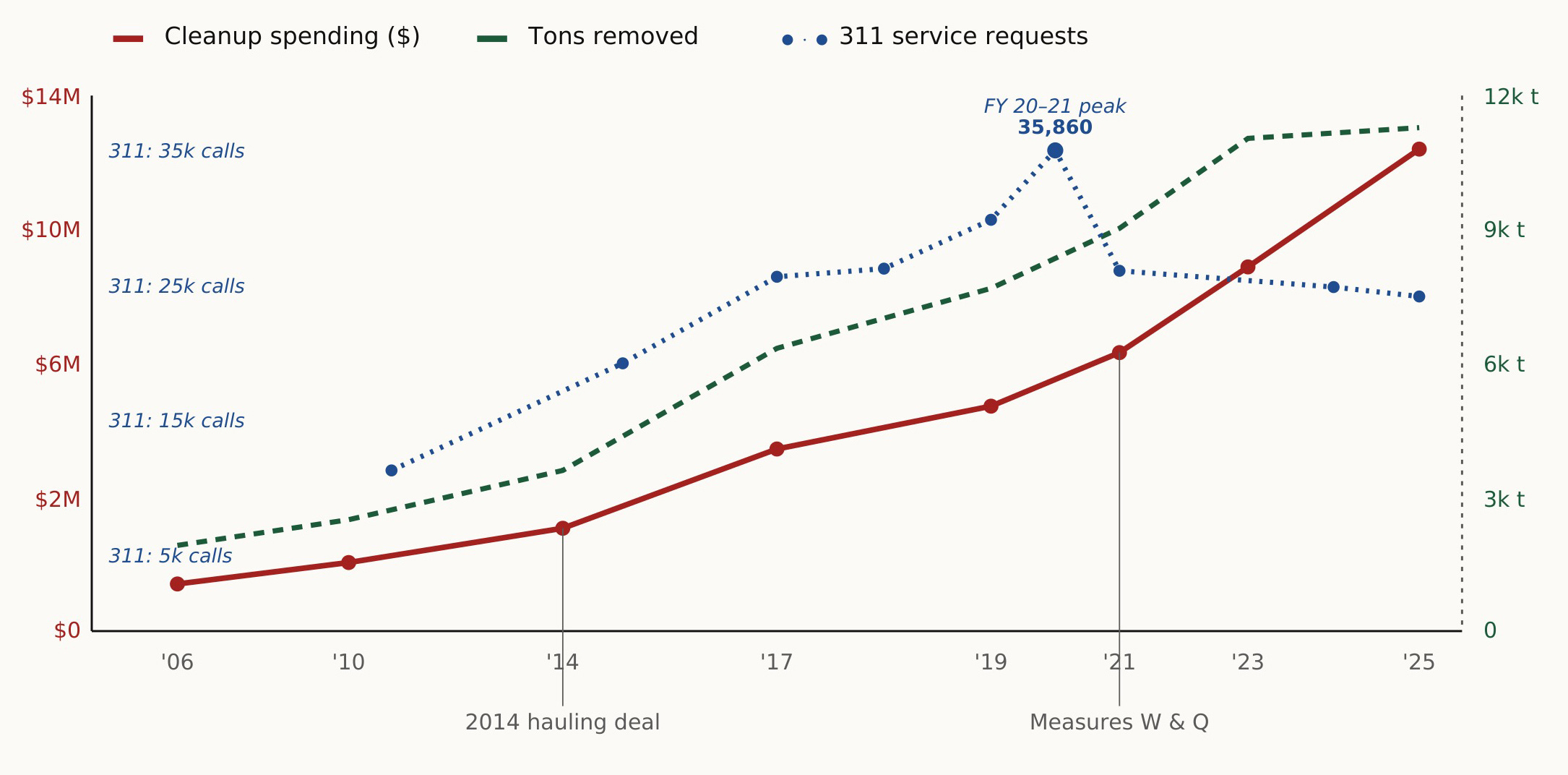
‘Where is that money going?’: 20 years of spending, 20 years of ever-growing trash
On April 23, Oakland City Auditor Michael C. Houston released a 56-page performance audit that found Oakland’s spending on illegal dumping has climbed nearly fivefold over two decades while the volume of dumped material has continued to rise.2 The audit issued 17 recommendations; only four were marked as “Complete.”
As Oakland Report documented in our reporting on former council member Rebecca Kaplan’s long involvement in the city’s illegal dumping activities,3 the city administrator hired Kaplan shortly after she left elected office — without a public recruitment or hiring announcement — as an “illegal dumping project manager” paid $149,410 per year plus benefits.4
Read this related article:

The $1.1 million ‘IDEA’ plan does not address the audit’s primary recommendation: renegotiating Oakland’s $1 billion Waste Management hauling contract, in which Kaplan played a key role negotiating and approving on the council.
Waste Management’s $53.36 minimum residential trash pickup fee for its Oakland customers is 56% higher than the regional average for cities served by the same hauler.
The ‘IDEA’ plan aims to operationalize the Apr. 14 legislative package from mayor Lee and council member Unger, which increased dumping fines to up to $5,000, criminalized using one’s vehicle to dump, and exempted encampment waste from the “illegal dumping” definition.5
Additionally, a proposed State Senate Bill 1218 (Arreguín), sponsored by the city of Oakland, would direct the DMV to block vehicle registration for unpaid dumping citations, if the bill is ultimately approved by the legislature and signed by the governor.

Drones, equipment and no-bid contracts
The auditor’s report highlighted Oakland’s poor track record on illegal dumping enforcement, which the ‘IDEA’ plan aims to improve.
According to the audit, Oakland received over 25,000 calls (to 311) about dumping, and removed at least 15 million pounds of trash, yet issued only 273 citations and collected fines from only 25 of them.
The audit also found that the city’s Environmental Enforcement Unit “lacks internal organization,” with no written policies, conflicting roles, insufficient training, and a five-month period in late 2024 when it patrolled only a 20-block stretch of East Oakland.
In the ‘IDEA’ plan, four of the ten line items — $515,000 total — would be awarded as no-bid contracts, along with waivers of Oakland’s competitive bidding and local/small business contracting rules:
$190,000 to Big Truck Rental of Tampa, Florida for grapple-truck rentals.
$150,000 to San Francisco AI-drone startup Aerbits, Inc. for an aerial imagery (drone camera) pilot.
$100,000 to Verizon via California’s CALNET master agreement.
$75,000 to Security Lines U.S. for additional cameras. The Security Lines contract expansion would bring cumulative spending with that vendor to roughly $910,000 since 2022.67
The plan’s largest single line item expense is $300,000 in staff overtime. During the May 12 committee meeting, city staff confirmed that the city only has eight positions on its Environmental Enforcement Officers team — five of which are filled, two vacant, and one frozen.
The plan also funds $95,000 in cleanup equipment and $90,000 to revive the “Bulky Block Parties” program the city shuttered in 2024.
Read this related article:

The ‘IDEA’ staff report does not fully address the relationship between dumping hot spots and Oakland’s homeless encampments. Oakland’s unsheltered population grew 10% from 2022 to 2024, even as Alameda County’s declined 3%.8
The auditor reported that the city’s encampment management team removed 5,428 tons of debris from encampments in 2025 — 50% more than the 3,617 tons collected citywide by illegal-dumping cleanup crews — after a ‘garbage-blitz’ effort diverted cleanups to encampment work.
The ‘IDEA’ plan responds to some audit recommendations, such as expanding outreach, new citation software, and camera evaluation. But it bypasses several others: renegotiating the Waste Management contract; implementing low-income renter subsidies; imposing commercial special assessments on the thousands of Oakland businesses without trash service; and working to make the English-only 311 call service multilingual.
Don’t miss a beat. Donate to Oakland Report to support our nonprofit work:
Video and transcript of council member Noel Gallo’s remarks on the ‘IDEA’ plan
It’s not about what we say, it’s about what we do, and sometimes we — some of us writing policy and recommendations, I never see you on the street picking anything up. I’ve been here for many years, but I never see people out. But they’re going to tell me how to do it, what to do, and when to do it.
So those are realities. You can shake your head and growl, but the reality is, I have seen Oakland in many different ways, and one of the realities that we’re facing: we have a contract with a Waste Management company that can’t deliver the service to allow Noel to go dump at Waste Management, and not create a bulky pick-up where I won’t have all my workers doing overtime work, with dumpsters and trucks where I could go to Waste Management like other cities do.
I go to Tucson, Arizona; I get to go. If I have a bill, I go straight to the dump yard [run by] Waste Management. And they only charge me $30, not $300. So I don’t have to go to the public works yard, and [then] the public works yard has got to go to the Waste Management yard.
So I think that for those that wrote these policies, please come out and help me. We’re out there every day. We’ve been out there every day for ten years picking it up. I’m not sitting here just making more excuses. All right?
So the reality is that we have to deal with Waste Management and what the city’s not doing — city employees are not doing administratively, sitting here at City Hall. Because there are many businesses in Oakland that don’t have a garbage license. So what they do is they come and leave it on the corner down the street so we can pick it up, and we’re not charging any fees.
Certainly at one time, public works used to do that on a daily basis early in the morning: clean the streets up, pick it up and make it clean, not only dealing with graffiti, but dealing with, I mean, garbage, but dealing with the graffiti.
You never saw graffiti throughout the city because we used to have cameras in certain places, and the police department would go with me at nighttime to capture those doing the graffiti and arrest them.
And I still get people from the sheriff’s department that come volunteer with me because they illegally dump or they did graffiti, but they’re coming from the city of Fremont, Castro Valley. I don’t see any people in Oakland getting arrested or cited to come work off their tickets. And they’re coming from other cities in Alameda County.
So what I’m asking the city administration, where is that franchise fee dollar doing that illegal — where like one or two cities in the state that ever did that because they went to court and sued the city because that was illegal, because the voters never paid for that or voted for that, but we’re still collecting $28 million — where is that money going? That’s supposed to be going back, keeping our streets clean.
So if you need to report that not only that fee, but also the cannabis operations, because I still remember when I was here, when we started, that they used to bring their trucks and give us millions of dollars. But now we changed the process of where is that money going to a city administration to keep this city safe and clean?
So for me, it’s, you know, we can do a lot of writing, a lot of talking, but I want to see those who wrote it and put it together, come on the street and help do it. So you know what the hell is going on in the neighborhood. You can see it yourself. Get your hands dirty.
It’s easy for me to sit here all day long writing to do this and do that and over here and feel sorry. But the reality is we need to hire more people within public works.
And if you go to public works today, right now, you’re going to see trucks — 50, 60 trucks that are not working because we don’t have the mechanics. We used to have ten mechanics, but I only have three, and the trucks are sitting because I drive city trucks every weekend and throughout the week. But most of the time they’re not working, and your people are not able to go and collect the trash and do what you’re saying we should be doing.
So for me, Oakland needs to get its act together, and public works transportation. We need to have that cooperation, not just with Waste Management, but California Waste Solutions, because they used to bring the big trucks on Saturdays to volunteer and help me clean up. But now, they don’t do that anymore because, the city — well, somebody, something’s going on with negotiations.
So for me it’s, whether you’re in West Oakland and East Oakland, I think what we need to do is improve the delivery of service. I don’t need more laws and more ordinances, I need to get the job done, as we’ve done in many years in the past.
And so the only other recommendation I have for you: you want to do education? Well, we used to receive that information in our high schools. No, it’s not okay for you to throw your trash out the window as we’re doing today. And it’s not okay for your school to be like it is in the condition today, because the youngsters used to volunteer to keep it clean every day. And that’s my high school years. I used to, once a month, they’d make us all work around the school, inside the school, in the neighborhood, to make sure that neighbors saw us caring for the community.
So I think that there are many ways to get this done, but at the end of the day, Waste Management has a dump yard that we can go and dump our trash like we do when we pick it up during the week, and it’s over: it’s clean. But Waste Management, California Waste Solutions, Civic Corps would be out on the streets daily unloading your trash cans, picking up whatever’s on the sidewalk and on the streets.
And so we need to get back to the work attitude. And that’s one of the things that’s missing in all these policies that I’m creating and doing this and that — but it’s about work.
It’s about cleaning Chinatown. I can write all the laws I want, but unless you get out and go clean it, it’s not going to change.
So what I ask is that, you know, be able to report back in terms of: what is the condition of Oakland, of public works, what is their need to fix those vehicles? How many more employees do they have, because many are not here anymore?
As an example, and I’ll leave you with: go to the public works yard and Coliseum Way. You’ve been there lately? In front of Oakland’s public works yard, it should be the cleanest area around, as a demonstration of cleanliness. It is dumped left and right. You come out with your truck, it’s the whole street. Even though I asked to put no parking at any time [signs], it is filled with garbage and trash and we allowed that in front of our property, and that’s a role model. We need to correct that.
But go take a look, go take a look and then you can decide what to write and what to do. But at the end of the day, I need more individuals working with public works and make sure that their vehicles are repaired and are able to assist the workers that we do have.
So anyway, thank you. I know, I don’t mean to express my frustration, but Oakland’s got to get its act together. And it’s not about how many laws and rules I have. We’ve got to go get it.
Look at Lake Merritt. You used to help me with Lake Merritt. Look where it is today. Not like where it used to be, where you had Olympic trials, people wandering, the high school kids all rowing at Lake Merritt. But nowadays, well, I’m not going to go to Lake Merritt, I’ll go somewhere else.
So anyways, thank you, but, and I do value that, and it’s more about than just $1 million. You got to remember that through Waste Management, they collect $36 million a year in my garbage bill on top of the garbage bill I have to pay on a monthly basis. Thank you.
– Council member Noel Gallo, May 12, 2026.
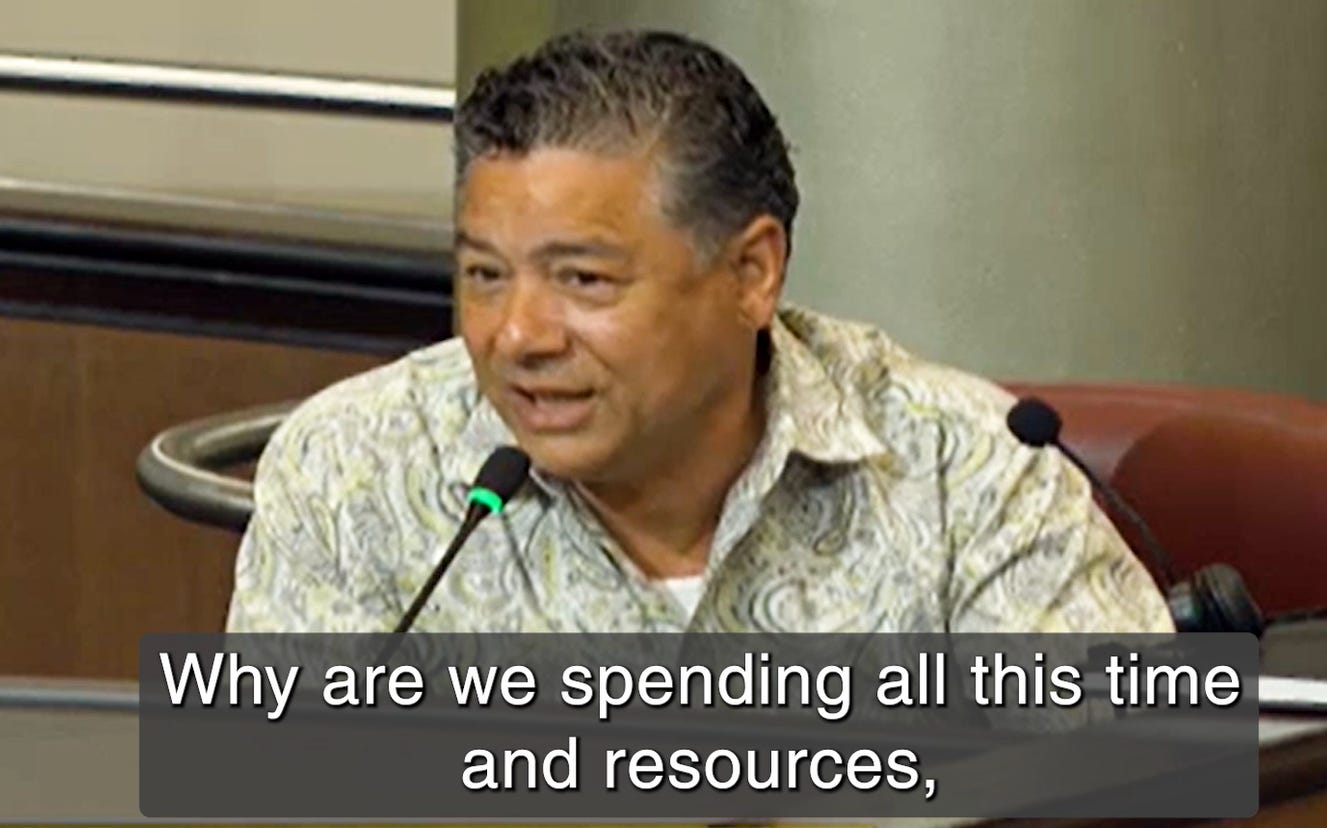
Transcript of council member Ken Houston’s remarks on the ‘IDEA’ plan
You know how ridiculous this sounds? When we’re talking about illegal dumping —in other cities, when they’re talking about other issues? Why is that? Why is that? It’s because we’re just cleaning up, cleaning up instead of deterrence. Why are we spending all this time and resources, on what? Clean up. It’s called deterrence.
The city of Oakland has the same equipment that Waste Management has. I don’t know other cities that have that. That’s ridiculous. Sitting on this council, I’m the only council member here that’s prosecuted a graffiti vandal and an illegal dumper.
Through Nancy O’Malley with supervisor Nate Miley, we had stopped and slowed it down. Then after Nancy left, the prosecution stopped. Now that we have another district attorney — she’s willing to prosecute. She’s running for office right now.
We have to deter this crime, council member Unger. It’s not called clean up, clean up, clean up, fine, fine, fine.
That’s why I said the information that the EEO’s [Environmental Enforcement Officers] are very, very important to this system, because they’re the ones that are on the ground that need to be protected. They’re the ones that are on the ground that will collect and go through the indicia to find out the individuals that are committing this crime against our community.
So if they have the information and the data that they can turn over in the proper way to the district attorney, we can prosecute these individuals that are committing crimes against our community: illegal dumpers and graffiti vandals, which is a visual cue of deterioration that attracts illegal dumping.
Let me give you a story.
Ten years ago, there was some huge, huge illegal dumping on San Leandro Boulevard. I went out, it was like 12:30, 1:00 at night. I saw this guy dump and I said, hey, you know, I want to, yeah, what makes you feel that you can dump here?
You know what he said to me? He said if they can tag and do graffiti vandalism for 30 minutes, I can dump it in ten. Right?
So my message is this: clean up is fine. We have to clean up and keep it clean. Because Noel’s been out there all the time, cleaning up, cleaning up, and spending his time just cleaning up our city. That’s unacceptable. He could be doing other things, right? We need to deter these individuals that are committing crimes against our community.
I’m gonna say it one more time: in my priorities, it was real simple. There was three: public safety, homeless and housing. I addressed that with the EAP [Encampment Abatement Program] and public safety.
We need to address it in a way that we can spend our time worrying about our seniors, worrying about our children, worrying about our homeless individuals that need housing, instead of talking about dumping — which people should know better to do it anyway, because I’m gonna tell you, much of the dumping in my community is coming from my community, from down the street with bags and stuff. I don’t know if it’s because of the size of the garbage bags, the garbage containers or not; we’re working on that also.
So my main point right now is to get money — that money that was promised for the EEO’s to be safe for themselves, to be safe, and to be able to be trained to identify hazardous and contaminated materials so that information can be documented and turned over to the district attorney, so these individuals that are committing crimes against our community can be prosecuted.
Because it is hurtful that I have to walk through this, my children, my seniors... it is sad.
I yield the floor.
– Council member Ken Houston, May 12, 2026.
Oakland Report provides accurate, unflinching, data-driven reporting and analysis that you will find nowhere else.
If you value our work, please donate. All contributions go directly to sustaining and growing our nonprofit work:
Note: This article has been updated from its original version to reflect the correct title for Environmental Enforcement Officers, the April 14 legislation sponsors, and the current public works and transportation committee membership.
City of Oakland Public Works Department. “Illegal Dumping Expenditure Plan.” Staff report to Public Works and Transportation Committee, Apr. 20, 2026. https://oakland.legistar.com/LegislationDetail.aspx?ID=7989762&GUID=3A7C0038-B049-42E0-8C1D-75FB01F98D57
Houston, Michael C. “Performance Audit of Illegal Dumping: Improvements to the accessibility of legal waste disposal and the city’s enforcement and remediation policies and operations could help alleviate Oakland’s illegal dumping problem.” Office of the Oakland City Auditor, Apr. 23, 2026. https://www.oaklandauditor.com/wp-content/uploads/2026/04/20260423_Performance-Audit-of-Illegal-Dumping-1.pdf
Reinhart, Sean S. "There’s something about Rebecca." Oakland Report, Apr. 27, 2026. https://www.oaklandreport.org/p/2026-04-27-theres-something-about-rebecca
Reinhart, Sean S. "City of Oakland gives Rebecca Kaplan, former city council member a $149,000-per-year job." Oakland Report, Nov. 5, 2025. https://www.oaklandreport.org/p/city-of-oakland-gives-rebecca-kaplan
Lee, Barbara. "Oakland unanimously approved comprehensive illegal dumping legislative package." Office of Oakland Mayor Barbara Lee, Apr. 15, 2026. https://www.mayorbarbaralee.com/press-releases/oakland-unanimously-approved-comprehensive-illegal-dumping-legislative-package
City of Oakland. "Adopt a resolution approving the Oakland Public Works Illegal Dumping Surveillance Camera Program Use Policy and Surveillance Impact Report, and the deployment of Portable Observation Device (POD) Surveillance Cameras at known dumping hot spots." Oakland City Council File #22-0003, Jan. 18, 2022.
City of Oakland. "Illegal Dumping Surveillance Camera Program - Approve Security Lines, U.S.’s License Plate Recognition (LPR) Cameras." Resolution No. 90143 C.M.S., adopted Mar. 19, 2024. https://oakland.legistar.com/LegislationDetail.aspx?ID=6588128
Reinhart, Sean S. "Oakland’s homeless population is growing by 1,000 people per year." Oakland Report, Mar. 17, 2026. https://www.oaklandreport.org/p/oakland-plans-to-spend-108-billion


