



Oakland Agenda Watch provides short summaries of key items on public meeting agendas that catch our attention. Today we take a look at the 2026 Anti-Displacement Strategic Action Plan presented to city council on March 16, 2026.
Oakland’s homeless population is growing by 1,000 people per year
City Council meeting, Mar. 16, 2026, agenda item 6.16
According to a new Anti-Displacement Strategic Action Plan produced by the city’s housing and community development department, over 2,500 people in the city become newly unhoused every year. Oakland’s system facilitates approximately 1,500 exits from homelessness annually, resulting in a net increase of over 1,000 homeless individuals per year.1
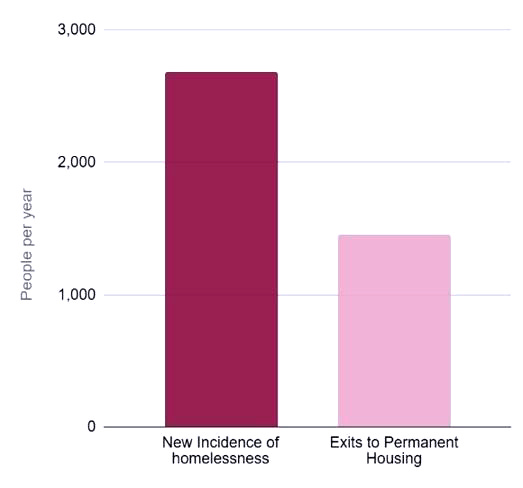
According to the anti-displacement plan, the actual figures on new incidences of homelessness are likely higher:
“These estimates neither include those who return to homelessness (as opposed to becoming newly unhoused for the first time) nor do they include those who become unhoused but do not enter a shelter program. Thus, while 2,550 is the estimate of new homelessness using current data, it is unfortunately an undercount.”
– from City of Oakland 2026 Anti-Displacement Strategic Action Plan
Alameda County’s homeless population decreased 3%. Oakland’s went up 9%
Oakland has grappled with a difficult and growing problem for the past several years: the more money the city spends to alleviate homelessness, the worse the problem appears to become.
With hundreds of millions of dollars spent regionally on homelessness programs, Oakland’s unhoused population has continued to swell.
According to the anti-displacement plan, the total homeless population in the city grew by 9% between 2022 and 2024, reaching 5,485 individuals.
The number of unsheltered individuals in Oakland—those living on the streets, in tents, or in vehicles—grew by 10% to 3,659 people.
Meanwhile, the homeless population in Alameda County declined 3% during the same period.
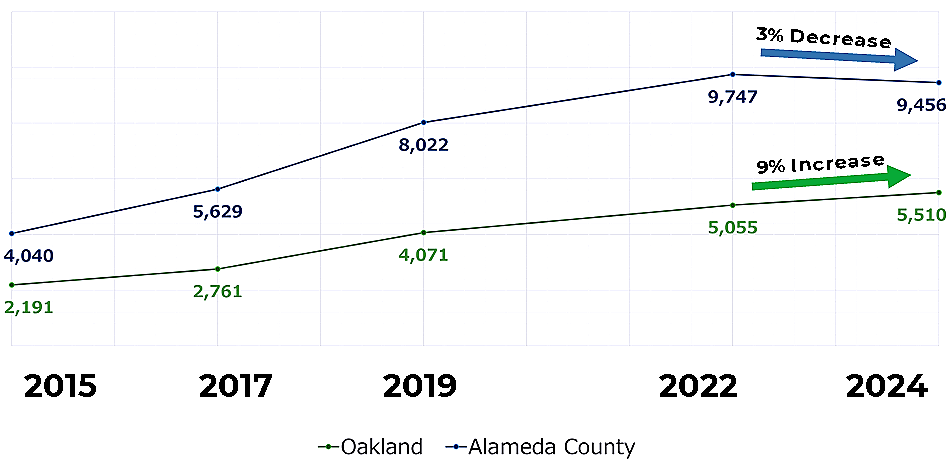
Oakland’s total population of 444,000 is approximately 27% of Alameda County’s total population of 1.64 million.23
By comparison, Oakland has 58% of Alameda County’s homeless population.4
A new Point-in-Time homeless count for 2026 is scheduled to be released this spring, followed by a comprehensive report this fall.5
The anti-displacement plan notes that among racial groups, Black residents have the highest relative rate of homelessness. Black residents make up approximately 22% of Oakland’s general population, but account for 52.5% of the total unhoused population, 47.9% of the unsheltered population, and 59% of all new entries into homelessness.
The plan cites a legacy of historic redlining,6 predatory lending practices, and systemic disinvestment in Black communities as primary drivers of the racial disparity.
Evictions since Oakland’s three-year moratorium was lifted
Most evictions were paused for over three years by the City of Oakland’s emergency eviction moratorium during the COVID-19 pandemic. Once the moratorium was lifted on July 14, 2023, evictions began again, and at higher numbers than in pre-pandemic years. Between October 2023 and September 2024, landlords filed an average of 223 evictions per month in Oakland, a 59% increase compared to the pre-pandemic year.7
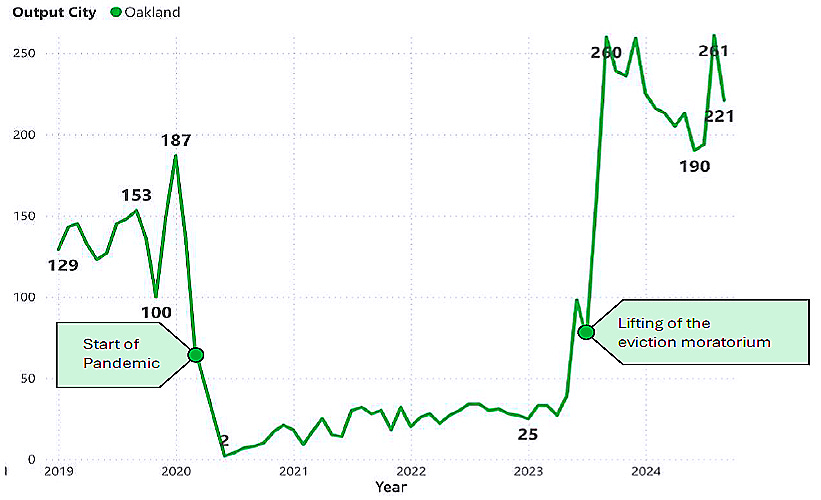
According to the anti-displacement plan, Oakland eviction filings represented approximately 43% of all eviction filings in Alameda County in calendar years 2019 and 2024. The eviction moratorium appears not to have resulted in a relative change in that aspect.
The plan says that according to 2020 Census data, 23% of Alameda County households are renters, and 38% of all tenant households in the county live in Oakland. Therefore, the Oakland eviction filing rate appears to be relatively high.
Oakland plans to spend $1.06 billion to cut homelessness 50% in five years – and it isn’t enough
Despite substantial levels of investment and effort, the net count of unhoused individuals in Oakland continues to climb.
An analysis of the city’s anti-displacement budget suggests that Oakland and Alameda County’s financial commitments fall well short of what is required to achieve the city’s goal of reducing homelessness 50% in five years and eliminating homelessness entirely in ten years.
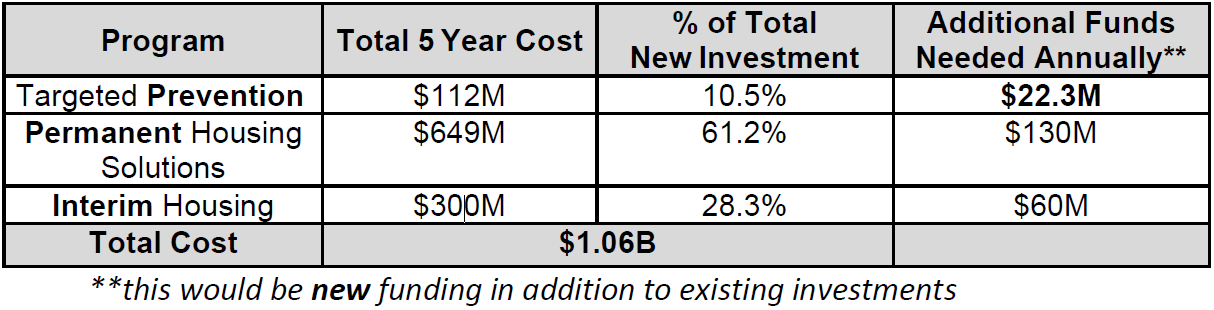
The city has quantified the cost of its 50% homelessness reduction goal, and the result is $1.06 billion.
The anti-displacement report further states that “if homelessness prevention is not adequately scaled,” $202.3 million more would be needed per year – an additional $1.01 billion over five years:
“According to the model, if homelessness prevention is not adequately scaled, Oakland’s overall homelessness solution system will increase in cost by over $200 million in 5 years. While preventing homelessness for a household costs the City approximately $10,000, providing housing for that same household once they become unhoused, could cost the City over $230,000 in capital housing development investments alone.”
– from City of Oakland 2026 Anti-Displacement Strategic Action Plan
At the current annual spending level of $122 million per year to facilitate 1,500 exits from homelessness, the current cost per household facilitated to a successful exit is $81,333. That average does not include the capital and ongoing costs of housing.
The focus of the anti-displacement plan is on the city’s non-capital funding sources and activities, meaning it does not cover housing production and preservation activities. (These activities were discussed in the city’s 2023-2027 Strategic Action Plan.)8
Given the significant gap between the total cost and the actual resources available, the result is a goal that the current budget cannot meet:
Current annual funding: $122 million (Measure Q parcel tax, Oakland General Fund, Alameda County).
Estimated required investment to achieve homelessness reduction goals: $406 million annually.
Annual funding gap: $284.3 million.
10-year outlook: A total estimated cost of $3.2 billion to end unsheltered homelessness in Oakland.
Oakland relies heavily on a network of community-based organizations, but outcomes are vague
The city’s portfolio of anti-displacement programs appears comprehensive on paper, but its lack of coordination, scale, and accountability are deficiencies in practice.
Oakland relies heavily on a network of community-based organizations and legal clinics to execute (practice) the city’s anti-displacement strategy in exchange for funding support from the city.
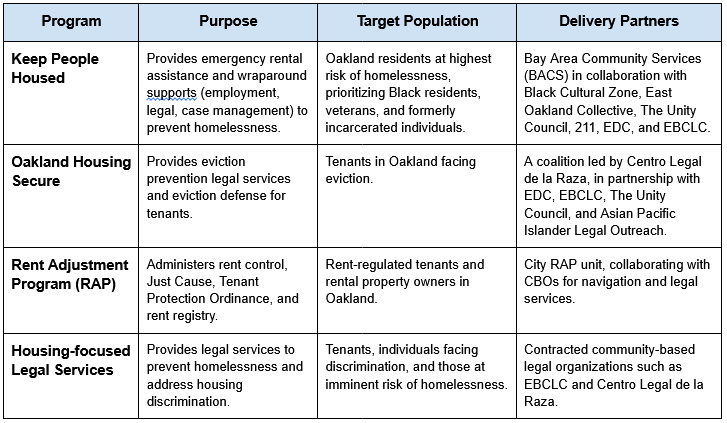
Unfortunately, many of these partners operate with constrained finances, and some do not consistently track outcomes.
A city audit in 2022 showed9 that Oakland spent $70 million on similar homelessness programs between 2019 and 2021, but the organizations that received the funds neglected to track outcomes to assess how effectively that money was spent.10
See this related article:


‘The system is designed to exhaust you’
The city’s commission on homelessness identified “system exhaustion” as a primary driver of homelessness, where the barrier to remaining housed is not just financial, but bureaucratic.11
Comments from focus group participants illustrate this aspect of Oakland’s system failure:
“If you called the [resource hotline] or they give you all these resources and other numbers to call. There is none. They put you back in the line of calls and they send you here, they send you there. But nobody has the right information for the right guidance of where you need [to go] – who is the person you need to speak to and how can I get the help... It was ridiculous to a point you give up. You give up.”
“The system is designed to exhaust you.”
– from Commission on Homelessness focus groups. Feb. 25, 2026.
A contributing factor to this shortcoming appears to be extreme staffing shortages. According to a report from the city’s human resources department, the city’s employee vacancy rate was approximately 22% as of April 2025, with the Workplace and Employment Standards department seeing a 36% vacancy rate.12
SUBSCRIBE TO RECEIVE UPDATES
The anti-displacement plan provides additional data and covers several other areas of concern, including rent burden, overcrowding and doubling-up, housing stock age and habitability, and foreclosures.
The plan also outlines implementation strategies, such as targeted prevention, encampment outreach, coordination between service providers, more shelter beds, deeply affordable housing, and ongoing rent subsidies.
Read the full plan here:

Other notable agenda items
Forever emergencies. As usual, the March 16 city council agenda included resolutions to renew three local emergency declarations, some of which have been in place for decades. This now-routine practice continues these formal states of emergency with no substantive review:
HIV/AIDS public health crisis. Agenda item #6.1
Medical cannabis. Agenda item #6.2
Homelessness crisis. Agenda item #6.3
One could fairly argue that homelessness is a real and present crisis in this city, and that a declaration that the city is in a homelessness “state of emergency” is justified. But cannabis is now legal and available for medicinal and recreational use. And while HIV/AIDS remains a serious condition, it is now considered a manageable chronic disease.
Ostensibly, these emergency declarations allow the city to access certain funds or streamline procedures in response to a crisis. But the city council’s perpetual renewal of emergency declarations with no review, no clear goals or measurements, and no sunset criteria has turned them into permanent policy fixtures divorced from the present, rather than temporary crisis-response tools. This reflects poorly on the city council’s credibility and seriousness with respect to what it qualifies as an emergency, and its rationale for making and renewing emergency declarations.Gender-affirming care. Council members Zac Unger, Rowena Brown and Charlene Wang sponsored a resolution:
“Reaffirming Oakland’s commitment to the right of its transgender, gender-nonconforming, intersex and two-spirit (TGNCI2S) residents and employees to obtain gender-affirming care without discrimination; and demanding healthcare providers and insurance carriers operating within the city to adhere to state and local laws mandating access to medically necessary healthcare, including gender-affirming care.” Agenda item #6.6.
Council members and staff travel to Philadelphia on taxpayers’ dime. Council members Kevin Jenkins and Zac Unger seek to reimburse council member Jenkins, his deputy chief of staff, and council member Unger’s deputy policy analyst up to $2,500 per person for their travel expenses while attending the National Forum for Black Public Administrators in Philadelphia. Agenda item #6.11.
Posey Tube improvements. The city of Oakland and Caltrans seek to amend an existing agreement between the two agencies to facilitate the start of construction on Caltrans’ Oakland-Alameda Access Project (OAAP) – a 3-year, $175 million upgrade to improve connectivity and safety at Posey Tube. The project will involve major traffic disruptions, including 8 full weekend closures and 20–25 nighttime closures of Posey Tube, the nearly mile-long, underwater connection between Oakland and Alameda. Agenda item #6.13.
Oakland Report is by no means comprehensive in our coverage of public agendas in Oakland. The scope and frequency of public meetings are far more than we can presently cover.
You can see the full Oakland City Council agenda and meeting materials at the city’s meeting calendar page.

BECOME A SUPPORTING MEMBER
We rely on our readers’ financial support to continue our work.
Your contributions are tax-deductible.
We are a 501(c)(3) charitable nonprofit based in beautiful Oakland, California. Our mission is to make truth more accessible to all Oakland residents.

City of Oakland. “Anti-Displacement Strategic Action Plan.” Oakland Housing and Community Development. Winter 2026. https://www.oaklandca.gov/files/assets/city/v/3/housing-comm-dev/documents/reports/hcd-anti-displacement-strategic-action-plan-2026.pdf
U.S. Census Bureau. “Quick Facts: Oakland, California.” U.S. Census website. Accessed Mar. 16, 2026. https://www.census.gov/quickfacts/fact/table/oaklandcitycalifornia/PST045224
U.S. Census Bureau. “Quick Facts: Alameda County, California.” U.S. Census website. Accessed Mar. 16, 2026.https://www.census.gov/quickfacts/fact/table/alamedacountycalifornia,US/PST045224
Ibid. Anti-Displacement Strategic Action Plan.
City of Oakland. “Receive an oral informational report of the 2026 Point-in-Time (PIT) count.” Commission on Homelessness. Feb. 25, 2026. https://www.oaklandca.gov/files/assets/city/v/1/public-meetings/commission-on-homelessness/2026/february-2026/february-2026-final-agenda-for-posting.pdf
Wikipedia contributors. “Redlining.” Wikipedia, The Free Encyclopedia. Accessed Mar. 16, 2026. https://en.wikipedia.org/wiki/Redlining
County of Alameda. “Unlawful Detainer (Eviction) Fillings.” Housing & Community Development department web data portal. Accessed Mar. 16, 2026. https://www.achcd.org/reports/dashboards/
City of Oakland. “2023-2027 Strategic Action Plan.“ Housing and community development department. June 2023. https://www.oaklandca.gov/files/assets/city/v/1/housing-comm-dev/documents/housing-reports/hcd-2023-2027-strategic-action-plan.pdf
Courtney, Ruby. “Performance audit of the City of Oakland’s homelessness services: Better strategy and data are needed for more effective and accountable service delivery and positive outcomes for Oakland’s homeless residents.” Office of the Oakland City Auditor. Sept. 19, 2022. https://www.oaklandauditor.com/wp-content/uploads/2022/09/20220919_Performance-Audit_The-City-of-Oaklands-Homelessness-Services_Final.pdf
Calton, Christopher. “As homelessness budgets grow, why does homelessness keep getting worse?” Oakland Report. May 21, 2024. https://www.oaklandreport.org/p/as-homelessness-budgets-grow-why
Ibid. City of Oakland Commission on Homelessness.
City of Oakland. “City-wide staffing.” Human Resources department. April 2025. https://www.oaklandca.gov/files/assets/city/v/1/city-administrator/documents/informational-memos/2025/informational-presentation-on-city-wide-staffing-april-2025.pdf
The number of homeless dropped in the rest of Alameda County because places like Hayward and Fremont took a hard line on the problem and, as predicted, they moved to Oakland. As other cities and towns throughout the Bay Area and beyond crack down on the homeless, this will continue to happen until Oakland wakes up and takes the hard line and puts treatment first. Cut-off all the nonreporting, unsuccessful NGOs/non-profits that eat up the budget and are making money off the homeless and partner with someone like Salvation Army that has a record of success and accountability. Not doing anything or putting housing first for a lot of the homeless (i.e. drug addicts and the mentally ill)is just cruel.
Perhaps a wider view would be helpful.
If the rest of Alameda County is 'cracking down' on homelessness, thereby reducing their number of homeless, and Oakland is not 'cracking down' and increasing their number of homeless, then Alameda County taxpayers are successfully SHIFTING the tax burden of the homeless onto the backs of the Oakland taxpayers. Why do Oakland Council members accept this? Why do Oakland taxpayers, their bosses, accept this? Is this obvious to anyone else?