


Editors’ note
Shortly after former Oakland councilmember Rebecca Kaplan left elected office in 2025, Oakland city administrator Jestin D. Johnson awarded her a $149,000-per-year-plus-benefits job as an ‘illegal dumping project manager.’ Johnson hired Kaplan with no public recruitment, no job description, and no public announcement. Oakland Report first published the details of Kaplan’s employment contract and compensation in November.1
Illegal dumping has been a signature issue for Kaplan since the early days of her political career. City officials have lauded Kaplan for her expertise and work in this area. Yet Oakland’s illegal dumping problems became measurably worse during Kaplan’s 16-year tenure on city council, and today have escalated to become among the city’s most visible, vexing, and expensive crises.2
Now the city of Oakland is paying Kaplan handsomely to work as a city employee — out of the public’s view — to ‘project manage’ the consequences of the illegal dumping policies and waste removal contracts she played an outsized role in shaping during her time on the council.
Before she got her new city job, Kaplan frequently appeared and spoke about her achievements in public, having run for office a dozen times over the past two decades. But since she signed her new city employment contract in September 2025, she has remained remarkably silent in public, and the city has provided scant information about Kaplan’s new role and activities.
This report draws from public records, city documents, independent audits, and media reports to help Oakland Report readers piece together what Kaplan has been doing in her new job — and the path she took to land her new publicly funded employment.
Oakland Report provides accurate, unflinching, data-driven reporting and analysis that you will find nowhere else. If you value our nonprofit work, please subscribe, share, and donate.
Thank you for reading Oakland Report. Your donation in any amount helps us continue our nonprofit work:
Kaplan’s $149,410-per-year-plus-benefits city job
The terms of Kaplan’s city employment offer do not include a detailed job description, required qualifications, or performance metrics. The available details are primarily focused on compensation:
“The agreed-upon salary will be $12,450.81 Monthly.”
“Salary, benefits, paid time off, and other terms of employment are covered in union Memorandum of Understanding (MOUs), policies, and regulations adopted by the Oakland City Council.”
“This position works 37.5 hours a week.”
“You will accrue 15 days of vacation per year.”
“This classification is not represented by a Union.”
“This is an at-will position.”
Kaplan’s over 16-year council tenure ended in May 2025, after two failed runs for Oakland mayor and a failed run for a seat on the Alameda County board of supervisors.
After her term as at-large councilmember ended in January 2025, the council appointed her to serve as District 2 interim councilmember from January to April 2025 to fill a vacant seat left by Nikki Bas’ election to the Alameda County board of supervisors.
Four months later in September, Kaplan was hired as an “Exempt Limited Duration Employee” (ELDE) in the City Administrator’s Office with an annual salary of $149,410, plus benefits. There was no public recruitment for the role, and no public announcement after the hire.
Kaplan’s hiring paperwork was signed by City Administrator Jestin D. Johnson, specifying that she would work out of the City Administrator’s Office at City Hall.
$2.3 million in compensation over 16 years
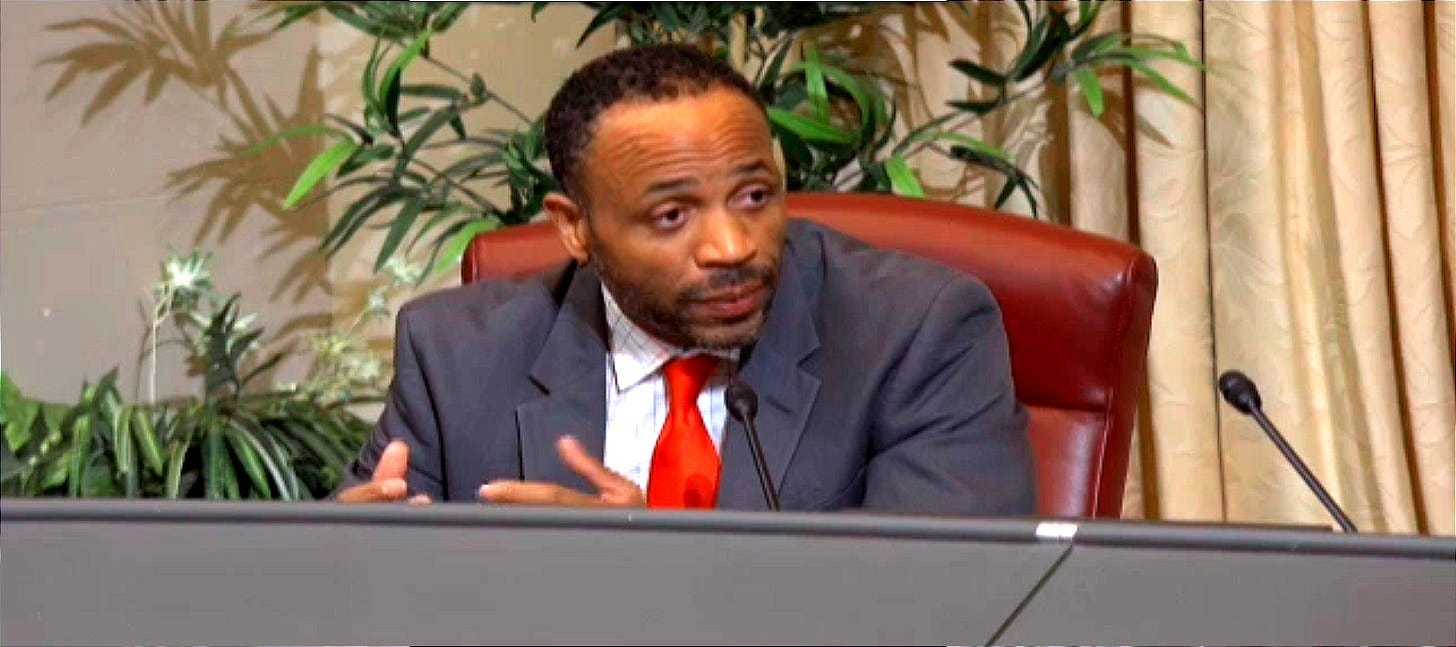
Kaplan was first sworn in to the at-large Oakland City Council seat on January 7, 2009, where she served for 16 years. The chart below shows the estimated compensation she received from the city during her council tenure, drawn from the Public Ethics Commission’s (PEC’s) published compensation data.3
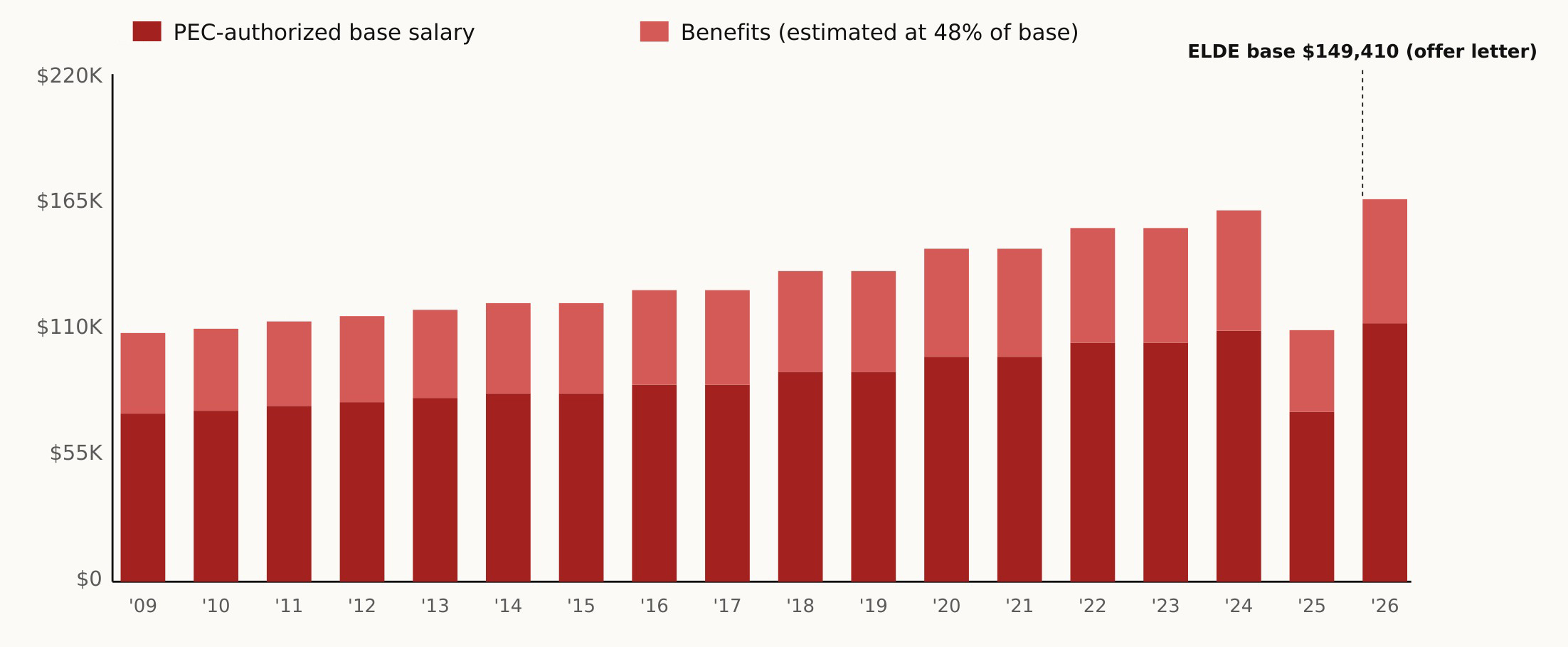
Adding the PEC-authorized base rates from 2009–2024 and the 2025 contracted ELDE term through its September 2026 expiration, Kaplan’s base salary from the City of Oakland totaled approximately $1.59 million from January 2009 through September 2026.
Kaplan received an estimated 48% more in benefits compensation on top of her salary, based on the city’s documented benefits-to-base ratios, bringing her total compensation to roughly $2.36 million over 17 years and 9 months.
Now we turn to the city’s efforts at combating illegal dumping during Kaplan’s tenure, and her role in those efforts.
Twenty years of spending, twenty years of ever-growing trash
City Auditor Michael C. Houston’s recent Performance Audit of Illegal Dumping documents what residents pay for waste service, what the city collects in citation revenue, and what the city has done with roughly $12 million a year in spending.4
The audit does not mention Kaplan by name. Her work, however, runs through nearly every contract, settlement, and policy decision the audit documents.
City administrator Johnson’s response to the audit says that “most” of the city’s illegal dumping strategy goals have been met — however only 4 of the 17 have been marked “Complete.”
Johnson’s response to the audit’s findings indicates that at least one of the key aspects of the city’s illegal dumping work is being done by “a project manager in the City Administrator’s Office” whom the document does not name.5 That project manager most likely is Rebecca Kaplan.
“A project manager in the City Administrator’s Office is currently performing an interagency coordinating role, participating in Countywide, Regional, and Statewide Illegal Dumping coordination, strategy, and convenings. This work includes identifying funding, policies, and resources with State, County, and other partners, including to advance countywide enforcement strategies.”
–City administrator Jestin D. Johnson, Apr. 23, 2026
The audit’s data, combined with prior city reports and contemporaneous press accounts, provide a view of what Oakland has tried, what it has cost, and what changed.
Cleanup spending has increased substantially since 2020. Tonnage of trash removed increased over the same period, but has leveled off in recent years.
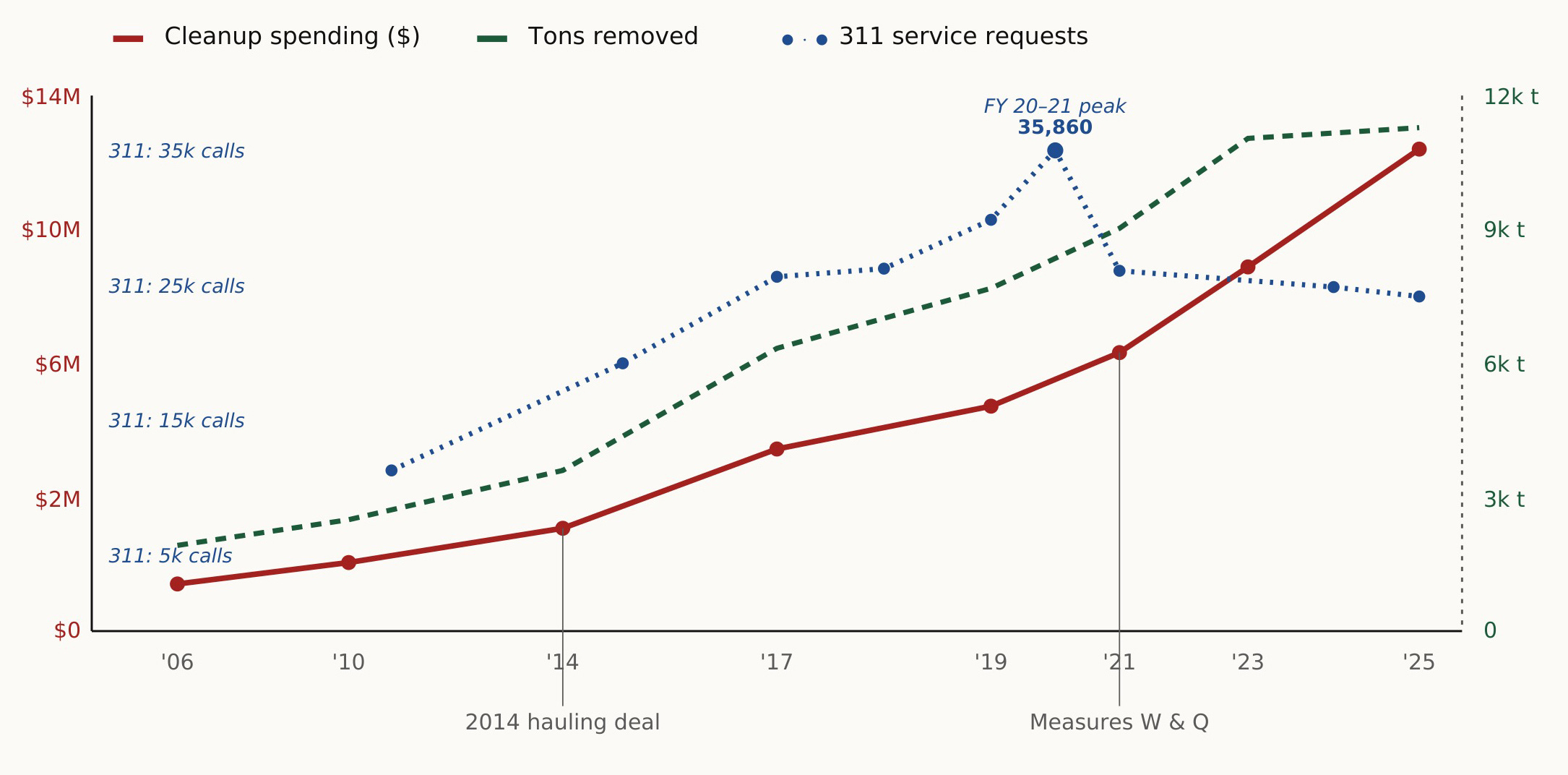
Resident reports of illegal dumping through 311 calls reached a pandemic-year peak of 35,860 in 2020, then dropped precipitously to 27,000 and steadily declined to 23,000 in 2025 — indicating a drop in calls that runs counter to the increasing scale of the problem.
The audit attributes the gap between the rising spending line and the declining 311 line partly to 311 being available only in English — which doesn’t entirely explain why 311 reporting went up sharply in previous years — and partly to Public Works more proactively hauling away dumping volume through ‘garbage blitz’ crews before residents file 311 reports.
The waste removal contract Oaklanders pay for — with trash fees 56% higher than average
The city’s contract with Waste Management emerged from a 2014 bidding process in which city staff recommended awarding a $1 billion trash, compost, and recycling contract to Waste Management. The contract was executed in 2015, and the current, amended version runs through 2030.
According to a 2016 Alameda County Grand Jury report,6 councilmembers Rebecca Kaplan, Lynette Gibson McElhaney, and Dan Kalb in 2014 moved to reopen the bidding process in favor of California Waste Solutions (CWS), a local recycler owned by the Duong family.
Waste Management filed a lawsuit, claiming that the contract was unlawfully steered to CWS at the last minute due to “personal and political connections” between CWS and elected officials. The case was ultimately settled: Waste Management received the trash and compost contracts, and CWS received the recycling contract.7
A few years later, the owners of CWS were federally indicted for corruption related to making improper political donations to several Oakland politicians, including Kaplan (more on that below).
The audit’s data show the cost of waste service in Oakland is substantially higher than the average in the region. The audit compares the minimum monthly curbside service rate for single-family households in five East Bay cities that contract with the same hauler, Waste Management of Alameda County, and use the same transfer station and landfill. Oakland’s rate is 56% above that average, second only to Albany.
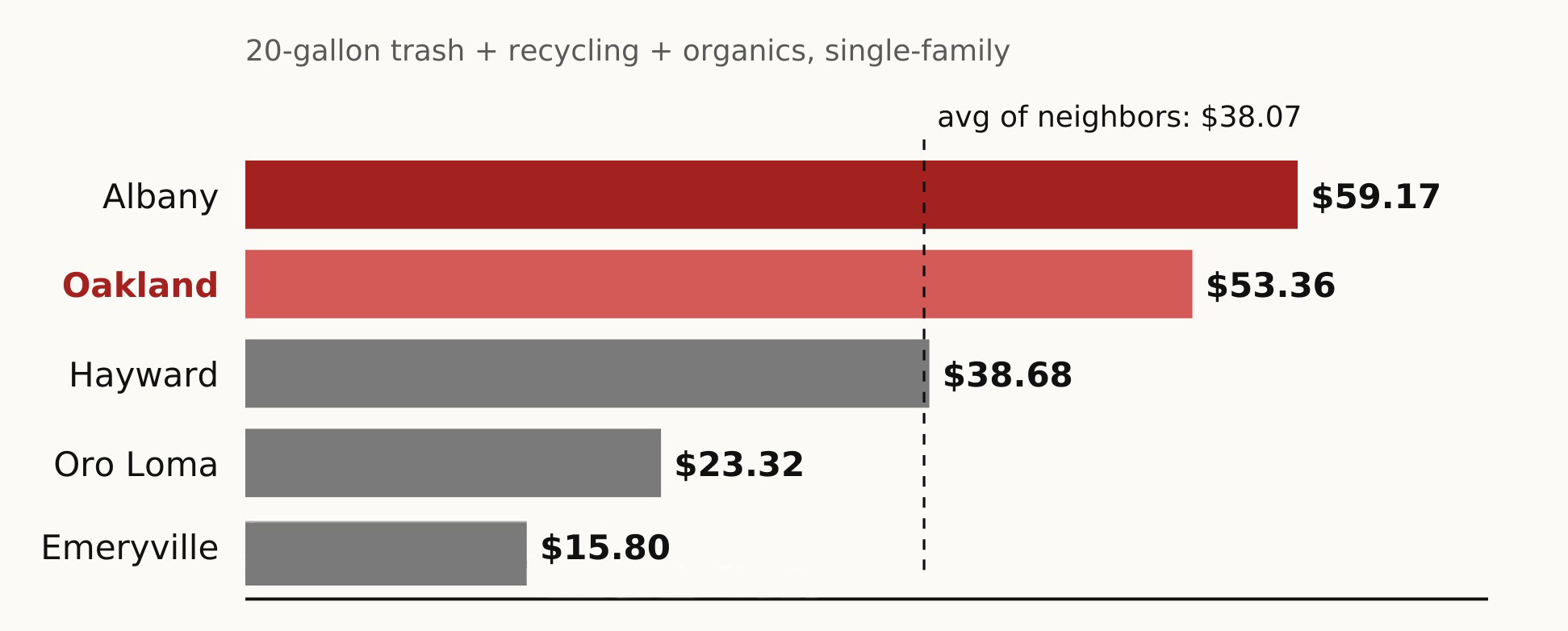
While Oakland residents have paid those higher-than-average rates, the city has poured ever-larger sums of public money into cleanup. Tonnage of waste removed by the city has ramped up significantly since FY 2019–20, but illegal dumping remains, by the audit’s account, “the most-requested City service.”
The audit reports the city’s fiscal year 2024–25 expenditures of $11.9 million on cleanup. The expenditures included $2 million spent on enforcement, but only $16,000 in paid citation revenue was collected. Roughly $1.3 million in citations were issued during the period, but only an estimated 11% of issued citations were paid.
Notably, the audit shows that the city’s ‘encampment management team’ removed 5,428 tons of debris from encampment sites in 2025 — substantially more than the 3,617 tons of illegal dumping collected citywide.
See this related article:

The 2026 audit’s first recommendation asks the Public Works department and the City Attorney to renegotiate the Waste Management contract or rebid it “at the next renewal date, to reduce hauling rates per volume and promote transparency by detailing cost components of the rates.” City management agreed; the target completion date is June 30, 2027 — six months before the next scheduled at-large council election.
The city’s illegal dumping tactics
Across two decades, Oakland has tried multiple approaches to illegal dumping, yet the problem has only grown in scale and expense:
The Waste Management contract (2015, runs through 2030) provides trash pickup service to Oakland homes and businesses. The audit found that Oakland residents pay rates 56% higher than the average of four neighboring cities served by the same hauler. The audit recommends renegotiating the agreement.
Public Works reactive cleanup crews ($11.9 million in fiscal year 2024–25). The city’s 311-driven response efforts removed roughly 7 million pounds of waste from city streets in 2025, according to the audit’s headline figure. The city reports collecting 18 million pounds annually citywide when proactive dumping and encampment cleanups are included.
The ‘garbage blitz’ proactive crew (operating since 2021, with expanded weekend coverage approved October 2025) deployed to known hot spots to clear dumping before residents call 311. The audit asserts that this model suppresses 311 reports by removing piles before they are reported, but also shows that dumping volumes continue to increase.
The ‘encampment management team’ (a separate Public Works effort) removed 5,428 tons of debris from encampment sites in 2025, substantially more than the 3,617 tons of illegal dumping collected citywide in the same period. The audit identifies funding diversion from ‘garbage blitz’ proactive crews to the ‘encampment management team’ in 2024 as a contributing factor to slower 311 response times.
The ‘environmental enforcement unit’ ($2.0 million spent in fiscal year 2024–25, only $16,000 in fines collected) issued $1.3 million in citations during the period — but only an estimated 11% of that was collected.8
Surveillance cameras (36 units, operating since March 2022). The audit recommends that Public Works evaluate and adjust placement to raise citations per camera. City management “partially agrees,” responding that “citation numbers should not be the determinative criteria for camera placement — sometimes a camera is preventing citable behavior from occurring.”
The Aerbits AI drone pilot ($150,000 over six months, approved by city council in April 2026) involves drones flying 72 missions over 1,440 miles of streets to detect dumping piles and automatically file 311 reports. Aerbits’s prior 13-month self-funded San Francisco pilot reported 96% peak reduction in active dumpsites and 4,376 service requests filed. However, the same pilot showed that dumpsites returned within 14 days when monitoring stopped.9
California State Senate Bill 1218 (Arreguín, sponsored by Oakland) would direct the DMV to collect unpaid illegal-dumping citations alongside vehicle registration. The bill had cleared one Senate committee as of the April 23 audit release.10
Mayor and councilmember dumpster allocation. The Waste Management contract provides 12 large dumpsters per year to the Mayor and each councilmember, plus 30 reserved for city events. The audit reports that 71 to 87 dumpsters went unused in each year over the audit window.
Free residential bulky-item pickup (one per year per residential unit, including renters, under the Waste Management contract). In 2025, 72% of single-family households used at least one pickup, but only 2% of multi-family units used the service. The audit recommends that Public Works ‘expand outreach.’
Bulky block parties (residents bring items to a designated location for free disposal on the last Saturday of each month) was operated through 2024, but the city ended the program due to budget constraints.
Davis Street Transfer Station free annual drop-off. Residents may bring items once per year for free disposal. In 2025, 4,501 residential drop-offs were recorded — most were from single-family residents.
Higher fines (adopted by city council April 14, 2026) increased citation amounts to as high as $5,000 per violation, matching Alameda County’s draft scale.11
Across these tactics, the audit’s data point in the same direction: more dollars spent, more tons hauled — and a consistent, substantial increase in the severity of the problem.
The auditor’s first recommendation — to renegotiate the contract that fixes Oakland’s rate structure 56% above average — is the only intervention the auditor identifies as capable of altering the underlying economics. Management agreed to that recommendation; the target completion date is over two years from now.
Kaplan has said very little in public about her activities since getting her new city job
In the seven months between her Sept. 27, 2025 hire as a ‘project manager (illegal dumping)’ and the Apr. 23, 2026 audit, Kaplan appears to have made only a few, low-key documented public statements on illegal dumping policy.
On Jan. 12, 2026, Kaplan appeared as a confirmed panelist at a community forum titled, “Public Action on Illegal Dumping,” and organized by Faith in Action East Bay, the Block By Block Organizing Network, and the East Bay Asian Youth Center.12
The event was attended by hundreds of residents and other panelists including City Auditor Michael Houston, Public Works Interim Director Josh Rowan, At-Large Councilmember Rowena Brown, and Erin Armstrong of Supervisor Nate Miley’s office.
An event recap posted the next day attributed one quote to Kaplan: “A complaint-based system is inherently inequitable.”13 The remark appeared to refer to the city’s reliance on resident-initiated 311 service requests, which are in English only, as the primary trigger for cleanup response.
On Mar. 5, 2026, Kaplan appeared at the Privacy Advisory Commission to present a use policy for the Aerbits AI drone program to locate illegal dumping sites. In her brief comments introducing the program, Kaplan assured the commission that the drone data would be kept secure and does not use facial recognition technology or retain “any personally identifiable information,” and added that it would be used to “deploy for clean up and remediation in a more effective manner, a more rapid manner, and a more equitable manner.”14
These two appearances are the only direct public quotations from Kaplan that Oakland Report has been able to identify after she secured her new city job in September 2025. Other reports allude to Kaplan’s activities without naming her.
A local online news site published a Mar. 2, 2026 article on illegal dumping fines that named Kaplan as “involved” in drafting the new ordinance through a secondhand description offered by Faith in Action East Bay organizer Dr. Ida Oberman; however, Kaplan herself was not quoted.15
A follow-up Mar. 9, 2026 article in the same online publication about State Senate Bill 1218 listed Kaplan among “other officials” working on the Oakland ordinance; but again, it included no direct statement from Kaplan.16
Local television station KTVU’s coverage of a second Faith in Action East Bay forum on illegal dumping, three days before the audit release, named Mayor Lee, Councilmember Zac Unger, and others as panelists; but this time Kaplan was not listed as a panelist.17
Despite Kaplan holding what appears to be a pivotal role in one of the city’s most high-profile initiatives — illegal dumping — the city has been silent on her involvement:
The city of Oakland’s news release webpage shows no press release issued by Kaplan or naming her since her September 2025 start of employment with the city.
The City Council has held no public hearing on Kaplan’s employment.
The council Public Works & Transportation Committee meeting record shows no item presented by Kaplan in her capacity as a city employee.
No public report authored by Kaplan has been posted on the city’s website.

What the available public records show
Oakland Report reviewed the city’s online public records request log to gain insight into Kaplan’s activities since she landed her new city job. A keyword search for “Kaplan” on that portal returned 122 requests, including some from Kaplan’s council tenure and subsequent city job, and some that are unrelated to her.18
Together, the public records — which were only made available after multiple Public Records Act requests, and some of which were redacted — suggest that Kaplan’s recent work includes developing policy, writing reports, coordinating with Waste Management, seeking philanthropic donations, and coordinating with nonprofit organizations.
The available public records do not contain a detailed job description, scope of work, or performance metrics for Kaplan’s position.
Here’s what we found:
October 29, 2025 Regional Convening on Illegal Dumping. Kaplan attended a “Bay Area Regional Convening” hosted by Alameda County Supervisor Nate Miley at the Alameda County Training and Conference Center in Oakland. The meeting’s stated goals were to “Release the Illegal Dumping Solutions Report,” “Unveil a Model Ordinance for Illegal Dumping Enforcement,” and hold a panel discussion on “Best Practices for Franchise Agreements” — the category covering Oakland’s Waste Management and California Waste Solutions contracts.
The day before the convening, Kaplan received the meeting information from Erin Armstrong, Supervisor Miley’s Director of Policy and Strategic Initiatives, and forwarded it to City Administrator Johnson and his deputy Aracely Garza. The afternoon of the convening (Oct. 29, 2025 at 3:32 PM), Kaplan emailed Johnson and Garza: “The Bay Area Regional Convening on illegal dumping today was great. I wanted to share the invitation they gave us, to participate in the Spring 2026 Statewide Illegal Dumping Conference. It will be on April 30 and May 1, 2026.” The email proposed a follow-up internal meeting for Nov. 6, 2025.
‘Strategies for Illegal Dumping’ memo. Kaplan authored a draft memo that Johnson distributed on Nov. 3, 2025 to a senior city group including Josh Rowan, Mayor Barbara Lee’s chief of staff Maya Saika Chen, City Attorney Ryan Richardson, communications director Sean Maher, and City Auditor Michael Houston. Johnson’s cover note: “I am sharing with you a copy of the initial illegal dumping strategies document that Rebecca Kaplan prepared. Recognizing that many of you have inquired about this work, I want to be sure that you all receive the same information.”
Three days later, Saika Chen forwarded the email to Erica Astrella in the Mayor’s office, writing: “Connecting you both so we can all be aligned on all the incredible work being done on illegal dumping. This is an amazing compilation and work plan Rebecca, thank you.” The memo includes an attached document with filename, “Strategies for Illegal Dumping Draft.pdf.”
Illegal Dumping Ordinance and accompanying staff report. On November 4, 2025, Kaplan emailed councilmember Unger’s aide Matthew Malsin a first-draft ordinance with a background research memo. The draft incorporated an administrative penalty scale of $2,500 for a first dumping violation, $5,000 for a second, and $10,000 for a third.
In the email, Kaplan flagged a recurring problem she had been “reviewing and discussing”: that fines “are then actually able to be collected, and that citations are issued in an efficient and effective manner.” She wrote that “a recommended best practice to help solve this” was to tie violations to vehicle ownership for citation purposes — the policy mechanism that became California State Senate Bill 1218.
On February 10, 2026, Kaplan circulated a draft staff report for the ordinance to a wider working group: Unger, Malsin, Patrick Bears (City Attorney’s office), Saika Chen and the mayor’s deputy chief of staff Preston Kilgore, Richardson, Hathaway, Garland, and Betsy Lake.
The Council adopted the ordinance on April 14, 2026. The published staff report makes no mention of Kaplan’s role in creating the ordinance.
The Aerbits AI drone pilot. Mayor Lee’s April 15 press release named Aerbits Inc. founder Brian Johnson as one of four named participants in the city’s legislative package rollout. Records indicate that Kaplan brokered the relationship. Assistant Public Works Director Kristin Hathaway wrote on February 4, 2026, in forwarding the formal proposal to City Administrator Johnson, Public Works Director Garland, and senior environmental staff: “In follow-up to our meeting last week with Brian Johnson, founder of Aerbits, he has submitted for our consideration a proposal for a pilot run of the services he offers… Thanks to Rebecca for coordinating his presentation and procuring the proposal.”
The Crankstart Foundation. On October 27, 2025, Gloria Bruce, Program Director for Housing Security and Public/Private Partnerships at the Crankstart Foundation — the philanthropy of investor Michael Moritz — emailed Kaplan: “So great to reconnect… would love to chat with you sometime soon to hear about your scope of work and if there is any opportunity for Crankstart to support. (FYI, I’ve also been in touch with Esther Morales in the Mayor’s Office about different philanthropic asks so will circle back with her on this as well). My colleague Eli Bildner would join us.”
Kaplan replied later the same afternoon: “Wonderful thanks and I’m excited to connect. I could do weds 10/29 at 2:30pm. Will you send a zoom link?” The October 29 meeting time ran concurrently with the close of Supervisor Miley’s convening. Eli Bildner is identified in the correspondence as Crankstart’s Vice President of Operations. The substance of the philanthropic ask appears to be redacted in the public records release.
Bulky-waste utilization analysis. On Dec. 8, 2025, Kaplan emailed then-Public Works Director Josh Rowan and Assistant Director Hathaway a written analysis of bulky-pickup utilization, with two screenshot exhibits drawn from a prior Public Works report.
Kaplan wrote: “While 24% of single-family homeowners used a free bulky pickup during the year, only 8% of multi-family (e.g. apartment) households used one. So there is substantial room for expansion of use of this program, especially for tenants/multi-family residential units. Also, see the free drop-offs at Davis St. Transfer station, only 9% of available drop-offs were used. Part of the impediment is the need to schedule an appointment ahead of time. As well as lack of knowledge of the program.”
Kaplan forwarded the same analysis to communications director Sean Maher the next day. The audit released four months later (Apr. 23, 2026) makes the same finding, recommending that Public Works ‘expand outreach.’
Coordination with Waste Management. On Jan. 9, 2026, Kaplan emailed Warren Chu, Public Sector Manager at Waste Management of Alameda County, with a screenshot showing the WM bulky waste online booking website was non-functional: “Since booking by using that website is promoted on the hand-outs, mailers, and other materials about the bulky waste program, I wanted to check back about timeline for fixing the web system, and to get clarification in terms of what we can give the public.” Chu replied that afternoon: “Our IT Business Solutions has been working on this since you informed us. They estimate it being fixed tonight.”
Partnership with Keep Oakland Beautiful. Christina Porter, Board Chair of Keep Oakland Beautiful (a nonprofit cleanup organization), emailed Kaplan on Nov. 24, 2025 to finalize two recycling-survey questions the two had discussed the previous week, asking Kaplan’s feedback before the survey distribution. The exchange suggests that Kaplan is a city point of contact for the cleanup nonprofit ecosystem.
Statewide conference participation. Kaplan’s Oct. 29, 2025 email to City Administrator Johnson and Garza forwarded an invitation from Supervisor Miley’s office to the Spring 2026 Statewide Conference on Illegal Dumping, held April 30 to May 1, 2026 in Sacramento (IDCON5). The conference is a recurring statewide gathering of jurisdictions, contractors, and policy advocates. Whether Oakland plans to send representatives, and if so whom, is not documented in the release.
Here we turn to Kaplan’s background as a councilmember, specifically her interactions with waste removal contractors, Oakland politicians, and ethics violations.
‘At least $3 million’ — the California Waste Solutions lawsuit and settlement
In 2017, the City of Oakland sued CWS, alleging that the recycling company whom Kaplan had advocated for the city to hire in 2015 (which itself resulted in a lawsuit from Waste Management) had overcharged multi-family property owners under a “premium backyard service” rate of up to $776.12 per month for cart-rolling service.
On July 30, 2021, the City Council met in closed session via Zoom to discuss a potential settlement in order to avoid costly litigation. Former District 6 Councilmember Loren Taylor, who attended the closed session, told a local online news outlet in 2024 that the city’s case “was stronger than the countersuit from CWS” and “would have been favorable to Oakland and Oakland residents” at trial.19
According to another unnamed source whom the news outlet reported was in the room during the discussion, then-City Attorney Barbara Parker recommended a “good faith” settlement offer “not to exceed $200,000.” According to the unnamed source, Kaplan surprised the group by moving an amendment that changed the authorized cash payment to CWS to “at least $3 million” — a 1,400% increase.
For his part, Taylor told the media outlet that he “does not recall if the city attorney office offered any direction on this case.”
On Dec. 7, 2021, the Council voted 8–0 in open session to authorize a settlement that included $3.2 million paid to CWS.20 Kaplan said at the meeting that she was happy to “get relief for a local business and relief for our public.”
In a separate component of the same settlement, CWS agreed to pay at least $6.2 million in refunds to overcharged multi-family customers. CWS also reduced its premium cart rate from $187.57 per month to $34.22.
‘Truly sorry’ — the 2022 ethics fine
In December 2013, Kaplan and her parents purchased a condominium on the Jack London waterfront. Kaplan made the unit her primary residence in 2018.
She did not list the property on her annual Form 700 financial disclosure for seven years. During that period, Kaplan voted at council meetings on Estuary Park, located within 500 feet of her condominium, in 2016, 2017, 2018, and 2020. The 2016 vote allocated $27.5 million in bond proceeds for the project.
A well-known city conflict-of-interest rule prohibits councilmembers from participating in votes that could have a material financial impact on real property in which they have a financial interest within 500 feet of a council action.
Kaplan finally reported the property on her 2019 Form 700, filed in 2020. The Public Ethics Commission (PEC) opened an investigation.
On Dec. 14, 2022, the PEC voted unanimously to impose a $19,000 fine, the maximum allowable under city code on Kaplan for two conflict-of-interest violations and three failures to timely disclose a financial interest.21
PEC enforcement chief Simon Russell described the violations as “serious” and the conduct as “negligent rather than deliberate.” A representative for Kaplan told the commission she was “truly sorry.”22

Sheng Thao, Andre Jones, and the two Duongs: the federal indictments
Oaklanders are likely familiar with the ongoing saga of recalled Oakland mayor Sheng Thao.
On June 20, 2024, federal agents executed search warrants at the homes of then-Mayor Thao, her partner Andre Jones, CWS owners David and Andy Duong, and at CWS’s offices. Oakland voters subsequently recalled Thao on Nov. 5, 2024.
Thao and Jones had previously spent years working for councilmember Kaplan. Jones served as Kaplan’s chief of staff from 2008 to April 2016. Thao joined Kaplan’s office as a paid intern in 2012, and was promoted to her chief of staff in 2017, a role she retained until late 2018 when she won election to the District 4 council seat.
In 2022, Kaplan endorsed Thao’s run for mayor. Thao won by 677 votes.
On January 17, 2025, federal prosecutors indicted Thao, Jones, and the two Duongs on eight counts of conspiracy, bribery, mail fraud, and wire fraud. The indictment alleges that beginning in October 2022, the Duongs promised to commit roughly $375,000 in benefits to Thao and Jones in exchange for Thao’s commitment, if elected mayor, to extend the CWS recycling contract, purchase modular housing units from Duong-backed company Evolutionary Homes, and appoint city officials selected by the Duongs.
The Duongs allegedly made $95,000 in cash payments to Jones disguised as wages for a no-show job at Evolutionary Homes, with $300,000 promised in total. Both Thao and Jones took steps to conceal the scheme, according to federal prosecutors. Bribe payments were routed to Jones at Thao’s direction, the indictment states, “to avoid a paper trail” back to her. All four defendants pleaded not guilty.23
The federal case is the criminal extension of an earlier civil investigation by the California Fair Political Practices Commission and the Oakland Public Ethics Commission that found, “Andy Duong was the true source of at least 93 contributions to multiple local campaign committees when he created a campaign contribution laundering scheme to benefit his family-owned company.”
Court records identified approximately $67,000 the Duongs allegedly funneled across the 2016–2018 election cycles to seven Oakland councilmembers and council candidates: Dan Kalb, Lynette Gibson McElhaney, Larry Reid, Abel Guillen, Desley Brooks, Sheng Thao, and Rebecca Kaplan. The FPPC alleged that $3,500 was routed to Kaplan through seven straw donors.24
A 2022 court filing made public an Andy Duong email about his political beneficiaries: “All of the above people are strong and relationship well established in our hands.”25
Kaplan has not been charged with any crime. She told a local news outlet in 2020 that she was unaware of the investigation and would not have knowingly accepted contributions tied to a city contractor: “I would certainly find improper contributions to be unacceptable, and would not keep such funds.”26 It is unclear whether Kaplan returned the donations she received from Duong’s straw donors.
One week after the June 2024 FBI raids, Kaplan voted to defeat a proposed ballot measure that would have given the Public Ethics Commission additional resources, including for the open CWS straw-donor investigation.27
Kaplan’s electoral record
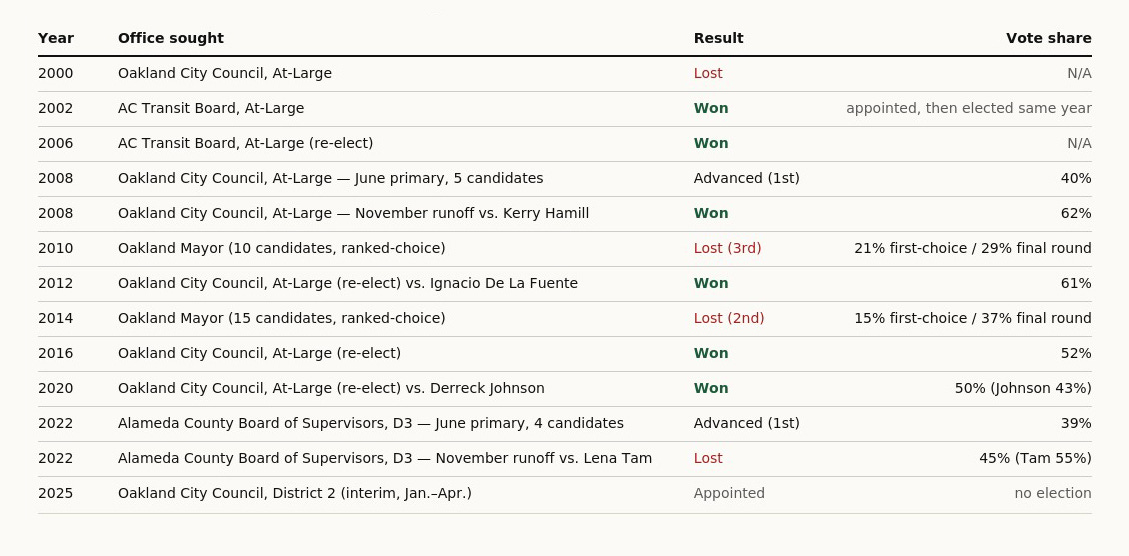
Kaplan’s political career, including her 2025 hire by the City Administrator, spans 25 years and twelve runs for elected office.
The city just can’t seem to quit Rebecca Kaplan
The record shows that Kaplan’s political career was marked by documented ethical lapses and close association with high-profile political players who are now under federal indictments for corruption, including alleged illegal campaign contributions to Kaplan. (She has denied any involvement or awareness of the alleged crimes.)
After two failed runs for mayor and a failed run for the board of supervisors, Kaplan appeared to have run out of options for continuing in public office — her primary livelihood for two decades.
It remains unclear why the city gave Rebecca Kaplan a lucrative city job after she left elected office. City insiders have justified Kaplan’s hire as warranted on the basis of her extensive knowledge of city operations and her work on illegal dumping in particular. But the record shows that the city’s illegal dumping problems grew significantly worse during Kaplan’s tenure on the council.
Kaplan unquestionably posted many positive achievements during her tenure on the council. An accounting of those achievements is not the focus and is beyond the scope of this analysis. We note that delivering positive results is a baseline expectation of public servants, especially elected officials.
However, it strains belief that Kaplan is the only individual qualified to fill the new city job she was given — in a city of nearly half a million people, a greater Bay Area region of over 7 million people, and a state of 39 million people. The city of Oakland itself already employs numerous people with deep qualifications and experience in the same areas.
In the absence of a public recruitment or a posted job description, there was no opportunity for others to compete for the job — nor for the public even to be made aware that Kaplan was under consideration — a job which is publicly funded, and ultimately works for and should be accountable to Oaklanders.
📖
Oakland Report is an experiment in a new form of media. Our nonprofit mission is to provide reasoned, fact-based, well-sourced reporting and analysis on local government issues, focused on observable and verifiable evidence free from implicit bias.
Our guiding principles are to present the facts and evidence and let the reader decide for themselves what to think. We achieve this by focusing on what people and organizations do, not what they say.
In that spirit — and because Kaplan has shown no inclination to respond to other news outlets’ requests for comment — we did not contact Kaplan for this story. We instead chose to simply relay what the public record states, and let our readers decide for themselves.
Another of our guiding principles is to always remain open to examining and questioning our own biases, and to keep an open forum for new information that may advance our understanding — and help Oaklanders better grasp the decision-making that affects our lives.
In that spirit, we invite Kaplan to present her perspective on this article and report on her activities in her new city job. If offered, we will publish her counterpoint as presented.
Oakland Report provides accurate, unflinching, data-driven reporting and analysis that you will find nowhere else. If you value our work, please donate. All contributions go directly to sustaining and growing our nonprofit work:
Note: This article was revised to include Kaplan’s comments at the Mar. 5, 2026 Privacy Advisory Commission meeting, which an alert reader brought to our attention. Our thanks to the reader for the tip.
Reinhart, Sean S. “City of Oakland gives Rebecca Kaplan, former city council member a $149,000-per-year job.” Oakland Report, Nov. 5, 2025. https://www.oaklandreport.org/p/city-of-oakland-gives-rebecca-kaplan
Karlamangla, Soumya. “How a city awash in garbage is trying to take out the trash.” New York Times, Oct. 8, 2025. https://archive.is/yI4dO; https://www.nytimes.com/2025/10/08/us/oakland-california-trash-garbage.html
City of Oakland. “City Council salaries.” Public Ethics Commission. Accessed Apr. 27, 2026. https://www.oaklandca.gov/Government/Boards-Commissions/Public-Ethics-Commission/Open-Government/City-Council-Salaries
Houston, Michael. “Performance audit of illegal dumping: Improvements to the accessibility of legal waste disposal and the city’s enforcement and remediation policies and operations could help alleviate Oakland’s illegal dumping problem.” Office of the City Auditor, Apr. 23, 2026. https://www.oaklandauditor.com/wp-content/uploads/2026/04/20260423_Performance-Audit-of-Illegal-Dumping-1.pdf
Johnson, Jestin D. “City Administrator statement on illegal dumping audit.” City of Oakland website, accessed Apr. 27, 2026. https://www.oaklandca.gov/News-Releases/City-Administrators-Statement-on-the-Illegal-Dumping-Audit
Alameda County Grand Jury. “2015 - 2016 Alameda County Grand Jury final report.” County of Alameda, June 1, 2016. https://grandjury.acgov.org/wp-content/uploads/2023/01/2015-2016-GJ-FinalReport.pdf
Waters, Robyn. “Oakland City Council gives controversial garbage contract to Waste Management.” Oakland North, Sept. 30, 2014. https://oaklandnorth.net/2014/09/30/oakland-city-council-gives-controversial-garbage-contract-to-waste-management/
Sambajon, Troy A. “Can cleaning up illegal dumps build community? Oakland volunteers sure hope so.” Christian Science Monitor, July 14, 2025. https://www.csmonitor.com/USA/Society/2025/0714/oakland-cleanup-trash-community
Bond Graham, Darwin. “AI drones to spot illegal dumping? Oakland is considering a pilot project.” The Oaklandside, Apr. 10, 2026. https://oaklandside.org/2026/04/10/drones-illegal-dumping-oakland-aerbits/
Lee, Barbara. “Oakland unanimously approved comprehensive illegal dumping legislative package.” Office of Oakland Mayor Barbara Lee, Apr. 15, 2026. https://www.mayorbarbaralee.com/press-releases/oakland-unanimously-approved-comprehensive-illegal-dumping-legislative-package
City of Oakland. “Ordinance to strengthen illegal dumping enforcement.” Oakland City Council meeting agenda, agenda item #6.7, Apr. 14, 2026. https://oakland.legistar.com/LegislationDetail.aspx?ID=7947032&GUID=FE8756DB-E9C7-4048-8F95-3539268CA0B0&Options=&Search=
Faith in Action East Bay. “Public action on illegal dumping: Oakland community groups to hold citywide public action with city officials to address health crisis posed by illegal dumping.” FIAEB website, Jan. 6, 2026. https://fiaeastbay.org/public-action-on-illegal-dumping/
Faith in Action East Bay. “Oakland demands solutions to illegal dumping.” FIAEB website, Jan. 13, 2026. https://fiaeastbay.org/oakland-demands-solutions-to-illegal-dumping/
City of Oakland. “Privacy Advisory Commission meeting video.” Mar. 5, 2026, 17:58. https://oakland.granicus.com/player/clip/7333
Wolfe, Eli. “Illegal dumpers face big fines in Oakland, but they rarely have to pay,” The Oaklandside, Mar. 2, 2026. https://oaklandside.org/2026/03/02/oakland-illegal-dumpers-fines-barbara-lee/
Wolfe, Eli. “Illegal dumpers could have vehicle registration blocked under proposed law,” The Oaklandside, Mar. 9, 2026. https://oaklandside.org/2026/03/09/illegal-dumping-oakland-dmv-vehicle-registration-fines-jesse-arreguin/
Sos, Zak. “Oakland leaders pressed on plan to crack down on illegal dumping crisis,” KTVU FOX 2, April 20, 2026, https://www.ktvu.com/news/oakland-leaders-pressed-plan-crack-down-illegal-dumping-crisis
City of Oakland. “Open public records web portal.” Search term “Kaplan,” accessed Apr. 19-26, 2026. https://oaklandca.nextrequest.com/requests?search_term=Kaplan
Rhoades, Callie. “Oakland vs. CWS: ‘Extraordinary’ moment in 2021 closed city meeting comes to light.” The Oaklandside, Sept. 25, 2024 (updated October 9, 2024). https://oaklandside.org/2024/09/25/oakland-lawsuit-california-waste-solutions-settlemeent/
City of Oakland. “Adopt a resolution authorizing and directing the city attorney to compromise and settle the case of City of Oakland (“City”) v. California Waste Solutions (“CWS”), Does 1-20, Alameda County Superior Court case no. RG17853559, and CWS’ cross claim against the city.” Oakland City Council meeting, agenda item #11, Dec. 7, 2021. https://oakland.legistar.com/LegislationDetail.aspx?ID=5343499&GUID=90ABFF8C-B485-41F2-98BB-9D0C45DFB520&Options=&Search=
City of Oakland. “In the matter of Rebecca Kaplan (PEC case no. 20-40).” Public Ethics Commission meeting, agenda item #7, Dec. 14, 2022. https://cao-94612.s3.amazonaws.com/documents/Complete-Merged-Agenda-12-14-22.pdf
City of Oakland. “In the matter of Rebecca Kaplan (PEC case no. 20-40).” Public Ethics Commission meeting video, agenda item #7, Dec. 14, 2022. oakland.granicus.com/player/clip/5251?view_id=7&redirect=true
Eby, Kate. “Timeline: FBI political corruption investigation involving Oakland Mayor Sheng Thao, Duong family.” ABC 7 Eyewitness News, Jan. 17, 2026. https://abc7news.com/post/timeline-fbi-political-corruption-investigation-involving-oakland-mayor/15030417/
Sierra, Stephanie and Lindsey Feingold. “Report alleges ‘campaign contribution laundering scheme’ involving Oakland mayor, city officials.” ABC 7 Eyewitness News, June 25, 2024. https://abc7news.com/post/report-duong-family-political-ties-donated-oakland-mayor/14997495/
Fair Political Practices Commission. “In the matter of California Waste Solutions and Andy Duong.” Report in support of a finding of probable cause, FPPC Case No. 19/931, Sept. 8, 2021.
Bond Graham, Darwin. “Accusations of political ‘money laundering’ under investigation in Oakland.” The Oaklandside, Sept. 15, 2020. https://oaklandside.org/2020/09/15/accusations-of-political-money-laundering-under-investigation-in-oakland/
City of Oakland. “Proposed ballot measure to modernize and strengthen ethics oversight in the City of Oakland.” Oakland City Council meetings, agenda item #10, June 26, 2024. https://oakland.legistar.com/LegislationDetail.aspx?ID=6717834&GUID=EAE26022-F355-4874-862E-6234D21C9299&Options=&Search=
Oakland no longer has a city government providing real service to the public. We have a political machine patronage system that runs like a protection racket.
Kaplan's "gift" job position is the only way she could ever hope to have such a position. Her public record demonstrates that she is NOT qualified for the job and citizens should be up-in-arms over this administration's blatant patronage of entitled public officials. This is what happens when we elect and re-elect (this year) over-the-hill figureheads to leadership instead of new, energetic, out-of-the box thinkers who would work hard to attract major employers, innovatively solve longstanding crime and illegal dumping issues, and move this city beyond the political doldrums its been mired in for decades.