


Video clip 1. “Who got the power? We got the power.” Oakland Education Association rallies behind its chosen candidates for Oakland school board — the incumbents who voted to approve their union contract’s pay and benefits. (Sources: Oakland Education Association;1 CBS News Bay Area;2 Adobe Stock; Public Enemy. Video montage by Oakland Report)
Oakland Report examines the data behind the headlines. Today we’re launching a new Media bias section focused on local media coverage of issues that affect Oaklanders’ lives. In this installment, we look at The Oaklandside’s September 22 profile of the two candidates for Oakland school board District 2.
A familiar pattern
On September 22, local media outlet The Oaklandside published a profile of the Oakland Unified School District (OUSD) board District 2 candidates — incumbent board president Jennifer Brouhard and challenger Arielle Fleisher — with the headline, “An experienced incumbent meets a parent challenger.”3
Its introduction describes Brouhard as “a retired teacher and a four-year veteran of the board.” It then describes Fleisher as “an OUSD parent and transportation policy manager” who “decided to jump into the race while her child was in kindergarten last year.”
“In one of the more closely watched races this election season, the president of the Oakland Unified school board faces a challenge from a new OUSD parent who decided to jump into the race while her child was in kindergarten last year.”
— The Oaklandside, Sept. 22, 2026
“Jump into,” coupled with the kindergarten detail, could be read to imply that Fleisher is a newcomer acting on impulse. When juxtaposed with the framing of Brouhard as a “veteran,” “teacher,” and “president,” a casual reader could infer that Fleisher is an inexperienced lightweight compared to Brouhard.
Fleisher’s professional and policy career is mentioned much later in the article, near the end. (She worked at the San Francisco Bay Area Planning and Urban Research Association (SPUR), the San Francisco Board of Supervisors, and the San Francisco Municipal Transportation Agency, and currently works for Waymo.)
Brouhard’s track record gets different treatment. The reporter sums it up in her own words, much earlier in the article: the district has “turned a corner,” with “a more solid budget” and “forward motion on academics.”
Notably, the academics claim is never backed up anywhere in the article — and the district’s modest gains since 2024 still leave it far behind the state average.
Editors' note: Oakland Report is an independent 501(c)(3) nonprofit organization — the same IRS nonprofit category as The Oaklandside. We are not affiliated with any public agency, labor union, corporate interest or political campaign, and we do not offer political endorsements. Our stance toward all politicians, public agencies, advocacy organizations, and corporate interests is one of skepticism and accountability grounded in verifiable evidence. We present the evidence we find — especially evidence that is overlooked, mischaracterized, or omitted elsewhere — and let our readers decide what to think about it. Learn more
Word choice is just one notable aspect of The Oaklandside’s profiles of the OUSD District 2 candidates. Another notable aspect is how it characterizes the supporting evidence it presents.
Much of the article’s account of the district’s record is accurate, including the district’s $100 million-plus structural deficit, its recent elimination of over 400 staff positions, its leadership turnover, and its union contracts.
However, its account of two key outside sources it cites is not accurate. The article overstates what a Stanford study found, and it misstates what Proposition 39 requires.
Both errors — whether intentional or not — appear to run in incumbent Jennifer Brouhard’s favor.
Another notable aspect of the profile is what it leaves out.
It does not mention that the teachers union, Oakland Education Association (OEA), supports Brouhard,4 who served three terms on OEA’s executive board and one term as its secretary,5 and who now, as an OUSD board member, votes to approve union contracts on behalf of the district.
It also leaves out the fact that the Alameda County Democratic Party declined to endorse Brouhard and another teachers union-backed incumbent, Valarie Bachelor, this month.6 (It does promise to publish a follow-up article about funding and endorsements.)
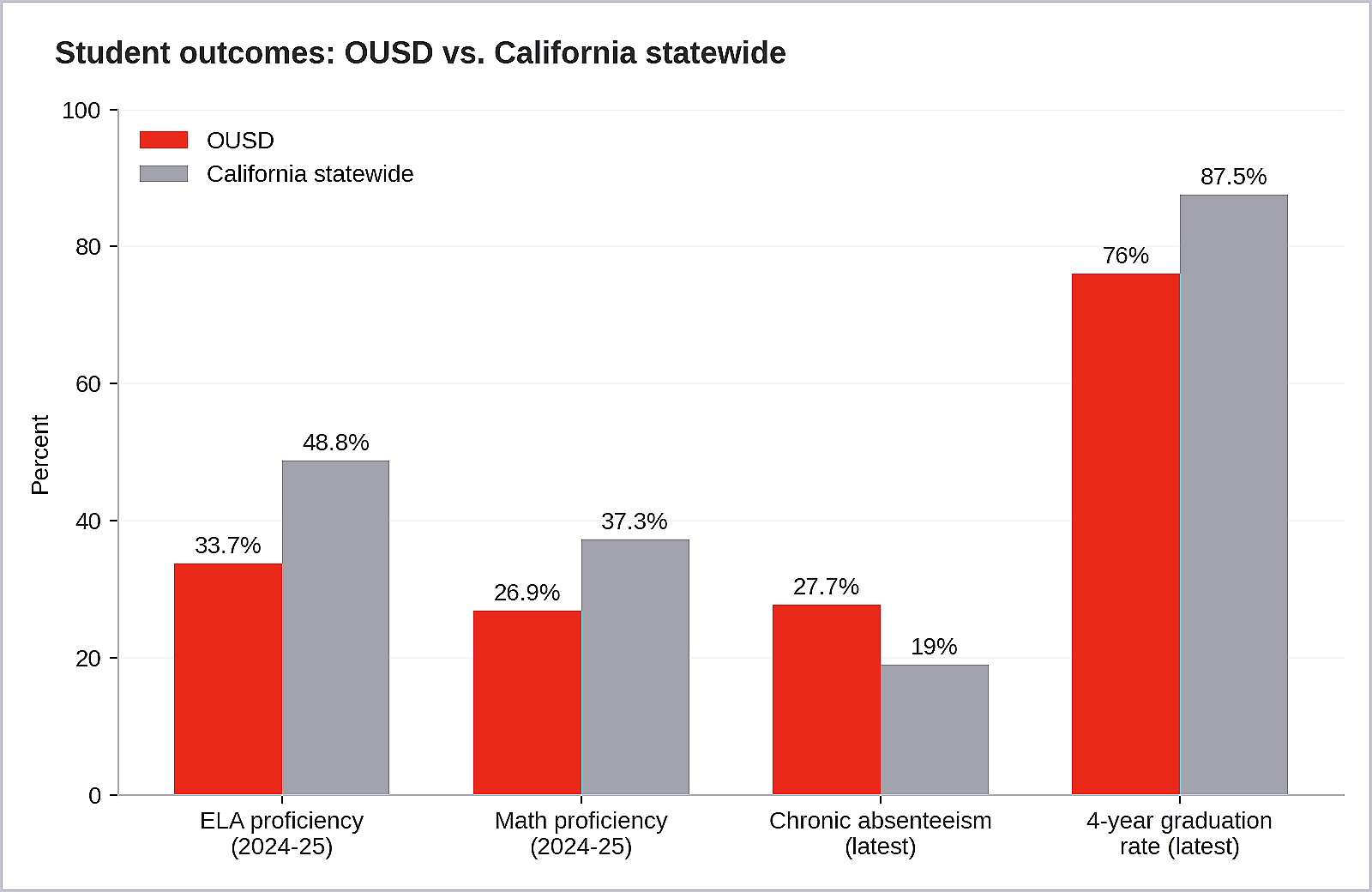
The profile also does not report that OUSD’s academic performance continues to be deficient. OUSD trails the state average by about 15 points in reading and 10 in math.7 Instead, it relays the incumbent Brouhard’s claim of “forward motion on academics” without checking it.
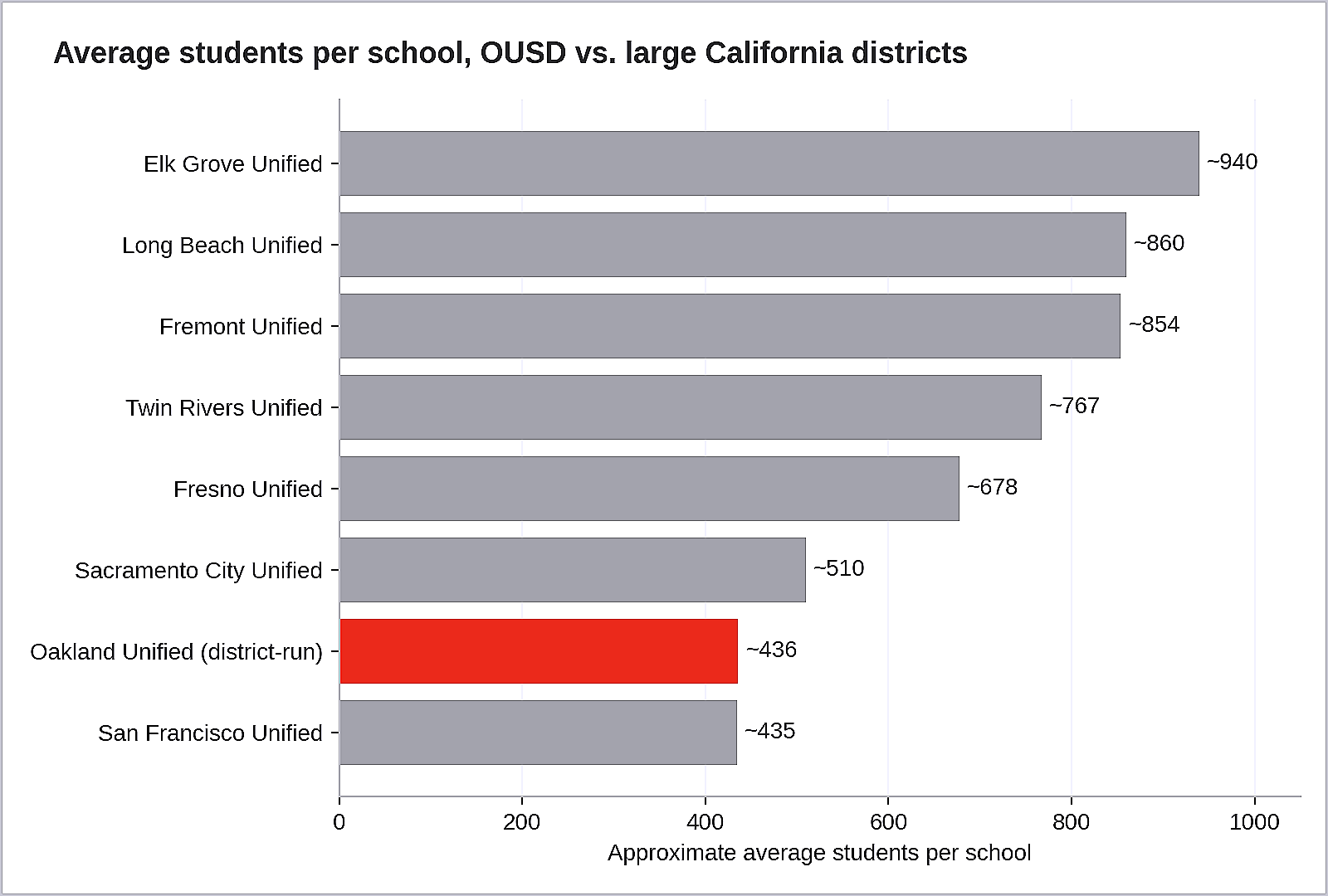
The Oaklandside’s article also doesn’t report that OUSD’s schools have among the lowest enrollment, on a pupils-per-school average, of any large California district.
It doesn’t mention that the author of the Stanford study it cites (“The study… found that closures led to enrollment losses, negating any savings the closures produced”) warns against reading it as a case against closures — and that the study found that large urban districts like Oakland’s actually did achieve spending reductions.
It offers no outside evidence for Fleisher’s position on closures — only a principals’ letter criticizing the board’s decision-making that it leaves to Fleisher to cite herself (while notably not providing a link to the principals’ letter). For example, it doesn’t mention the county superintendent’s finding that OUSD operates 77 school sites where an efficiency study suggested that it could operate as few as 46 schools.
It doesn’t directly connect Fleisher’s claim about staff cuts (paraphrased by the article’s author as, “cutting literacy specialists during a reading crisis and laying off attendance specialists and slashing the enrollment department while setting a goal to boost attendance and enrollment”) to the eliminated positions the same article reports.
It also does not report the county superintendent’s June warning that the OEA teachers union contract Brouhard credits for a 99% fill rate “endangers the District’s fiscal stability.”
To be fair, no single article can fully cover every facet of a complex issue, especially with a large government agency like Oakland Unified. But when an article touches on a specific facet, the choices it makes about which details are deemed relevant for mention are worthy of closer scrutiny.
This analysis takes a closer look at what The Oaklandside’s article on the OUSD District 2 board candidates seems to have chosen to prove — consciously or not — and who it appears to politically benefit.
Subscribe to Oakland Report (it’s free).
The framing was set in 2021
Brouhard was elected to her OUSD board seat in 2022 on an anti-closure platform, alongside a slate of similarly aligned teachers union-backed candidates. Her election came during a period when the district had been under state receivership (direct financial oversight) for nearly two decades, and the possibility of closing underenrolled schools to control costs was a widely discussed and highly controversial topic.
The previous board had approved the closures in February 2022, citing the cost of operating more school sites than the district’s enrollment — and thus its attendance-based state funding — could reasonably sustain.8
In January 2023, the new board, including Brouhard, reversed the five closures that had not yet taken effect.
Both events took place amid The Oaklandside’s steady coverage of the school closure debate.
[Editor’s note: That coverage, and our objections to what we perceived as bias in The Oaklandside’s reporting at the time, was a primary catalyst for Oakland Report’s founding in 2023.]
Here we review that coverage from May 2021 through the then-new OUSD board’s 2023 school closure reversal. Two patterns stand out, and a third calls for a closer test.
1. Conclusions before the data. In May 2021, OUSD presented a progress report on its 2019-20 school mergers. The Oaklandside’s headline said the mergers “show mixed results.” The article stated, in the reporter’s voice, that spending had gone up at several expanded schools, “essentially recreating the problem” the mergers were meant to fix. The same article reported that district officials said it was “too early to draw conclusions,” and that two merged schools had cut spending by $909,000 and $62,000.9
“Too early to draw conclusions” is not the same as “mixed results.” The Oaklandside carried the “mixed results” label into its June 2021, February 2023 and December 2025 coverage, each time citing its own earlier piece.101112
The cumulative effect of this framing was that some readers could have been led to believe that the economics of school closures was “mixed” and led to a “problem” rather than that they had not yet been quantified by the district. From this coverage alone, some readers could have reasonably inferred that the financial savings achieved through closing underenrolled schools was something to doubt.
2. The cost of not closing underenrolled schools. The Oaklandside did report, during the 2022 debate, that the district expected the closures to save $4 million to $15 million a year.13 But it did so largely in the context of anti-closure advocates’ statements and activities, under headlines such as, “Protesters caravan to school board members’ homes, denouncing OUSD closures.”14
The Oaklandside was not alone. Oakland North, for example, ran a piece under the headline, “OUSD has had success with small schools, so why are they on the chopping block?”15
The cost of keeping the schools open did not get its own headline in The Oaklandside until Jan. 19, 2023 (“How will OUSD afford to keep schools open?”) — after the election that seated Brouhard and other anti-closure board members, and days before the new board voted to reverse the closures.16
By late 2024, the district faced a $95 million deficit, driven partly by the high cost of operating school sites that were underenrolled and thus not bringing in as much attendance-based revenue — and school closures were, in The Oaklandside’s words, “back on the table.”17181920
Related stories:


The equity framing around school closures
During the 2022 closure fight, The Oaklandside consistently returned to the theme that Black students comprised 22% of OUSD’s total enrollment, but 41–43% of the students at the schools slated for closure were Black. It filed these stories under a section labeled “Education Equity.”2122
The data used for this framing (that the proposed closures would impact schools with higher percentages of Black students) was accurate — and incomplete.
OUSD, by its own account, identified schools for potential closure largely based on their enrollment. More than half of its schools then had fewer than 400 students, and most of those were in neighborhoods that had relatively higher percentages of Black students.23
Another, perhaps more apt test would compare the closure list with that pool of “small” schools — that is, not including schools that exceeded the 400 students per school enrollment threshold.
State enrollment data for OUSD in 2021–22 shows that Black students were 21.3% of students at all district-run schools. At district-run schools under 400 students, Black students were 24.8% of enrollment. At the seven schools slated for outright closure, they were 36.6%.24
Looking at the data that way, the ethnicity gap doesn’t entirely disappear, but it narrows. Black students comprised about 1.5 times the enrollment at the closure list schools compared to other “small” schools, and 1.7 times the enrollment across the entire district. Across all 11 schools on the 2022 list, including mergers and grade cuts, Black student enrollment was 24.6%, in line with the “small” school subset. Hillcrest, whose student body was 45% White, was one of the four schools slated for a grade cut rather than a closure.
The Oaklandside reported neither the small school figure nor the full list figure. Neither did the attorney general’s 2024 letter, which also used the district-wide baseline.25 Readers got the starkest comparison available, not the arguably most relevant one, which still showed a disparity, yet a smaller one.
None of this makes The Oaklandside’s 2022 coverage wrong on its facts. However, it does suggest that the publication had a settled view of closures by the time the school board election arrived: that the potential savings are in doubt or weren’t realized as projected, and that the impact of closures lands hardest on Black students.
The second half of that view, about a higher percentage of Black students impacted, has support in the data, but to a lesser degree than readers were shown. Evidence that fit that view got into its coverage, while evidence that complicated it appears to have been left out or downplayed.
Which brings us to the present article.
More ink for the incumbent
To begin our analysis, Oakland Report ran a simple count: how many words The Oaklandside's profile gave to each candidate in the shared introduction, the Brouhard section, and the Fleisher section. We left out the headline, photo captions, and the closing promotional section.
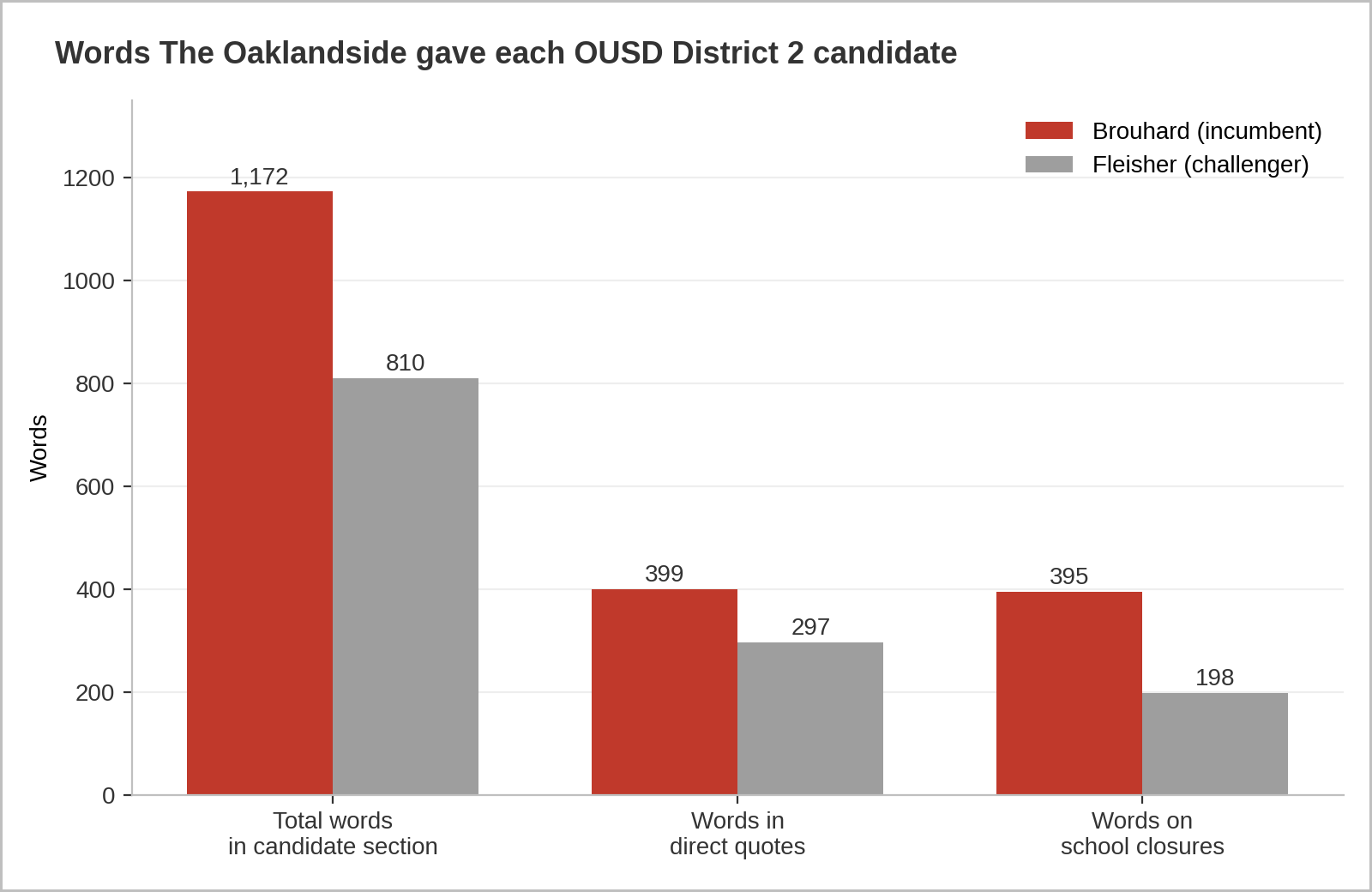
To be clear, a word count doesn’t indicate any bias in and of itself, and it legitimately is neither possible nor necessary to write perfectly equal word counts. Incumbents have directly relevant governance track records that warrant recounting, and to be fair, part of Brouhard’s section covers episodes that some would say make her look bad. Challengers like Fleisher often have thinner, less detailed governance track records to report, and their past experience and platforms often can be conveyed in fewer words.
What is perhaps more significant is the profile’s framing of the candidates, the relevant issues, and the supporting evidence — not its word count.
The Stanford study is real, but the article’s summary of it is not accurate
The Oaklandside’s profile says a Stanford study “found that closing schools did not substantially improve the financial standing of school districts” and that closures “led to enrollment losses, negating any savings.”26
However, that mischaracterizes the study’s findings as they pertain to OUSD’s situation. Stanford professor Francis Pearman looked at 796 California districts from 2011 to 2019.27 His main result was not as conclusive as the article says. The study found that closures cut per-pupil spending and revenue by about $440 each, but the margin of error on that estimate is nearly as large as the number itself, and the findings were different when narrowed to large districts like Oakland.
Furthermore, the Oaklandside article left out two things that matter for an Oakland reader.
First, Pearman told Stanford’s news service that the study findings “should not be taken as an argument against school closures in all cases, especially where districts are facing circumstances like steep enrollment declines or deteriorating facilities.”28
Second, the study looked separately at large urban districts, the group most like Oakland. There, closures cut spending by about $1,224 per student.
The study calls that result statistically meaningful, even though the districts’ overall finances did not improve.29
“Negating any savings,” as Oaklandside put it, is not what the study found. That is a stronger claim than the study’s author makes, and it is not supported for the group of districts most like Oakland.
Notably, Oaklandside’s article supplied no primary evidence at all for the other side of the school closure question.
Fleisher’s view on the issue is presented in the form of her own reference to an April letter from more than 60 OUSD principals criticizing the district’s leadership.30 (Fleisher has said publicly that closures should be considered, but has not said that she supports them outright: "Everything should be on the table, including closing schools," when developing a vision and budget.)
Perhaps even more notably, Alameda County superintendent Alysse Castro, whose office has fiscal oversight of all school districts in the county, has publicly said that OUSD runs 77 school sites when an efficiency study suggested operating only 46.31 That fact is not in the Oaklandside profile, even as it writes hundreds of words on the topic of school closures.
Proposition 39 does not say what the article says it says
The article explains Brouhard’s quote — “When we close a school, we do have to offer it to charters” — by describing Proposition 39 as “the 2000 state law that requires school districts to make empty facilities available to local charter schools.”32
State law (Education Code section 47614) requires districts to give any charter school with at least 80 in-district students facilities “reasonably equivalent” to those of other district students.33 What triggers the duty is a charter’s request, not an empty building.
OUSD’s own Proposition 39 guide says the law’s goal is for facilities to be “shared fairly among all public school pupils.” It warns that compliance can cause “considerable disruption” at schools that are open and running.34 Closing a school changes which buildings are available, but it creates no new duty.
The article’s version turns a policy argument into a legal fact. It is reasonable to consider the possibility that a casual reader could be led to believe that the law rules out an option it does not.
The article checked claims for the incumbent differently than it did for the challenger
Fleisher’s arguably sharpest claim is that the board cut literacy and attendance staff while setting goals to improve reading and attendance. The profile presents this as “decisions that appear haphazard, Fleisher said.”35
Meanwhile, the Brouhard section of the same article reports that the February layoffs cut “attendance specialists, literacy tutors and case managers,” in a passage that focuses on Brouhard’s claim of making tough but necessary budget decisions.36 The board’s Sept. 24, 2025 budget resolution cited a plan to increase attendance as a way to raise revenue.37
The facts supporting Fleisher’s claim were in the article. The reporter did not connect them in the context of Fleisher’s section. This is not a fatal flaw in and of itself, but the placement appears to align with a subtle yet perceptible pattern.
For example, Brouhard’s claim that 99% of teaching jobs are filled is treated differently. The profile describes this, paraphrasing Brouhard in the author’s words, as a “testament to the solid teachers’ contract.” It does not mention that Castro warned in June that the same contract “endangers the District’s fiscal stability.”38
The profile left out relevant information about the incumbent’s backing
The profile lets Brouhard answer the charge that she is "in the pockets" of the union, in her own words. It does not report the underlying fact. Oakland Education Association (OEA), the teachers union, supports Brouhard's re-election with financial contributions and door-to-door political canvassing by its members.39 It backed her in 2022 as well.4041
Related stories:


The profile also skips a notable political setback for Brouhard that took place earlier this month. The Alameda County Democratic Party declined to endorse Brouhard or board vice president Valarie Bachelor, even after both told the party they had made progress.42
To be fair, Fleisher’s relevant political backing also is missing. She’s endorsed by influential local figures like former mayor Libby Schaaf and former councilmember Loren Taylor.43 Empower Oakland, the advocacy group Taylor founded and on whose leadership team Fleisher has served, has also endorsed her.44 A parent-focused political committee with charter-aligned donors has given to and supports her campaign.45
As noted above, The Oaklandside promises a separate, follow-up story on campaign money and endorsements. Until it is published, readers of the profile know only what each candidate says about her own supporters.
Share this article with someone you know.
Other considerations and counterpoints
In fairness to The Oaklandside and to both candidates, we present these counterpoints without further rebuttal:
The profile does note some of the arguably most challenging aspects of Brouhard’s record: the afterschool cuts she called “that mistake,” the superintendent’s exit with no public explanation, and the departure of two senior finance officials.
The introductory characterization of Fleisher’s “jump into the race” and the kindergarten detail come from Fleisher’s own account of why she ran. The profile’s author did not invent them.
The district-wide comparison of ethnicity in schools identified for closures also was cited by the attorney general. Our own “small” school analysis confirms a real disparity at the seven closing schools. And Oakland’s small schools were built in the early 2000s for neighborhoods that have higher percentages of Black students, so the makeup of that pool is itself a product of policy.
Where the publication has looked and found no evidence, it has said so. In December 2025 it reported that OUSD “has never publicly presented documentation of any savings” from the 2022 closures.46
Word counts measure space, not intent. A promised follow-up article on funding and endorsements may fill several of the gaps noted in this analysis.
Conclusion
The Oaklandside’s profile is factually accurate about the aspects of the district’s record it includes.
However, it is demonstrably inaccurate on two key sources it cites — and both errors favor the incumbent: what the Stanford study found, and what Proposition 39 requires.
Beyond those misstatements, which by themselves are arguably within an acceptable margin of error for any publication (including this one), it does something more subtle: It appears to supply proof for the incumbent’s strongest argument, and only hers, and lets the challenger’s best-documented claim stand as opinion. It also leaves out who backs the incumbent — a significant detail in the context of the district’s finances and expenditures, which are largely driven by labor costs.
The evidence suggests that a casual reader of this profile alone could come away from it underestimating OUSD’s performance shortfalls, the openness of the closure question, and the political stakes of the race.
Oaklandside’s record since 2021 suggests that this framing existed well before either candidate filed, and that it was built on real disparities presented in some of the starkest possible terms, often leading in the same direction. Whether that reflects a conscious choice, or a disinterested reporting of an incumbent’s record, is not something a word count or a single article by itself can settle.
ABOUT THE AUTHOR
“Charlene Price” is an Oakland resident who has extensive interactions with OUSD. The author’s name has been changed to protect their privacy and prevent personal and professional retaliation. Oakland Report has verified the identity of the writer and the accuracy of the facts in this report.

DONATE TO OAKLAND REPORT
We are an independent 501(c)(3) nonprofit organization, not affiliated with any public agency, labor union, corporate interest or political campaign. Your voluntary donation is needed to continue to produce accurate, deeply researched, evidence-driven articles like this one.
Oakland Report is an experiment in a new form of media: reasoned, data-driven analysis focused on observable and verifiable evidence. We present the facts and let the reader decide. Learn more at oaklandreport.org
Oakland Education Association. “Reminder for tomorrow: We are out on the streets mobilizing for our public schools!” Facebook video, Sept. 11, 2026. https://www.facebook.com/reel/2851737425203511
CBS News Bay Area. “Oakland Unified parent criticizes district’s last-minute scramble to balance budget.” Youtube video, Feb. 25, 2026. https://www.youtube.com/watch?v=8dE3zrUvIEE&t=37s
McBride, Ashley. "Election 2026: An experienced incumbent meets a parent challenger in Oakland school board District 2." The Oaklandside, Sept. 22, 2026. https://oaklandside.org/2026/09/22/oakland-election-2026-school-board-district-2/
Oakland Education Association. “After a full week in the classroom with students, Oakland educators showed up on a Saturday to knock doors for Jennifer Brouhard (D2) and Valerie Bachelor (D6), the union-backed school board candidates who will fight for our public schools.” Facebook, Sept. 22, 2026. https://www.facebook.com/watch/?v=908152348815862
Ballotpedia contributors. "Jennifer Brouhard… elected to three terms on the OEA Executive Board, one term as OEA secretary"). Ballotpedia, accessed Sept. 23, 2026. https://ballotpedia.org/Jennifer_Brouhard
Tavares, Steven. "Alameda County Dems deliver a blow to OUSD incumbents." East Bay Insiders, Sept. 15, 2026. https://eastbayinsiders.substack.com/p/alameda-county-dems-deliver-a-blow
California Department of Education. "Enrollment by School: Oakland Unified School District, 2021-22.” CDE DataQuest web portal, accessed Sept. 22, 2026. https://cde.ca.gov/ds/cm/dqhighlights.asp
Rancaño, Vanessa. "Oakland moves to close 7 schools despite fierce community opposition." KQED, Feb. 9, 2022. https://www.kqed.org/news/11904618/oakland-moves-to-close-seven-schools-despite-fierce-community-opposition
McBride, Ashley. "School closures and mergers show mixed results for Oakland Unified." The Oaklandside, May 13, 2021. https://oaklandside.org/2021/05/13/oakland-unified-citywide-plan-school-closures/
McBride, Ashley. "Oakland school closures, mergers, and expansions: here's how OUSD will decide." The Oaklandside, Jun. 24, 2021. https://oaklandside.org/2021/06/24/oakland-school-closures-mergers-citywide-plan/
McBride, Ashley. "School mergers are back on the table in OUSD." The Oaklandside, Feb. 28, 2023. https://oaklandside.org/2023/02/28/oakland-school-mergers-closures-budget-ousd/
McBride, Ashley. "OUSD has $100M in cuts to make. School sites won't be spared." The Oaklandside, Dec. 10, 2025. https://oaklandside.org/2025/12/10/ousd-oakland-budget-cuts-school-site-staff/
McBride, Ashley. "OUSD to families: Keep students home this Friday." The Oaklandside, Apr. 26, 2022. https://oaklandside.org/2022/04/26/ousd-to-families-keep-students-home-this-friday/
Wu, Zhe. "Protesters caravan to school board members' homes, denouncing OUSD closures." The Oaklandside, Feb. 3, 2022. https://oaklandside.org/2022/02/03/protesters-caravan-to-denounce-ousd-school-closures/
Wu, Zhe. "OUSD has had success with small schools, so why are they on the chopping block?" Oakland North, May 5, 2022. https://oaklandnorth.net/2022/05/05/oakland-small-schools-closing/
McBride, Ashley. "How will OUSD afford to keep schools open?" The Oaklandside, Jan. 19, 2023. https://oaklandside.org/2023/01/19/ousd-oakland-school-closures-hutchinson-alameda-county-castro/
McBride, Ashley. "With $95M deficit looming, OUSD turns to school closures — again." The Oaklandside, Oct. 30, 2024. https://oaklandside.org/2024/10/30/with-95-million-deficit-looming-oakland-unified-turns-to-school-closures-again/
Gardner, Emmet. "Oakland public school enrollment fell 35% — far more than the shrinking child population." Oakland Report, Jul. 23, 2026. https://www.oaklandreport.org/p/ousd-enrollment-decline-district-run-schools
Kakkar, Tarini. "Oakland Unified spent over $28,000 per student — more than any nearby district." Oakland Report, Aug. 7, 2026. https://www.oaklandreport.org/p/ousd-spending-and-performance
Reinhart, Sean S. "Oakland Unified’s general fund cash shrank by $100 million last year." Oakland Report, Sept. 9, 2026. https://www.oaklandreport.org/p/oakland-unified-cash-fell-100-million
McBride, Ashley. "Calls to stop OUSD closure plan grow." The Oaklandside, Feb. 17, 2022. https://oaklandside.org/2022/02/17/calls-to-stop-ousd-closure-plan-grow/
Op. cit. (Aziz and McBride, Feb. 3, 2022)
Op. cit. (Wu, May 5, 2022)
California Department of Education. "Enrollment by School, 2020–21 through 2022–23" (census-day enrollment by race/ethnicity, file enr202022-v2). CDE DataQuest downloadable files, accessed Sept. 23, 2026. https://www.cde.ca.gov/ds/ad/filesenrcensus.asp
Bonta, Rob. Letter to Oakland Unified School District re potential closures. California Department of Justice, Jan. 29, 2024. https://oag.ca.gov/system/files/attachments/press-docs/CalDOJ.LettertoOaklandUnifedRePotentialClosures.1.29.24.final_.pdf; reported in CBS News Bay Area, Jan. 29, 2024, https://www.cbsnews.com/amp/sanfrancisco/news/ag-bonta-warns-oakland-unified-of-again-making-a-decision-that-impacts-black-low-income-students
Op. cit. (McBride, Sept. 22, 2026)
Pearman, Francis A., II. "The fiscal consequences of school closures in California: evidence from a statewide synthetic difference-in-differences design." Stanford SCALE / Getting Down to Facts, May 2026. https://gettingdowntofacts.com/reports/fiscal-consequences-school-closures-california-evidence-statewide-synthetic-difference; summarized in Sawchuk, Stephen. "Closing a school? Don't expect to save money, a new study warns." Education Week, Jun. 2026. https://www.edweek.org/leadership/closing-a-school-dont-expect-to-save-money-a-new-study-warns/2026/06
Stanford University. "Study shows school closures fail to fix district finances." Stanford Report, Sept. 2026. https://news.stanford.edu/stories/2026/09/california-school-closures-financial-impact-research
Ibid. (Stanford University)
Tucker, Jill. "Oakland principals issue rare call to close schools, end leadership limbo amid fiscal crisis." San Francisco Chronicle, Apr. 28, 2026. https://www.sfchronicle.com/bayarea/article/oakland-schools-close-22224171.php; https://archive.is/MYXQP
DeBenedetti, Katie. “Oakland’s school merger plan has stalled, and the district’s huge deficit remains.” KQED, Dec. 12, 2024. https://www.kqed.org/news/12017719/oaklands-school-merger-plan-stalled-districts-huge-deficit-remains
Op. cit. (McBride, Sept. 22, 2026)
California Education Code § 47614(b). California Legislative Information. https://leginfo.legislature.ca.gov/faces/codes_displaySection.xhtml?lawCode=EDC§ionNum=47614
Oakland Unified School District. "Proposition 39 guide." OUSD, updated August 2025, accessed Sept. 22, 2026. https://resources.finalsite.net/images/v1756935184/ousdorg/za2edxdyvq9gchczlbbc/2026-27Prop39Guide_1.pdf
Op. cit. (McBride, Sept. 22, 2026)
McBride, Ashley. "OUSD board approves 421 staff layoffs." The Oaklandside, Feb. 26, 2026. https://oaklandside.org/2026/02/26/ousd-board-approves-421-staff-layoffs/
Brouhard, Jennifer and Valarie Bachelor. “ Directing the preparation of budget scenarios to address district’s projected fiscal years 2026-27 and 2027-28 structural deficit.” Oakland Unified School District board of education meeting, agenda item S-2, Sept. 24, 2025. https://ousd.legistar.com/LegislationDetail.aspx?ID=7691934&GUID=015878CB-DB54-482E-9564-E53B9833839F&Options=&Search=
Reinhart, Sean S. "Union raises 'endanger' Oakland school finances as board set to approve $1.2 billion budget." Oakland Report, Jun. 23, 2026. https://www.oaklandreport.org/p/union-raises-endanger-oakland-schools
Op. cit. (Oakland Education Association)
California Teachers Association. "Electing Education Champions: Jennifer Brouhard." CTA, Oct. 18, 2022. https://www.cta.org/educator/posts/electing-education-champions-jennifer-brouhard
Reinhart, Sean S. "The elephant in the classroom: the Oakland school board's deep ties to the Oakland teachers union." Oakland Report, Apr. 30, 2026. https://www.oaklandreport.org/p/the-elephant-in-the-classroom
Op. cit. (East Bay Insiders)
Arielle Fleisher for OUSD District 2 School Board contributors. "Endorsements." Arielle Fleisher campaign wesbite, accessed Sept. 23, 2026. https://www.arielleforoakland.com/endorsements.html
Empower Oakland contributors. "Meet the Oakland school board candidates before you vote." Empower Oakland, Sept. 22, 20262026. https://empoweroakland.substack.com/p/meet-the-oakland-school-board-candidates
City of Oakland. “Campaign finance - FPPC form 460 - schedule A - monetary contributions.” Public Ethics Commission Netfile data portal, accessed Sept. 23, 2026. https://data.oaklandca.gov/dataset/Campaign-Finance-FPPC-Form-460-Schedule-A-Monetary/3xq4-ermg/about_data
Op. cit. (McBride, Dec. 10, 2025)
