



Oakland Agenda Watch provides summaries of key items on upcoming public meeting agendas that catch our attention. In this installment, we look at the June 18, 2026 warning letter from the Alameda County Office of Education to the Oakland Unified School District board, which is set to adopt a $1.2 billion budget on June 24.
How public schools are managed affects all of us
Public school districts are instrumental to the success or failure of a community, whether one has children in public schools or not.
Public education is rightly one of the biggest and most consequential expenses of public funds, and public school districts often are among a city’s largest employers.1234
Yet, the actions and composition of elected school boards are often overlooked by the general public — an afterthought taken for granted, until something goes wrong.56
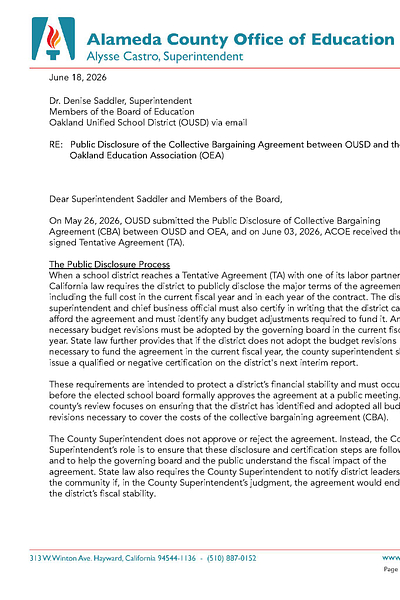
Last week, the Alameda County superintendent of schools, who oversees the finances of public school districts throughout the county, sent a letter to Oakland Unified School District (OUSD) warning that a new contract with teachers union Oakland Education Association (OEA) “endangers the district’s fiscal stability.”7
“As the Board has not yet identified how or when it will make the necessary adjustments to balance the budget and maintain required reserves, the County Superintendent is required by law to notify district leaders and the community that the [OEA teachers union] agreement endangers the district’s fiscal stability.”
— Alameda County superintendent of schools Alysse Castro, June 18, 2026
Superintendent Alysse Castro’s warning comes as OUSD is set to adopt its 2026-27 budget on June 24.8
Castro’s letter says that the district appears to have the ability to pay for the raises in the coming year, but it has not shown how it will keep paying for them in future years.
State law requires school districts to publicly disclose the cost of any tentative labor agreement (union contract) and to certify in writing that they can afford the deal in the current year and the two years that follow.9
This is the third escalating warning Castro has sent OUSD in five months. In April, she issued a rare “going concern” letter — a formal oversight step that precedes county intervention and “safeguards for rapid intervention if conditions worsen.”10
Key points
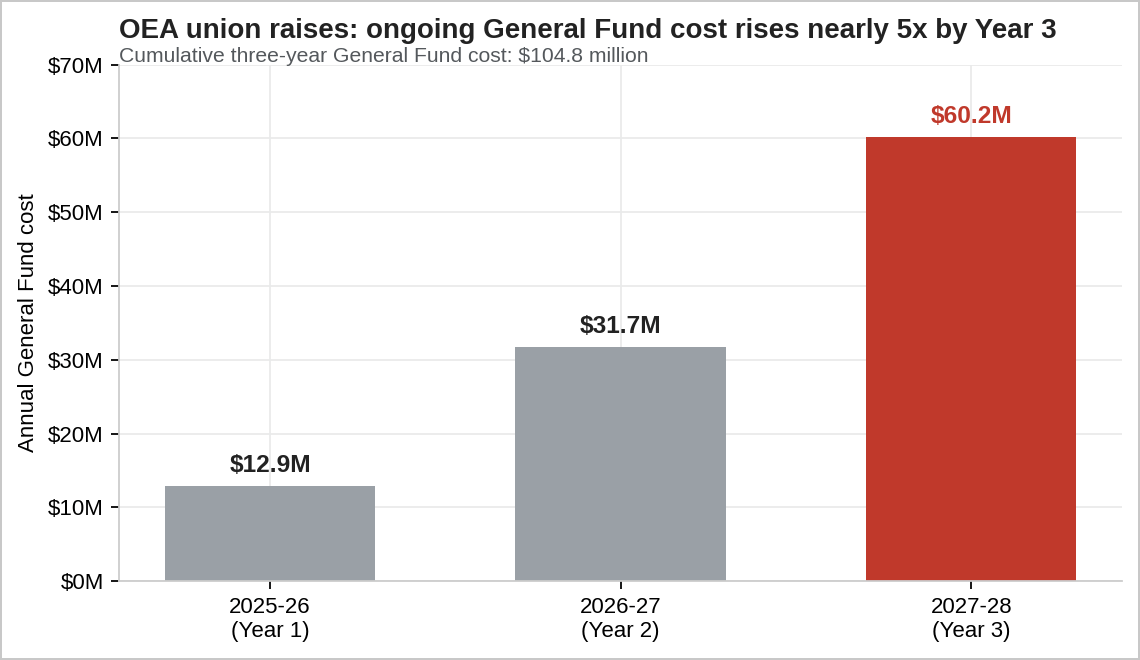
The proposed OEA contract will cost OUSD an additional $104.8 million over three years. The additional annual cost to OUSD’s general fund would be $12.9 million in 2025-26, and would rise to $60.2 million by 2027-28. Another $3.6 million in costs would be borne across other funds.
The OUSD board needs to make $30 million in cuts it has not yet identified. The district’s budget assumes roughly $30 million in cuts in 2026-27 and again in 2027-28 — but the district doesn’t say what those cuts are.
Without those cuts, the district would fall below the required 2 percent reserve (emergency savings) in 2026-27. OUSD also would have a negative fund balance in 2027-28.
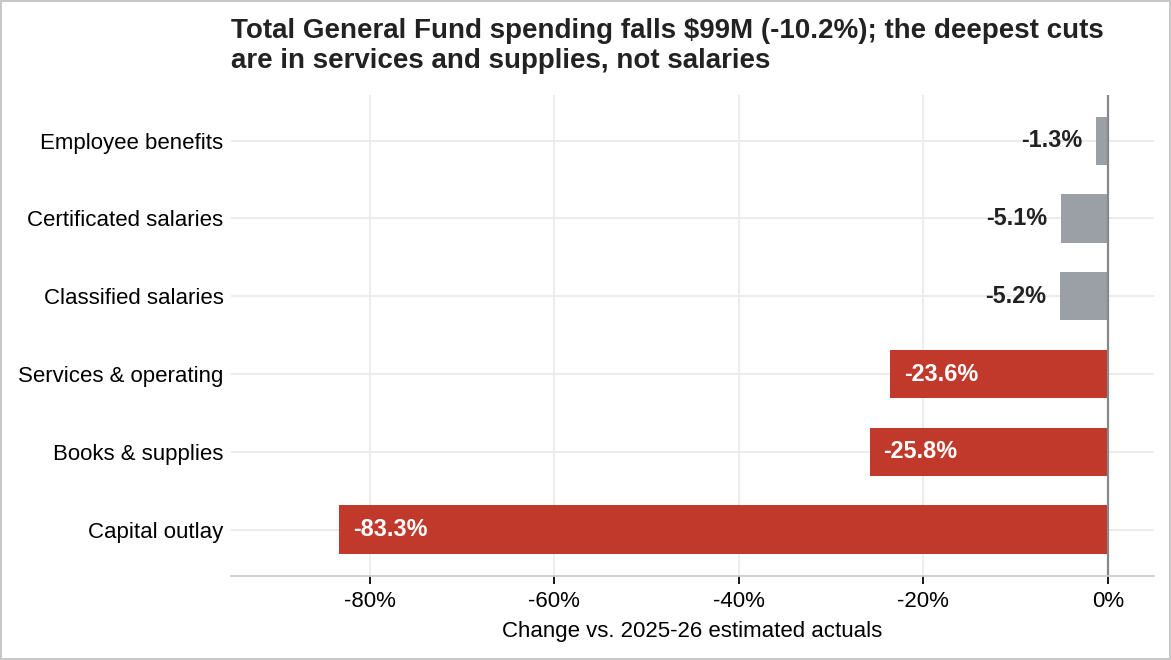
The OUSD board is set to approve a $1.2 billion budget for 2026-27. General fund spending would be cut around $99 million (10.2 percent), with the deepest cuts in services, supplies and capital, rather than its largest spending category: personnel.11
The OEA teachers union contract was negotiated and is being funded by a school board majority and staff who have deep ties to OEA. Four school board members worked for or received campaign support from OEA, and OUSD’s interim superintendent is a past president of OEA.12
OEA union contract would award up to 13% raises, some retroactively
The proposed contract awards raises in two stages:
Retroactive 7 percent raises at the top of the salary range and 4 percent raises to all other salary steps for the current fiscal year 2025-26.
Additional 2 percent raises for the top step and 3 percent to other steps on July 1, 2026; and another 4 percent across the board on June 30, 2027.
The cumulative raises equate to roughly 13 percent at the top salary step and 11 percent at the other steps over two years — roughly twice as high as a neutral fact-finder’s recommendation of around 6 percent.13
The deal also creates targeted increases for special education teachers, nurses, psychologists, social workers, speech-language pathologists, and early-childhood educators.
OUSD’s spending is forecast to result in a $100.2 million budget deficit (10.3 percent) in the current 2025-26 year, and a $37.2 million deficit (4.3 percent) in 2026-27.
OUSD is one of the highest-funded large school districts in California on a per-pupil basis.14
Despite its relatively high funding, only 33.7 percent of OUSD students met or exceeded California’s English language arts standard, and only 26.9 percent met or exceeded the math standard — well below the statewide rates of 48.8 percent in English and about 37 percent in math.15
The OEA raises depend on school cuts that don’t exist yet
The county superintendent’s stated concern is not the raises themselves, but the absence of a clear plan to pay for them.
Castro’s letter notes that the proposed OEA contract increases OUSD’s ongoing costs by approximately $30 million starting July 1, but its budget forecasts are “built on an assumption of… as yet unspecified budget reductions.”
She writes that OUSD identified “a single budget revision of $30 million in future reductions that have not yet been specified,” without the clear plan, timeline, and board-approved direction that typically accompany such reductions.
State law requires a district to “itemize any budget revision necessary to meet the costs of the agreement [union contract] in each year of its term.”
Castro warns that because the new fiscal year begins July 1 — days after the board vote — any savings will likely have to come mid-year, where one-time fixes are easier to find than permanent reductions to ongoing costs.
She adds that one-time savings do not resolve a structural deficit; they must be repeated again and again in “a process that multiplies the pain.”
The budget the board will consider tomorrow reduces General Fund expenditures to about $874 million from around $973 million the prior year — a $99 million, 10.2 percent reduction.
Roughly 5 percent of the reduction is consistent with the over 400 staff positions the board voted to eliminate earlier this year.16
Castro’s letter notes that although the board “made the hard choice to reduce staff by nearly 400 people, dramatically cutting central support services,” it cautions that “next year will bring more cuts, and the year after, more still.”
Raiding today’s cash to fund tomorrow’s promises
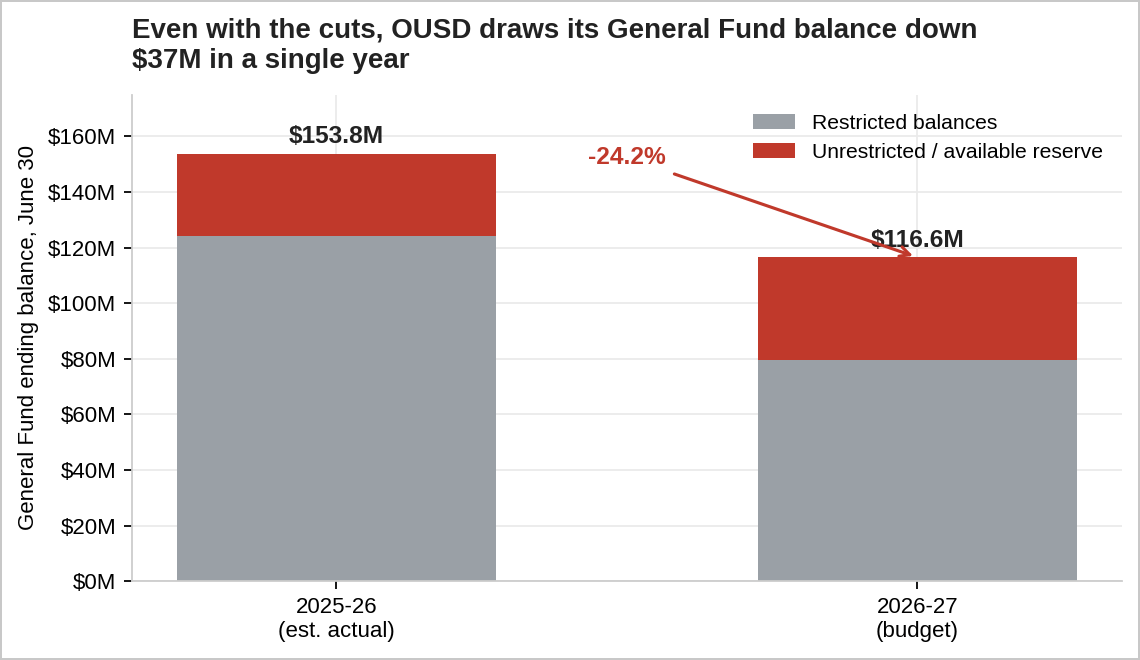
Castro makes clear that this is not a cash crisis. “The issue is not whether OUSD has sufficient cash to implement this agreement today — based on the District’s projections, it does.”
But the one-time cash comes with an ongoing cost. The 2026-27 budget draws the General Fund balance down by about $37 million in a single year, even after the cuts.
State revenue updates and unspent 2025-26 funds also could potentially reduce the extent of the required cuts. OUSD accumulated substantial reserves from one-time pandemic resources, and could divert restricted funds to support routine operations.
The district’s 2025-26 Third Interim multiyear budget forecast, released last month, showed OUSD meeting both the 2 percent state-required reserve and its locally adopted 3 percent reserve in the current and two following years — but only if the unspecified $30 million reductions are achieved in each of 2026-27 and 2027-28.17
Castro writes that without those cuts, the district “would be unable to meet the 2 percent state-required [reserve funding] in 2026-27 and would project a negative fund balance in 2027-28.”
The OUSD board majority and staff have deep ties to OEA
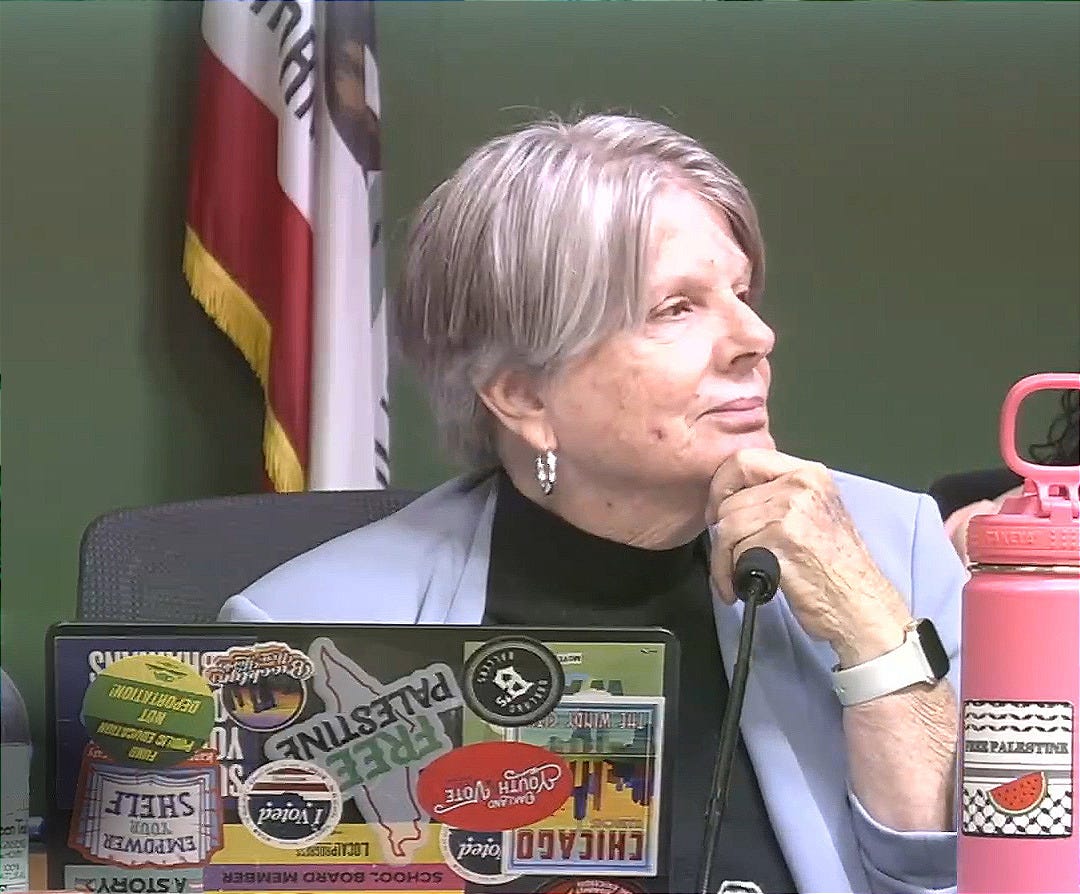
As Oakland Report has documented, the four-member board majority that has driven OUSD’s major decisions over the past year — president Jennifer Brouhard, vice president Valarie Bachelor, Rachel Latta, and VanCedric Williams — was elected with OEA’s financial and political support, and the union has publicly stood behind their leadership.
The most influential beneficiary of OEA’s support is board president Jennifer Brouhard. Before her election to the school board in 2022, Brouhard held prominent leadership roles in OEA, including three terms on the OEA executive board and one term as OEA secretary, in addition to many years as an OEA school site representative.18
Another influential recipient of OEA’s support is OUSD’s interim superintendent, Denise Saddler. She served six years as OEA’s president before the same school board majority installed her as interim superintendent, after abruptly ending the contract of the prior superintendent who steered OUSD out of financial receivership.19
Read this related article:
The elephant in the classroom

Oakland Education Association has spent over $239,000 to elect a school board majority friendly to the union’s financial interests. Those board members have returned the favor.
Board member Mike Hutchinson, part of the three-member minority, called on Saddler to resign in late March, warning that approving the OEA agreement without specifying what the needed cuts would be would push the 2026-27 budget shortfall back above $100 million.20
None of the above-mentioned union-school board ties is necessarily disqualifying. Elected boards routinely negotiate with unions who helped elect them, and it is possible for a former union leader to serve as an elected official in a manner that prioritizes the best interests of the public they were elected to serve.
However, it is reasonable to consider that elected officials who benefit from financial and political support from a union, and then negotiate a lucrative contract with that same union — a contract that requires deep budget cuts to afford — may have real or perceived conflicts of interest that would warrant recusal in many other settings.
Other considerations and counterpoints
In fairness, the county superintendent does not dispute that OUSD can pay for the agreement this year. Castro credits the district for improving its budget outlook by using restricted funds for regular operations, that is, shifting eligible costs off the general fund and onto the restricted funds instead, which she calls “a positive budgeting practice.”
She also notes that it is “not uncommon for districts to leave details of future year reductions to be developed later,” and that some solutions can be refined later in the budget cycle.
Castro acknowledges that the board did make some difficult reductions this year, including the elimination of over 400 positions, and she notes that “all schools stayed open, staff got raises, and 34,000 kids enjoyed community schools.”
Higher revenue from the state and unspent 2025-26 funds could shrink the cuts still needed in the coming year.
Supporters of the raises also argue that competitive pay is itself a fiscal strategy in a district that has struggled to retain teachers.
What’s on the Oakland Unified School District board’s June 24 agenda
The OUSD board of education meets on Wednesday, June 24 starting at 4:10 p.m. at the La Escuelita Education Center. The meeting agenda contains 287 individual items. The three budget items that anchor the agenda are scheduled early in the proceedings:
Adopt the 2026-27 all-funds budget of $1,205,122,242.
Adopt the Year 3 Local Control and Accountability Plan (LCAP) at a projected $504,582,961, including $120,702,398 in supplemental and concentration funds tied to high-need students.
Adopt a resolution continuing the district’s Financial Stabilization Implementation Plan for 2026-27.
Castro’s letter ties her oversight of OUSD’s budget directly to the above-noted budget items: she “strongly encourages” the district to bring “a list of tradeoffs at the same meeting” in which it approves the OEA contract and pay raises.
Her letter also states that the district “will be required to show its path to affordability before ACOE can approve the 26-27 budget.”
Oakland Report is by no means comprehensive in our coverage of public meetings in Oakland. The scope and frequency of public meetings are far more than we can presently cover. You can see the full June 24 OUSD board meeting agenda and reports at the district’s meeting calendar.
We rely on your financial support
Oakland Report is a 501(c)(3) nonprofit organization, powered entirely by donations from readers like you. Your contribution in any amount helps us to continue to produce accurate, well-researched, deep-dive informational articles like this one.
Granados, Mebane and Molly Osborne. “Seeing school districts as big business and superintendents as CEOs.” EdNC (EducationNC), May 6, 2024. https://www.ednc.org/05-06-2024-seeing-school-districts-as-big-business-and-superintendents-as-ceos/
U.S. Census Bureau. "Public school spending per pupil reaches historic high in 2024." U.S. Census Bureau press release, May 7, 2026. https://www.census.gov/newsroom/press-releases/2026/school-system-finances.html
Barrow, Lisa, and Cecilia Elena Rouse. “Using market valuation to assess public school spending.” National Bureau of Economic Research, July 2002. https://www.nber.org/papers/w9054
Rothwell, Jonathan. "Housing costs, zoning, and access to high-scoring schools." Brookings Institution, April 2012. https://www.brookings.edu/articles/housing-costs-zoning-and-access-to-high-scoring-schools/
Center for American Progress. “5 reasons to pay attention to local school board elections.” Center for American Progress, Sept. 17, 2024. https://www.americanprogress.org/article/5-reasons-to-pay-attention-to-local-school-board-elections/
Anzia, Sarah F. "Timing and turnout: how off-cycle elections favor organized groups." University of Chicago Press, 2013. https://press.uchicago.edu/ucp/books/book/chicago/T/bo16956602.html
Castro, Alysse. "Public disclosure of the collective bargaining agreement between OUSD and the Oakland Education Association (OEA)." Alameda County Office of Education letter to OUSD Superintendent and Board of Education, Jun. 18, 2026.
Oakland Unified School District. "2026-2027 fiscal year — district budget — all funds." Board of Education meeting, Jun. 24, 2026. https://ousd.legistar.com/LegislationDetail.aspx?ID=8044001
State of California. “Government Code § 3547.5.” California Government Code, Title 1, Division 4, Chapter 10.7 (Educational Employment Relations Act), accessed Jun. 23, 2026. https://leginfo.legislature.ca.gov/faces/codes_displaySection.xhtml?sectionNum=3547.5.&nodeTreePath=2.6.22.8&lawCode=GOV
Oakland Report contributors. “County schools chief issues ‘Going Concern’ notice to OUSD, warning of higher risk of running out of money.” Oakland Report, Apr. 21, 2026. https://www.oaklandreport.org/p/20260421-ousd-at-risk
Gard, Tara and Ryan Nguyen. "2026-27 adopted budget, SACS form 01 (general fund, unrestricted and restricted)." Oakland Unified School District board of education meeting, Jun. 24, 2026. https://ousd.legistar.com/View.ashx?M=F&ID=15515743
Reinhart, Sean S. "The elephant in the classroom." Oakland Report, Apr. 30, 2026. https://www.oaklandreport.org/p/the-elephant-in-the-classroom
Ibid. Reinhart, Sean S.
California Department of Education. “Current expense of education per Average Daily Attendance (ADA), 2024–25 — Oakland Unified and statewide.” CDE Financial Accountability and Information Services, Current Expense of Education data file, accessed Jun. 23, 2026. https://www.cde.ca.gov/ds/fd/ec/currentexpense.asp
California Department of Education. “CAASPP smarter balanced assessment results, 2024–25 — Oakland Unified and statewide, English language arts/literacy and mathematics (percent met or exceeded standard).” Test Results for California’s Assessments, accessed Jun. 23, 2026. https://caaspp-elpac.cde.ca.gov/
McBride, Ashley. “OUSD board approves 421 staff layoffs.” The Oaklandside, Feb. 26, 2026. https://oaklandside.org/2026/02/26/ousd-board-approves-421-staff-layoffs/
Oakland Unified School District. “2025-26 Third Interim financial report — multiyear projection (SACS Form MYP) and criteria and standards review (Form 01CS), reserve for economic uncertainties.” Board of Education meeting, May 27, 2026. https://ousd.legistar.com/MeetingDetail.aspx?ID=1417138&GUID=2401A5DD-D32F-474A-A97F-532307757C7F&Options=info|&Search=
Ballotpedia contributors. “Jennifer Brouhard.” Ballotpedia website, accessed Apr. 29, 2026. https://ballotpedia.org/Jennifer_Brouhard
McBride, Ashley. “Oakland school board re-elects leadership as senior staff exit in contentious departures.” The Oaklandside, Jan. 5, 2026. https://oaklandside.org/2026/01/05/ousd-board-leadership-election-senior-staff-departures/
Oakland Report contributors. "'You should resign': Oakland school board member calls for interim superintendent to quit." Oakland Report, Mar. 31, 2026. https://www.oaklandreport.org/p/20260330-ousd-hutchinson-saddler-resign
This Board seems determined to activate the tripwire to put OUSD back under State oversight. It seems calculated as the last time that happened the district got a $100 million loan. These board members seem to be betting on another bailout so their buddies can get their raises at the expense of local control.
Sooo, seems to me that it was a huge conflict of interest to elect Valarie Bachelor to the school board (serving since January 2023), while she was still the Lead Organizer for California’s Teachers Union CFT (until June 2024).
Mike Hutchinson has been ostracized for his stands, yet he is the one who should be listened to! The only one who understands the budget and has called out the board members who have created a budget based on wishful thinking.