



Oakland Agenda Watch provides short summaries of key items on public meeting agendas that catch our attention. Today we take a look at the year-end financial statements presented to the Oakland Unified School District board on September 9.
Oakland Unified’s general fund cash fell $100 million in a single year
Oakland Unified School District board meeting, Sept. 9, 2026, agenda item Q
On June 24, the Oakland Unified School District (OUSD) board of education adopted a $1.2 billion budget for 2026-27. Its budget only balances if the district cuts another $30 million this fall — but it still hasn’t said where, exactly those cuts will land or what they will affect.1
OUSD’s chief financial officer described the math this way.2
“The question is, how do we end up with a positive fund balance if there’s a deficit? Well, because, if we were to cut $30 million from our budget, we end up with this amount.”
— OUSD chief financial officer Ryan Nguyen, June 24, 2026
It’s now two months into the new fiscal year.
The September 9 board meeting agenda lists four budget-related items: the ‘unaudited actuals’ that review OUSD’s year-end income and spending from 2025-26, its year-end general fund balances, an Education Protection Account (EPA) spending plan, and a resolution allowing the district to move cash between its own funds.345
Oakland Report examined all four reports. They show that the district’s cash on hand in its general fund shrank by $100 million last year, and it’s still unclear how or where the district plans to cut $30 million this year.
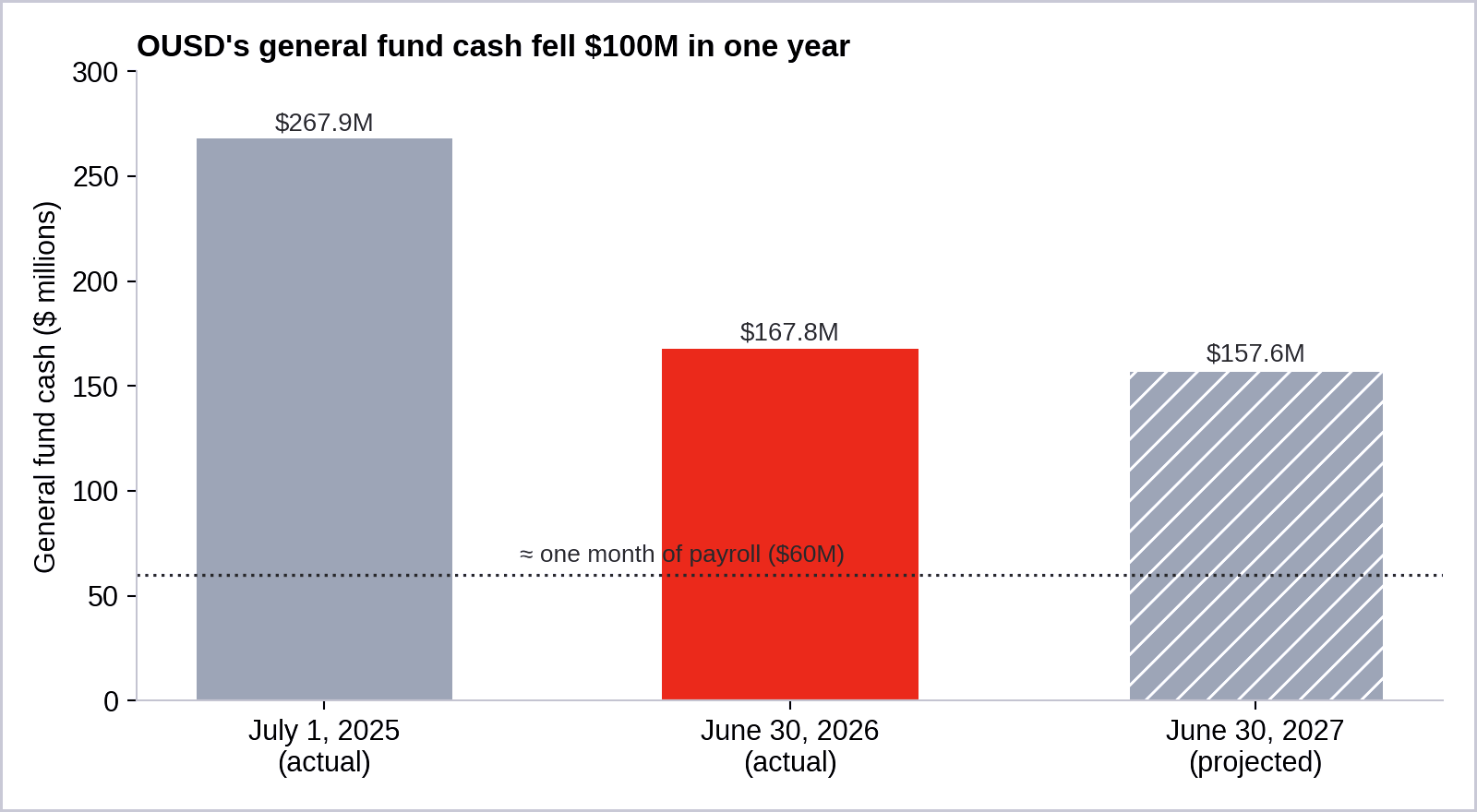
According to the year-end statements under review at today’s meeting, OUSD’s general fund cash started 2025-26 at $267.9 million and ended at $167.8 million. District staff project that it will shrink to $157.6 million by June 2027.
One month of the district’s payroll costs roughly $60 million.
Key findings
The district’s general fund cash fell $100 million in a single year. Its main unrestricted fund shrank from $267.9 million to $167.8 million.
OUSD ended the 2025-26 fiscal year with $16.4 million more than it projected in May. Unrestricted money — the part the district can spend on anything — ended the year at $32.3 million.
But only $4.2 million of that is free to use. $27.7 million is locked in required emergency reserves.
The district still hasn’t informed the public where it will find another $30 million in cuts this year. Its “Next Steps” slide says only that it will “continue financial stabilization efforts.”
Subscribe to Oakland Report.
The district’s financial year ended better than it projected
‘Unaudited actuals’ are not a budget forecast or an adopted budget. In financial terms, ‘actuals’ show the real amount of funding the district brought in and how much it spent in the previous fiscal year.
Year-end actuals typically provide a truer picture of a public agency’s finances than its board-approved budget and forecasts, which sometimes are based on hopes and dreams as much as the financial realities the agency faces.
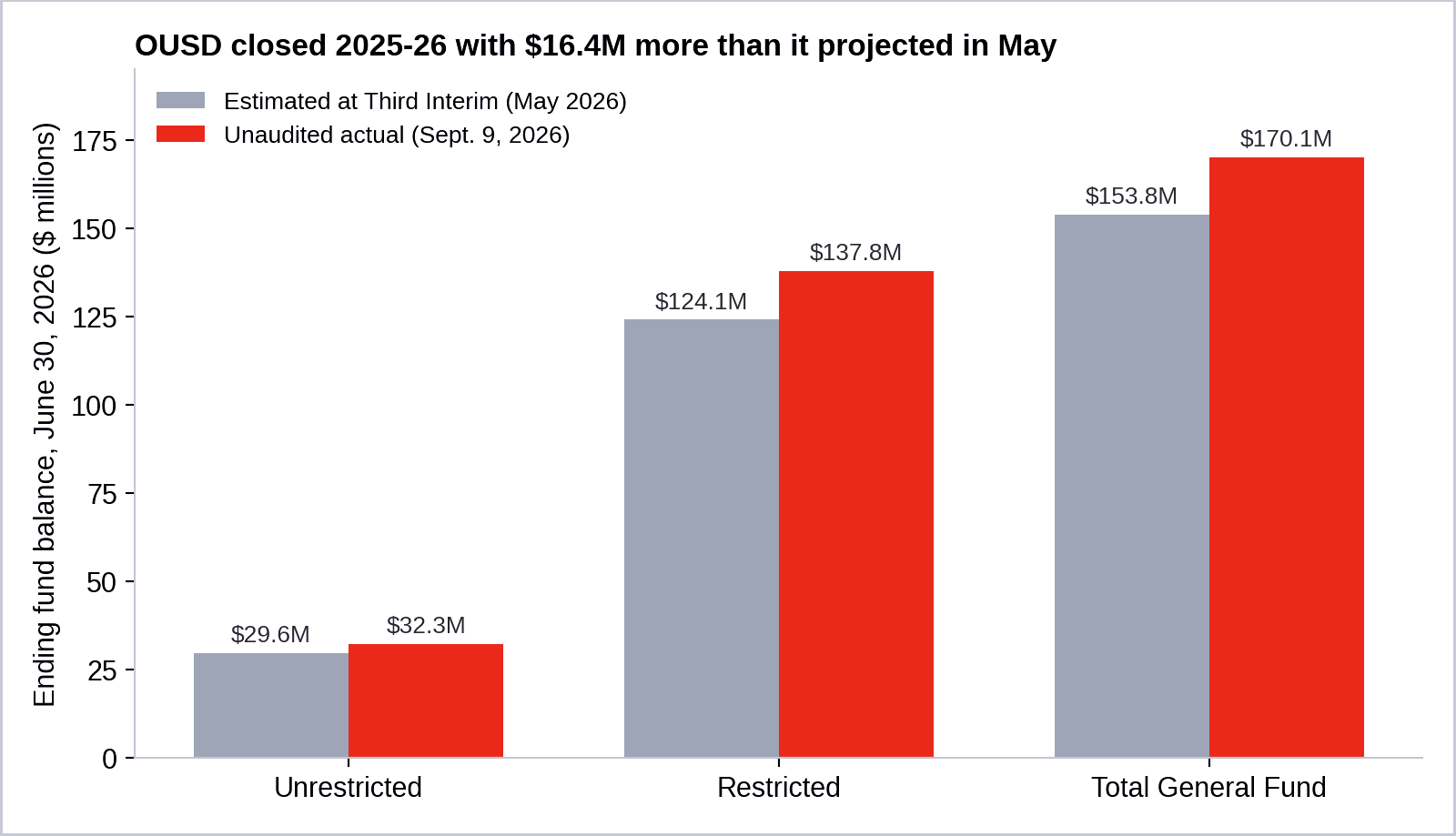
OUSD’s unaudited actuals show that in fiscal year 2025-26, the district took in $838.5 million and spent $924.7 million from its general fund.
Including transfers, its general fund balance shrank by $91.5 million, from $261.6 million to $170.1 million.
That is a substantial difference, but it is smaller than the district predicted. Staff say the district’s deficit spending ended $20 million below what the June 2025 budget projected.
Nearly every spending category came in under budget, more than offsetting a $30 million drop in restricted revenue.
The district is moving to shuffle money between funds
The district is seeking permission to allow the general fund to ‘lend’ cash to three smaller funds — adult education, child development, and cafeteria — when their state and federal reimbursements arrive late.
This type of interfund loan is permitted under the Education Code and is not uncommon.
Loans must be repaid within the year, and staff must report every transfer at the First and Second Interim financial reports.
The same presentation shows why the timing of cash being available matters. As noted above, one month of the district’s payroll costs roughly $60 million.
Share this story with someone you know.
The district’s financial cushion is smaller than it appears
Most of the district’s ‘extra’ money sits in its restricted funds, which grew to $137.8 million. Those funds are legally tied only to specific programs. District staff attribute the increase partly to unspent EPA and Title I grant money last year.
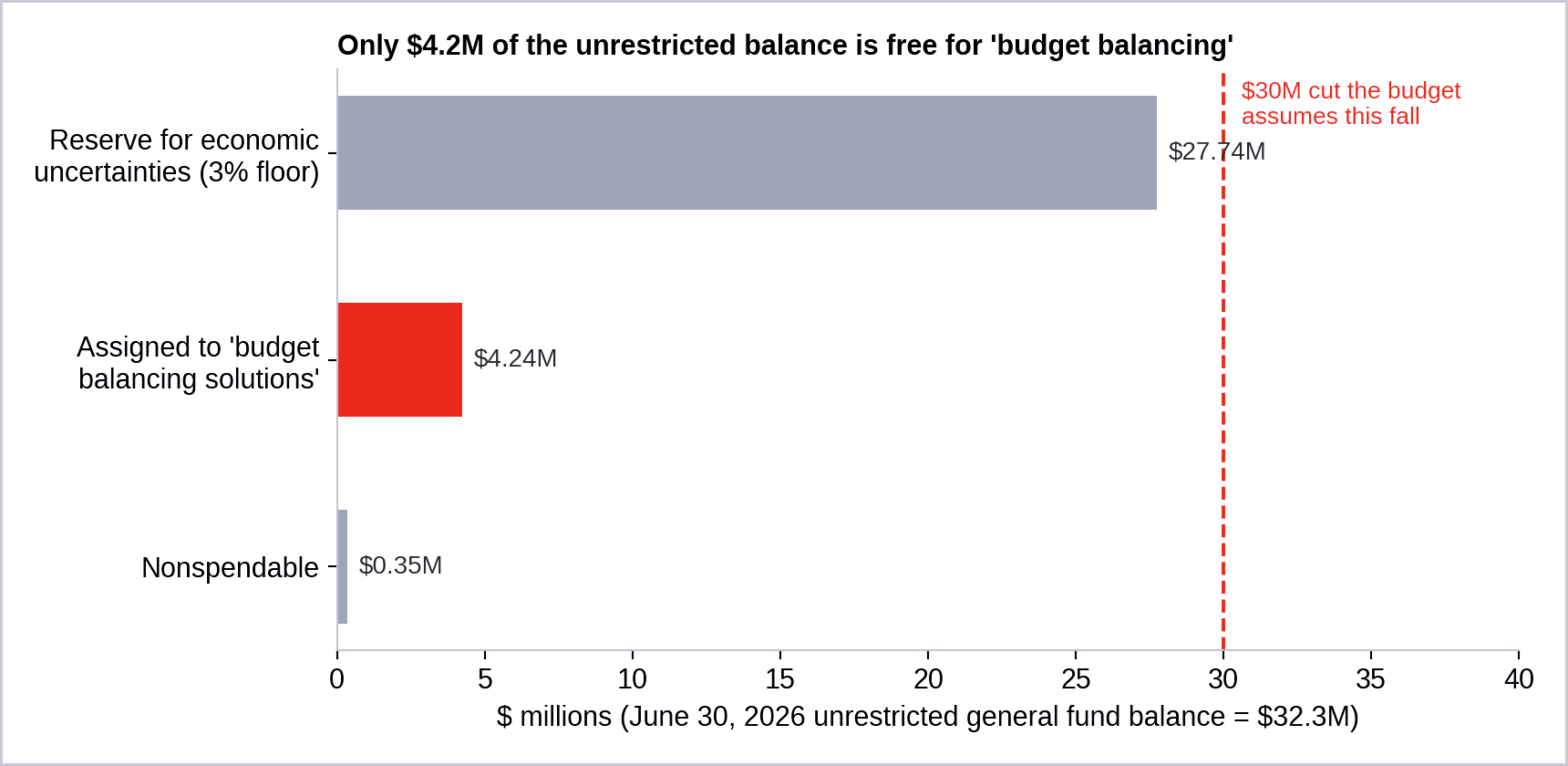
The district’s unrestricted balance is what matters for the question of where the board’s as-yet-unspecified $30 million in new cuts will come from.
As of June 30, that unrestricted balance was $32.3 million. Of that, $27.7 million is the district’s ‘reserve for economic uncertainties’ — a rainy day fund set at 3 percent of spending, per board policy. Another roughly $350,000 is nonspendable for various reasons.
That leaves only $4.2 million available, which staff have assigned to “budget balancing solutions going forward.”
The data suggests that the better-than-expected year-end balance covers around one-seventh of the promised $30 million in cuts.
Read this related article:

A fourth budget-related item on the agenda about Education Protection Act funding is routine. OUSD expects to receive around $57.5 million in Proposition 30/55 money and plans to spend all of it on teacher salaries and benefits, as the state constitution requires. District staff are careful to note that EPA “is not new or additional money.”
Other considerations and counterpoints
We present these counterpoints for readers to consider:
These figures are prepared by district staff and are unaudited; the independent audit is due in December.
The final state budget also added around $8 million in cost-of-living money and up to $12 million for special education.6 District staff say updated projections will follow.
The district’s new unaudited actuals suggest that the required cut is now smaller than $30 million.
Staff note that the district’s financial reserves meet both the 2 percent state and 3 percent board minimums.
The district’s finances ended fiscal year 2025-26 in better shape than it projected.
‘Still planning to implement’ the cuts
Alameda County superintendent Alysse Castro wrote on June 18 that OUSD identified “a single budget revision of $30 million in future reductions that have not yet been specified.”7
Without these cuts, she wrote, the district “would be unable to meet the 2 percent state-required [reserve] in 2026-27.”
In August, district staff told the board they were “still planning to implement” the $30 million reduction.
Meanwhile, the district appears to have burned through $100 million of its cash balance last year — and as of today, exactly how it plans to cut another $30 million remains unknown to the public.

BECOME A SUPPORTING MEMBER
Oakland Report is an experiment in a new form of media: reasoned, data-driven analysis focused on observable and verifiable evidence. We present the facts and let the reader decide. If you value our work, please donate.
Reinhart, Sean S. “Union raises ‘endanger’ Oakland school finances as board set to approve $1.2 billion budget.” Oakland Report, Jun. 23, 2026. https://www.oaklandreport.org/p/union-raises-endanger-oakland-schools
Rasmus, Allie. “OUSD could see a budget surplus, if it makes difficult financial choices.” KTVU, Jun. 26, 2026. https://www.ktvu.com/news/ousd-could-see-budget-surplus-makes-difficult-financial-choices
Gard, Tara et al. “Annual statement of all receipts and expenditures of the district for fiscal year 2025-2026 (unaudited actuals).” OUSD board of education meeting, Sept. 9, 2026. https://ousd.legistar.com/LegislationDetail.aspx?ID=8196248&GUID=CDE41630-E995-4029-B050-E748D392AF1A; presentation: https://ousd.legistar.com/View.ashx?M=F&ID=15833358&GUID=DB1CC255-7936-41EF-B281-A4B3816A3D47
Saddler, Denise et al. “Education Protection Account expenditure summary, fiscal year 2026-27.” OUSD board of education meeting, Sept. 9, 2026. https://ousd.legistar.com/LegislationDetail.aspx?ID=8202737&GUID=262BB449-4D17-46DA-B36A-E98BF7AB7E19
Saddler, Denise et al. “Temporary borrowing between district funds, fiscal year 2026-27.” OUSD board of education meeting, Sept. 9, 2026. https://ousd.legistar.com/LegislationDetail.aspx?ID=8202738&GUID=4B4BE6A8-309A-4F9C-A96F-3030241F9784
McBride, Ashley. "State budget brought good news for OUSD finances." The Oaklandside, Aug. 13, 2026. https://oaklandside.org/2026/08/13/state-budget-brought-good-news-for-ousd-finances/
Castro, Alysse. “Letter to the Oakland Unified School District regarding the OEA collective bargaining agreement.” Alameda County Office of Education, Jun. 18, 2026. Op. cit. (note 1).