


Oakland Report examines the influence behind the government decisions that affect Oaklanders’ lives. This installment follows the money behind the Oakland Education Association, the most consistent political spender in school board elections. Subsequent analyses will examine other entities that engage and spend heavily to influence Oakland politics.
Deep pockets, and a board majority to show for it
The Oakland Education Association (OEA) calls its platform and slate of school board candidates the path to “student-centered schools,” and warns of “billionaire-backed” challengers.1
Its financial and political records paint a more detailed picture: significant and growing financial reserves, a political arm whose largest checks come from other unions — California Teachers Association, National Education Association and, this year, Service Employees International Union — and a record of political spending on school board races that no entity or individual on the opposing side has matched.
Key findings
OEA reported $1,245,310 in revenue in fiscal year 2025, mostly from dues. Its net assets nearly doubled to $667,170 that year.
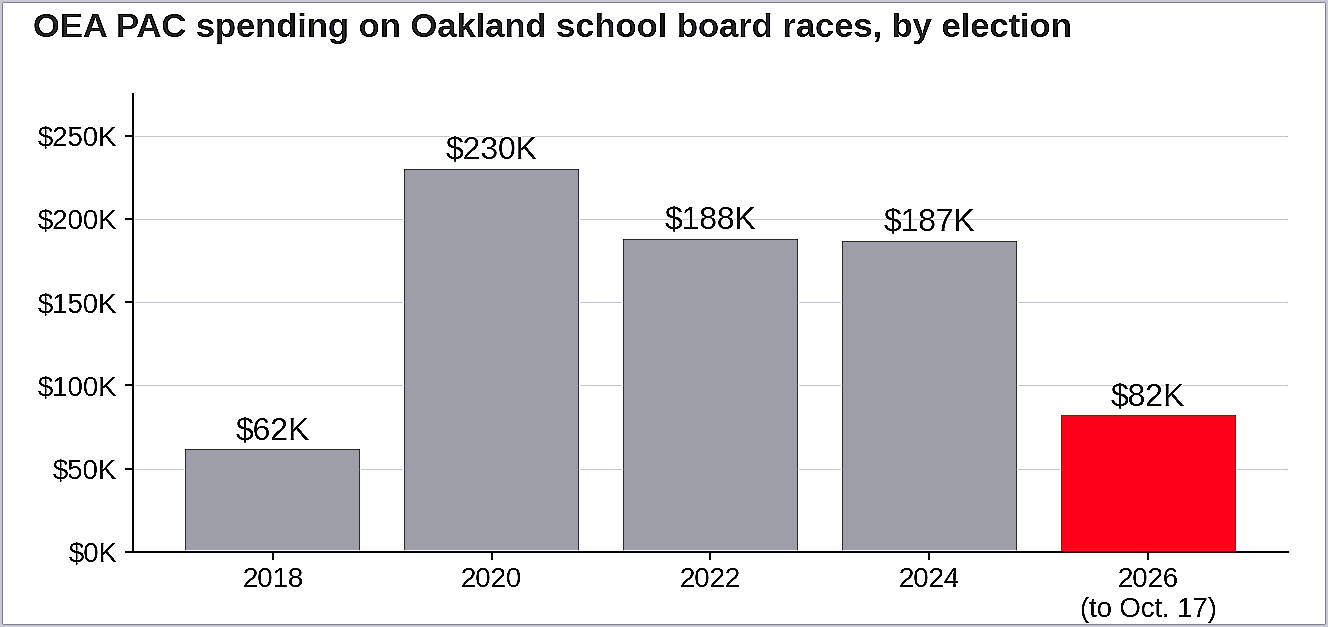
OEA political action committee (PAC) has spent $686,917 on OUSD board races since 2020. It spent more than any other committee over that period.
OEA PAC has spent $81,969 so far this cycle. Its spending in past cycles suggests that it will spend more heavily in the upcoming final week of the campaign.
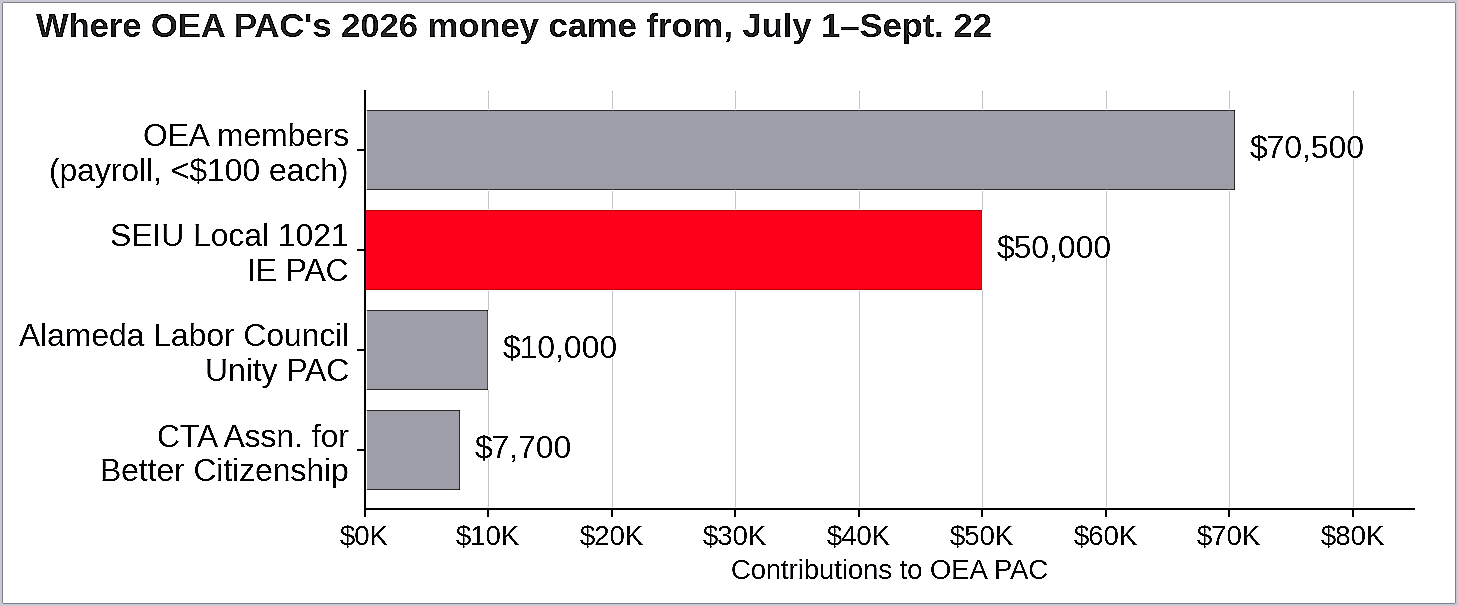
About half of OEA’s political money has come from other unions in 2026, and most of its 2024 money did. This summer, OEA PAC took in $70,500 in small contributions from its members, and larger checks from other labor organizations: $50,000 from SEIU Local 1021, $10,000 from the Alameda Labor Council and $7,700 from California Teachers Association (CTA), which gave $97,000 in 2024.
OEA’s parent union, CTA, is the deep pocket behind it: CTA reported $249.1 million in revenue and $574.2 million in net assets in 2025, up $158 million in four years.
Share this article with someone you know.
OEA: a small local union with a big parent, outsized influence on the school board, and a growing financial cushion
OEA represents roughly 3,000 teachers, counselors and nurses.2 Its financial disclosures show $997,235 in dues-type revenue; dues are typically withheld from workers’ paychecks.3 How much of that money OEA spends on direct representation of its members in the workplace, and how much it spends on political influence activities is unclear.
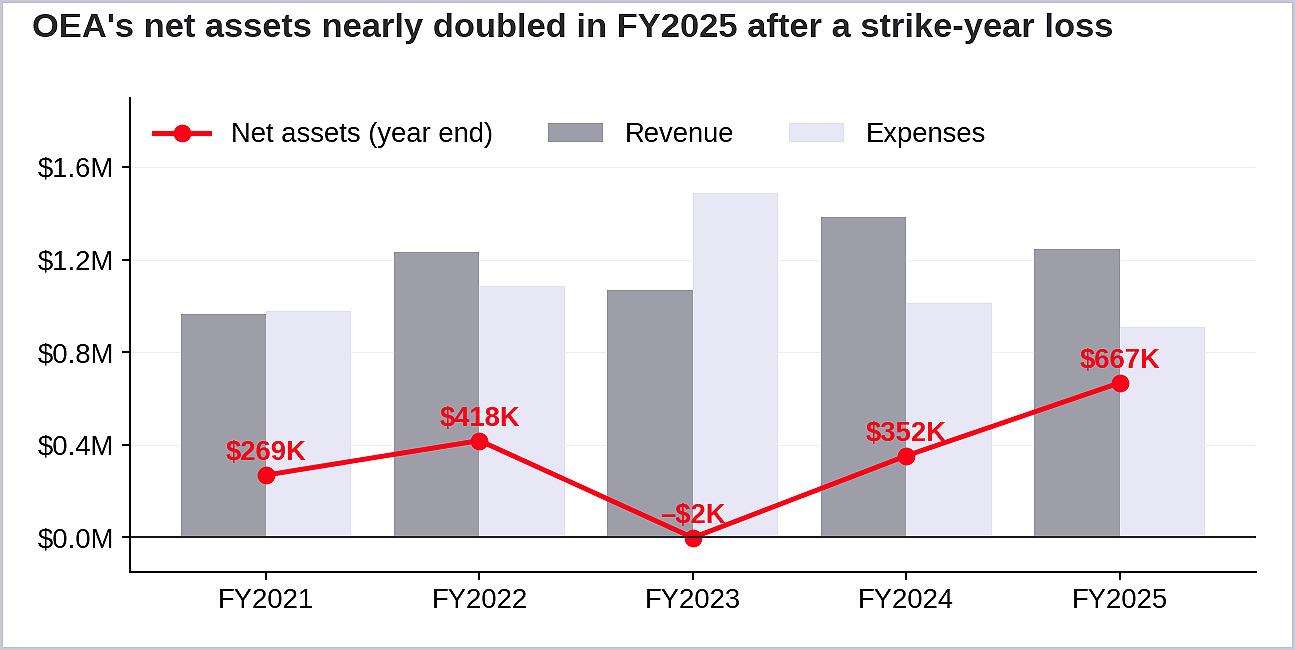
After a $419,720 loss in fiscal year 2023 — a year OEA went on strike — it rebuilt to $1.28 million in assets against $612,859 in liabilities.
The sources of OEA’s political money
OEA’s political action committee, a separate entity, has raised $1.9 million since it was created.4
Its member/workers’ small contributions provide a steady and consistent stream of revenue.
Additional, greater income comes from CTA’s political committee, the National Education Association (NEA) Advocacy Fund ($15,000 in 2022 and 2024) and, this year, Service Employees International Union (SEIU) Local 1021, which spends about $3.2 million a year on politics.56
OEA’s wealthy parent organization
Every OEA member/worker pays CTA about $858 a year on top of local dues, and pays around $234 to NEA.7
CTA’s $221.6 million in dues funds a headquarters in Burlingame. Its highest-paid employee, an assistant manager, earned $365,568 plus $198,711 in other compensation; its executive director earned $314,930 plus $235,518.8
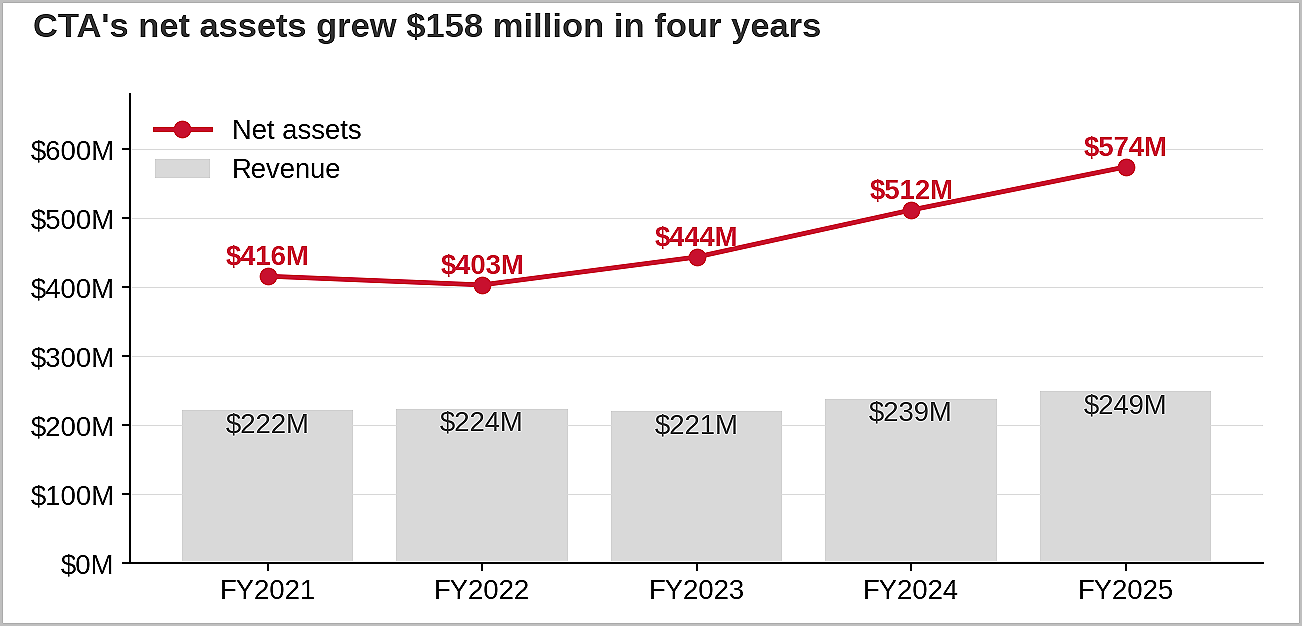
A portion of CTA’s funding goes to its political committee, which collected $2.5 million this cycle for local teacher PACs, including Oakland’s, according to Transparency USA.9
Subscribe to Oakland Report (it’s free).
OEA’s money has bought a school board majority friendly to OEA’s interests first and foremost
OEA-backed candidates in this election cycle (Jennifer Brouhard, and Valarie Bachelor) are incumbents who tend to vote as a bloc with the OUSD board’s union-backed 4–3 majority.10
President Jennifer Brouhard served three terms on OEA’s executive board; she is currently running for re-election.11
Vice president Valarie Bachelor, a former California Federation of Teachers organizer who now directs ACCE Oakland, a tenant-advocacy group, won in 2022 with about $51,000 in OEA PAC support; she also is running for re-election.12
OUSD board member VanCedric Williams is a member of the California Teachers Association board of directors.
OUSD board member Rachel Latta describes herself as being “raised in a union household,” lists “organizer” among her past jobs, and in 2024 was endorsed by the Alameda Labor Council, the Working Families Party, ACCE, Bay Rising Action and Oakland Rising Action.
The superintendent they appointed, Denise Saddler, led OEA as union president for six years.
OEA representatives bend the rules on electioneering, and the union-backed board majority has waved off conflicts of interest
The record also shows a willingness, by the union and the board majority it elected, to brush aside rules and warnings that stand in the way of the union’s goals. Recent examples in the public record include, but are not limited to:
Electioneering on campus. Last month, an OEA site representative whose day job is a school librarian posted flyers attacking “wealthy elites” by the door of Skyline High’s main office, where 16- and 17-year-old voters attend school. District rules bar employees from posting campaign material on district property; state law makes using district resources for it a crime.13
Undisclosed union pay. CTA’s tax filings report paying OUSD board member VanCedric Williams $4,877, $48,695 and $52,731 in 2022–24. Asked before the June vote on OEA’s contract whether CTA paid him, Williams called the question “misinformation” and voted yes. None of his four Form 700 statements lists CTA income.14
A warning overridden. The OEA’s recent contract with OUSD adds $104.8 million in expenses to the school district over three years. The board approved it despite warnings from the county superintendent that the contract “endangers the District’s fiscal stability.”15
District reserves drained. OUSD’s general fund cash fell from $267.9 million to $167.8 million in 2025–26, leaving $27.7 million locked in required reserves and only $4.2 million free to spend, against $30 million in additional budget cuts the board adopted but has not specified.16
Fiscal officers out. Superintendent Kyla Johnson-Trammell had steered OUSD to the final payment on its 2003 state loan, and an exit audit found the district running 30 more schools than it could afford. She was expected to bring the board a plan to reduce that number in June 2025.1718 On April 23, 2025, the board majority approved her separation 4–3 in closed session, on Bachelor’s motion, with no public reason given. The principals’ union president told the board members had been warned, “We control the board, we got Kyla fired, we can get you fired.” Brouhard later called the parting mutual. Eight months on, chief business officer Lisa Grant-Dawson recommended a “negative” budget certification. The board majority voted it “qualified,” and superintendent Denise Saddler, a former OEA president, substituted her own budget plan without telling Grant-Dawson. Grant-Dawson resigned two days later, saying she would not lead the district “back in” to receivership.19 The position appears not to have been refilled since.
The reality of OEA’s “student-centered” platform
OUSD spends $28,286 per student, more than any neighbor and among the highest of California’s 345 unified school districts. Yet only 34% of its students met the state English standard and only 27% met the math standard in 2024–25, compared to 49% and 37% statewide. OUSD’s Black and Hispanic students trail their statewide peers in these key academic achievement markers by 12 to 17 points.20
County superintendent Alysse Castro wrote this week that OUSD runs far more schools relative to enrollment than its peers and that “a budget can be balanced but not be good for kids.”21
The East Bay Times editorial board, urging an end to the union’s “chaotic control,” cited the district’s credit rating as one step above “junk” investments.2223
OEA struck in 2019 and 2023 and authorized a third strike in February 2026 before settling on the current contract.24
Whether union influence caused those outcomes is subject to debate. Castro credits the board with doing what it told voters it would do: keep every school open and cut elsewhere. The county says the district’s finances are “materially stronger.”25
On the other hand, the county’s Democratic Party notably declined to endorse the union-backed incumbents, Brouhard and Bachelor.26
What is not debatable on the facts is that OEA and its labor affiliates have had the money, the votes and the time to influence the district’s elected leadership and staff, and OUSD now spends more per student than nearly all of its neighbors and nearly 90% of California’s unified districts, for academic results well below the state average.
Other considerations and counterpoints
In fairness to OEA and the candidates, we offer the following counterpoints for readers to consider.
OEA’s ongoing stream of funding comes from thousands of members, indicating wide support that could be fairly characterized as “grassroots” in nature.
OEA’s main political opponent in this election cycle, the advocacy group Empower Oakland, names a Forbes-listed billionaire among its top funders.27
Williams’ pay is typical of CTA directors, and his vote on the OEA contract was not decisive (the vote was 5–0, out of seven possible votes).
Johnson-Trammell, the former superintendent was already due to step back in late 2025, and Grant-Dawson’s dispute reportedly was with new superintendent Saddler, not the board.
A special interest by any measure
Unions exist to protect workers and to help them negotiate fair compensation and safe, supportive working conditions.
Teachers are held in high regard for dedicating their professional lives to furthering education and enlightenment.
That said, no organization is immune from the corrosive effects of outsized power, disproportionate wealth, and overwhelming influence over public affairs.
The record shows that powerful and influential organizations — including corporations, local governments, and public employee unions — have at times abused their power.
Public scrutiny, strong oversight and responsible regulation, and commitment to the highest ethical standards are the most reliable safeguards available.
Some organizations have guardrails to check that tendency. Public employee unions have fewer: they bargain with the elected officials they help elect.
By resources, persistence and conduct, OEA and CTA behave as any special interest group does: they accumulate, spend to elect allies — and the allies deliver.
Whether “student-centered” describes the result in Oakland is for each voter to consider and decide for themselves.
ABOUT THE AUTHOR
“Charlene Price” is an Oakland resident who has extensive interactions with OUSD. The author’s name has been changed to protect their privacy and prevent personal and professional retaliation. Oakland Report has verified the identity of the writer and the accuracy of the facts in this report.

WE ARE 100% SUPPORTED BY YOU
Oakland Report is an experiment in a new form of media. We are an independent, community-led 501(c)(3) nonprofit organization, not affiliated with any public agency, labor union, corporate interest or political campaign. If you value our services, please donate. We rely on your voluntary donations to continue our nonprofit work.
Oakland Education Association. Facebook and Instagram posts, Sept.–Oct. 2026, including “Reject the billionaire backed candidates.” https://www.facebook.com/oaklandea
Oakland Education Association. “Who We Are.” https://oaklandea.org/who-we-are/
Oakland Education Association. “Form 990, fiscal year ending Aug. 31, 2025,” filed Jun. 19, 2026. ProPublica Nonprofit Explorer, EIN 94-1330958. https://projects.propublica.org/nonprofits/organizations/941330958
Open Disclosure Oakland. “Oakland Education Association Political Action Committee,” total raised to date, accessed Oct. 23, 2026. https://www.opendisclosure.io/committee/1345259/
Oakland Education Association Political Action Committee. “Form 460, Jul. 1–Sept. 19, 2026,” filing 217501272; Open Disclosure Oakland committee page, accessed Oct. 23, 2026. https://www.opendisclosure.io/committee/1345259/
SEIU Local 1021. “Form LM-2, calendar year 2025,” U.S. Department of Labor OLMS. https://olmsapps.dol.gov/query/orgReport.do?rptId=862170&rptForm=LM2Form
California Teachers Association. “CTA Dues Structure” and “Membership Enrollment Form,” 2025–26 and 2026–27. https://www.cta.org/document/cta-dues-structure
California Teachers Association. “Form 990, fiscal year ending Aug. 31, 2025,” filed Jun. 30, 2026. ProPublica Nonprofit Explorer, EIN 94-0362310. https://projects.propublica.org/nonprofits/organizations/940362310
Transparency USA. “California Teachers Association/Association for Better Citizenship, 2026 session” (compiled from Cal-Access ID 741941). https://www.transparencyusa.org/ca/committee/california-teachers-associationassociation-for-better-citizenship-741941-rcp
Reinhart, Sean S. “The elephant in the classroom: the Oakland school board’s deep ties to the Oakland teachers union.” Oakland Report, Apr. 30, 2026. https://www.oaklandreport.org/p/the-elephant-in-the-classroom
Price, Charlene. “Oakland’s teachers union backs Jennifer Brouhard — and her own party declined to.” Oakland Report, Sept. 23, 2026. https://www.oaklandreport.org/p/oaklands-teachers-union-jennifer-brouhard-oaklandside
Open Disclosure Oakland. “Valarie Bachelor, Nov. 8, 2022 election,” independent expenditures. https://www.opendisclosure.io/candidate/oakland/2022-11-08/valarie-bachelor/
Price, Charlene. “OEA teachers union rep caught posting political attack flyers outside high school’s main office .” Oakland Report, Oct. 1, 2026. https://www.oaklandreport.org/p/skyline-high-campaign-flyers-teachers-union-oea
Price, Charlene. "Oakland school board director VanCedric Williams was paid by California teachers union. He denied it, then voted to approve teachers union contract." Oakland Report, Sept. 6, 2026. https://www.oaklandreport.org/p/oakland-school-board-director-vancedric
Reinhart, Sean S. “Union raises ‘endanger’ Oakland school finances as board set to approve $1.2 billion budget.” Oakland Report, Jun. 23, 2026. https://www.oaklandreport.org/p/union-raises-endanger-oakland-schools
Reinhart, Sean S. “Oakland Unified’s general fund cash shrank by $100 million last year.” Oakland Report, Sept. 9, 2026. https://www.oaklandreport.org/p/oakland-unified-cash-fell-100-million
DeBenedetti, Katie. “Oakland school board votes to remove superintendent, sparking worries of instability.” KQED, Apr. 24, 2025. https://www.kqed.org/news/12037315/oakland-school-board-votes-remove-superintendent-sparking-worries-instability
Tucker, Jill. “Union-backed Oakland school board majority ousts homegrown superintendent.” San Francisco Chronicle, Apr. 23, 2025. https://www.sfchronicle.com/bayarea/article/union-backed-oakland-school-board-majority-ousts-20289400.php
DeBenedetti, Katie. “Oakland schools in turmoil after 2 key officials depart over budget crisis.” KQED, Dec. 18, 2025. https://www.kqed.org/news/12067547/oakland-schools-in-turmoil-after-two-key-officials-depart-over-budget-crisis
Kakkar, Tarini. “Oakland Unified spent over $28,000 per student — more than any nearby district.” Oakland Report, Aug. 7, 2026. https://www.oaklandreport.org/p/ousd-spending-and-performance
Castro, Alysse. “Castro: Oakland has its schools back. Now voters face a new challenge.” East Bay Times, Oct. 20, 2026. https://www.eastbaytimes.com/2026/10/20/alysse-castro-oakland-schools-back-now-voters-face-state-receivership-school-closures/; https://archive.is/JtaUI
East Bay Times editorial board. “Endorsement: End Oakland teacher union’s chaotic control of the school board.” East Bay Times, Oct. 23, 2026. https://www.eastbaytimes.com/2026/10/23/endorsement-end-oakland-teachers-unions-chaotic-control-school-board-fleisher-camp-williams/; https://archive.is/0BIe1)
Fitch Ratings. “Fitch Affirms Oakland Unified School District, CA IDR at ‘BBB’; Outlook Negative,” Aug. 17, 2026. https://www.fitchratings.com/research/us-public-finance/fitch-affirms-oakland-unified-school-district-ca-idr-at-bbb-outlook-negative-17-08-2026
McBride, Ashley. "Oakland teachers avert strike, reach tentative deal with OUSD." The Oaklandside, Feb. 27, 2026. https://oaklandside.org/2026/02/27/oakland-teachers-avert-strike-reach-tentative-deal-with-ousd/
Oakland Post. “County Office of Education Says OUSD Finances Are Getting Healthier, Materially Stronger,” Oct. 2026. https://www.postnewsgroup.com/county-office-of-education-says-ousd-finances-are-getting-healthier-materially-stronger/
Tavares, Steven. “Alameda County Dems Deliver a Blow to OUSD incumbents.” East Bay Insiders, Sept. 15, 2026. https://eastbayinsiders.substack.com/p/alameda-county-dems-deliver-a-blow
Empower Oakland. Voter guide disclaimer, “Committee’s top funders: Gagan Biyani, Chris Larsen, Ryan Graciano” (Gov. Code §84501 threshold $50,000) https://www.empoweroakland.com/voter-guide; Forbes, “Chris Larsen” profile, accessed Oct. 22, 2026. https://www.forbes.com/profile/chris-larsen/
Rex - Thank you for your comment. Voters are not entirely to blame when they cast their votes based on incomplete information, misinformation, and falsehoods. Laying the government's failures at the feet of voters isn't entirely fair because voters don't enact policies, set budgets, spend public money, or provide government services. That's the government's job. Its elected officials and professional staff are granted the privilege of serving as responsible stewards of the public interest, regardless of who is elected or not. And when the results of that work are poor, the government is primarily to blame. Thank you again, the discussion is appreciated.
The problem of public employees unions dominating local elections is much broader than the OUSD. Virtually every large Bay Area city, school board, and special districts like BART, EBMUD and EBRPD are run by their own unions. This may sound almost utopian, but they spend their agencies into near bankruptcy.
The financial pipeline runs from union dues to union political action committee to the favored candidate, who then rewards the union members. A pretty neat, self-serving system. But it results in the least efficient, most expensive local governments in the country.
There have been attempts to break this chain in the past. Prop 32 in 2012, if passed, would have made worker's contributions to political action committees voluntary not automatic. It got over 40% of the statewide vote although massively outspent by the unions.
The situation you see in OUSD will just continue there and elsewhere unless a new Prop 32 or equivalent is created and passes.