


Video clip 1. Oakland police’s federal oversight has ended. A federal judge lifted what has been more than two decades of federal monitoring of the Oakland Police Department, ending the longest-running oversight of a police force in U.S. history. (Video montage by Oakland Report)
Editors’ note: This article was originally posted by Oakland resident Rajni Mandal on her Substack page. Oakland Report is republishing it with Mandal’s permission for our readers to consider. Subscribe to Rajni Mandal’s Public Safety Updates to receive her articles directly.
What was meant to be a few years became decades
As I was walking to federal court on Tuesday afternoon, I was thinking of the first time I even heard the term “NSA.” I had heard it spoken during my first meeting of the Police Commission, which I attended back in the summer of 2024. The term was bandied about, and seemed to represent something very complicated, obtuse, and something that those who were speaking knew more about than me.
I later came to learn more about this out-of-court settlement,1 which was enacted in response to the infamous Riders scandal over 25 years ago. The lawsuit was brought forth by civil rights attorneys Jim Chanin2 and John Burris3 against the City of Oakland.
The NSA (Negotiated Settlement Agreement) is a 74-page-long document which outlines 51 “tasks” which entail everything from investigations of police misconduct, reporting use of force, personnel management, training and police academies.4 Progress and compliance with these reforms was to be adjudicated by a federal judge and court-appointed monitor.
What was meant to be a few years became decades—and finally today, after 23 years, Judge William Orrick5 announced that federal oversight would end, with a final dismissal order to follow. Although many may term this as an “exit,” it is rather a continuation of changing policing practices and culture that can now be fully under local control.
Subscribe to Oakland Report (it’s free).
The cost of federal oversight
The consequences of this decision are significant, not only with regards to streamlining police oversight, but also financial cost. As I have written previously:6
“Since 2003, the City has spent over $20 million on monitor and court-related expenses,7 along with more than $3 million in attorney fees.8 Robert Warshaw and Associates, contracted as the federal monitor, initially received nearly $1 million annually—a figure that has dropped to approximately $400,000 since 2023.”910
— The author, May 8, 2025
For city officials, however, criticizing the federal monitor and court oversight could have consequences, given the City’s position in the litigation. During court today, federal monitor Robert Warshaw11 discussed how one police chief was called into Judge Thelton Henderson’s12 kitchen the night after the chief criticized the NSA.
The relationship between the monitor and OPD leadership was often contentious. Former chiefs Anne Kirkpatrick, Sean Whent and LeRonne Armstrong publicly criticized Warshaw or the monitoring structure,13 and Armstrong later argued that his criticism of Warshaw contributed to his firing.14
Finding a way out
Although the reforms are essential and necessary, the length, complexity and cost of oversight had become increasingly burdensome and, for years, the City also lacked a coordinated internal structure for managing compliance.
In January 2025, city councilmembers had begun discussing collaborating with the City Attorney to develop a unified plan to end court oversight.15 In November 2025, mayor Lee then established a new position, the Constitutional Policing Administrator, and developed a cross-departmental approach to assessing task compliance.16 This included biweekly meetings with police leadership, City Administrator, mayoral staff, Police Commission Chair, and city attorney representatives.
The improved communication, as well as involvement with the federal monitor’s team, led to significant praise by Judge Orrick.17 The appointment of chief Beere by mayor Lee was also touted today by Judge Orrick, the plaintiff’s attorneys and monitor Warshaw as instrumental to maintaining constitutional policing and NSA standards, even after court oversight.
Share this story.
Who speaks for the community?
At the same time, the community itself became increasingly involved in a court process that for decades had largely been conducted among the parties, the monitor and City officials. In years prior, advocacy groups had sent letters directly to court expressing their views regarding federal oversight and accountability of the police department.
These included a “motion to intervene” filed in 2019 by former Alameda County district attorney Pamela Price, then an attorney representing the Coalition for Police Accountability (CPA).18 The motion sought to make CPA and four community advocates—Rashidah Grinage, Saied Karamooz, Anne Janks, and John Jones III—formal parties to the federal case. They argued that the existing parties did not adequately represent the interests of Oakland residents and that community participation could help the court achieve sustainable compliance with the NSA and ultimately bring federal oversight to an end. Their subsequent letter in 2025 criticizing then-police chief Floyd Mitchell19 was directly referenced by Judge Orrick, showing that these community submissions were being heard within the court process.
This led me to create and circulate a petition amongst residents to urge the court to end federal oversight of the police department.20 Judge Orrick recognized the petition in court, giving direct acknowledgment to more than 1,000 Oakland residents asking that responsibility for policing be returned to local institutions:21
“For those of you who have signed petitions urging me to close down the court’s oversight function, I hear you. I agree with most of your sentiments. The elected and appointed leaders of the city and OPD, including the police commission and not the federal court, should be 100% responsible for policing in Oakland.”
— Judge William H. Orrick, Jan. 27, 2026
More than one community voice
Prior to today’s hearing, the court also received letters from the Bay Area Council22 and SAFE Oakland23, who collectively represent leaders from the faith, business, civil rights, and neighborhood communities, supporting exit from federal oversight and returning police accountability to the city and its residents.
CPA also submitted a letter advocating the opposite stance, warning that the civilian oversight structure was not funded nor strong enough to monitor nor maintain reform.24
Judge Orrick again commented on those letters, noting that community organizations and lawyers had differing views on compliance, in reference to one task being 2% below target.
I do believe this increased community participation was significant. By the final year of federal oversight, there was no single “community” position before the court. Residents, neighborhood groups, business and faith leaders, civil rights advocates and police-accountability organizations were speaking directly to the court, and sometimes asking the judge to do opposite things.
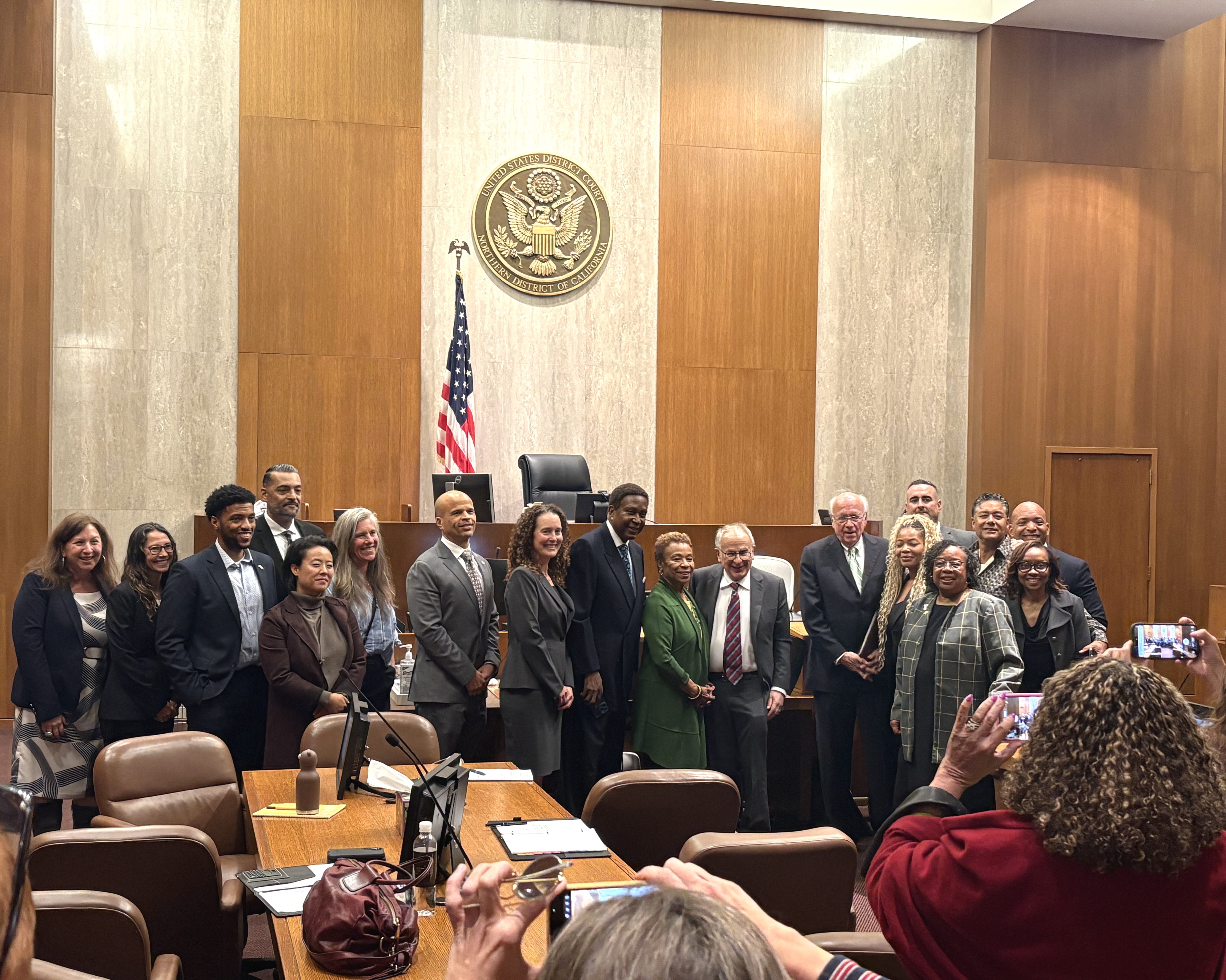
The word “community” was also brought up repeatedly today by the judge, mayor, chief Beere and the plaintiff’s attorneys. After years in which this case was largely a discussion between attorneys, the monitor, police officials and a federal judge, Oakland residents and community organizations had increasingly become part of that discussion as well.
Bringing it back home
I took down this exchange between Judge Orrick and chief Beere during the hearing, which I think sums up today’s outcome:
Orrick: “Tomorrow are you prepared to comply with and reach all the needs of constitutional policing for the city of Oakland?”
Beere: “We live and breathe it…the NSA is part of the Oakland Police Department’s DNA. We have absorbed the practice and institutionalized it. Wednesday morning, we will continue to do it and improve on it.”
Orrick: “You are off to a great start from everything I hear and read. It is gratifying to have you in this spot. Thank you for doing it.”
Beere: “I believe in this department and community. I am a product of the NSA.”
— Judge William H. Orrick and Oakland police chief James Beere, Sept. 29, 2026
Later in the hearing, Orrick responded to mayor Lee:
“I appreciate the commitment to constitutional policing and this effort to bring oversight back where it belongs…it belongs to the people which you serve and the institution you run, the city.”
— Judge William H. Orrick, addressing Oakland mayor Barbara Lee, Sept. 29, 2026
And now, the next chapter begins. The disagreements about policing, oversight and accountability are not over. But after 23 years, those debates will no longer primarily take place before a federal judge and monitor. They return to Oakland: its elected officials, its civilian oversight bodies, its police department, and its residents.
Oakland Report is an experiment in a new form of media: reasoned, data-driven, well-sourced analysis focused on observable and verifiable evidence. We present the facts and let the reader decide. Do you have an idea for a story on local government issues? Learn more at oaklandreport.org/about.
Wikipedia contributors. "Allen v. City of Oakland." Wikipedia, accessed Sept. 30, 2026. https://en.wikipedia.org/wiki/Allen_v._City_of_Oakland
Wikipedia contributors. "Jim Chanin." Wikipedia, accessed Sept. 30, 2026. https://en.wikipedia.org/wiki/Jim_Chanin
Wikipedia contributors. "John Burris." Wikipedia, accessed Sept. 30, 2026. https://en.wikipedia.org/wiki/John_Burris
"Negotiated Settlement Agreement." Delphine Allen, et al. v. City of Oakland, et al., U.S. District Court for the Northern District of California, Case No. C00-4599, Jan. 22, 2003. https://oaklandca.s3.us-west-1.amazonaws.com/government/o/OPD/a/publicreports/oak060142.pdf
Wikipedia contributors. "William Orrick III." Wikipedia, accessed Sept. 30, 2026. https://en.wikipedia.org/wiki/William_Orrick_III
Mandal, Rajni. "Twenty years under watch: will Oakland police finally exit federal oversight this year?" Oakland Report, May 8, 2025. https://www.oaklandreport.org/p/twenty-years-under-watch-will-oakland
City of Oakland. “The total amount of money the City of Oakland has paid to Robert Warshaw, appointed Monitor and Compliance Director by the federal court under the terms of the Negotiated Settlement Agreement in the Delphine Allen v. City of Oakland case.” Public records request #23-6464. Oakland NextRequest portal, 2023. https://oaklandca.nextrequest.com/requests/23-6464
City of Oakland. “Expenses associated with Robert Warshaw and his team of consultants to independently monitor OPD.” Public records request #23-1491. Oakland NextRequest portal, 2023. https://oaklandca.nextrequest.com/requests/23-1491
City of Oakland. “Contract and invoices showing the total amount(s) paid by the City of Oakland to independent monitor Robert Warshaw and his team of consultants.” Public records request #24-13104. Oakland NextRequest portal, 2024. https://oaklandca.nextrequest.com/requests/24-13104
U.S. District Court for the Northern District of California. Allen v. City of Oakland, No. 3:00-cv-04599, docket. CourtListener, accessed Sept. 30, 2026. https://www.courtlistener.com/docket/4496116/allen-v-city-of-oakland/
Wikipedia contributors. "Robert Warshaw." Wikipedia, accessed Sept. 30, 2026. https://en.wikipedia.org/wiki/Robert_Warshaw
Wikipedia contributors. "Thelton Henderson." Wikipedia, accessed Sept. 30, 2026. https://en.wikipedia.org/wiki/Thelton_Henderson
Cassidy, Megan. "Ouster of Oakland chief inflames tensions over police monitor." San Francisco Chronicle, Mar. 4, 2020. https://www.sfchronicle.com/crime/article/Ouster-of-Oakland-chief-inflames-tensions-over-15101813.php; https://archive.is/MuRt7
Armstrong, LeRonne. "Statement by Chief LeRonne Armstrong." Oakland Post / Post News Group, Feb. 18, 2023. https://www.postnewsgroup.com/statement-by-chief-leronne-armstrong/
City of Oakland. “OPD NSA status update.” Oakland council public safety committee meeting, agenda item #3, Jan. 14, 2025. https://oakland.legistar.com/MeetingDetail.aspx?ID=1267242&GUID=AA17FD10-33F9-417A-8C95-022828911925&Options=info%7C&Search=
Mandal, Rajni. "Oakland police could exit federal oversight soon. What comes after?" Oakland Report, Aug. 18, 2026. https://www.oaklandreport.org/p/what-comes-after-oakland-police-federal-oversight
Mandal, Rajni. "Oakland Police federal oversight: A different tone in court signals a potential end to NSA." Oakland Report, Jan. 28, 2026. https://www.oaklandreport.org/p/20260128-oakland-police-negotiated-settlement
Price, Pamela Y., for the Coalition for Police Accountability et al. "Motion to intervene." Allen v. City of Oakland, May 8, 2019. https://docs.oaklandreport.news/Motion%20to%20Intervene%20%E2%80%93%20%231243%20in%20Allen%20v.%20City%20of%20Oakland%20(N.D.%20Cal.%2C%203_00-cv-04599)%20%E2%80%93%20CourtListener.pdf
Coalition for Police Accountability. “Letter to the court regarding then-police chief Floyd Mitchell, Allen v. City of Oakland.” Jul. 10, 2025. https://docs.oaklandreport.news/July%202025%20NSA%20court%20transcript.pdf
Lin, Da and Jose Fabian. "Oakland mother pushes to end federal oversight of police department." CBS News Bay Area, Sept. 1, 2025. https://www.cbsnews.com/sanfrancisco/news/oakland-mother-pushes-to-end-federal-oversight-of-police-department/
United States District Court, Northern District of California. “Transcript of case management conference, Allen v. City of Oakland.” U.S. District Court of Northern California, Jan. 27, 2026. https://docs.oaklandreport.news/january%202026%20court%20transcript.pdf
Schaaf, Libby. “Letter to the court, Allen v. City of Oakland.” Bay Area Council, Sept. 9, 2026. https://docs.oaklandreport.news/Bay%20area%20council%20letter.pdf
Adams, Cynthia et al. “Letter to the court, Allen v. City of Oakland.” SAFE Oakland, Sept. 22, 2026. https://docs.oaklandreport.news/Safe%20Oakland%20letter.pdf
Cleveland, Millie and Larry C. White. “Letter to the court, Allen v. City of Oakland.” Coalition for Police Accountability, Sept. 21, 2026. https://docs.oaklandreport.news/CPA%20letter%20to%20court.pdf
This victory is your Rajni and Oakland Report. You fought hard for this and I am proud to have signed your petition. The next steps are going to be critical. We cannot allow the police commission and whatever new agencies Oakland tries to put in to be politically weaponized. We need to closely examine and change certain ordinances in our city charter that hinder our police from doing their job. Onward to our next steps in creating a safe and beautiful Oakland. Mindy Pechenuk, candidate for Oakland Mayor 2026