



This article is reposted from Rajni Mandal’s Public Safety Updates newsletter. Subscribe to receive all of Rajni’s updates directly.
A different tone in federal court
Yesterday’s federal court hearing on Oakland’s long-running police reform case felt meaningfully different. While federal oversight under the Negotiated Settlement Agreement (NSA) continues for now, Judge Wiliam Orrick repeatedly emphasized that Oakland is in a fundamentally new place, something he described as happening “for the first time” since he has been involved in the case.
“For the first time”
Judge Orrick returned to this phrase multiple times in his opening remarks:
I would like to think that we’re on the threshold of the institutionalization of constitutional policing1 in Oakland for the first time since I’ve been involved in this case. And I suspect for the first time ever, the city has prioritized constitutional policing in word, deed and resources.
— Judge William Orrick, Jan. 27, 2026
His remarks set the tone for the entire hearing.
Praise for city leadership
The judge was notably positive about city leadership and engagement.
He highlighted the mayor’s commitment to not just reaching compliance, but ensuring constitutional policing lasts long after federal oversight ends, calling this focus on sustainability a key reason for his optimism.
He also praised the city’s executive structure, especially the role of Michelle Phillips, the interim Constitutional Policing Administrator, who is embedded in Oakland Police Department (OPD) while reporting through city administration. The judge described this role as “pivotal for the long-term success of constitutional policing in Oakland”. He also acknowledged Phillips’ remarks as “probably the first recognition that the city and OPD succeed together and they fail by pointing fingers at each other.”
Even the plaintiffs’ attorneys expressed optimism. Jim Chanin said, “I’m very excited about the people in place at the current time.”
John Burris agreed, while emphasizing that work remains: “We have not got there yet. And I’m hopeful that we will in the near future—because we’d like to leave too.”
Help Oakland Report reach our goal of 10,000 subscribers
At the conclusion of the mayor’s remarks, Judge Orrick offered unusually direct praise, noting that no prior mayor had demonstrated such a holistic understanding of what it will take to finish this work. He said he was “very optimistic,” while also underscoring that the city still needs to ‘bring it across the finish line’.
City leadership team showed up
The hearing itself reflected this shift through the direct presence and engagement of city and OPD leadership.
Interim Chief James Beere explained that the Internal Affairs Bureau (IAB) now reports directly to him and described how leadership is addressing staffing shortages. He also spoke about improving transparency and communication with officers, particularly in serious cases. His remarks reflected clear ownership of the work.
Deputy Chief Aaron Smith, who leads IAB, spoke candidly about how demanding the work has been and the strain caused by long-running investigations. He acknowledged the need to improve both timeliness and fairness, and described steps being taken to identify bottlenecks earlier, strengthen supervision, and improve training.

Mayor Barbara Lee framed accountability as a core responsibility of city leadership. Rather than treating staffing or oversight challenges as issues to be handled elsewhere, she spoke about capacity, resourcing, and coordination as essential to making constitutional policing last. Her remarks made clear that this work sits not only within OPD, but across City Hall.
Michelle Phillips described spending significant time inside OPD, including sitting with Internal Affairs staff to understand how cases move from intake through investigation. She also spoke about working directly with the mayor and city administrator to remove structural barriers. She described cultural change being felt “in the halls” of both OPD and City Hall, not just written into policy.
Judge Orrick responded positively, saying he was “very excited” by what he heard and emphasizing that Phillips’ role is central to long-term sustainability. His comments reinforced a broader theme of the hearing: lasting progress depends on leadership alignment across OPD and city administration.

Not an exit hearing (yet)
Despite the positive tone, Judge Orrick was clear that this was not an exit hearing. Looking ahead to the next court hearing in May, he outlined exactly what he wants to see:
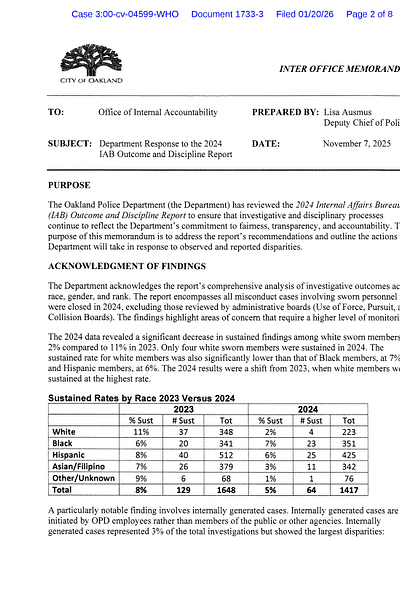
Updated 2025 Internal Affairs data, prepared by May 1
Sustained improvement in investigation timelines (Task 2 in the NSA)
Evidence that staffing, training, and process changes are taking hold with continued cross-departmental communication and coordination
Deeper “drill-down” analysis of disciplinary cases, particularly in internally generated cases that have shown racial and gender disparities.
“Very optimistic about the future”
The Mayor echoed the judge’s assessment that OPD has made significant progress but have some work remaining to complete its exit the NSA:
Your Honor, let me just say to you, I did say at the last hearing that I really wanted this ended under my watch. And I want to thank everyone in the city and OPD, the plaintiff’s attorneys, for understanding that I’m not ready either to end this yet, but I do believe we will be able to complete these tasks.”
— Mayor Barbara Lee, Jan. 27, 2026
Yesterday’s hearing did not end federal oversight, but it did mark a clear shift in tone from past hearings. For the first time, Judge Orrick focused less on individual compliance checklists and more on whether the city and OPD are operating as one accountable system that can sustain constitutional policing over time.
The judge also addressed a community petition calling for an end to federal oversight. He said he heard the community and largely agreed with the sentiment behind the petition, but emphasized that the court still needs to see stability over time.
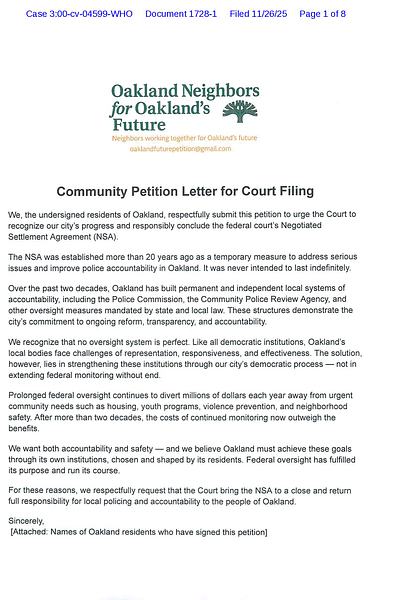
Looking ahead, the next hearing on May 27 will test whether the alignment now visible across City leadership and OPD can hold. While work remains, the court’s remarks reflected a level of confidence and clarity not often heard in these proceedings.
As Judge Orrick put it, he is “very optimistic about the future.”
Yesterday’s hearing did not end federal oversight, but it did signal real momentum, raising the possibility of an exit in the near future if current progress holds.
Update: After publication, a footnote defining “constitutional policing” was added to this article in response to a reader suggestion. Our thanks and appreciation to the reader for suggesting it. —Ed.
See these related articles:


DONATE TO SUPPORT OUR WORK

We are a 501(c)(3) charitable nonprofit based in beautiful Oakland, California. Our mission is to make truth more accessible to all Oakland residents through investigative reporting and evidence-based analysis of local issues.
Thank you.
“Constitutional policing” is a framework in which law enforcement agencies operate within the legal boundaries of the U.S. Constitution, state constitutions, and court decisions; respect, protect, and uphold people’s civil rights and liberties; and practice fair, impartial, and effective policing, free from bias, to foster legitimacy and trust.
Readers should not have to look up bureaucratic/legal jargon such as “constitutional policing.”
John Burris - "because we’d like to leave too"...
Yeah, right. This agreement helped cover college tuition for his kids and a lot more.
Moreover, Oaklanders should not forget that Jim Chanin served in multiple roles that were a clear conflict of interest, professionally and financially. The fact that he dared took on those roles is an honest indication of the lack of strength and clarity of his ethics.
I am thankful for the work of Brenda Harbin-Forte and others in removing Jim from the Oakland Police Commission Selection Panel.