



Editors’ note: This article was originally posted by Oakland resident Rajni Mandal on her Substack page. Oakland Report is republishing it with Mandal’s permission for our readers to consider. Subscribe to Rajni Mandal’s Public Safety Updates to receive her articles directly.
Making reform permanent
Within weeks of taking office in 2025, mayor Barbara Lee told the federal court that she intended to end Oakland’s federal police oversight “under my watch.”1
In November 2025, she announced the creation of a new position within her administration: the constitutional policing administrator.23
The position was designed to serve as an “internal and embedded monitor and guidance role to improve accountability” within the Oakland Police Department (OPD).4
The position sits within city administration under the direct supervision of the city administrator, works closely with OPD leadership, and advises the mayor.
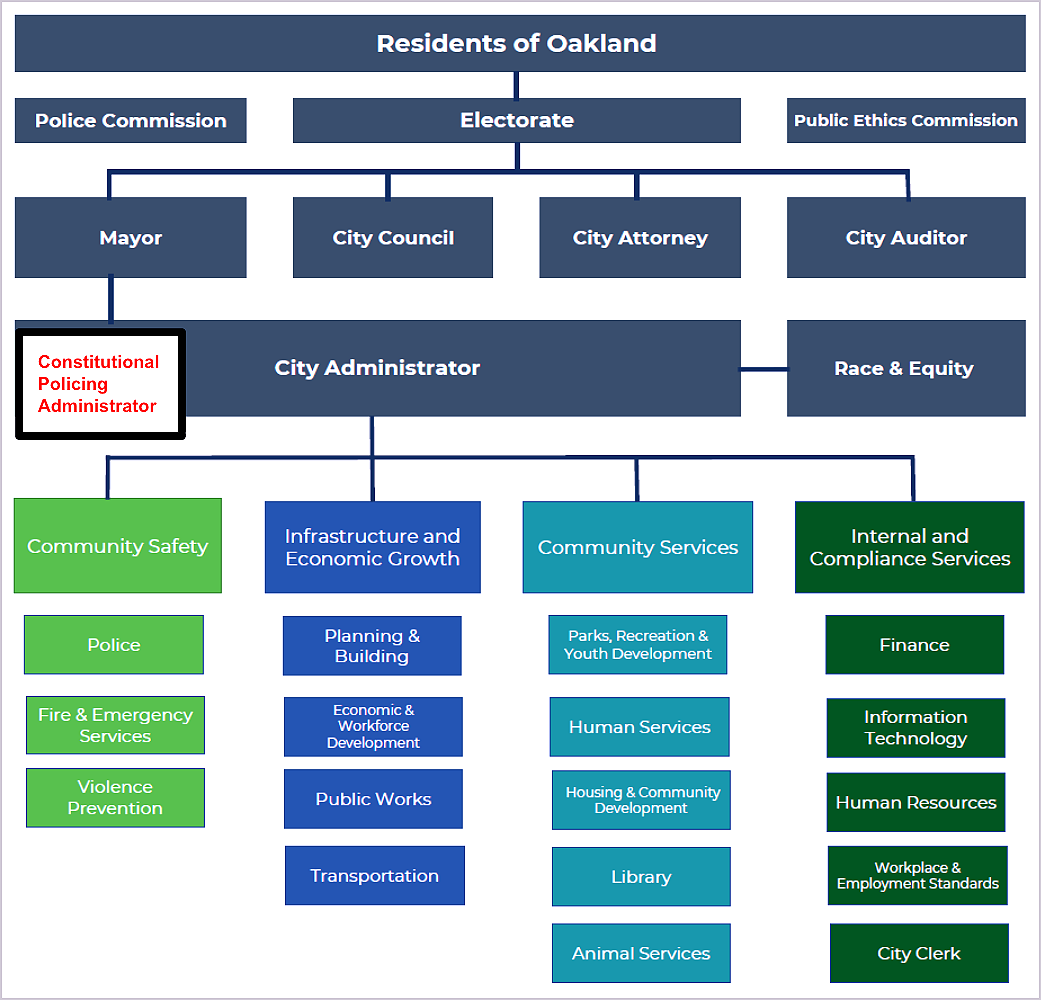
The city has begun a national search for a permanent constitutional policing administrator, a role that assistant city administrator Michelle Phillips has filled on an interim basis since last November. The city council approved the creation and funding of the permanent position earlier this year.5
Phillips has described her close working relationship with OPD leadership to the federal court.6 She has worked with OPD on streamlining intake and investigative processes for Internal Affairs. She has also worked with OPD, the mayor and city administration on staffing and recruitment, as well as interdepartmental public safety strategies for events such as First Fridays.7
Phillips explained this close coordination to the court as:
“… Continued communication, folks going from office to office, really engaged in talking about police reform efforts in a way that is ingrained in the fabric of the department, and not just a concept.”
— Michelle Phillips, Jan. 27, 2026
Although at first glance this may appear to be yet another layer of police oversight, the position instead appears designed to provide administrative guidance and coordination within city government after federal oversight ends.
A role separate from civilian oversight
The new position has also drawn the attention of the police commission, which is part of Oakland’s civilian oversight system for the police department.8
Created by voters in 2016 and expanded to include the Office of Inspector General in 2020, this system provides independent oversight of certain OPD policies, audits, and investigations of police misconduct; functions that can also relate to constitutional policing.
Civilian oversight provides an independent pathway of accountability, separate from the mayor and city administration’s responsibility for the management and operation of OPD.
Oakland’s civilian oversight structure is unusual in the degree of independence and authority granted to it by the city charter. Police commissioners are appointed volunteers, yet the commission has significant powers that include the authority to terminate the police chief for cause.
At the most recent police commission meeting, commissioner Angela Jackson-Castain proposed that the commission issue a formal statement regarding the constitutional policing administrator position.9
“I think this is undermining the role of the police commission, IG [Office of Inspector General] and CPRA [Community Police Review Agency],” Jackson-Castain said, describing the role as “a redundancy”:
“But when it’s to the point where our goals are being undermined, our charter mandate is being undermined, we’re being defunded actively, and the city administrator’s office has managerial influence on the work that we do in providing constitutional policing oversight — then I do believe it is our duty to stand up for not only the commission but for all the offices that fall under us.”
— Angela Jackson-Castain, Aug. 13, 2026
Commission chair Ricardo Garcia-Acosta disagreed. He described the benefit of “having a point person” who could “be the connective tissue between all the different city departments.” He cited efforts such as transferring misconduct investigations from Internal Affairs to CPRA, establishing a mediation program, and tracking deadlines for misconduct investigations.
The city’s recruitment announcement explicitly distinguishes the two functions: “While internal accountability and civilian oversight share many core priorities, their roles do not and cannot replace each other.”10
The police commission exercises independent oversight through the specific authorities granted to it by the city charter, but it does not direct or administer OPD’s operations.
The constitutional policing administrator serves a different function, working directly with OPD leadership, the city administrator and mayor to coordinate and implement reforms from within city government.
A position endorsed by the court
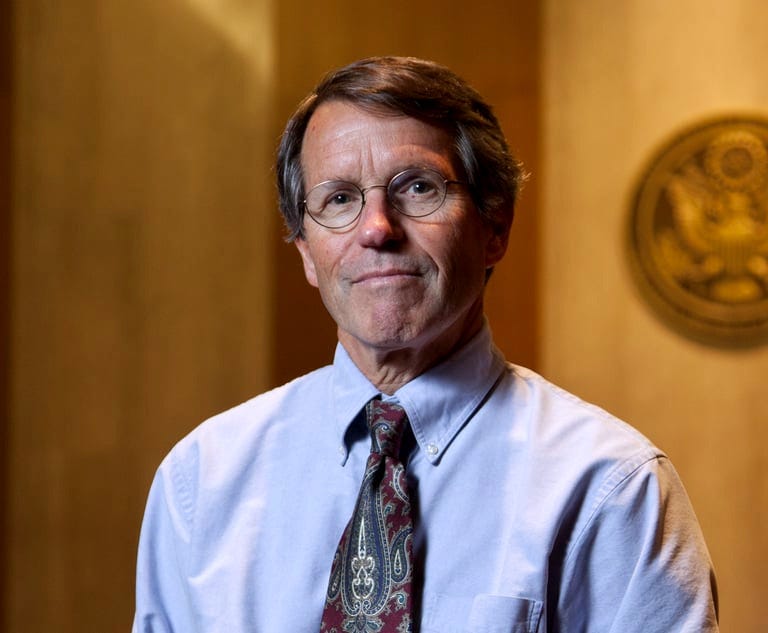
While some members of the police commission have questioned the role, Judge William Orrick, the federal judge overseeing the Negotiated Settlement Agreement (NSA), has emphasized its importance, stating:
“I would like to think that we’re on the threshold of the institutionalization of constitutional policing in Oakland for the first time since I’ve been involved in this case. And I suspect for the first time ever, the city has prioritized constitutional policing in word, deed and resources.”
— Judge William Orrick, Jan. 27, 2026
Orrick described the constitutional policing administrator role as “pivotal for the long-term success of constitutional policing in Oakland.” He also described the City’s approach as “probably the first recognition that the city and OPD succeed together and they fail by pointing fingers at each other.”
The federal monitor’s March report also recognized the mayor’s personal commitment and involvement in efforts to achieve compliance.11
Then, in May 2026, the monitor and court concluded that the city was in full compliance with the NSA for the first time.12
What’s next
The next case management conference is scheduled for September 29.13 The court ordered the city to provide a compliance update on all 51 tasks of the NSA, as well as a reflection on the lessons learned from the case, including “failures as well as successes.”
The September hearing could mark the next step in Oakland’s transition away from federal oversight. After more than two decades of oversight by the federal court and monitor, responsibility for maintaining these reforms would finally rest with the city.
The constitutional policing administrator is a key part of that plan, creating an internal structure to coordinate reform and maintain accountability after federal oversight ends.
As the mayor has emphasized, the city’s work does not end with NSA compliance:
“Constitutional policing is no longer an aspiration. It is a standard…compliance is a milestone, not a finish line.”
— Mayor Barbara Lee, May 27, 2026
Don’t miss a beat. Subscribe to author Rajni Mandal’s Public Safety Updates.
Fernandez, Lisa. “Oakland police chief blames 2023 ransomware attack for delay in Internal Affairs cases.” KTVU, Jul. 11, 2025. https://www.ktvu.com/news/oakland-police-chief-blames-2023-ransomware-attack-delay-ia-cases
Lee, Barbara. “Mayor Lee announces interim police chief and new constitutional policing administrator position.” YouTube / @oaklandlovelife, Nov. 17, 2025. https://www.youtube.com/watch?v=XC636j88xi8
Law Enforcement Knowledge Lab contributors. “Constitutional policing.” LE Knowledge Lab webpage, accessed Aug. 17, 2026. https://leknowledgelab.org/constitutional-policing/
Johnson, Jestin D. “Amendment to Ordinance No. 12187 C.M.S. (the salary ordinance) for various classifications and exemptions.” City of Oakland finance and management committee meeting, agenda item 3, Mar. 24, 2026. https://oakland.legistar.com/View.ashx?M=F&ID=15316254&GUID=44DE6C9F-D7C4-4FF0-A07E-821166513795
City of Oakland contributors. “Amendment to Ordinance No. 12187 C.M.S. (the salary ordinance) for various classifications and exemptions.” Oakland city council meeting, agenda item 6.8, May 5, 2026. https://oakland.legistar.com/LegislationDetail.aspx?ID=7926663&GUID=02717B70-B853-455C-AA67-EA75E7AC5AE5&Options=&Search=
Mandal, Ranji. “NSA update: a different tone in federal court.” Rajni Mandal’s Public Safety Updates, Jan. 27, 2026. https://rajnimandal.substack.com/p/nsa-update-a-different-tone-in-federal
Fernandez, Lisa. “Oakland hiring constitutional policing head as federal oversight nears end. What does this mean?” KTVU, Aug. 11, 2026. https://www.ktvu.com/news/oakland-hiring-new-constitutional-policing-administrator
Mandal, Rajni. “Oakland’s police oversight system: auditor’s report raises questions, recommends independent staffing study.” Oakland Report, Mar. 12, 2026. https://www.oaklandreport.org/p/20260312-oaklands-police-oversight-system
City of Oakland contributors. “Police commission regular meeting.” Oakland Police Commission, Aug. 13, 2026. https://www.oaklandca.gov/Public-Meetings/Police-Commission/2025/81326-OPC-Regular-Meeting
City of Oakland contributors. “City of Oakland recruiting for Constitutional Policing Administrator.” City of Oakland news release, Aug. 7, 2026. https://www.oaklandca.gov/News-Releases/Recruitment-Open-for-Constitutional-Policing-Administrator
Mandal, Rajni. “NSA update: a light at the end of a long tunnel.” Rajni Mandal’s Public Safety Updates, Mar. 29, 2026. https://rajnimandal.substack.com/p/nsa-update-a-light-at-the-end-of
Mandal, Rajni. “NSA update: a hearing about hope.” Rajni Mandal’s Public Safety Updates, May 29, 2026. https://rajnimandal.substack.com/p/nsa-update-a-hearing-about-hope
United States District Court, Northern District of California. “District Judge William H. Orrick.” U.S District Court webpage, accessed Aug. 17, 2026. https://cand.uscourts.gov/judges/who/orrick-william-h
Thank you for that clarification, Sean, and for managing a very common sense sub stack site. It’s astonishing, how oblivious Oakland voters have been for 60 years, electing complete incompetents to run their city. I grew up there from 1956 to 1968 when it was a beautiful, safe and well- run city. Unless Mindy is elected mayor, there is no chance Oakland will rebound from implosion. It’s been in a doom loop for years, and will likely end up like Detroit in our lifetimes.
I still love the town, but I have very little hope for a turnaround.
Thanks Rajni and Oakland Report. Rajni, you dedication and persistence on the question of Oakland safety and police is so appreciated. I agree it is time for the federal oversight to end. I would very much like to know what our police officers think about this new position of Constitituional Policing Administrator. To me it seems Oakland has too many people overseeing the overseeing. My thinking is we need hands on and not so such a political beaucracy. We are wasting tax payers money. Mindy Pechenuk, for Oakland Mayor.