



EDITOR’S NOTE: Oakland Report’s charter reform series is exploring Oakland’s city charter and how it potentially could change — a question that Oakland voters may be asked on the ballot in November. This installment is focused on the city council’s consideration of restructuring the Police Commission. See all nine Charter Reform series articles published to date.
A proposal to restructure the Oakland Police Commission
On May 7, the City Council’s Rules and Legislation Committee will review a proposal to reconsider how civilian police oversight operates in Oakland.
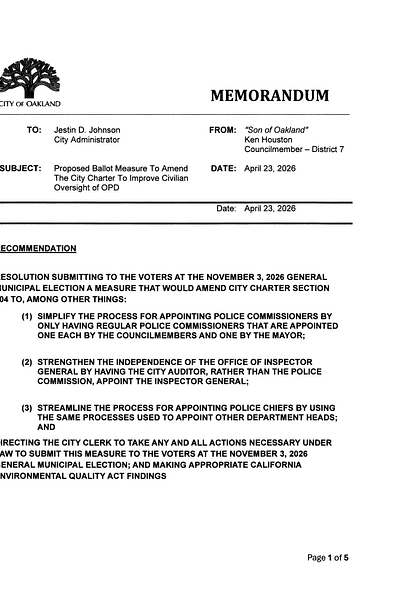
Councilmember Ken Houston has introduced a charter reform measure that, if placed on the ballot and approved by voters this November, would be the most significant overhaul of the Oakland Police Commission since its inception a decade ago.
The proposal aims to amend City Charter Section 604 to resolve what internal audits and legal memos describe as an unsustainable “oversight maze”— a system of overlapping authorities and legal ambiguities that has demonstrated a pattern of governance conflicts, substantial legal costs, and drains on city resources.1
Police Commission at a crossroads: the charter reform proposal
The proposed charter amendment would implement three primary structural changes to the Police Commission:
1. Police Commission appointments
The measure would eliminate the current multi-step Selection Panel process. Historically, the Selection Panel, itself a group of citizen appointees, has been a recurring source of legal disputes, political infighting, and prolonged commission vacancies.
Under the new proposal, the Selection Panel would be disbanded, and each of the eight councilmembers plus the mayor would directly appoint one regular commissioner— similar to the process used for other city commissions. This change is meant to establish a more direct line of accountability between elected officials and their appointees.
2. Inspector General oversight
The power to appoint and supervise the Office of the Inspector General (OIG) would transfer from the unelected Police Commission to the elected City Auditor. It also would move the supervision of the Inspector General from the Police Commission to the Auditor’s office.
This shift is intended to ensure the OIG operates with professional independence and accountability standards for municipal audit functions, under the supervision of an elected auditor rather than an unelected commission.
3. Police chief hiring and firing
The process for appointing the Chief of Police would be streamlined to match the procedures used for other city department heads (i.e., appointed by and reporting to the city administrator).
This change is intended to address the prolonged leadership vacuums that have left the Oakland Police Department (OPD) with 11 chiefs or interim chiefs since 2013, including a recent 15-month vacancy.
The proposed amendment also would remove the Police Commission’s current power to fire the police chief— the only citizen-led commission in the nation to have such power— and place it fully back in the hands of elected leaders and/or the city administrator, as is typical in other cities.
The evolution of Oakland’s ‘oversight maze’
The Police Commission was established when Oakland voters overwhelmingly passed Measure LL in 2016. Four years later, voters passed Measure S1, further expanding the commission’s authority and creating the Office of the Inspector General.
Today, Oakland Police Commission is widely considered the most powerful civilian oversight body in the United States. It also is the only citizen-led commission in the nation with the power to fire the Chief of Police.
Bestowing such extraordinary power on a civilian commission without clear structural parameters has resulted in institutional chaos, according to critics.
A review of public records, legal findings, and audit reports points to a system burdened by foundational flaws. These issues are seen by some not as isolated incidents driven by individual personalities; but rather as persistent structural defects that remain largely unresolved, according to two independent City Auditor reports issued in 20202 and 2026.3
Legal exposure, escalating liability, and drained resources
Opponents of the reform measure have framed it as an attempt to weaken the independent watchdog and oversight powers of the Police Commission.
However, audits of the commission’s actions over the last eight years suggest that the current structure is creating legal and administrative liabilities that undermine effective oversight.
The commission’s extensive reach, mandated by the City Charter, has resulted in an adversarial relationship with the broader municipal government, particularly the Office of the City Attorney, according to multiple reports. The two aforementioned City Auditor reports document the Police Commission’s pattern of excluding or disregarding the City Attorney’s legal guidance, exposing the city to unnecessary legal risk.
Share this article:
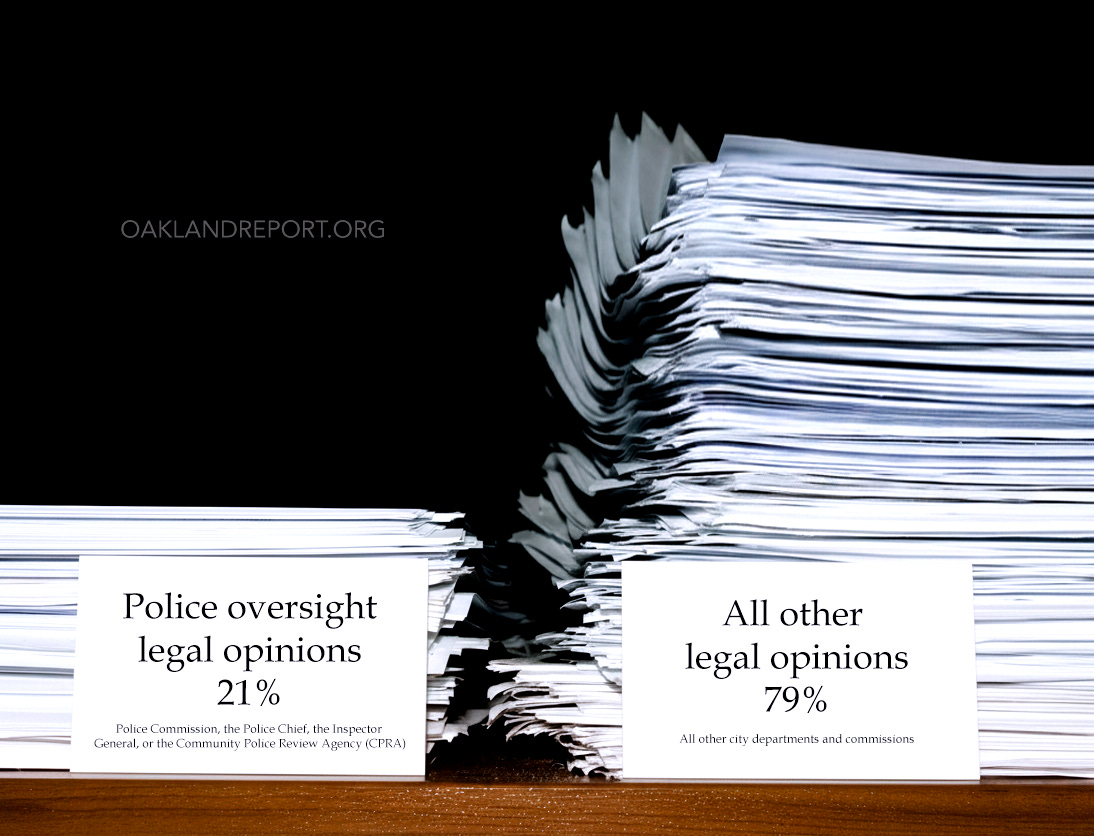
Since 2018, more than one in five public legal opinions issued by the City Attorney’s office have explicitly concerned the police oversight system. This disproportionate demand on shared legal resources is driven by recurring ambiguities in the charter that require repeated legal intervention.
For example, the commission appointed ‘holdover,’ alternate commission member Omar Farmer to a full seat on the commission March 26, in apparent violation of California’s sunshine laws and after the City Council twice rejected Farmer’s reappointment.4
The City Attorney issued a formal legal opinion on April 9 affirming that Farmer is “by definition… not fully qualified to serve a new, fixed term on the Police Commission.”
The Police Commission proceeded with the appointment anyway on April 23, asserting that it was not bound by the City Attorney’s legal conclusions.
See this related article:

Moreover, the commission has struggled to integrate into the city’s broader municipal architecture. The commission has repeatedly conflated its independence from OPD— a vital and legitimate charter mandate— with absolute independence from the City Council, the Mayor’s Office, and the City Administrator.
This disconnect from the rest of the city governance structure resulted in a convoluted governance conflict in 2024-2025 over OPD’s pursuit policy, requiring City Attorney intervention to clarify that the City Council retained ultimate authority over major public safety directives.5
Furthermore, unilateral actions by the Police Commission’s NSA Ad Hoc Committee to present materials directly to federal monitors, without coordinating with the City Attorney or Mayor, actively undermined the city’s unified litigation posture.67
Similarly, the OIG— an arm of the Police Commission— in late April 2026 conducted ‘policy assessments’ of drone and automated license plate reader (ALPR) technologies. However, the Privacy Advisory Commission (PAC) is the advisory body legally mandated to perform such assessments per the city’s Surveillance Ordinance.
The PAC reportedly was not consulted or involved in the OIG’s assessment, leading to formal concerns that the OIG was overstepping its legal mandate due to a lack of structured oversight from the Police Commission.8
The city has had to settle four separate legal actions naming the Police Commission or its Selection Panel as defendants. The most prominent, Kirkpatrick v. City of Oakland, resulted in a $1.5 million jury verdict after it was determined the commission retaliated against former Police Chief Anne Kirkpatrick for reporting commissioner misconduct to the City Attorney and Mayor.9
The remaining three cases: Hraiz & Phillips (PRA dispute),10 Milele/Chanin (Selection Panel procedures),11 and Sacks (PRA and Sunshine Act violations),12 each required the city’s legal resources to defend and negotiate, and in two cases produced structural remedies as part of settlement terms.
Permanent ad hoc committees and the Brown Act
A foundational rule of effective government is transparency. While the Police Commission publicly champions open government, its operational practices appear to frequently bypass it.
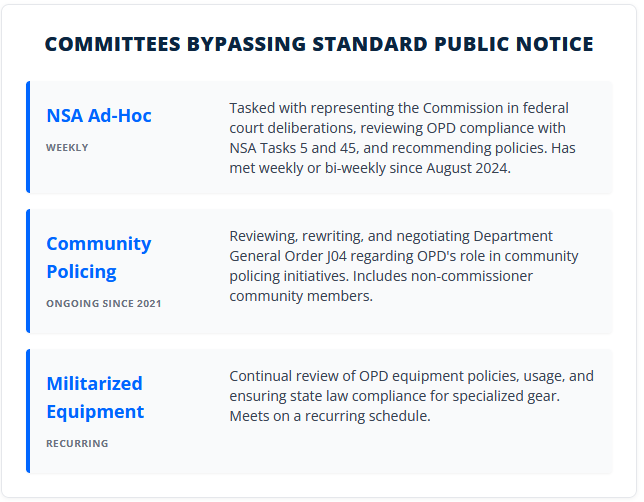
Reviews of the commission’s activities indicate that it relies heavily on ad hoc (temporary or special purpose) committees to conduct ongoing policy work.4
Under California’s open meeting law, the Brown Act, ad hoc committees are meant to be temporary in nature and only dedicated to preparing standalone projects with a defined start and end.
As such, ad hoc committees are not required to give public notice for their meetings, post agendas, or provide open access to the public. However, this exemption only applies if an ad hoc committee consists solely of members of the legislative body and does not involve continuing subject matter jurisdiction.13
In other words, ad hoc subcommittees cannot handle long-term, ongoing policies, per state law. Yet, the Police Commission’s ad hoc committees routinely govern continuous structural policy areas and frequently include non-commissioners, such as OPD command staff and invited community members.
By classifying these ongoing committees as ad hoc, the commission shields continuous policy deliberations from standard public noticing and agenda requirements.14
Maintaining semi-permanent ad hoc committees for ongoing policy work contradicts Oakland’s commitment to transparent governance, according to critics.

Supervision gaps
The current Oakland City Charter establishes a supervisory relationship between the commission and the Office of the Inspector General.15 Additionally, the Oakland Municipal Code requires the commission to dictate the OIG’s priorities and conduct periodic performance reviews.16
However, the 2026 audit findings indicate a complete inversion of this relationship. Rather than the commission providing a legally mandated directive, the Inspector General has been historically permitted to present a self-determined work plan, which the commission merely receives.
This passive approach culminated in an April 23 commission meeting where commissioners could not articulate the rationale behind selecting specific Negotiated Settlement Agreement (NSA) tasks for audit, relying entirely on the OIG to publish the reasoning retroactively.17
Furthermore, the March 2026 audit highlighted that while the commission established the requisite performance review forms for the Inspector General, it failed to execute the evaluations.
This lack of review eliminates any structured record of OIG prioritization or performance, leaving critical audit backlog failures to be discovered by external reviewers rather than by the commission’s legally mandated supervision.
See this related article:

Leadership instability and systemic disconnect
The Police Commission’s role in the selection and removal of the Chief of Police has contributed to a revolving door of leadership at OPD. As has been widely reported, Oakland has cycled through 11 police chiefs or interim chiefs since 2013.
OPD operated without a permanent police chief for 15 months between February 2023 and May 2024. Following the latest departure in December 2025, recruitment projections suggest the vacancy will extend past July 2026—more than nine months of interim leadership.18
Much of this delay stems from the convoluted, multi-layered Selection Panel process mandated by the current Charter, which has been bogged down by recurring legal disputes, lack of procedural clarity, and multi-year vacancies on the panel.
The record suggests that the system has repeatedly failed to produce timely, stable police department leadership transitions, handicapping OPD’s ability to execute long-term strategic reforms or maintain compliance with the Negotiated Settlement Agreement (NSA).
See this related article:

Commissioner conduct
The 2020 audit found that commissioners had inappropriately directed staff, made disparaging comments to staff and the public, and acted on matters outside their authority.
The same underlying patterns— scope overreach, failure to follow City Attorney guidance, and actions taken that are outside the commission’s authority— are documented in the public record from 2024–2026.
Since 2023, at least four formal ethics complaints have been filed with the Public Ethics Commission (PEC) involving Police Commission actors:
Inspector General Michelle Phillips against commission chair Tyfahra Milele (Brown Act violations and interference with OIG duties, January 2023)19
Brenda Harbin-Forte against Selection Panel chair James Chanin (failure to disclose NSA-related financial compensation, July 2023)20
Harbin-Forte against councilmember Kevin Jenkins (retaliation against chair Milele, July 2023)21
CPRA Director Mac Muir against commissioner Regina Jackson (retaliation for his independent investigation into OPD officers, April 2024).22
(None resulted in a published PEC finding.)
See this related article:

Alternative perspectives on reform
While the need for restructuring the Police Commission has been acknowledged by some elected leaders, the mechanism for achieving it remains a subject of debate.
City Auditor Michael C. Houston’s (no relation to the councilmember) March 2026 audit of the Police Commission noted that many of the operational inconsistencies between the City Charter and the Municipal Code could potentially be resolved without an expensive ballot measure.
Auditor Houston pointed to a dormant enabling ordinance previously drafted by former councilmember Dan Kalb, which passed its first reading in late 2024 but ultimately was not adopted by the council. Auditor Houston suggested that reintroducing this ordinance could clarify the Police Commission’s operational boundaries internally.
However, councilmember Houston’s rapid advancement of the ballot measure— introduced just days after auditor Houston’s remarks— signals a belief among some city leaders that internal municipal code tweaks are insufficient to correct the foundational flaws embedded in the Charter itself.
Setting the criteria for reform
Civilian oversight is a vital component of modern municipal democracy, and police oversight is an essential component of constitutional policing. But the institution responsible for enforcing accountability must itself be accountable.
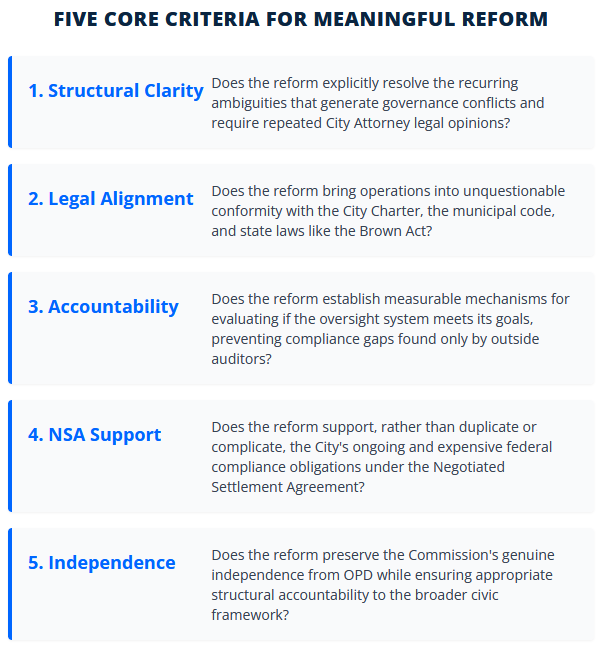
As the City Council considers the reform proposal, one thing to watch is whether it evaluates the measure against specific, objective benchmarks rather than political rhetoric.
Who watches the watchdogs?
Oakland’s experiment with complex, multi-tiered civilian oversight has yielded diminishing returns, according to elected city leaders and community observers. The evidence accumulated over eight years suggests a Police Commission that consistently operates outside its authorized scope, violates public transparency laws, consumes an inordinate amount of police and legal resources, and exposes the city to unnecessary legal risk.
Civilian oversight of police remains a foundational mandate of the Oakland electorate. However, the concerns about the Police Commission’s current configuration stem from a desire for a system that is governed by structural clarity, legal alignment, and enforceable accountability.
The May 7 Rules and Legislation Committee deliberations about the proposed Charter reform will set the stage for city leaders to decide whether to preserve an oversight architecture that some say functions as an unaccountable parallel government, or to build a streamlined system that some say should demand as much accountability from its watchdogs as it does from its police.
Supporters of restructuring the Police Commission assert that reform is not a retreat from police oversight, but rather is the necessary, data-driven evolution required to build an oversight system that Oaklanders can trust— one that operates transparently, respects legal boundaries, and effectively manages public resources.

Oakland Report provides accurate, unflinching, data-driven reporting and analysis that you will find nowhere else. If you value our work, please donate. All contributions go directly to sustaining and growing our nonprofit work:
City of Oakland. “Proposed ballot measure to amend the City Charter to improve civilian oversight of OPD.” Rules and Legislation Committee meeting, May 7, 2026. https://oakland.legistar.com/LegislationDetail.aspx?ID=7990578&GUID=087EF658-4018-4BF6-AD45-FB2EE05F4188
Ruby, Courtney. “Performance audit of the Oakland Police Commission and the Community Police Review Agency.” Office of the Oakland City Auditor, Jun. 1 2020. https://www.oaklandauditor.com/wp-content/uploads/2020/06/20200601_Performance-Audit_Police-Commission-CPRA_FINAL-REPORT.pdf
Houston, Michael. “Audit of Oakland Police Oversight Agencies: The Oakland Police Commission, Community Police Review Agency, and Office of the Inspector General.” Office of the Oakland City Auditor, Mar. 10, 2026. https://www.oaklandauditor.com/wp-content/uploads/2026/03/20260310-Audit-of-Police-Oversight-Agencies.pdf
Montana, Alex. “Police Commission appointment appears to violate state law.” Oakland Report, Apr. 1, 2026. https://www.oaklandreport.org/p/20260401-police-commission-appointment-brown-acts
Richardson, Ryan. “City Council and Police Commission authority to revise police pursuit policy. Office of the Oakland City Attorney, Feb. 3, 2025. https://www.oaklandcityattorney.org/wp-content/uploads/2025/02/Public-Legal-Opinion-re-City-Council-and-Police-Commission-Authority-to-Revise-Police-Pursuit-Policy.pdf
United States District Court, Northern District of California. “Delpine Allen, et al v. City of Oakland, et al.” Case No. 00-cv-04599, Joint Case Management Settlement, July 10, 2025. https://oakland.legistar.com/View.ashx?M=F&ID=14814075&GUID=D6E1B067-7BF0-48FF-93DE-F3B61ECD4913
City of Oakland. “NSA as hoc committee meeting video.” Oakland Police Commission, Sept. 18, 2025. https://www.youtube.com/watch?v=FSiXhByvraI
City of Oakland, “Oakland Police Commission meeting video.” Apr. 13, 2026. https://oakland.granicus.com/player/clip/7466?publish_id=7301557b-424b-11f1-bb28-005056a89546&redirect=true
City of Oakland. “Adopt a resolution authorizing and directing the City Attorney to compromise and settle the case of Anne Kirkpatrick v. City of Oakland, United States District Court Case No. 3:20-CV-05843 , City Attorney’s File No. 34091, in the amount of one million five hundred thousand dollars and zero cents ($1,500,000.00).” Oakland City Council meeting, Jul. 26, 2022. https://oakland.legistar.com/LegislationDetail.aspx?ID=5736353&GUID=F956E7CC-26F9-44F7-9D24-4DD1AA62A8CD&Options=&Search=
City of Oakland. “Adopt a resolution authorizing and directing the City Attorney to compromise and settle the case of Francisco Negrete, William Berger, Craig Tanaka, Brandon Hraiz, Josef Phillips, v. City Of Oakland; Police Commission of the City of Oakland; Does 1 - 10, inclusive, Alameda County Superior Court case No. RG20062117, City Attorney’s file No. X04860-1, in the amount of forty thousand dollars and zero cent ($40,000.00).” Oakland City Council meeting, Jan. 18, 2022. https://oakland.legistar.com/LegislationDetail.aspx?ID=5363723&GUID=D7B8A3D9-0C23-45C6-ADEF-E6D9558D90A2&Options=&Search=
City of Oakland. “Adopt a resolution authorizing and directing the City Attorney to settle the case of Tyfahra Milele, David Jordan, and Ginale Harris v. James B. Chanin, City of Oakland, Oakland Police Commission Selection Panel, and Nikki Fortunato Bas, Alameda Superior Court Case No. 23CV038479, City Attorney’s File No. X05510, for no monetary relief and an agreement to make certain revisions to the Oakland Police Commission Selection Panel’s policies and procedures.” Oakland City Council meeting, May 7, 2024. https://oakland.legistar.com/LegislationDetail.aspx?ID=6646581&GUID=E38F0CD1-77FF-476A-BFE2-7068178851FC&Options=&Search=
City of Oakland. “Marleen L. Sacks & Alameda County Taxpayers’ Association v. City of Oakland.” Oakland City Council meeting, Feb. 4, 2025. https://oakland.legistar.com/LegislationDetail.aspx?ID=7104944&GUID=ADD7B842-88CF-45E3-B3B1-7F0385D3498A&Options=&Search=
California State Legislature. “California Code GOV 5493.8.6.” The Brown Act - meetings. https://leginfo.legislature.ca.gov/faces/codes_displaySection.xhtml?lawCode=GOV§ionNum=54953.8.6
City of Oakland. “Police Commission website.” Ad Hoc Committee List, accessed May 6, 2026. https://www.oaklandca.gov/Government/Boards-Commissions/Police-Commission
City of Oakland. “City Charter.” Section 604. Police Commission. https://library.municode.com/ca/oakland/codes/code_of_ordinances?nodeId=THCHOA_ARTVIADOR
City of Oakland. “Municipal Code.” Chapter 2.45. Police Commission. https://library.municode.com/ca/oakland/codes/code_of_ordinances?nodeId=TIT2ADPE_CH2.45OAPOCO
City of Oakland. “Update from Office of the Inspector General.” Police Commission meeting, agenda item IX, Apr. 23, 2026. https://www.oaklandca.gov/files/assets/city/v/1/police-commission/agendas/4.23.26-opc-regular-meeting-agenda.4.2.finmm.2.pdf
City of Oakland. “Oakland Police Chief search.” Website accessed May 6, 2026. https://www.oaklandca.gov/Government/Boards-Commissions/Police-Commission/Oakland-Police-Chief-Search
Wolfe, Eli. “The fight over the Oakland Police Commission is getting uglier.” The Oaklandside, July 1, 2023. https://oaklandside.org/2023/07/21/the-fight-over-the-oakland-police-commission-is-getting-uglier/
Harbin-Forte, Brenda. “Notice of Dismissal of Complaint No. 23-24 Regarding James Chanin.” Letter to City of Oakland Public Ethics Commission et al, Nov. 19, 2025. https://www.oaklandca.gov/files/assets/city/v/1/public-ethics-commission/documents/letter-to-ethics-commission-objecting-to-james-chanin-complaint-dismissal_redacted-1.pdf
Harbin-Forte, Brenda. “Notice of Dismissal of Complaint No. 23-23 Regarding City Councilmember Kevin Jenkins.” Letter to City of Oakland Public Ethics Commission et al, Nov. 19, 2025. https://www.oaklandca.gov/files/assets/city/v/1/public-ethics-commission/documents/letter-to-ethics-commission-objecting-to-kevin-jenkins-complaint-dismissal_redacted-1.pdf
Wolfe, Eli. “Oakland police commissioner called chief investigator a ‘rat,’ according to complaint.” The Oaklandside, Apr. 24, 2025. https://oaklandside.org/2025/04/24/oakland-police-commissioner-investigator-rat-ethics-complaint/