


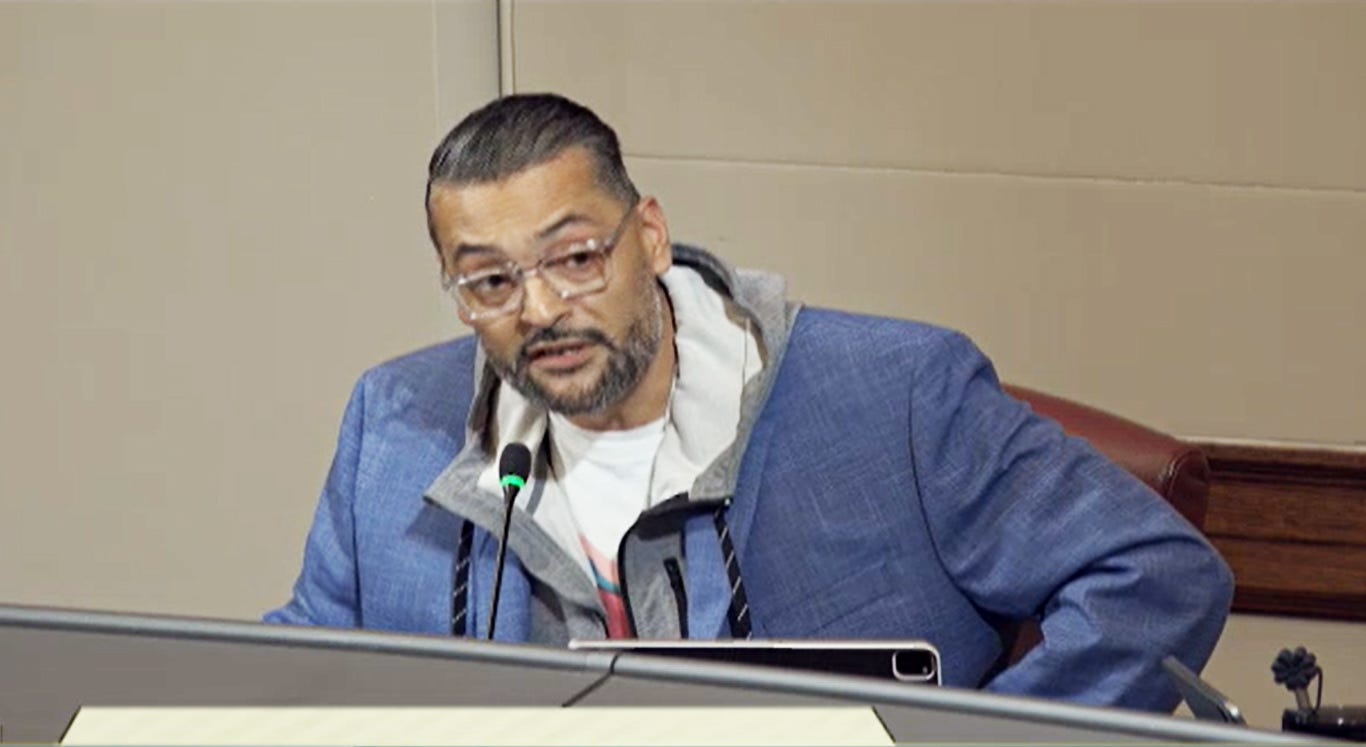
Departing police commission chairperson Ricardo Garcia Acosta and commission alternate Omar Farmer have drafted a statement criticizing what they describe as police chief Floyd Mitchell’s unwillingness to, “take ownership of the task of repairing a decades-long culture that, when faced with officer misconduct, wrongly labels corrective disciplinary action as ‘weaponization’ and ‘punishment.’”
They seek to have the Oakland Police Commission (OPC) ratify and adopt their statement as an official submission to the federal judge overseeing the Negotiated Settlement Agreement (NSA).1
Their statement also characterizes the police department as “distrustful of civilian investigative oversight and any discipline that results from officer misbehavior,” and accuses city officials of allowing “anti-commission harassment.”
The city council denied Garcia Acosta’s and Farmer’s applications for reappointment on October 21, effectively ending their tenure on the police commission.2 In denying the applications, some council members cited concerns about the commission’s selection process and a lack of public confidence in the commission’s approach to police oversight.3
See this related article:

The Oakland Police Commission’s agenda for its November 13 meeting includes Garcia Acosta and Farmer’s draft Case Management Conference (CMC) Statement,4 a formal document the police commission submits to the federal judge in charge of Oakland’s NSA, also known as the police consent decree.
If finalized by the full police commission, the CMC statement will be submitted to the federal monitor for a case conference on December 9 to review Oakland’s standing with respect to the NSA.
A litany of criticisms and recriminations
The draft statement offers a list of criticisms and recriminations of the city and its police chief. Some of the criticisms appear to be direct responses to the city council’s decision not to reappoint the commissioners, who themselves became a subject of public concern and criticism over their approach to their oversight duties.
For example, in their statement Garcia Acosta and Farmer criticize what they describe as “the city’s failure to vociferously defend” the police commission and “the commission’s stability”:
“Efforts to upset Commission-functioning are attacks not only on the task of identifying a successor Chief of Police but on the greater goal of implementing effective and enduring independent oversight. Now more than ever, the Commission’s stability is fundamental to that project. The City’s failure to vociferously defend its designated independent police oversight governing body will undermine the continued success of the current Commission and risk decreased compliance with the NSA or a short-lived exit from the agreement.”
— Ricardo Garcia Acosta and Omar Farmer, from “Oakland Police Commission Draft Case Management Conference (CMC) Statement”
Elsewhere in their statement, Garcia Acosta and Farmer appear to express disgruntlement with the city council’s decision not to reappoint them to the commission. They characterize the council members’ stated concerns about their qualifications as a “guise” to allow the city council to appoint “OPD-friendly commissioners”:
“Most recently, after much review, the OPC Selection Committee unanimously approved current Chair Ricardo Garcia-Acosta and Alternate Commissioner Omar Farmer for reappointment to their present Commission positions. Nonetheless, under the guise of concern about candidate recruitment and qualifications, the City Council rejected their reappointments. The Selection Panel was asked to renew the months-long process of recruiting and interviewing new candidates, with Councilmembers committing to perform outreach and with one councilmember stating that they are coordinating with officers to identify OPD-“friendly” commissioners.
— Ricardo Garcia Acosta and Omar Farmer, from “Oakland Police Commission Draft Case Management Conference (CMC) Statement”
Garcia Acosta and Farmer did not offer evidence to support their claims of deceit and bias.

Faulting the city for declining to “quell” public criticism
The draft statement returns multiple times to the idea that city officials are obligated to defend the police commission against public criticisms of its approach to oversight.
For example, the statement alludes to threats to commission members’ safety at commission meetings, then expresses disappointment about their failed bid to be reappointed to the commission. The statement did not specify or elaborate on the nature or source of any of the threats.
“Unbeknownst to the Commission, verified and credible threats had been made to the safety of the Commission, resulting in an increased law enforcement presence at Commission meetings. Once already, these safety concerns have left the Commission without a quorum to conduct Commission business. Unfortunately, the failure to approve reappointment of two members of the most effective Commission yet has gone far in validating the anti-Commission climate.”
— Ricardo Garcia Acosta and Omar Farmer, from “Oakland Police Commission Draft Case Management Conference (CMC) Statement”
The statement also posits that the city could have difficulty recruiting commissioners unless all city officials suppress “anti-Commission harassment”:
“Without support from all City officials that demonstrates a commitment to independent civilian oversight that can quell anti-Commission harassment, the City could face a challenge in recruiting and maintaining volunteer commissioners.”
— Ricardo Garcia Acosta and Omar Farmer, from “Oakland Police Commission Draft Case Management Conference (CMC) Statement”
Who is responsible for refuting public criticism of the police commission?
In another example, Farmer and Garcia Acosta cite what they describe as an oft-repeated narrative that increased crime is the result of the commission’s mishandling of police disciplinary processes. They label the criticisms as “falsehoods” and fault city officials for not contradicting them enough:
“An oft-repeated narrative blames independent oversight of the OPD disciplinary process for crime levels within Oakland. Uncontradicted by some City officials, these falsehoods jeopardize the Commission’s present and future ability to function effectively.”
— Ricardo Garcia Acosta and Omar Farmer, from “Oakland Police Commission Draft Case Management Conference (CMC) Statement”
They did not offer evidence to rebut the criticisms of oversight and defend the commission’s work on its merits.
In another passage, the draft statement appears to criticize departing police chief Floyd Mitchell for expressing his frustrations with the impacts the police commission’s use of disciplinary processes has had on police officers’ ability to do their jobs effectively.
Rather than offer an evidence-based rationale in response to Mitchell’s concerns about impacts to the police department’s operations and personnel, the statement accuses him of failing to take ownership of reforming the police department’s culture:
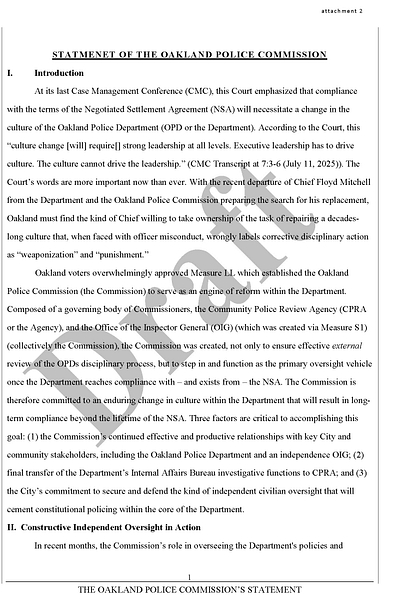
“With the recent departure of Chief Floyd Mitchell from the Department and the Oakland Police Commission preparing the search for his replacement, Oakland must find the kind of Chief willing to take ownership of the task of repairing a decades-long culture that, when faced with officer misconduct, wrongly labels corrective disciplinary action as “weaponization” and “punishment.”
— Ricardo Garcia Acosta and Omar Farmer, from “Oakland Police Commission Draft Case Management Conference (CMC) Statement”
(As Oakland Report has previously reported, Oakland has churned through ten police chiefs over the past ten years, a remarkably low retention rate compared to the average tenure of seven years that police chiefs typically serve.)5
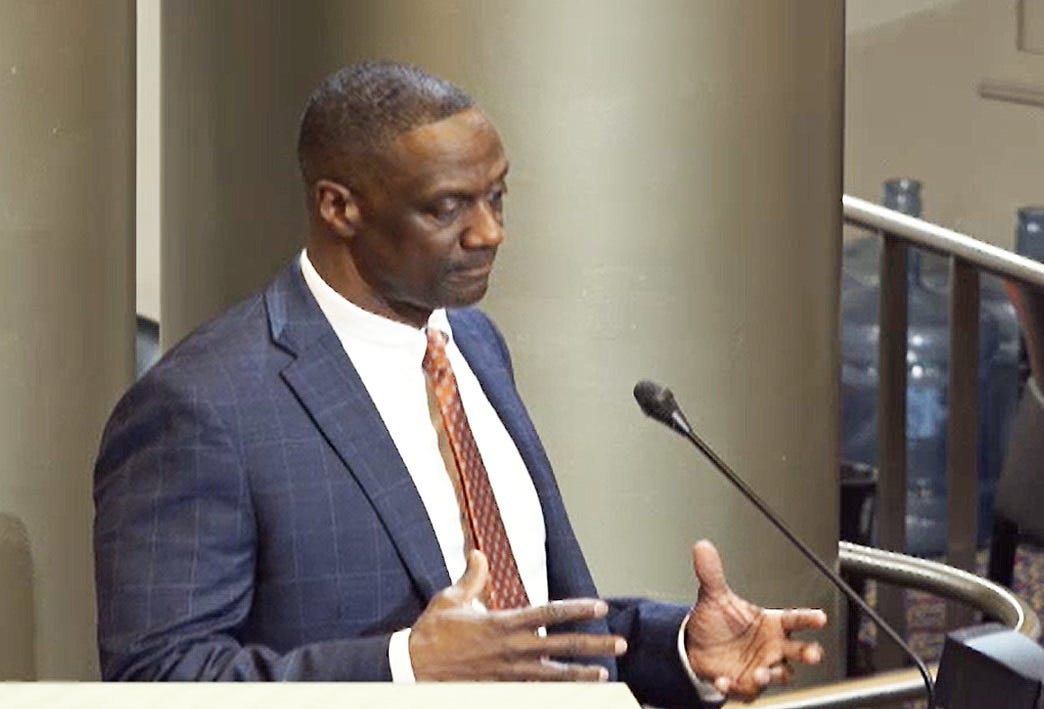
You can read the full “Oakland Police Commission Draft Case Management Conference (CMC) Statement” here:
The police commission is set to discuss the draft CMC statement at its meeting on November 13 at Oakland City Hall, Hearing Room 2, First Floor, 1 Frank H. Ogawa Plaza. After a closed session at 5:30 p.m., the meeting’s open session begins at approximately 6:30 p.m. You can read the complete meeting agenda of 10 items here.
The Negotiated Settlement Agreement (NSA) is a federal court-mandated reform process for the Oakland Police Department (OPD) that began in 2003 due to misconduct allegations. It requires OPD to implement dozens of reforms in areas like internal affairs, use of force, and community policing. The NSA also placed OPD under the direct supervision of a federal monitor and a federal district judge who together were and still are empowered to determine the department’s compliance with the reform tasks.
City of Oakland, Concurrent Meeting of the Oakland Redevelopment Successor Agency and the City Council. “Meeting Minutes, October 21, 2025.” Adopt A Resolution Accepting The Police Commission Selection Panel’s Slate Of Two Commissioners, Ricardo Garcia-Acosta And Omar Farmer, To Serve On The Oakland Police Commission. City of Oakland, California, October 21, 2025, p. 14, item S8. https://oakland.legistar.com/View.ashx?M=M&ID=1339687&GUID=B3A274AA-C1C8-42C6-807C-31D17DF606A7
Montana, Alex. “Oakland’s police commission - when does oversight become obstruction?” Oakland Report, November 10, 2025. https://www.oaklandreport.org/p/20251110-oaklands-police-commission
City of Oakland, Meeting of the Oakland Police Commission. “Meeting Agenda, November 13, 2025.” Commission Vote on Case Management Conference (CMC) Statement for Submission in Delphine Allen et al. v. City of Oakland et al., N.D. Cal. No. 00-cv-4599-WHO, in Preparation for the Upcoming Case Management Conference (CMC). City of Oakland, California, November 13, 2025, p. 49, item VI, Attachment 2. https://www.oaklandca.gov/files/assets/city/v/1/police-commission/opc-regular-meeting-agenda11.13.25.fin2.docx.pdf#page=49
Ibid. Montana, Alex. “Oakland’s police commission - when does oversight become obstruction?”
So they lied when the Chief quit and they said they had a great relationship and met “countless times” (what police chief wants to meet with a commission “countless times” over basic stuff?
But I digress….this is now saying the opposite and reinforces my original hypothesis: Floyd Mitchell quit due to our soggy police commission.
If Oakland is going to have a redundant Police Commission, then the elected officials who select the commissioners are going to have to do a better job of recruiting and selecting the commissioners, and not just defaulting to whatever half-bright ideological cronies looking to make a name for themselves in progressive circles happen to be around. The departing commissioners’ proposed submission to the court is proof enough that they were not suitable for the job.