


Police Commission appointment was discussed behind closed doors with no advance notification to the public
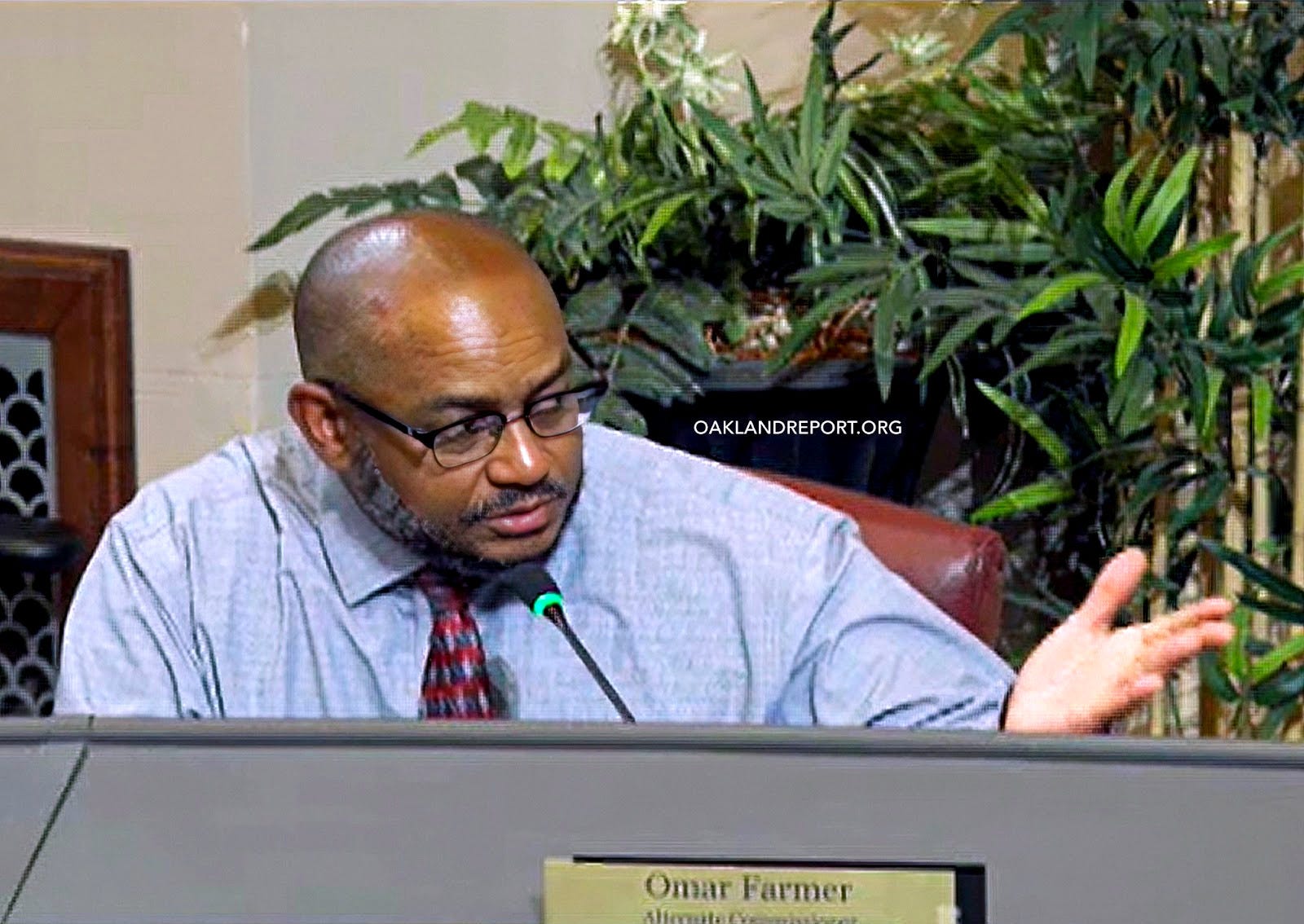
The Oakland Police Commission (OPC) has appointed ‘holdover,’ alternate commission member Omar Farmer to a full seat on the commission, in apparent violation of California’s sunshine laws and the will of Oakland city council.
Farmer’s reappointment to the OPC was previously rejected by city council on Oct. 21, 2025 and again on January 20, 2026.
However, Farmer continued to serve on the OPC in a ‘holdover status’ due to there being no one nominated to replace him.
Following a closed-door session out of view of the public on March 26, the OPC announced that it had elevated Farmer to a full commissioner seat to fill a vacancy.1
The posted agenda for the March 26 OPC meeting included no public notice that a commission member appointment would be discussed or decided.
By bypassing the city council’s double rejection of Farmer, the OPC appears to be acting in open defiance of the council.
Thank you for reading Oakland Report. Subscribe to receive new articles in your inbox.
‘Cure and correct’ demand: Police Commission violated the Brown Act
In plain terms, the Brown Act is a state law that says the government’s business, including commissions must be done in public. The law is designed to require open meetings, posted agendas, and meaningful opportunities for citizens to see, hear, review, and speak to government decision-makers before discussions are held or votes are cast.
A formal “cure and correct” demand for the March 26 appointment has been filed under the Brown Act by Oakland resident Rajni Mandal.
Mandal notified the city council, city attorney and OPC about the violation in emails obtained by Oakland Report:
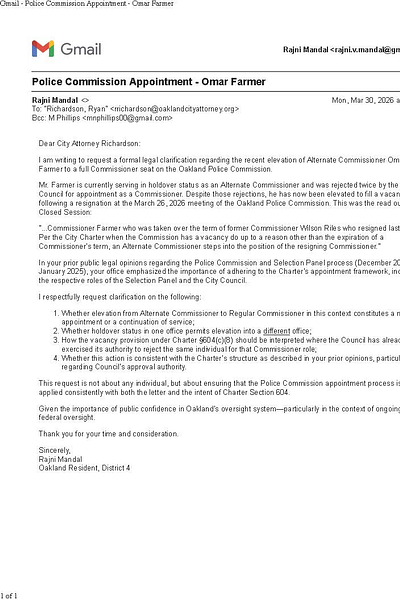
The core of the alleged Brown Act violation is that OPC’s action to select and elevate a Police Commissioner was not listed on the public agenda, and thus violated a core provision of state law.
The cure-and-correct demand calls for the OPC to either void the action or defend its legality.2
California Government Code § 54960.1 provides a specific legal process for addressing alleged Brown Act violations. An interested party may submit a written demand requiring the offending party, in this case the OPC, to “cure and correct” an alleged violation.3
The OPC has 30 days from receipt of the demand to cure or correct the challenged action. If the legislative body takes no action within the 30-day period, the demanding party has 15 days to commence a lawsuit to render the action null and void.
A power struggle in Oakland’s police oversight
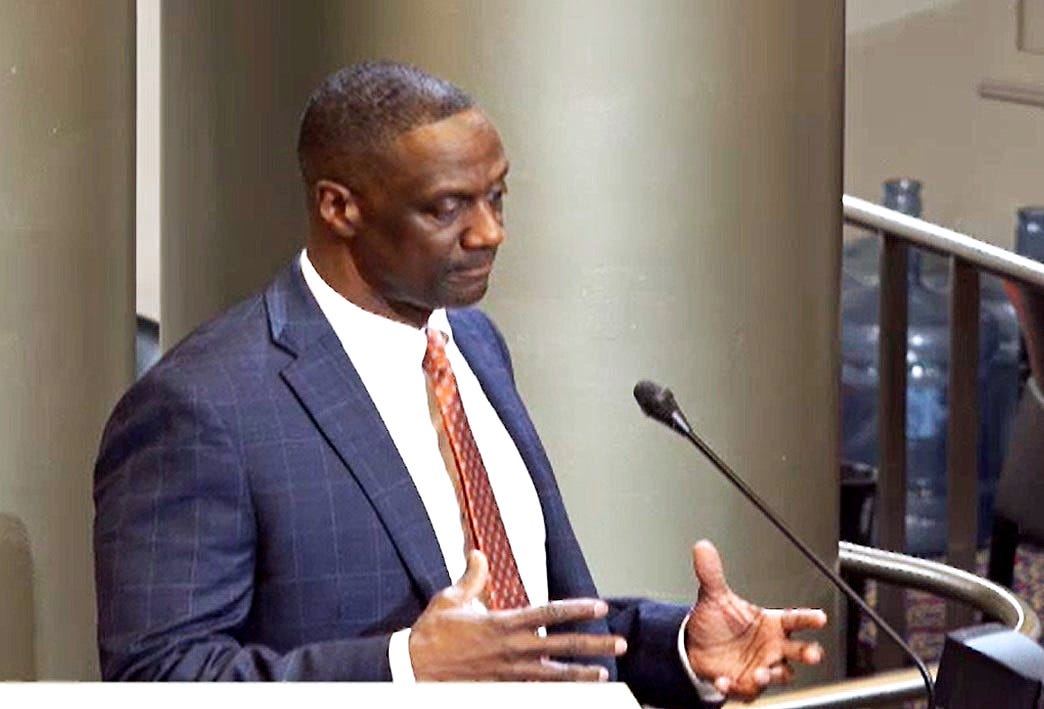
For months, City Hall has been locked in a struggle between a commission determined to assert its independence and a city council wary of losing its grip on police oversight.
Farmer’s reappointment to the OPC was previously rejected by city council on Oct. 21, 2025 and again on January 20, 2026.
However, Farmer continued to serve on the OPC in a ‘holdover status’ due to there being no one nominated to replace him. Per state law and a December 2025 city attorney opinion, termed-out commission members may continue serving in ‘holdover status’ until a replacement is seated.4
Despite his position in a ‘holdover,’ alternate commission seat, and being twice rejected for reappointment by city council, Farmer is currently the chair of the OPC’s Negotiated Settlement Agreement (NSA) Ad Hoc Committee and co-chair of the Mental Health Ad Hoc Committee, placing him at the center of some of Oakland’s most sensitive policing reforms.
See this related article:

Can a twice-rejected nominee be appointed anyway?
In theory, the police commission selection process is designed to engage community expertise in police oversight while filtering out unqualified or unproductive candidates.
In practice, this “complex selection process” is a source of administrative bottlenecks, as city council president Kevin Jenkins warned in May 2024. In his proposal to restructure the police commission through a ballot measure (which was not taken up), Jenkins characterized the current system as inefficient, citing potential biases and “fraught” recruitment environments that lead to prolonged vacancies in the commission and the Office of the Chief of Police.5
According to Jenkins, these procedural tensions manifested in a “fragile state” of governance, where the commission makes use of alternate members to fulfill essential committee functions.

The standard path to commission appointments vs. the current ‘fragile state’
Standard path (Charter section 604):
Step 1: Nine-person Selection Panel recruits/screens candidates.
Step 2: Candidates recommended to City Council.
Step 3: City Council confirms four regular commissioners and one alternate; the mayor appoints three regular commissioners and one alternate
Step 4: Regular commissioners chair key ad hoc committees (NSA, Policy, etc.).
Current ‘fragile state’:
Step 1: “Complex selection process” leads to recruitment delays.
Step 2: Vacancies persist in regular commissioner seats.
Step 3: Alternate commissioners (e.g., Farmer) are elevated to chair critical committees to maintain basic oversight functions.
Step 4: Potential dilution of oversight intensity and increased legal risk due to perceived lack of permanent, confirmed leadership.
The city council’s rejections of Omar Farmer were for reappointment nominations originating from the Selection Panel.6
However, City Charter Section 604(d)(8) states: “For vacancies occurring for reasons other than the expiration of a regular member’s term, the Commission shall select one of the Alternate Commissioners to replace the regular member for that regular member’s remaining term of office.”7
This language grants the OPC the discretionary authority to select which alternate fills a mid-term vacancy in a full commission seat. Once elevated, Farmer assumes the remainder of the vacated seat’s term. A new vacancy is then created for the alternate position, which must be backfilled by the original appointing authority (the Selection Panel, subject to council confirmation).
Oversight in the balance
The makeup of the citizen-led police commission is of material significance to Oakland’s efforts to exit over two decades of federal oversight.
The Negotiated Settlement Agreement governs the current federal oversight of the Oakland Police Department (OPD). The NSA is a 2003 federal court-ordered reform program established to oversee OPD following the “Riders” scandal in the 1990s, where officers were accused of misconduct. The NSA requires OPD to implement 51 specific tasks regarding officer behavior, including use-of-force and internal investigations.
By not following policies and procedures and undermining its credibility – and creating further conflict and rift with the rest of the city - OPC is jeopardizing Oakland’s compliance with the NSA. The judge and monitor have repeatedly said that leadership and collaboration are key factors to achieve compliance.
The NSA “Scorecard” for OPD reveals a department close to, but not quite past the finish line to exit federal oversight.
OPD oversight ‘Scorecard’ (February 2026 data):
Staffing crisis: Only 614 sworn positions are filled out of an authorized 678. More concerning still, the police department’s operational strength is down to 495 officers.
Administrative leaves: 17 officers are on administrative leave. Just seven of those officers, now off for 1–2 years, are burning through $2,112,588 annually in salary and benefits while doing zero police work.
Misconduct investigations: The Community Police Review Agency (CPRA) completed 15 investigations and administratively closed five more in February 2026. Allegations ranged from “Use of Force” to “Truthfulness.”
Compliance gaps: The department is in “Partial compliance” with Task 45 (Discipline Policy) and “Not in compliance” with Task 5 (Internal Affairs Bureau Complaint Procedures).
The irony is notable: Omar Farmer, whom the council apparently tried to block from continuing to serve on the commission, now chairs a significant ad hoc committee reviewing NSA compliance, including Task 5 and Task 45.
Furthermore, the NSA ad hoc committee’s activities appear to go beyond its charter-defined scope: in its strategic plan, the ad hoc committee has assigned itself various tasks aimed at achieving NSA compliance.8 However, their charter-defined role is to maintain a structure to provide oversight and compliance once Oakland exits the NSA.
In his role as committee chair, Farmer has repeatedly demanded information and reports for this out-of-scope activity, including as recently as March 26 — duplicating work and introducing confusion about which body is responsible for reforms. This out-of-scope activity has created conflict with OPC, OPD and city administration, and risks undermining the city’s progress toward the reforms required by the NSA.
In this respect, the success of Oakland’s exit from federal oversight now partly rests in the hands of the very man the city’s leadership twice tried to exclude.
See this related article:

City of Oakland. “Police Commission meeting agenda.” OPC, Mar. 26, 2026. https://www.oaklandca.gov/files/assets/city/v/1/police-commission/agendas/3.26.26-opc-regular-meeting-agenda-3.26.26.2.fin.pdf
First Amendment Coalition. “California Brown Act Primer.” FAC website, accessed Apr. 1, 2026. https://firstamendmentcoalition.org/handbook/california-brown-act-primer/
FindLaw contributors. “California Code, Government Code - GOV § 54960.1.” Findlaw, Jan. 1, 2025. https://firstamendmentcoalition.org/handbook/california-brown-act-primer/
Richardson, Ryan. “Interpretation of Charter section 604(c) regarding Police Commission and selection panel appointments and replacements.” Oakland City Attorney’s Office, Dec. 12, 2025. https://www.oaklandcityattorney.org/wp-content/uploads/Public-Legal-Opinion-re-Selection-Panel-FINAL-December-12-2025.pdf
Jenkins, Kevin. “Charter Changes Police Commission.” City of Oakland, May 1, 2024. https://oakland.legistar.com/View.ashx?M=F&ID=12898615&GUID=50528822-6B0E-4DD4-BF3A-2017AAD761C8
City of Oakland. “Statement on the City Council’s action regarding the reappointment of Chair Ricardo Garcia-Acosta and alternate Commissioner Omar Farmer.” Oakland Police Commission, October 2025. https://www.oaklandca.gov/files/assets/city/v/1/police-commission/media_-statement-on-the-city-councils-action-regarding-the-reappointment-of-chair-ricardo-garcia-acosta-and-alternate-commissioner-omar-farmer.pdf
City of Oakland. “Police Commission meeting agenda.” OPC, May 8, 2024. https://cao-94612.s3.us-west-2.amazonaws.com/documents/OPC-Special-Meeting-5.8.24.FINMM.docx.pdf
City of Oakland. “Police Commission meeting agenda.” OPC, Dec. 11, 2025. https://www.oaklandca.gov/files/assets/city/v/1/police-commission/agendas/opc-regular-meeting-agenda12.11.25-fin.2.docx.pdf
It seems to me that procedural bickering is overtaking common sense. Keep your eyes on the ball, everyone! The real problem is lack of police officers, isn’t it?
Turmoil on the police commission has been going on for years, not months. Meanwhile, we live in one of nation’s most dangerous cities. What a coinkydink.