



Oakland Report continues its coverage of the Oakland Unified School District (OUSD) board as it works to close a long-term budget gap and avoid returning to state receivership only one year after exiting it. In this installment, we examine how OUSD handled one-time pandemic relief and attendance-based funding reductions, compared with Hayward Unified and Berkeley Unified.
‘Those funds are now gone’
The basic reason for Oakland Unified School District’s (OUSD’s) financial distress is no enigma. Like virtually all other public budget deficits, OUSD’s basic problem stems from spending more than comes in.
Many factors created the over $100 million structural budget gap OUSD has struggled to fix.1 But the board’s promise of a “transparent” budgeting process for closing that gap is not supported by its actual record of poor financial disclosure and lack of follow-through.
In this article, we examine two specific factors which illustrate the overall problem at OUSD: poor financial management practices, combined with lack of transparency to the public about how the district is handling the public money with which it has been entrusted to educate Oakland’s children.
We also compare Oakland’s financial management of these two factors with that of other nearby school districts in Berkeley and Hayward.
On its budget webpage about the COVID-19 grants it received during the pandemic, OUSD tells families to “think of one-time funds like an inheritance. Money that was always going to run out.”
While that may be true in some cases, in other cases an “inheritance” — especially a large one like the pandemic relief grants — can be managed in a way that stabilizes or even elevates one’s financial position.
On its webpage about the COVID-19 relief grants, the district states flatly: “Those funds are now gone.”2 Yet the webpage offers no detailed accounting of where the “inheritance” went.
When journalists and state reviewers asked where the money went, the district’s answers were incomplete at best.
Similarly, OUSD’s budget woes are driven in part by steadily declining enrollment, which results in less funding from the state of California, which distributes school funding based on school attendance.
Yet the enrollment decline was neither sudden nor unforeseeable. Statewide enrollment has fallen for a decade, and OUSD’s superintendent’s reports have warned against budgeting on hoped-for attendance gains.
Sound financial management dictates that when income is expected to go down — especially due to a significant, long-term income reduction like a pay cut or job loss — then expenses should be reduced to stay within budget.
Yet OUSD has not made or sustained the difficult decisions needed to reduce its long-term spending — instead repeatedly choosing short-term cuts while increasing its ongoing regular expenses like payroll.
Key findings
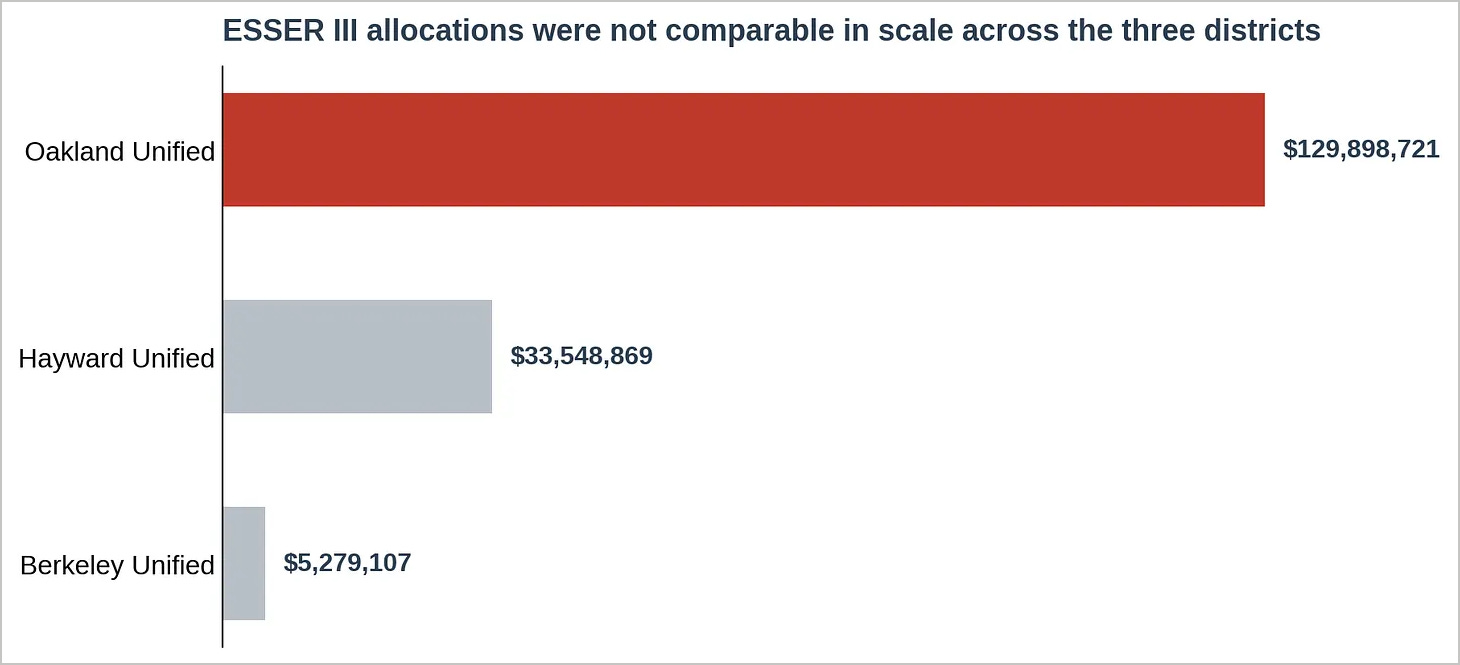
OUSD was allocated $129.9 million in final-round federal COVID-19 pandemic relief funding — nearly four times Hayward Unified’s $33.5 million and about 25 times Berkeley Unified’s $5.3 million, in part because the money followed federal poverty formulas.34
OUSD refused public records requests about its COVID-19 grant expenses, and ended up having to repay nearly $1 million in relief money spending the state flagged as questionable.5678
The money appears to have been spent, not forfeited — largely on staffing and one-time pay the district could not sustain once the funds expired.910
Many districts have lost enrollment, but not all have gone broke. California funds districts on average daily attendance (ADA), so when enrollment goes down, so does a major source of school funding. Yet as of March 2025, Oakland and Hayward held “negative” budget certifications, the state’s most severe warning, while Berkeley reports itself solvent. (Oakland more recently self-certified its budget as “positive” based on $30 million in budget cuts it has yet to specify.)11121314
The ‘inheritance’: what OUSD got, and what it hasn’t revealed
The pandemic brought a series of one-time federal aid packages: over $2 billion to California’s K-12 system under the CARES Act alone, and over $23 billion in total financial aid across three rounds. The final and largest round gave OUSD $129.9 million.1516
This temporary federal funding (also referred to as “stimulus” funding) was a sliver of hope for Oakland’s school district, educators, and families during a uniquely unstable period.17
What happened next is harder for the public to see than it should be — and that lack of public transparency by OUSD is telling.
In 2022, the nonprofit newsroom CalMatters asked more than 30 school districts for their stimulus spending records. Most districts complied — but Oakland Unified refused multiple times. “Unfortunately, The District is unable to locate any document responsive to your request,” a district legal assistant wrote at the time.
It is reasonable to consider that a district confident in its financial record would have answered the requests, especially with such a high-profile, large-dollar grant.
CalMatters also reported that OUSD repaid nearly $1 million in relief money that state reviewers flagged as questionable — including roughly $360,000 for three commercial trucks. OUSD disputed the finding, saying the trucks delivered food, protective equipment, and technology.
According to EdSource’s database of quarterly reports, as of March 31, 2023, OUSD had reported spending only 40.2% of its largest relief grant, the third round of Elementary and Secondary School Emergency Relief funding (ESSER III) — $52,257,010 of the $129.9 million. Hayward had reported 73.6% and Berkeley over 90%.18
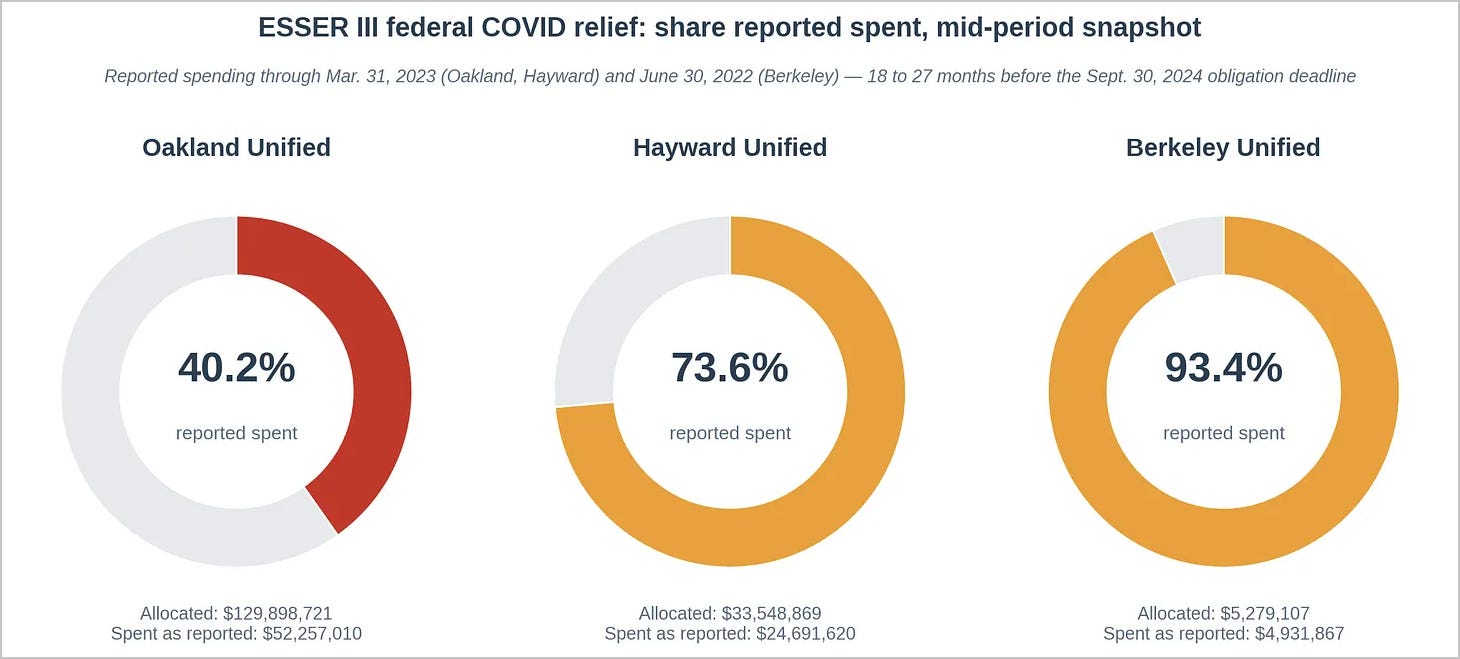
Note: that 40.2% was a mid-period reading, not a final tally. Districts had until September 30, 2024 to commit the funds, and reports captured only money already spent.19
We found no public record that OUSD forfeited (gave up) a material share of the money — aside from the $1 million it paid back — and considerable evidence it ultimately spent the money.
The district put about $16 million of relief funds toward one-time teacher payments in 2023, and its post-2024 deficit traces to relief-funded hiring — hundreds of teachers, social workers, aides, and tutors — that it could not afford once the money expired.20
The record shows that the problem is not that OUSD let the money expire unused. Rather, it appears that the district spent the one-time money on ongoing obligations, declined to show the receipts, and then described the shortfall as an outside event — an “inheritance” that ran out — rather than the more complicated reality that the shortfall appears to be a result of OUSD’s own poor financial choices.
The attendance problem: fewer students equals less money, every year
California is one of a handful of states that fund districts on the number of students actually in school each day (absences for illness, truancy and other reasons count as “not in school”) through a formula known as Average Daily Attendance (ADA). OUSD’s enrollment decline leads to lower attendance and, with it, less state revenue.
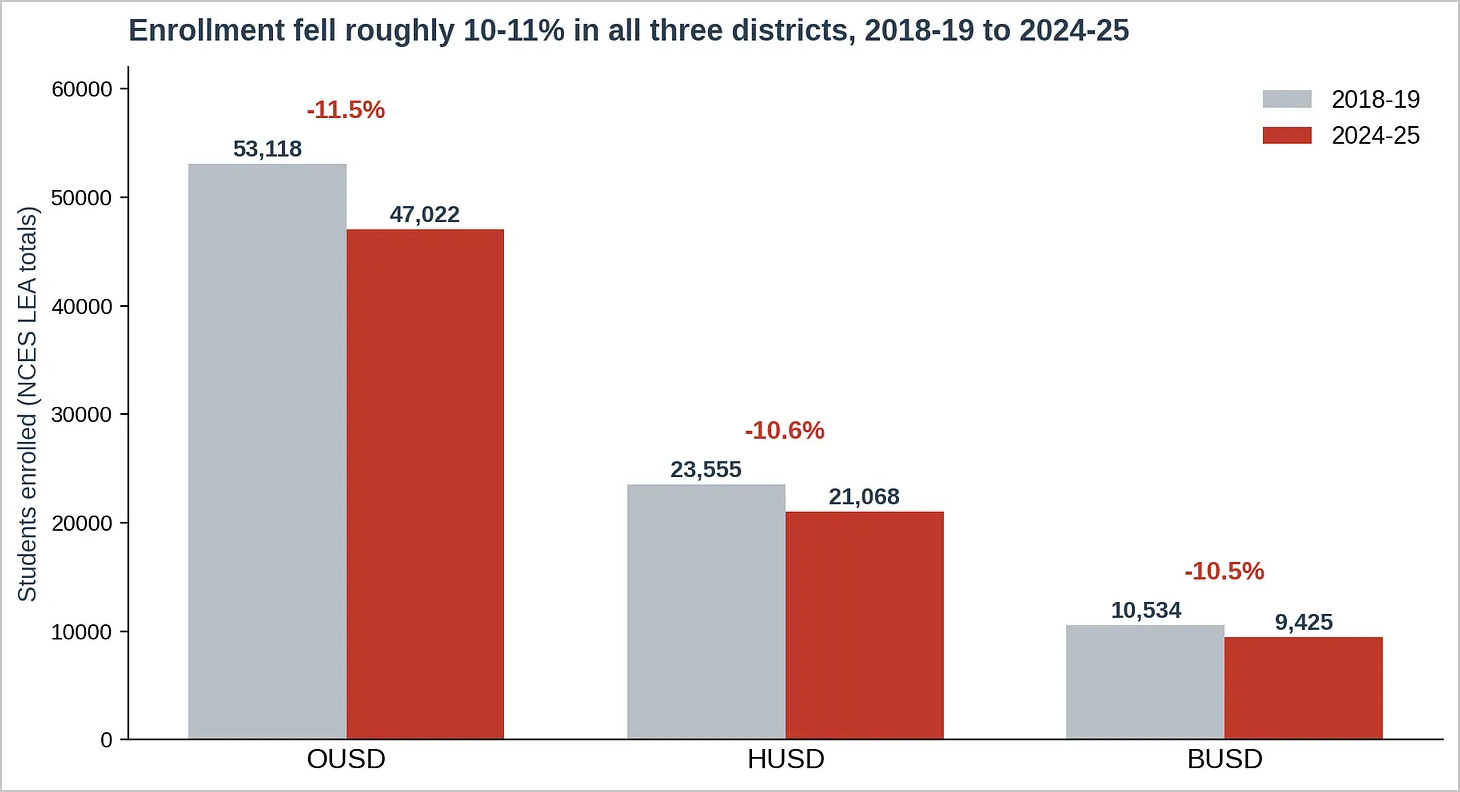
Federal data reports enrollment across Oakland Unified at 53,118 students in 2018-19, falling to 47,022 by 2024-25 — a decline of 11.5%. Those totals include OUSD-authorized charter schools; district-run school enrollment — about 34,000 — is what drives ADA revenue.
Officials attribute the decline to falling birth rates, families moving away, and competition from charter, private, and neighboring districts that accept transfers of Oakland students.
OUSD’s enrollment decline was neither sudden nor unexpected. Statewide enrollment has fallen for a decade, multiple expert forecasts indicate that the trend will continue, and OUSD’s superintendent’s reports have warned against budgeting on hoped-for attendance gains “not supported by historical and demographic enrollment data.”21
Still, as Oakland Report has reported, the district’s spending kept rising even as enrollment steadily – and predictably – fell.22
Hayward: spent the money, still went negative
Hayward Unified School District (HUSD) spent its relief money far faster than Oakland — showing that spending the funds is not the same as accounting for them, nor is it the same as fiscal health.
A 2021 state audit found that Hayward, at the time of review, was “unable to provide documentation to support the allowability of more than $4 million” of its first-round ESSER pandemic relief spending — findings HUSD said it was working to resolve.
The same audit noted that HUSD spent nearly all of that award on laptops, distance-learning training, and protective equipment — while offering no optional in-person instruction until May 2021. The audit framed this as a spending-pattern observation, not dishonesty.
By Hayward’s own accounting, its pandemic relief funds — $87 million in all — were spent by the September 2024 expiration. But the spending did not prevent a budget reckoning. In December 2024, HUSD reported a $55 million shortfall, triggering a “negative” budget self-certification — meaning the district may not meet its financial obligations — and state fiscal advisers were assigned to monitor it.23
Like OUSD, Hayward blames expired COVID-19 grant funding, enrollment decline, and enrollment-driven state budget pressures. Michael Fine, head of the state’s fiscal crisis team, offered a kinder read than he gave Oakland: Hayward’s new leaders “inherited some issues and did the right thing” by self-certifying negative.
Berkeley: financially solvent — with caveats Oakland should note
In contrast to OUSD and HUSD, Berkeley Unified School District (BUSD) appears to have spent nearly all of its federal award — 93.4% per its audited FY 2021-22 financial statements — with documented spending on preschool, meals, and expanded learning.24
BUSD today states that it “is fiscally solvent and meets the 3% reserve required by the State of California.”
In fairness to OUSD, Berkeley’s award was $5.3 million — about 4% of Oakland’s — so it had a far smaller windfall to absorb.
Also, Berkeley Unified received significant revenue from voter-approved local school taxes funding smaller classes, libraries, technology, and arts — a cushion against the same roughly 10.5% enrollment decline that OUSD absorbed with a somewhat smaller special-tax cushion.25
In June 2026, BUSD adopted $11.2 million in cuts to balance its 2026-27 budget, and it still projects over $7 million in deficits for 2027-29.26
Berkeley’s solvency through a proportionate drop suggests disciplined budgeting can keep these pressures from becoming a crisis.
Read this related article:

‘New commitments without a clear plan to pay for them’
The COVID-19 stimulus grant funding story at OUSD fits a pattern Oakland Report has documented in past articles.
Alameda County superintendent of schools Alysse Castro, approving OUSD’s 2025-26 budget as meeting only “absolute minimum requirements,” described the district’s history: “requesting plans, then disregarding them; rejecting staff recommendations; ... and, when difficult decisions are finally made, rescinding them shortly thereafter.”27
In April she issued a formal “Going Concern” notice, warning that OUSD was “continuing to make new commitments without a clear plan to pay for them.”28
In June she notified the public that the new Oakland Education Association (OEA) teachers union contract “endangers the district’s fiscal stability” absent roughly $30 million a year in cuts the board has not identified.
The spending commitments have kept coming. In February 2026 the board approved laying off roughly 400 workers, but weeks later it agreed to a teachers’ contract adding $32 million in new 2026-27 costs, rising to $60 million in new costs per year by 2027-28.
As Oakland Report documented in April, four board members worked for or received campaign support from the OEA, and the interim superintendent is a past OEA president.29
That said, there has been some encouraging financial movement in recent weeks. In May 2026, the board self-certified its budget outlook as “positive” — its first in over two decades — and in June it adopted a $1.205 billion budget for 2026-27.30
But the “positive” self-certification rests on a concerning budget maneuver Castro has repeatedly criticized: about $30 million per year in future cuts the board has not publicly specified.31
Read this related article:

Methodology and caveats
The three districts we compared in this article differ significantly in size, relief received, and local tax structure.
Correlation is not causation: fiscal outcomes reflect many factors beyond COVID-19 pandemic relief fund management and enrollment declines.
Quarterly spending reports lag actual commitments, so mid-period “percent spent” figures understate final spending.
No public tally of final ESSER III spending versus forfeiture exists, and we could not confirm OUSD’s final total — precisely because the district has declined to release detailed records.
This analysis draws on EdSource’s compilation of quarterly COVID-relief spending reports; State Auditor reports; CalMatters’ 2022 public records investigation; district budget documents; federal enrollment data; and local media coverage.
Other considerations and counterpoints
In fairness to OUSD and its defenders, we note the following, largely without rebuttal:
The forces squeezing OUSD’s budget — expiring one-time funds, falling enrollment, inflation, and attendance-based funding — are real, statewide, and hit high-poverty urban districts like Oakland hardest.
Spending relief funds on people was widely urged in 2021-23 to address learning loss and student mental health; many districts did the same and face the same financial cliff.
OUSD structured its 2023 teacher payments as one-time, to avoid building raises into the base budget.
OUSD’s May 2026 “positive” budget self-certification and the 2026-27 budget, with about $99 million in reductions, are genuine, if fragile, progress.
OUSD did file the state-required quarterly ESSER expenditure reports, which is how third-party analysts were able to track its spending pace at all.32
Berkeley’s health owes much to advantages Oakland could not precisely replicate: a far smaller windfall and substantial voter-approved special taxes.
Unsolved: exactly where OUSD’s ‘inheritance’ went
The evidence supports a narrower — and in some ways more troubling — conclusion than “OUSD wasted its COVID-19 money.”
The district received a nine-figure financial windfall, spent it in ways it has declined to fully document, absorbed one-time money into ongoing commitments, and framed the predictable expiration of the funding as a cause of its deficit.
Its neighboring districts faced the same pandemic relief expiration and enrollment declines. Hayward at least confronted its numbers honestly, by its regulators’ account; Berkeley stayed solvent while still cutting.
The data suggests OUSD’s crisis is less a story about money that disappeared than about a district that has yet to show the public — or perhaps itself — exactly where its money goes.
[Editor’s note: After this article was published, we added a parenthetical clarification explaining that Average Daily Attendance (ADA) includes absences, meaning that school districts receive less funding when enrolled students are absent due to illness, truancy, and other reasons. Our thanks to an alert reader who requested the clarification.]
About the author
Tarini Kakkar is a student journalist majoring in Cognitive Science and English at University of California, Berkeley. She is particularly interested in community and data-driven reporting across print, audio, and video platforms.
Growing up in Delhi NCR, India instilled her appreciation for arts and culture and her interest in political multimedia. Attending UC Berkeley gave her an expanded platform to engage with various student media, and she now spends much of her time juggling meetings with academics and coffee runs.
Tarini is a steadfast advocate for transparency and fairness in journalism, aiming to build a career in reporting in confident defiance of the claim that news is “a dying industry.” She is participating in Oakland Report’s inaugural summer internship program.

WE ARE 100% SUPPORTED BY YOU
Oakland Report provides accurate, unflinching, data-driven reporting and analysis that you will find nowhere else. If you value our work, please donate. All contributions go directly to sustaining and growing our 501(c)(3) nonprofit work.
Oakland Unified School District. “Our goal — understanding OUSD’s budget.” OUSD Business Services webpage, accessed Jul. 14, 2026. https://www.ousd.org/business-services/finance-departments/understanding-ousds-budget/our-goal
Oakland Unified School District. "Understanding our budget challenge." OUSD Business Services webpage, accessed Jul. 14, 2026. https://www.ousd.org/business-services/finance-departments/understanding-ousds-budget/understanding-our-budget-challenge
California Department of Education. “COVID-19 relief funding summary sheet — federal stimulus funding.” CDE, accessed Jul. 14, 2026. https://www.cde.ca.gov/fg/cr/relieffunds.asp
EdSource. “Amounts California districts were allotted and spent in federal Covid aid.” EdSource, Jun. 14, 2023. https://edsource.org/2023/amounts-california-districts-were-allotted-and-spent-in-federal-covid-aid/692198
Lewis, Robert and Joe Hong. “Secrecy shrouds how California schools spent COVID stimulus.” CalMatters, Jun. 9, 2022. https://calmatters.org/education/2022/06/california-schools-stimulus-funds-oversight/
Lewis, Robert and Joe Hong. "Spending spree: Oversight scarce as billions in COVID aid poured into California schools." CalMatters, Jun. 9, 2022. https://calmatters.org/education/2022/06/covid-relief-spending-california-schools/
Howle, Elaine M. "California Department of Education: it needs to provide better oversight to ensure that local educational agencies promptly and effectively use federal COVID-19 funds." California State Auditor, Oct. 19, 2021. https://www.auditor.ca.gov/pdfs/reports/2021-614.pdf
Nguyen, Candice. “Mismanagement and misspending: CA schools risk losing $160 million in COVID-19 stimulus.” NBC Bay Area, Oct. 2021. https://www.nbcbayarea.com/investigations/mismanagement-and-misspending-ca-schools-risk-losing-160-million-in-covid-19-stimulus/2690809/
McBride, Ashley. “Oakland Unified School District has a $24M deficit to overcome.” The Oaklandside, Feb. 13, 2024. https://oaklandside.org/2024/02/13/oakland-unified-has-a-24m-deficit-to-overcome/
Bay City News wire service. “Oakland Unified board votes to lay off 400 workers to tackle massive budget shortfall.” Local News Matters, Feb. 26, 2026. https://localnewsmatters.org/2026/02/26/oakland-unified-layoffs-400-workers-budget-deficit/
Meyerhoff, Beth. “Attendance issues could drive a change in how school district funding is calculated.” California State PTA, March 2022. https://capta.org/attendance-issues-could-drive-a-change-in-how-school-district-funding-is-calculated/
National Center for Education Statistics. "District Detail: Oakland Unified (ID 0628050)." NCES Common Core of Data, accessed Jul. 2026. https://nces.ed.gov/ccd/districtsearch/district_detail.asp?Search=2&details=1&ID2=0628050&DistrictID=0628050
EdSource / Local News Matters. "Which school districts are on California's latest financial danger lists — and why." Local News Matters / EdSource, Mar. 6, 2025. https://localnewsmatters.org/2025/03/06/which-school-districts-are-on-californias-latest-financial-danger-lists-and-why/
Berkeley Unified School District. “Understanding the budget.” BUSD Business Services Division webpage, accessed Jul. 14, 2026. https://www.berkeleyschools.net/departments/business-services-division/berkeley-unified-budget/
Kemp, Heather. “The end of ESSER.” CSBA California Schools, Summer 2024. https://publications.csba.org/issue/summer-2024/the-end-of-esser/
Congressional Research Service. "Elementary and secondary education: federal COVID-19 pandemic funds and their period of availability." Congress.gov, CRS Product R47027; see also CRS In Focus IF12978, "Late liquidation period for elementary and secondary education funds provided during COVID-19 pandemic." https://www.congress.gov/crs-product/R47027; https://www.congress.gov/crs-product/IF12978
McBride, Ashley. “How Oakland Unified could spend millions in COVID relief funds.” The Oaklandside, Mar. 18, 2021. https://oaklandside.org/2021/03/18/oakland-unified-covid-relief-funding-millions/
Berkeley Unified School District. "Annual financial report, June 30, 2022 — schedule of expenditures of federal awards." BUSD, March 2023. https://www.berkeleyschools.net/wp-content/uploads/2023/03/Berkeley-USD-6.30.2022-FS-Final-1.pdf
Fensterwald, John and Daniel J. Lewis. "Many California districts yet to spend federal Covid relief despite deep, widespread learning loss." EdSource, Jun. 14, 2023. https://edsource.org/2023/many-california-districts-yet-to-spend-federal-covid-relief-despite-deep-widespread-learning-loss/692344
Bryant, Jake et al. "Stimulus funding deadlines loom: How are K-12 schools adjusting their priorities?" McKinsey, Sept. 22, 2023. https://www.mckinsey.com/industries/education/our-insights/stimulus-funding-deadlines-loom-how-are-k-12-schools-adjusting-their-priorities
Stone, J.R. "Oakland Unified school board declines to take any action on possible closures." ABC7 News, Dec. 12, 2024. https://abc7news.com/post/oakland-unified-school-board-declines-take-any-action-possible-closures/15644831/
Reinhart, Sean S. "A day of budget reckoning for Oakland Unified School District." Oakland Report, Dec. 10, 2025. https://www.oaklandreport.org/p/a-day-of-budget-reckoning-for-oakland
Oakland Report contributors. "'A decision-making problem': County schools chief warns Oakland Unified is at risk of running out of money." Oakland Report, Apr. 21, 2026. https://www.oaklandreport.org/p/20260421-ousd-at-risk
Hayward Unified School District. “Fiscal stability plan 2025-2026” and “Budget solutions 2024-25.” HUSD Business Services website, accessed Jul. 14, 2026. https://www.husd.us/departments/business-services/budget-department/budgetsolutions/fiscal-stability-plan-2025-2026; https://www.husd.us/departments/business-services/budget-department/budgetsolutions/budget
Berkeley Unified School District. "Updated expenditures — 2022 expanded learning opportunities grant plan." BUSD, Nov. 13, 2024. https://www.berkeleyschools.net/wp-content/uploads/2024/12/Updated-Expenditures-2022-ELO-G-Plan-BUSD-2024.11.13.pdf
Berkeley Unified School District. "2026-27 consolidated school plans." BUSD, June 2026. https://www.berkeleyschools.net/wp-content/uploads/2026/06/2026-27-Consolidated-School-Plans.pdf
Arredondo, Vanessa. “BUSD balanced its budget, but deficits remain in the forecast.” Berkeleyside, Jul. 2, 2026. https://www.berkeleyside.org/2026/07/02/busd-balanced-its-budget-but-deficits-remain-in-the-forecast
Borek, Bob. "Oakland school board kicks budget can down the road, passing 'absolute minimum requirements' for county's approval." Oakland Report, Nov. 4, 2025. https://www.oaklandreport.org/p/oakland-school-board-kicks-budget
Reinhart, Sean S. "County warns OEA raises 'endanger' OUSD finances as board prepares to adopt a $1.2 billion budget." Oakland Report, Jun. 23, 2026. https://www.oaklandreport.org/p/union-raises-endanger-oakland-schools
McBride, Ashley. “OUSD leaders call budget outlook ‘positive’ for first time in 22 years.” The Oaklandside, May 28, 2026. https://oaklandside.org/2026/05/28/ousd-budget-positive-deficit-school-board/
McBride, Ashley. "OUSD's budget has a projected surplus — if it can cut $30M." The Oaklandside, Jun. 25, 2026. https://oaklandside.org/2026/06/25/deficit-surplus-ousd-passed-a-very-confusing-budget/
Jordan, Phyllis. "How California's Schools Are Spending Billions in Federal Pandemic Relief." FutureEd, Georgetown University McCourt School of Public Policy, Apr. 2024. https://www.future-ed.org/california-esser-spending/
Great article! One thing: the statement, "California is one of a handful of states that fund districts on the number of students actually in school each day through a formula known as Average Daily Attendance (ADA). OUSD’s enrollment decline leads to lower attendance and, with it, less state revenue" conflates two things often conflated -- attendance & enrollment. When enrolled kids are absent, the dollars don't come in. It doesn't matter if a student has measles or is truant: kid not in class, no funding. Oakland has a fairly high truancy rate, compounding its declining enrollment problems. Please help the public understand this issue.
OUSD pattern is similar to Oakland government: spending levels not nearly supported by revenue.