


Video clip 1. Mayor Barbara Lee promotes a “bulky trash block party”; a walk through West Oakland. July 2026. (Video sources: Instagram / @mayorbarbaralee; X / @senecaspeaks21)
Editors’ note: This essay was released by city of Oakland transportation director Josh Rowan on his personal Substack page with the subtitle, “A personal journey through Oakland’s illegal dumping crisis — from instinct to discovery to a four-step plan the city already has the tools to execute.” Oakland Report is republishing it with Rowan’s permission for our readers to consider.
BY JOSH ROWAN
Built to keep the garbage flowing
Oakland has a garbage problem. Everyone knows it. Almost everyone has the wrong solution.
This is the story of how I got it wrong, what the trash itself taught me, what history explains, what the math proves, and what four steps would end this — if anyone in authority has the will to take them.
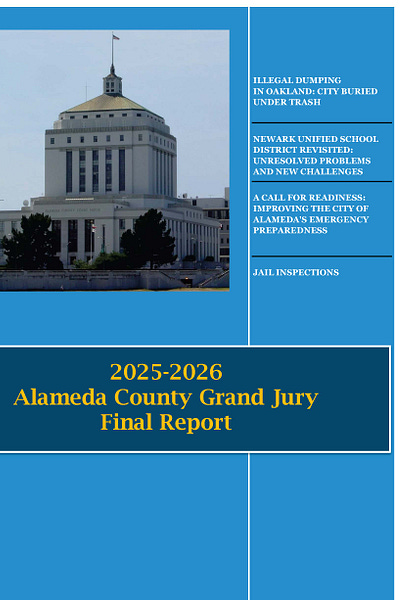
Three independent oversight bodies — the Oakland City Auditor,1 the Alameda County Civil Grand Jury,2 and Oakland’s own employee survey3 — examined this problem separately in 2026 and reached identical conclusions.
They confirmed what I had been saying for over a year and what got me attacked for saying.
Read this related article:

The garbage is on the ground because of failed policy and because the trash is now a commodity that has value.
Not because Oakland residents are uniquely dirty. Not because enforcement is too weak. Because the system was built to keep the garbage coming — and keep the money flowing.
Trash is cash. Garbage is gold. Until Oakland dismantles the economics that make it profitable, the before-and-after photos will never stop.
Act 1
Oakland Scavenger — when it worked
Before Waste Management took over in 1986, Oakland’s trash was collected by the Oakland Scavenger Company — a worker-owned business founded by Italian immigrants more than a century ago.4
The scavengers knew their routes. They knew their customers. They had a direct ownership stake in the quality of their work. Retired third-generation garbage men remember a city that worked differently — a personal relationship between collector and community that corporate consolidation erased overnight.
When long-term Oakland residents say it wasn’t like this ten or fifteen years ago, they are not misremembering. They are describing a system that existed and functioned.
Two decisions destroyed it.
First: In 1986, Waste Management acquired the Oakland Scavenger Company. The worker-owned model ended. National corporate waste management began.
The personal accountability of ownership gave way to the efficiency calculations of a publicly traded company.
Waste Management is not a villain in this story. They just behave the way they behave.
We need them for now as a partner.
Second: In 2006, Oakland adopted a Zero Waste Strategic Plan. The intent was noble. Smaller cans would push residents to generate less waste.
In practice, it failed catastrophically. The plan pushed customers toward smaller garbage containers on the assumption that they would recycle more and need less trash can space.
Americans were entering an era of increasing packaging and disposable goods. Oakland imposed smaller trash cans on residents at exactly the moment residents were generating more waste.
The garbage had nowhere legal to go. It went to the street.
The Grand Jury named this directly as a cause of illegal dumping: the rate structure that resulted from the Zero Waste plan’s assumptions made larger containers cost nearly double, pushing residents toward the smallest can available.
The Davis Street Transfer Station in San Leandro — not even in Oakland — became the city’s primary legal drop-off option. One free visit per year. Residents had to drive to another city to use it.
The city ran popular bulky block parties — free neighborhood drop-off events that worked, drawing thousands of vehicles and hundreds of tons of waste — then ended them in 2024 due to budget constraints.
The policy hole grew. The trash filled it.5
This is why the long-term residents are right. It wasn’t like this before. Corporate consolidation coupled with a failed zero waste policy created a problem Oakland has been cleaning up ever since — and has never once addressed at its root.
Video clip 2. Encampment on 26th and Wood Street on May 15, 2026. (Source: Oakland Report)
Act 2
The flywheel — how I got it wrong and what the trash taught me
It was the fall of 2024. I drove into Oakland for the first time since the 1990s — the last time Chuck Cotter and I had come here together.
I spent a day behind the wheel. I ended up on East 14th headed east, turned left into the hills.
I grew up in Los Alamos, New Mexico. We had a hill and a valley. The hill meant wealth, privilege, and whiteness. The valley did not.
Oakland had the same dynamic. I had found it without anyone telling me where to look.
As I came into West Oakland, I could not soften what I thought. What the hell is all this trash?
In February 2025, my family visited. Mrs. Rowan saw it immediately. What’s with all this trash on the ground?
Around that time I interviewed with Mayor [Sheng] Thao on Zoom. She asked what I thought of Oakland. I said it was a beautiful city with enormous potential.
Then I put my foot in my mouth. What’s with all the garbage on the ground? I knew I had struck a nerve. Better out than in.
For most of 2024, I was Oakland’s DOT [Department of Transportation] Director. I created office hours — every Thursday in East Oakland, meeting with residents.
I found suppressed frustration and trauma. The complaints were consistent: the city ignores us, the sideshows are ruining our quality of life, the illegal dumping is out of control.
I was relieved illegal dumping belonged to Public Works. How hard could it be? Just pick up the garbage.
Then it happened at Charlie May Coffee and Tea House
A woman I had met once before at office hours came back. Furious. The kind of furious that makes you wonder whether the table or you is about to get hit.
She had visited another city — not known for greatness — and found no trash. Oakland sits beside water and hills and is covered in garbage. She challenged me. Then she recruited friends. They challenged me too. Do something about it.
I agreed. I had no authority. I spent my Fridays standing next to piles of trash. I stared at what was in them. Diapers. Food containers. Furniture. Clothing. Somebody’s house. Not construction debris. Not industrial waste. Somebody’s house.
The dominant narrative was that Oakland was a helpless victim — nefarious actors driving in from other cities with truckloads of construction debris.
That happens. It is not the primary driver.
City officials involved in cleanup told the Grand Jury the same thing: based on examinations of the debris, a majority appears to be residential. Anecdotally, several officials told the Grand Jury that most waste appears to come from within Oakland.
I was looking at residential garbage. I was wrong about where it came from. I changed my mind.
At the end of 2024, I became Acting Public Works Director. The trash was mine. I assembled my managers with the largest crews and most equipment. All hands. Clean the city.
My managers spoke truth without softening it. Fine plan. What happens when the trash comes back?
Video clip 3. Oakland has long struggled to reduce the volume of trash dumped in its streets. (Sources: Instagram @KTVU2; X @senecaspeaks21; Oakland Report)
I spent time with the crews who pick it up — KOCB [Keep Oakland Clean and Beautiful]. Remarkable people. Their equipment is inadequate.
There is no clearer signal that a workforce’s work does not matter than providing poor tools to do it.
The Grand Jury confirmed this independently: KOCB crews frequently encounter broken vehicles and equipment, with repairs delayed — and the resulting slowdowns are a documented drag on the city’s cleanup capacity.
That became priority one: better staff, better equipment. Current capacity is approximately 20 million pounds per year — or 47 pounds for every Oakland resident. We needed 30 million.6
Then I ran an experiment. I picked specific locations and kept them clean. I believed visible effort would discourage dumping.
The opposite happened. The cleaner we kept a location, the more trash appeared. Hot spots became de facto transfer facilities. Cleaner meant more trash. And the new trash was residential and commercial.
The flywheel was spinning and I had just made it spin faster.
The New York Times called it Trashland
The New York Times reached out to cover Oakland’s trash. They called it Trashland.
I notified the PIO and City Administrator. They approved the interview. I followed every proper channel. Some high-profile trash advocates were unhappy I did the interview, that my photo ran in the Times, and that I said picking up the trash is not the solution.7
The most controversial thing I said was this: we are doing this to ourselves.
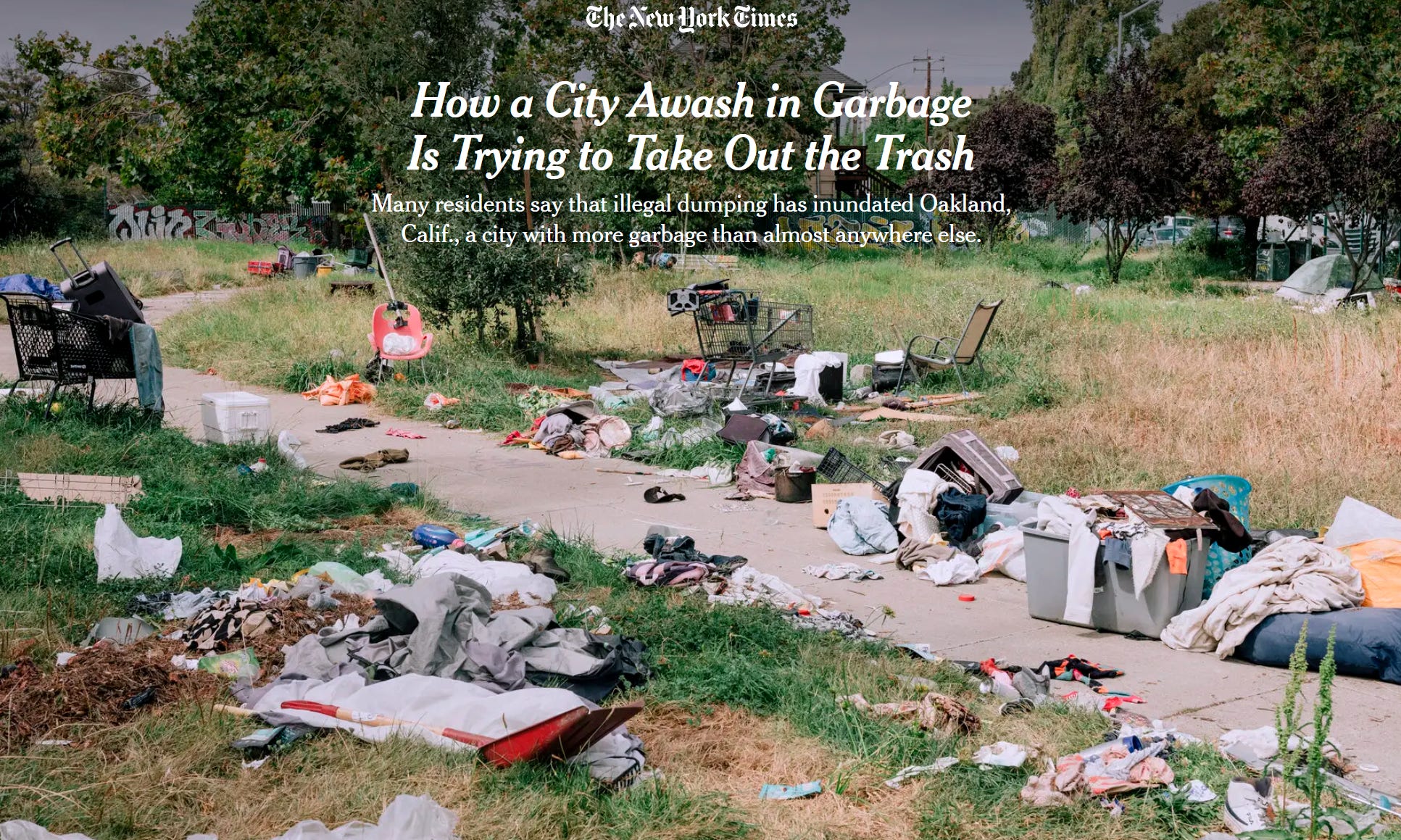
The trash is residential. It is commercial. It is not imported. Oaklanders dump in Oakland. No one agreed. Some took offense — an outsider blaming Oakland for its own problem. We are victims, I was told.
I kept staring at the piles. The piles kept telling the same story.
The zero waste failure and the equity hidden inside it
During office hours, roughly half the residents who came to see me said the same thing: it wasn’t like this ten or fifteen years ago.
That is when the Zero Waste Strategic Plan took effect and the solid waste market consolidated. Both decisions compounded on each other and produced the streets you see today.
The Grand Jury confirmed it: Oakland’s standard residential garbage container holds 32 gallons. A 64-gallon container costs $110.31 per month — nearly double the $62.83 charged for the 32-gallon standard.
Rates rise steeply with larger containers, exactly as the Zero Waste plan’s assumptions intended.
The result: to keep costs low, residents choose cans that are too small for their actual waste generation. The overflow goes to the street.
This is not speculation. This is Finding 26-4 of the Grand Jury report.
Here is the equity dimension that nobody talks about. It costs more to collect trash in the Oakland hills.
The terrain requires smaller trucks and two-person crews. Under Oakland’s current flat rate structure, flatlands residents pay the same rate as hills residents — even though hills collection costs more to deliver.
The flatlands subsidize the hills. The people with the least financial resources pay more than their share of the city’s collection costs. So they choose the smallest can to cut their monthly bill.
The overflow goes to the street. The flatlands bear both the subsidy and the dumping.
Berkeley already prices collection by actual cost of service — a structure mandated under California’s Proposition 218. When Berkeley realigned its rates to actual costs in 2023, it acknowledged years of cross-subsidy. 89
Oakland has the same legal framework available. It has not used it. The flatlands pay for the hills. That is institutional inequity hiding inside a garbage bill.
The math
Oakland has roughly 80,000 single-family homes. The standard residential trash container holds 32 gallons. Public Works removes approximately 20 million pounds per year — 47 pounds per resident.
At a conservative density of half a pound per gallon for residential household waste, that is 40 million gallons annually — roughly 61 Olympic-sized swimming pools worth of illegal dumping removed from Oakland streets every year.10
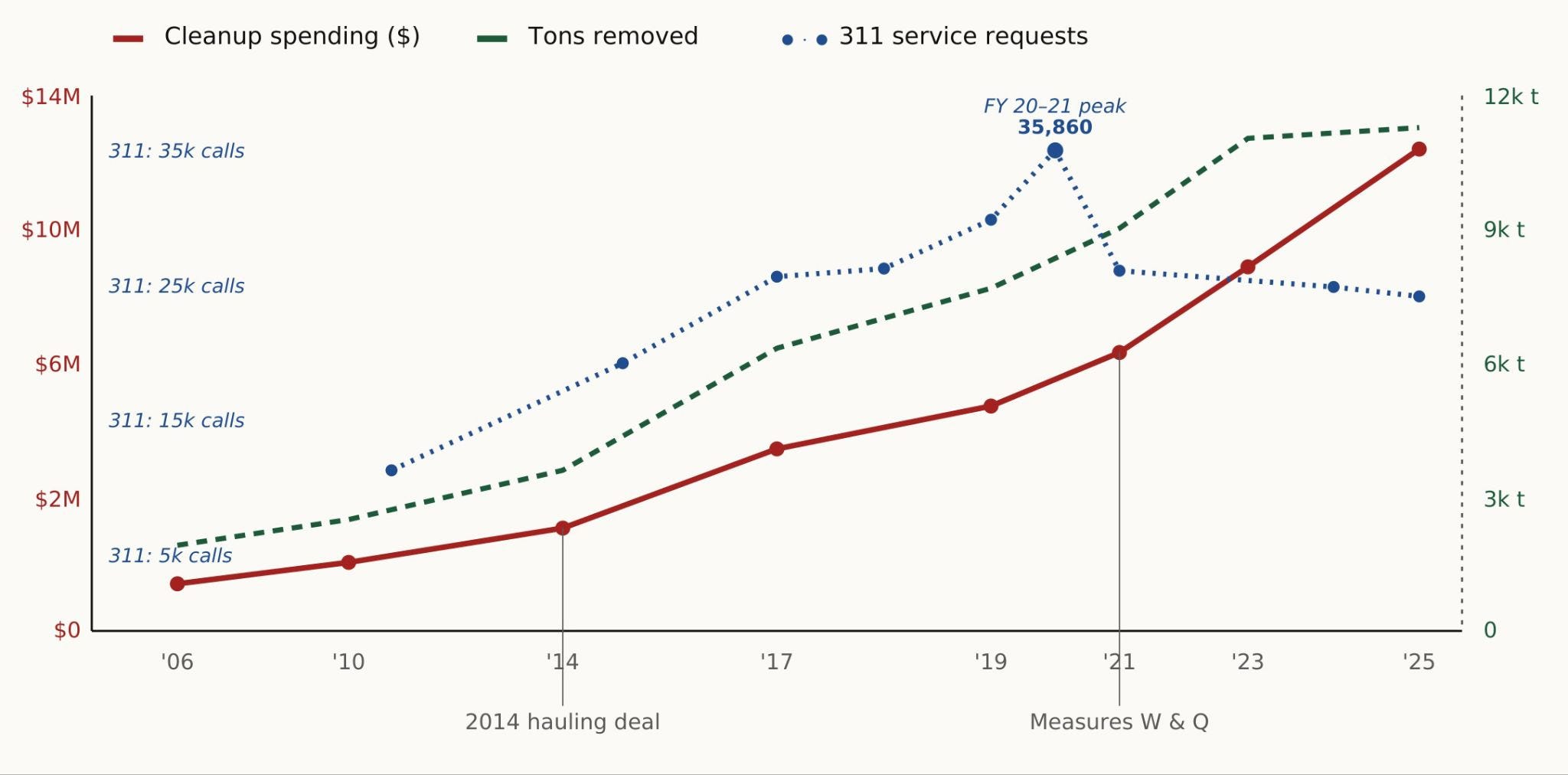
Move the can to 64 gallons. The gap between the current 32-gallon standard and a 64-gallon standard — from single-family homes alone — adds 166 million gallons of legal annual capacity. That is more than four times the volume currently removed from the streets.
Instead of circling the block looking for a median, a commercial dumpster, or one of the city’s public street bins — the green cans placed throughout neighborhoods that attract bags of overflow trash the night before collection, and that some neighborhoods have actually petitioned to have removed for this reason — residents could ask a neighbor if they have extra space.
That is not a policy failure. That is a neighborhood functioning. The Waste Management pilot showed exactly that dynamic — when capacity exists, people use it.
This is fifth-grade arithmetic. Multiply two numbers. Subtract. Compare. The answer has been here since 2006.
Oakland collects more than $30 million per year in franchise fees from Waste Management for the exclusive right to collect garbage from Oakland residents. Those fees are baked into the rates residents pay.
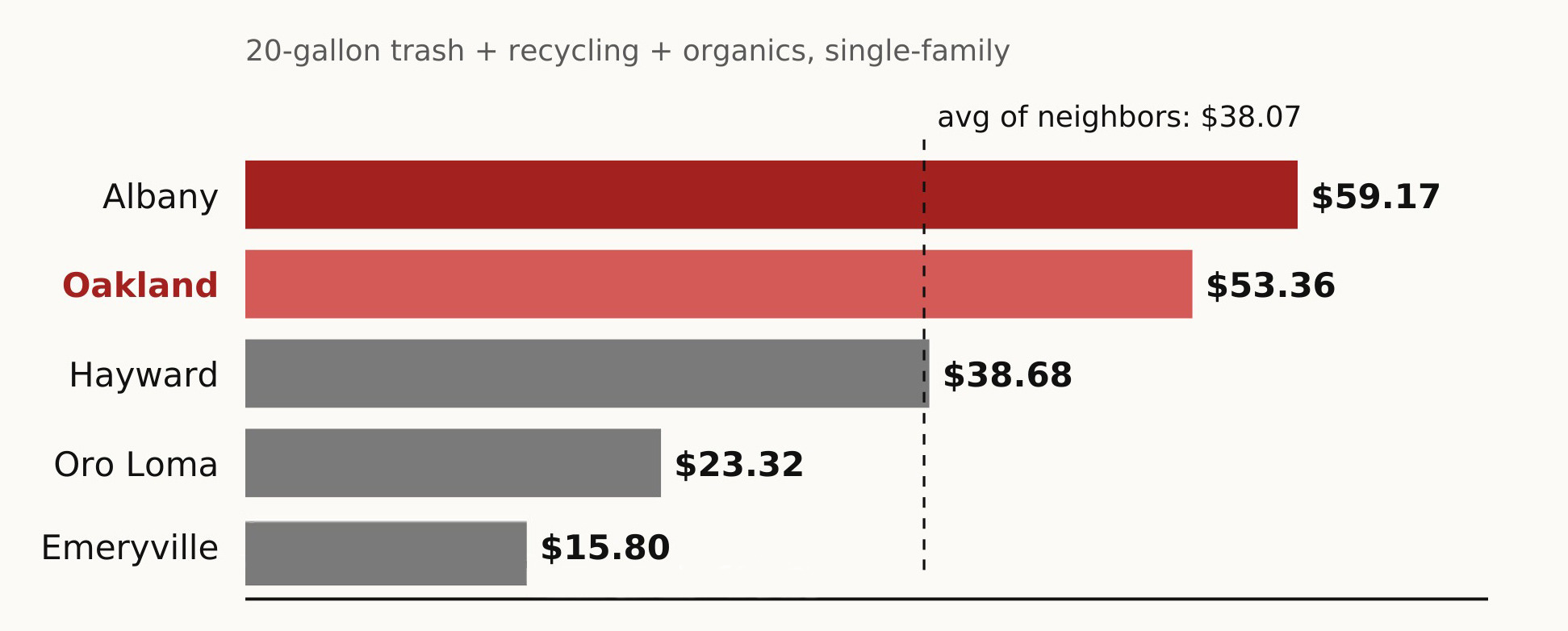
Oakland’s rates run 23 to 40 percent above neighboring cities served by the same hauler. The franchise fee may be a direct driver of the high prices that push residents toward smaller cans and overflow onto streets.
That connection deserves scrutiny. A forensic audit of the Waste Management franchise fee is not a fishing expedition. It is due diligence on a $30 million annual revenue stream that may represent another layer of failed policy.
What this actually costs
The Grand Jury found that the Public Works Department budget includes approximately $28.2 million for the divisions directly responsible for abating and enforcing illegal dumping — including:
$10 million directly for dumping cleanup
$2.6 million for environmental enforcement
$750,000 for stewardship and volunteer coordination
$11.1 million for street sweeping, which the department views as a first line of defense.
Meanwhile, the city collected just over $16,000 in citation revenue in FY 2024-25, against $2 million in enforcement spending.
The Environmental Enforcement Unit issued citations consistently in the six figures annually — and collected a fraction. Of 3,293 citations issued since 2020, the city conducted 588 internal reviews and dismissed 566 of them.
Only 14 proceeded to appeal hearings.
Act 3
Trash is cash — no one in charge and everyone getting paid
In 2014, a city council member announced a candidacy for mayor at an illegal dumping site in East Oakland. She posed for photos. She left the trash where it was.
That was the moment garbage became a political platform in Oakland.
More than a decade later, the same politician is still in the middle of the action, still proposing solutions, still collecting a city paycheck to address a problem she has never solved.
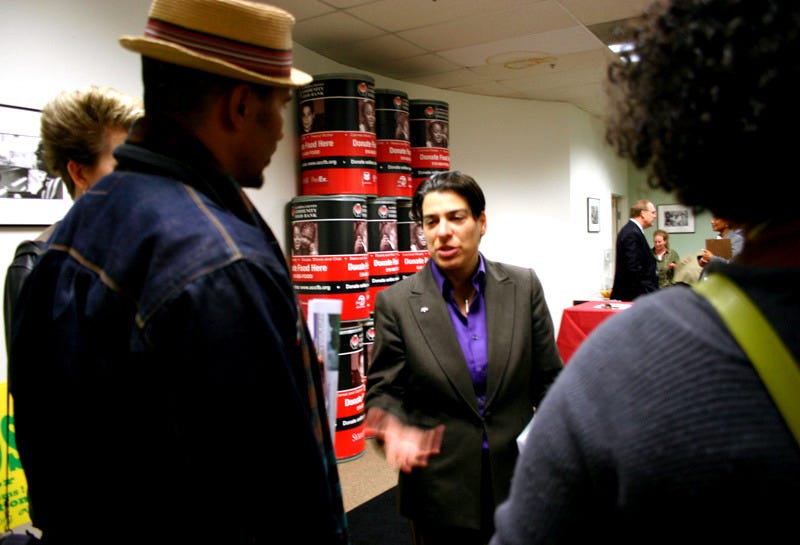
Picking up garbage became a social media platform. Before-and-after photos built audiences. Community cleanup events built political brands.
Cameras showed up. Politicians showed up. Nonprofits showed up. For-profits showed up. Everyone wanted a piece of the action. The before photo is worth more than the after photo. The before photo is the fundraiser. As long as there are before photos, the money flows.
Read this related article:

One nonprofit led the way — securing no-bid contracts and change orders, receiving waivers of the small and local business ordinance, and operating without competitive procurement for years after the emergency justification that created the arrangement had ended.
The result was predictable.
Other organizations, both nonprofit and for-profit, saw the model and lined up for the same treatment. I could not go anywhere in public without someone seeking a no-bid contract to pick up trash. Everyone wanted to get paid without competition, without small business requirements, without accountability for results.
I have done a financial analysis of that nonprofit’s contracts, change orders, and invoice records. The findings are significant and will be released separately.
A special thanks to @pengweather— not an Oakland resident, but someone who genuinely cared about this city’s garbage problem and sought to make a difference without seeking anything in return. He represents what civic engagement is supposed to look like.
Help us reach our goal of 10,000 subscribers.
Nobody is in charge — the Grand Jury said so directly
The Grand Jury documented a city where officials gave conflicting accounts of their own programs, were unaware of Council actions taken months earlier, and could not agree on basic facts about their approach.
The report described officials who ‘seemed unaware of recent developments or what other parts of the city government were doing.’ They provided ‘different descriptions of Oakland’s current approach to illegal dumping.’
They ‘either could not explain or provided unclear information about the status of Oaktown PROUD.’ [Prevent and Report Our Unlawful Dumping program.]
Officials were unaware that the city council had authorized the use of Community Safety camera footage for illegal dumping enforcement — an action taken months before the Grand Jury’s investigation.
The Grand Jury’s conclusion: ‘Oakland’s efforts have suffered from a lack of clarity and consistency, with many officials involved, conflicting descriptions of the city’s current approach, limited awareness of current developments, and no one clearly in charge.’
Finding 26-24 states it plainly: the City of Oakland does not have a single point person responsible for overseeing and coordinating its illegal dumping efforts. Recommendation 26-7 calls for designating one within 90 days.
In the past several years, Oakland has not referred a single case to the Alameda County District Attorney for criminal prosecution of illegal dumping. It has filed one civil action. 11
The Grand Jury asked the Finance Department for basic citation collection data. It asked multiple times. People promised to deliver the information. It never came. A county oversight body asked a city for its own math and the city could not produce it.
The Acting City Administrator’s official response to the Grand Jury report said the city was ‘pleased to be in alignment with the recommendations’ and that they ‘have already been authorized, funded, and launched.’ The response mentioned cameras, drones, handheld technology for enforcement officers, overtime funding, and cleanup events.
It did not mention the Waste Management contract renegotiation — the City Auditor’s top recommendation — once.12
BECOME A SUPPORTING MEMBER
If you value our work, please donate. Your contribution in any amount helps us continue to produce articles like this one.
The enforcement collapse
The Grand Jury called illegal dumping enforcement in Oakland ‘inadequate and abysmal.’ The numbers back that up. The Environmental Enforcement Unit — seven budgeted positions, one still frozen — issued a few hundred citations per year against roughly 24,000 to 25,000 cleanup requests annually.
Of citations issued since 2020, the city dismissed 566 of 588 that received internal administrative review. Only 14 reached appeal hearings.
Cameras captured dumping incidents and yielded 17.9 percent of citations over several years — while violators routinely covered or removed license plates to avoid identification.
The District Attorney has been direct: she cannot prosecute a license plate. She needs a positive identification of the person committing the crime.
We are flying drones over East Oakland searching for piles of garbage after the fact. East Oakland is already one of the most surveilled communities in the region.
Read this related article:

The idea that the answer is more surveillance of Black and immigrant communities — communities that bear the brunt of the zero waste policy failure — while the policy itself goes unchanged is not an equity position. It is the opposite.
Most people dumping illegally are not criminals. They are struggling to survive in a city that jammed them up with a failed policy. If we believe what we say about equity, we stop talking and fix the policy.
A message to every candidate running this year
It is an election year. Candidates are making promises. Some do not understand the problem they are promising to solve.
Here is my message to all of them: the first one of you who poses for a photo in front of a pile of garbage loses my support. I encourage you to join a neighborhood adopt-a-spot cleanup. I will personally take you on a citywide trash tour — after hours, when the cameras are off.
Go educate yourself before you make another promise.
And if you skip that step and come into office waving your arms demanding all-hands solutions — I understand. I know exactly how that feels. That is what I did.
The trash always comes back, often more.
Read this related article:

The mayor has a ten-point plan. Two of those points speak directly to this crisis — investing in illegal dumping solutions and auditing city finances.
We are watching. Honor those commitments.
Start the financial audit with the Waste Management franchise fee. Oakland residents deserve to know where that $30 million goes annually and whether it is contributing to the rates that drive residents toward undersized cans and streets full of overflow.
Act 4
Stop the flywheel — the four-step plan
Stop with the before-and-after photos of garbage piles. The before photo goes away through prevention. Stop providing cover for policy failure by spending your own weekend picking up the garbage of others. This is a map problem — the garbage lands where policy failure meets economic incentive. Fix the map.
Four steps. All achievable within twelve months. All supported by the data, the math, and three independent oversight reports. All focused on prevention, not cleanup.
Step 1: Better staff and better equip public works
The crews who pick up trash are remarkable people doing difficult work with inadequate equipment.
Invest in them. Current capacity is approximately 20 million pounds per year. We need 30 million. The only way to get there is to staff and equip the teams who do the actual work.
City crews and Waste Management are the only two groups that should be paid to pick up Oakland’s trash. Every dollar spent on no-bid nonprofit contracts is a dollar not invested in the people and equipment that will still be here in ten years.
Step 2: Get back to the negotiating table with Waste Management
We had a deal. Then we did not have a deal. Oakland residents pay 23 to 40 percent more than neighboring cities served by the same hauler.
The City Auditor named contract renegotiation as the top recommendation. The Grand Jury’s Recommendation 26-8 called for completing amendments to the franchise agreement that will change the rate structure to make larger containers more affordable, enable increased use of free bulky waste services, and reduce scheduling delays.
Waste Management has already piloted larger bins and documented immediate reductions in street overflow. More gallons at the curb. Lower prices.
Finish the negotiation. And while at the table, conduct a forensic audit of the franchise fee to determine whether that fee structure is itself a driver of the rates pushing residents toward illegal dumping.
Step 3: Collapse the private junk hauler economy
Stop paying cash up front for results you cannot verify. Require proof of legal disposal — a receipt or photo from a licensed transfer station — before electronic payment releases.
The Grand Jury’s own report noted that KOCB’s website already urges customers to ‘Request dump receipts from haulers before paying’ — then acknowledged that this almost never happens because it is not practical for a customer to withhold payment until the hauler returns with a receipt.
Flip that dynamic. Pay after proof, via a digital app. The hauler who dumps illegally does not get paid. The hauler who disposes properly gets paid within seconds. No permits required. No new regulations required.
One payment rule change ends the economic incentive for illegal dumping by unlicensed haulers.
Step 4: Pass the commercial special assessment
It is already written. The Grand Jury estimated thousands of Oakland businesses operate without mandatory trash service — with some estimates as high as one in six.
When commercial customers stop paying, service stops and the trash goes to the street.
Oakland’s ordinance currently does not allow the city to take the same property lien actions against delinquent businesses that it can take against residential owners. The commercial special assessment closes this gap. Pass it now.
The bottom line
The City Auditor issued 17 recommendations in April 2026. Only four were marked complete as of the Grand Jury’s report in June. The city approved the IDEA Plan in May 2026 — $1.1 million in new contracts, drones, and equipment — without the auditor’s primary recommendation to renegotiate the Waste Management contract.

The Acting City Administrator’s response to the Grand Jury praised the IDEA Plan and made no mention of the contract renegotiation the auditor and Grand Jury both called for.
One city employee, responding to the 2026 Ethical Climate Survey, wrote that the City Council is blatantly corrupt. The Auditor’s office printed it without comment.
Employees with ten or more years of service rated their elected officials 62 out of 100. The longest-serving employees trust their leaders least.
I have been attacked for eighteen months for saying what three independent bodies have now confirmed. I know what I am. I am the biggest threat to the trash grift. I promised my East Oakland friends I would play every card I have. I am playing them.
I cannot live in this garbage. I will not raise my son in filth. I have the resources to leave Oakland. That solves my family’s problem. It does not solve Oakland’s problem. Oakland has two years to show me it means what it says about equity, about services, about being a city that works for everyone who lives in it.
Change the policy. Fix the zero waste failure. Audit the franchise fee. Staff and equip public works. Collapse the private hauler economics. Pass the commercial assessment. Get back to the table with Waste Management and close the deal.
Read this related article:
Even dogs don’t soil where they eat. Oakland can do better. It has to.
I’m from the flats, I walk these streets
Every morning, just to reach
School ain’t far, but the walk’s a mess
Stepping over your couch, your old mattressWe walk with pride, heads held high
Don’t trash the Town, that’s my reply
One day we’ll walk these streets and see
The Town for me, the Town for me— from Josh Rowan, “I Walk This Town” [12]
ABOUT THE AUTHOR
Josh Rowan is the director of transportation for the city of Oakland. A resident of Oakland, he joined the city of Oakland in that role in April 2024, then also served as the city of Oakland’s public works director for several months in 2025.
Josh served as interim oversight director of Oakland public works during the period covered by the city auditor’s April 2026 performance audit, which acknowledged his cooperation in its cover letter and cited his November 2025 memorandum to the privacy advisory commission as a source.
Prior to working for Oakland, he served as commissioner of the city of Atlanta’s department of transportation. His career in the public sector includes work as a program manager for transportation, transit, education, healthcare, and law enforcement capital construction. He holds a bachelor’s degree in civil engineering from Georgia Institute of Technology.
The views expressed in our Commentaries do not necessarily reflect the editorial views of Oakland Report or its contributing writers.

WE ARE 100% SUPPORTED BY YOU
Oakland Report is an experiment in a new form of media. We provide reasoned, deep-dive, data-driven reporting and analysis that you will find nowhere else. If you value our work, please donate. All contributions go directly to sustaining and growing our nonprofit work.
Houston, Michael C. et al. "Performance audit of illegal dumping: improvements to the accessibility of legal waste disposal and the city's enforcement and remediation policies and operations could help alleviate Oakland's illegal dumping problem." Office of the Oakland City Auditor, Apr. 23, 2026. https://www.oaklandauditor.com/wp-content/uploads/2026/04/20260423_Performance-Audit-of-Illegal-Dumping-1.pdf
Alameda County Grand Jury. "Illegal dumping in Oakland: city buried under trash." 2025–2026 Alameda County Grand Jury Final Report, Jun. 2026, pp. 12–37. https://grandjury.acgov.org/wp-content/uploads/2026/06/2025-2026-Alameda-County-Grand-Jury-Final-Report.pdf
Houston, Michael C. et al. “Ethical climate survey report: 2025-26 survey results.” Office of the Oakland City Auditor, Jun. 29, 2026. https://www.oaklandauditor.com/wp-content/uploads/2026/06/Ethical-Climate-Survey-Report.pdf
O’Donaghue, Liam. “‘We let everybody throw it away’: how garbage worked before corporations took over.” East Bay Yesterday, Aug. 13, 2025. https://eastbayyesterday.com/episodes/we-let-everybody-throw-it-away/
Wolfe, Eli. “Oakland’s illegal dumping strategy isn’t working. A new report explains why.” The Oaklandside, Apr. 23, 2026. https://oaklandside.org/2026/04/23/oakland-illegal-dumping-audit-2026-waste-management/
Author's estimate based on public works operational data during author's tenure as interim director of Oakland public works, 2024-2025. Cited in city auditor performance audit cover letter, April 2026 [ibid. Houston, Michael et al.], which acknowledged author's cooperation and cited author's November 2025 memorandum to the privacy advisory commission as a source.
Karlamangla, Soumya. “How a city awash in garbage is trying to take out the trash.” New York Times, Oct. 8, 2025. https://archive.is/yI4dO; https://www.nytimes.com/2025/10/08/us/oakland-california-trash-garbage.html
Ramos, John. “Some Berkeley residents could pay more for garbage service despite producing less waste.” CBS News, May 23, 2023. https://www.cbsnews.com/sanfrancisco/news/some-berkeley-residents-could-pay-more-for-garbage-service-despite-producing-less-waste/
Savidge, Nico. “Got a letter about your Berkeley trash bill? Here’s why it’s going up.” Berkeleyside, May 22, 2023. https://www.berkeleyside.org/2023/05/22/berkeley-trash-collection-bill-rate-hike
Author’s calculation. Single-family homes: approximately 80,000 (41.6% of ~192,000 total housing units, 2024 Census). Standard container: 32 gallons (Grand Jury report / Waste Management rate schedule). Annual removal: ~20 million pounds / 47 pounds per resident (Grand Jury Finding 26-2). Density: 0.5 lbs/gallon for residential household waste. Olympic pool = 660,000 gallons. 61 pools removed annually; 166 million gallons of additional annual capacity created by moving to 64-gallon standard (214 pools). Full methodology at joshrowan.substack.com.
Editors’ note: Per the 2025-2026 Alameda County Grand Jury report, no case was referred for criminal prosecution in several years; the City Auditor's April 2026 audit records six referrals (Jan. 2024–Dec. 2025), all diverted to traffic court. Mayor Barbara Lee pledged in her ten-point plan to partner with the district attorney to prosecute illegal dumping, but acknowledged in August 2025 that no prosecutions had followed, citing an in-progress protocol with the DA's office. The one civil action is the author's figure, and has not been independently been comfirmed by Oakland Report.
Lake, Betsy. “City administrator statement on illegal dumping grand jury report.” City of Oakland press release, Jun. 16, 2026. https://www.oaklandca.gov/News-Releases/City-Administrator-Statement-on-Illegal-Dumping-Grand-Jury-Report
The facts and data are clear, Rebecca Kaplan is one of the worst things to happen to Oakland.
This is another outstanding Oakland Report story.If I had to highlight two major points they would be:
1. "roughly 61 Olympic-sized swimming pools worth of illegal dumping removed from Oakland streets every year."
2. "Oakland’s rates run 23 to 40 percent above neighboring cities served by the same hauler."
As a long-time skeptic of Oakland Public "Works," I applaud Mr. Rowan for his courage in a political environment filled with misinformation, political malfeasance, and cowardice.