


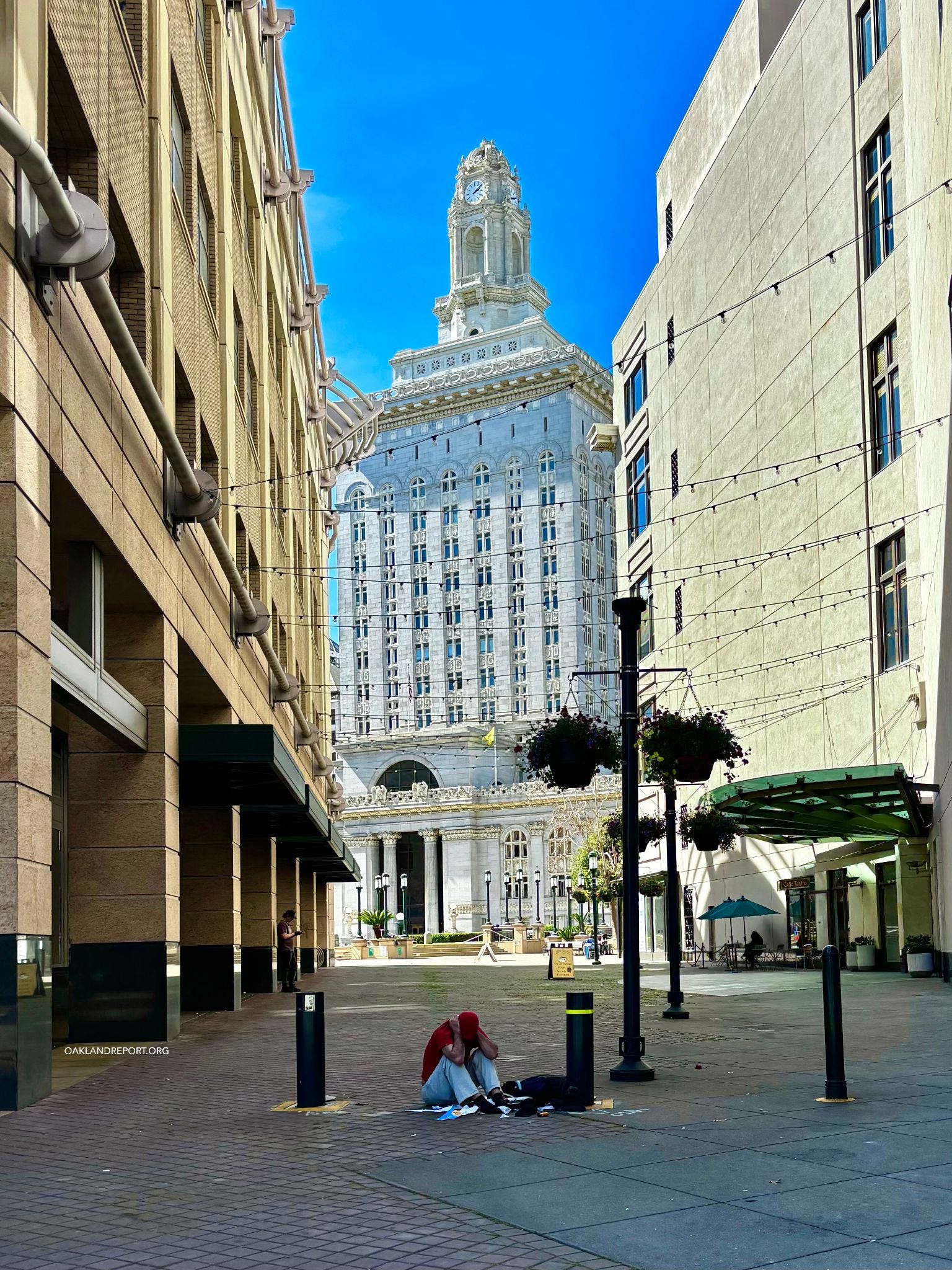
Video clip 1: Encampment on 26th and Wood Street on May 15, 2026. (Source: Oakland Report)
Oakland Report examines the data behind the headlines. Today we look at the preliminary 2026 ‘point-in-time’ homeless count announced by Alameda County on May 19.
Out of sight, out of mind
County officials announced on Tuesday what they called the largest reduction in homelessness Alameda County has ever recorded. Oakland Mayor Barbara Lee offered remarks at the press conference:
“Today is proof that we’re doing the right thing.”
–Oakland Mayor Barbara Lee, on the 2026 preliminary homeless count results, May 19, 2026
The preliminary report on the biennial county-wide point-in-time homeless count found 8,201 unhoused people countywide in 2026, a reduction of 13% since the last count in 2024.1
Oakland, the epicenter of the regional crisis, showed a reduction of nearly 20%.
It is a striking statistic, worthy of critical evaluation. Oakland Report took a closer look at the data and the context around it, and empirical research on the topic of homelessness.
Our key finding: the headline 20% reduction appears not to have taken several relevant factors into consideration:
The 2026 count took place after the largest encampment-clearing sweep in the city’s history.
Oakland’s number of shelter beds did not substantively increase.
Research has concluded that encampment sweeps without shelter beds leads to dispersal, not rehousing of homeless individuals.
The city’s own reports state that Oakland’s homeless population has grown by a net 1,000 people per year.
The county’s latest report of a reduction in the number of homeless people counted is undeniably better news than had the count increased. But more likely than not, Oakland’s 20% count reduction, while technically accurate according to the point-in-time count’s methodology, is overstated.
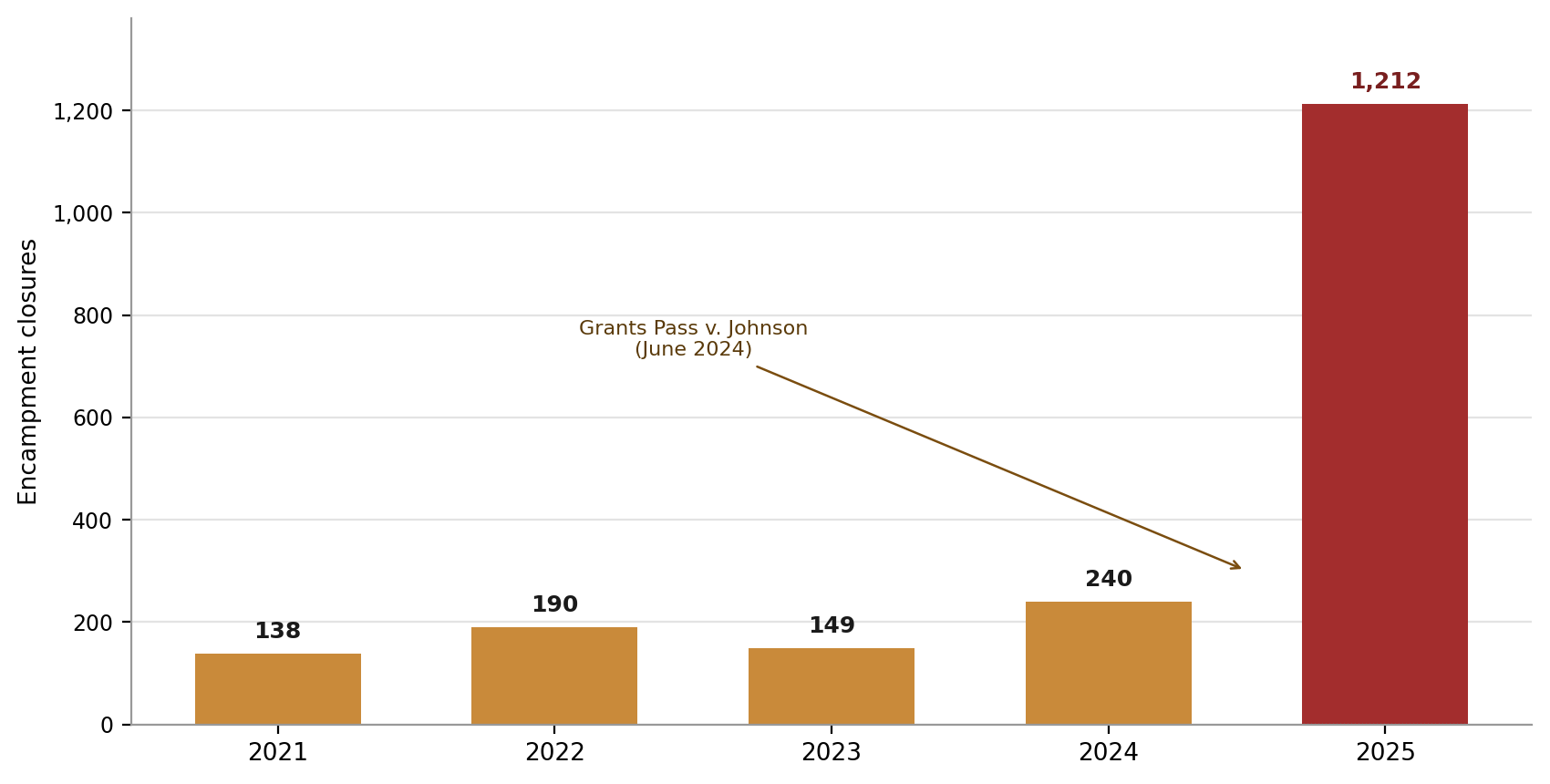
‘Known locations’: The 2026 count took place after the largest sustained encampment-clearing sweep in the city’s history
In the eighteen months before the 2026 point-in-time homeless count took place, Oakland conducted more encampment closures than at any point in its history.
The city completed roughly 140 and 240 closures per year through 2024. Then in 2025, closures surged to 1,212 closures — an increase of more than 600%.2
The point-in-time homeless count takes place every two years. The previous count took place in 2024, before the significant increase in encampment sweeps began. The new count announced on Tuesday was conducted in January 2026, after a sustained, fifteen-month surge in encampment sweeps.
The acceleration in encampment closures was precipitated by the U.S. Supreme Court’s June 2024 decision in Grants Pass v. Johnson, which held that cities may penalize public camping even without offering shelter.
Shortly after the Grants Pass decision, former Mayor Sheng Thao ordered city workers to close all encampments deemed an “emergency,” stating that “in no case will emergency or urgent closures be delayed for shelter unavailability.”
This change is significant because Alameda County’s methodology, adopted in 2024 and reused in 2026, sends volunteers to ‘known locations’ — sites where outreach workers already know unhoused people are living.3
When encampments are repeatedly dispersed, ‘known locations’ are less likely to have encampments when volunteers show up. And new encampments, especially smaller ones, may not be among the ‘known locations’ yet.
Oakland’s number of shelter beds did not substantively increase
If the 2026 decline reflected genuine shelter placements, then it is reasonable to expect that the number of sheltered homeless people would have grown roughly in equal measure to the decline in the number of unsheltered homeless people counted. It did not.
Oakland’s sheltered population nearly doubled between 2017 and 2022, due largely to COVID-era Project Roomkey hotels.4
Since then, the number of shelter beds has not significantly increased.
As of Thao’s September 2024 order to close encampments, the city counted roughly 1,200 emergency shelter and transitional housing beds, 280 safe RV parking spaces, and 600 permanent units developed since 2020.5
Then, in 2025 and 2026, Oakland began closing shelters, including the 3rd & Peralta community cabins, the 71st Avenue RV safe parking site, and Mandela House.6
When the last point-in time count was taken in 2024, Oakland had approximately 1,826 shelter beds. The city has not produced data indicating an increase in shelter beds since then.
The data suggests that the roughly 1,075 people who vanished from Oakland’s count between 2024 and 2026 did not all move into Oakland shelters, because there were not enough for them to move into.
Federal data confirms the same plateau in shelter availability county-wide. Each year the U.S Department of Housing and Urban Development (HUD) compiles a Housing Inventory Count for every ‘Continuum of Care’ (CoC) — a census of beds dedicated to homeless residents.
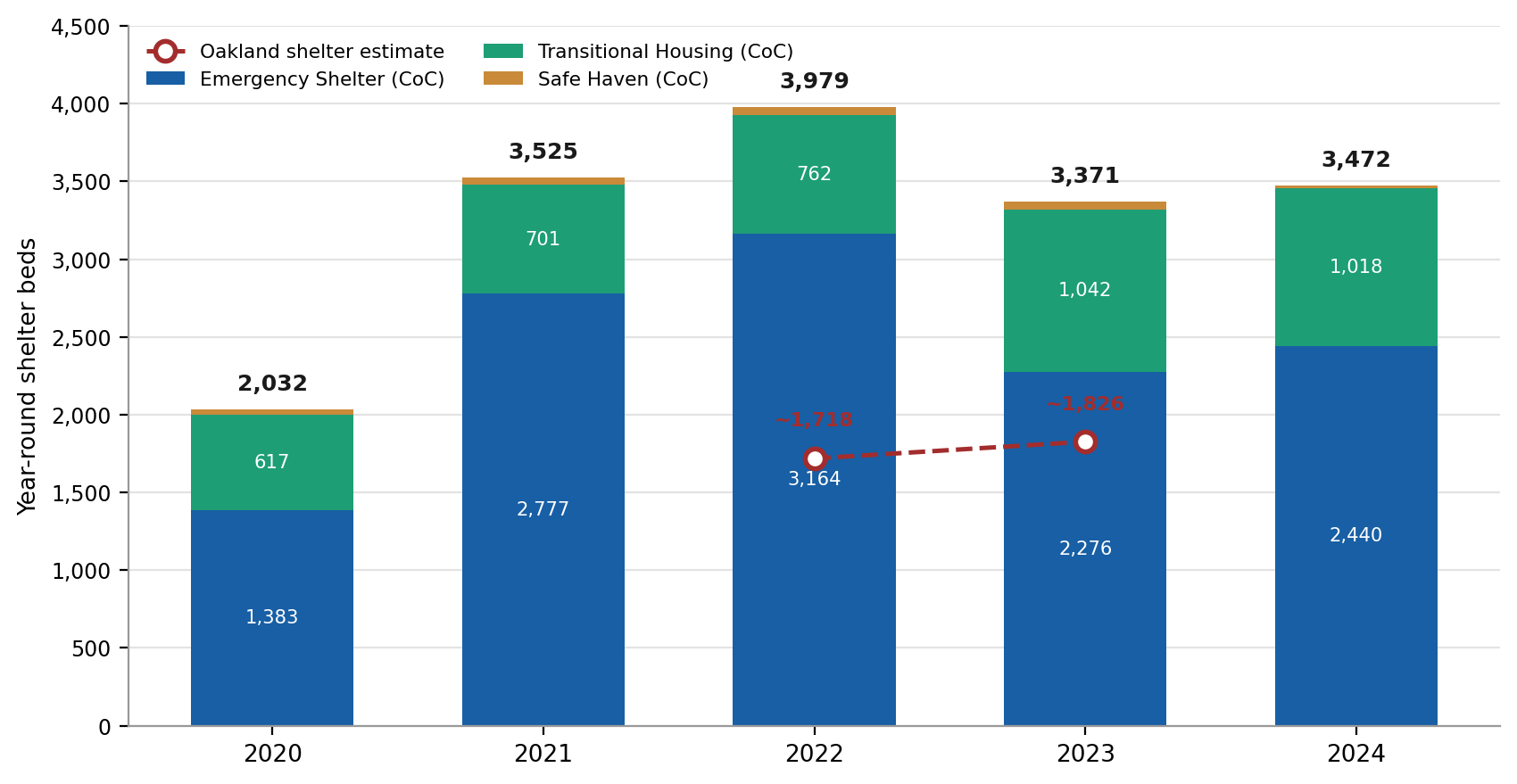
For the Oakland/Berkeley/Alameda County CoC, the combined emergency shelter, transitional housing, and ‘safe-haven’ inventory shows a regional pattern that mirrors Oakland’s.
Countywide, shelter capacity nearly doubled from about 2,000 beds in 2020 to nearly 4,000 in 2022, lifted by COVID emergency funding, then fell back and settled around 3,400 to 3,500 beds — essentially flat for the two years through 2024.7
Permanent supportive housing, counted separately, grew over the same period; but emergency and interim shelter — the beds that an unsheltered person displaced by a sweep could actually move into that night — did not.
The available Oakland-specific data — roughly 1,718 people sheltered in 2022 and 1,826 in 2024 — indicate that Oakland accounts for somewhere between 40 and 55 percent of the entire county’s shelter capacity.
These two points are a count of people sheltered on the nights of the point-in-time counts rather than a bed-capacity census, so they are an estimate, not a precise inventory. But the estimate moved by only about 100 people across two years.
Across every available measure, Oakland’s shelter supply was flat or shrinking during the window when its homeless count at ‘known locations’ fell by 20%.
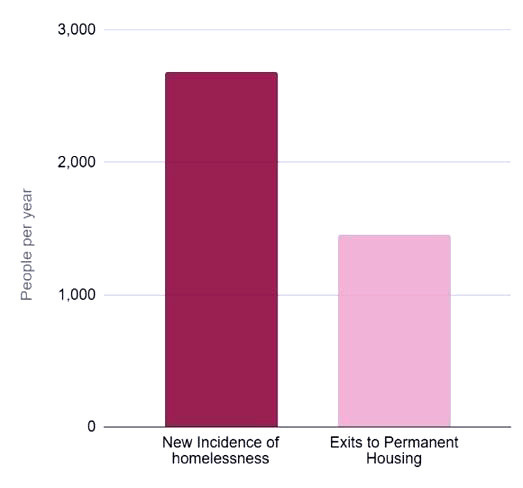
Oakland’s homeless population has grown by 1,000 people per year
Oakland’s 2026 Anti-Displacement Strategic Action Plan found that more than 2,550 people become newly unhoused in the city each year, while the system facilitates only about 1,500 exits — a net increase of over 1,000 people annually.8
The plan conceded even the 2,550 number “is unfortunately an undercount,” excluding people who return to homelessness and those who never enter a shelter program.
It seems unlikely that a system adding a thousand people a year could produce a 1,075-person two-year decline through shelter and housing placement alone.
(According to news reports, the county’s director of Housing and Homelessness Services Jonathan Russell stated that Alameda County saw more people exit homelessness than enter in 2025, however the data provided in the preliminary results does not include that information.)9
Read this related article:

Data suggests that dispersal is a factor
If people were swept out of ‘known locations’ of Oakland encampments without additional shelter beds, it stands to reason that many of them would move to other locations nearby, including, in some cases, other areas of the county.
The county’s own city-by-city point-in-time count data offers additional insight into this question.
The 2026 point-in-time figures show six of fifteen Alameda County jurisdictions saw increases in homeless people counted between 2024 and 2026.
All three of the East County cities increased: Livermore (+24%), Pleasanton (+37%), and Dublin (+60%). The unincorporated county rose 11%. Berkeley rose 4%. Fremont rose 6%. Regionally, the East County climbed 29% — an increase of 107 people.
East County’s gain accounts for only about a tenth of Oakland’s reported loss. But the direction is notable, and it is what dispersal predicts: the city sweeping hardest loses population while its suburban neighbors and unincorporated fringes gain.
The rest are likely dispersed into less-visible corners of Oakland itself — places a ‘known locations’ count are less likely to detect — and some, perhaps, into departures from the county.
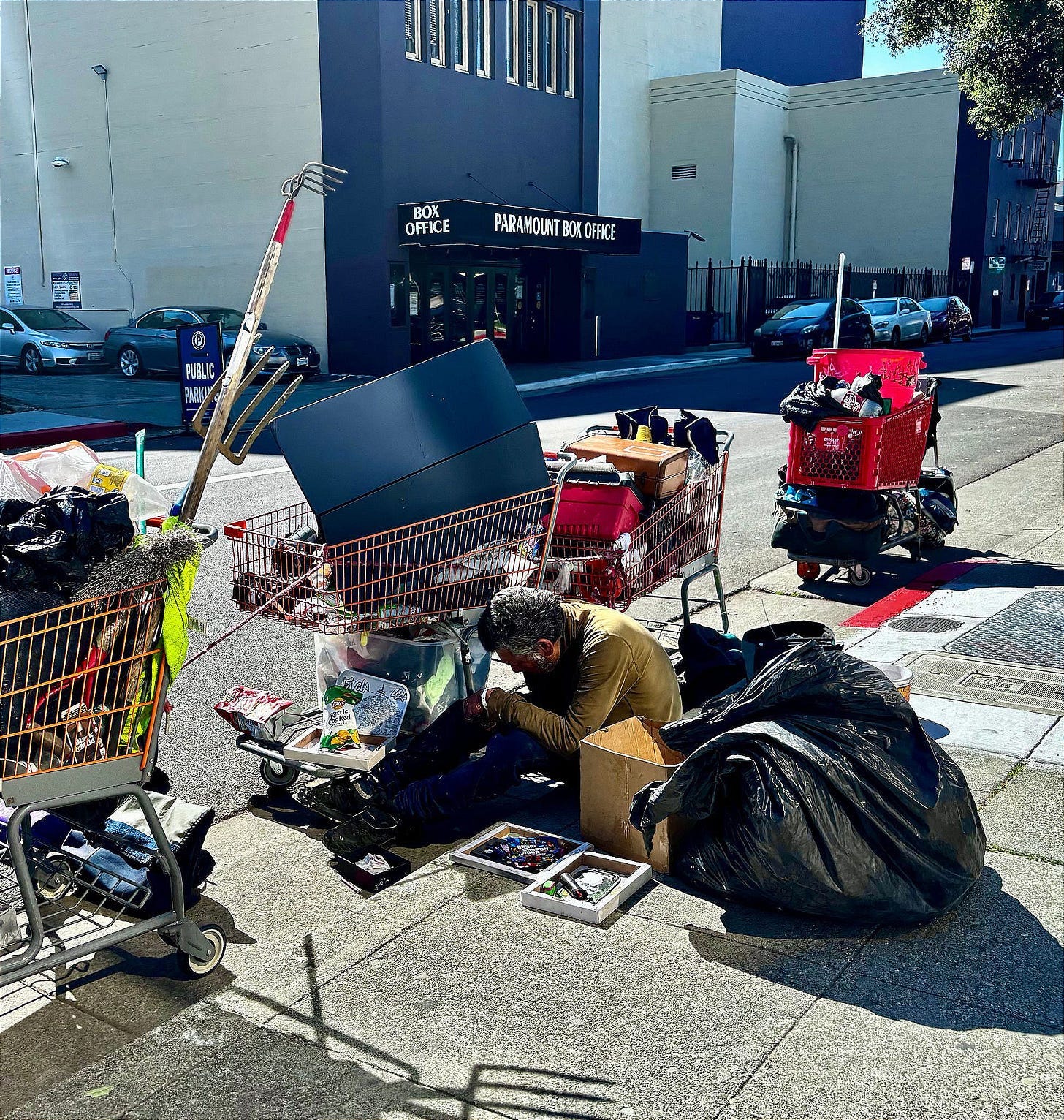
Sweeps without shelter tend to disperse people, not reduce actual homelessness: research
A substantial body of peer-reviewed research has examined what happens when cities clear encampments.
A July 2025 report by the National Association of County and City Health Officials found that more than 90% of displaced people remain in public spaces afterward, and nearly two-thirds simply move down the street. According to that report, “Encampment sweeps do not reduce homelessness. Nor do they improve housing access.”10
A landmark 2023 simulation study by the Centers for Disease Control and the National Health Care for the Homeless Council modeled involuntary displacement across 23 American cities. In hundreds of projections, no scenario in any city showed sweeps producing neutral or positive outcomes.11
Additionally, the practice of sweeps was estimated to contribute to 15% to 25% of deaths among the unsheltered population over a decade.
The American Public Health Association, in a January 2024 brief, called forcible displacement “a temporary cosmetic fix” that “does little to effectively connect unhoused people to services and housing.”12
Dr. Aislinn Bird, who directs integrated care for Alameda County Health Care for the Homeless, described these impacts to KQED in October 2025: “Before we would pull up to a large encampment and people would come to us; they knew that we were going to be there and provide care. Now that folks are so dispersed, we often lose track of them.”13
If the county’s clinicians lose track of patients after sweeps, it stands to reason that a count that depends on knowing where people are will lose track of them too.
Why the preliminary ‘point in time’ number will likely stand in the public’s awareness
The headline number of “a 20% reduction in homelessness in Oakland,” absent the additional context outlined in this report, is likely to remain the public story for months, shaping budgets, speeches, and the narrative that current strategy is working.
The county’s recently announced point-in-time results are preliminary. The county says it will release the comprehensive report in the fall.
A more comprehensive, nuanced conclusion of the preliminary data is this: Some real reduction in homelessness has occurred — but likely due in part to reduced visibility of homeless people as a result of Oakland’s unprecedented surge in encampment sweeps.
The 2026 count’s preliminary results are encouraging, but likely are overstated. The data and research suggest that some of that claimed success was not due to reducing homelessness, but by making homelessness harder to see.
WE ARE 100% SUPPORTED BY YOU
Oakland Report provides accurate, unflinching, data-driven reporting and analysis that you will find nowhere else. If you value our work, please donate. All contributions go directly to sustaining and growing our nonprofit work:
Note: This article has been updated with a parenthetical paragraph on a news report that county director of Housing and Homelessness Services Jonathan Russell stated that Alameda County saw more people exit homelessness than enter in 2025.
County of Alameda. “2026 Point-in-Time Count: Initial Results.” Alameda County Health, May 19, 2026. https://weblink.alamedacountyca.gov/ACHHS/DocView.aspx?id=484&dbid=0&repo=ACH-DocumentLibrary&cr=1
City of Oakland. "Homelessness Strategic Action Plan." Commission on Homelessness, Feb. 25, 2026. https://www.oaklandca.gov/files/assets/city/v/1/public-meetings/commission-on-homelessness/2026/april-2026/homeless-sap-commission-
County of Alameda. “Jurisdictional Leads Resources for the 2026 Point-in-Time (PIT) County in Alameda County.” Alameda County EveryOne Counts, Jan. 22, 2026. https://pointintime.info/volunteer/alameda-county-jurisdictional-leads/
Ruby, Courtney et al. “Performance audit of the City of Oakland’s homelessness services.” Office of the Oakland City Auditor, Sept. 19, 2022). https://www.oaklandauditor.com/wp-content/uploads/2022/09/20220919_Performance-Audit_The-City-of-Oaklands-Homelessness-Services_Final.pdf
City of Oakland. “Executive Order on homeless encampments” Office of Mayor Sheng Thao, Sept. 23, 2024. Cited in City of Oakland, "Encampment management team October 2024 update." https://www.oaklandca.gov/files/assets/city/v/1/human-services/documents/unhoused/october-2024-update.pdf
Orenstein, Natalie. “As 3 Oakland homeless shelters close, city and residents question outcomes.” The Oaklandside, Mar. 31, 2026. https://oaklandside.org/2026/03/31/oakland-homeless-shelters-close-3rd-peralta-hceb/
HUD CoC Performance Profile, CA-502 Oakland/Berkeley/Alameda County CoC, Housing Inventory Count Summary. Year-round shelter beds. https://files.hudexchange.info/reports/published/CoC_Perf_CoC_CA-502-2024_CA_2024.pdf
City of Oakland. “Anti-Displacement Strategic Action Plan.” Oakland Housing and Community Development. Winter 2026. https://www.oaklandca.gov/files/assets/city/v/3/housing-comm-dev/documents/reports/hcd-anti-displacement-strategic-action-plan-2026.pdf
DeBenedetti, Kate. “Homelessness is down in Alameda County. Can it maintain that progress?” KQED, May 19, 2026. https://www.kqed.org/news/12084262/homelessness-is-down-in-alameda-county-can-it-maintain-that-progress
National Association of County and City Health Officials, "The Public Health Impacts of Encampment 'Sweeps'" (July 2025). https://www.naccho.org/uploads/downloadable-resources/FINAL-ES-Brief-Combined-7.28.2025.pdf
Joshua A. Barocas et al., "Population-Level Health Effects of Involuntary Displacement of People Experiencing Unsheltered Homelessness Who Inject Drugs in US Cities," JAMA, Apr. 10, 2023. https://jamanetwork.com/journals/jama/fullarticle/2803839
American Public Health Association. "Displacement of Encampments." Jan. 16, 2024. https://www.apha.org/policy-and-advocacy/public-health-policy-briefs/policy-database/2024/01/16/displacement-of-encampments
McClurg, Lesley. “The hidden health risk behind Bay Area homeless encampment sweeps.” KQED, Oct. 23, 2025. https://www.kqed.org/science/1998435/the-hidden-health-risk-behind-bay-area-homeless-encampment-sweeps
Oakland Report is an experiment in a new form of media: reasoned, data-driven, well-sourced analysis focused on observable and verifiable evidence. We present the facts and let the reader decide. Learn more at oaklandreport.org.

Do we have ever have discussions about how to actually help?
Wondering where the homeless are now? Just shuffled to another encampment or getting the help that they need?