



Video clip 1. Oakland has long struggled to reduce the volume of trash dumped in its streets. (Sources: Instagram @KTVU2; X @senecaspeaks21; Oakland Report)
Oakland Report examines the data behind the headlines. In this installment, we take a look at how five local media outlets covered Oakland’s $9.2 million Crankstart illegal dumping grant — and compare it to the city audit questioning its main strategy.
Comparing media coverage in Oakland
When news breaks in Oakland, a single event can be told from many different angles across many outlets.
In many media outlets, selective details and unchallenged quotes from interested parties often take the forefront, while other relevant details of an issue are glossed over or even left out entirely.
This fragmentation is partly a function of media outlets’ limited capacity — and readers’ limited attention — to dive deeply into a given issue.
The different angles also can be attributed at least partly to traditional journalists’ heavy reliance on quotes from interested parties, official press releases, and press conferences to relay information and tell a story.
Many media outlets’ business models rely on advertising, “sponsored content”, and maintaining access to officials — any of which could quietly influence the resulting story angles.
In some cases, the outlet itself may have a prevailing ideological or political viewpoint that further shapes story selection, word choices, and how information is presented and an issue is framed.
The result is that media coverage of a given issue can be technically and factually true — and still fail to capture the whole picture.
Last month’s announcement of a three-year, $9.2 million grant from Crankstart (billionaire Michael Moritz’s foundation) to fight illegal dumping primarily through enforcement after dumping happens, offers a test case.
The grant announcement1 came one week after voters rejected Measure E, the parcel tax whose supporters, including mayor Barbara Lee, claimed would help fund illegal dumping enforcement, among other expenses.
The San Francisco Chronicle, CBS News, KTVU, SFGate, and The Oaklandside all covered the city’s announcement and press conference.23456
We examined each article and compared it to the data and findings in the Oakland city auditor’s performance audit of illegal dumping, released seven weeks earlier.7
Key findings:
Media coverage led with enforcement; the audit leads with affordability. All five articles foreground the growth of the camera network from 35 to 85 units. The audit’s first finding is that legal disposal costs too much, with Oakland’s curbside rates 23 to 40 percent above the average of neighboring cities served by the same hauler.
The audit’s main finding was mostly unaddressed. Four of the five articles mentioned the city audit, but none held up Oakland’s high waste removal fees — or the audit’s main recommendation to renegotiate the Waste Management contract — against the enforcement-heavy plan announced at the press conference.
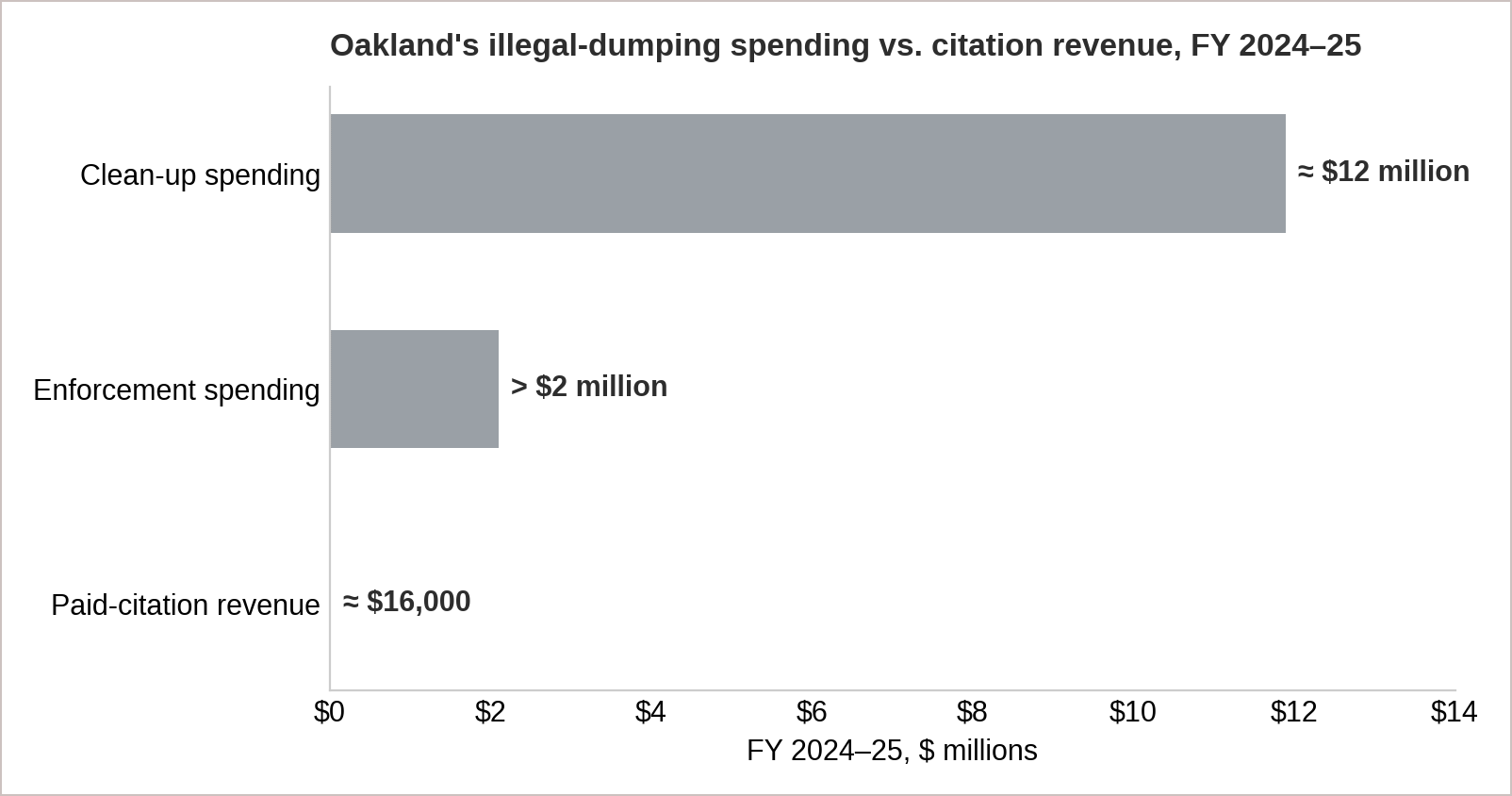
The city audit found camera-based citations were not cost-effective. Five months of monitoring the city’s illegal dumping cameras found that they produced only 10 citations (tickets/fines). In fiscal year 2024–25, Oakland spent more than $2 million on enforcement; but citations returned only around $16,000 in paid fines.
These aren’t the drones you’re looking for: what the five media outlets shared
As each outlet covered, the grant money will help grow Oakland’s network of illegal dumping cameras from 35 to 85, fly more drones around the city to spot illegal dumping sites, test larger trash containers, and raise awareness of free bulky-item pickup.
Nearly all the articles rely heavily on quotes from mayor Barbara Lee, public works director Liam Garland, and Crankstart CEO Missy Narula to convey key information about the grant and the issue it intends to help address.
To be clear, the media outlets’ coverage was factually correct, for the most part — the press conference they covered was focused on enforcement, and reporters faithfully quoted the officials who spoke. But the stagecraft of a press conference and the reality in the official public data are different things.
The public data on illegal dumping is the most authoritative benchmark, so we examine it first.
[Editors’ note: We chose the Crankstart press conference for this analysis precisely because we did not report about it. One of our guiding principles is to focus on what people and organizations do, not what they say. It’s not for us to compare ourselves to other outlets, whose work we recognize and appreciate — and refer to often. People can read Oakland Report’s articles and decide for themselves how our work compares to other media outlets.]
What the city audit of Oakland’s illegal dumping efforts said
Cameras and citations are mostly ineffective. The audit calls the city’s illegal dumping camera program “still developing” rather than failed, but its findings and the underlying data complicate that framing.
The auditor monitored all the city’s camera locations from November 2024 through March 2025, and found that they produced only 10 citations to illegal dumpers. Some cameras sit where they capture no dumping; multiple images have come back too dark or too blurry to identify dumpers; and moving a camera requires a bucket truck and staff time.
Furthermore, the audit found that if a citation is appealed and not easily resolved, the city must provide an independent hearing officer, who often costs more than the citation itself.
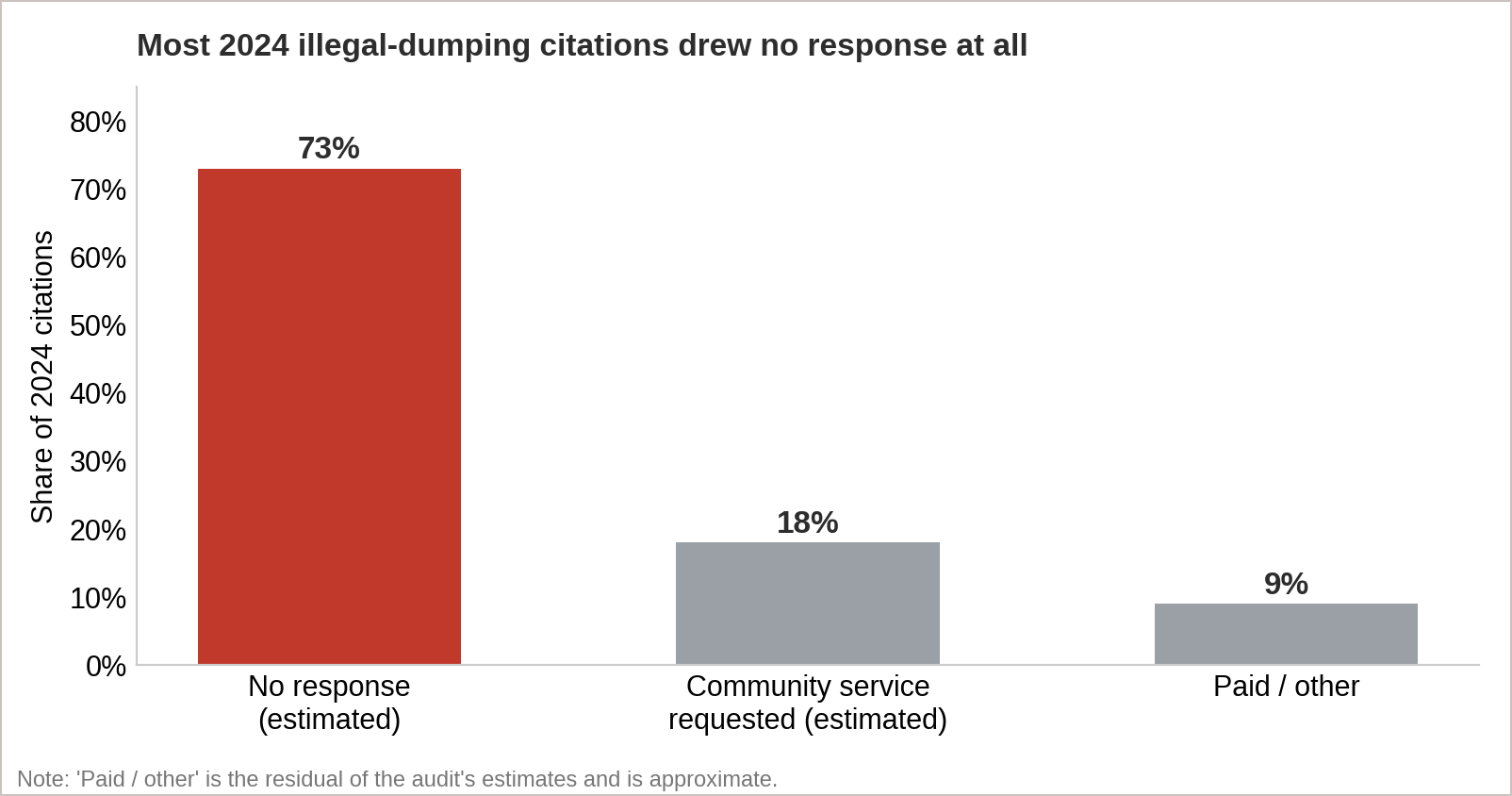
But the audit also found that it rarely comes to that, because an estimated 73 percent of 2024 citations weren’t responded to at all.
In fiscal year 2024–25, paid citations brought in just over $16,000, compared to over $2 million spent on enforcement, and nearly $12 million spent on cleanup.
Poor record-keeping between departments also let over $4,000 in citations expire before they could be filed.
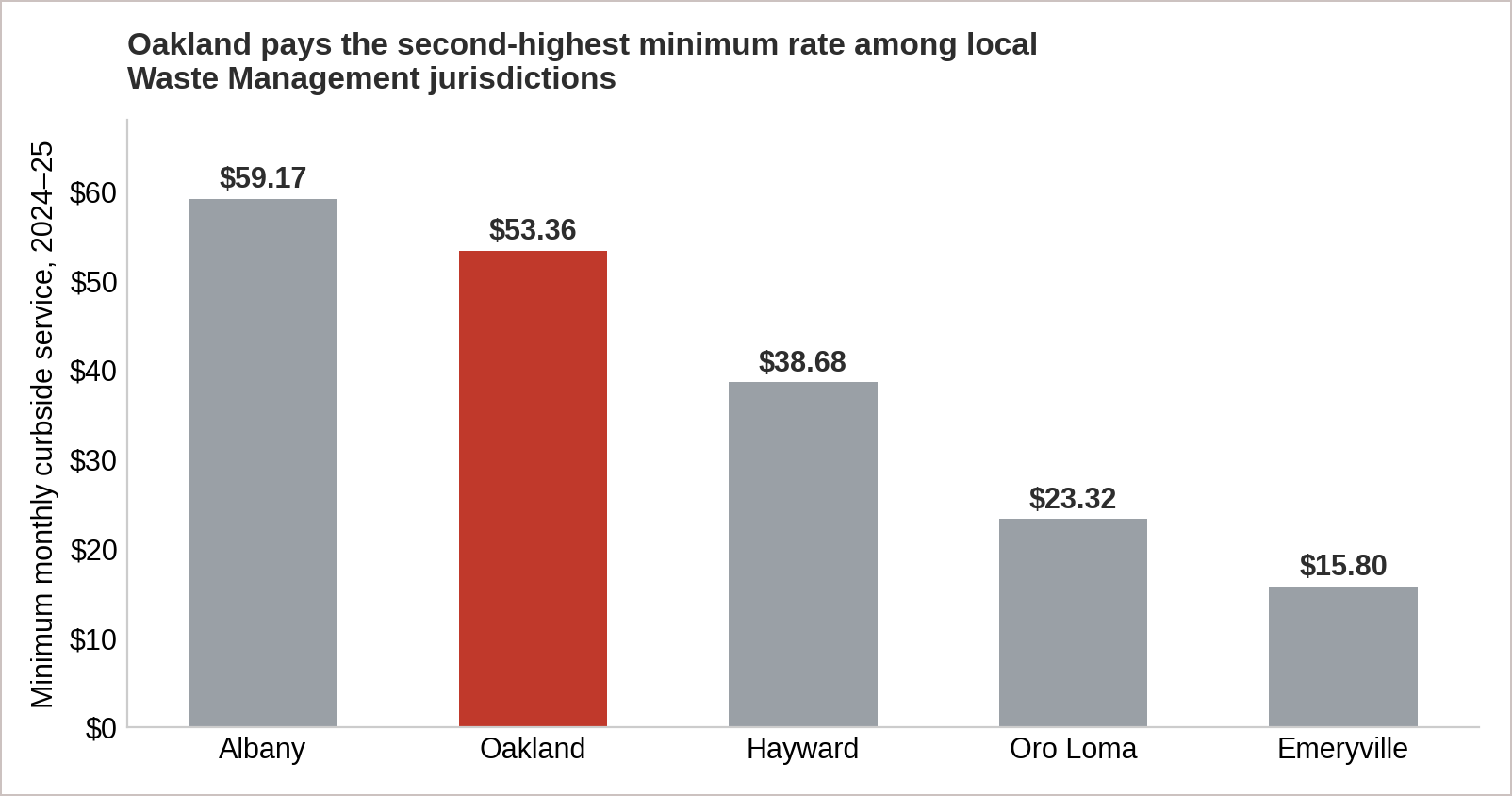
Disposal costs and access are significant barriers. The finding the auditor placed first is about incentives, not enforcement. The audit found that legal disposal (trash pickup and dropoff) in Oakland is expensive.
The audit’s first recommendation is to renegotiate the Waste Management contract or assess other options through a “competitive selection process.”
Minimum monthly service costs $53.36 in Oakland versus $38.68 in Hayward and $15.80 in Emeryville — and Oakland renters don’t have the option of a discounted rate at all.
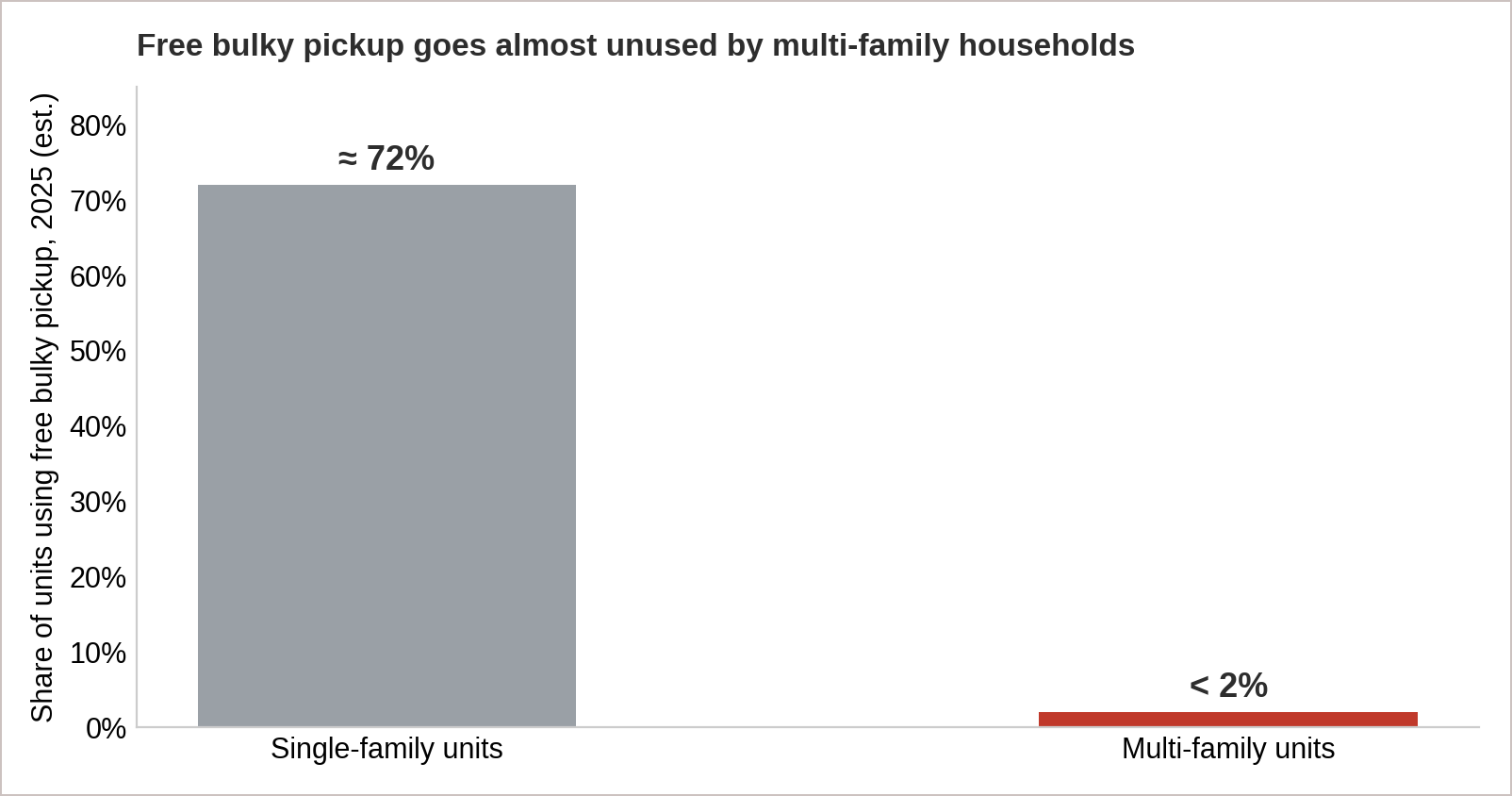
It is true that Oakland offers free bulky pickup, which the public has received well — but it is limited and remarkably underused by apartment dwellers. Single-family homes get two free pickups a year; multi-family (apartment) units get one.
In 2025, about 72 percent of single-family units used a free pickup, but less than 2 percent of multi-family units did — even though they make up 84 percent of residential accounts, and field staff report the largest dump piles near big apartment complexes.
The San Francisco Chronicle: enforcement-first — and the most skeptical of enforcement’s effectiveness
The Chronicle’s article described the Crankstart grant money as funding “tech-focused enforcement initiatives and a few prevention programs.”
It is the only media outlet of the five we examined that quantified what the grant won’t do: fill in for Measure E’s hoped-for $2.1 million for eleven staff positions and $1.8 million for dump trucks, after voters rejected the measure.
Garland, the city’s public works director, supplies the article’s marquee quote: dumpers will “start feeling the pain.”
The Chronicle did briefly mention the audit — reporting that monitoring technology has “provided mixed results” and noting the low number of 10 citations. That skeptical note is where its enforcement discussion ends; the affordability findings aren’t mentioned. (The outlet previously covered the audit in an April story.)8
CBS News: closest to the audit’s focus
CBS News quoted junk hauler Kevin Torrey on renters who can’t afford legal disposal, credits “a recent city audit” for the bulky-pickup gap, and reports a fix others skip — multi-family tenants can now schedule their own pickups.
It also aired a March segment on the city’s use of drones to fly over Oakland and spot illegal dumping sites.9 Its coverage lands closest to the audit’s main focus: cost and access.
KTVU: focused on enforcement to match the press conference’s theme — and a funder’s hedge
The KTVU story leans hardest into deterrence through enforcement — deputy police chief Anthony Tedesco vows to “end your anonymity” — even as Crankstart’s Eli Bildner conceded that “success isn’t guaranteed.”
KTVU’s story does not mention the audit or Measure E.
But KTVU has an enforcement beat: its 2024 investigation reported that the city collected just 11 percent of fines issued, and days after the grant it covered a county grand jury calling Oakland’s approach “abysmal.”10
SFGate: the announcement, lightly examined
SFGate’s article, which was drawn from the Bay City News wire service, hews closest to the press conference: the precise grant figure ($9.275 million), the camera and drone plans, and quotes from deputy police chief Tedesco and Aerbits (the drone company) CEO Brian Johnson.
The SFGATE version does reference Measure E and the audit, naming high disposal costs and enforcement gaps in one early paragraph. It gives the outreach plan real space: Garland says free bulky pickup “gets utilized by between 9 to 20% of our residents,” a number the city wants to increase.
The Bay City News service also had previously covered the audit in April.11
The Oaklandside: the loudest cheer, and the political context
The Oaklandside carries the press conference’s most quotable moment: deputy police chief Tedesco telling dumpers “You should be nervous,” which drew the biggest cheer.
It also does the most to frame the grant politically, against Measure E’s failure and mayor Lee’s promise of bringing in revenue from private funders.
It cites the audit’s finding that the city failed to stop millions of pounds of trash, partly because free “bulky block party” drop-offs ended in 2024.
The rate gap and citation costs don’t appear in its June story — but they had appeared elsewhere. The Oaklandside published an article about the audit in April, and earlier reported that just 25 of the roughly 270 people cited in 2025 paid.12
Its record of coverage on illegal dumping is the deepest of the four; the audit’s thin presence in its announcement story appeared to be a choice, not a gap in knowledge.
Media coverage at-a-glance
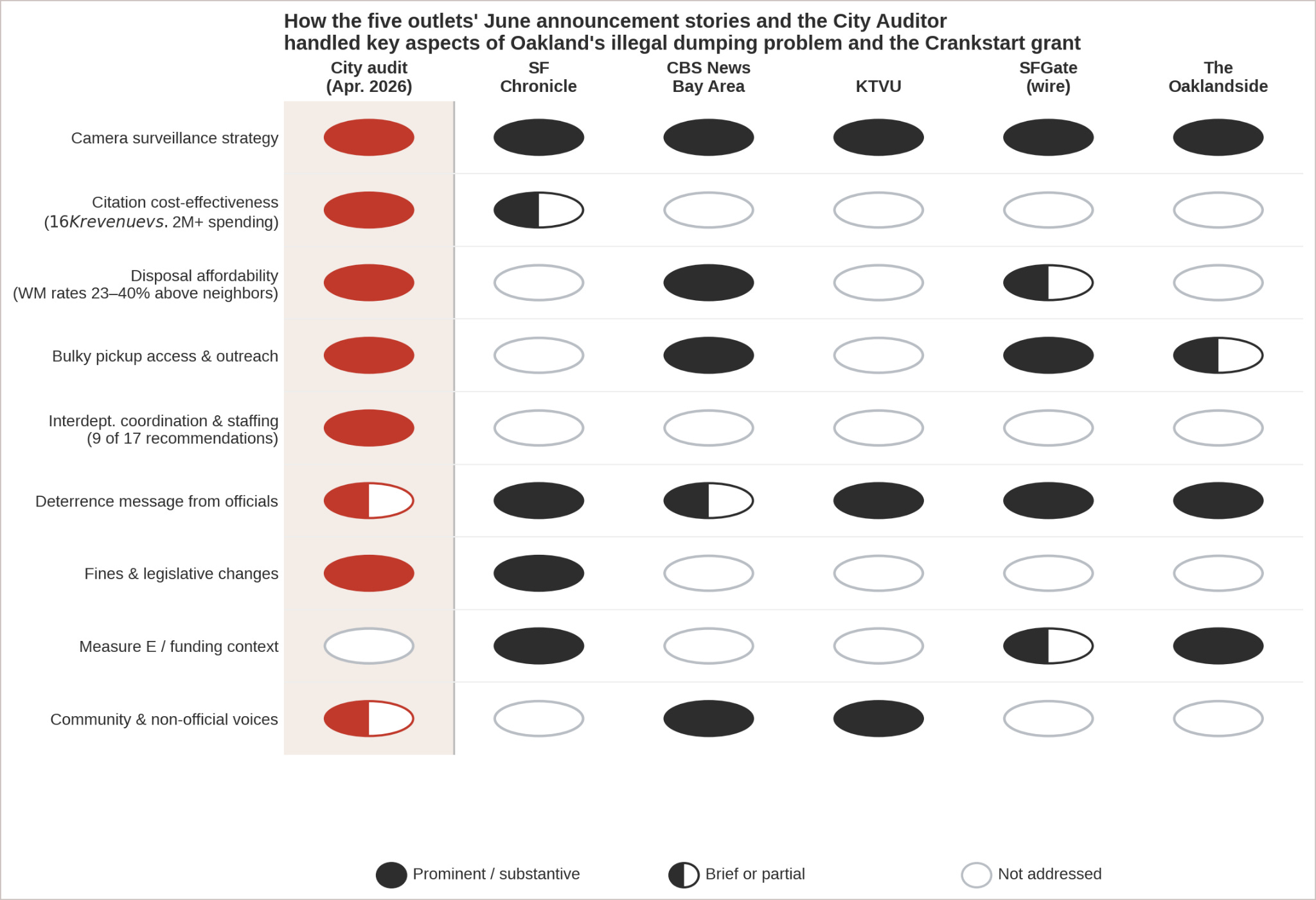
Every outlet focused on the cameras, which is understandable because it was a focus of the press conference. The audit’s next two themes — citation costs and affordability — received far less attention, despite their being natural topics for follow-up questions or fact-checking.
The Crankstart grant itself is broader than the coverage suggests: the city lists container upsizing, outreach, and independent evaluation among its five components.
However, we could find no public announcement or official document that breaks down the $9.2 million grant into specific expenses.
If you like our work, please consider donating. Your contribution helps us continue to produce deep-dive, evidence-based, unflinching articles like this one.
Counterpoints and other considerations
The city says license plate reader upgrades made it four times more likely a dumper caught on camera is cited.
Cameras produced 134 citations from April 2024 to March 2025 — though 54 percent came from a single illegal transfer station.
In April the council doubled the first-offense fine to $1,500, consistent with the audit’s recommendations.
Independent evaluation is a named grant component, answering the audit’s finding that enforcement was never formally measured.
Two of the media outlets had already given readers dedicated audit stories in April; a press conference story is not the same as a program evaluation story.
Information gaps result in a partial picture of a serious issue
Nothing here shows any outlet reported falsely, and this was not ignorance: every June article mentioned the audit, and two outlets had previously covered it in depth.
The gap is in connection and proportion. The city audit puts affordability first and treats cameras as a developing strategy with a poor cost record; the local media coverage — prompted by the city’s press release and press conference — did the reverse.
With how fast the media environment moves, readers should be able to grasp the bigger picture — or at least its most important parts — in any one article. At the very least, a healthy news ecosystem offers diversity among outlets rather than the same framing again and again.
These issues play a significant role in people’s understanding of the government decisions that affect our lives, for better or for worse.
A reader who encounters this story only through these articles would reasonably conclude that catching dumpers is the plan — with little way of knowing that the city’s own auditor had concluded, seven weeks earlier, that the cheaper and likely more effective path to cleaner streets actually runs through the price of a garbage bin.

WE ARE 100% SUPPORTED BY YOU
Oakland Report is an experiment in a new form of media. Our nonprofit mission is to provide accurate, data-driven reporting you will find nowhere else. If you value our work, please become a supporting member today.
About the authors
Phoebe Vo is an incoming second year student at University of California, Berkeley, where she works as a reporter for the Daily Californian university newspaper. She has more than five years of experience in journalism. Her goal is to continue her career covering issues important to the Bay Area. Phoebe is a participant in Oakland Report’s inaugural summer internship program.

Sean S. Reinhart is a former library director, now retired after 26 years in local government. He served as library and community services director for the cities of Hayward and Menlo Park for a combined 16 years, where he helped build Hayward’s new main library and Menlo Park’s new multi-service community center. His post-retirement endeavors include serving as the managing editor of Oakland Report.
Sean and his family have lived in Oakland for 15 years. He grew up in nearby Hayward. Sean enjoys exploring California’s world-renowned coastline, valleys, deserts and mountains. His creative pursuits include writing, printmaking, carpentry, music and visual arts. He enjoys meeting new people, reading, hiking, gardening, and spending time with his family.

City of Oakland. “Mayor Lee & Crankstart announce historic $9.2M investment to combat illegal dumping in Oakland.” City of Oakland press release, June 11, 2026. https://www.oaklandca.gov/News-Releases/Mayor-Babara-Lee/MAYOR-LEE-CRANKSTART-ANNOUNCE-HISTORIC-9.2M-INVESTMENT-TO-COMBAT-ILLEGAL-DUMPING-IN-OAKLAND
Talerico, Kate. “Barbara Lee lands $9.3 million philanthropic boost for Oakland anti-dumping efforts.” San Francisco Chronicle, Jun. 11, 2026. https://www.sfchronicle.com/eastbay/article/dumping-trash-oakland-crankstart-22298389.php; https://archive.is/m35h2
CBS News contributors. “Oakland lands $9.3M in funding to fight illegal dumping as residents seek easier disposal options.” CBS News, Jun. 11, 2026. https://www.cbsnews.com/sanfrancisco/news/oakland-illegal-dumping-funding-disposal-options/
Lee, Henry. “Illegal dumping crackdown in Oakland; funding from SF foundation.” KTVU, Jun. 2026. https://www.ktvu.com/news/oakland-gets-9m-from-sf-foundation-crack-down-illegal-dumping
Gokhale, Tanay / Bay City News Service. “Oakland: city receives $9.2 million investment to combat illegal dumping.” SFGate, Jun. 11, 2026. https://www.sfgate.com/news/bayarea/article/oakland-city-receives-9-2-million-investment-to-22302071.php
Bondgraham, Darwin and Eli Wolfe. “SF tech investor pours $9M into illegal dumping fight in Oakland.” The Oaklandside, Jun. 11, 2026. https://oaklandside.org/2026/06/11/illegal-dumping-crankstart-foundation-grant-oakland/
Houston, Michael C. et al. "Performance audit of illegal dumping: improvements to the accessibility of legal waste disposal and the city's enforcement and remediation policies and operations could help alleviate Oakland's illegal dumping problem." Office of the Oakland City Auditor, Apr. 23, 2026. https://www.oaklandauditor.com/wp-content/uploads/2026/04/20260423_Performance-Audit-of-Illegal-Dumping-1.pdf
Talerico, Kate. "Oakland spent $2M to collect just $16K in illegal dumping fines. Could new laws help?" San Francisco Chronicle, Apr. 23, 2026. https://www.sfchronicle.com/eastbay/article/oakland-illegal-dumping-fines-violators-22220949.php; https://archive.is/mhQRS
Nielsen, Katie. “Oakland considering using drones to crack down on illegal dumping sites.” CBS News (video), Mar. 26, 2026. https://www.cbsnews.com/sanfrancisco/video/oakland-considering-using-drones-to-crack-down-on-illegal-dumping-sites/
Lee, Henry. "Oakland's approach to illegal dumping 'abysmal,' civil grand jury says." KTVU, Jun. 2026. https://www.ktvu.com/news/oaklands-approach-illegal-dumping-abysmal-civil-grand-jury-says
Agcaoili, Gabe. “Oakland audit concludes high garbage costs, weak enforcement drive illegal dumping.” Bay City News / Local News Matters, Apr. 27, 2026. https://localnewsmatters.org/2026/04/27/oakland-audit-concludes-high-garbage-costs-weak-enforcement-drive-illegal-dumping/; see also Russell, Kiley. “Oakland leaders tout illegal dumping crackdown with tougher fines, AI tech.” Bay City News / Local News Matters, Apr. 21, 2026. https://localnewsmatters.org/2026/04/21/oakland-illegal-dumping-fines-drones-ordinance/
Wolfe, Eli. “Oakland’s illegal dumping strategy isn’t working. A new report explains why.” The Oaklandside, Apr. 23, 2026. https://oaklandside.org/2026/04/23/oakland-illegal-dumping-audit-2026-waste-management/; see also Wolfe, Eli. “Illegal dumpers could have vehicle registration blocked under proposed law.” The Oaklandside, Mar. 9, 2026. https://oaklandside.org/2026/03/09/illegal-dumping-oakland-dmv-vehicle-registration-fines-jesse-arreguin/; Wolfe, Eli. “Illegal dumping fines could go up a lot in Oakland.” The Oaklandside, Mar. 16, 2026. https://oaklandside.org/2026/03/16/illegal-dumping-fines-could-go-up-a-lot-in-oakland/; Bondgraham, Darwin. “AI drones to spot illegal dumping? Oakland is considering a pilot project.” The Oaklandside, Apr. 10, 2026. https://oaklandside.org/2026/04/10/drones-illegal-dumping-oakland-aerbits/
According to the auditor's report, the cameras from DPW don't result in enough citations to justify their cost. When the annual report was presented to the Privacy Advisory Commission (PAC) last year, DPW couldn't explain the camera locations nor its effectiveness. The footage is sent off-site for viewing and filtering - which is in itself a huge amount of time spent for low yield. These cameras capture video, faces, cars, etc and the data sharing policies are also very loose - having the off-site vendor sign off on a generic release form, and upload footage to a City-owned shared drive. https://www.oaklandca.gov/files/assets/city/v/2/public-meetings/privacy-advisory-commission/2025/11-6-2025-privacy-advisory-commission-meeting-agenda-packet.pdf
Although DPW does now have ALPR, and PAC approved recent expansion of existing Flock ALPR cameras for DPW use for illegal dumping, the actual yield so far has been minimal, as was described in this article.
As for the drone program - this is a pilot program, in which Oakland is the first city to use the technology. The founder/creator/engineer noted at PAC that the training set is about 15,000 photos of trash piles around his neighborhood. The drones are used to scan and create new 311 requests and prioritize existing 311 requests. It can also close 311 requests once the site is cleaned up.
https://www.oaklandca.gov/files/assets/city/v/2/public-meetings/privacy-advisory-commission/2025/11-6-2025-privacy-advisory-commission-meeting-agenda-packet.pdf
However, the auditor's report describes how this "proactive" reporting leads to increased lead times for crews to clean up dumping sites and increased community frustration - so DPW actually returned to just responding to 311 requests (a "reactive" approach). In addition, this does not prevent recurrent dumping at the site.
I'm just including this additional information because I do believe the auditor's report is an excellent analysis of a very complicated topic and has concrete observations and recommendations, which unfortunately are not being heeded by the rest of City Hall. For me, the key finding is that the majority of illegal dumping is residential trash - and the recent report of delinquent trash fees shows that the City is owed over $7 million dollars in delinquent trash fees from property owners that don't pay for trash fees.
Per the report: "If the City fails to collect or recover its costs, including administrative fees, the City’s Mandatory Trash Fund (1700) may incur a loss of up to $2,037,824.00, resulting in a negative Fund balance."
https://acrobat.adobe.com/id/urn:aaid:sc:US:3a1c97d3-f1ed-43d2-b9bc-cb4203f35170
There is one thing we as Oaklanders can do to make a dent in the illegal dumping. There are two big items in the city’s court (renegotiate with Waste Management and legislate the commercial special assessment). These are important, but the public doesn’t control them.
There is an item that we all control. It doesn’t require another program. It doesn’t require permits or even increased enforcement. It is simple. Please help spread the word.
STOP PAYING PRIVATE HAULERS IN ADVANCE FOR THEIR SERVICES.
STOP PAYING IN ADVANCE.
STOP NOW.
The most powerful tool is to collapse the economics of the private junk hauling. Force them to take your “stuff” to the correct location and dump it properly. Require that they send you confirmation that the job was done correctly. They can text a photo of the dump slip. They can text photos of your “stuff” at the transfer facility. Pay them with an electronic application. They can dump, verify, and get paid within a matter of minutes.
STOP PAYING IN ADVANCE.
You can only change behavior by changing the economics. There are times for sticks and times for carrots. This is a time to incentivize the correct behavior versus the widely believed notion that enforcement is the best medicine.
STOP PAYING IN ADVANCE.