

By GAIL WALLACE and MICHAEL W. WALLACE
Editor’s note: Oakland Report’s charter reform series is exploring Oakland’s city charter and how it potentially could change — a question that Oakland voters are being asked on November’s ballot with Oakland’s Measure EE. We invited Gail Wallace, board member at League of Women Voters of Oakland, and Michael W. Wallace, senior pastor at Mount Zion Missionary Baptist Church to offer their commentary for our readers to consider. Earlier this week, we published a commentary from Measure EE opponents. Other installments in our charter reform series share counterpoint perspectives from prominent participants in the charter reform debate.
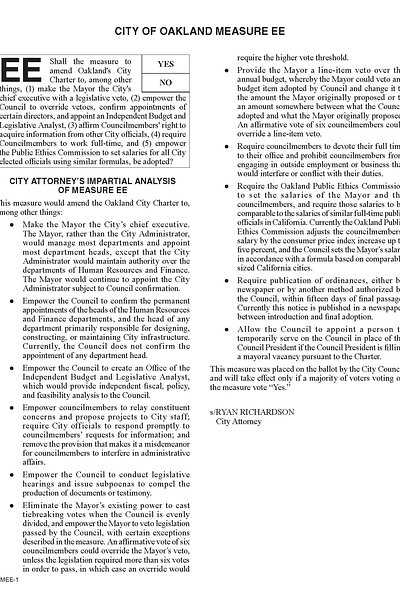
Measure EE would give the mayor clear responsibility for running city government.
“Make it clear who is responsible.” That is the call to action we heard again and again when asking Oaklanders how city government could work better.
For six months, the League of Women Voters of Oakland1 and SPUR2 organized citywide outreach to ask residents how changes to the city’s charter could better define the roles of elected officials, improve city financial planning, and increase government accountability and transparency. More than 1,150 Oaklanders weighed in through public meetings in every city council district and surveys. Current and former city staff and elected officials provided their perspectives in interviews.
Across our city, Oaklanders want services they can count on, clear answers when something goes wrong, and leaders who would take responsibility for fixing problems. People said they are confused about who is in charge. They want city hall to respond faster to urgent concerns on the issues impacting our neighborhoods, including public safety, homelessness and illegal dumping.
Subscribe to Oakland Report (it’s free).
A measure on the ballot on November 3 offers an opportunity to meet those expectations.3 Measure EE would give the mayor clear responsibility for running city government. Just as importantly, it would give the city council stronger tools to review decisions, investigate problems, and hold the executive branch accountable.
Measure EE establishes clear accountability.
Today, Oakland’s system divides executive responsibility between an elected mayor and a non-elected city administrator. Under the current charter, the city administrator holds authority over city operations and department leadership that residents often assume belongs to the mayor they elected to run the city.
Measure EE would reconcile these contradictions, making the mayor the city’s chief executive. This would give an elected leader clear authority to direct and coordinate the work of the city administrator and city departments and make it harder to avoid responsibility when that work falls short. Measure EE makes the mayor — not a non-elected administrator — ultimately accountable to voters for results.
Having clear and explicit lines of authority optimizes conditions for making decisions faster, coordinating responses more effectively, and delivering results more quickly on key challenges such as homelessness, public safety, and illegal dumping.

Consider a neighborhood facing repeated illegal dumping. Removing one pile of trash may address the immediate complaint. Preventing the next pile may require several departments to coordinate cleanup, enforcement and longer-term improvements. Residents should not have to untangle city hall’s organizational chart to find out who is responsible for bringing those departments together.
Measure EE strengthens checks and balances.
Measure EE also recognizes that accountability should not begin and end at the ballot box. That’s why the measure includes important checks and balances, strengthening the city council’s ability to demand information from departments, craft sound policy, investigate concerns, and hold the executive branch accountable.
Measure EE:
Gives the city council stronger authority to conduct hearings and issue subpoenas when it needs answers from city departments or outside parties.
Requires council confirmation of key department leaders, including the officials responsible for finance, human resources, public works and transportation. Not every department appointment would require confirmation, but the council would have a formal check on these consequential leadership choices.
Establishes an independent budget and legislative analyst office to support the council, providing them with independent expertise about city budgets, major proposals, and the likely cost of policy decisions. That would help council members ask better questions, make informed decisions and represent their districts more effectively.
Measure EE preserves council members’ ability to request information and report constituent concerns. Just as importantly, it emphasizes the power to call legislative hearings when patterns of constituent concerns point to more systemic problems or a need to rethink or change how we deliver services.
Measure EE would give the mayor veto power over legislation and budget decisions. But it also gives the eight-member council the power to override that veto with six votes. In other words, the mayor can lead, but the council retains the power to decide when a strong majority achieves consensus.
Share this article with someone you know.
Measure EE is the kind of accountable, functional and transparent government Oakland deserves.
These are the practical, common-sense tools for better government that a diverse, complex city like Oakland requires. That’s why Measure EE is backed by a broad coalition, from the League of Women Voters of Oakland, SPUR, Bay Area Council, the Oakland Chamber of Commerce, Empower Oakland and Revitalize East Bay to Oakland Rising Action, East Bay Young Democrats, the Alameda County Democratic Party and labor. A wide range of elected leaders are also championing Measure EE, including mayor Barbara Lee, Oakland council president Kevin Jenkins and council member Charlene Wang, state senator Jesse Arreguín and congresswoman Lateefah Simon.
Of course, no government structure can guarantee honest leadership. More authority must be matched by scrutiny, enforcement and robust public participation. But Oaklanders are asking for a government where responsibility is clear and where the tools to demand answers are stronger than they are today. Under Measure EE, an elected mayor will have the authority to manage city operations and the city council will be better equipped to examine executive decisions and represent residents.
That is the kind of accountable, functional and transparent government Oakland deserves. Join us at www.reformoaklandyesonee.com and vote YES on Measure EE.
— Gail Wallace, board member, League on Women Voters of Oakland
— Michael W. Wallace, senior pastor, Mount Zion Missionary Baptist Church
Don’t miss a beat.
Subscribe to Oakland Report (it’s free).
The views expressed in our Commentaries do not necessarily reflect the editorial views of Oakland Report or its contributing writers.
See these related articles about charter reform:


BECOME A DONATING MEMBER
We rely on our readers’ financial support to continue our work. Your contributions are tax-deductible.
We are a 501(c)(3) charitable nonprofit based in beautiful Oakland, California. Our mission is to make truth more accessible to all Oakland residents. Learn more.
Thank you!
League of Women Voters of Oakland contributors. “Website.” LVWO, accessed Oct. 20, 2026. https://www.lwv.org/local-leagues/lwv-oakland
San Francisco Bay Area Planning and Urban Research Association contributors. “Website.” SPUR, accessed Oct. 20, 2026. https://www.spur.org/
Alameda County Registrar of Voters. “Voter Information Guide: Oakland Measure EE.” Nov. 3, 2026 general election. https://docs.oaklandreport.news/Measure-EE-voter-information-guide_nov2026_eng.pdf
A strong-mayor system could improve service delivery by clarifying executive authority. But stronger executive authority also makes independent financial safeguards especially important.
The Coliseum sale is a good example. Oakland’s Finance Department warned against relying on uncertain sale proceeds, yet the Mayor proposed and Council adopted a budget counting on that money anyway. Additional budget analysis would not necessarily have changed that decision.
SPUR recommended an independent Controller with authority to certify revenues, enforce fiscal policies, and prevent spending without sufficient funds. San Francisco has such an independent Controller, while New York City has an independent budget office with protected funding.
Measure EE strengthens Council oversight, but it does not establish those same protections. The Mayor’s Working Group identified additional fiscal safeguards but deferred them for future consideration.
The question is why Oakland would expand mayoral authority now while leaving safeguards that could help prevent another Coliseum-style budget decision for another day.
There is no doubt Oakland residents want accountability. However once again Oakland takes the low road here. The gatherings I attended hosted by the LWV to discuss charter reform all discussed strong mayor vs what all the other cities have been successfully doing which is a strong council. Same changes just different power structure. All groups preferred to not have a strong mayor. We had hoped both versions would be on the ballot but what does Oakland do but take the one form most people did not want and run with that one alone. It’s just so frustrating to run at full speed into walls. But perhaps EE is the thing to do I just don’t believe the right people are in government to execute on it constructively at this time; the level of incompetence is breathtaking, really. But I do agree we need to run with EE for now and hope for positive changes.