


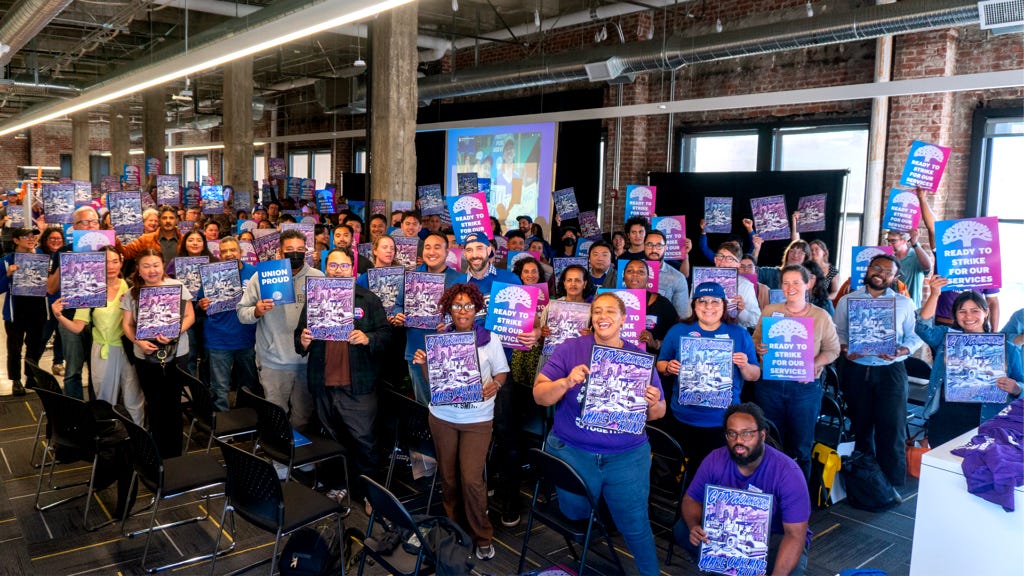
Public sector unions IFPTE Local 21 and SEIU Local 1021 announced plans to picket mayor Barbara Lee’s state of the city speech on Tuesday, Oct. 6. The two unions, which represent the city’s technical and service workers, have been locked in contentious contract negotiations with the city for months.
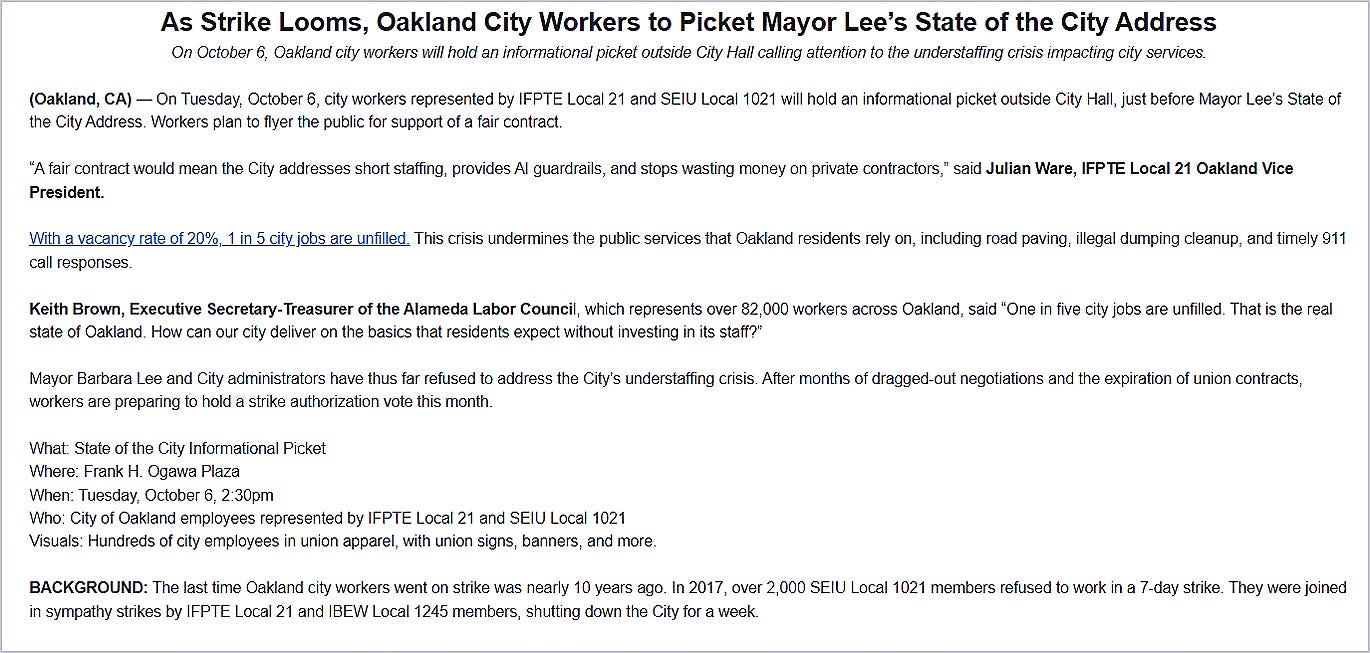
The unions recently held “strike school” sessions to train city workers for a potential strike action.

The city is facing over $100 million in structural budget deficits through the end of the decade. The two unions argue that 1 in 5 city jobs remain unfilled. The unions are largely funded by city workers’ dues withheld from their city paychecks.
The unions’ demands, the city’s reported offers, and the finances
IFPTE Local 21 represents the city’s professional and technical employees including engineers, inspectors, and planners. SEIU Local 1021 represents clerical and front-line service staff. Their combined membership in Oakland includes around 3,100 city employees.
Since bargaining opened, the unions have pressed five demands in bulletins, rallies, and public comment:
Cost-of-living raises
Withdrawal of the city’s proposed benefit concessions (such as health and retirement premiums, the cost of which the city currently pays 100%)
Continued work-from-home, which IFPTE characterizes as a no-cost benefit
Filling vacant positions (the city’s vacancy rate is currently around 20%)
Converting some sworn police desk assignments to civilian jobs.
On that last demand, a May 2025 union-commissioned report identified 38 such positions.12
Editors’ note: Oakland Report is an independent 501(c)(3) nonprofit organization. We are not affiliated with any public agency, labor union, corporate interest or political campaign, and we do not offer political endorsements. We present the evidence we find — especially evidence that is elsewhere overlooked, mischaracterized, or omitted — and let our readers decide what to think about it. Learn more
Where negotiations stand
The contracts for SEIU, IFPTE, the International Brotherhood of Electrical Workers (IBEW) Local 1245, and the Confidential Management Employees Association (CMEA) expired June 30, 2026.
The city has been in negotiations with those unions for months. The city council, which has the final authority to approve or reject proposed contracts, has met in closed session multiple times to discuss the negotiation. The negotiations are led on the city side by unrepresented executive and confidential city staff.
The city has not publicly disclosed its bargaining positions, so most of what has been publicly said about them comes from union bulletins.
By SEIU’s telling, the city’s opening position in May was to request that the employees begin paying more for medical coverage immediately, with further increases in 2027, and to contribute an additional 1% of pay toward pensions — with no cost-of-living raise.3
On Sept. 23, the union called the city’s revised offer “bogus”. It described the offer as 7% pay increases over three years, plus bonuses the union described as not guaranteed and non-pensionable.
SEIU posted a strike-vote schedule on Oct. 1. We could find no announcement of a strike date as of this writing.
We also we could find no public record of an impasse declaration, state mediation, fact-finding, or an unfair labor practice charge before the Public Employment Relations Board (PERB) in this round of bargaining.
California’s public-sector rules generally require impasse procedures to run their course before a lawful economic strike, unless a union alleges unfair labor practices — the route these unions took before the roughly week-long December 2017 strike, which then-mayor Libby Schaaf called unlawful.4
Share this article with someone you know.
A decade of raises
Since the 2017 strike, the civilian unions have received across-the-board raises the total roughly 28% (about 31% compounded), excluding step increases, equity adjustments, and bonuses which raised pay further for specific job classifications. Most of it came in the 14% increases in the 2022–25 agreements.
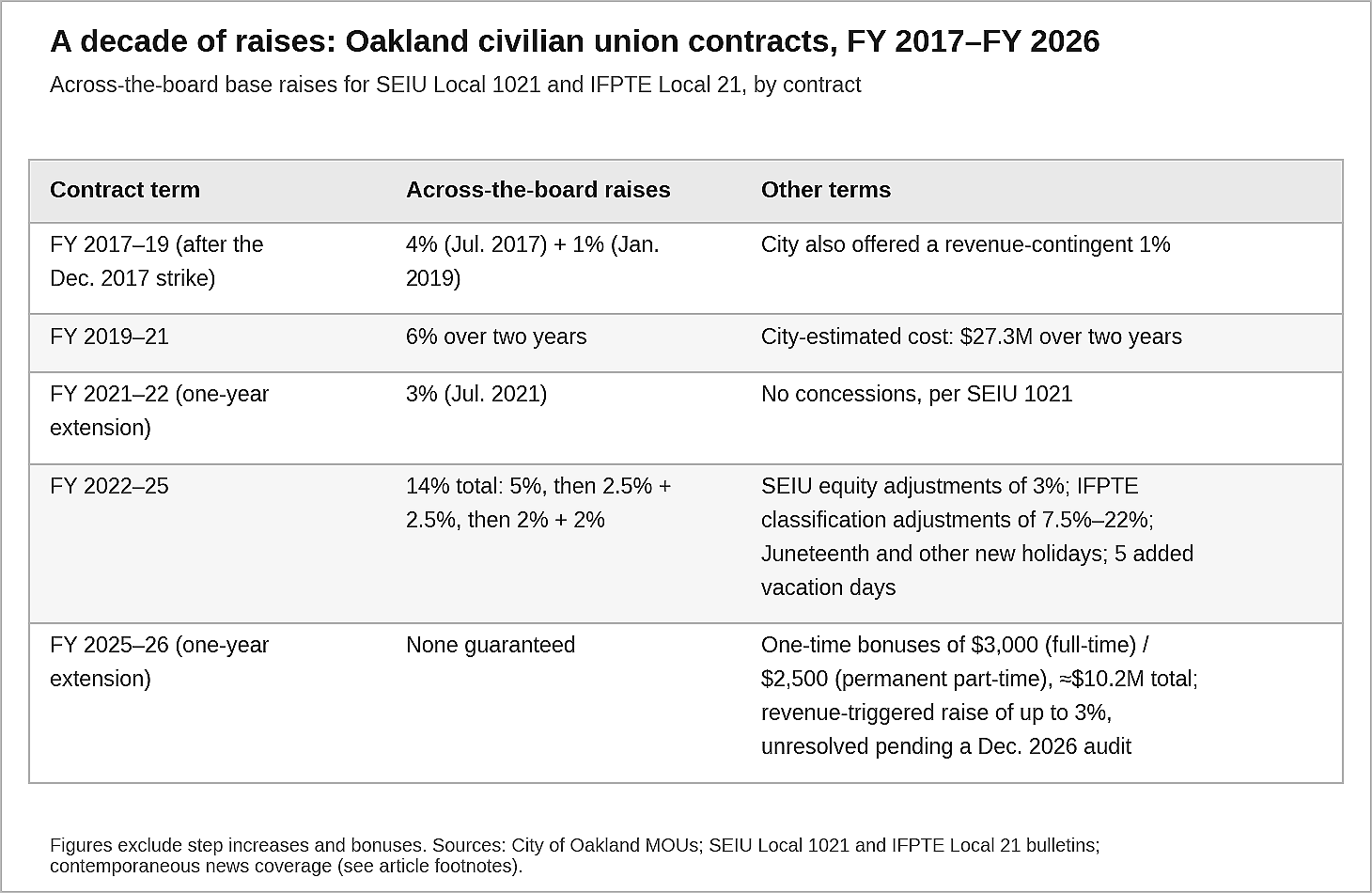
The one-year 2025-26 contract extensions which expired June 30 paid one-time bonuses of $3,000 for full-time and $2,500 for permanent part-time workers — about $10.2 million in total — instead of a base raise.
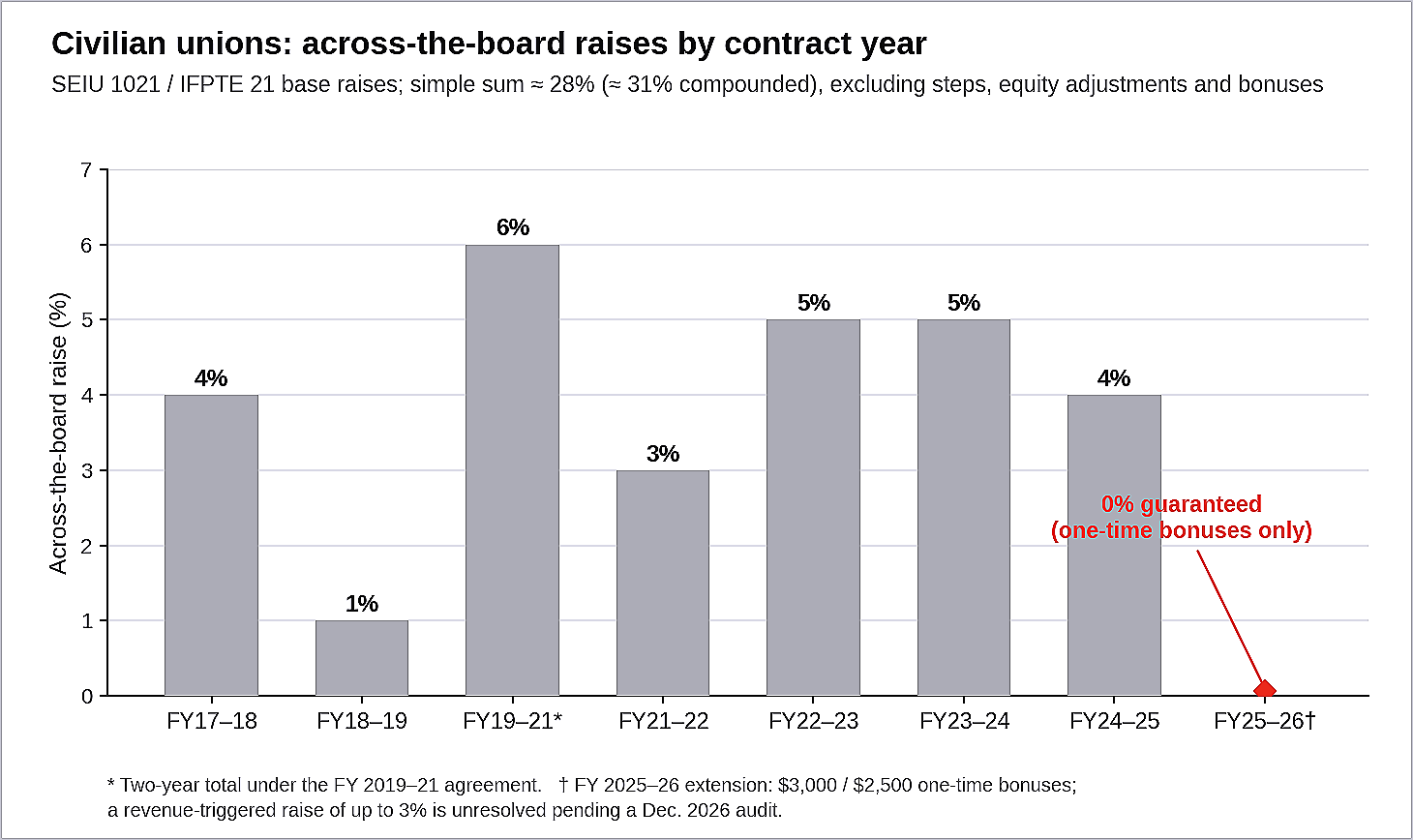
It also included a contingent “triggered” raise of 0.05% for each $150,000 of General Purpose Fund revenue the city receives above a $787.7 million projection, capped at 3%, and to be settled after a year-end audit in December 2026.5
SEIU has stated that members received no raise in the contract's final year. The trigger had not fired as of the city’s third quarter revenue report, and the city has not yet published its year-end 2025-26 report. Thus no final determination has been made yet.
Oakland Report previously found that average total compensation per city employee grew 79% over ten years — a figure that covers all employees, including police and fire overtime and benefits, and should not be read as civilian base-pay growth.6
Related story:

How the police and fire contracts compare
The city council approved a new Oakland Police Officers’ Association (OPOA) contract on September 15, with council member Carroll Fife casting the lone no vote. Its terms run from July 2026 through June 2031:
Raises totaling 14% in nine steps
Longevity pay of up to 15% of base for officers with 20 or more years of service
The city’s share of the cost of employees’ Kaiser premiums stepping down from 100% to 90% by January 2030
Officer pension contributions rising from 12% to 15% of pay by July 2030
A “me-too” clause that gives the police union the same increases that other unions may later negotiate, if those other unions’ increases are greater.[19]
A staff report from the city human resources director estimated the agreement’s net five-year cost to the city at $72.1 million, reaching about $29 million a year by 2031, but not accounting for medical cost inflation.
Related story:

The OPOA MOU covering December 2018 through June 2024 set out and recited every across-the-board increase officers received back to July 2015.7
Compounded from July 2017, police base pay rose about 29.9% through FY 2025–26, compared to about 31.6% for the “civilian” units like IFPTE and SEIU. So, over a decade there have been comparable raises, with the civilian units slightly “ahead.”
The fire union’s decade is documented too, and it is comparable to the police union’s compensation increases. After a 14-month dispute that went to arbitration, an arbitrator’s January 2019 award set IAFF Local 55’s 2017–20 contract in a package the city described as ‘up to 8%’ over three years.8
The current fire MOU, as extended in 2022, then delivered 2.5% (Jan. 2021), 1.5% (Jul. 2021), 2% (Jan. 2022), 3.5% (Jul. 2022), 3.5% (Jul. 2023), 3% (Jul. 2024), and 3% (Jul. 2025).
Compounded from July 2017, that is about +29.2% — within a point of police — or +30.5% if the contingent raise ultimately is “triggered” when the city’s fourth quarter financial report is released around end of this calendar year.
The firefighters contract expired the same day as the civilian units’, June 30, 2026. The firefighters union is among the unions named in the police contract’s “me too” clause.
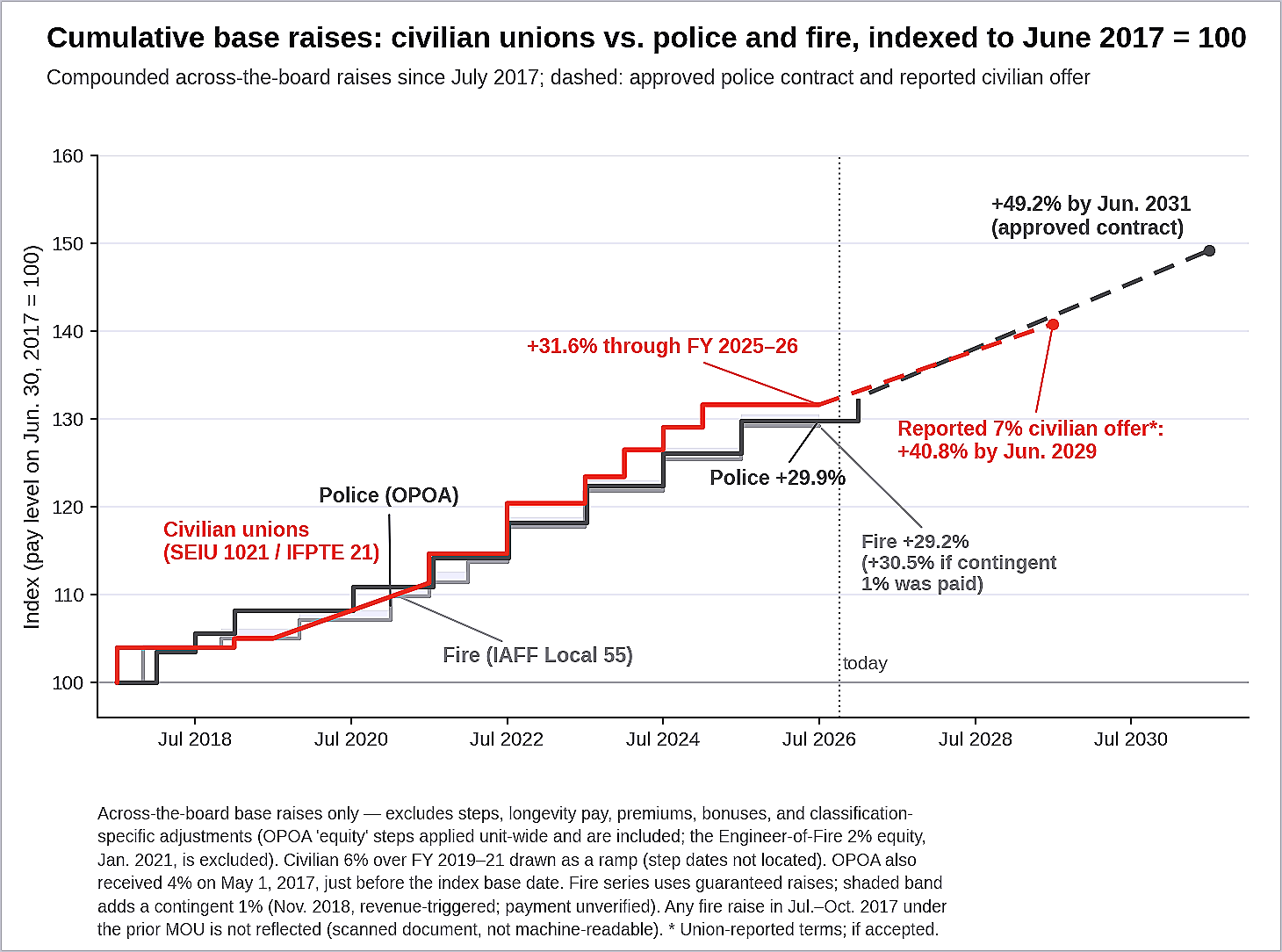
The recently approved police contract compounds to about 14.9% more by mid-2031 — roughly 2.8% per year, back-loaded, and paired with the health and pension concessions described above. The city’s reported civilian offer — 7% over three years, about 2.3% per year — tracks the police trajectory through mid-2029, assuming no future additional concessions in either direction.
The OPOA agreement’s “me too” clause entitles officers to match any better terms a civilian union may negotiate before 2031, so any civilian settlement would also reprice the police contract — which narrows the city’s financial room to maneuver. The implementing salary ordinance returns to council for final passage on Oct. 6, the day of the mayor’s speech.
The budget backdrop
Whatever is agreed in the civilian contracts currently under dispute must fit a budget that, by the city’s own forecast, is struggling with a nine-figure structural gap.
The Finance Department’s five-year forecast projects annual General Purpose Fund deficits of roughly $115 million to nearly $130 million through FY 2029–30.
The city’s fiscal year 2025–27 budget closed a $265 million two-year gap in part by assuming a new parcel tax. As placed on the June ballot (with significant financial and political support from SEIU, IFPTE, and the firefighters union), Measure E would have raised about $34 million a year. Voters rejected it.
The city’s midcycle budget then was approved by city council on a 6–2 vote with no layoffs. It leaned on one-time money,9 cut the police budget from about $410 million to $375 million,10 and declared “extreme fiscal necessity” for the fourth consecutive year to unlock restricted funds.11
Credit rating agency Moody’s downgraded the city’s general-obligation rating to Aa2 with a “negative” outlook in December 2024. Another rating agency, S&P cut its rating two notches to AA− in February 2025. Both agencies affirmed those ratings in October 2025.12
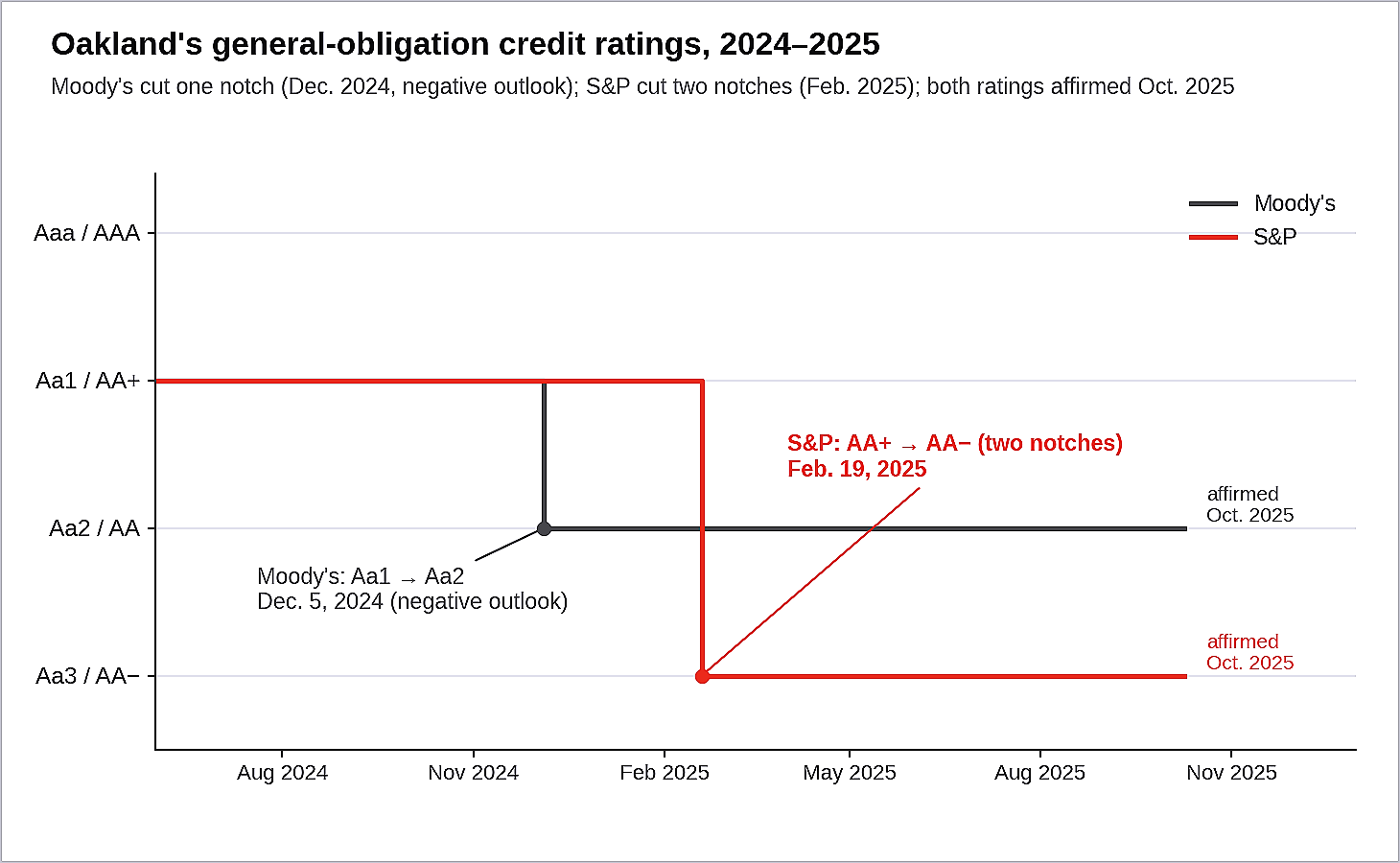
Personnel costs are the city’s largest expense category. Each percentage point of across-the-board raises weighs directly on the structural gap, and can affect the city’s credit ratings.
Other considerations and caveats
Several of the figures above come with caveats.
The terms of the city’s offers come from union bulletins; the city has not confirmed them.
The fiscal year 2025–26 “triggered” raise remains unresolved: a reported third-quarter projection of a roughly $32 million surplus does not by itself satisfy the revenue test, and the determination awaits the city’s year-end financial report.
The cumulative raise totals are our own calculation from MOU terms — they exclude steps and equity adjustments, which raised pay more for some classifications, and the deficit figures are projections, not actuals.
The decade comparison in Figure 3 is indexed to June 30, 2017 because that is the earliest date from which both units’ raises are documented. OPOA’s ‘equity adjustment’ steps applied unit-wide to base salary and are therefore included, while classification-specific equity adjustments — civilian and the 2021 Engineer-of-Fire raise — are excluded
The civilian 6% raise over fiscal years 2019–21 is drawn as a ramp because its step dates were not located
What the record supports is a this: civilian workers absorbed a year without a guaranteed base raise while police secured a five-year deal with larger annual increases while also making significant benefit concession the civilian units have yet to make — and the city faces nine-figure annual gaps that any civilian union settlement, through the police contract’s ‘me too’ clause, would compound.
It stands to reason that the civilian unions’ planned picketing at mayor Barbara Lee’s state of the city speech today is aimed at exactly that tension.
SUPPORT OUR WORK
Oakland Report is an experiment in a new form of media: reasoned, data-driven analysis focused on observable and verifiable evidence. We are an independent 501(c)(3) nonprofit organization, not affiliated with any public agency, labor union, corporate interest or political campaign. We present the facts and let the reader decide.
Gokhale, Tanay. "Oakland city workers shut down meeting, hold rally to demand fair contract." Local News Matters, Jun. 9, 2026. https://localnewsmatters.org/2026/06/09/oakland-city-workers-contract-protest/
SEIU, IFPTE, IBEW contributors. “Smarter public safety: a roadmap for Oakland.” SEIU, IFPTE, and IBEW, May 2025. https://ifpte21.org/wp-content/uploads/2025/05/Smarter-Public-Safety-A-Roadmap-for-Oakland-May-6-2025.pdf
SEIU Local 1021. "City of Oakland.” SEIU Local 1021 webpage, accessed Oct. 5, 2026. https://www.seiu1021.org/city-oakland
Veklerov, Kimberly. "Oakland city workers strike as talks break down; mayor calls walkout unlawful." SFGate, Dec. 5, 2017. https://www.sfgate.com/bayarea/article/Labor-negotiations-end-Oakland-workers-prepare-12404995.php
Wolfe, Eli. "Oakland city workers' new union contracts approved." The Oaklandside, Sept. 15, 2025. https://oaklandside.org/2025/09/15/oakland-city-workers-new-union-contracts-approved/
Ubell, Michael and Tim Gardner. "Oakland employee compensation grew 2.5 times faster than inflation, far outpacing other cities." Oakland Report, Jul. 9, 2024. https://www.oaklandreport.org/p/oakland-employee-compensation-grew
City of Oakland and Oakland Police Officers' Association. "Memorandum of Understanding, effective December 12, 2018 through June 30, 2024." Article III.A (salary). https://cao-94612.s3.amazonaws.com/documents/Item-6-OPOA_MOU_2018-2024.pdf
KTVU contributors. "City reaches contract agreement with Oakland firefighters' union," KTVU, Jan. 17, 2019. https://www.ktvu.com/news/city-reaches-contract-agreement-with-oakland-firefighters-union
Hassan, Anser. "Oakland City Council approves mid-cycle amendments to $4 billion budget without layoffs after Measure E failure." ABC7 San Francisco, Jun. 14, 2026. https://abc7news.com/post/oakland-city-council-approves-mid-cycle-amendments-4-billion-budget-layoffs-measure-failure/19292791/
Wiens, Kylee. "Oakland budget reduces police overtime after Measure E fails." East Bay Express, Jun. 2026. https://eastbayexpress.com/oakland-budget-reduces-police-overtime-after-measure-e-fails/
Reinhart, Sean S. "Oakland set to declare 'extreme fiscal necessity' again, coordinate with unions to increase property taxes." Oakland Report, Feb. 10, 2026. https://www.oaklandreport.org/p/20260210-oakland-declare-extreme-fiscal-necessity
Trejo, Jaime. "City of Oakland general obligation (GO) credit ratings." PFM Financial Advisors, Jan. 27, 2026. https://oakland.legistar.com/View.ashx?GUID=00352F4F-A512-448B-9BE9-C8771C1BBB0F&ID=15088333&M=F
The city is broke and has been for years. Do the unions care? Of course not. The unions are self-perpetuating predators that, to use old Marxist vernacular - “prey upon the life of the people!”
Thanks for the article. This underscores why Oakland needs new leadership and we should make our votes count in this election. All Oakland workers deserve a good standard of living and a great city. We need to increase the revenue of Oakland, the American System way. Increase real production and business. Then there is funding to cover all needs of our Oaklanders. That means Oakland tax payers are not ATM machines for the city. TIme to stop slicing up Oakland like a shrinking pie. Who get the last slice of a bankrupt budget? Grow our business and bring in new industries. Mindy Pechenuk for Oakland Mayor 2026