



Oakland Agenda Watch provides summaries of upcoming public meeting agenda items that catch our attention. In this installment, we examine the proposed new labor agreement between the city of Oakland and the Oakland Police Officers Association.
Oakland set to approve new police union contract
Oakland city council meeting, Sept. 15, 2026, agenda item #5.2
The city of Oakland and the Oakland Police Officers Association (OPOA) reached a tentative labor agreement on Aug. 27. The full city council is set to vote on it tomorrow.
Council president Kevin Jenkins and public safety committee chair Charlene Wang said the agreement is “essential to reducing officer turnover, improving public safety outcomes, and ensuring the city’s financial stability.”1
“[The tentative agreement has] five years of predictable costs we can responsibly plan around.”
— Council member Charlene Wang, Aug. 28, 2026
Oakland Report reviewed the proposed OPOA agreement, other city employee unions’ labor agreements, and police overtime and staffing data in advance of tomorrow’s vote.
Key findings
Officers would get a 14% base pay increase over five years. The raises would be paid in nine steps from January 2027 through June 2031. Police captains would get an extra 5%. Longevity pay for senior officers would rise to as much as 15% of base pay.
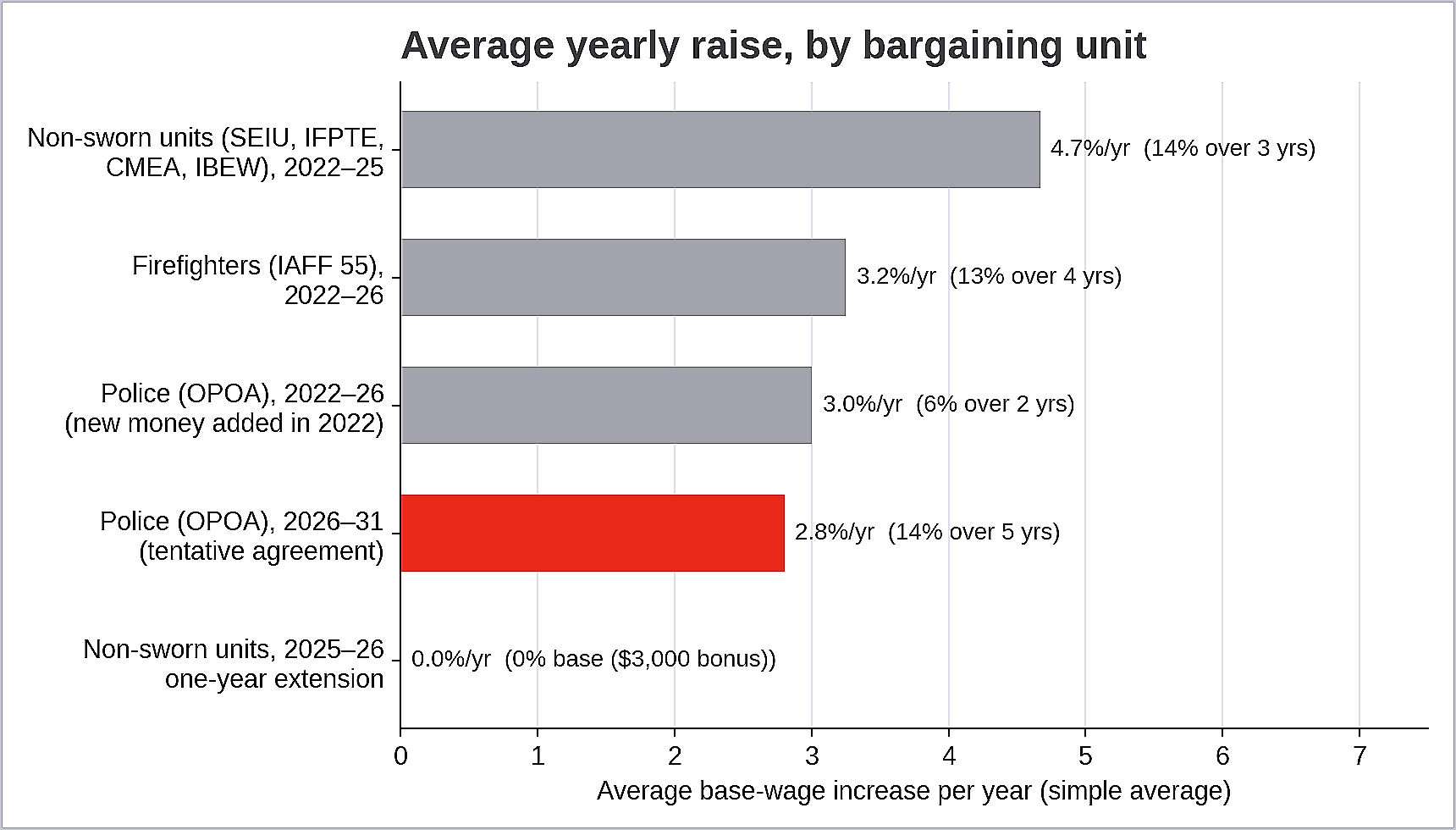
That is less than the other unions received in their most recent labor agreements. SEIU, IFPTE, and two smaller non-sworn labor unions got the same 14% pay raises in 2022, but over a more accelerated time span of three years — averaging 4.7% pay raises per year compared to 2.8% for police — and made no benefit concessions.
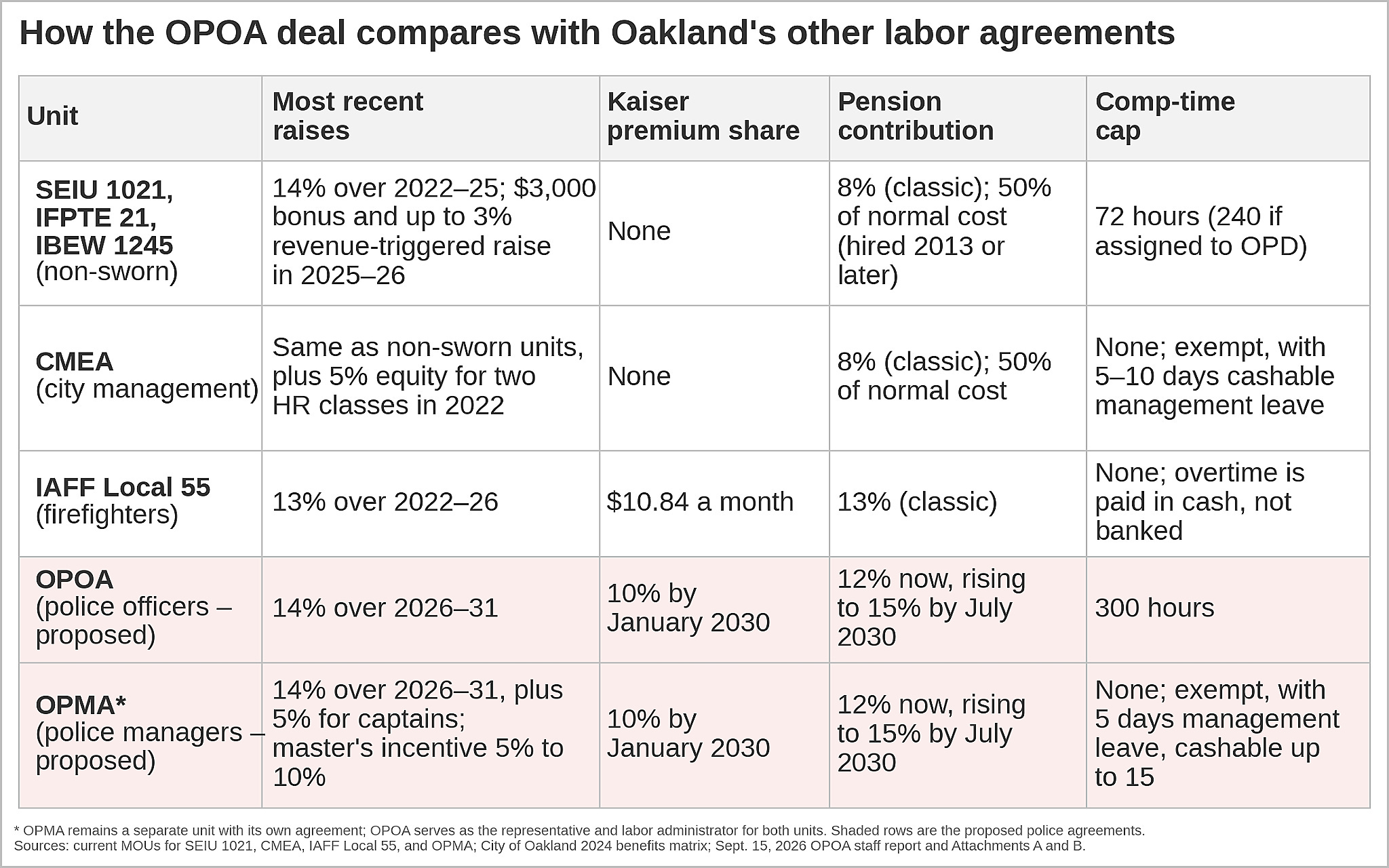
Police officers would pay into their health premiums, and pay more toward their pensions. Under the proposed OPOA deal, the city’s share of Kaiser premiums would drop from 100% to 90% by January 2030, and officers would add 3% to their pension contributions by July 2030. No non-sworn union agreed to either concession in its last two contracts.
The staff report puts the net new cost at $72.1 million over five years, reaching about $29 million in new cost per year by 2031. That figure leaves out medical cost inflation and scheduled pension rate increases.
The fire department is fully staffed; the police department is not. Oakland fire department has had all 25 stations open since September 2025. (The fire stations have remained in operation despite the city’s warnings that some might close if voters didn’t approve a new parcel tax, Measure E, this past June. Voters rejected it.) The police department has approximately 620 of 678 budgeted officer positions filled, and only about 500 to 512 can work full duty — roughly 190 below the 700 minimum officers voters required in Measure NN.
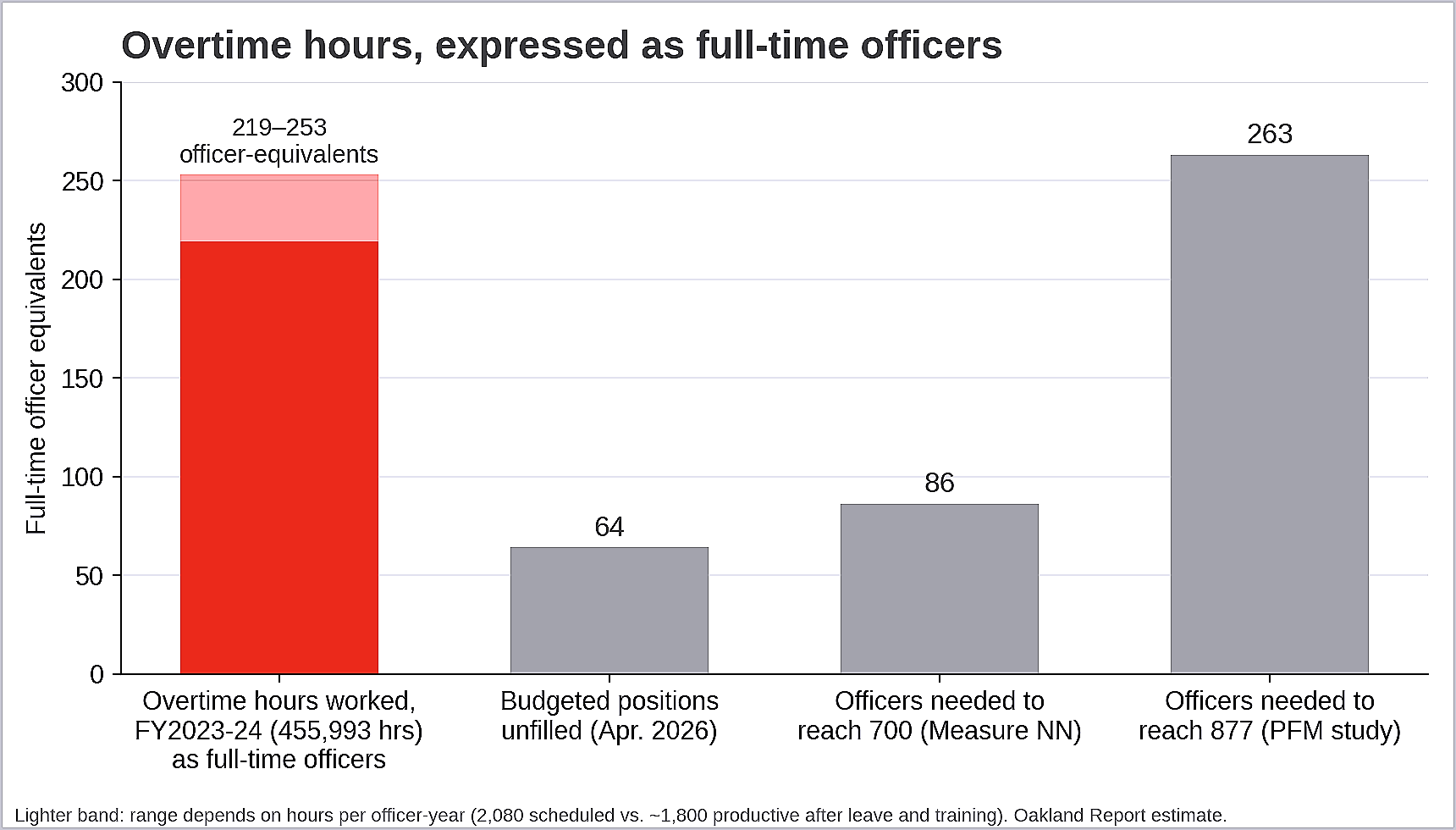
The contract does not add an annual overtime limit or change the 300-hour comp time cap. Oakland police officers logged nearly 456,000 overtime hours in fiscal year 2023-24 — roughly equivalent to the work of 219 to 253 full-time officers. The city auditor in 2019 found that Oakland’s police comp time cap was the highest of any major California city.

DONATE TO OAKLAND REPORT
We are an independent, citizen-led 501(c)(3) nonprofit organization, not affiliated with any public agency, labor union, corporate interest, or political organization. We rely on your voluntary financial contributions to help us continue to produce reasoned, evidence-based articles like this one.
What officers would gain in the new contract
The proposed new OPOA agreement would run from July 1, 2026 to June 30, 2031. Pay raises would start at 2% in January 2027 and total 14% by June 2031 — an average 2.8% pay raises per year.2
By comparison, the city’s 2022 labor agreements with its non-sworn “civilian” unions SEIU Local 1021, IFPTE Local 21, CMEA, and IBEW Local 1245 averaged higher pay increases at 4.7% per year over three years.
(The above-noted non-sworn unions are currently working under labor agreements that expired on June 30, and have been in negotiations with the city on new agreements.)3
Consumer prices in the San Francisco-Oakland-Hayward metropolitan area rose 3.4% in the 12 months ending August 2026 and 3.0% in calendar 2025, as measured by the Consumer Price Index (CPI).4
If inflation holds near 3%, the OPOA raises would fall slightly short of the cost of living over the life of the proposed new agreement. The first pay raise would not arrive until January 2027 — six months into the contract. The proposed contract has no cost-of-living adjustment tied to the CPI.
Also in the proposed OPOA deal, police captains would receive a 5% wage compaction adjustment in January 2027. Longevity pay would become a share of base pay, and by July 2028, an officer with 20 or more years of service would earn a 15% premium.
Subscribe to Oakland Report (it’s free)
What officers would give back — and how the deal compares to other city unions
The city currently pays 100% of the Kaiser health premium. Under the proposed OPOA agreement, that share would step down 2.5 points a year, reaching 90% in January 2030.
If the new OPOA agreement takes effect, police officers would be the only city workers paying more than a nominal share of their health premium in the base Kaiser plan. (Firefighters pay $10.84 per month; non-sworn employees pay none.)
Officers also would contribute an additional 1.5% of their pay toward their pensions starting in July 2027, then 0.5% more in each of the next three years, reaching an additional 3% (15% total) by July 2030.
Police officers currently contribute 12% of pay toward their pensions, compared with 8% to 8.25% currently paid by non-sworn employees. Firefighters currently contribute 13% of their pay toward their pensions.5
These health and retirement concessions are new. In the 2022 bargaining round, the city’s four non-sworn unions received 14% base pay raises over three years with no new employee payments toward health premiums and no new employee payments toward pensions.
Notably, sworn police officers and firefighters reach their full retirement benefit rate at younger ages than non-sworn employees.
Officers and firefighters hired before the 2011–12 pension tier cutoffs earn 3% of final pay for each year of service, and reach that rate at age 50. Non-sworn employees hired in the same period earn 2.7% a year and reach it at age 55.
Under the 2013 state pension reform, newer police and fire hires reach their top rate of 2.7% a year at 57, while newer non-sworn hires reach 2% a year at 62 and their top rate of 2.5% at 67.6
What the new OPOA agreement would cost the city — and what the city’s cost estimate leaves out
The staff report estimates $88.9 million in new wages and premiums, offset by $16.8 million in employee health and pension contributions, for a net new cost of $72.1 million. The rank-and-file police labor unit accounts for $69.0 million and the police managers’ unit for $3.1 million.
The report states that the estimate “excludes” future medical inflation and status quo pension rate increases. It does not separate General Purpose Fund costs from restricted funds such as Measure NN, and it does not say how many sworn positions it assumes.
The proposed OPOA contract also contains a “me too” clause: If SEIU, IFPTE, the two other non-sworn units, or the firefighters gain better contract terms before June 2031, OPOA would get the difference.
All five of the other unions are now out of contract or in an extension that expired June 30, 2026.78 (They have been negotiating new contracts with the city.) The city’s estimated $72.1 million figure does not include this exposure.
The city’s five-year financial forecast projects budget gaps of roughly $120 million per year through 2030.9 The year-five additional cost of the proposed OPOA contract — about $29 million — would equal roughly a quarter of that annual gap.
Police staffing: the proposed agreement sets no hiring or retention targets
Aside from the longevity pay noted above, the proposed OPOA agreement contains no hiring targets, no academy commitments, and no retention bonuses.
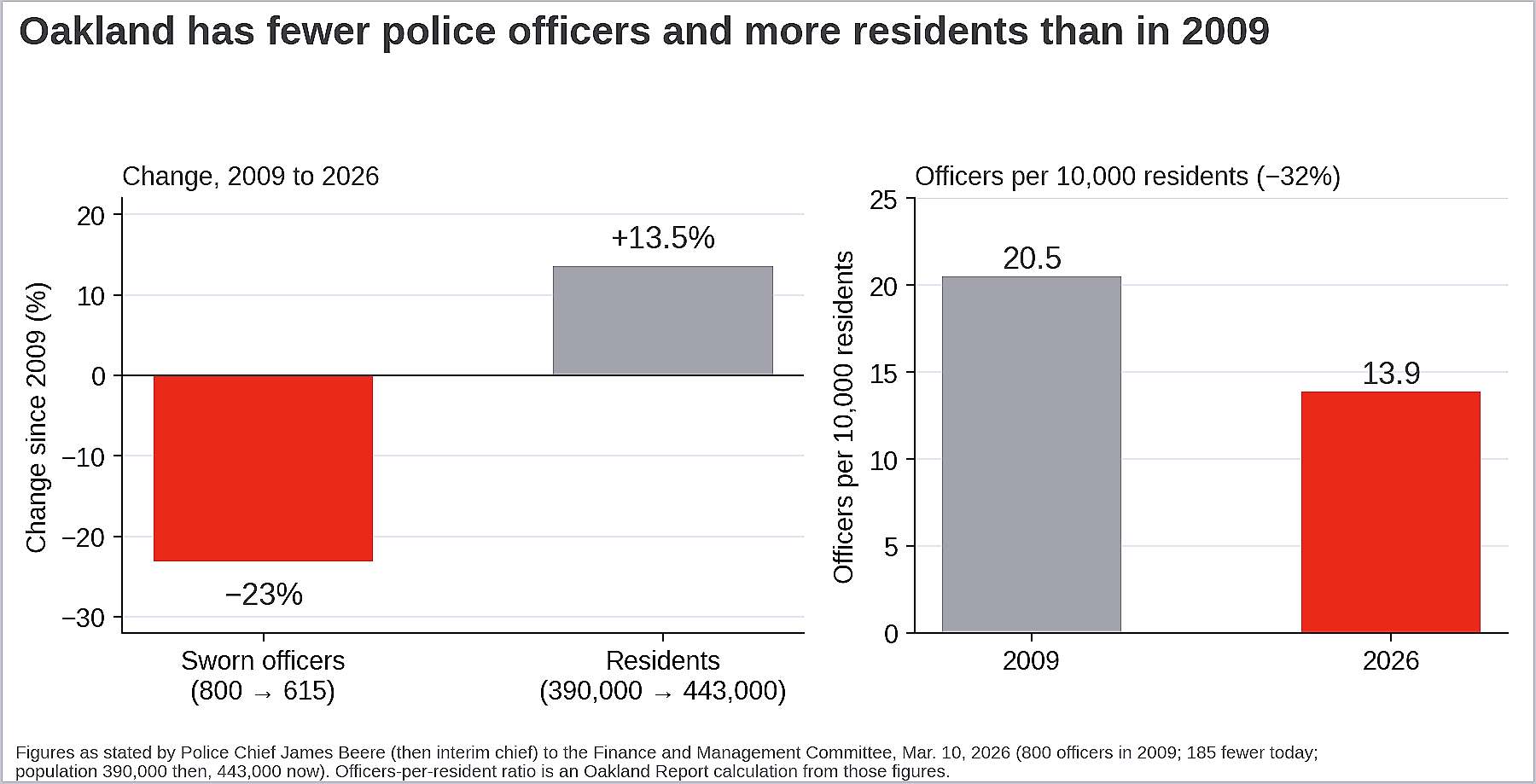
Earlier this year, police chief James Beere informed a council committee that in 2009, the city had around 800 police officers to serve 390,000 residents, and now in 2026 it has only around 615 officers to serve 443,000 residents.10
“That’s a 23% reduction in staff, but yet a 13.5% increase in the population,” Beere said.
The city of Oakland’s current budget authorizes 678 sworn police officers.
In April 2026, police department staff told the citizen-run police commission that its operational strength was only 512 officers: 614 of its budgeted positions were filled, but 102 were assigned to various forms of leave or modified duty.11
The police department reported 620 sworn officers in June 2026, down from 671 when its current strategic plan began.12
A city-commissioned study delivered in late 2024 concluded that Oakland needs a baseline of 877 sworn officers to handle its workload — 199 more than the city budgeted at the time.13
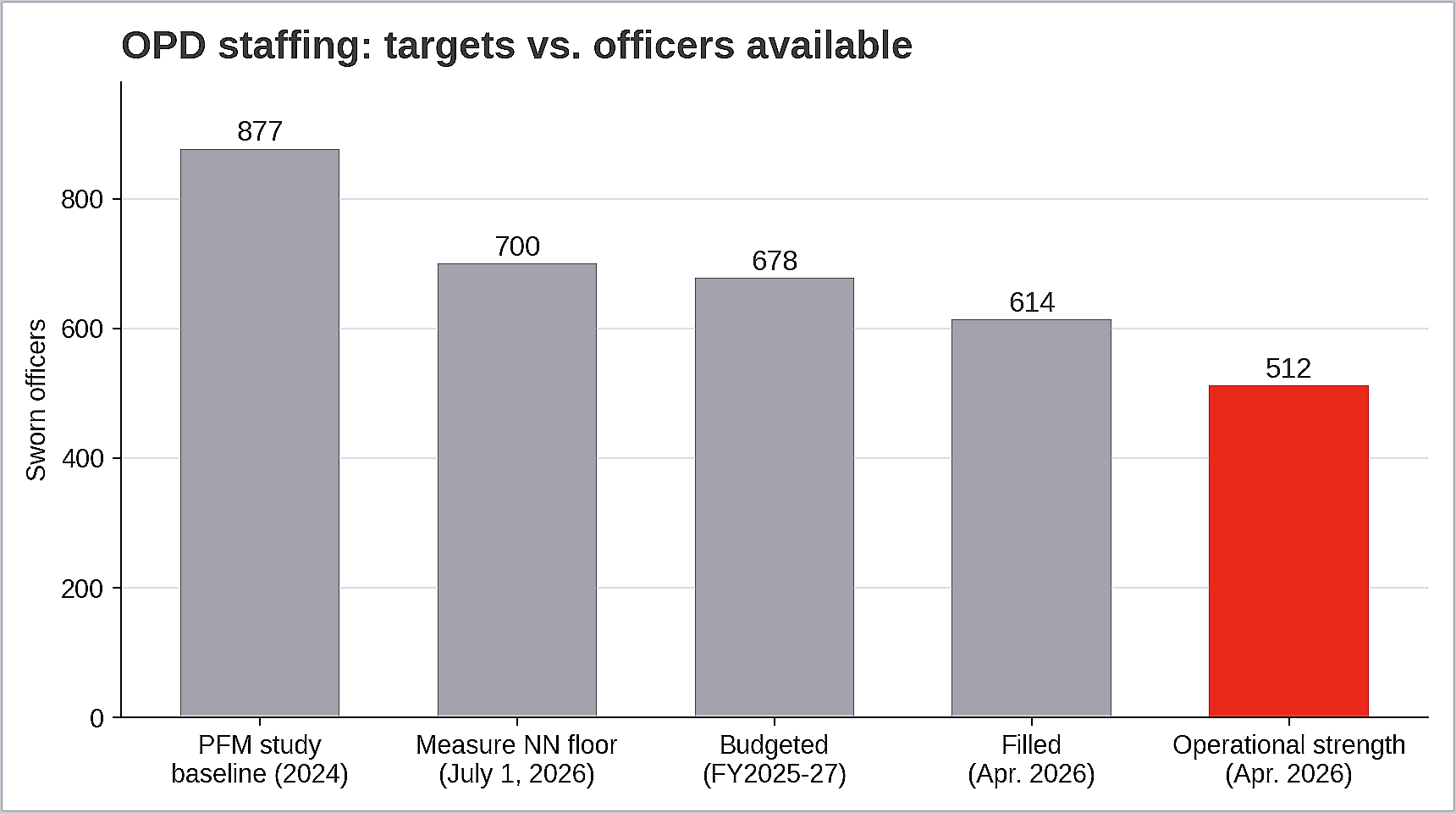
Oakland voters have set higher targets for police staffing. Measure Z (2014) required 678 officers. Measure NN (2024) raised the minimum to 700 officers by July 1, 2026, in exchange for about $47.4 million per year in parcel and parking taxes.14
The council has not budgeted for the minimum 700 officers required by Measure NN, yet the city has continued to collect the tax from Oakland residents and businesses. The city has declared a state of “extreme fiscal necessity” — the escape clause written into the measure — four years in a row in order to sidestep voter-approved requirements.15
Overtime rules would not substantively change
The city of Oakland currently does not set a hard cap on police overtime hours, and the proposed OPOA agreement doesn’t set one.
Overtime is not optional for sworn public safety personnel like police officers and firefighters.
The police department must staff patrol beats every shift, answer 911 calls, appear in court, respond to unanticipated public safety emergencies, and meet its federal settlement obligations whether it has 700 officers or 500 officers. When a shift comes up short, the contract’s “extension of shift” and “backfill” provisions require officers to stay or be called in.
City officials say that without overtime, patrol backfill, 911 response, and violent crime investigations “would be impossible” at current staffing levels.16
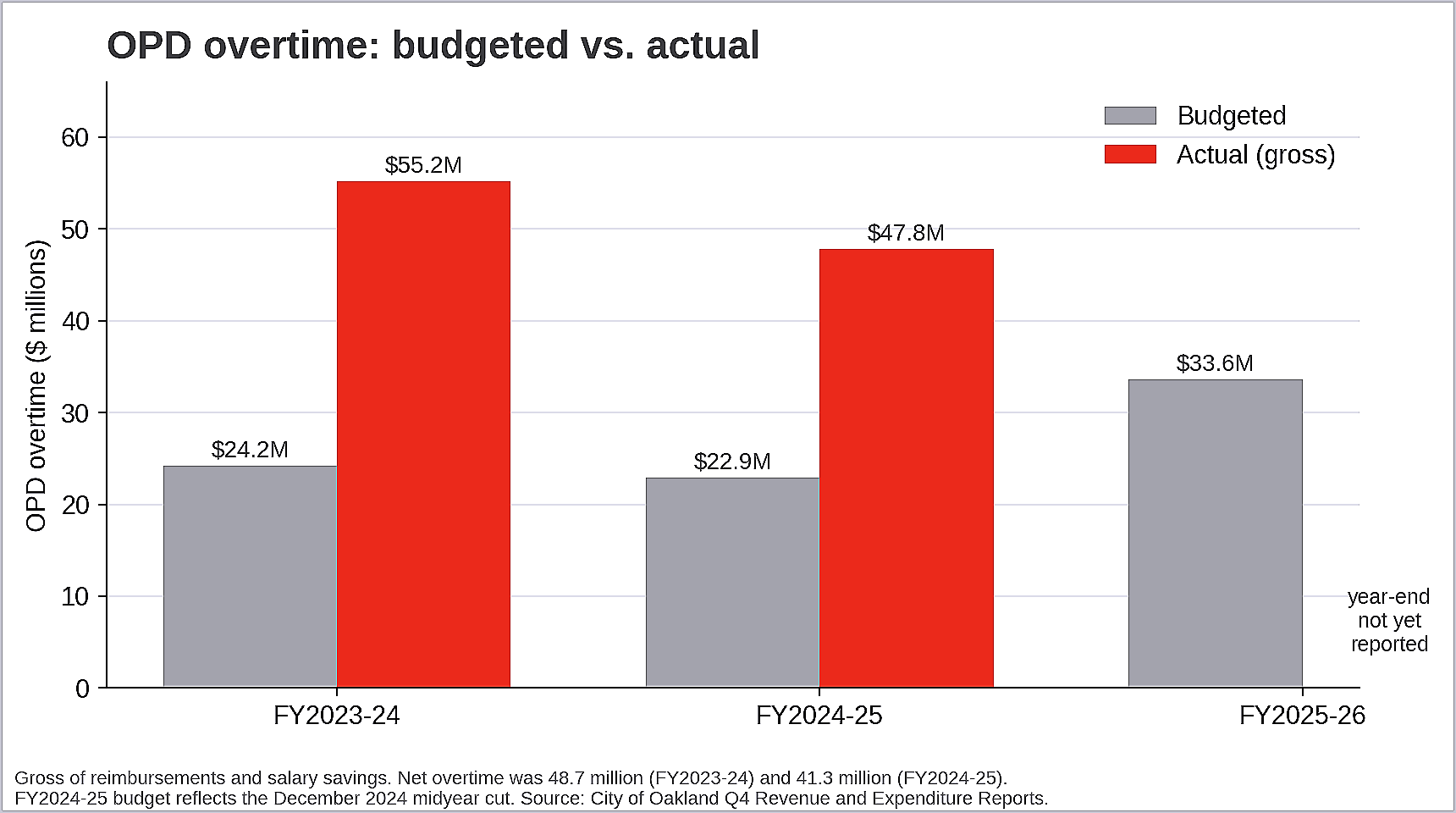
In the first half of FY2025-26, backfill and shift extension were the largest overtime costs, at $8.4 million of $25.2 million.
In 2024, one lieutenant was paid $493,247 in overtime. That year, 169 officers earned more than $100,000 in overtime, up from 58 in 2021.17
After a local media outlet reported that the city could not document about half of the lieutenant’s overtime hours, the department said the matter was “under investigation.” No findings from that investigation have been made public, as far as we can tell.
(Under California law, most police personnel and disciplinary records stay confidential unless they involve a shooting, a serious use of force, or a sustained finding of dishonesty or sexual assault — categories a timekeeping investigation generally would not trigger. The absence of public findings in this case does not alone indicate whether the investigation was sustained, closed, or resulted in discipline.)1819
In 2025 the same lieutenant was again the city’s highest-paid employee, with $398,000 in overtime and $765,000 in total compensation. Police officers were paid a total $42 million in overtime in calendar 2025, just over half the city’s overall total, and 67 officers had total compensation above $500,000.20
In February 2026, as then-interim police chief, Beere cancelled discretionary overtime by special order: any unbudgeted overtime now need approval from the chief’s office, and officers must track their overtime shifts more closely.21
Asked by a council committee in March whether any cap on overtime hours exists, Beere stated that overtime has inherent limits due to operational factors such as a required rest period in the department’s general orders.
“As long as you’re adhering to the rest period, that’s going to cap [overtime] naturally. You cannot just work 20 hours straight three days in a row.”
— Then-interim (now permanent) police chief James Beere, Mar. 10, 2026
Beere added that officers returning from vacation to work backfill is one reason “it could appear that there’s no cap.” He also indicated that the department’s investigation into overtime use was still active.
The comp time cap remains unchanged
Comp time is paid time off that an officer can take instead of cash for overtime hours worked — earned at the same time-and-a-half rate.
An officer who works 10 hours of overtime and chooses comp time thus can bank 15 hours of future leave. If the shift has to be backfilled when that leave is taken, another officer can be paid overtime to cover it.
The city auditor examined police overtime in 2019 and found that the city’s 300-hour cap on police comp time was “the highest limit of any major city in the state.”
The auditor surveyed nine large California cities — including San Francisco, San Jose, Los Angeles, and San Diego — and found that their police comp-time accrual limits averaged 148 hours, less than half Oakland’s.
The auditor recommended an annual cap on overtime hours, and noted that reducing the comp time cap depended on the next OPOA contact negotiation.2223
That negotiation is this one. The tentative agreement retains the 300-hour comp time cap, and it gives the city new authority to buy down comp time banks.
“The city saves money by being understaffed”
A May 2025 report commissioned by three non-sworn city unions, using payroll records obtained by public records request, found that officers logged nearly 456,000 overtime hours in fiscal year 2023-24 — an average of more than 640 hours per officer, or 12.3 hours every week.
At 2,080 hours per work year, that total equates to roughly 219 full-time officers. At roughly 1,800 productive hours after leave and training, it equates to around 253 full-time officers. Either figure exceeds the 64 unfilled positions and the 86 officers needed to reach 700.
How much of that overtime would be erased by fully staffing the police department’s sworn officer ranks? Less than the hours suggest.
Backfill — the category used to cover absences and meet minimum patrol staffing — accounted for over 34,000 hours and $3.4 million in fiscal year 2023-24. The equates to around 7% of overtime, and it has fallen 41% since 2019-20.
The larger and faster-growing category is shift extension: over 91,000 hours and $9.2 million, up 49% in hours since 2019-20.
Officers can start a shift extension themselves without a supervisor’s approval — for example, to finish a service call that began near the end of their scheduled shift — and the city does not track how many extensions are approved in advance. More officers would not automatically reduce those hours.
Between 2011 and 2024, overtime hours rose nearly 200% while sworn staffing grew only 8.5%. From 2015 to 2019, staffing rose 15% while average overtime hours rose 55%.
On these figures, reaching 700 officers would reliably absorb only the vacancy-driven share — roughly $4 million to $10 million a year — and reaching 877 officers would add capacity across investigations and special enforcement without, by itself, changing the rules that govern the rest.
The non-sworn unions’ estimate is that Oakland could reach $20 million to $30 million in annual overtime through management controls, “civilianizing” 38 sworn administrative positions (that is, converting jobs performed by sworn positions to positions staffed by those non-sworn unions’ members) and the 2019 auditor’s recommended limits — not staffing alone.
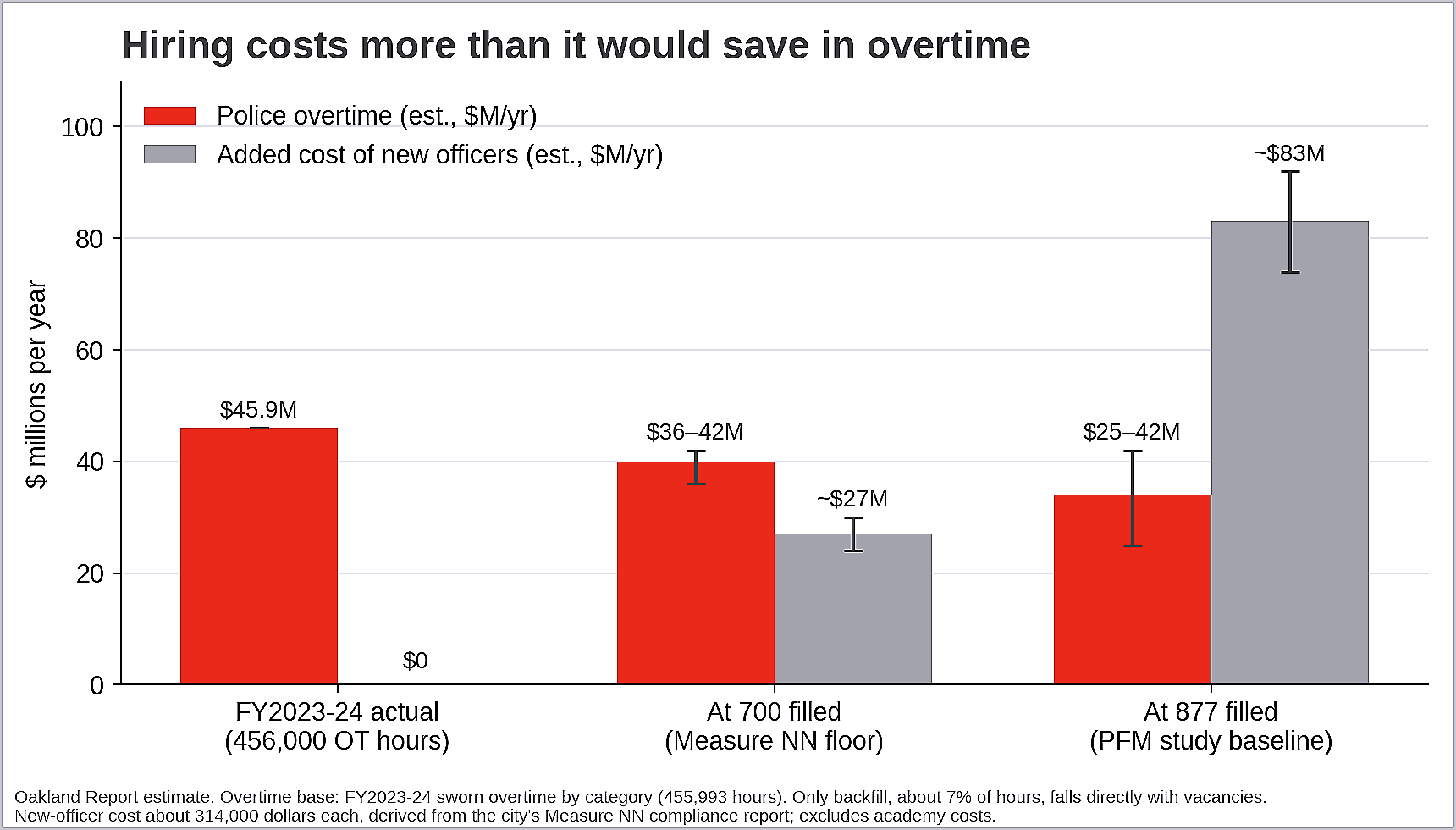
Hiring is also the more financially expensive path to covering police staffing needs. The city’s Measure NN compliance report implies a cost of about $314,000 per additional officer, before academy costs of roughly $3.9 million per class.24
At that rate, 86 more officers cost about $27 million a year and 263 more cost about $83 million.
“You’re actually saving money by not having police officers and paying for them on overtime.”
— Then-interim (now permanent) police chief James Beere, Mar. 10, 2026
Beere said as much to the committee in March: “You’re actually saving money by not having police officers and paying for them on overtime.”
“This has been a formula that’s been in place since I started back in 1997, and the city saves money by being understaffed, because you’re not paying for a full, fully burdened police officer with benefits,” he said.
Other potential costs of relying on overtime to compensate for under-staffing
Oakland’s police overtime is concentrated among a relatively small number of officers. In 2024, 169 officers earned more than $100,000 in overtime — about a quarter of sworn officers on the payroll that year — and 27 officers (around 4%) earned more than $200,000 in overtime.
Department-wide overtime averaged about 640 hours per officer in fiscal year 2023-24, or roughly 12 hours of overtime per week. By comparison, the top earner that year worked 3,304 overtime hours (around 63 hours per week) on top of 1,938 regular hours — an average of 101 hours per week across the year.
It seems likely that not every officer can take on such extensive additional hours. Family and other obligations limit who can. Some research on police work hours links long shifts and heavy overtime to fatigue, more injuries, and diminished judgment in encounters with the public.25 Studies of police agencies also find that officers who see work and pay as fairly shared report higher job satisfaction and less misconduct.26
By comparison, the city’s contract with SEIU Local 1021 requires overtime to be “distributed among qualified unit members as equally as possible” and caps most members’ comp time at 72 hours. As noted above, the police cap on comp time is 300 hours.27
In fairness, the work performed by sworn and non-sworn employees is vastly different in nature, intensity, and personal risk.
It is reasonable to consider that a fully staffed sworn police roster, with less overtime spread more evenly among officers, likely would serve both officer health and fairness within the ranks. A strictly financial examination of the cost of heavily relying on overtime to cover staffing shortfalls does not capture either potential benefit.
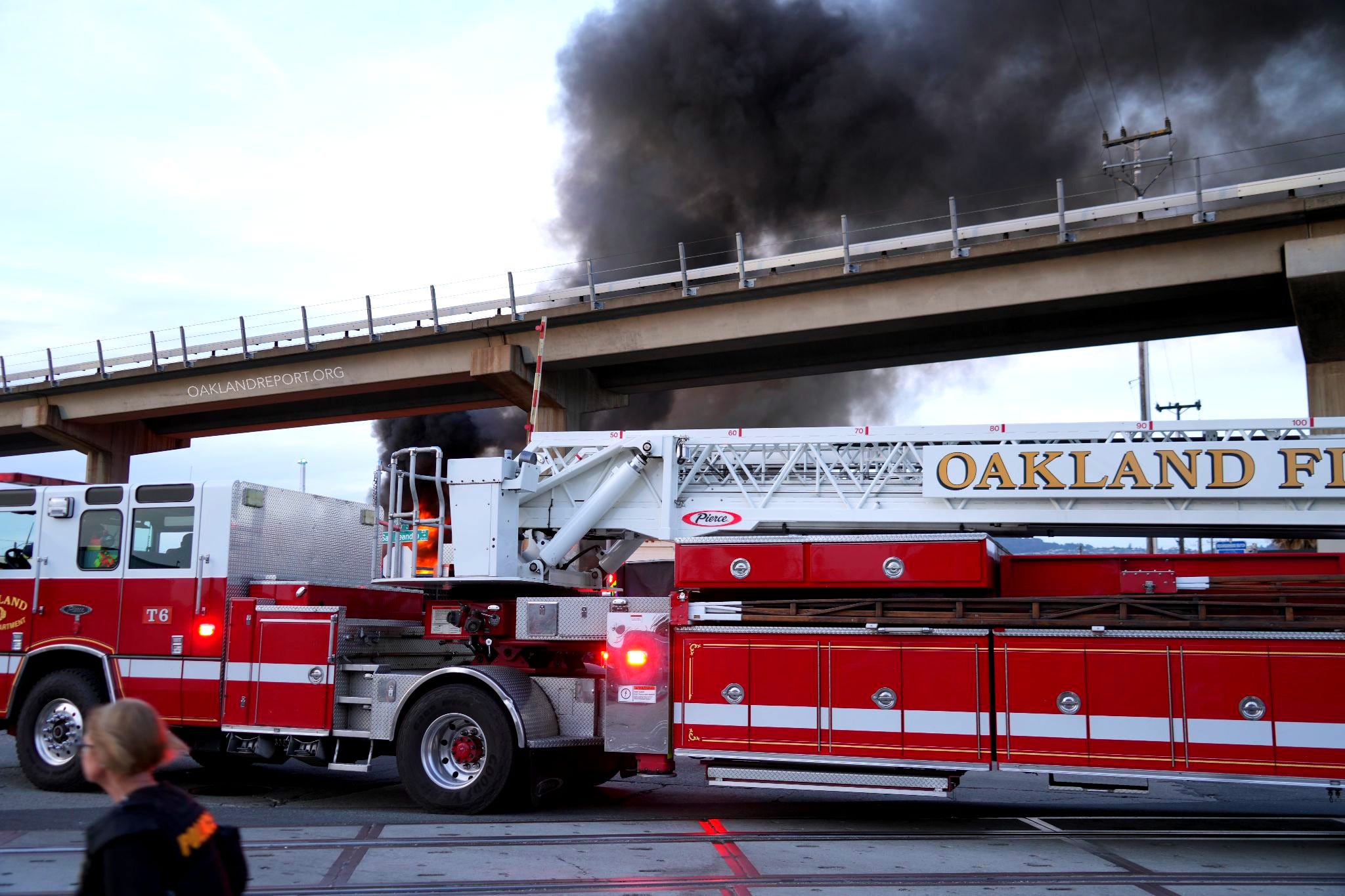
Oakland’s fire department, which also has mandatory overtime requirements for sworn personnel, offers a useful comparison. The fire department reached full staffing in September 2025, with all 25 stations open for the first time in about 20 years.28
The fire department’s staffing level is above its Measure NN minimum of 480 sworn firefighters. It lost about 49 members to separations in fiscal year 2024-25, compared to about 114 separations for the police department.29
Notably, the fire department was projected to overspend its fiscal year 2024-25 budget by $34.5 million, or 21% — mostly on overtime.30
The reason is the same one that drives police overtime: the firefighters’ contract requires every engine and truck to be staffed to a set minimum each day: 25 engines with four firefighters apiece, seven trucks, the airport station, three battalion chiefs and an arson investigator — about 141 positions per shift, regardless of who is sick, injured, or in training.
The firefighters’ staffing agreement runs through 2037, regardless of what happens to the rest of the contract.
One rule does differ. Oakland’s fire department does not permit employee-initiated shift extensions under any circumstances; the police department does. Full staffing closed the fire department’s vacancy gap. It did not close its overtime gap.
Share this story with someone you know.
Other considerations and caveats
The city administration has argued against annual overtime caps at current staffing levels, stating in 2022 that limits “can potentially lead to mandatory overtime” and possible federal labor-law violations.
OPOA president Sgt. Huy Nguyen has said understaffing, not contract terms, drives overtime: “At this staffing level, more officers will be forced to work excessive overtime, which in turn will accelerate attrition.”
The proposed OPOA health and pension concessions are permanent cost shifts the city did not obtain from any other union in this cycle.
The $72.1 million figure is the staff report’s estimate, not an audited cost.
Fiscal year 2025-26 overtime results are projections.
This is a first reading. The salary ordinance is scheduled to return to city council for final passage on Oct. 6, 2026.
A mostly less-generous contract than other city unions have — and one whose cost depends on what they settle for next
The OPOA agreement is more modest per year than the 2022 deals the city’s other, non-sworn unions received, and it is the first contract in this cycle to shift health and pension costs onto employees.
It adds roughly $29 million a year to a budget already running a projected $120 million annual gap.
And, it leaves in place the overtime structure the auditor flagged seven years ago — and ties any change to a staffing level the department is at least 80 officers short of reaching and could take years to recover, if ever.

DONATE TO OAKLAND REPORT
We are an independent 501(c)(3) nonprofit organization, not affiliated with any public agency, labor union, corporate interest or political organization. Your voluntary donation is needed to continue to produce accurate, well-researched, data-driven articles like this one.
Related stories:


Romero, Roselyn. "Oakland police reach tentative deal for 14% pay raise over 5 years." The Oaklandside, Aug. 28, 2026. https://oaklandside.org/2026/08/28/oakland-police-union-tentative-contract/
City of Oakland. "Resolutions approving memoranda of understanding with the Oakland Police Officers’ Association (rank and file and managers units) and ordinance amending salary ordinance no. 12187 C.M.S." Oakland city council meeting, Sept. 15, 2026, agenda item #5.2. https://oakland.legistar.com/LegislationDetail.aspx?ID=8200115&GUID=4B544C1B-FCC1-499C-97F2-98B00D9DB819
City of Oakland. "Approve the memoranda of understanding between the city of Oakland and miscellaneous unions and salary ordinance amendment for miscellaneous and unrepresented employees." Oakland city council meeting, Jul. 19, 2022, file #22-0647. https://oakland.legistar.com/LegislationDetail.aspx?ID=5726831&GUID=949324B3-D726-4D94-9942-BC35A341296E
U.S. Bureau of Labor Statistics. "Consumer price index, San Francisco area — August 2026." Western Information Office, Sept. 2026. https://www.bls.gov/regions/west/news-release/consumerpriceindex_sanfrancisco.htm
City of Oakland. "Summary of benefits, year 2024." Human Resources Management department, rev. December 2023. https://cao-94612.s3.us-west-2.amazonaws.com/documents/2024-Benefits-Matrix.pdf
California Government Code sections 7522.20 and 7522.25 (retirement formulas for members hired on or after January 1, 2013). Tier formulas for earlier hires are in the IAFF Local 55 memorandum of understanding, section 8.4 (note 8), and the SEIU Local 1021 memorandum of understanding, section 6.1 (note 27).
Oaklandside staff. "Oakland city workers’ new union contracts approved." The Oaklandside, Sept. 15, 2025. https://oaklandside.org/2025/09/15/oakland-city-workers-new-union-contracts-approved/
City of Oakland and International Association of Firefighters, Local 55. "Memorandum of understanding, November 1, 2020 to June 30, 2026." https://www.oaklandca.gov/files/assets/city/v/1/fire/documents/iaff/2020-2026-iaff-local-55-memorandum-of-understanding-for-posting.pdf
City of Oakland. "Fiscal year 2026-30 five-year financial forecast." Finance department, file #25-0745. https://oakland.legistar.com/LegislationDetail.aspx?ID=7399425&GUID=59FCB8D8-076B-4ADD-83D4-C76B8B893563
City of Oakland. "Receive an informational report regarding OPD overtime." Finance and management committee meeting, Mar. 10, 2026, agenda item #4. https://oakland.legistar.com/LegislationDetail.aspx?ID=7869611&GUID=C7BCAC70-EEEF-4B85-BAD6-3E1BE26E88FC
Oakland Police Commission. "Regular meeting agenda packet," Apr. 9, 2026. https://www.oaklandca.gov/files/assets/city/v/1/police-commission/agendas/opc-regular-meeting-agenda-4.9.26.fin.mm.pdf
City of Oakland. "Bi-annual report to the Oakland public safety planning and oversight commission." Jun. 15, 2026. https://www.oaklandca.gov/files/assets/city/v/1/public-meetings/oakland-public-safety-planning-and-oversight-commission/2026-attachments/6-15-2026-opspoc-meeting-agenda-packet.pdf
Gardner, Tim. "Oakland releases police staffing study — it says a minimum of 877 officers are needed." Oakland Report, Apr. 16, 2025. https://www.oaklandreport.org/p/oakland-releases-the-opd-staffing
Alameda County Registrar of Voters. "Measure NN: citywide violence reduction services." Nov. 5, 2024. https://acvote.alamedacountyca.gov/acvote-assets/02_election_information/PDFs/20241105/en/Measures/32%20-%20Measure%20NN%20-%20City%20of%20Oakland%20-%20Citywide%20Violence%20Reduction%20Services.pdf
Reinhart, Sean S. "Oakland’s ‘unanticipated’ financial emergency set to enter its fourth year." Oakland Report, Jun. 12, 2026. https://www.oaklandreport.org/p/oaklands-unanticipated-financial-fourth-year
Oaklandside staff. "City unions urge Oakland to get police overtime spending under control." The Oaklandside, May 7, 2025. https://oaklandside.org/2025/05/07/oakland-police-department-overtime-budget-unions-2025/
Klein, Beck. "One Oakland police officer made $490,000 in overtime. The city can’t find records detailing much of what he did." The Oaklandside, Jan. 29, 2026. https://oaklandside.org/2026/01/29/oakland-police-overtime/
Klein, Beck. "Oakland police say they’re investigating overtime issues revealed by Oaklandside." The Oaklandside, Feb. 11, 2026. https://oaklandside.org/2026/02/11/oakland-police-say-theyre-investigating-overtime-issues-revealed-by-oaklandside/
California Penal Code section 832.7, as amended by SB 1421 (2018) and SB 16 (2021). See also City of Oakland, "SB 1421 and SB 16 police personnel records." https://www.oaklandca.gov/Public-Safety-Streets/Police/OPD-Data/SB-1421-and-SB-16-Police-Personnel-Records
Bondgraham, Darwin. "Who was the city of Oakland’s highest paid employee in 2025?" The Oaklandside, Aug. 11, 2026. https://oaklandside.org/2026/08/11/oakland-city-employees-pay-compensation-overtime-data/
Klein, Beck. "Overtime at OPD is now much harder to greenlight, following investigation by Oaklandside." The Oaklandside, Mar. 11, 2026. https://oaklandside.org/2026/03/11/oakland-police-chief-orders-end-discretionary-overtime-james-beere/
City of Oakland. "Recommendation follow-up report on the 2019 Oakland police department overtime audit." Office of the City Auditor, Jan. 13, 2022. https://www.oaklandauditor.com/wp-content/uploads/2022/01/20220113_OPD-Overtime-Recommendation-Follow-up-Report-on-2019-OPD-Overtime-Audit-1.pdf
IFPTE Local 21, SEIU Local 1021 and IBEW Local 1245. "Smarter public safety: a roadmap for Oakland." May 6, 2025. https://ifpte21.org/wp-content/uploads/2025/05/Smarter-Public-Safety-A-Roadmap-for-Oakland-May-6-2025.pdf
Reinhart, Sean S. "Mayor Barbara Lee says meeting Measure NN’s minimum police staffing requirement now depends on voters approving a second parcel tax: Measure E." Oakland Report, May 17, 2026. https://www.oaklandreport.org/p/mayor-barbara-lee-says-meeting-measure
Vila, Bryan. "Impact of long work hours on police officers and the communities they serve." American Journal of Industrial Medicine 49, no. 11 (2006): 972-980. https://onlinelibrary.wiley.com/doi/10.1002/ajim.20333. See also Violanti, John M. et al., "Shift work and the incidence of injury among police officers," American Journal of Industrial Medicine 55 (2012); and James, Lois et al., "The impact of work shift and fatigue on police officer response in simulated interactions with citizens," Journal of Experimental Criminology 14 (2018): 111-120.
Wolfe, Scott E. and Alex R. Piquero. "Organizational justice and police misconduct." Criminal Justice and Behavior 38, no. 4 (2011): 332-353. See also Colquitt, Jason A. et al., "Justice at the millennium: a meta-analytic review of 25 years of organizational justice research," Journal of Applied Psychology 86, no. 3 (2001): 425-445.
City of Oakland and SEIU Local 1021. "Memorandum of understanding, July 1, 2025 to June 30, 2026." https://www.oaklandca.gov/files/assets/city/v/3/human-resources/documents/working-for-oakland/unions/seiu/seiu-mou-2025-2026-final-202603.pdf
Rhoades, Callie. "This fire season, Oakland Fire says it’s fully staffed for the first time in 20 years." The Oaklandside, Sept. 4, 2025. https://oaklandside.org/2025/09/04/this-fire-season-oakland-fire-says-its-fully-staffed-for-the-first-time-in-20-years/
Oaklandside staff. "Oakland is struggling to hire city workers." The Oaklandside, Mar. 25, 2026. https://oaklandside.org/2026/03/25/oakland-is-struggling-to-hire-city-workers/
NBC Bay Area. "Oakland city council hears report on dire state of municipal budget." 2024. https://www.nbcbayarea.com/news/local/east-bay/oakland-city-council-report-municipal-budget-2/3714535/
It is of limited use to compare the outcome of a labor contract concluded in 2026 with ones from 2022. As I'm sure you remember, in 2022 the Council was led by Nikki Bas. Along with Rebecca Kaplan and Carroll Fife, they happily agreed to raises for the non-sworn unions that the City could not possibly afford. I think of those years as "the bad old days." Remember the manufacturing of "income" from the hoped-for sale of the Coliseum in order to balance the budget? I think we can view this new labor agreement with Police as a positive sign that the current Council is being more fiscally responsible in its labor negotiations than the preceding Council. I fervently hope that the Council continues this trend in the current negotiations with the other bargaining units and keeps labor costs within the City's ability to fund them.
Thanks for this. Fine, useful analysis that appears to be accurate. Esp good to use the footnotes for verification of the facts. REGARDS