


Two seats changed, but most of the school board – and the teachers union’s outsized influence over it – remains
On November 3, after years of headlines about money troubles at Oakland Unified School District (OUSD), voters removed two of the three school board members running for re-election.12
Board vice president Valarie Bachelor was defeated by Alexandra Williams in District 6.
Board member Mike Hutchinson was ousted by Kathryn Camp in District 4.
Board president Jennifer Brouhard fended off a challenge from Arielle Fleisher by about 400 votes in District 2. Fleisher conceded on Nov. 14.3
The teachers union, Oakland Education Association (OEA), backed three candidates in this election: Brouhard, Bachelor and newcomer Sylvia Pfeiffer Williams.4 Only Brouhard won. OEA’s political committee had spent about $82,000 on the Brouhard and Bachelor races by late October.5
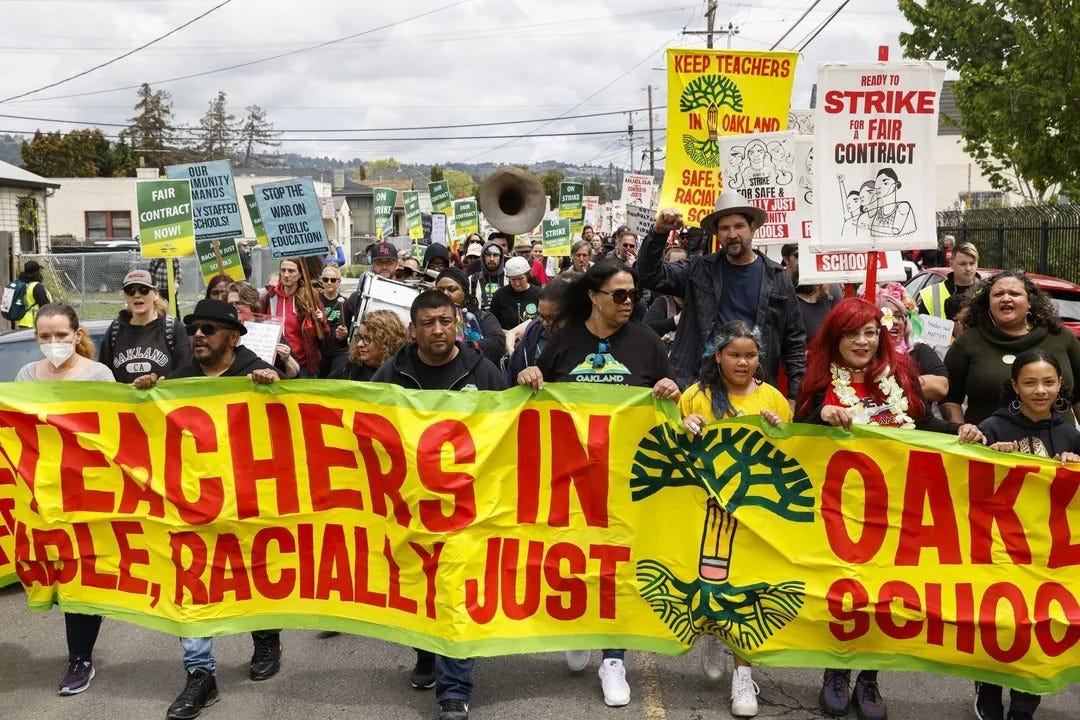
Bachelor’s loss is a setback for the OEA union. Board members it helped elect will now hold only three of the seven board seats instead of four, so they lose their union-backed majority. But the union’s influence over the district’s budget remains potent. Five of the seven board members were in power while the district’s finances got worse. The rank-and-file teachers are largely in line with OEA’s talking points and actively hostile to efforts that could reduce their influence or rein in spending in a way that affects them: in February, 91% of the OEA members who voted chose to authorize a strike.6 And the district’s top executive, superintendent Denise Saddler, is herself a former OEA president.
Public employee unions are not the same as other unions
Here we pause to state that there is nothing inherently wrong with workers forming a union and bargaining for better pay and working conditions. Unions have an important role in a balanced, well-run society.
But public employee unions are not like private sector unions, because they can fund and help elect the officials who approve their pay and benefits. Teachers, like firefighters and other public servants, are held in high regard in society, and their unions can and do leverage that high regard in political messaging. A common technique the teachers union’s supporters use to attack the union’s critics is to claim that if they oppose the union, therefore they oppose teachers — a false equivalency, but politically effective.
Studies show that these dynamics have helped make teachers unions among the most powerful forces in American public education.7 For example, a 2022 study of school board races in California and Florida found that union-backed candidates won about 70% of competitive races, and that the endorsement itself seemed to help them win.8
It is reasonable to consider that board members who owe their powerful elected positions partly to a union’s political funding and support, may feel pressure to return the favor when that union’s pay and benefit raises are negotiated.
Public agencies also face different consequences for poor performance than businesses do. A business that does poorly tends to lose customers and income — and a business that keeps overspending goes out of business. A school district loses some state money when families leave, but state rules soften that blow.9 Its local taxes do not decrease. It does not go out of business. A school district can even ask voters for more tax funding to fix the problems it arguably created itself, and often does.10
OUSD tried that this year. In August, the district faced a $105 million teachers contract with no plan to pay for it. The board voted to ask voters to renew a parcel tax. In a sign of its ongoing organizational dysfunction, district officials then missed the deadline to put it on the ballot.11
Even running out of cash, back in 2003, did not close OUSD. The state lent it $100 million and sent an administrator to run the district.12
In April, Alameda County superintendent of schools Alysse Castro, who oversees the budgets of all school districts in the county including Oakland, put it this way:
“At over $800 million in revenue serving 34,000 students, OUSD is among the highest-funded urban districts in California. This is not a revenue problem—it is a decision-making problem.”13
— Alysse Castro, April 16, 2026
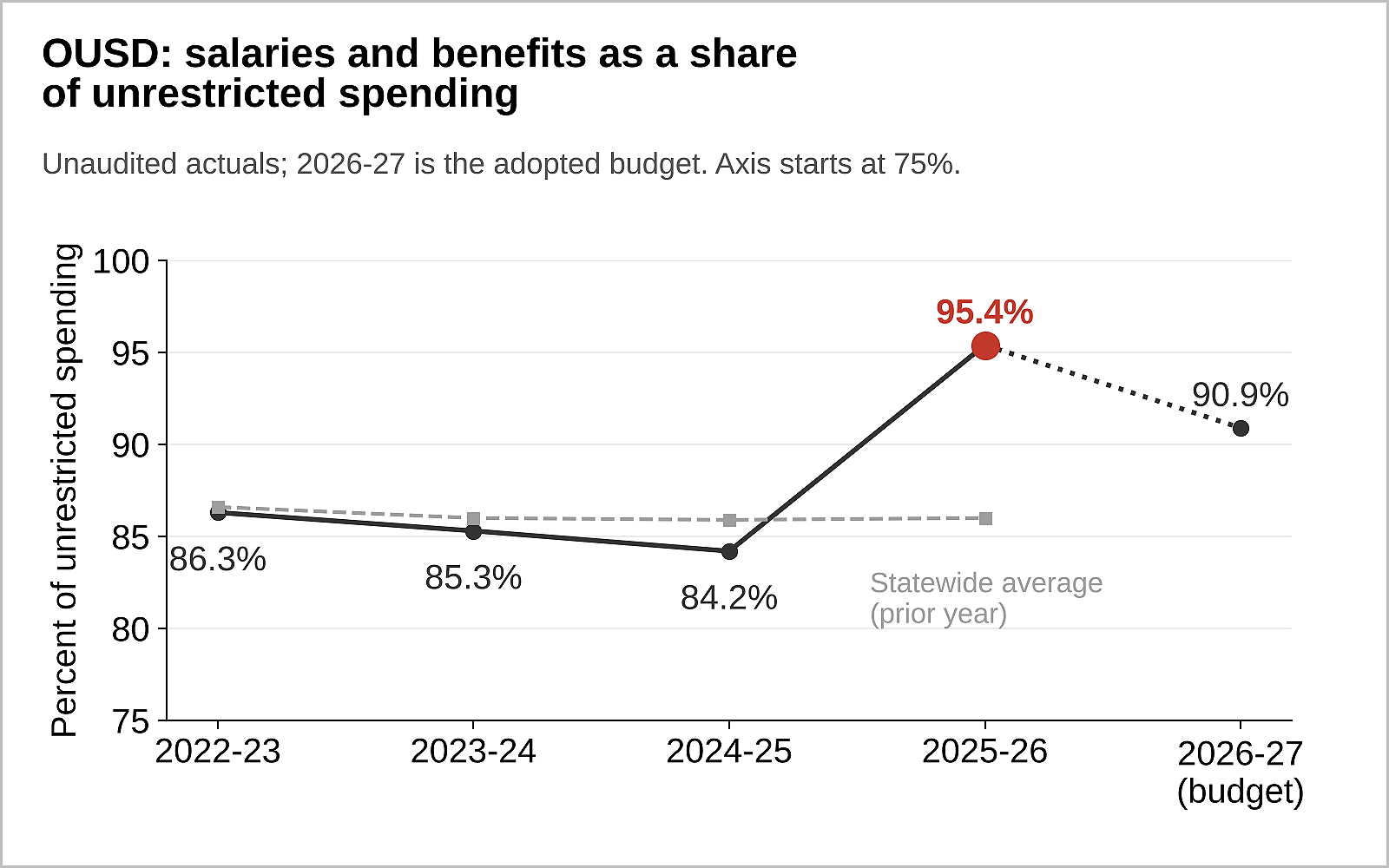
OUSD spent 95 cents of every unrestricted dollar on labor last year, after giving out pay raises it had not shown it could afford
Nine days after the election, the state’s Fiscal Crisis and Management Assistance Team (FCMAT) presented a report to the school board that concluded OUSD is still at “high risk” of running out of money.1415
The report found that the board kept making new savings plans before finishing old ones, and approved raises even though its own forecasts showed a deficit (spending more money than it was making) every year.
“These actions indicate that the district disregarded its own projections and took action that worsened its fiscal condition.”
—FCMAT report, Oct. 29, 2026
Pay and benefits took 95 cents of every unrestricted dollar last year, up from 84 cents the year before. In one labor deal, workers got a lasting 14% raise in a year when the state’s cost-of-living increase for schools was 2.3%.16
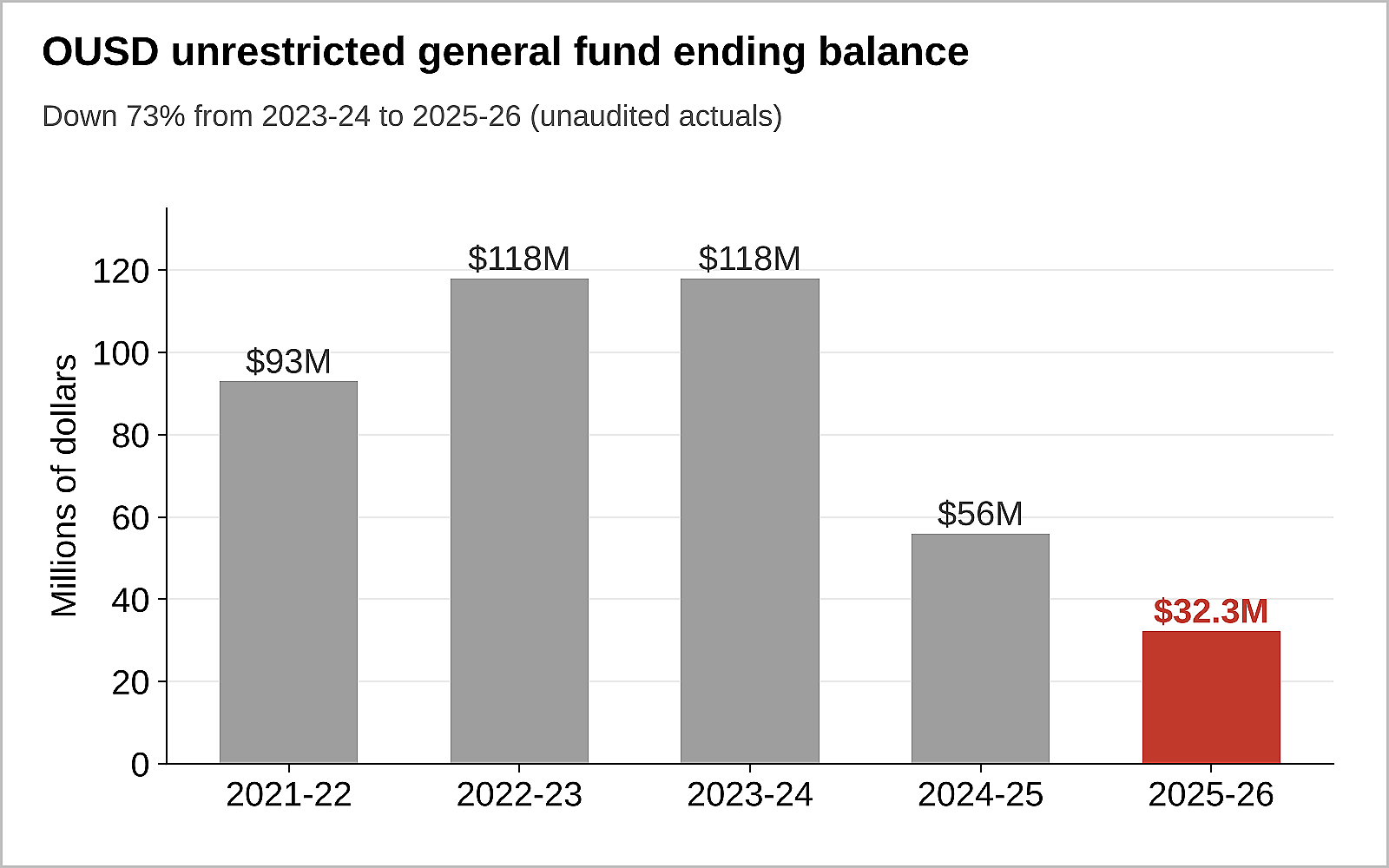
The district’s savings are shrinking, making it highly vulnerable to another financial crash. In order to fill the budget hole, the district approved $92.3 million in budget fixes last year — but $63.5 million of those were one-time fixes that can’t be repeated, and dig the district even deeper into a budget hole.17
Many of the budget fixes were on paper, achieved by shifting costs into restricted funds, which can only be spent on certain things. While this is technically allowed, it undermines the district’s financial health because those one-time funds are running low.
The district used voter-approved parcel tax funds to fill budget holes
Some of last year’s budget fixes came from diverting dedicated parcel taxes — local property taxes that voters approved for specific school programs — to fund general expenses instead.
Near the end of the school year, the district used $3.5 million in unspent reserves from Measures N and H, which were intended to pay for high school college and career programs, to cover salaries instead. It also moved about $5.1 million from Measure G1, a tax dedicated for teacher retention and middle schools, to teacher salaries.
The citizens commission that oversees Measures N and H voted against the move in June. On November 12, it told the board the money had been “misappropriated” and asked for it back.
A reasonable observer could interpret this as the school board breaking a promise to voters. District leaders say it was legal. A review ordered by the county found no signs of fraud. But Castro, the county superintendent, called it a “loophole” that was technically allowed but out of sync with what the measures were meant to do.18
Labor influence and labor spending
School board members voted to give pay and benefit raises to the unions who helped elect them — raises that the district can ill afford. For example, this year’s OEA contract raises pay by about 13% for the most senior teachers and 11% for others over two years. A neutral state fact-finder had recommended about 10% and 9%.19
The district says the deal will cost an extra $104.8 million over three years.20 In June, Castro warned that it “endangers the District’s fiscal stability” because the board had not shown how it would pay for it.21
Even with these clear warning signs visible for all to see, the union-backed school board members have voted in ways that appear designed to obscure the truth about the district’s dire financial circumstances and the primary reasons why the district spends more than it takes in.
In December 2025, the district’s budget chief, Lisa Grant-Dawson, said its finances should be rated “negative,” a warning that it might not be able to pay its bills. But board members Brouhard, Latta, VanCedric Williams and Bachelor voted for a milder rating instead. Hutchinson, Patrice Berry and Clifford Thompson voted no on that change.22
Hours before that vote, OEA had emailed its members that “OUSD does not have a structural deficit,” despite clear evidence to the contrary, and accused Grant-Dawson, the budget chief, of “blatant insubordination.”23 She left the district that month.
From 2020 through September 2026, OEA spent about $687,000 on school board races, more than any other committee.24
Saddler, the district superintendent, led OEA for six years before the board named her interim superintendent in 2025. Brouhard, the board president, once served on OEA’s executive board.25
The OUSD board approved up to $150,000 for a nationwide superintendent search.26 It then suspended the search in a closed-door meeting and extended Saddler’s contract through June 2027.27
On June 24, just before voting for the OEA contract, board member VanCedric Williams told the board he does “not take a paycheck from CTA,” the California Teachers Association, OEA’s statewide parent union. But CTA’s federal tax filings report paying him $48,695 in 2023 and $52,731 in 2024 while he sat on its board.28
During their re-election campaigns, Brouhard and Bachelor both said in campaign videos that “billionaires” want to close schools so they can be “used for things like data centers.” Oakland Report found no evidence for that claim.29
Brouhard’s and Bachelor’s apparently false campaign claim was not an isolated incident of OEA’s candidates and supporters acting unethically in order to win the election. On September 29, an OEA site representative who works at Skyline High School pinned two political attack flyers to the bulletin board beside the school’s main office. One attacked the “wealthy elites” funding school board races, and the other targeted candidates who were challenging the OEA-backed incumbents. District rules bar employees from posting campaign materials on school property. In Oakland, 16- and 17-year-olds can vote in school board elections, and the flyers hung where those students attend school. The principal had them removed that day, after complaints. It is unclear whether OEA directed the posting, but the high school confirmed that an OEA rep — who should know and follow the rules — was responsible.
None of these incidents is enough, on its own, to disqualify any specific board member from holding office. But board members elected with a union’s help — help that included false campaign claims and breaking rules around electioneering — may face at least the appearance of a conflict of interest when they decide that union’s pay.
Other considerations and counterpoints
The county approved OUSD’s 2026-27 budget on Nov. 5, and the district’s FCMAT financial risk score, while high, is falling.
Castro has said the problem is not the raises but the lack of a plan to pay for them.
Supporters say better pay retains teachers who might otherwise seek employment elsewhere. Bachelor said 99% of teaching jobs were filled this fall.
FCMAT did not blame the deficit on any one contract, and other unions also got raises.
The long and uncertain road ahead
The recent election — and its rejection of two board incumbents — changed the board’s math, but not its record.
Three of the five returning members voted against their own budget chief’s advice last December.
The district’s top executive is a former OEA president, and the rank-and-file teachers remain largely aligned with the direction OEA leads them.
All seven OUSD board members will inherit a teachers contract that the county said the district had no plan to afford.
The county wants the OUSD board to have budget fixes ready by February 2027.30 Early layoff notices are due by March 15.31
ABOUT THE AUTHOR
“Charlene Price” is an Oakland resident who has extensive interactions with OUSD. The author’s name has been changed to protect their privacy and prevent personal and professional retaliation. Oakland Report has verified the identity of the writer and the accuracy of the facts in this report.

SUPPORT OUR WORK
Oakland Report is an experiment in a new form of media. We are an independent, community-led 501(c)(3) nonprofit organization, not affiliated with any public agency, labor union, corporate interest or political campaign. If you value our services, please donate. We rely on your voluntary donations to continue our nonprofit work.
Alameda County Registrar of Voters. “General Election, November 3, 2026: preliminary/unofficial results, post-election update #4.” Alameda County, Nov. 16, 2026. https://www.alamedacountyca.gov/rovresults/260/
McBride, Ashley. “OUSD District 2 candidate Arielle Fleisher concedes in tight race.” The Oaklandside, Nov. 16, 2026. https://oaklandside.org/2026/11/16/ousd-district-2-candidate-arielle-fleisher-concedes-in-tight-race/
McBride, Ashley. “OUSD District 2 candidate Arielle Fleisher concedes in tight race.” The Oaklandside, Nov. 16, 2026. https://oaklandside.org/2026/11/16/ousd-district-2-candidate-arielle-fleisher-concedes-in-tight-race/
Mulick, Sam. “Preliminary Oakland Unified election results point to rebuke of incumbents.” The Mercury News, Nov. 13, 2026. https://www.mercurynews.com/2026/11/13/preliminary-oakland-unified-election-results-point-to-rebuke-of-incumbents/
McBride, Ashley. “Who’s spending on Oakland school board races this year?” The Oaklandside, Oct. 27, 2026. https://oaklandside.org/2026/10/27/oakland-school-board-election-2026-endorsements-campaign-spending/
McBride, Ashley. “Oakland teachers vote to authorize strike.” The Oaklandside, Feb. 23, 2026. https://oaklandside.org/2026/02/23/ousd-teachers-vote-to-strike/
Moe, Terry M. Special Interest: Teachers Unions and America’s Public Schools. Washington, D.C.: Brookings Institution Press, 2011. https://eric.ed.gov/?id=ED517366
Hartney, Michael T. “Teachers’ unions and school board elections: a reassessment.” Interest Groups & Advocacy 11 (2022): 237–262. https://doi.org/10.1057/s41309-022-00152-5
California Department of Education. “Local Control Funding Formula Overview.” CDE, accessed Nov. 17, 2026. https://www.cde.ca.gov/fg/aa/lc/lcffoverview.asp
California State Treasurer’s Office. “B.1.4.3 Parcel Taxes.” California Debt Financing Guide, accessed Nov. 17, 2026. https://debtguide-api.treasurer.ca.gov/guide-pages/appendix-b-school-finance/b-1-school-facility-finance/b-1-4-other-financing-sources/b-1-4-3-parcel-taxes
EdSource contributors. “Oakland Unified officials miss deadline to place parcel tax on ballot.” EdSource, Aug. 11, 2026. https://edsource.org/updates/oakland-unified-officials-miss-deadline-to-place-parcel-tax-on-ballot
Oakland Unified School District. “OUSD completes historic steps toward exiting state receivership.” OUSD News, Apr. 22, 2025. https://www.ousd.org/communications-public-affairs/newsroom/news/~board/ousd-news/post/ousd-set-to-take-historic-step-of-paying-off-state-loan-and-formally-exiting-receivership
Castro, Alysse. “Qualified certification of 2025-26 second interim budget report with going concern notice.” Alameda County Office of Education letter to OUSD, Apr. 16, 2026. https://www.oaklandreport.org/api/v1/file/7cbcafb5-27a3-4c65-82aa-d99af49433fc.pdf
Fiscal Crisis and Management Assistance Team contributors. “Oakland Unified School District Fiscal Health Risk Analysis.” FCMAT, Oct. 29, 2026. https://www.fcmat.org/PublicationsReports/OUSD%20FHRA%20final%2010.29.2026.pdf
Oakland Unified School District. “Board of Education regular meeting.” OUSD meeting video, Nov. 12, 2026, items K1 (FCMAT, 3:44:24–4:51:00) and P1 (Financial Stabilization Implementation Plan, 4:54:01–5:42:44). https://youtu.be/Y-Y5699q8W4
California Department of Education. “Budget Act for 2025–26: Information.” CDE, accessed Nov. 18, 2026. https://www.cde.ca.gov/fg/fr/eb/ba2025-26.asp
Gard, Tara et al. “Financial stabilization update.” OUSD Board of Education, Item A9, Nov. 12, 2026. https://ousd.legistar.com/View.ashx?M=F&ID=16123274&GUID=51404A0A-E2D3-44E2-A37C-654F1670D150
McBride, Ashley. “OUSD and an oversight committee duel over how funds for college and career prep were spent.” The Oaklandside, Oct. 9, 2026. https://oaklandside.org/2026/10/09/ousd-college-career-parcel-tax-funding/
California Public Employment Relations Board. “Factfinding report and recommendation: Oakland Education Association, CTA/NEA and Oakland Unified School District.” PERB, Feb. 19, 2026. https://perb.ca.gov/wp-content/uploads/2026/03/FR0904-1.pdf
Reinhart, Sean S. “Union raises ‘endanger’ Oakland school finances as board set to approve $1.2 billion budget.” Oakland Report, Jun. 23, 2026. https://www.oaklandreport.org/p/union-raises-endanger-oakland-schools
Castro, Alysse. “Public disclosure of the collective bargaining agreement between OUSD and the Oakland Education Association.” Alameda County Office of Education letter to OUSD, Jun. 18, 2026. https://www.oaklandreport.org/api/v1/file/4c892cf8-7037-4e1f-89f5-aae2a6ed0bc8.pdf
McBride, Ashley. “OUSD leaders call budget outlook ‘positive’ for first time in 22 years.” The Oaklandside, May 28, 2026. https://oaklandside.org/2026/05/28/ousd-budget-positive-deficit-school-board/
Borek, Bob. “Oakland school board (OUSD) approves $102.5 million in budget cuts in 5-2 vote.” Oakland Report, Dec. 13, 2025. https://www.oaklandreport.org/p/oakland-school-board-ousd-approves
Price, Charlene. “OEA teachers union rep caught posting political attack flyers outside high school’s main office.” Oakland Report, Oct. 1, 2026. https://www.oaklandreport.org/p/skyline-high-campaign-flyers-teachers-union-oea
Corry, Melanie. “OUSD names former union president as interim superintendent.” CBS News, May 30, 2025. https://www.cbsnews.com/sanfrancisco/news/ousd-names-interim-superintendent; Ballotpedia contributors. “Jennifer Brouhard.” Ballotpedia, accessed Nov. 16, 2026. https://ballotpedia.org/Jennifer_Brouhard
McBride, Ashley. “OUSD postpones superintendent search.” The Oaklandside, Apr. 23, 2026. https://oaklandside.org/2026/04/23/oakland-superintendent-search-denise-saddler-budget/
KQED. “Oakland school board set to extend Denise Saddler’s superintendent contract.” KQED, May 13, 2026. https://www.kqed.org/news/12083494/oakland-school-board-set-to-extend-denise-saddlers-superintendent-contract
Price, Charlene. “Oakland school board director VanCedric Williams was paid by California teachers union. He denied it, then voted to approve teachers union contract.” Oakland Report, Sept. 6, 2026. https://www.oaklandreport.org/p/oakland-school-board-director-vancedric; Tucker, Jill. “Oakland school board member denied that the teachers union paid him. It did.” San Francisco Chronicle, Sept. 4, 2026. https://www.sfchronicle.com/bayarea/article/oakland-schools-board-member-conflict-22418000.php
Reinhart, Sean S. “OUSD incumbents claim ‘billionaires’ want to turn schools into data centers — but nothing in the record supports it.” Oakland Report, Oct. 28, 2026. https://www.oaklandreport.org/p/oakland-school-trustees-claim-billionaires-data-centers
Bravo!
This should begin a larger conversation about the 'special' nature of public employee unions, ALL public employee unions, and the important differences from private sector unions.
Free speech is not negotiable. The right of employees to bargain with employers is not negotiable. The difference is with the nature of the 'employer.'
Public employee unions keep arguing that their employer is just like the 'evil' business owner. But when voters and taxpayers look for that villain, they find themselves looking in a mirror! Keep following that logic and inevitably the voters and taxpayers become the 'evil' business owner refusing to be fair to employees.
Public employee unions must be able to negotiate a range of employment concerns with their employers. But they must not be allowed to select the elected officials that negotiate their compensation and benefits. That is a fundamental 'Conflict of Interest'.
Gaming a commercial transaction in favor of one side is the definition of 'corruption.'
Behind this issue is the larger issue of adequate support for education. Our democracy and our society must have stronger educational systems to support the future. More money is needed. But some of the need can be met with professional management and budgeting free from public union corruption of elections. This can be done while protecting most union rights. And it will boost public support and remove many of the anti-funding arguments at election time. It only requires the parties to restore balance and put the kids first.
I hear you, Sean. Let’s throw the bums out (to coin a cliche)!