


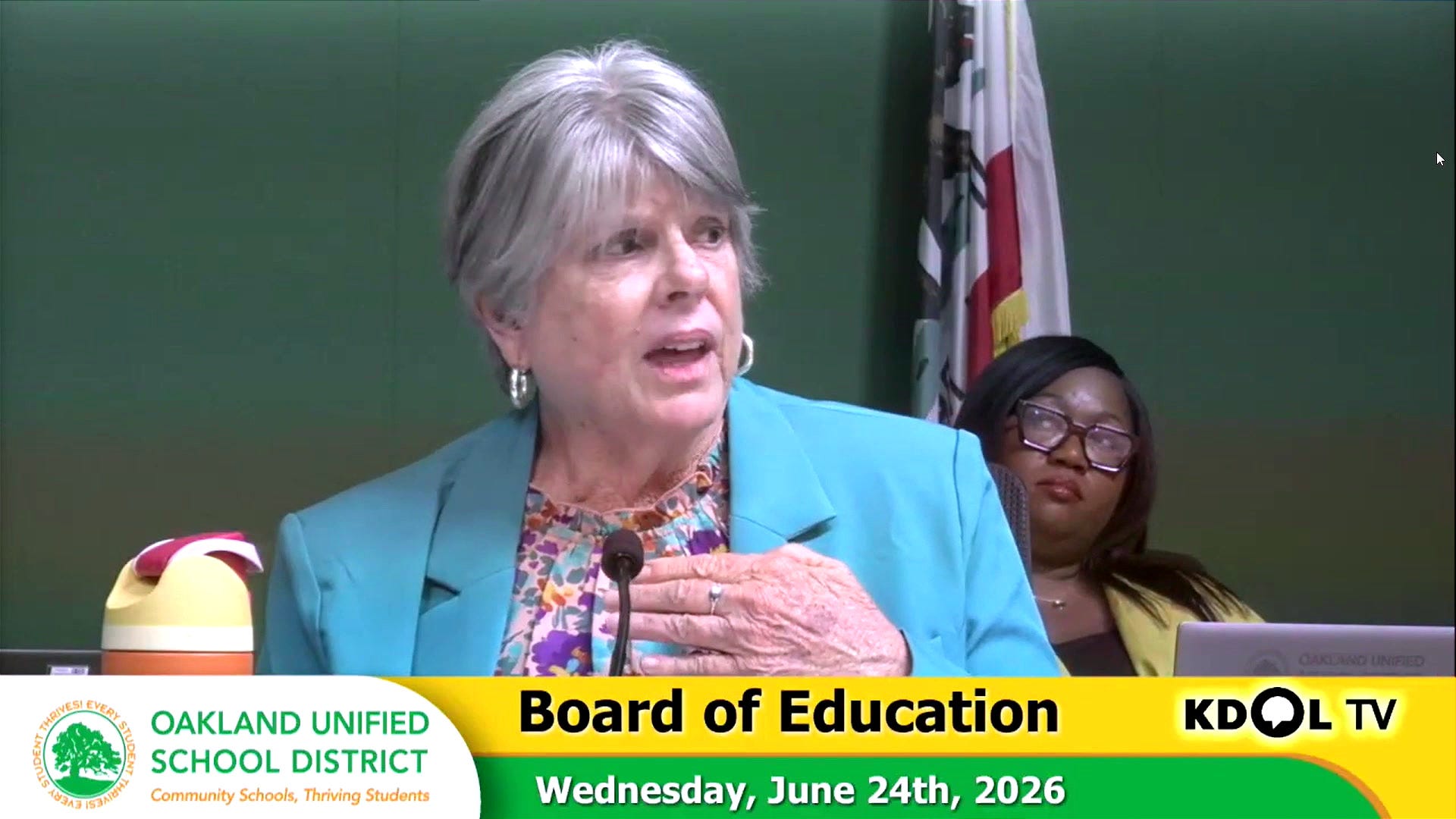
Oakland Unified School District (OUSD) board president Jennifer Brouhard wrote a July 5 opinion column that said the school board would not solve its budget gap by closing schools.1
“In December, the board gave clear direction: bring forward a budget proposal that did not include a state loan and did not include school closures. [Interim superintendent Denise] Saddler and her team did exactly what the board asked them to do.”
— OUSD board president Jennifer Brouhard, Jul. 5, 2026
A few weeks later, EdSource reported that 73 public schools closed statewide in 2026, and noted that OUSD tied for second-most schools closed, at five.2
Oakland Report checked records on school closures, plus 27 years of statewide enrollment data. We counted six school closures in Oakland — the sixth was a school operated by the Alameda County Office of Education.
Our key takeaway: OUSD’s district-run enrollment has fallen by more than a third since 2000-01, yet 49 of its 78 schools have fewer students than the largest charter school that closed this year.3
Meanwhile, charter enrollment grew twelvefold over the same span — yet it is the charter sector, not the district-run sector, that closed schools in 2026.
Key findings
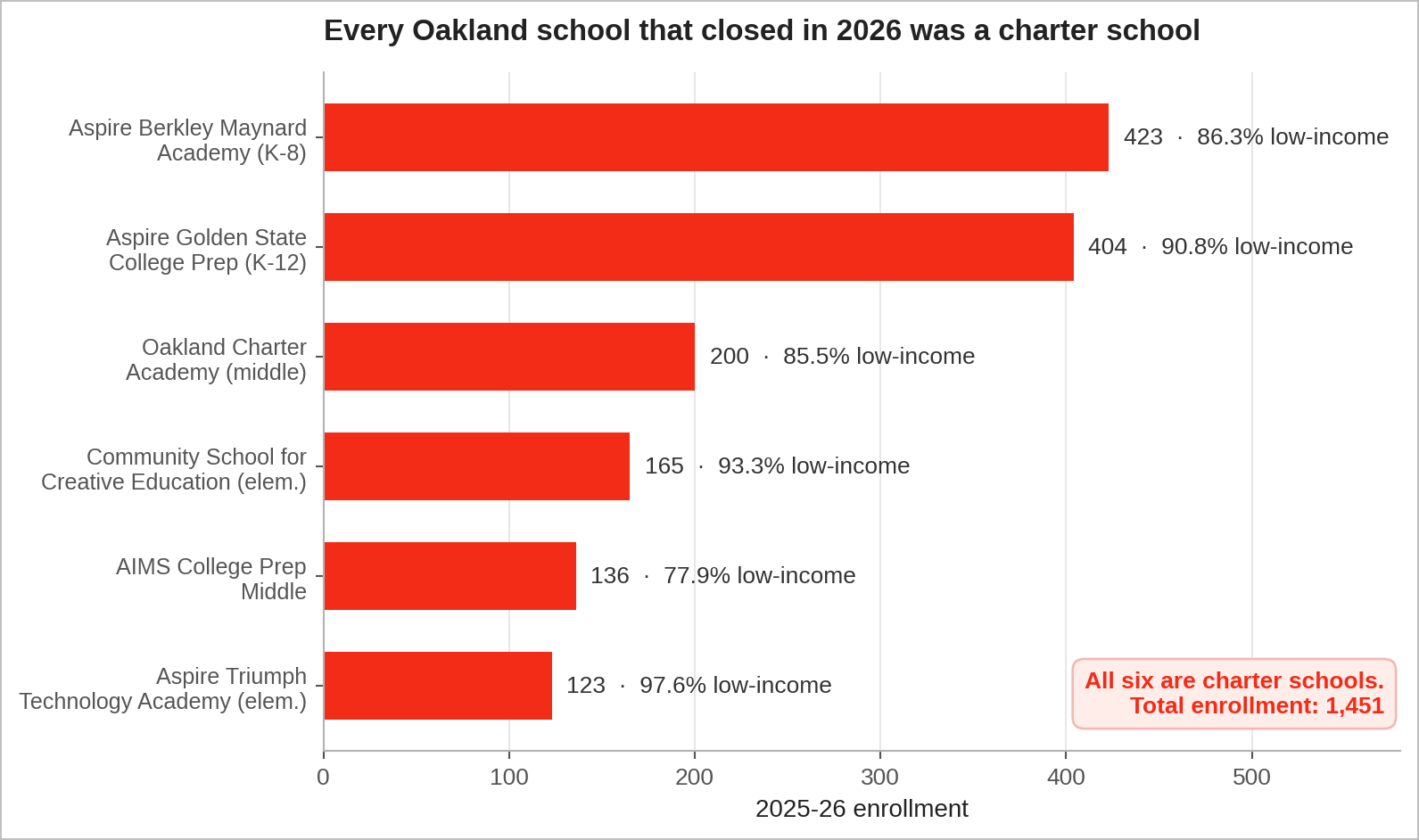
All six schools closed in Oakland were charter schools. The six schools enrolled 1,451 students combined. Five of the closures were approved by OUSD, and one by the county office of education.
Their students were poorer than average: 88 percent of students in the closed schools qualified for free or reduced-price meals, compared to 80 percent across Oakland’s public schools, 73 percent at California schools that closed in 2026, and 62 percent statewide.4
District-run enrollment has fallen around 36 percent since 2000-01. Its enrollment has declined far more than the number of school-age children in Oakland has.5
Charter enrollment grew significantly over the same time span, from about 1 percent of Oakland’s public school students to 22 percent — though it has fallen in more recent years.
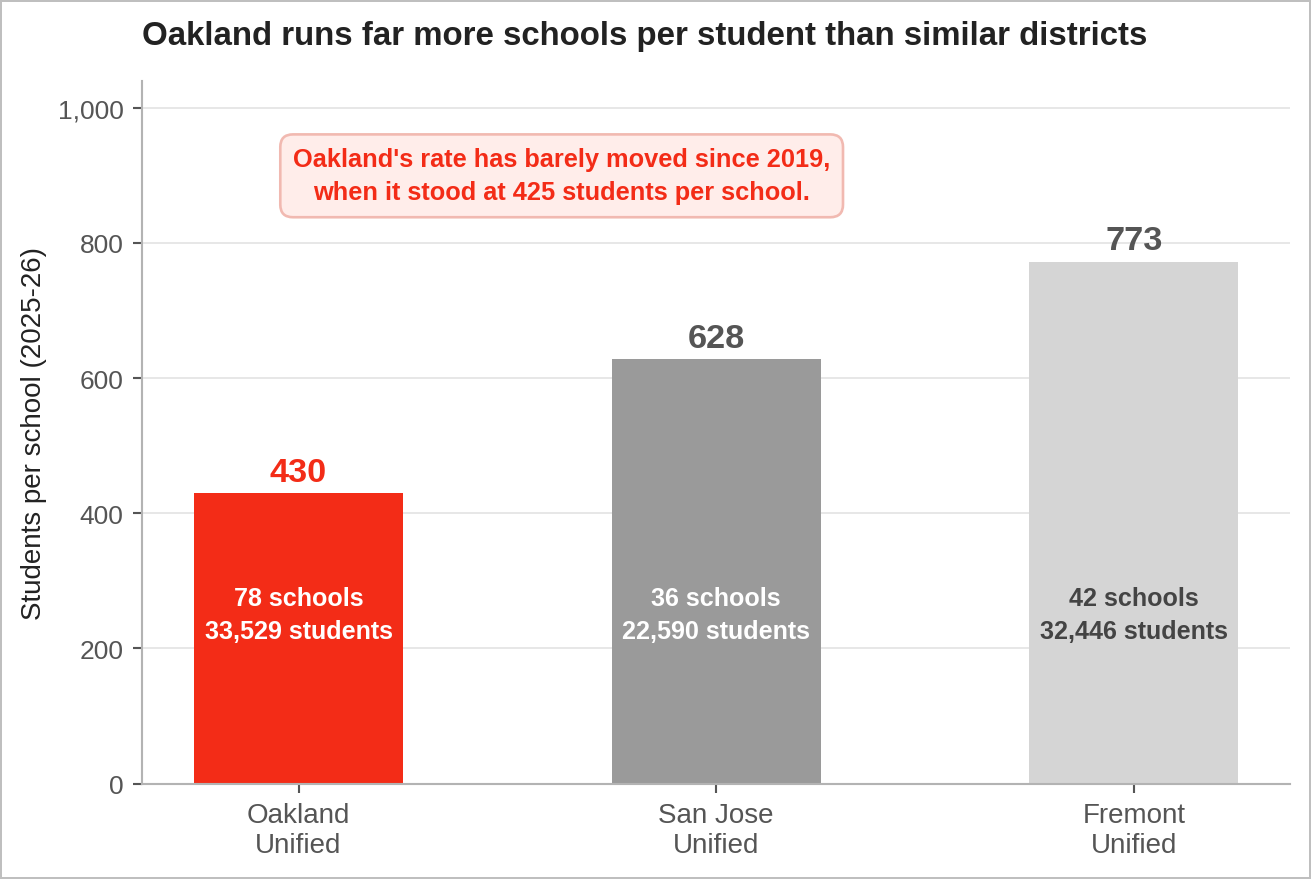
Oakland averages 430 students per school, compared to 628 students per school in San Jose Unified and 773 in Fremont Unified.
OUSD’s schools are only 60% full. The district’s recent Facilities Master Plan confirms that enrollment fills only around 60% of the planned-use capacity the district was built for — an efficiency gap we estimate costs Oakland schools $11 to $21 million per year.
Subscribe for free to Oakland Report.
OUSD’s enrollment decline was concentrated in district-run schools – not charters
OUSD’s total enrollment decline has accelerated over the past ten years — roughly nine percent since 2015-16, a figure that includes charter schools the district approved.
But when examining district-run and charter schools separately, the two school types’ enrollment totals moved in opposite directions.
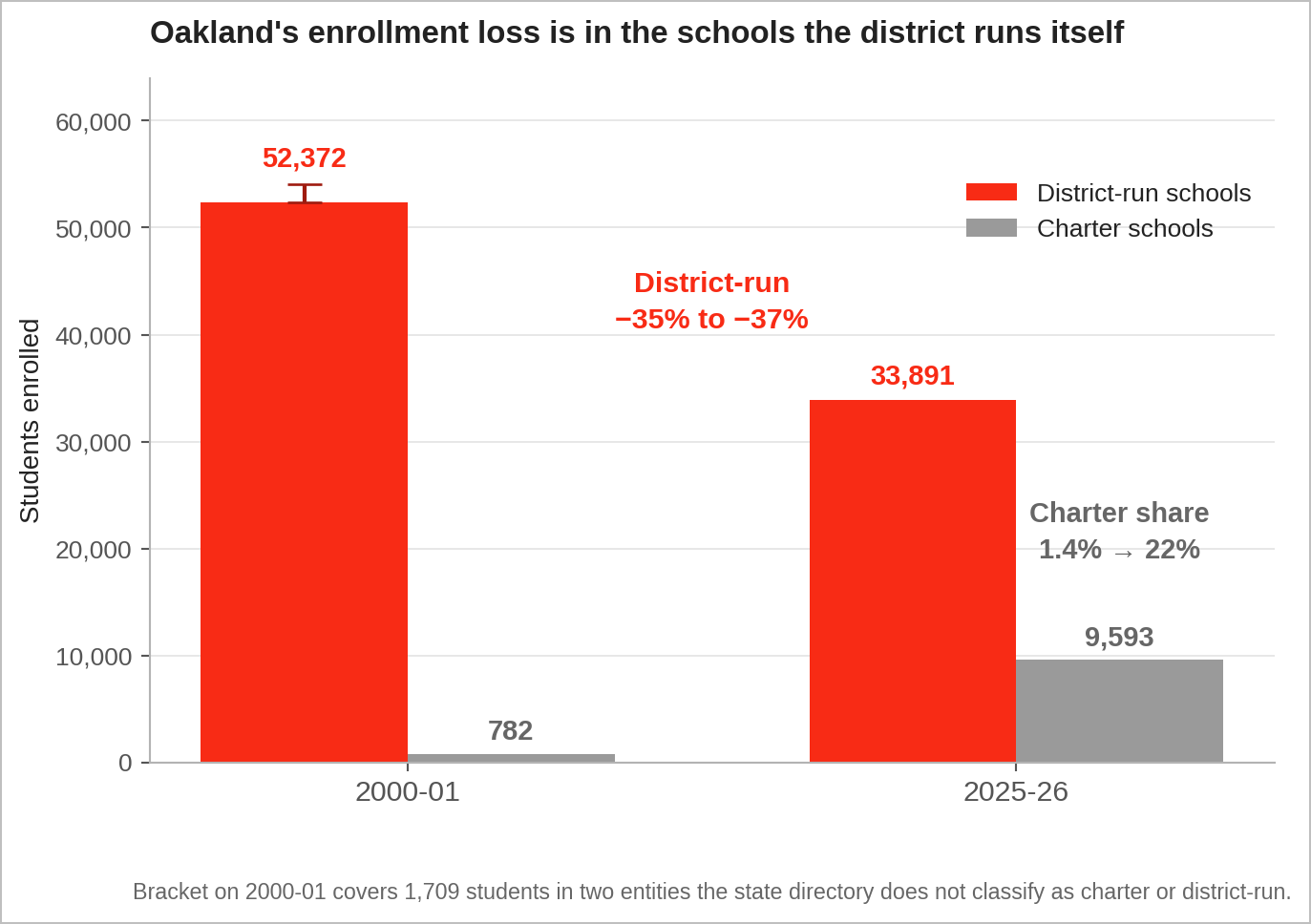
Oakland’s total public enrollment fell about 21 percent between 2000-01 and 2025-26, but that single number obscures the more detailed enrollment trends beneath it: district-run schools lost more than a third of their students while charters grew more than twelvefold.6
The six schools that closed
All six of the Oakland schools were closed after their governing agencies refused to renew their charters, mostly over test scores. For example, on the 2025 state tests, only around seven percent of students at Aspire Golden State College Prep met the math standard.7
In July, the State Board of Education let the closures stand, faulting OUSD’s methods but citing a 2019 charter school law.8
The education code says cost findings against a new charter “shall not be used to deny a renewal of an existing charter school.” But another section of the code says a district “shall not renew” a charter scoring in the two lowest levels on every state measure two years running, unless it puts in writing that the school is fixing the problem.9
In other words, for the weakest schools, refusing charter renewal is what the law expects. So the governing agencies (OUSD and ACOE) were following the law.
The students at the closed schools were poorer than average
Studies have shown that school closures tend to fall hardest on low-income schools with low test scores.10
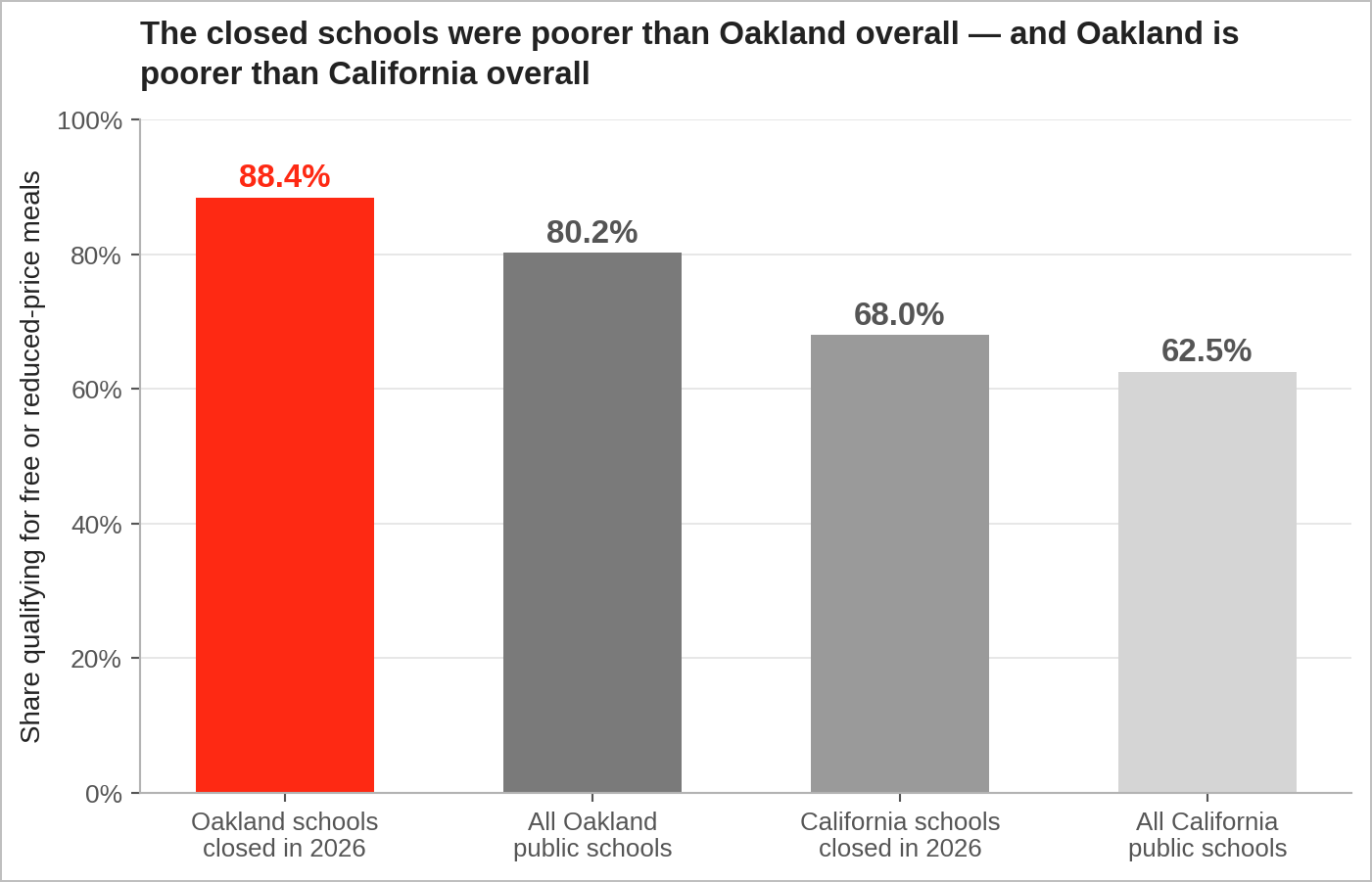
Oakland’s six closed schools fit that pattern, but most of the gap compared to the state average is because the district’s schools are already 80 percent low-income. Even compared to that baseline, the closed schools were 8 points poorer than Oakland’s public schools overall.
Note: six schools is a small dataset, so these data suggest a direction, not an absolute trend.
Read this related article:

Every dollar spent carrying empty buildings is a dollar not spent on students
Alameda County Office of Education (ACOE) superintendent Alysse Castro has said OUSD runs more schools than its enrollment can pay for.11
The district’s own 2026 Facilities Master Plan confirms: enrollment fills only about 60 percent of the space OUSD was built for, and 71 percent of the space it now schedules, leaving some 23,000 empty seats.12
At the fill rate of similar districts, Oakland’s students would fill around 43 to 53 schools. According to public records, OUSD currently operates 78 schools.
According to OUSD’s facilities master plan, its excess square footage “forces the district to divert funds into utilities, custodial services, and administrative staffing for underutilized buildings rather than direct student services.”
The district’s own reports estimated potential savings of $3 million if it merged 10 schools into five in 2024.
Based on those district-produced numbers, Oakland Report estimates that continuing to operate 25 to 35 more schools than its enrollment supports costs the district somewhere between $11 million to $21 million per year.
The district’s budget plan counts on raising about $10 million a year from better attendance (the state gives school districts funding based on attendance). In Oakland, running a school footprint the size of its peers’ students-per-school footproints would be worth one to two times that. By the board’s own math, where a percentage point of attendance is worth $5.25 million, it would result in budget savings equivalent to raising attendance by two to four points.13
The district’s 2026-27 budget shows $841.0 million coming in against $874.3 million going out, and a $37.2 million drop in fund balance — down 62.9 percent, from $100.2 million the year before.14
To be clear, closing more schools would not fix all of OUSD’s budget woes. Even the high end of the estimated savings would not close the OUSD’s structural budget deficit without additional budget changes.
But the public record suggests that the cost of not closing underenrolled schools is and will continue to be substantial.
As board president Brouhard herself stated, the board directed its staff not to consider school closures or mergers. As a result, the budget savings plans staff presented to the board in November found less than $22 million of the $100 million needed to close the gap. In February, the board cut 421 jobs while keeping schools open.15
Then in June, the board adopted a 2026-27 budget projecting an $8 million surplus — but only if it finds $30 million in cuts — this year and again the year after — but it still has not identified exactly what those cuts will be.16

Other considerations and caveats
The board has valid reasons for caution. Closing schools is one of the most difficult, controversial, and emotionally charged steps a district can take.
The six charter school closures in 2026 were real, potentially devastating losses for the 1,028 affected students and their families.
The state attorney general warned in 2024 that OUSD’s 2022 closure plan would have fallen hardest on Black students, low-income students and students with disabilities.17
The district has also made progress in some areas: for example, its attendance rose to 91.8 percent.
The enrollment data does not flag charters separately in long-past years, so the 2000-01 split between charters and district-run schools is a range.
The school counts exclude adult education, preschool and child development centers; counting them raises Oakland’s total number of schools to 86.
The $11 million–$21 million savings figure is our estimate, built from the district’s past savings estimates rather than by direct study of the district’s individual buildings and enrollment patterns.
Share this article with someone you know.
Conclusion
Neither the data nor this analysis pass judgment on the value of charter schools versus district-run schools. Each type of school — public, charter, private, homeschool — has its benefits and drawbacks for parents to consider. Such an examination is beyond the scope of this report.
It is understandable, to a degree, that public school districts tend to be hostile to charters, as they draw resources away from district-run schools.
It also is reasonable to consider the possibility that when a public school district is underperforming, the added competition from charter and private schools is even less likely to be welcomed by the district nor by supporters of district-run public schools.
The above considerations raise another question: When district-run schools perform to high standards that compare well to both charter and private school options, does that result in stronger enrollment at district-run schools? Oakland Report may examine the data behind that question in a future analysis.
What this analysis does show: Six schools closed in Oakland this year, and all were charters. But for the district’s own schools, leaving closures off the table was a specific direction by its board, even as it implemented substantial cuts elsewhere and faces yet more cuts to be determined — and OUSD continues to operate far more schools per student than other large districts.
Read this related article:

ABOUT THE AUTHOR
“Charlene Price” is an Oakland resident who has extensive interactions with OUSD. The author’s name has been changed to protect their privacy and prevent personal and professional retaliation. Oakland Report has verified the identity of the writer and the accuracy of the facts in this report.

BECOME A SUPPORTING MEMBER
Oakland Report is an experiment in a new form of media. If you value our work, please donate. We are a citizen-led nonprofit organization based in beautiful Oakland, California. Your contribution in any amount helps us continue to produce articles like this one.
Brouhard, Jennifer. "Opinion: unfair media attacks on OUSD leadership for not closing schools." Oakland Post, Jul. 5, 2026. https://www.postnewsgroup.com/opinion-unfair-media-attacks-on-ousd-leadership-for-not-closing-schools/
Allen, Justin and Yuxuan Xie. "California school closures rise as enrollment decline continues." EdSource, Aug. 17, 2026. https://edsource.org/2026/california-school-closures-enrollment-decline/764123
Oakland Report analysis of CDE census day enrollment and school directory files, 2025-26. The six Oakland schools that closed in 2026 enrolled, largest to smallest:
Aspire Berkley Maynard Academy (423)
Aspire Golden State College Preparatory Academy (404)
Oakland Charter Academy (200)
Community School for Creative Education (165)
AIMS College Prep Middle (136)
Aspire Triumph Technology Academy (123).
Of OUSD's 78 active district-run schools, 49 enrolled fewer than 423 students and 13 fewer than 200:
Ralph J. Bunche Continuation High (53)
Street Academy Alternative High (83)
Gateway to College High at Laney College (100)
Dewey Academy High (127)
Young Adult Program (130)
Prescott Elementary (132)
Carl B. Munck Elementary (169)
Fred T. Korematsu Discovery Academy Elementary (183)
West Oakland Middle (189)
Grass Valley Elementary (190)
MetWest High (193)
Sankofa United Elementary (198)
Horace Mann Elementary (199).
Six of those 13 are continuation, alternative or transition programs that are small by design. Of the seven traditional schools among them, four were spared — Munck, Korematsu, Grass Valley and Horace Mann — when a newly seated board rescinded the 2022 closure plan in January 2023.
California Department of Education contributors. "Free or reduced-price meal (FRPM) data, 2025-26, school-level file." CDE data portal, accessed Aug. 19, 2026. https://www.cde.ca.gov/ds/ad/filessp.asp
Gardner, Emmet. “Oakland public school enrollment fell 35% — far more than the shrinking child population.” Oakland Report, Jul. 23, 2026. https://www.oaklandreport.org/p/ousd-enrollment-decline-district-run-schools
California Department of Education contributors. “Enrollment by school, 1998-99 through 2006-07.” CDE data portal, accessed Aug. 19, 2026. https://www.cde.ca.gov/ds/ad/filesenr.asp
California Department of Education and Educational Testing Service. "Smarter balanced summative assessment research file, 2025 — percentage standard met and above, all students, all grades." CAASPP/ELPAC data portal, accessed Aug. 19, 2026. https://caaspp-elpac.ets.org/caaspp/ResearchFileListSB
Fensterwald, John. "Puzzled California state board faults legislature as it denies charter school appeal." EdSource, Jul. 10, 2026. https://edsource.org/2026/puzzled-california-state-board-faults-legislature-as-it-denies-charter-school-appeal/761876
O'Donnell, Patrick. "Assembly Bill 1505 — Charter schools: petitions and renewals." California Legislature, 2019-20 Regular Session, Chapter 486, Statutes of 2019. https://leginfo.legislature.ca.gov/faces/billNavClient.xhtml?bill_id=201920200AB1505
Lafortune, Julien and Emmanuel Prunty. "Factors and future projections for K-12 declining enrollment." Public Policy Institute of California, December 2023. https://www.ppic.org/publication/factors-and-future-projections-for-k-12-declining-enrollment/
DeBenedetti, Katie. "Oakland Unified wins budget approval but faces dire warning on financial future." KQED, Nov. 3, 2025. https://www.kqed.org/news/12062643/oakland-unified-wins-budget-approval-but-faces-dire-warning-on-financial-future
Oakland Unified School District contributors. “Facilities master plan 2026 — data analysis, section 4.6, building occupancy rate and capacity.” OUSD, adopted Apr. 22, 2026. https://www.ousd.org/facilities-planning-management/about/facilities-department/facilities-master-plan/data-review
Oakland Unified School District contributors. "Update report — budget scenarios, OUSD structural deficit, fiscal years 2025-2026 and 2026-2027." OUSD board of education meeting, Dec. 10, 2025. https://ousd.legistar.com/LegislationDetail.aspx?ID=7774308&GUID=56790DE6-2E1E-4AC1-AAC5-B350DE16B3D7&Options=&Search=
Oakland Unified School District contributors. "2026-2027 fiscal year - district budget - all funds - deputy superintendent, business and operations." OUSD board of education meeting, Jun. 24, 2026. https://ousd.legistar.com/LegislationDetail.aspx?ID=8044001&GUID=80EAB549-CF6E-4A6C-878A-4991A3C31957&Options=&Search=
McBride, Ashley. "OUSD board approves 421 staff layoffs." The Oaklandside, Feb. 26, 2026. https://oaklandside.org/2026/02/26/ousd-board-approves-421-staff-layoffs/
McBride, Ashley. "Deficit? Surplus? OUSD passed a very confusing budget." The Oaklandside, Jun. 25, 2026. https://oaklandside.org/2026/06/25/deficit-surplus-ousd-passed-a-very-confusing-budget/
Bonta, Rob et al. "Attorney general Bonta advises Oakland Unified to comply with state laws as it considers school closures." Office of the Attorney General, Jan. 29, 2024. https://www.oag.ca.gov/news/press-releases/attorney-general-bonta-advises-oakland-unified-comply-state-laws-it-considers-1
Is it fair to say Charter Schools are Non Union. So they did not touch any Union Teachers ?
This article is horribly misleading - and honestly, articles like this are so unhelpful to charter schools.
5 of the 6 actually "self closed" - where the decision was made by the charter operator.
This article makes it sound like OUSD closed them, but that is incorrect. "5 of these closures were approved by OUSD " is really poor journalism and unhelpful for charters in the Oakland context. And this is coming from someone who leads a charter network in East Oakland.
Please make the appropriate edits.