


Video montage 1. “It’s basically a law that’s not enforceable.” Oakland public ethics commission chair expresses frustration that it has no way to enforce the police commission’s violation of open meeting laws. (Video source: City of Oakland. Montage by Oakland Report.)
Oakland Agenda Watch provides summaries of upcoming public meeting agenda items that catch our attention. In this installment, we examine a “cure and correct” letter written by public ethics commission enforcement staff to the Oakland police commission.
Ten months later, the police commission considers a cure for having broken the rules
Oakland Police Commission regular meeting, Sept. 10, 2026, agenda item X
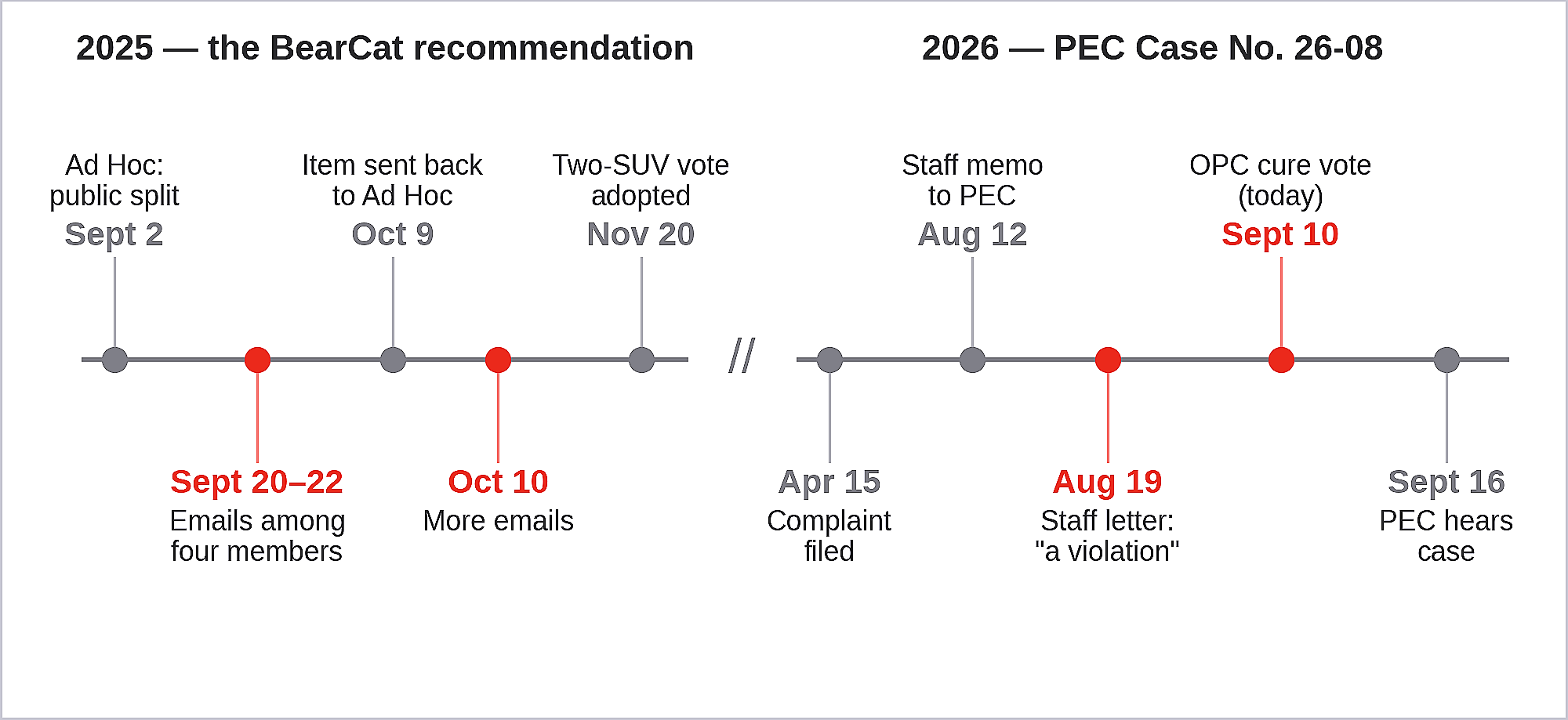
On August 19, Oakland’s public ethics commission (PEC) enforcement chief Tovah Ackerman notified the Oakland police commission that emails among four police commissioners on September 20–22 and October 10, 2025 violated Oakland’s sunshine ordinance and the Brown Act.1
Ackerman characterized her letter, which was issued on a public ethics commission letterhead, as “informal preliminary guidance.”
The PEC’s enforcement staff found that the four members of the police commission — Omar Farmer, Wilson Riles, Sam Dawit, and chair Ricardo Garcia-Acosta — exchanged email communications regarding a ‘militarized equipment ad hoc committee’ recommendation to divest from an Oakland police department BearCat armored vehicle.
Notably, an earlier draft of the recommendation had said that OPD should not replace the BearCat at all.2
The complaint further alleges that a commissioner revised the ad hoc committee’s recommendation via these private exchanges, circumventing public meeting requirements.

Following these private email exchanges, the full police commission voted to adopt the ad hoc committee’s revised proposal during its November 20, 2025, special meeting.
That vote told the Oakland police department to give up its Lenco BearCat armored truck and buy two smaller armored SUVs.3
Ackerman’s August 19 letter further recommends that the police commission put its November 20, 2025 vote on armored vehicles back on the agenda to decide whether to “cure and correct” the violation.
PEC staff’s memo says the final version of the BearCat recommendation reflected the views of a commissioner who was not on the committee that wrote it, citing an interview with commissioner Omar Farmer.
A public comment filed with the PEC this week by Oakland resident Rajni Mandal asks the commission not to adopt the PEC staff’s recommendation as written.4
[Editors’ note: Mandal is an occasional Oakland Report contributing writer.]
The police commission put the PEC letter on today’s agenda for discussion and a potential vote.
The agenda describes the PEC’s guidance as concluding that the emails “constitute a meeting,” and asks commissioners to decide “whether the need exists to cure and correct” the November 20 vote.5
For the PEC’s part, it will not take up the case until September 16.6
‘It’s basically a law that’s not enforceable.... So if people want to violate it… it’s easy to violate’
The public ethics commission admitted that it has no real power to enforce the police commission’s sunshine ordinance violation when it discussed the matter on July 15, 2026.7
“I just want to be really clear that what we’re saying here as an ethics commission is that it’s basically a law that’s not enforceable, essentially. So if people want to violate it, and it’s easy to violate, you know, with messing up meeting notices and agendas and you have bodies that are volunteers and amateurs and stuff like that. So it really doesn’t give us a lot of help.”
– Francis Upton IV, public ethics commission chair, July 15, 2026
Oakland Report reviewed the full text of the sunshine ordinance violation regarding ‘serial meetings’ (such as by having four commissioners on an email discussing commission business, out of view of the public). Our conclusion: the police commission definitely appears to have violated the ordinance.
Notably, the PEC has yet to issue a ruling on the matter. At its July 15 meeting, PEC staff confirmed that it can notify commissions and ask them to voluntarily correct violations, but the PEC has no true enforcement mechanism.
Redo — and possibly overturn — the Bearcat vote?
The police commission’s agenda includes the option to redo its past vote to keep the Bearcat. The relevant agenda item reads, “Request regarding whether the need exists to cure and correct the Commission’s November 20, 2025, vote on Recommendation A”.
It is important to keep in mind that this recommendation (to redo the vote) was based solely on Farmer’s testimony, according to the PEC staff report. Farmer filed his complaint in April — five months after the emails had been sent around — asserting that the vote was invalid because of the ‘serial meeting’ issue created by the emails among police commissioners.
In sum, the PEC is basing its recommendation based on Farmer’s testimony alone, and now the proposed cure is for the police commission to reconsider (and possibly overturn) its previous vote.
The memo’s key source is a commissioner the council refused to reappoint — twice
Farmer’s own seat on the police commission has been in dispute for almost a year. The city council declined to reappoint Farmer twice, on October 21, 2025 and again on January 20, 2026.8
After the first council vote against reappointment, Farmer and chair Ricardo Garcia-Acosta issued a statement accusing the police chief and blaming the city for “anti-commission harassment.”9
Related story:

Farmer’s term had expired in October 2025, but he stayed on as a ‘holdover’ alternate because no replacement had been seated.
The commission then used a different route to keep Farmer, defying the city council’s intent. City Charter section 604(d)(8) lets the commission elevate an ‘alternate’ to fill a permanent voting seat that becomes vacant for a reason other than an expired term.
Critically, the elevation of an ‘alternate’ is intended to maintain a quorum so the commission can conduct its business, but only the Selection Panel can officially fill a vacancy.
Commissioner Wilson Riles left the commission on February 2, 2026. (Riles passed away a few months later.)
On March 26, the police commission emerged from a closed session and announced that Farmer had “taken over the term of former Commissioner Wilson Riles.”
However, the posted March 26 agenda gave no public notice of any appointment — an apparent violation of the Brown Act.10
Read this related article:

Mandal, the same resident who filed this week’s public comment, filed a Brown Act “cure and correct” demand on March 31.
Police commission vice chair Shawana Booker then claimed that the announcement “was not a readout of a closed session vote.” However, the meeting video clearly shows Booker confirming that it was.
On April 9, city attorney Ryan Richardson issued an opinion that the commission “must take action, appropriately noticed,” to fill a vacancy, and that a person the council declined to reconfirm “is not qualified to serve a new fixed term.” The commission could seat Farmer only temporarily, Richardson wrote, and must replace him “promptly.”11
Two weeks later, on April 23, the police commission selected Farmer to assume the remainder of Riles’ term. The commission’s website now describes him as “serving in a holdover capacity as a Commissioner, not as an Alternate Commissioner,” with a term ending October 16, 2026.12
In other words, a holdover alternate whom the council twice declined to reappoint became a full commissioner without a council vote.
Farmer sat on the committee that drafted the BearCat recommendation and, at its September 2, 2025 meeting, defended the draft’s position not to replace the BearCat.
Farmer now sits on the police commission’s reconstituted “militarized equipment ad hoc committee,” alongside chair Garcia-Acosta and commissioner Shane Williams.
The facts of the matter are not in dispute. The sunshine ordinance expressly forbids serial emails among a quorum, and the PEC exists to enforce that rule.13
Aside from the revelation that the PEC actually has no enforcement mechanism to speak of, the question is one of order: Ten months after the violation occurred, who decides whether a violation occurred, and when?
The ordinance says a mandatory cure follows a PEC hearing, not a staff letter
The city’s sunshine ordinance section 2.20.270(D) says nothing stops a local body from curing a challenged action on its own. It further says that if the PEC, “upon the conclusion of a formal hearing conducted pursuant to its General Complaint Procedures” finds a violation, the body “shall agendize for immediate determination whether to correct and cure the violation.”
The police commission staff’s memo asks the PEC to “adopt a finding that sufficient evidence of a violation… exists and issue guidance to the Oakland Police Commission to agendize this matter.”
The memo itself says the section applies “when the PEC determines a violation has occurred.”
PEC staff Ackerman’s August 19 letter paraphrases the same section the same way: “when the PEC determines a violation has occurred, the local body… ‘shall agendize for immediate determination whether to correct and cure the violation.’” The words “upon the conclusion of a formal hearing” do not appear in her letter’s summary of the rule.
It stands to reason that a “sufficient evidence” finding at a regular meeting is not the same as a finding after a formal hearing.
The PEC’s own rules keep the decision with the ethics commission, not the police commission
The PEC’s “mediation and complaint procedures” outlines the correct sequence.
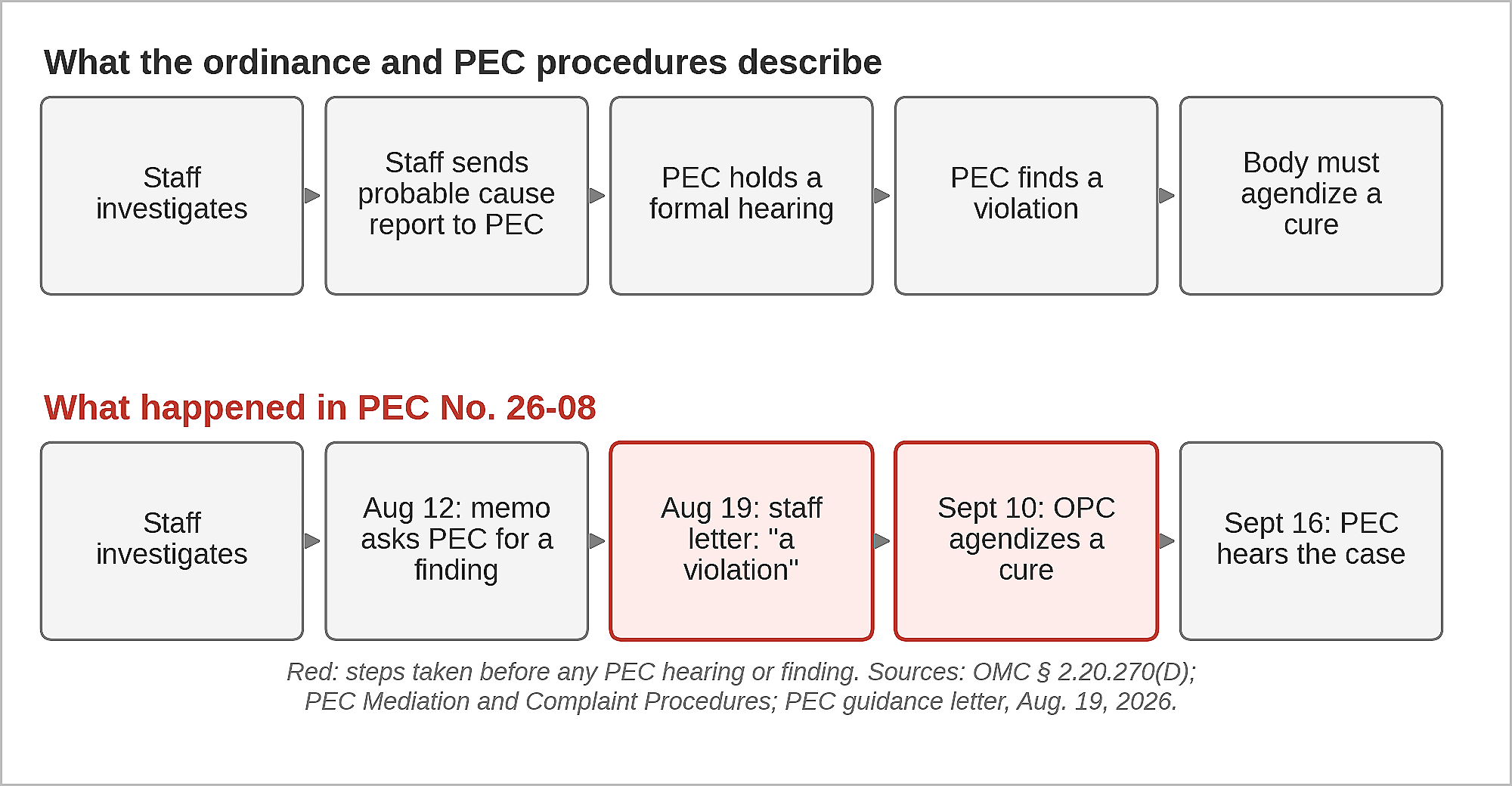
After an investigation, PEC staff writes a probable cause report. The PEC then reviews it and may close the case, ask for more investigation, or move toward a hearing.14
A violation is found “only if the weight of the evidence shows that it was more likely than not that a violation has occurred.” The procedures call for “a fair hearing for persons and entities accused of violations” among their purposes.
Ackerman’s August 19 letter reached the police commission before any of those steps happened at the commission level. Her letter does not hide this. It says staff “will present this information to the PEC at its regular meeting on September 16, 2026, and recommend that the PEC find a violation,” and that her “informal” guidance is issued “in anticipation of that meeting.” It asks the Police Commission to “notify PEC staff of any action it takes so that staff can report that activity in their presentation to the PEC.”
Counterpoint: the case for early guidance
PEC staff would likely make these points, which we offer here without further rebuttal:
The ordinance directs the PEC to “provide information to other city departments and local bodies on appropriate ways in which to implement this ordinance.”
The letter was labeled “informal” and “preliminary,” and framed as voluntary: “If you choose to do so.” It also asks that any re-agendized item “include a new opportunity for public comment.”
At the PEC’s July 15 meeting, the enforcement chief said staff sometimes resolves sunshine ordinance issues informally, “short of an official formal commission action.”
The November 20 vote was a recommendation to the City Council. The ordinance says a challenged advisory action does not stop the receiving body from acting.
Read this related article:

The police commission may cure on its own; whether it must is a question the PEC has not answered
Today’s item asks the police commission to treat a staff conclusion as if it were a commission finding. The ordinance’s mandatory cure follows a hearing and a PEC determination. Neither has occurred yet.
The public comment also asks the PEC to check whether former commissioner Sam Dawit and chair Ricardo Garcia-Acosta were interviewed about how the BearCat recommendation changed.
The practical effect is that ten months after the apparent violation, the police commission appears set to vote on the police department’s use of the Bearcat vehicle — and potentially to overturn its previous vote.
Those are questions about the merits. The sequencing question is simpler: as of today, only PEC staff has declared a violation, not the PEC itself.
Whether the police commission will agree, ten months after the fact, remains to be seen.
Don’t miss a beat. Donate to support our nonprofit work.
Ackerman, Tovah. "Case no. 26-08: Public Ethics Commission guidance to cure and correct agenda item VI recommendation A from the November 20, 2025 special meeting." Oakland Public Ethics Commission letter to Oakland Police Commission, dated Aug. 19, 2026. https://docs.oaklandreport.news/26-08%20-%20Cure%20and%20Correct%20Guidance%20Letter%20-%20August%2019%2C%202026%20-%20Signed.pdf
Ackerman, Tovah. "Staff memorandum, PEC case no. 26-08." Oakland Public Ethics Commission meeting, Sept. 16, 2026. https://www.oaklandca.gov/files/assets/city/v/1/public-ethics-commission/documents/09-16-2026-pec-regular-meeting-agenda.pdf
City of Oakland. “Oakland police commission special meeting agenda.” Oakland Police Commission, agenda item VI(A), Nov. 20, 2025. https://www.oaklandca.gov/files/assets/city/v/1/police-commission/agendas/opc-special-meeting-agenda11.20.25-fin.2pdf.pdf
Mandal, Rajni. “Agenda item 6 – PEC case no. 26-08, in the matter of the Oakland police commission.” Public comment submitted for the Sept. 10, 2026 Oakland Police Commission meeting, dated Sept. 8, 2026. https://docs.oaklandreport.news/PEC%20Public%20Comment%20Mandal%20PEC%20Case%2026-08-1.pdf
City of Oakland. "Oakland police commission regular meeting agenda (revised).” Oakland Police Commission, agenda items X and XI, Sept. 10, 2026. https://www.oaklandca.gov/files/assets/city/v/1/police-commission/agendas/9.10.26-revised-opc-regular-meeting-agenda-9.10.26.fin.6.pdf
City of Oakland. “Public ethics commission meeting agenda.” Public Ethics Commission, Sept. 16, 2026. https://www.oaklandca.gov/files/assets/city/v/1/public-ethics-commission/documents/09-16-2026-pec-regular-meeting-agenda.pdf
City of Oakland. “Public ethics commission meeting video.” Public Ethics Commission, 55:00:00 - 58:00:00, Jul. 15, 2026. https://oakland.granicus.com/player/clip/7672?meta_id=658383
Montana, Alex. “Twice-rejected police commissioner ‘not qualified’ to serve a new fixed term: City Attorney.” Oakland Report, Apr. 10, 2026. https://www.oaklandreport.org/p/20260410-twice-rejected-police-commissioner
Reinhart, Sean S. “Outgoing police commissioners accuse police chief and blame city for ‘anti-commission harassment.’” Oakland Report, Nov. 11, 2025. https://www.oaklandreport.org/p/20251111-rejected-police-commissioners-slam
Montana, Alex. "Police Commission appointment appears to violate state law." Oakland Report, Apr. 2, 2026. https://www.oaklandreport.org/p/20260401-police-commission-appointment-brown-acts
Richardson, Ryan. “Third interpretation of charter section 604(c) regarding the selection and appointment of Oakland police commissioners and selection panelists.” Office of the Oakland City Attorney, Apr. 9, 2026. https://www.oaklandcityattorney.org/wp-content/uploads/Third-Legal-Opinion-re-Oakland-Police-Commission-and-Selection-Panel-FINAL-April-9-2026.pdf
City of Oakland. "Commissioners & staff / Become a commissioner." Oakland Police Commission webpage, accessed Sept. 9, 2026. https://www.oaklandca.gov/Government/Boards-Commissions/Police-Commission/Commissioners-Staff-Become-a-Commissioner
City of Oakland. "Oakland sunshine ordinance." Oakland Municipal Code, chapter 2.20, § 2.20.030(F)(1), accessed Sept. 9, 2026. https://cao-94612.s3.amazonaws.com/documents/Item-6a-Oakland-Sunshine-Ordinance.pdf
City of Oakland. “Mediation and complaint procedures, §§ VI(A), VI(C).” Public Ethics Commission, effective Jan. 4, 2024. https://www.oaklandca.gov/files/assets/city/v/1/boards-amp-commissions/documents/pec/enforcement/pec-complaint-procedures-effective-january-7-2024.pdf

WE RELY ON YOUR FINANCIAL SUPPORT
Oakland Report provides deep-dive, data-driven reporting and analysis that you will find nowhere else. If you value our work, please donate. All contributions go directly to continuing our nonprofit work.
Oakland Police Commission was formed as an overreaction to public sentiment regarding alleged police misconduct following the Michael Brown shooting. It was granted sweeping powers and no mechanism for restraint. Since it's inception the OPC has dragged out needed policy reform through endless ad hocs and attires outright hostility toward the police department. None of this is surprising to anyone who follows Oakland politics. The city council in years past has joined hands in protesting it's own department, allowed Frank Ogawa Plaza to be "occupied" until they could not longer tolerate the crime that came with it, and then chastised the department for how the plaza was cleared. Oakland is a failing city because the political leadership doesn't have the courage to tell the radicals, "no."