


BY SANFORD FORTE
Oakland is beautiful – but the city’s dysfunction is holding it back
I love living in Oakland — specifically, West Oakland — since arriving from San Francisco several years ago.
Oakland has a vibrant and diverse culture, a dynamic food scene, stunning natural features, architecturally beautiful neighborhoods, an entrepreneurial spirit, and above all, extraordinary people.
Oakland can and should be a world-class city.
But the city government’s chronic dysfunction and institutionalized inequity — which city leaders continue to perpetuate to this day — are holding it back.
In this commentary, I will use the colloquial term ‘Flats’ to refer to the flatland areas of West Oakland and East Oakland.
The Flats are a defining feature of Oakland, home to some of the most interesting and diverse neighborhoods in the city. The Flats are arguably what most people — especially those who don’t live here — think about when they think about Oakland.
This part of Oakland is wonderful in many ways. But unfortunately the Flats, where the city’s Black and Hispanic residents are concentrated, continue to bear the worst outcomes relative to other areas of the city, across nearly every measure of economic opportunity, public health, public safety, and neighborhood conditions.12
Many of these challenges stem from a long legacy of institutionalized disinvestment, segregation, economic inequality, and racial injustice.
Unfortunately, this legacy of inequity continues to this day — partly due to generational after-effects of the institutionalized discrimination of the past, but also due to being perpetuated in new forms by city leaders in the present.
Read this related article:

As co-chair of West Oakland Neighbors, a 600-plus member association of West Oakland residents and business owners, I spend a lot of time speaking with West Oakland neighbors and business owners — including in more recent years, probably hundreds of unhoused people who have set up camp here.
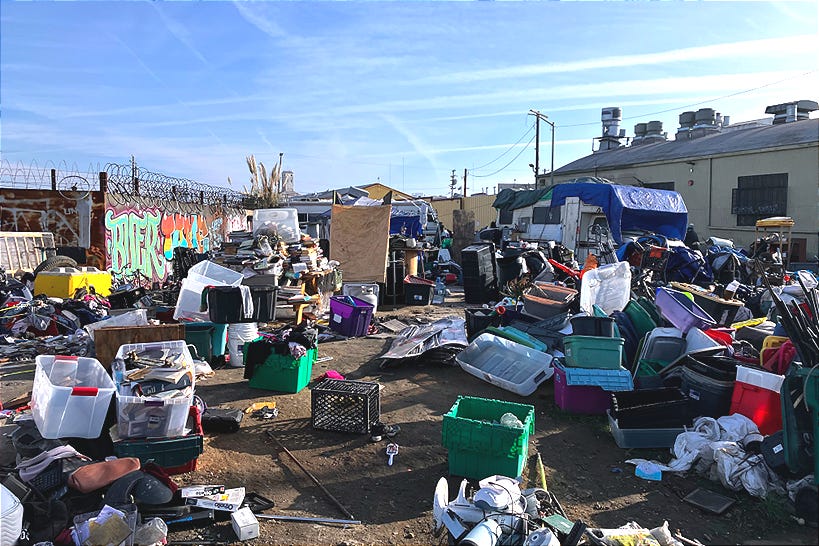
Through all these interactions, it’s apparent that a big thing holding back the Flats right now is the out-of-control presence of encampments — in recreational vehicles (RVs), tents, and makeshift shelters — and the associated debris, blight, crime and behavioral problems they cause in West Oakland.
Oakland’s ‘sensitivity areas’ place an inequitable burden on the Flats
In response to the spread of Oakland’s homeless camps and RV settlements, Oakland city council recently adopted an Encampment Abatement Policy (EAP) in an attempt to restore order by controlling the behavior and location of homeless camps.3
The Encampment Abatement Policy was framed by its supporters as a way to address health and safety conditions through regulating conduct rather than housing status — establishing rules on where, when, and how unhoused people are permitted to camp, such as campsite size limits, spacing requirements, and bans on hazardous storage and illegal utility hookups.45
But as a practical matter, the EAP formally sacrifices neighborhoods in the Flats to remain ground zero for this problem, while shielding the more affluent, predominantly White neighborhoods in the hills from it.
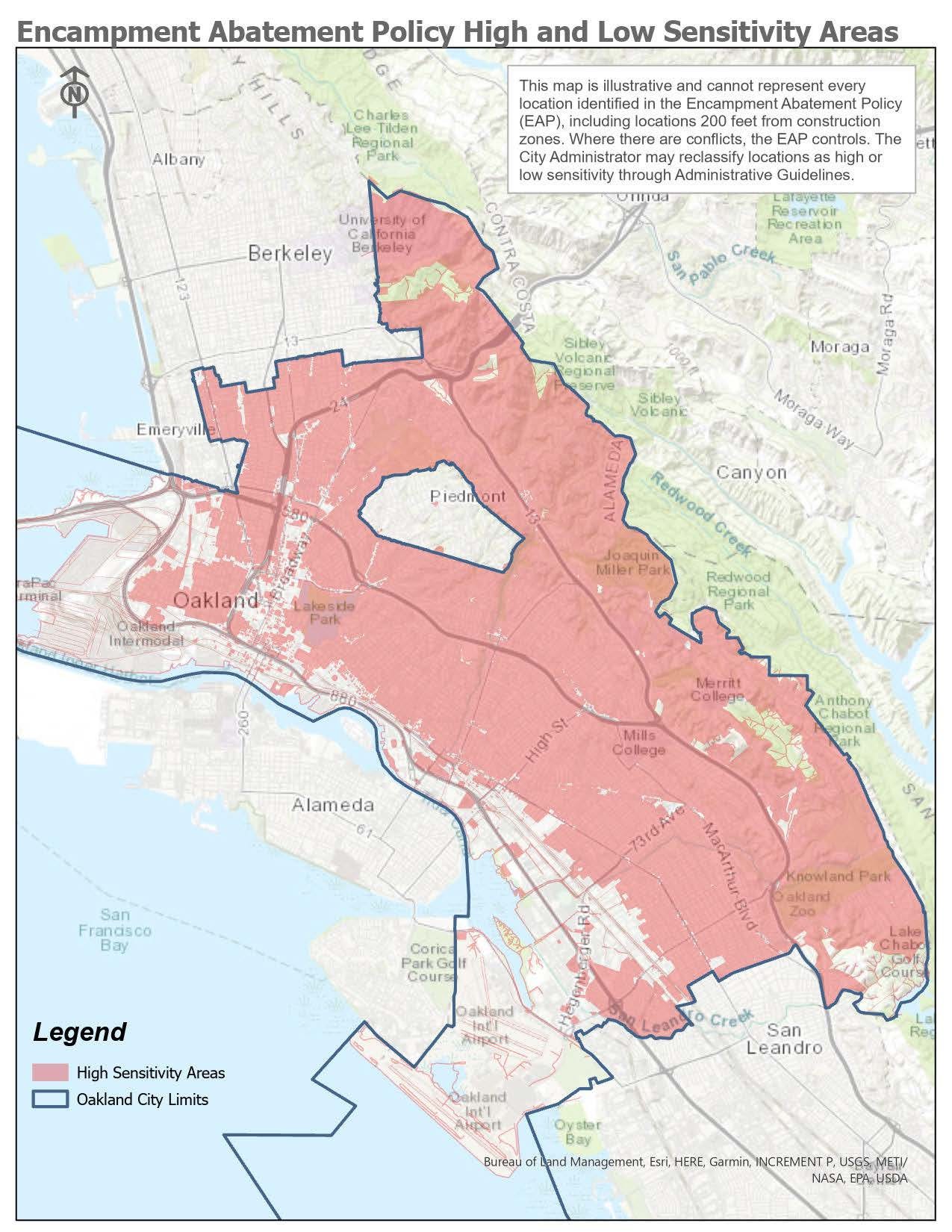
The EAP approved by city council identifies a ‘Sensitivity Area’ map that designates ‘high sensitivity’ areas as off-limits locations for RVs and encampments, and ‘low sensitivity’ areas where the city essentially allows these encampments to persist.6
According to the Sensitivity Area map, 95% of Oakland is designated ‘high sensitivity’ and therefore off-limits to encampments — including nearly all of the more affluent, majority White areas in the hills. The ‘low sensitivity’ areas where encampments are allowed are almost exclusively located in less affluent, majority Black and Hispanic neighborhoods in West and East Oakland, i.e., the Flats.
This appears to run counter to the city of Oakland’s stated goal to provide services equitably across all its neighborhoods.
Rather than moving to solve the encampment problem for all Oaklanders, city officials are demonstrably making the Flats a sacrifice area where the problem is allowed to continue effectively unabated.
Don’t miss a beat. Donate to support our nonprofit work.
The new redlining
The city’s 2026 Anti-Displacement Strategic Action Plan notes that among racial groups, Black residents have the highest relative rate of homelessness.7
Black residents make up approximately 22% of Oakland’s general population, but account for 52.5% of the total unhoused population, 47.9% of the unsheltered population, and 59% of all new entries into homelessness.
The city’s anti-displacement plan cites a legacy of redlining,8 predatory lending practices, and systemic disinvestment in Black communities as primary drivers of the racial disparity.
Yet, some city council members and career officials who connect the dots between race and homelessness appear not to acknowledge that confining the homeless problem primarily to so-called ‘low sensitivity’ areas in the Flats amounts to a new form of institutionalized racial, economic and social injustice.
Homelessness is not a crime — but behaviors in encampments often are
Homelessness is not a crime in and of itself. It’s a tragic condition with many causes: a lack of affordable housing, untreated mental illness and drug addiction, sudden job loss, debilitating illness, family crisis and many other complex and intertwined factors.9
Unfortunately, many of the behaviors exhibited by people in these encampments — including drug dealing and manufacturing, violence, fencing stolen goods and vehicle parts, littering, and blocking public rights-of-way — are, in fact, crimes.
These behaviors are traumatic and harmful to residents and businesses in the Flats. That the city now formally allows the conditions that foster these crimes to continue violates these Oaklanders’ rights to have safety and security in their neighborhoods comparable to that enjoyed by other neighborhoods in the city.
Read this related article:

The West Oakland area around Mandela Parkway has long contained some of the city’s largest, most established, and most impactful encampments.10
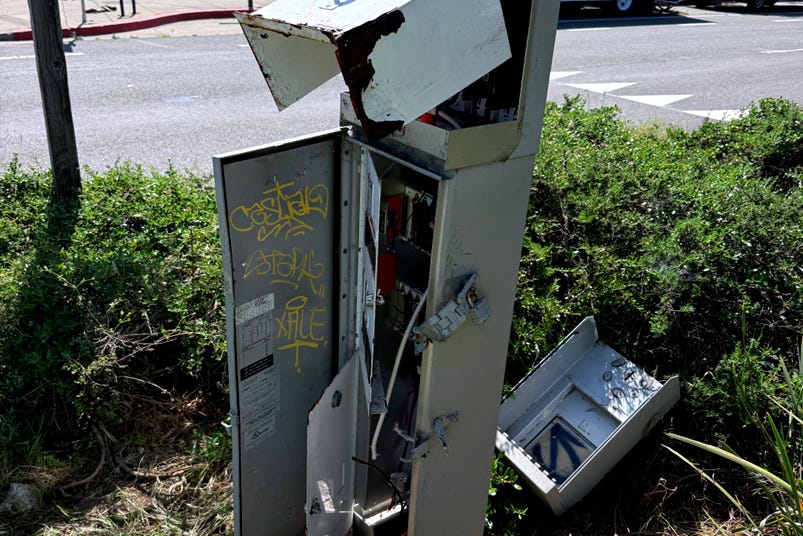
Thieves have stripped copper wire from streetlights and water irrigation boxes all along the corridor, rendering the once-beautiful Mandela Parkway median park (formally named the Cypress Freeway Memorial Park) dark and unsafe in the evenings, and its greenery deprived of water. It’s often unclear exactly who the thieves are, but the neighborhood did not experience this problem at such intensity until recent years, after encampments and RVs moved into and were allowed to remain and grow here.
Oakland residents living near long-standing encampments have reported crime, threatening confrontations, and a diminished sense of safety. In one example, residents described a rise in stolen and stripped vehicles they associated with a nearby encampment; elsewhere, a business owner reported being confronted by a man wielding an ax. The City's own records acknowledge that long-standing encampments have posed public health and safety concerns for nearby residents.1112
I’ve personally witnessed senior citizens and people in wheelchairs have to navigate into street traffic because a tent or RV has blocked a sidewalk or a street. My observations may ring true with other observers as well.
Meanwhile, if a homeowner or business blocks the street or sidewalk with their possessions, they are issued a citation.

‘Harm reduction’ strategies do more harm than good
One of the reasons for the unacceptable behavior is that, sadly, over 67 percent of unhoused people are chronically drug-addicted and mentally ill, according to a meta-study in the Journal of the American Medical Association.13
State law is such that it is difficult to compel those people into treatment, even when they are living in unsafe conditions for extended periods of time, and demonstrably pose a health and safety threat to themselves and others.
Prevailing policies of ‘harm reduction’ (famous for allowing encampments to remain in unsafe conditions, and for distributing publicly-funded drugs and drug paraphernalia to addicted people) and ‘housing first’ (which openly allows drug use in publicly-subsidized shelters and housing) perpetuate the suffering for precisely the people who are least equipped to voluntarily navigate their way to sobriety and healing.
Read this related article:

Under current policy, people with substance use disorders or serious mental illness are generally directed to voluntarily seek or remain in treatment — but only when they are 'ready.' Research shows that waiting for a patient to be 'ready' can mean missed treatment windows, that motivation can be built rather than waited for, and that voluntary frameworks under-serve people who have severe, treatment-resistant illnesses.1415
Even supporters of ‘harm reduction’ will assert that this policy, when implemented as a standalone approach without strong, meaningful pathways to treatment and recovery, can leave people stabilized in active addiction rather than moving them toward recovery.16
To be clear, this is not a judgment of people in those unfortunate circumstances. They need help. But their antisocial behaviors too often are enabled and intensified, not reduced by so-called ‘harm reduction.’
Alameda County and the city of Oakland have practiced various ‘housing first’ and ‘harm reduction’ tactics for well over a decade — and these tactics have failed to reduce the problem of encampments and harmful behavior. Indeed, the problem appears to have only escalated in size and severity.

The city plans to spend billions on policies that perpetuate the problem
Oakland has grappled with a difficult and growing problem for the past several years: the more money the city spends to alleviate homelessness, the worse the problem appears to become.
According to the city’s 2026 Anti-Displacement Strategic Action Plan, Oakland estimates that it will need to spend $1.06 billion in new funding to reduce homelessness by 50 percent in five years.
Yet deteriorating, long-persisting encampments, recurring toxic fires, and theft and stripping of vehicles remain common in West Oakland — problems that have persisted for years despite repeated city and state intervention.1718
A person living in an encampment who has a medical emergency from drug use will rightly call an ambulance, go to an emergency room, and often then get released back to the streets where the cycle can repeat indefinitely.
When an RV or tent catches fire while its inhabitant is cooking a meal, cooking methamphetamine or building fires for warmth, people call the fire department, putting firefighters in a dangerous — and preventable — situation.
A 2021 city performance audit found that Oakland fire department responded to 988 fire emergencies at homeless encampments over the two years 2019 and 2020 — an average of more than one encampment fire per day — accounting for roughly 12.5 percent of all Fire Department calls in each of those years.19
The frequency has only increased since then: by 2025 alone, the fire department recorded 818 encampment fires — roughly 66 percent more per year than the 2021 audit's two-year average.20
Notably, closing the infamous Wood Street is credited with reducing fires citywide; residents there pleaded for housing solutions before its closure finally happened. Yet other encampments have cropped up in other nearby locations, and are now officially allowed to exist elsewhere in this same area, perpetuating the cycle.
Research on unsheltered and encampment populations finds that serious mental illness and substance use disorders are far more prevalent than in the general public, and that the instability of street life combined with limited access to treatment makes recovery without sustained intervention extremely difficult.21
We must come to grips with the fact our neighborhoods will continue to be in disarray unless the basic civil standards of behavior we expect from the chronically unhoused — the same expectations that other citizens are held to — are enforced.
Oakland deserves better
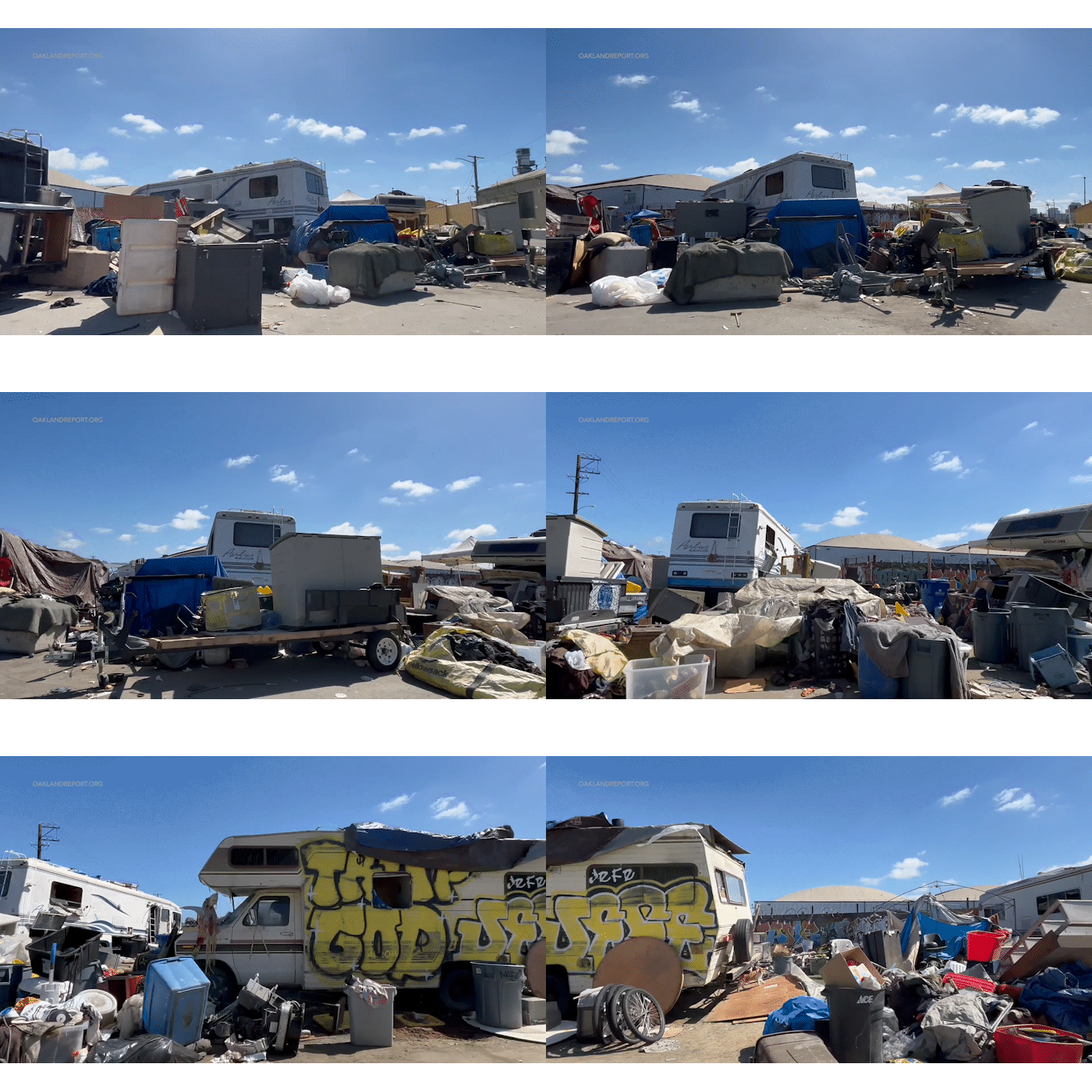
The city currently permits thousands of unhoused people in Oakland to live in unsafe, unsanitary, and illegal conditions seemingly indefinitely, with few constraints on their behavior.
Oakland has, over many years, repeatedly formed task forces, cleared camps, funded voluntary outreach, and built transition centers on a ‘housing first’ model that does not condition shelter on sobriety or treatment.
These efforts have produced disappointing results — and the city's own performance data bears out part of that concern. The city auditor's 2022 homelessness report found that of the 669 residents who left community cabin sites over three years, only about 30 percent moved on to permanent housing, well short of the city's 50 percent goal. In the worst year tracked, 58 percent of those who left returned to homelessness.
More recent figures show a similar pattern: at some homeless cabin programs, including 3rd and Peralta, nearly half of those who left in 2024–2025 returned to homelessness or to unknown circumstances; and across two safe-parking RV sites, the combined figure was 63 percent.22
Notably, the same audit found Oakland's family-focused shelter and transitional housing programs performed far better, in one year housing 77 percent of those who left — suggesting the shortfalls have been concentrated in particular program types rather than across the board.
I’m a politically liberal person, but I refuse to performatively claim that I care about the unhoused — which I do, very much — while at the same time promote and defend the ineffective use of scarce city resources on policies and tactics that appear to perpetuate the problem; or, that don’t work at scale for so many of the the unhoused.
I’ve come to the conclusion that some of our elected officials and administrators can’t see literally what’s happening in front of their eyes: the spread of near-dystopian behavior that emanates from homeless encampments and RVs in the Flats.
Notably, some of those officials live in and represent districts that are now officially shielded from this problem — the so-called ‘high sensitivity’ areas in Oakland’s new map.
Meanwhile, there appears to be scant concern offered to those of us in the ‘low sensitivity’ areas who now officially have to endure the burden of this problem for the sake of those who happen to live in the historically privileged ‘high sensitivity’ areas — and a city organization whose chronic dysfunction appears to render it unable, or unwilling, to make the difficult decisions required to solve the problem for everyone.
We invite counterpoint commentaries from other leading voices in Oakland. Do you have something to say on this issue or others? Visit our About page for more information.
Oakland’s Flats represent our city to the outside world. We deserve better, and so do the chronically unhoused who are being essentially abandoned to street encampments and RVs because they are permitted to refuse or leave services that they so clearly need to survive and heal.
The Flats don’t deserve the institutionalized marginalization being visited upon us by the city’s inequitable ‘sensitivity area’ maps. We’re weary of being the sacrifice area for Oakland’s structural problems. We’re tired of taking on the lion’s share of the homeless burden. Oakland citizens in the Flats want and deserve order in their neighborhoods and public commons, like other Oakland neighborhoods take for granted.
We can help the unhoused who want to receive help, but we must not continue to condone more years and years of dysfunctional chaos on our streets and in our public commons — especially when the consequences of decisions made by city officials disproportionately affect West and East Oakland — again.

WE ARE 100% SUPPORTED BY YOU
Oakland Report provides accurate, unflinching, data-driven reporting and analysis that you will find nowhere else. If you value our work, please donate. All contributions go directly to sustaining and growing our 501(c)(3) nonprofit work:
ABOUT THE AUTHOR
Sanford Forte is co-chair of West Oakland Neighbors, comprised of 600+ residents and business owners in West Oakland. He is the founder of the largest open public market on the lower San Francisco Peninsula; a former library commissioner and public activist. In his professional life, Sanford played a key role in the creation of the Open Textbook movement which led to access high-quality educational content for millions of students, worldwide, for free.
Sanford is interested in finding humane, scalable, workable solutions to the disconnect between the insufficient treatment of mental illness and drug addiction among Oakland’s unhoused community. He believes this has led to the tragic spread of homeless camps into the most vulnerable parts of Oakland, further constraining the neighborhoods in those communities to overcome a long history of structural and economic and racial injustice.

The views expressed in our Commentaries do not necessarily reflect the editorial views of Oakland Report or its contributing writers.
City of Oakland. "2018 Oakland Equity Indicators Report: Measuring Change Toward Greater Equity in Oakland." Resilient Oakland Office and Department of Race & Equity, 2018. https://cao-94612.s3.amazonaws.com/documents/2018-Equity-Indicators-Full-Report.pdf
City of Oakland. “Anti-Displacement Strategic Action Plan.” Oakland Housing and Community Development. Winter 2026. https://www.oaklandca.gov/files/assets/city/v/3/housing-comm-dev/documents/reports/hcd-anti-displacement-strategic-action-plan-2026.pdf
City of Oakland. “Adopt a Resolution amending Resolution No. 88341 to repeal the 2020 Encampment Management Policy and replace with a 2025 Encampment Abatement Policy that (a) defines ‘encampment’ to exclude vehicles and authorizes citation and towing of inhabited vehicles by city departments pursuant to the California Vehicle Code and Oakland Vehicle Code; (b) continues to require reasonable efforts to make shelter offers and 7-day notice prior to non-urgent encampment closures; and (c) clarifies emergency and urgent health and safety conditions that authorize immediate, 24-hour, or 72-hour notice for encampment closures, including encampments blocking sidewalks.” Oakland City Council meeting agenda, Apr. 14, 2026. https://oakland.legistar.com/LegislationDetail.aspx?ID=7493872&GUID=4D7B3D3D-ED16-403A-9988-B11E206E01E7
Boone, Alastair. "Oakland adopts controversial Encampment Abatement Policy," Street Spirit, May 5, 2026. https://thestreetspirit.org/2026/05/05/oakland-adopts-controversial-encampment-abatement-policy/
Peters, David. "What to do about Oakland's encampment policy." Empower Oakland, Oct. 20, 2025. https://empoweroakland.substack.com/p/what-to-do-about-oaklands-encampment
City of Oakland. “Encampment Abatement Policy high and low sensitivity areas map.” Oakland City Council meeting agenda, Apr. 14, 2026. https://oakland.legistar.com/View.ashx?M=F&ID=15363884&GUID=11A7B6B4-9AC8-417F-88B1-65B6BF88C41F
Ibid. City of Oakland. “Anti-Displacement Strategic Action Plan.”
Wikipedia contributors. “Redlining.” Wikipedia, The Free Encyclopedia. Accessed Mar. 16, 2026. https://en.wikipedia.org/wiki/Redlining
Mojtabai, Ramin. "Perceived reasons for loss of housing and continued homelessness among homeless persons with mental illness." Psychiatric Services, February 2005. https://pubmed.ncbi.nlm.nih.gov/15703344/
Jameson-Ellsmore, Ben. “Curbside castle: architecture and aspiration at an Oakland homeless encampment.” Platform, Feb. 8, 2022. https://www.platformspace.net/home/curbside-castle-architecture-and-aspiration-at-an-oakland-homeless-encampment
Lin, Da. "Oakland neighborhood deals with rising crime near homeless encampment." CBS News Bay Area, Nov. 4, 2023. https://www.cbsnews.com/sanfrancisco/news/oakland-neighborhood-rising-crime-near-homeless-encampment
Lin, Da. "Pedestrians crowded off Oakland sidewalk by growing homeless camp." CBS News Bay Area, May 25, 2024. https://www.cbsnews.com/sanfrancisco/news/pedestrians-crowded-off-oakland-sidewalk-growing-homeless-camp
Harris, Emily. “Two-thirds of unhoused people have mental health disorders.” JAMA, May 10, 2024. https://jamanetwork.com/journals/jama/article-abstract/2818774
McCance-Katz, Elinore et al. "Enhancing motivation for change in substance use disorder treatment." Substance Abuse and Mental Health Services Administration, 2019. https://library.samhsa.gov/sites/default/files/tip-35-pep19-02-01-003.pdf
U.S. Government Accountability Office contributors. "Serious mental illness: HHS assessments of assisted outpatient treatment have yielded inconclusive results." GAO, Jul. 10, 2025. https://www.gao.gov/products/gao-25-107526
Davidson, Larry et al. "Recovery-oriented systems of care: a perspective on the past, present, and future." Alcohol Research: Current Reviews, Jul. 22, 2021. https://www.ncbi.nlm.nih.gov/pmc/articles/PMC8336784/
Lee, Amber. "Frustration over ongoing garbage, encampment fires along Wood Street." KTVU FOX 2, Jan. 10, 2025. https://www.ktvu.com/news/wood-street-west-oakland-frustration-garbage-encampment-fires
CBS News contributors. "Caltrans to close troubled homeless encampment in West Oakland following fire." CBS News Bay Area, Jul. 15, 2022. https://www.cbsnews.com/sanfrancisco/news/west-oakland-wood-street-homeless-encampment-to-close-following-fire
Ruby, Courtney et al. "Performance audit of the City of Oakland's homeless encampment management interventions and activities." Office of the Oakland City Auditor, Apr. 14, 2021. https://www.oaklandauditor.com/wp-content/uploads/2021/04/20210414_Performance-Audit_City-of-Oaklands-Homeless-Encampment-Management-Interventions-and-Activities.pdf
Covington, Damon et al. “Oakland Fire Department 2025 annual report.” Oakland Fire Department, 2026. https://heyzine.com/flip-book/4fe26a4134.html
Kushel, Margot, et al. “Toward a new understanding: the California statewide study of people experiencing homelessness.” University of California, San Francisco, Benioff Homelessness and Housing Initiative, June 2023. https://homelessness.ucsf.edu/our-impact/our-studies/california-statewide-study-people-experiencing-homelessness
Orenstein, Natalie. "As 3 Oakland homeless shelters close, city and residents question outcomes." The Oaklandside, Mar. 31, 2026. https://oaklandside.org/2026/03/31/oakland-homeless-shelters-close-3rd-peralta-hceb/
Thank you for speaking up Andre. We need a better city council person for starters. Fife is a abject failure in every way possible.
As long as the Homelessness Industrial Complex is funded by $Ms and $Bs of taxpayer dollars, the problem will only get worse. I hate seeing this portrayed as a race and equity issue. It is not. The perverse incentive of paying growing bureaucratic NGOs to "solve" the problem just means the staff get 6 figure paychecks while enabling the substance abuse practiced by a large majority of the homeless. Humans respond to incentives. The current incentives are malignant. Allowing people to wallow in filth which breeds medieval diseases while encouraging their addictions is corrupt. Not all homeless are in this category, but the ones who aren't would be much better served if the addicts were put in rehab or jail if they refuse treatment.