

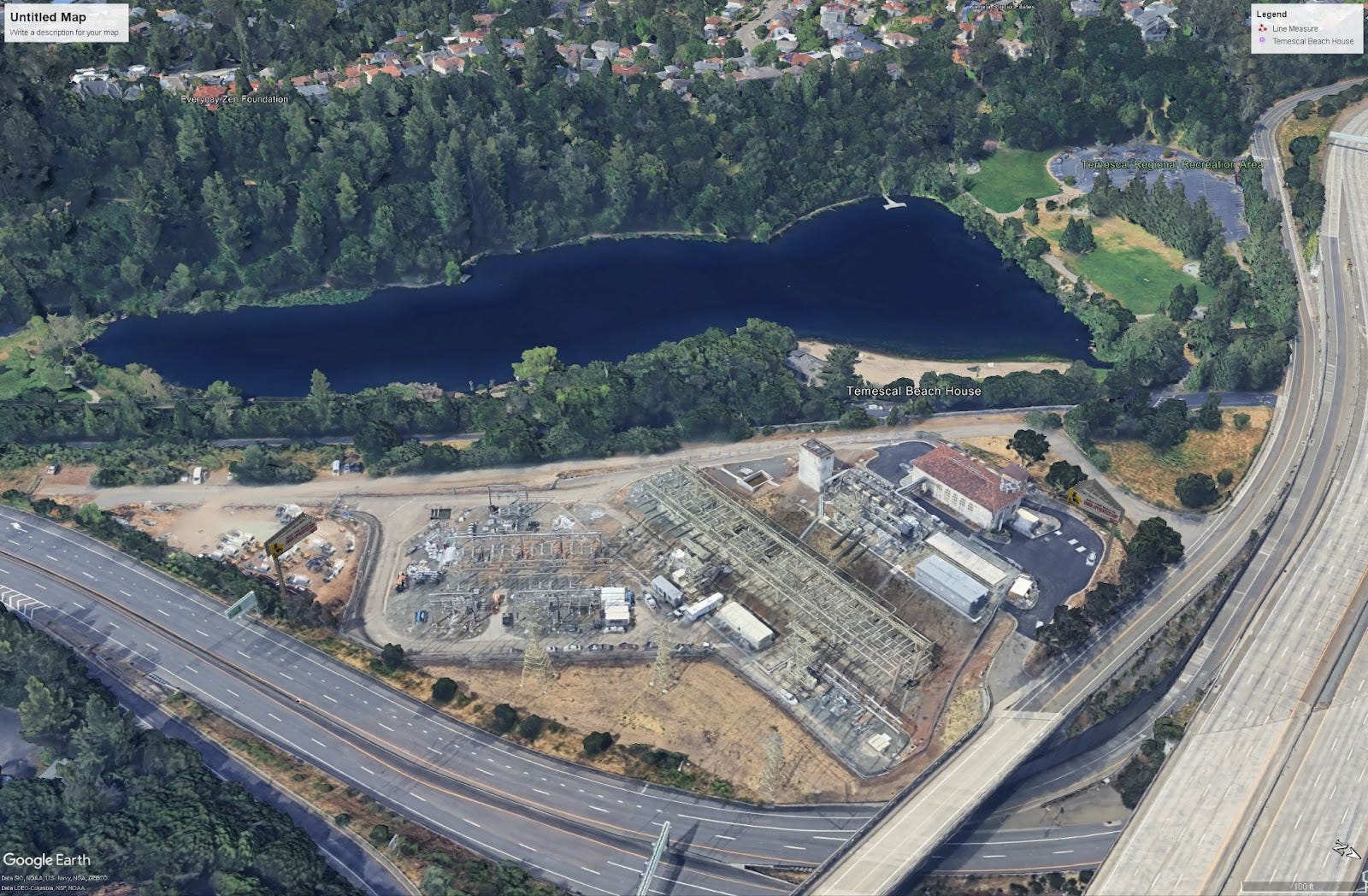
Editor’s note: This commentary was written in response to our article, Billboards over Lake Temescal, published on December 19 with the subtitle, “A picture is worth a thousand words – but what if it’s a fake? How misinformation distorts public opinion and undermines reasoned debate.” We, the editors of Oakland Report welcome and appreciate the dialogue – and the author of this commentary’s willingness to offer their counterpoint.
BY JEFFERY KAHN
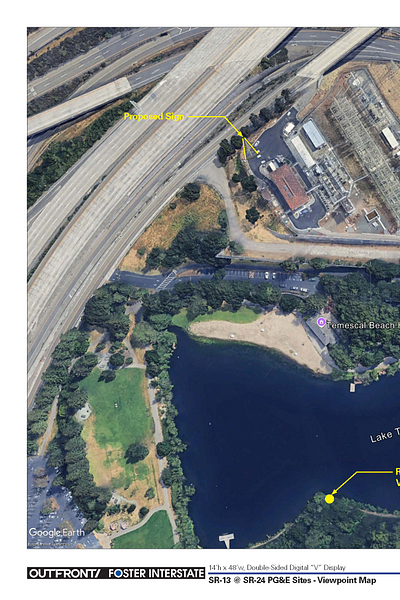
On December 19, Oakland Report published an article making the case that a “fake” image was used in a December 3 Nextdoor post opposing electronic billboards in Oakland. The Nextdoor post reported that an undisclosed effort was making its way through City of Oakland channels that would place two electronic billboards at the PG&E substation next to Lake Temescal. The post included images depicting the billboards at Lake Temescal.
Oakland Report made the assertion that “The Nextdoor posts and emails spread misinformation that incited people to react based on fake images and false claims.” The Oakland Report article used the word “fake” ten times.
I was the author of that Nextdoor post. In retrospect, I agree that the image did significantly exaggerate the size of the two proposed billboards, and does not show the billboards’ exact locations within the PG&E Lake Temescal substation nor their exact orientation to the lake. Mea culpa.
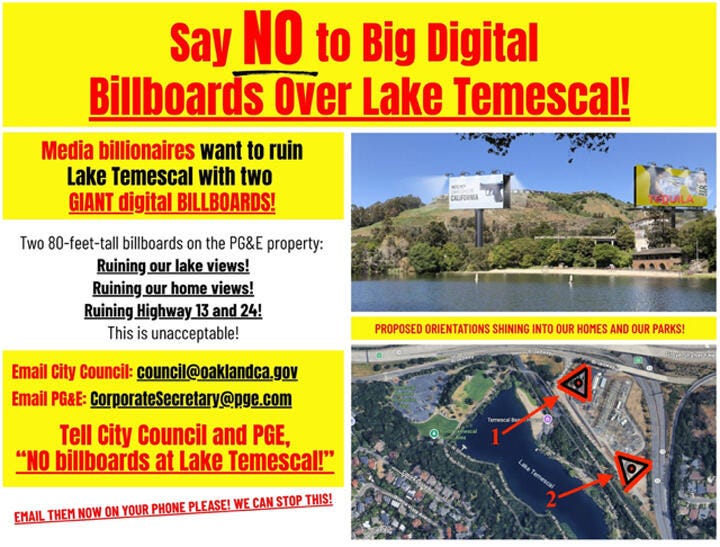
As we have now learned, the proposed day-and-night electronic billboards would be illuminated on two sides, from 48-to-60-feet wide and from 14-to-20-feet high, and have a height up to 85-feet above highway level.
Ironically, the Oakland Report article is itself misleading, committing the exact same transgression of which I was accused. Oakland Report’s “real rendering” of the proposed Lake Temescal billboards, the image at the top of the story, was provided by the Outfront billboard company. Obviously, it puts the best face on what these billboards will look like.
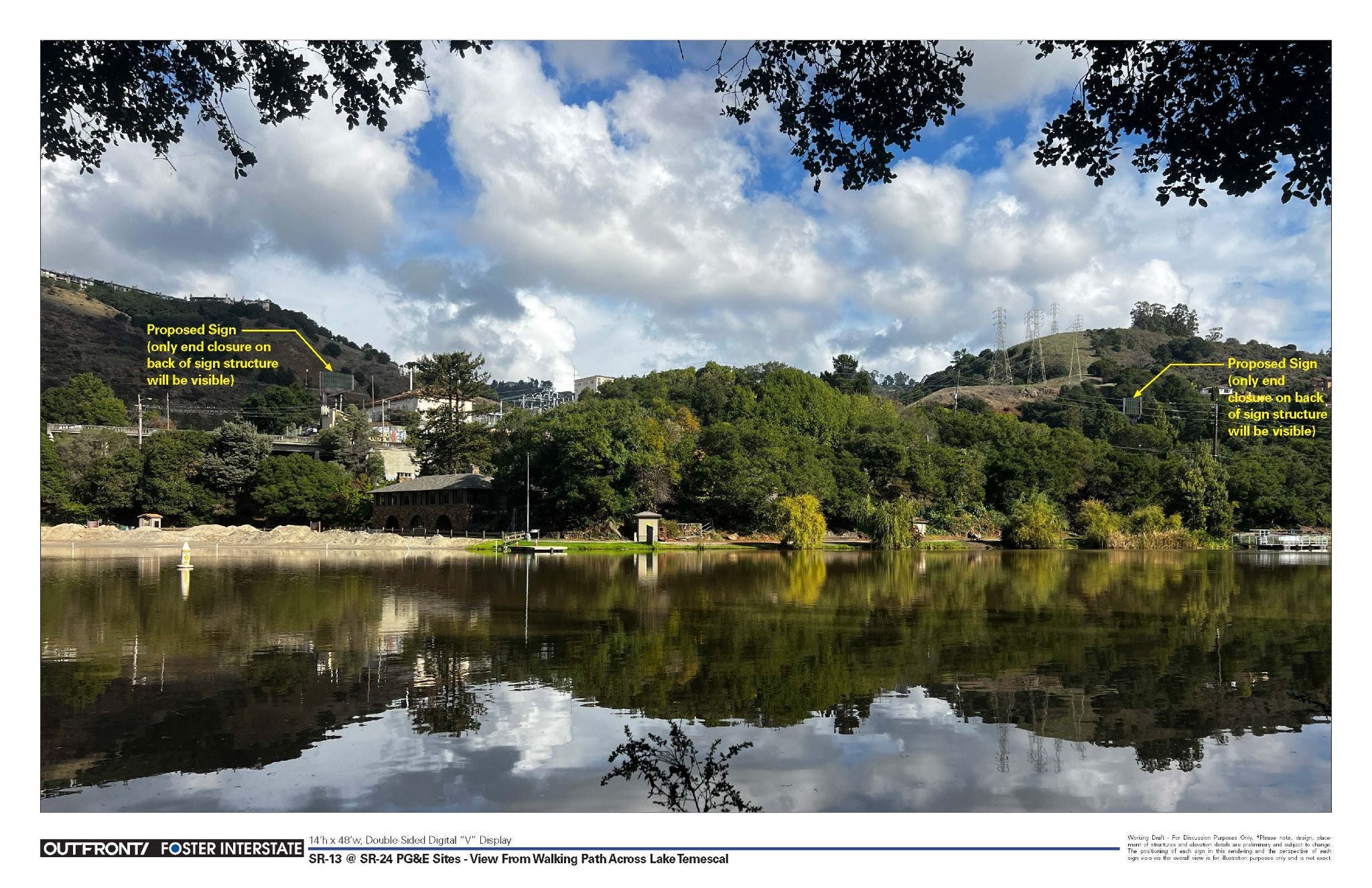
The image is demonstrably a wide-angle camera view of Lake Temescal which makes the billboards far across the lake appear smaller and more distant than they are to the naked eye. Wide-angle lenses make objects look farther away mainly because they include a much wider field of view in the same rectangular frame, so everything in that frame has to be “shrunk down.” I dare say that if the billboards were this unobtrusive, almost invisible in the trees, they would not serve their purpose. This “real rendering” from Outfront diminishes the billboards. It is a rendering, but it is not real.
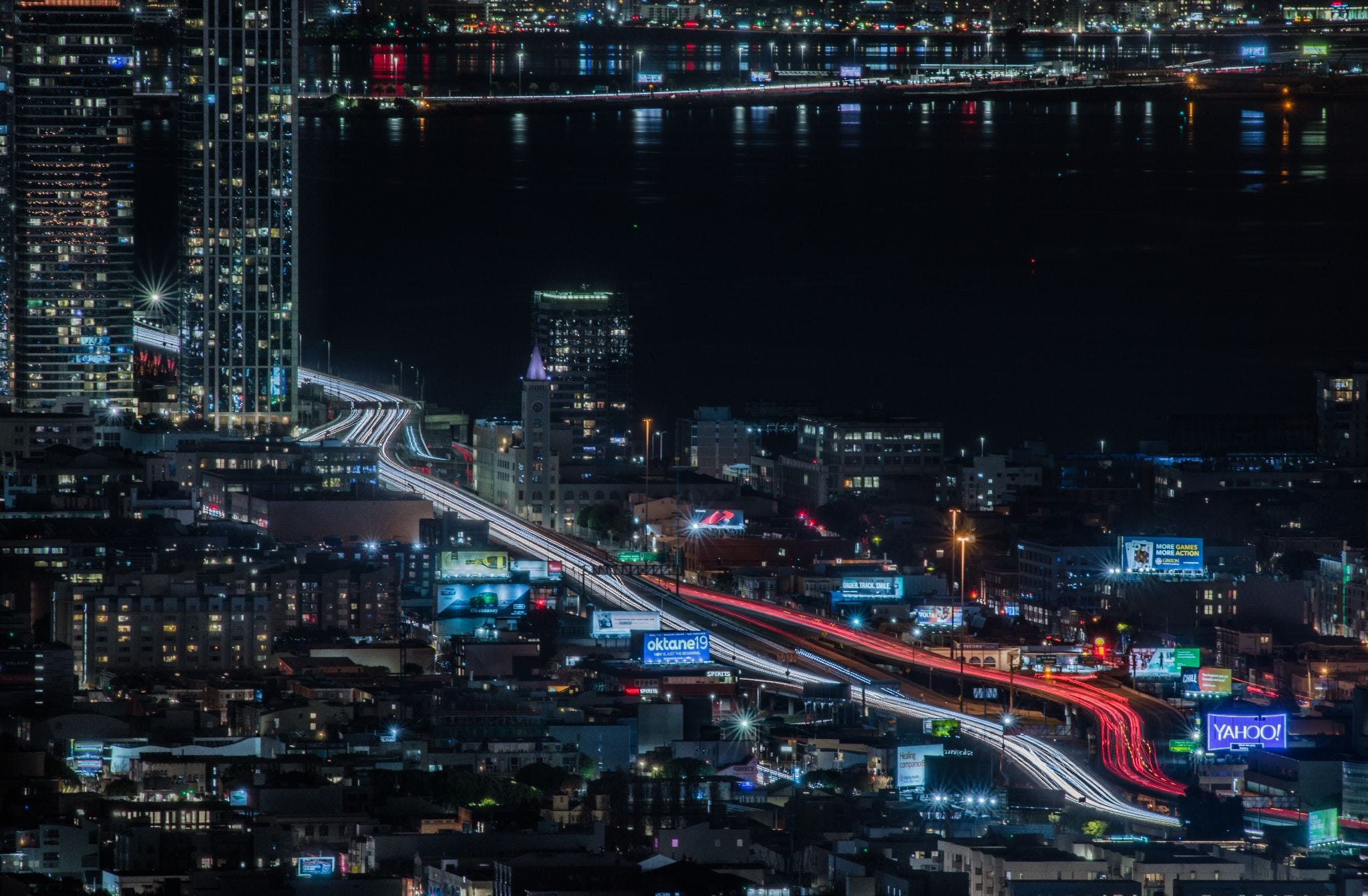
The real issue here is not the billboards’ size, but their visual impact on the landscape. Particularly at night. Billboards are designed to catch the eye and grab your attention. At night, electronic billboards command your attention.
As for a depiction that truly represents the visual impact of these towering electronic billboards: Consider the existing electronic billboards near the Bay Bridge Toll Plaza and, at night, how prominent they are even four or more miles away to tens of thousands of homes in the East Bay. How about we see a rendering of what these new proposed billboards look like at night! All of the “real renderings” are in daylight. No wonder that!
More about the image I posted to Nextdoor: I received word of the billboard plans via friends and, at the time, thought it might not be true. After all, there were no stories in the Oakland Report, The Oaklandside, San Francisco Chronicle, or East Bay Times. Even Google couldn’t find anything. Oakland council members replied to email queries saying it was the first they had heard of it, that they were now able to confirm that a billboard proposal was imminent, but they were unable to learn where the billboards were to be located.
I did not create the so-called “fake” image, receiving it as part of a long email chain, and don’t know who attached the image nor its source. I did post the image, the only visual we had at the time as there was still no public record of this billboard proposal that I had seen, and the city’s Rules and Legislation Committee was scheduled to take up the matter the next day. Again, I acknowledge that image had flaws.
That said, I take issue with other aspects of the Oakland Report article.
This billboard deal was a proposal that city council members and sponsors Charlene Wang and Noel Gallo had kept quiet – no news stories, no awareness of the proposal by other council members or the mayor -- attempting to get it through the city approval process without drawing public notice.
Why? Because the public does not want electronic billboards in Oakland. In fact, at the December 4 Oakland Rules & Legislation Committee meeting, council member Wang refused council member Janani Ramachandran’s request to disclose the locations of the five billboards to the committee as had been the case in a past billboard deal. Wang said they would be disclosed prior to the February 10, 2026, Community & Economic Development committee vote on the billboards (disclosure which is required by law). Ramachandran asked Wang if she would withdraw the two Lake Temescal billboards from the proposal. That withdrawal did not happen.
Video clip 1: Council members Wang and Ramachandran exchange their views during a meeting to schedule a future council discussion about proposed digital billboards at Lake Temescal. Oakland, California, Dec. 4, 2025. The committee voted to schedule the item for the full city council meeting on Feb. 10, 2026. (Source: City of Oakland):
To its credit, Oakland Report managed to learn the locations and report that the Lake Temescal locations are alternates, but did not cite its source for this in their original article. After I inquired as to the source, Oakland Report edited the article to include a link to a legal notice that included the locations. Good work! Realize, however, that the locations can be changed prior to the upcoming February 10 council committee vote on the billboard proposal. As council member Wang’s chief of staff wrote to constituents on December 7, “We will work to address these concerns, and adjust sign capabilities/ locations as needed.”
One other problem with the Oakland Report story: It says the city will receive one-time fees plus annual fees of $750,000 per year per each of the five billboards. That is not quite right. The proposal says “payments up to $750,000.” Up to could be something, or it could be nothing.
See this related article:

The biggest problem I have with the Oakland Report article is that it violated a fundamental rule of journalism. Oakland Report asserted that I published “fake” images, yet never attempted to contact me to hear my side of the story. I am a second-generation newspaper reporter, and one thing I learned again and again: When you actually speak to the person who is the focus of your story, your point of view shifts. And you learn things you did not know as well as where you might be wrong.
In the end, I continue to support and to thank Oakland Report for stellar work in the community over the past several years, and for shining the bright light of public attention on a heretofore undisclosed effort to locate five large day-and-night electronic billboards in Oakland. Write the Oakland council and tell them what you think of this!
The views expressed in our Commentary section do not necessarily reflect the editorial views of Oakland Report or its contributing authors.
ABOUT THE AUTHOR
Jeffery Kahn is an Oakland resident, the retired director of web and digital information at UC Berkeley as well as at Lawrence Berkeley National Laboratory, and a career journalist who has written for daily newspapers and magazines including Sierra, California, and Defenders of Wildlife. He was a board member of the Oakland Fire Prevention and Suppression Assessment District. Most recently, he has helped lead the effort to persuade the East Bay Regional Park District to act to restore Lake Temescal and end the chronic toxic algae blooms there.
If you like our work, please consider donating to Oakland Report.
We are a nonprofit charitable 501(c)(3) organization. Our mission is to provide reasoned, evidence-based, and well-sourced analyses and critiques of the policies, actions, and inactions of our local government.
Your donation in any amount helps us continue to produce more articles like this one.
Thank you.
Despite your disappointment at the shortfalls in the original article, I personally feel rather upbeat about a community writing platform that brings out the best in all of us and helps us eventually reach a useful consensus based on some truth. Thank you for taking the time to write such a useful response. Another fascinating Oakland conversation that we are all now party to. 👍👍
No matter the size, day/night digital billboards certainly have no place in residential areas.
In general, though, they are a blight on the earth and shouldn't be permitted anywhere.