


Oakland Report is exploring how media bias and manipulation are used to distort public opinion and shape narratives that are disconnected from evidence and reason, which in turn undermines policymaking, community trust, and public engagement in the decisions that affect our lives.
An urgent call-to-action
Earlier this month, an urgent call-to-action began circulating on Nextdoor, on neighborhood email lists and by word-of-mouth warning about “big digital billboards over Lake Temescal!”
The call-to-action featured an image of two towering digital billboards facing Lake Temescal, displaying advertisements for guns and alcohol.
One high-visibility Nextdoor post featured the image and expressed alarm about the billboards: “For the thousands of homes on the hillside to the east, your panoramic vistas would be dominated by blazing, bright billboards, their screens ever-changing with advertising… an abomination, the lights of Times Square.”
As of this writing, the Nextdoor post has generated 85 comments, overwhelmingly negative with descriptions like “grotesque,” “madness,” and “paradise lost.”
The post listed the email addresses of city council members and urged people to write to them in opposition and show up in person at a council committee meeting the next day on December 4.
Two public commenters appeared in person at the December 4 council committee meeting and echoed the rhetoric and imagery used in the Nextdoor post. One described the proposed billboards as “monstrosities” that would “loom up on the hill like skyscrapers.”
The purpose of the meeting was not to debate the merits and drawbacks of the proposal, nor to vote on its potential approval. The meeting’s purpose was to set the city council’s schedule of future agenda topics, including the billboard proposal, for future discussion by the full council.
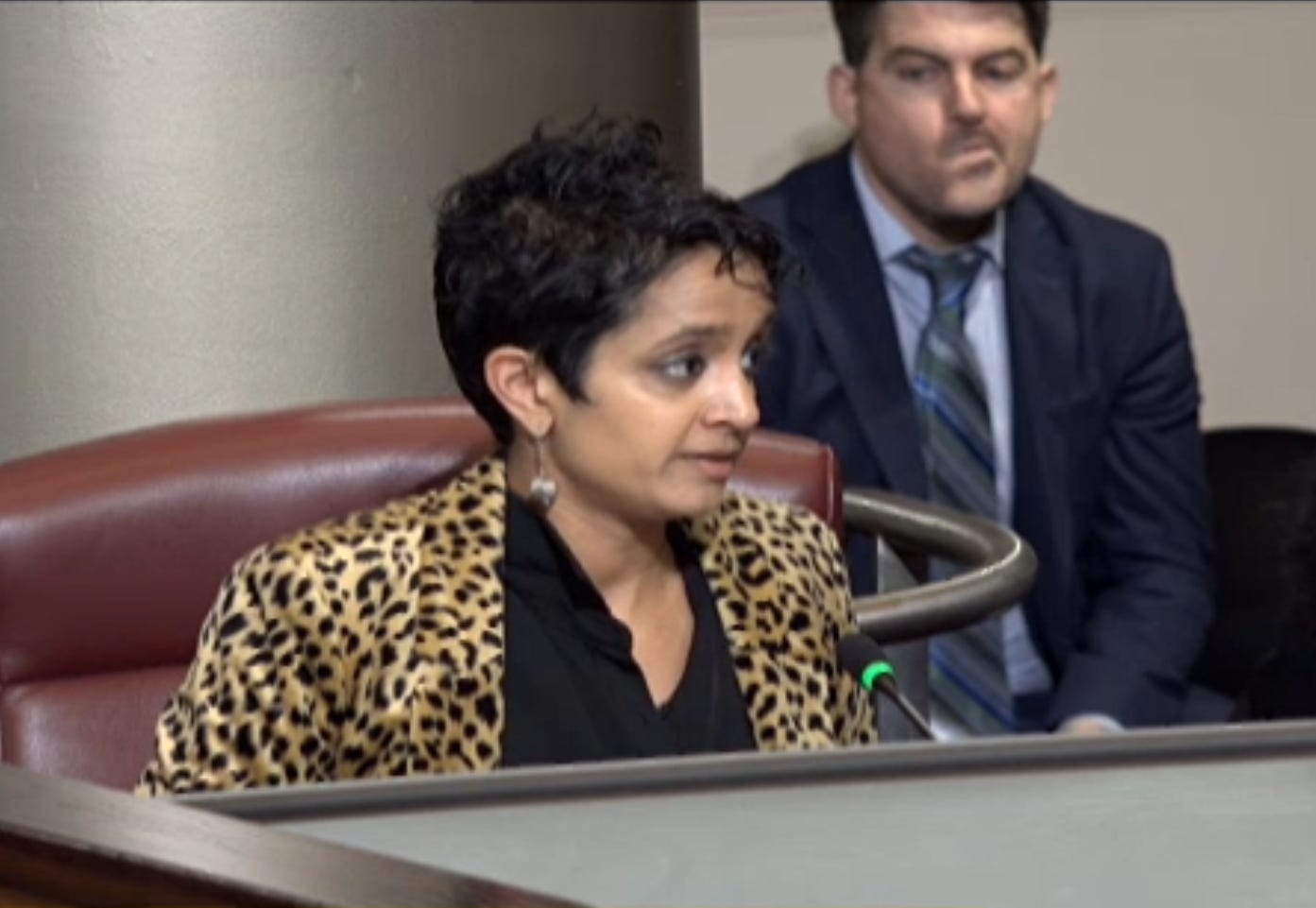
After the public comments opposing the proposal, committee member Janani Ramachandran, who represents the district that includes homes by Lake Temescal, registered a “strong no vote” against scheduling the proposal for discussion by the full council. (The committee then voted to schedule the item in February as proposed.)
To be clear, there is no problem with people expressing their views through public comments, nor is there a problem with a duly elected council member voting for or against any item that may come before them.
The problem is, the image was a fake.
A picture is worth a thousand words – but what if the picture is a fake?
This article isn’t about whether digital billboards are good or bad, or whether they should be located near Lake Temescal or anywhere else. It’s about reasoned debate being undermined when verifiable evidence is trumped by misinformation and manufactured outrage.

It appears that the fake image was circulated in response to a formal public notice issued in advance of a city council review of the proposal tentatively scheduled on Feb. 10, 2026.
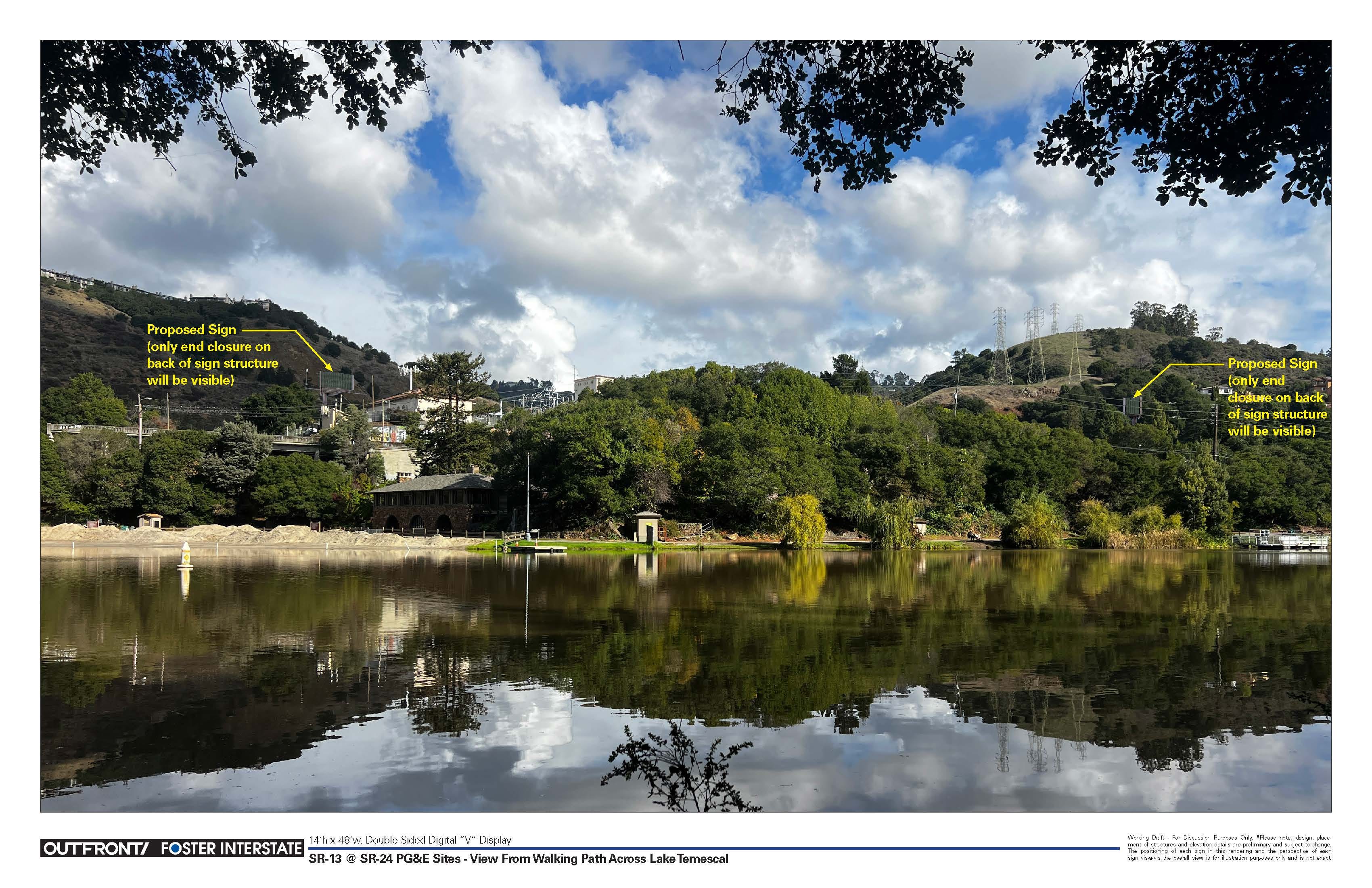
The actual renderings of the billboards in the public notice show significantly smaller and less obtrusive billboards that face away from the lake.
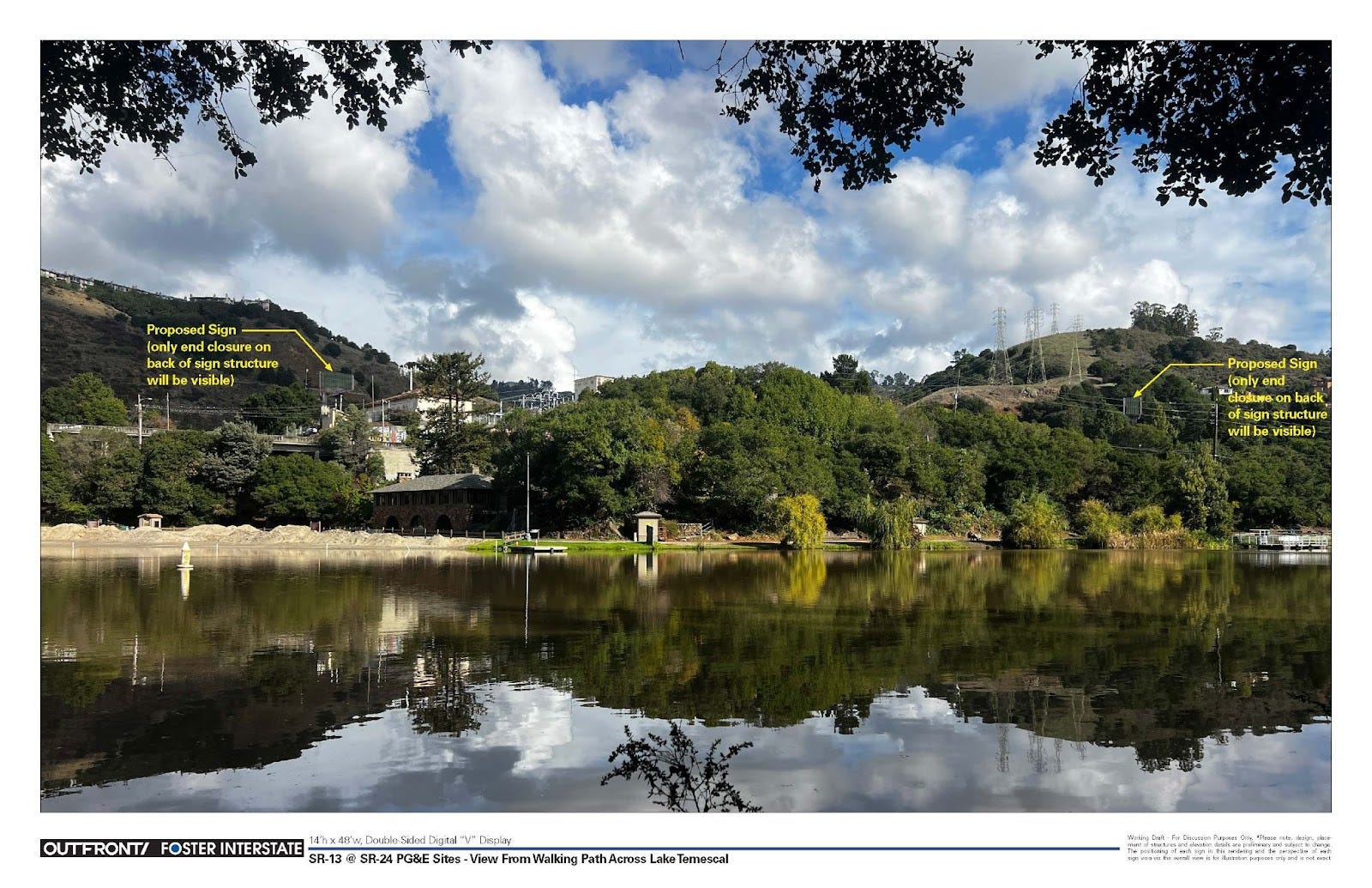
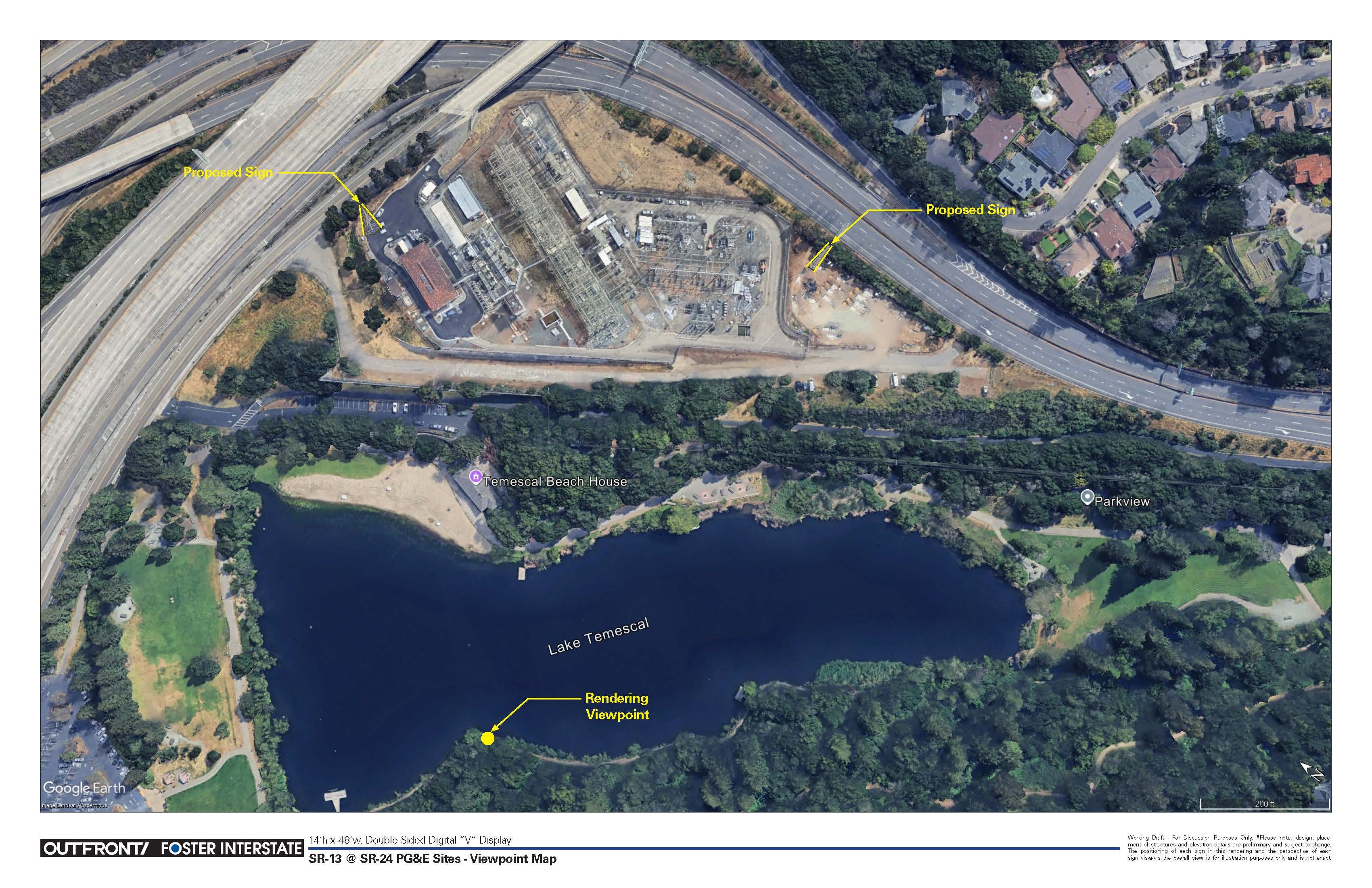
It is unclear why the maker of the fake image chose to render significantly larger billboards that directly face the lake with advertisements for guns and alcohol, none of which are shown in the real renderings.
Billboard advertisements for guns, tobacco and alcohol were banned in Oakland in 1997. Under the current ordinance, they are allowed only in narrowly defined circumstances that do not appear to apply here.
What the public notice and proposal actually say
The public notice proposes the removal of 11 existing billboard faces in various locations around the city, and the installation of 5 new digital billboards. The proposal also identifies 5 primary proposed locations and 10 alternate proposed locations for the proposed 5 new/relocated billboards.
The notice also includes information about one-time fees of up to $2.3 million that would be paid to the city, plus annual fees of $750,000 per year, payment of an unspecified amount of carbon offset fees,1 and an unspecified amount of free advertising space on the billboards for the city to use.
Thank you for reading Oakland Report. If you like our work, please share it with others.
According to the public notice, the 5 primary proposed locations for the proposed 5 new/relocated digital billboards are all located along the Interstate 880 freeway corridor:
4801 Oakport Street
1155 5th Street
3 5th Avenue
121 E 12th Street
837 Kennedy Street
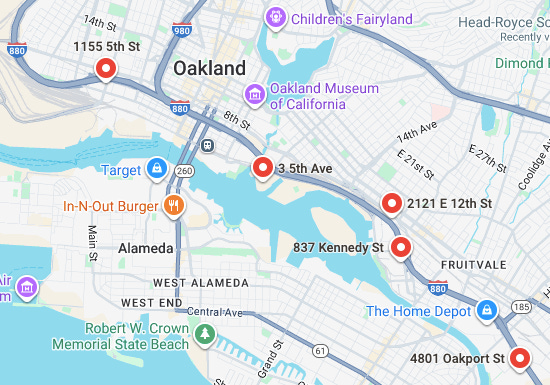
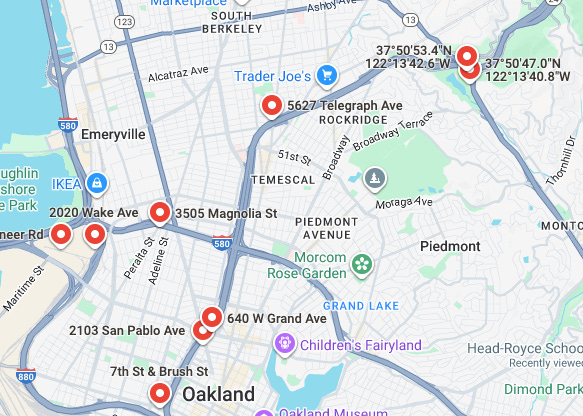
The 10 alternate proposed locations are:
5627 Telegraph Avenue
PG&E SR-24
PG&E SR-13
640 W Grand Avenue
2103 San Pablo Avenue
Brush Street & 7th Street
3505 Magnolia Street
2020 Wake Avenue
2400 Engineer Road
5601 Oakport Street
The PG&E substation located on an industrial parcel next to the State Route SR-24 (commonly called Highway 24) and SR-13 (commonly called Highway 13) freeway corridors is identified among the 10 alternate proposed locations.
Billboard regulations and the process for reviewing proposals
New billboards are generally prohibited under the city’s planning code. However, a 2023 amendment allowed relocations in which existing billboards may be removed and replaced with digital ones at new sites, under various restrictions.
The shift to allowing replacements/relocations of existing billboards began in 2020 when the City Council directed the Planning Commission to propose amendments which would allow for installation of digital billboards.
Among the justifications the city offered for the amendment at that time were, “to incentivize greater economic investment in local non-profit organizations, and health facilities, while providing local property owners new economic opportunities.” Billboards typically also generate revenues to the city through regulatory fees.
Per the planning code, billboard replacement/relocation proposals fall within the Planning Commission’s purview to approve or deny. The city council has the option to “call up” any planning commission decision for review by the full council; otherwise the planning commission’s decisions are final.
City has recently approved other billboard replacements/relocations
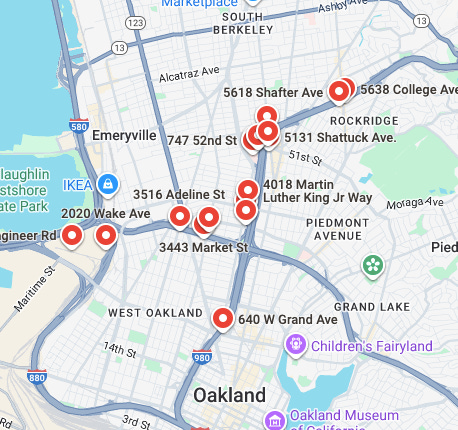
A similar billboard replacement/relocation to the one proposed here was approved by the city council on June 17. In that case, the list of alternate proposed locations for replacement digital billboards included locations along the Highway 24 freeway corridor where it passes through the Temescal and Rockridge districts.
Evidence matters
The Nextdoor posts and emails spread misinformation that incited people to react based on fake images and false claims that are debunked by the primary source material in the formal public notice and renderings.
This matters because Oakland’s decision-making process is meant to allow the public to see and have input on the decisions that affect their lives. But that input is only credible and effective if it is based on what’s real.
Public notices, agendas, staff reports, commission hearings, and environmental review processes exist so Oakland residents can learn the facts and reasoning from the primary sources. When those primary sources are undermined by fake images and misinformation, public opinion can become distorted into manufactured outrage — reactive to misinformation instead of proactively informed by facts.
When that reaction later turns out to have been based on falsehoods, it can undercut the credibility of people who reacted in an uninformed manner — people who may very well have legitimate justifications for opposing the billboards and otherwise could help contribute to a reasoned and productive public debate.
In a city where public trust and credibility is already strained, manufactured outrage based on misinformation can distort the conversation and distract from productively solving the issue at hand. This in turn leads to more distrust and less credibility all around, and an escalating cycle of dysfunction that can make it more difficult for the community to work together and solve problems together.
ABOUT THE AUTHOR
Rajni Mandal is a physician and now a full-time mom who wants a safer neighborhood and city for her two young children. She is a volunteer contributor to Oakland Report whose focus is on increasing awareness about transparency in public safety and misinformation in the public discourse.
[Editor’s note: This article was updated on Dec. 20, 2025, to embed hyperlinks to the City of Oakland’s November, 21, 2025, public notice in two places where the words “public notice” appear in the body of the article.]
Billboard replacement/relocation agreements sometimes include “carbon offset” fees. The “offset” refers to a financial or credit-based accounting mechanism for projected energy use, and is not a finding that the billboards reduce emissions or provide an environmental benefit. The carbon offset is intended to account for the digital billboards’ use of electricity, which is generated in part by carbon-emitting methods such as burning natural or synthetic gas to power electricity-generating turbines.
Thanks for all of your efforts on our behalf. You do great work.
While I do appreciate the distortions you point out, the fact does remain that digital billboards would be amazingly intrusive to a great number of people. After all, you can see the digital billboards down on 880 from up on Grizzly Peak.
A better resolution would be to ban them entirely for all the light pollution they cause for all residents.
Excellent article. Thank you