



EDITOR’S NOTE: Oakland Report’s charter reform series is exploring Oakland’s city charter and how it potentially could change — a question that Oakland voters may be asked on the ballot in November. This installment is focused on a proposal to reform the Police Commission through a charter reform ballot measure. A future installment will focus on ranked-choice voting and its effects on candidate quality and elections. See all eight Charter Reform series articles published to date.
Overhauling oversight
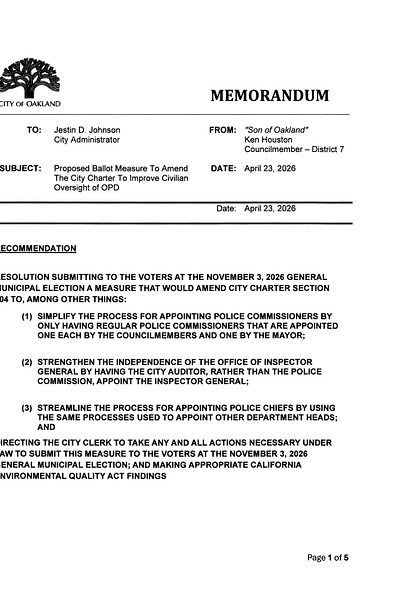
This week council member Ken Houston released a proposal to reform the city’s civilian Police Commission.1 The proposal targets three aspects of the commission that city officials and outside reviewers have identified as sources of dysfunction:
How police commissioners are appointed
Who controls the Office of Inspector General (OIG)
The Police Commission’s role in hiring Oakland’s police chief.
Houston’s proposal arrives after a period of institutional friction between the Police Commission and the rest of city government, marked by prolonged police chief vacancies, a revolving door of chiefs, contentious commissioner reappointment battles, and an auditor’s report finding that the oversight system lacks sufficient resources and independence to fulfill its legal mandates.
The proposed reform would require amending the city charter through a ballot measure with majority approval of Oakland voters. The proposal is scheduled for its first hearing at the Rules and Legislation Committee on May 7. If approved by the full City Council, it would go before Oakland voters in November.
Oakland Report provides accurate, unflinching, data-driven reporting and analysis that you will find nowhere else. If you value our nonprofit work, please subscribe, share, and donate:
A decade of layered oversight
Oakland’s current police oversight framework is the product of reform efforts responding to police misconduct cases. In 2003, Oakland Police Department (OPD) was placed under federal court supervision following the “Riders” police misconduct case. This federal oversight remains in place today, known as the Negotiated Settlement Agreement (NSA).
In 2016, voters approved Measure LL, creating the Police Commission and the Community Police Review Agency (CPRA). In 2020, voters approved Measure S1, expanding the Commission’s authority and creating the Office of Inspector General (OIG). In 2024, voters approved Measure NN, which created a new Oakland Public Safety Planning and Oversight Commission (OPSPOC), responsible for overseeing the development of a four-year community violence reduction plan, and managing approximately $47 million per year in parcel tax funding for public safety programs.
The result is one of the most powerful civilian oversight structures in the country. Oakland is the only major U.S. city with a charter-established citizen board authorized to fire the police chief, in addition to wide-ranging disciplinary, investigative, and audit authority over the police department.
Nearly a decade in, that architecture is showing strain. A March 2026 audit by the Office of the City Auditor found that the three oversight agencies met only 26 of 43 select City Charter and Municipal Code requirements, and identified vacancies, frozen positions, low minimum staffing, and leadership turnover as obstacles to fulfilling their legal mandates.2
The auditor’s report also found inconsistencies between the Charter and Municipal Code on the hiring and removal of CPRA and OIG leadership, and recommended that the Council adopt revisions to resolve them. A proposal to revise the enabling ordinances after Measure S1’s passage has been pending Council consideration since early 2025.

What the proposed reforms would change
1. Direct appointments by elected officials
Currently, the elected city council doesn’t directly appoint people to the Police Commission. Instead, each councilmember and the mayor appoint one member to a nine-person Selection Panel, which then recruits, vets, and nominates seven of the nine commissioners. The mayor appoints the other two directly. The Commission consists of seven regular and two alternate members.
Houston’s measure would dissolve the Selection Panel. Each of the eight councilmembers and the mayor would directly appoint one regular commissioner, producing a nine-member body with no alternates.
The new proposal argues that the existing two-tier system—requiring 18 volunteers across two bodies and two meeting calendars—creates administrative bottlenecks. Council President Kevin Jenkins raised similar concerns in May 2024 in a restructuring proposal that was not taken up, citing recruitment difficulties and prolonged vacancies.3
2. Inspector General moved under the City Auditor
Under the current charter, the Police Commission hires and can fire the Inspector General. The proposed charter amendment would transfer that authority to the elected City Auditor, who would also conduct the performance reviews.
The proposed reform frames this as a question of structural independence: the OIG’s mandate to audit both OPD and CPRA creates tension when the OIG reports to the body overseeing CPRA.
The City Auditor’s March 2026 report identified the city administrator’s influence over the OIG budget as a “structural threat to independence.” City Auditor Michael Houston (no relation to councilmember Houston) separately responded to an informal proposal to house OIG within his office—noting he was neutral on the merits while flagging reporting and conflict-of-interest questions that would need resolution.
3. Police chief hiring responsibility removed from the Commission
The proposal’s most consequential change is that the Police Commission would lose its current role in recruiting and nominating candidates for the city’s police chief. The chief would instead be appointed through the same process used for other department heads—by the City Administrator with mayoral oversight. The Commission would retain authority to remove the chief by a five-member vote, alone or jointly with the Mayor.
The proposal cites the city’s recent track record on chief recruitments as justification. OPD was without a permanent chief for 15 months between February 2023 and May 2024, and the current recruitment process—launched after Chief Floyd Mitchell’s resignation in October 2025—is not expected to produce a new chief until at least July 2026, more than nine months after Mitchell gave notice.

A department in perpetual transition
The proposed reforms arrive during an extended period of leadership instability at OPD that is unmatched among major American police departments. Oakland has had 11 chiefs or interim chiefs since 2013.4 By comparison, over the same period San Francisco had three chiefs and San Jose six.
Former Oakland Police Chief Anne Kirkpatrick was fired by the Commission in 2020 and later was awarded $1.5 million in a wrongful-termination case. In a news interview, Kirkpatrick stated that the city does not adequately support the police department.5
Oakland’s last permanent chief, Floyd Mitchell—the only permanent chief in nearly 15 years to resign rather than be fired or pushed out—stepped down in October 2025 after 18 months, despite a declining crime rate and progress toward exiting federal oversight.6 Contemporaneous news reports about Mitchell’s resignation cited the chief’s frustration with federal oversight and the Police Commission as factors in his decision.7
The Oakland Police Officers’ Association called Mitchell’s departure “another chapter in a troubling pattern of instability” and urged the Mayor and Council to confront the dysfunction. The Commission launched a nationwide search for a permanent police chief after Mitchell’s departure, and the extended timeline mirrors the 15-month vacancy that preceded Mitchell’s hiring. (Oakland’s police department is currently led by interim chief James Beere.)
Commissioner disputes and a Brown Act controversy
The charter reform proposal comes after months of friction between the City Council and the Police Commission over commissioner appointments.
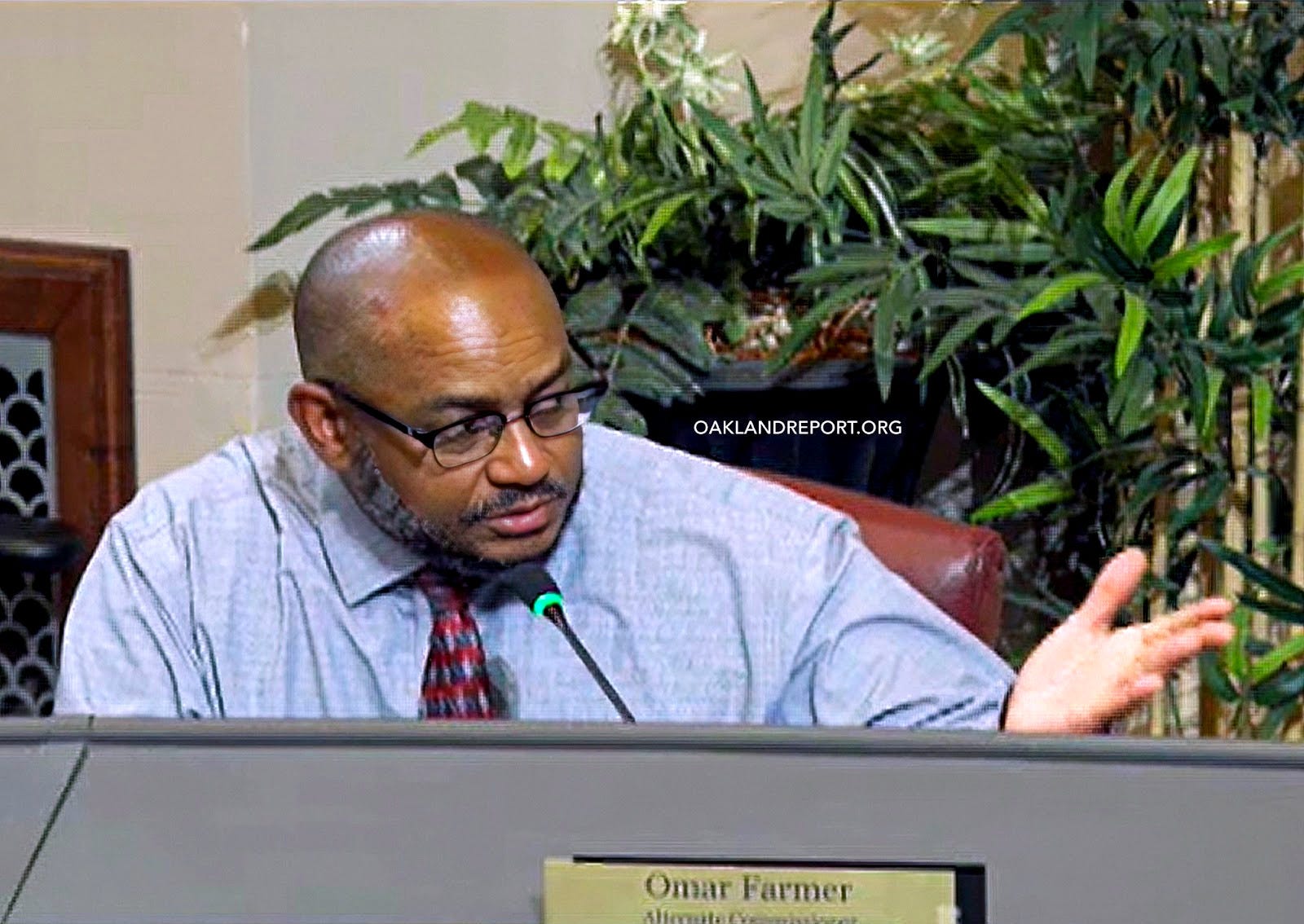
In October 2025, the Council declined to reappoint Commission Chair Ricardo Garcia Acosta and alternate commissioner Omar Farmer, citing concerns about the Commission’s approach to oversight.
Garcia Acosta and Farmer responded to the council’s rejection with a public statement accusing the chief of refusing to address misconduct and blaming the city for tolerating “anti-commission harassment,” and sought to submit the statement to the federal NSA judge.8 Due to a loophole in state law, they were allowed to continue to serve on the commission in “holdover” status because there were no other nominees to replace them.
After the Council rejected Farmer’s reappointment a second time in January, Farmer continued serving in the “holdover” capacity. Then, on March 26, the Commission announced after a closed-door session that Farmer had been elevated to a full commissioner seat to fill a vacancy. The move drew a formal Brown Act “cure and correct” demand from Oakland resident Rajni Mandal, who argued that the appointment was not listed on the public agenda and therefore violated California’s open-meeting law.9
On April 9, City Attorney Ryan Richardson issued a legal opinion confirming that the Commission’s action appeared to violate the Brown Act. Richardson also found that Farmer, having been twice rejected by Council, was “by definition… not fully qualified to serve a new, fixed term on the Police Commission.”10
The Police Commission subsequently voted to appoint Farmer as a full commissioner on April 23—and did so without following the City Attorney’s legal requirements, asserting that the Commission has its own legal counsel and is not bound by the City Attorney’s opinion.11

What the proposed reform preserves
The proposed charter amendment would preserve the Police Commission and retain its core policy oversight functions. The Commission would retain its authority to:
Oversee OPD policies and procedures for conformance with constitutional policing standards
Propose and approve changes to use-of-force policies, profiling protections, and other key general orders
Review the police department’s budget
Require the Chief of Police to attend Commission meetings and submit annual reports
Issue subpoenas
Remove the police chief by a vote of at least five members.
The CPRA’s investigative functions would be unchanged. The Commission’s adjudication role in disciplinary disputes between the CPRA and the Chief of Police—through the Discipline Committee process—also would be preserved.
Political landscape and next steps
The proposed charter reform faces a complex political path. Oakland voters approved the Commission’s creation in 2016 and expanded its powers in 2020 by significant margins. Any proposal to reform the Commission will likely generate organized opposition from police accountability advocates who view the current structure as essential protection against department misconduct.
At the same time, the proposal arrives during a period of heightened public frustration with government dysfunction, chronic police staffing shortages.
OPD currently has an active police force of around 500 sworn officers, out of a budgeted 678—fewer than the 700 officers required by Measure NN. The department also remains under federal oversight now entering its 23rd year. The police officers’ union, civic leaders, and multiple former chiefs have publicly cited the complexity of the oversight environment as a barrier to effective policing and stable leadership.
The council Rules and Legislation Committee hearing on May 7 will be the first public venue for debate. If the full Council approves the proposal, the ballot measure must be filed with the Alameda County Registrar of Voters at least 88 days before the November 3 election. Then it would be for Oakland voters to decide.
Houston, Ken. “Proposed Ballot Measure To Amend The City Charter To Improve Civilian Oversight Of OPD.” City of Oakland, Apr. 22, 2026. https://oakland.legistar.com/LegislationDetail.aspx?ID=7990578&GUID=087EF658-4018-4BF6-AD45-FB2EE05F4188
Houston, Michael. "New Audit Finds More Resources and Strengthened Independence Needed for the City Agencies Tasked with Overseeing the Oakland Police Department." Office of the Oakland City Auditor, Mar. 10, 2026. https://www.oaklandauditor.com/new-audit-finds-more-resources-and-strengthened-independence-needed-for-the-city-agencies-tasked-with-overseeing-the-oakland-police-department/
Jenkins, Kevin. “Charter Changes Police Commission.” City of Oakland, May 1, 2024. https://oakland.legistar.com/View.ashx?M=F&ID=12898615&GUID=50528822-6B0E-4DD4-BF3A-2017AAD761C8
ABC7 News Staff. “Oakland has had 11 different police chiefs in 15 years as Chief Floyd Mitchell steps down.” ABC7 San Francisco, October 9, 2025. https://abc7news.com/post/oakland-has-had-11-different-police-chiefs-15-years-chief-floyd-mitchell-steps-down/17965500/
Jones, Velena. “Oakland police Chief Floyd Mitchell submits resignation.” NBC Bay Area, October 9, 2025. https://www.nbcbayarea.com/news/local/oakland-police-chief-resigns/3960455/
Fernandez, Lisa and Henry K. Lee. “Oakland Police Chief Floyd Mitchell resigns after 18 months.” KTVU Fox 2, October 9, 2025. https://www.ktvu.com/news/oakland-police-chief-floyd-mitchell-resigns-year-after-being-hired
Anthony, Laura. “Fired Oakland Police Chief Anne Kirkpatrick levels accusations at Mayor Libby Schaaf, police commission.” ABC 7 Eyewitness News, Feb. 24, 2020. https://abc7news.com/post/fired-oakland-police-chief-anne-kirkpatrick-breaks-silence/5964109/
Reinhart, Sean S. “Outgoing police commissioners accuse police chief and blame city for ‘anti-commission harassment.’” Oakland Report, November 11, 2025. https://www.oaklandreport.org/p/20251111-rejected-police-commissioners-slam
Oakland Report, Twice-rejected police commissioner ‘not qualified’ to serve a new fixed term: City Attorney, April 10, 2026.
Montana, Alex. “Police Commission appointment appears to violate state law.” Oakland Report, Apr. 1, 2026. https://www.oaklandreport.org/p/20260401-police-commission-appointment-brown-acts
Mandal, Rajni. "Public Safety Update – April 24, 2026." Rajni Mandal’s Public Safety Updates, April 24, 2026. https://rajnimandal.substack.com/p/public-safety-update-april-24-2026

Another great article Oakland based and Oakland Police issues based. One of the things I appreciate about the articles you have been publishing is you present the issues and concerns without apparent hyperbole or tipping of the scales.
I have been watching commission meetings for a long time now. I'm always taken aback by what I view as significant narcissism displayed by many of the Commissioners. They take any public criticism as a type of personal attack and sometimes behave in a manner that would lead an officer to some type of discipline or reprimand.
The Commission spends an inordinate amount of time on ad hocs that don't produce timely changes to policies or procedures, while seemingly demanding the department they oversee to immediately respond to their every whim.
One thing I do enjoy watching is the commentary by a few regulars. I honestly think they could just record their comments and hit play when the approach the mic. They dont offer any differentiation in their comments. Ms. Mandal is seemingly the only regular who focuses directly on the responsibilities of the commission and oversight of the department.
It seems to me that by concentrating on the legal complexities, the main issue gets overshadowed. Do most regular citizens understand these legal arguments, and more importantly, are they interested in understanding them?
I think we want a well staffed and functioning police force! Period.
Politicians and bureaucrats need to hash it out and not play the legal game. You were hired and elected to get results. Show some good will and cooperate instead of bicker.