



Oakland Agenda Watch provides short summaries of key items on upcoming public meeting agendas that catch our attention.
More amendments to enhance city council “officeholder funds”
Oakland City Council meeting, Jan. 6, 2026, agenda item #6.6
On June 17, 2025, over the objections of the city’s public ethics commission, Oakland city council dramatically increased the amount of money council members could raise for their “officeholder funds.”1
“Officeholder funds” are expense accounts for council members, the mayor, and other elected officials.
Elected officials may solicit and accept donations to these expense accounts from their supporters, including supporters who receive city contracts (outside of a 180-day waiting period).2
The elected officials can then spend the funds “for any political, governmental or other lawful purpose.” Exceptions include overt political campaign expenses, religious or other memberships, and improperly supplementing employees’ pay.3
The previous limits on total contributions to officeholder funds were: $25,000 per year for district council members, the city auditor and school board members; $30,000 per year for the at-large council member and the city attorney; and $50,000 per year for the mayor.
The city council’s June 17, 2025 amendments raised those limits to: $75,000 per year for district council members (a 3x increase), $100,000 per year for the at-large council member and city attorney (a 2.3x increase), and $100,000 per year for the mayor (a 2x increase).
Among other allowable expenses, officeholder funds currently can be used to give “donations to tax-exempt educational institutions or tax exempt charitable, civic or service organizations, including the purchase of tickets to charitable or civic events.”4
While this may seem innocuous on the surface, Oakland has numerous politically active tax-exempt organizations that receive city contracts and grants approved by city council — some of which are championed by individual council members, and some that have well-developed advocacy, public relations and community networks at their disposal.
The direct cycling of funds and perks between council members and local organizations that actively engage in political discourse in the city increases the potential for conflicts of interest, and increases the risk of potential corruption.
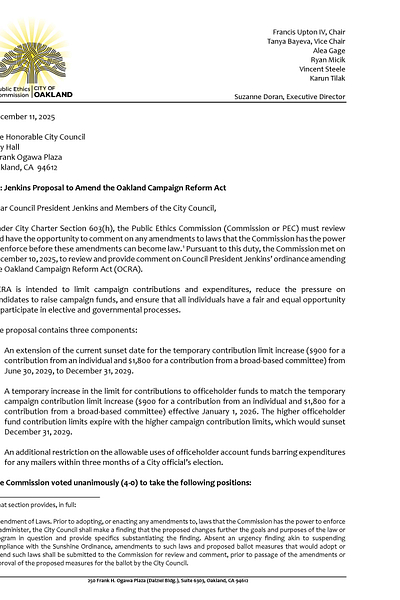
The city’s public ethics commission opposed the proposed increases to the officeholder funds, stating in a May 29, 2025 memo to the council:
“Commissioners voted unanimously to oppose this proposal, expressing concerns that it may allow large-dollar donors additional opportunity to give more money to officials, increasing the risk of perception or real conflicts of interest... [and] that current laws governing the use and solicitation of officeholder funds could be perceived as insufficient to prevent misuse.”
– from Public Ethics Commission letter to City Council, May 29, 2025.5
The public ethics commission reiterated its concerns about increasing officeholder fund contribution limits in a subsequent Dec. 11, 2025, letter to the city council.6
According to a May 15, 2025 report authored by city council president Kevin Jenkins and council members Janani Ramachandran and Ken Houston, the officeholder fund increases were specifically intended to be used for campaign-type purposes and to displace campaign fundraising efforts:
“This change will… encourage and promote public discussion of issues important to the district constituents and the broader community while simultaneously allowing elected officials to spend less time fundraising so they can focus on these issues and events… Finally, increasing the officeholder fund limits curbs corruption and the appearance of corruption by encouraging transparent and traceable contributions to elected officials, which fosters more independence for elected officials who may use such contributions for any political, governmental or other lawful purpose except for campaigns and other prohibited uses.”
– Council president Kevin Jenkins and council members Janani Ramachandran and Ken Houston, May 15, 2025.7
It is unclear how this change would allow council members to spend less time fundraising, since they would still need to fundraise to fill their officeholder accounts. It also is unclear what non-transparent and non-traceable contributions the council members are alluding and comparing this change to in their report.
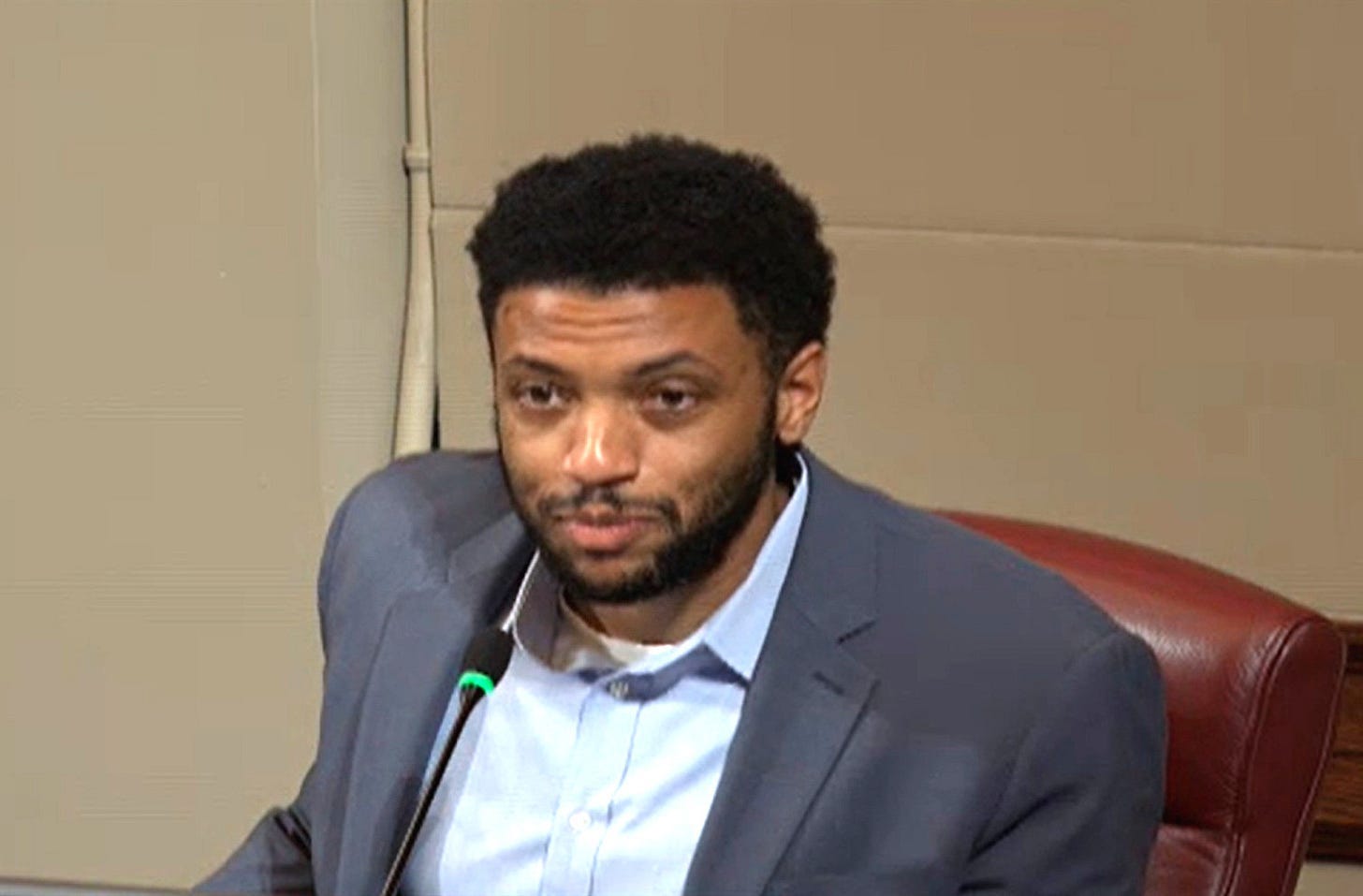
The new proposal up for council’s consideration on January 6 — also sponsored by council president Jenkins — has three components that appear mainly designed to further enhance the funding available to current officeholders for their campaign-type activities.
The first component of the new proposal would slightly extend the sunset date — from June 30, 2029, to Dec. 31, 2029 — for a previously approved temporary contribution limit increase for political candidates who agree to voluntary expenditure caps. The temporary increase was from $650 to $900 for a contribution from an individual and from $1,300 to $1,800 for a contribution from a broad-based committee.8
The second component of the new proposal would increase the contribution limit for “officeholder funds” to match the temporary campaign contribution limit increase in the first component noted above ($900 for a contribution from an individual and $1,800 for a contribution from a committee), also sunsetting on Dec. 31, 2029.
The third component would prohibit incumbents from using their officeholder funds to pay for “mailers” within three months of an election in which they are a candidate. The proposal would not prohibit such mailers in general, which are currently allowed.
This new proposed prohibition suggests that such mailers are seen as potential vehicles to boost incumbent officeholders’ re-election prospects during election season using officeholder funds, and the thinking apparently is not to allow them to be mailed during election season alongside other overtly political mailers that fill voters’ mailboxes.
However, the new proposal appears to be silent on using officeholder funds for other forms of campaign-type communications — such as digital/social media ads, websites, and email outreach — and whether such formats would also be prohibited within three months of an election.
It also implies that such mailers can or have been used for political campaign purposes, which is supposedly prohibited by the rules for officeholder funds. If they are not campaign-related, why prohibit them during election season? If they are campaign-related, why are they permitted at all?
Forever emergencies
Oakland City Council meeting, Jan. 6, 2026.
As usual, the January 6 city council agenda includes resolutions to renew three long-standing local emergency declarations, some of which have been in place for decades. This now-routine practice continues these formal states of emergency with no substantive review or new action plans:
HIV/AIDS public health crisis. Agenda item #6.2
Safe and affordable access to medical cannabis. Agenda item #6.3
Homelessness crisis. Agenda item #6.4
One could fairly argue that homelessness is a real and present crisis in this city, and that a declaration that the city is in a homelessness “state of emergency” is justified.
But cannabis is now legal and readily available not only for medicinal use but also for recreational use. And while HIV/AIDS remains a serious condition, it is now considered a manageable chronic disease.9
Ostensibly, these emergency declarations allow the city to access certain funds or streamline procedures. This often makes sense during times of acute crisis when rapid response is critical. But what happens when the emergency declaration is never lifted, and in fact is actively and repeatedly renewed, with no substantive discussion about the status of the “emergency,” long after the acute crisis has subsided?
The city council’s perpetual renewal of emergency declarations with no review, no clear goals or metrics, and no sunset criteria has turned them into permanent policy fixtures completely divorced from living reality, rather than temporary crisis-response tools. This reflects poorly on the city council’s credibility and seriousness with respect to what it qualifies as an emergency, and its rationale for making and renewing emergency declarations.
Opening door to new PFRS board members
Oakland City Council meeting, Jan. 6, 2026, agenda item #5.1
As Oakland Report has previously reported, the city of Oakland has a significant surplus of funds in the Police and Fire Retirement System (PFRS).10
PFRS is the city-operated pension fund that was closed in 1976 and replaced with the California Public Employee Retirement System (CalPERS).
The city’s actuaries estimate a potential surplus of $262 million in the PFRS account at the end of 2026, after the PFRS debt is fully paid off.
PFRS has no active members. Its entire membership consists of retirees. According to the staff report, as of June 30, 2025, the system’s 597 retired members had an average age of 81. Its remaining members are geographically dispersed and some reside in nursing homes. According to the report, this has made it difficult to find eligible board candidates and to achieve the quorums needed for the board to conduct business and oversee the fund.
On January 6, the council will consider a proposal to place a measure on the June 2, 2026, ballot to amend the City Charter governing the PFRS. If approved by voters, the measure would expand board eligibility to include any “qualified individual” elected by members if no retiree can serve, and would reduce the board meeting frequency from monthly to at least quarterly to align with key financial reports.
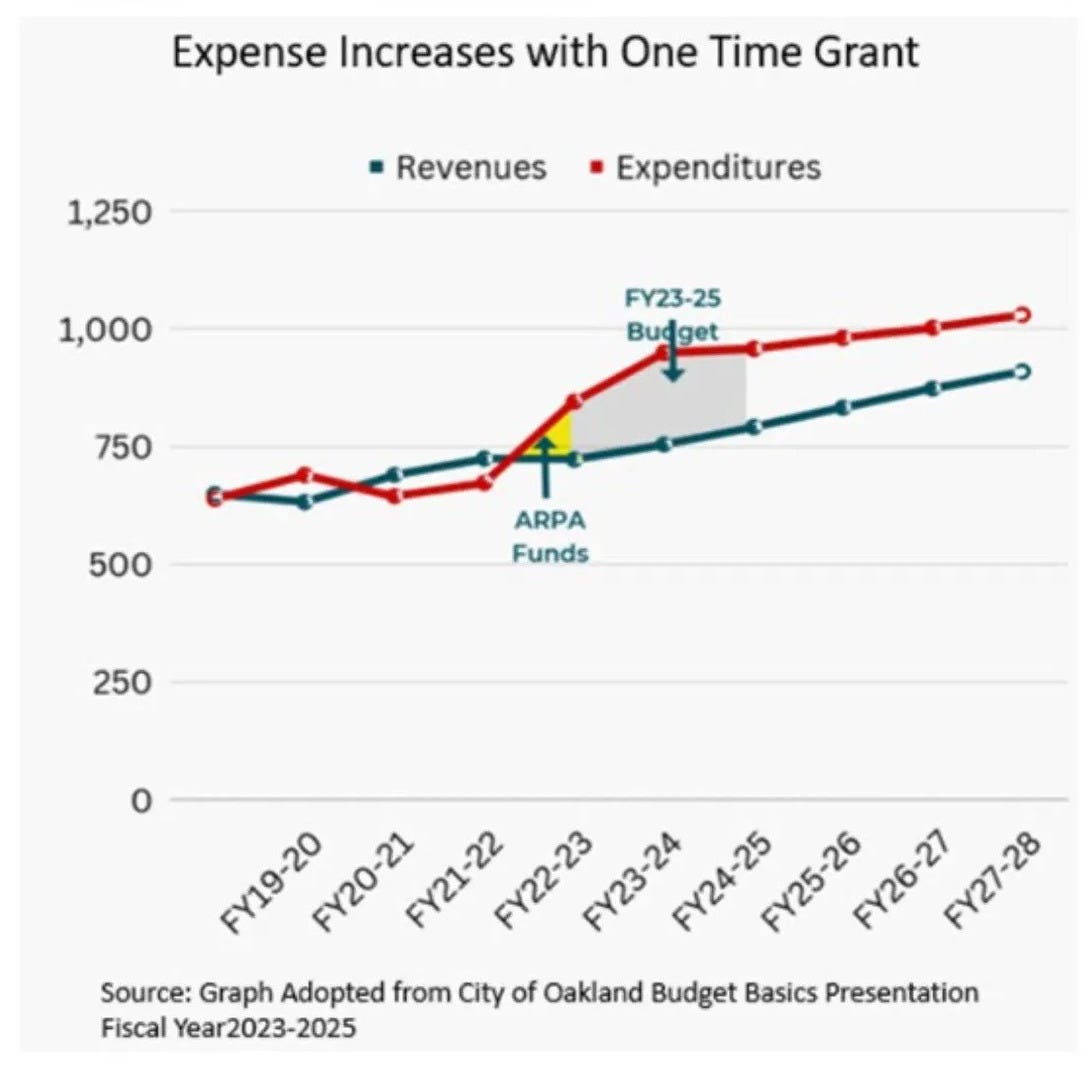
The city is considering various ways to raise revenue to close a nine-figure structural budget deficit, including by raising taxes.11
One deficit-reducing option the city has explored (and which Oakland Report has suggested in multiple articles) is to potentially use the PFRS surplus to pay down the city’s CalPERS unfunded actuarial liabilities. This move would save the city around $20 million annually in interest payments, while further securing employee retirements.
But in order to make such a change, the PFRS board would need to be involved in the decision-making process, which it cannot do if it is unable to achieve a quorum.
See this related article:

Other notable agenda items on January 6
$10.4 million construction contract for the “27th Street Complete Streets Project.” This item is to award a contract to Redgwick Construction to construct traffic safety improvements on 27th Street between Telegraph Avenue and Grand Avenue/Bay Place. According to the staff report, the work will include physically separated bicycle lanes, buffered bicycle lanes, protected intersections, pedestrian crossings improvements, bus boarding islands, curb ramps, and traffic signal improvements. Agenda item # 6.7
Commission appointments. The council will consider appointments to seats on various citizen boards and commissions, including:
Fatimah Aure to the Commission on Persons with Disabilities (reappointment). Agenda item #6.9
Genice Jacobs to the Commission on Homelessness. Agenda item #6.10
Rudy Gonzales and Jennifer Benford Seibert to the Civil Service Board. Agenda item #6.11
David Newton to the Oakland - Alameda County Coliseum Authority Board of Commissioners. Agenda item #6.12
Oakland Report is by no means comprehensive in our coverage of public meetings in Oakland. The scope and frequency of public meetings are far more than we can presently cover. You can view the full agenda for the January 6 Oakland City Council meeting on the city’s meeting calendar.

City of Oakland. “Concurrent Meeting of the Oakland Redevelopment Successor Agency and the City Council.” Campaign Reform Act: Temporary Increase In Contribution Limits. Oakland, California, June 17, 2025, agenda item #5.7. https://oakland.legistar.com/LegislationDetail.aspx?ID=7266450&GUID=A0ABB9C4-4446-48F1-939C-949EEC873DB5
City of Oakland. “Oakland Municipal Code.” Contractors doing business with the City or the Oakland Unified School District prohibited from making contributions. Chapter 3.12.140(A). https://library.municode.com/ca/oakland/codes/code_of_ordinances?nodeId=TIT3MUEL_CH3.12THOACAREAC_ARTIIICOLI_3.12.140CODOBUOAUNSCDIPRMACO
City of Oakland. “Oakland Municipal Code.” Officeholder fund, Chapter 3.12.150. https://library.municode.com/ca/oakland/codes/code_of_ordinances?nodeId=TIT3MUEL_CH3.12THOACAREAC_ARTIIICOLI_3.12.150OFFU
Ibid. Oakland Municipal Code 3.12.150(B)(9)
City of Oakland. “Letter from Public Ethics Commission to City Council.” Re: Ramachandran/Houston/Jenkins Proposal to Amend OCRA and the LPF Act. Oakland, California, May 29, 2025. https://oakland.legistar.com/View.ashx?M=F&ID=15026449&GUID=39CBC4E7-F925-4154-BE93-F1E856556939
City of Oakland. “Letter from Public Ethics Commission to City Council.” Re: Jenkins Proposal to Amend the Oakland Campaign Reform Act. Oakland, California, Dec. 11, 2025. https://oakland.legistar.com/View.ashx?M=F&ID=15026451&GUID=D87FE96D-A6FB-4886-B399-449B10C402C8
City of Oakland. “Report from Council President Kevin Jenkins and Councilmembers Janani Ramachandran and Ken Houston to Mayor and City Council.” Campaign Reform Act: Temporary Increase In Contribution Limits. Oakland, California, May 15, 2025. https://oakland.legistar.com/View.ashx?M=F&ID=14216075&GUID=D9DE2461-BD40-48CC-8E9A-8CDAC9230D68
City of Oakland. “Ordinance No. 13849 C.M.S.” Ordinance Amending Oakland Municipal Code Title 3, Municipal Elections, Article Iii, Chapter 3.12, The Oakland Campaign Reform Act, To Add Section 3.12.045 To Temporarily Increase Contribution Limits For Candidates In 2026 Elections And To Amend Section 3.12.150 To Increase Officeholder Fund Limits. Oakland, California, June 17, 2025. https://oakland.legistar.com/View.ashx?M=F&ID=14317740&GUID=196D0D8F-7FD6-42EF-A2B0-153A18E51C49
Katella, Kathy. “How HIV Became the Virus We Can Treat.” Yale Medicine, Oct. 12, 2021. https://www.yalemedicine.org/news/hiv-treatable
Gardner, Tim. “The Pension Override Tax surplus – an unexplored opportunity to reduce the city’s operating expenses.” Oakland Report, Dec. 24, 2025. https://www.oaklandreport.org/i/182479778/the-pension-override-tax-surplus-an-unexplored-opportunity-to-reduce-the-citys-operating-expenses
Reinhart, Sean S. “‘Death and Taxes’ - Oakland City Council is the one who knocks.” Oakland Report, Oct. 27, 2025. https://www.oaklandreport.org/p/death-and-taxes-oakland-city-council
Suggested edit of the officeholder fund item from a math geek. 75k is 3× 25k, a 200 percent increase. 100k is twice 50k, a 100 percent increase. Thanks for reporting these agenda items
"$10.4 million construction contract for the “27th Street Complete Streets Project.” This item is to award a contract to Redgwick Construction to construct traffic safety improvements on 27th Street between Telegraph Avenue and Grand Avenue/Bay Place. According to the staff report, the work will include physically separated bicycle lanes, buffered bicycle lanes, protected intersections, pedestrian crossings improvements, bus boarding islands, curb ramps, and traffic signal improvements." Redgwick Construction is the contractor involved in the gas explosion that took place Dec. 11 in Hayward, CA. This is not to say that the contractor "caused" the accident - maybe the blame lies with PG&E. But until there's a "conclusion", why do this deal? BTW, the project to reconfigure E. Lewelling Blvd. was a very sore point with many of the residents who claim a poor relationship with said contractor over a period of about 1 year.