



Editors’ note: This article was originally posted by Oakland resident Rajni Mandal on her Substack page. Oakland Report is republishing it with Mandal’s permission for our readers to consider. Subscribe to Rajni Mandal’s Public Safety Updates to receive her articles directly.
(We also have been inspired by Mandal’s article to conduct an expanded analysis that examines every story published by the five media outlets over the past 12 months. Look for that expanded analysis in Oakland Report in the coming days.)
On August 24, five people were stabbed at several locations in Oakland’s Fruitvale neighborhood over a period of about 30 minutes. One person was killed and four others were injured.
The incident received standalone coverage from multiple local media outlets, including KQED,1 KTVU,2 East Bay Times3 and San Francisco Chronicle4 — except for Oaklandside.
There is nothing particularly unusual about a news organization deciding not to cover an individual crime. Newsrooms make those decisions every day based on staffing, resources and editorial priorities.
But those choices also determine which events their readers encounter. As traditional local news has become increasingly divided among publications with different approaches to journalism, relying on a single outlet may provide only part of what is happening in a community.
The Fruitvale stabbing raised a question: what picture of serious violence would someone receive if they relied primarily on Oaklandside for public safety news? I reviewed a year of its coverage to find out.

Reviewing a year of violent incidents
The review covered August 27, 2025 through August 29, 2026. Rather than trying to determine which crimes were important enough to warrant a story, I used both an objective severity threshold and coverage by other news organizations.
The analysis included homicides and suspected homicides; police shootings resulting in injury or death; shootings or stabbings involving multiple victims; shootings at a school or college; and traffic collisions resulting in multiple deaths.
An incident was then included only if at least two of four comparison news organizations (KQED, KTVU, East Bay Times and San Francisco Chronicle) published standalone coverage.
This produced 41 incidents during the twelve-month period, of which Oaklandside published standalone coverage of seven, or 17%.
(The complete methodology and list of incidents are included in the appendix.)
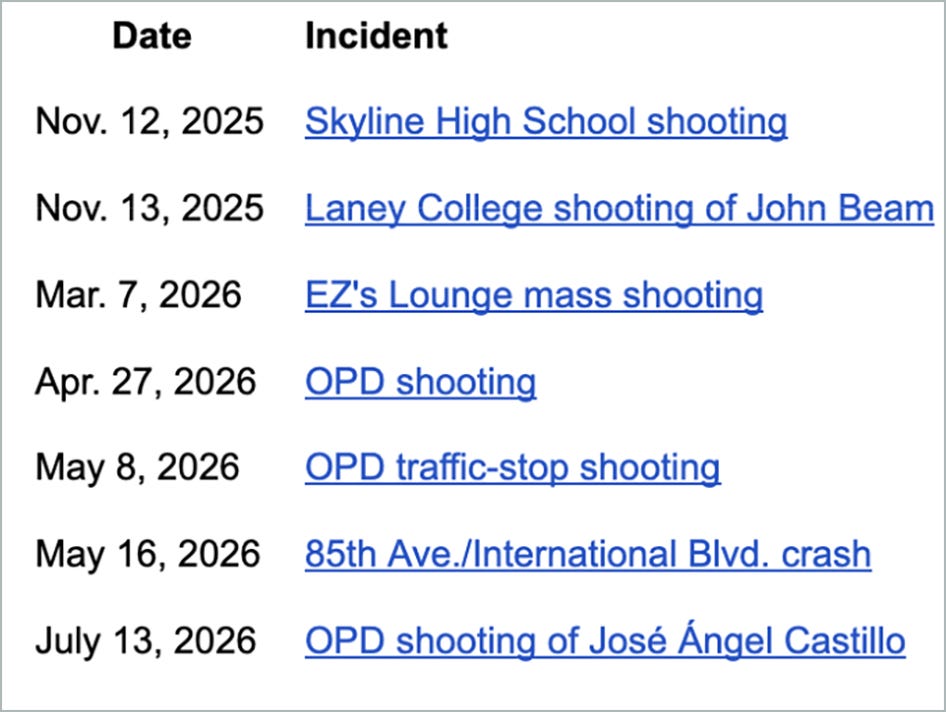
The seven incidents were concentrated in several categories. Oaklandside covered all three police shootings that met the criteria for the review.567 Two other incidents involved shootings at a school or college,89 while another was a mass shooting that killed two people and wounded five.10 The remaining incident was a traffic collision that killed three people.11
These differences show which incidents were selected, but not why. Oaklandside is not a traditional breaking news operation and does not attempt to report every homicide in Oakland. Comparing it only with a television station or regional daily newspaper could therefore create a misleading expectation about the type of journalism it is trying to provide.
KQED provides a more useful comparison. Both are nonprofit, mission-driven news organizations that emphasize public service journalism rather than comprehensive coverage of individual crimes. Oaklandside focuses specifically on Oakland, while KQED is a much larger public media organization serving the Bay Area across radio, television and digital platforms.
Despite those differences, KQED provides a useful benchmark for whether Oaklandside’s selectivity is unusual within this type of journalism.

Comparing Oaklandside with KQED
KQED covered nine of the 41 incidents (22%), compared with seven for Oaklandside. Their selections were nearly identical: every incident Oaklandside covered was also covered by KQED. The only two additional incidents covered by KQED were the July 31 shooting at the OUSD adult school12 and the August 24 Fruitvale stabbing spree.13
The comparison puts Oaklandside’s 17% coverage rate in context. Both publications were highly selective about reporting individual violent incidents, and they made almost all of the same selections.
KQED and Oaklandside also have an existing editorial relationship: KQED has republished Oaklandside reporting, and Oaklandside journalists regularly appear on KQED programs.14
Shared or republished stories did not affect which incidents qualified for this analysis, and I found no evidence that the newsrooms coordinate coverage decisions. Still, their relationship makes it difficult to view their similar selections as entirely independent.
Different approaches within Cityside
Selective incident coverage is not universal among nonprofit local news organizations. Oaklandside, Berkeleyside and Richmondside are all operated by Cityside,15 but take different approaches.
Richmondside regularly publishes standalone reports on individual homicides and tracks the city’s homicide count.16 Richmond has substantially fewer homicides than Oakland, making a direct comparison of coverage rates inappropriate. However, its coverage shows that routine incident-level homicide reporting is not outside Cityside’s editorial model.
Berkeleyside also publishes standalone reports on individual homicides, although Berkeley had too few during the study period for a meaningful quantitative comparison. The three publications therefore appear to make different decisions about how much incident-level reporting is part of their local news function.

A changing local news landscape
These different approaches are part of a much larger change in local journalism.
Traditional metropolitan newspapers once attempted to provide a broad community record, with reporters covering police, courts, city hall, schools, neighborhoods, business and other subjects.
That model has substantially contracted.
Nearly 40% of local U.S. newspapers have disappeared since 2005, according to Northwestern University’s Local News Initiative,17 while newspaper employment has fallen by more than 75%.
Other forms of local journalism have grown during that decline. Local outlets are now the largest segment of the Institute for Nonprofit News network,18 while the share of Americans who say they at least sometimes get local news from online-only sources increased from 15% in 2018 to 42% in 2025.19
The result is not simply that one type of journalism has replaced another. The functions of local news are increasingly divided among publications with different missions and editorial priorities.
What readers see
There are advantages to this model. Smaller publications can develop expertise in particular subjects, neighborhoods or institutions and produce reporting that might otherwise not exist. But it also means that no single publication necessarily provides a complete picture of what is happening in a community.
Individual violent incidents are only one part of public safety reporting. Oaklandside also reports on policing, accountability, surveillance, crime trends and other public safety issues. But individual incidents are also part of the information readers use to understand public safety in their community.
Research has found that media coverage can influence how important people perceive crime to be as a public issue.2021
This review does not establish that Oaklandside’s coverage affected its readers’ perceptions. It does show that in a fragmented local news environment, the picture readers receive of public safety depends in part on which outlets they follow, and which events those outlets select for coverage.
Share this article with someone you know.
Appendix: Methodology and Data
Study design
This was a retrospective review of standalone news coverage of serious violent and public safety incidents in Oakland between August 27, 2025 and August 29, 2026. The unit of analysis was the incident, not the article. Multiple articles or follow up reports concerning the same event were treated as one editorial selection.
Selection of comparison outlets
Four Bay Area news organizations were selected as comparison outlets: KQED, East Bay Times, KTVU and San Francisco Chronicle. They were selected to provide established news organizations with substantial Oakland or regional coverage while representing different organizational and distribution models.
KTVU is a major commercial television news organization based in Oakland.
East Bay Times provides longstanding newspaper coverage of Oakland and the East Bay.
San Francisco Chronicle is a major regional newspaper with regular Oakland and breaking news coverage.
KQED is the Bay Area’s public media organization and provides a useful comparison with Oaklandside’s public service-oriented model.
Incident criteria
To avoid making subjective judgments about which crimes were sufficiently serious to warrant news coverage, incidents were eligible for review if they fell into one of five predefined categories:
Homicides and suspected homicides.
Police shootings resulting in injury or death.
Nonfatal shootings or stabbings involving multiple victims.
Nonfatal shootings at a school or college.
Traffic collisions resulting in multiple deaths.
Other public safety events — including single victim nonfatal shootings outside schools, robberies, assaults and other crimes — were not included.
Peer coverage threshold
Meeting the incident criteria alone did not place an event in the final dataset. An eligible incident also had to receive standalone coverage from at least two of the four comparison outlets. A substantive follow up story could count as selection if the underlying incident remained a substantial subject of the story. A passing reference in an article principally about another subject did not. Other news organizations could be used to verify factual information but did not count toward the two outlet threshold.22 Stories were also reviewed for republication or syndication so that the same underlying editorial selection would not be counted as two independent selections.
Oaklandside review
Oaklandside’s public safety articles during the study period were manually reviewed. For each incident in the final peer-selected dataset, Oaklandside was coded as having selected the incident when it published at least one standalone article substantially concerned with that event. Policy reporting, crime trend stories, government accountability reporting and other thematic journalism were not counted unless the article constituted standalone coverage of the qualifying incident.
Results
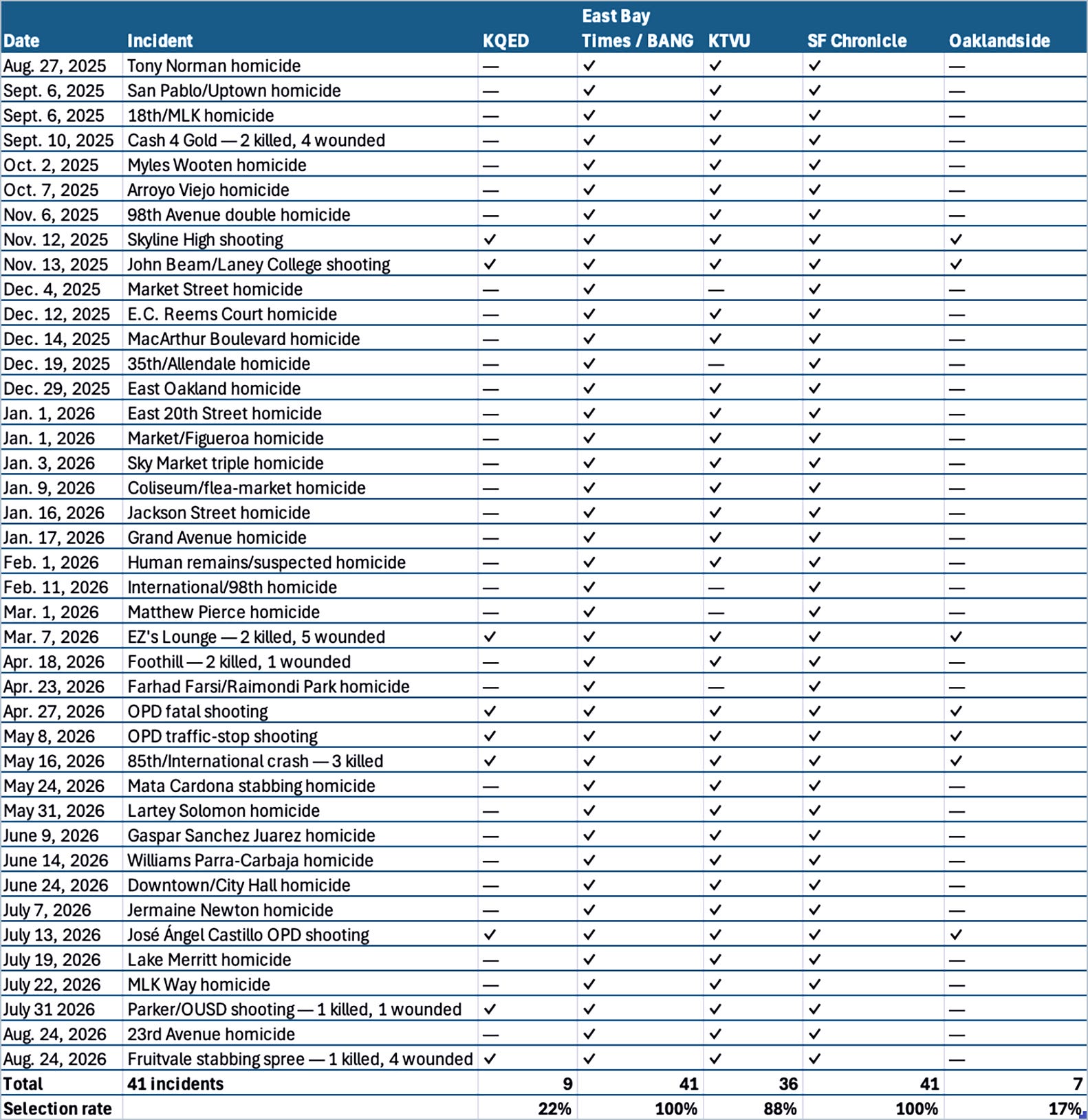
Forty-one incidents met both the substantive criteria and the two-of-four peer coverage threshold. Oaklandside selected 7 of 41 (17.1%). KQED selected 9 of 41 (22.0%).
All seven Oaklandside selections were also selected by KQED. KQED selected two additional incidents that Oaklandside did not.
Complete incident dataset
H: Homicide or suspected homicide.
P: Police shooting resulting in injury or death.
S: Qualifying school or college shooting.
T: Traffic collision resulting in multiple deaths.

Limitations
This analysis is an observational review of editorial selection, not a measure of editorial intent.
The peer coverage threshold does not represent every serious crime that occurred in Oakland. It identifies incidents meeting predefined severity criteria that also received coverage from multiple comparison news organizations.
News archives and search systems can be incomplete, and some deaths may subsequently be reclassified.
The analysis does not measure story prominence, article length, number of follow-ups, sourcing, framing or the quality of reporting.
Finally, news organizations do not operate in complete isolation. KQED and Oaklandside have a documented content-sharing relationship, and Bay Area newsrooms routinely cite one another, employ journalists who have worked at competing publications, and participate in a broader collaborative journalism ecosystem.
No evidence was found that this caused an incident to enter the dataset through duplicate publication, but the direct KQED/Oaklandside comparison should be interpreted as descriptive rather than as a test of independent editorial decision-making.
Sources for the full data tables are available upon request.
Read this related article:

Postscript: Disclosure
Oakland Report is another part of Oakland’s changing local media landscape. It began as a volunteer project in 2023 and is now operated by the nonprofit Citizens Oakland. It describes itself as an independent, citizen-led publication focused primarily on fact-based reporting and analysis of local government, rather than comprehensive daily news coverage.
I have contributed articles to and had articles republished in Oakland Report, including reporting and commentary on public safety and local government. Oakland Report was not included as a comparison outlet in this analysis.
Financial disclosure: I am a current paid subscriber to KQED, San Francisco Chronicle, Oakland Report and East Bay Times. I was a paid subscriber to Oaklandside in 2024.
Don’t miss a beat. Subscribe to author Rajni Mandal’s Public Safety Updates.
DeBenedetti, Katie. “East Oakland ‘random’ stabbing spree leaves 1 dead, 4 injured, police say.” KQED, Aug. 25, 2026. https://www.kqed.org/news/12096644/east-oakland-stabbings-leave-1-dead-4-injured
Lee, Henry. “Oakland stabbing spree suspect refuses to leave jail cell for court.” KTVU, Aug. 27, 2026. https://www.ktvu.com/news/oakland-stabbing-spree-suspect-refuses-cell-court
Harris, Harry. “Fatal Oakland stabbing victim loved helping others.” East Bay Times, Aug. 26, 2026. https://www.eastbaytimes.com/2026/08/26/fatal-oakland-stabbing-victim-loved-helping-others/; https://archive.is/4DWGE
Park, Brooke. “Suspect in Oakland mass stabbing was on probation for previous violent assault.” San Francisco Chronicle, Aug. 29, 2026. https://www.sfchronicle.com/crime/article/oakland-mass-stabbing-suspect-named-22406139.php
Romero, Roselyn and Darwin Bondgraham. “Video of fatal Oakland police shooting released by OPD.” The Oaklandside, Aug. 12, 2026. https://oaklandside.org/2026/08/12/opd-officer-involved-shooting-body-cam-footage/
Bondgraham, Darwin. “Oakland police shoot and kill armed man.” The Oaklandside, Apr. 28, 2026. https://oaklandside.org/2026/04/28/police-shooting-oakland-opd/
Romero, Roselyn. “Oakland police shoot driver during early morning traffic stop.” The Oaklandside, May 8, 2026. https://oaklandside.org/2026/05/08/opd-officer-shooting-traffic-stop-oakland-little-saigon/
Kaplan, Esther and Ashley McBride. “Suspects in Skyline High School shooting had ‘ghost guns,’ police say.” The Oaklandside, Nov. 14, 2025. https://oaklandside.org/2025/11/14/suspects-skyline-high-school-shooting-ghost-guns-police-charges/
Romero, Roselyn. “Shooting at Laney College leaves John Beam, legendary football coach, in critical condition.” The Oaklandside, Nov. 13, 2025. https://oaklandside.org/2025/11/13/shooting-laney-college-oakland/
Romero, Roselyn. “EZ’s Lounge shooting suspect charged with firearms offense.” The Oaklandside, May 14, 2026. https://oaklandside.org/2026/05/14/ezs-lounge-shooting-oakland-suspect-charged/
Bondgraham, Darwin et al. “3 killed by driver who crashed into pedestrians on East Oakland sidewalk.” The Oaklandside, May 17, 2026. https://oaklandside.org/2026/05/17/3-killed-reckless-driver-east-oakland-85th-international/
DeBenedetti, Katie. “East Oakland school shooting leaves 1 student dead, another injured.” KQED, Jul. 31, 2026. https://www.kqed.org/news/12093536/east-oakland-school-shooting-leaves-1-student-dead-another-injured
Ibid. DeBenedetti, Katie.
Cruz Guevarra, Ericka et al. “Violent crime is down in Oakland.” KQED, Jan. 28, 2026. https://www.kqed.org/news/12071250/violent-crime-is-down-in-oakland
Cityside contributors. “About.” Cityside Journalism Initiative, accessed Sept. 1, 2026. https://citysidejournalism.org/about/
Umanzor, Joel. “Stabbing at Richmond home leaves one dead, one injured.” Richmondside, Aug. 12, 2026. https://richmondside.org/2026/08/12/richmond-stabbing-leaves-one-dead/
Metzger, Zach. “The state of local news: 2025 report.” Medill Local News Initiative, Northwestern University, Oct. 2025. https://localnewsinitiative.northwestern.edu/projects/state-of-local-news/2025/report/
Holcomb, Jesse et al. “The 2026 INN Index.” Institute for Nonprofit News, Jun. 2026. https://inn.org/inn_reports_pages/2026-index/
Pew Research Center contributors. “Local news fact sheet.” Pew Research Center, accessed Sept. 1, 2026. https://www.pewresearch.org/journalism/fact-sheet/local-news-fact-sheet/
Lowry, Dennis T. et al. “Setting the public fear agenda: a longitudinal analysis of network TV crime reporting, public perceptions of crime, and FBI crime statistics.” Journal of Communication, Mar. 1, 2003. https://onlinelibrary.wiley.com/doi/abs/10.1111/j.1460-2466.2003.tb03005.x
Gross, Kimberly and Sean Aday. “The scary world in your living room and neighborhood: using local broadcast news, neighborhood crime rates, and personal experience to test agenda setting and cultivation.” Journal of Communication, Sept. 2003. https://academic.oup.com/joc/article-abstract/53/3/411/4102957
Note: Because East Bay Times and Mercury News share reporting through Bay Area News Group, this analysis included relevant Mercury News articles as East Bay Times/BANG coverage. If Mercury News articles were excluded and only stories published specifically by East Bay Times were counted, two incidents would no longer meet the study's inclusion criteria, reducing the dataset from 41 to 39. The results would change only slightly: Oaklandside from 17% to 18%, and KQED from 22% to 23%.
Oaklandside is, and has ALWAYS been fake news. Ditto KQED. They are propaganda for the corrupt failing progressive cabal that controls Oakland.
As someone who does not watch local news or read the SF Chronicle I see that I am missing important information by only relying on Oaklandside.