



EDITOR’S NOTE: Oakland Report subscriber Victoria Wake wrote a letter to the editor objecting to the characterization of high-turnout voters in our March 2 commentary by the Oakland Charter Reform Project, “Oakland voters should reject the inadequate ‘strong-mayor’ proposal.” Here is the excerpt from the commentary:
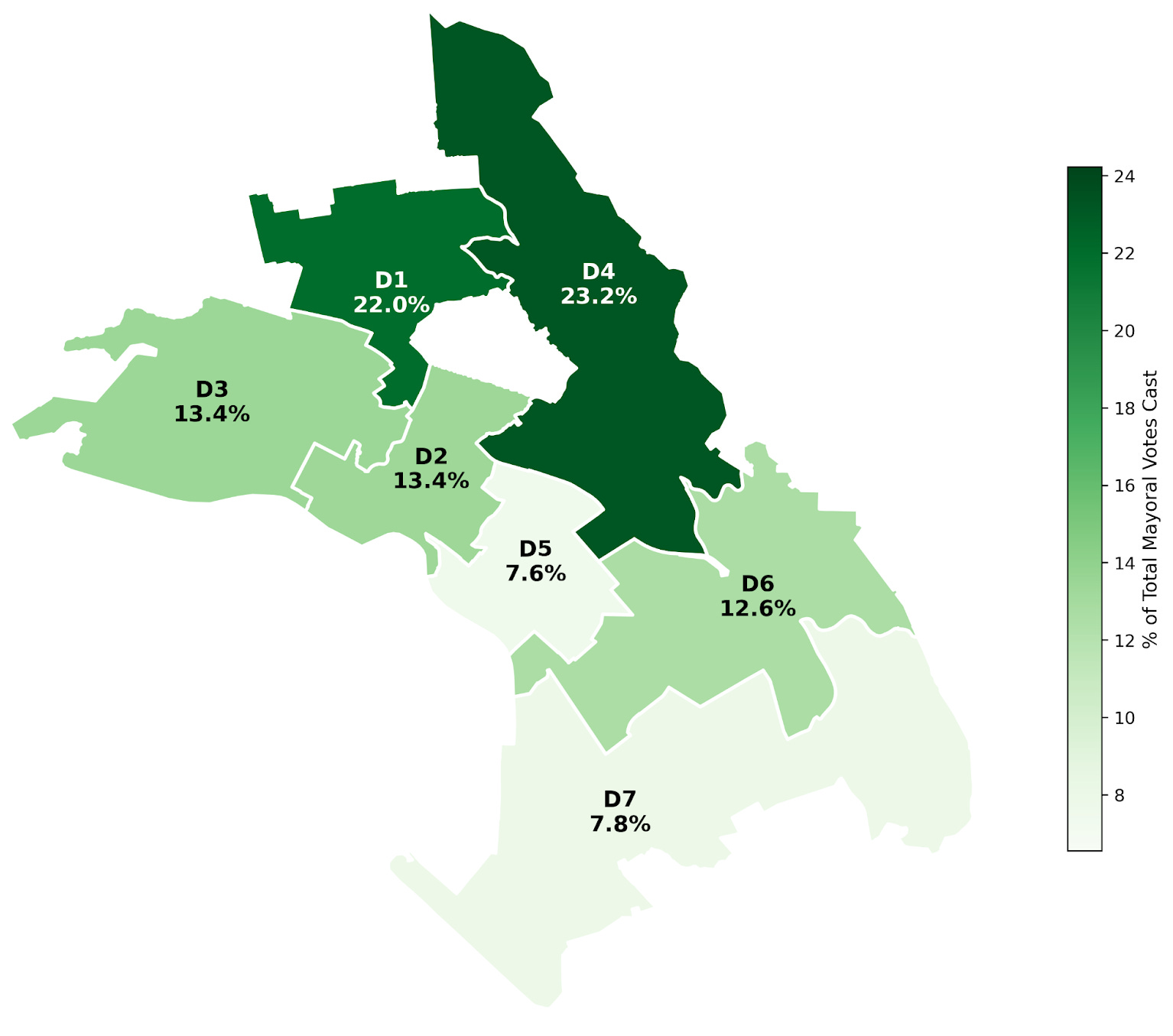
“Unfortunately, instead of giving every community an equal voice as proposed by the Model City Charter, the Mayor’s Working Group’s reforms would instead empower only that subset of voters who show up in the midterm elections. These voters are not representative of Oakland residents overall: they are disproportionately residents of North Oakland and the Oakland Hills, which tend to be white, wealthy, college-educated homeowners. Based on geography alone, these highly engaged voters will likely skew the issues any citywide elected mayor hears about and feels compelled to address.”
— Steven Falk, Ben Gould and Nancy Falk, “Oakland voters should reject the inadequate ‘strong-mayor’ proposal.”
We invited the Oakland Charter Reform Project to respond to Victoria’s letter, and a dialog ensued. With everyone’s permission, we are publishing their exchange here for our readers to consider. We believe their discussion offers an on-ramp for Oaklanders to engage with this issue in a thoughtful manner. We encourage readers to continue to discussion in the comments section.

Victoria Wake
March 4, 2026, 5:15 p.m.
Thank you for your commentary on charter reform. With your explanation, I generally agree with the council/manager form that you are supporting. What throws me off, though, is your unnecessary disparaging of areas of Oakland that have higher rates of voter turnout. Jeez. What a screwy condemnation!
I am very active in my Dimond district community, and from what I see here and elsewhere, everyone in Oakland wants the very same thing: basic services that are delivered effectively and City staff who are accessible and accountable.
I don't hear anyone dismissing concerns of Oakland as a whole or any part of Oakland. For example, I'm pretty sure that every community in Oakland wants more police coverage. I'm also pretty sure that every community in Oakland wants more reliable garbage collection and illegal dumping prevention. Likewise, I don't think any community in Oakland is happy about homeless encampments. And I don't think anyone is pitching for an inequitable distribution of those services.
You are coming up with artificial distinctions—and kind of ludicrous stereotypes—and it manufactures a picture of serious divisiveness that isn't there. Your bias is really showing and it undercuts your arguments. You make me want to apologize for my excessive voting, something I hadn't thought of as a selfish act.
Nancy Falk (Oakland Charter Reform Project)
March 6, 2026, 2:14 p.m.
Thank you for reading our commentary, sharing your perspective, caring about Oakland and voting. Our comments were not intended to disparage anyone and certainly not highly-engaged residents in districts with high voter turnout. Indeed, we encourage voters in all districts across Oakland to vote every Election Day.
Our core argument in that specific section of the Commentary is that a Strong Mayor system of government is not obviously the best form of government to represent Oakland’s diversity and address current disparities. In recommending a Strong Mayor system the Mayor’s Working Group asserts, without compelling evidence, that a city-wide elected mayor would better “address racial, geographic and wealth disparities.”
In seeking to evaluate this specific assertion, we looked at the last two elections. Given the data on voter turnout and population by district, coupled with the pragmatic realities candidates and incumbents face when running for (re)election, we’re not convinced of the Working Group’s assertion. In fact, based on our analysis, we believe the evidence suggests it’s rather unlikely that a single, city-wide elected Mayor would better represent Oakland’s diverse needs (that is, better than a council-manager structure).
So that all Oaklanders may get the efficient and effective city services all deserve, we continue to advocate for the “third option” for charter reform: a powerful City Council that includes a powerful Mayor as chair with veto authority PLUS a professional Administrator who manages city operations and reports to the entire City Council (which now includes the Mayor).
Thanks, again, for engaging.

Victoria Wake
March 6, 2026, 2:23 p.m.
Thanks for responding. I agree with your perspective on strong mayor vs. strong council. How are we going to get a different proposal on the table? I couldn’t attend the Empower Oakland gathering last night, but I’m wondering if that group shares your perspective and if there will be a concerted effort to overcome the Mayor’s Working Group recommendations. If you have time to even briefly write back with your thoughts on this, I would appreciate it. I’ll contribute in any way I can to helping make it happen.
P.S. Thanks for your first paragraph below. I do just want to reiterate the importance of being careful with the language that you use and stay away from accusing any one segment of Oakland of not caring about the City as a whole.
Nancy Falk
March 6, 2026, 3:44 p.m.
Victoria, thanks for your offer to take further action. We’re suggesting concerned Oaklanders email their Councilmember to express their support for this Third Option in reforming the city charter. I’ll send you a follow up note with that info for your consideration.
Oakland Report
March 6, 2026, 5:52 p.m.
Thank you for your messages. The discussion is appreciated! We would like to publish both Victoria’s message and Nancy’s response in our next Letters column. Our editorial board would draft a brief cover paragraph introducing the contents. We would encourage additional debate in the comments section, if desired. Your discussion would be a good on-ramp for Oaklanders to engage with this issue in a thoughtful manner.
The views expressed in our Commentaries do not necessarily reflect the editorial views of Oakland Report or its contributing writers.
See this related article:

BECOME A SUPPORTING MEMBER

We rely on our readers’ financial support to continue our work.
Your contributions are tax-deductible.
We are a 501(c)(3) charitable nonprofit based in beautiful Oakland, California. Our mission is to make truth more accessible to all Oakland residents. Learn more
Thank you!
A “powerful” mayor embedded in a “powerful” council with a “professional” city administrator. What are the roles and responsibilities of these powerful and professional people?
- Can the mayor direct work?
- Can the mayor veto?
- Does mayor have executive order powers?
- Can council direct work?
- Does Section 218 still apply?
- Is the city administrator’s future based on the vote count at the moment?
- Who hires / fires department heads?
What makes the mayor “powerful” versus “weak”?
What makes the council “powerful” versus “weak”? Would the current council be considered “powerful”?
What makes the city administrator “professional”? Are we saying the current city administrator is “unprofessional”?
This is starting to sound like some elected folks don’t want to give up their positions or their power. I can understand they. So, let’s just give everyone more power and make them work together. What can go wrong?
Lastly, I’m coming to the personal conclusion that Oakland is not ready for and would not benefit from a strong mayor form of government. We have a culture that values high engagement and a lot of collaboration. That’s excellent and good. The strong mayor is constantly pushing to execute their agenda. The conflict might be too much.
Personally, I would rather report to a mayor and implement his/her vision.