


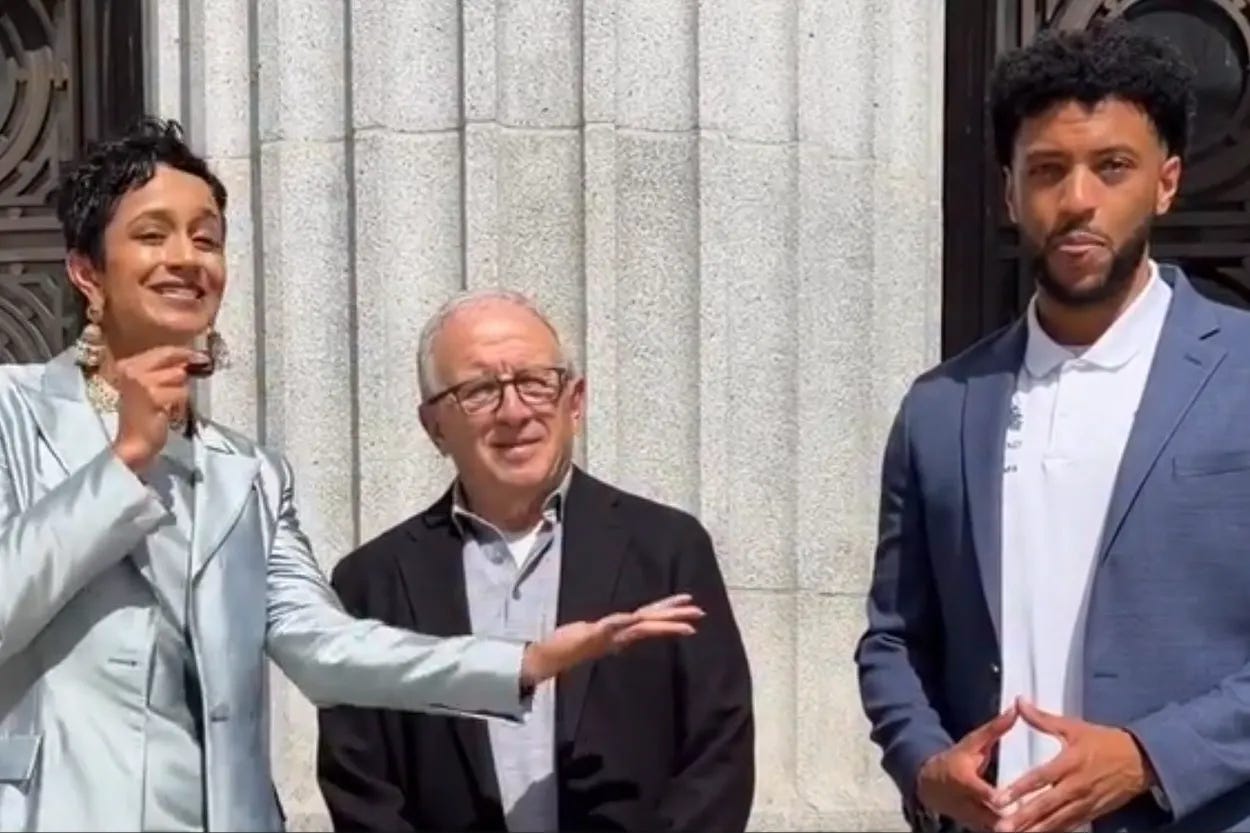
Editors’ note: This open letter was posted by Oakland resident and retired Caltrans manager Chris Urkofsky on Nextdoor, objecting to the terms of the city’s sale of the Oakland Coliseum Complex to a group led by first-time developer Ray Bobbitt.1 We are republishing it here with Urkofsky’s permission, with citations added, for our readers to consider.
BY CHRIS URKOFSKY
Can’t support the process that produced the Coliseum deal
I voted for council member Janani Ramachandran because she promised a new standard of transparency, accountability and fiscal discipline.
This letter explains why I believe the revised Coliseum transaction falls short of those principles.
Council member Ramachandran, I am writing as one of your constituents—not as someone opposed to redevelopment of the Coliseum, but as someone who believes Oakland deserves transparent government and prudent stewardship of its public assets.
I support redeveloping the Coliseum. I support affordable housing. I support community benefits. I support transforming this long-neglected property into something that benefits East Oakland.
What I cannot support is the process that produced this deal.
The revised agreement asks Oakland taxpayers to accept seller financing, deferred payments extending years into the future, and substantial financial risk.23
Those terms may ultimately prove justified—but only if the city can demonstrate that they represent the best reasonably available outcome for Oakland.
To date, I have not seen that demonstrated.
Instead, I have watched the city repeatedly restructure this transaction to preserve the participation of the same purchaser after the original purchase and sale agreement failed to close under its negotiated terms.4
That agreement established payment deadlines, default provisions, and expressly stated that “time is of the essence.”5
When those obligations were not met, the City did not enforce the agreement or return the property to the marketplace.67
Instead, it renegotiated the transaction, granted additional opportunities to perform, and ultimately approved a substantially revised agreement.8
Read this related article:

When a loan is not a ‘loan’: city officials use wordplay to elide the truth about the Coliseum sale
That raises obvious questions:
Why was preserving this particular purchaser considered preferable to reopening the process and inviting competitive bids?
What financial analysis demonstrated that continued negotiations with Oakland Acquisition Company represented a better outcome than testing the market?
Those questions have never been adequately answered.
Councilmember Noel Gallo raised additional concerns during the Council’s deliberations regarding the City’s limited visibility into negotiations involving Alameda County’s interest and questioned whether Oakland negotiated an adequate share of future ticket revenues.9
Those concerns deserve substantive answers—not assurances.
Troubled by “handshake deal”
Equally troubling has been the lack of transparency.
Major revisions to the agreement appeared only after negotiations had concluded. Public explanations followed rather than preceded significant changes.
Taxpayers should not have to reconstruct the economics of a nine-figure public transaction by comparing multiple versions of contracts and staff reports.
Good government requires more than eventual disclosure. It requires transparency while decisions are still being made.
I was also troubled by Councilmember Ken Houston’s description of aspects of this transaction as a “handshake deal,” followed by Mr. Irving Azoff’s assurance that “my word is my bond.”
While personal trust has its place, public transactions involving more than $100 million in taxpayer-owned assets must rest on enforceable agreements, documented financial analysis, rigorous due diligence and transparent public oversight—not personal assurances or informal understandings.
Help us reach our goal of 10,000 subscribers.
Standards should not change depending on who is sitting across the negotiating table
Perhaps most disappointing is how difficult I find it to reconcile your vote with the principles you have publicly championed.1011
You have written about fiscal responsibility, transparency, accountability and the need for Oakland to develop “a culture of enforcement.”12
You have criticized fiscal recklessness and argued that government must consistently enforce the standards it establishes.13
Those are principles with which I wholeheartedly agree. That is why I find your support for this transaction so difficult to understand.
If Oakland truly needs a culture of enforcement, shouldn’t that principle apply when the City is disposing of one of its largest public assets?
Oakland residents are expected to comply with deadlines. Contractors doing business with the City are expected to comply with deadlines. Developers seeking permits are expected to comply with deadlines.
It is reasonable to ask why those same expectations did not apply when the purchaser of one of Oakland’s largest public assets failed to close under the negotiated terms of the agreement. The standards should not change depending on who is sitting across the negotiating table.
Constituents deserve acknowledgment and engagement
I am equally disappointed by your office’s lack of responsiveness. Over the past several weeks I have contacted your constituent representative multiple times regarding this transaction and left several messages requesting a return call. None has been returned.
Whether you ultimately agree with my concerns or not, constituents deserve acknowledgment and engagement—particularly on one of the largest public real estate transactions in Oakland’s history.
Reasonable people can disagree about the future of the Coliseum. They should not disagree about the standards that govern the disposition of public property.
The burden is not on critics to propose an alternative redevelopment plan.
The burden is on the City to demonstrate that this transaction represents the best risk-adjusted outcome reasonably available to Oakland after a transparent process supported by sound financial analysis and full public accountability.
I do not believe that burden has been met.
If I have misunderstood the facts or overlooked analyses supporting this transaction, I invite you to respond publicly.
Oakland residents deserve to hear directly why you believe this was the best available deal for the City. I intend this letter to begin, not end, that discussion.
Respectfully,
Chris Urkofsky
Oakland resident
District 4
Editors’ note
Oakland Report is an experiment in a new form of media. Our nonprofit mission is to provide reasoned, fact-based, well-sourced reporting and analysis on local government issues, focused on observable and verifiable evidence free from implicit bias.
Our guiding principles are to present the facts and evidence and let the reader decide for themselves what to think. We achieve this by focusing on what people and organizations do, not what they say.
Another of our guiding principles is to always remain open to examining and questioning our own biases, and to keep an open forum for new information that may advance our understanding — and help Oaklanders better grasp the decision-making that affects our lives.
In that spirit, we invite Ramachandran to present her perspective on this article and report on her thought process behind her support for the Coliseum deal. If offered, we will publish her counterpoint as presented.
CORRECTION: This article was originally published with a video montage of clips from council member Ramachandran’s social media account (Instagram). The video was prepared by Oakland Report staff, and not by the author of this commentary. The video compilation fell short of our own standard of “no implicit bias,” and we have replaced it with the static image at the top of this article. Learn more.
ABOUT THE AUTHOR
Chris Urkofsky is a 35-year Oakland resident who recently retired after a 33-year career with the California Department of Transportation (Caltrans), where he served as a licensed land surveyor and manager overseeing the development of regional Geographic Information Systems (GIS).
Throughout his career, Chris worked at the intersection of land records, mapping, information technology, public infrastructure and government administration—experience that reinforced his belief in transparency, accountability and the rule of law in public decision-making.
A lifelong student of political science, public policy and history, Chris has been active in California Democratic Party affairs, served as a public sector union officer, and written on governance, fiscal responsibility and the stewardship of public assets.
While he strongly supports redevelopment of the Coliseum property, Chris believes major public transactions must be conducted through transparent processes that protect taxpayers and preserve public trust. He and his wife have called Oakland home for more than three decades.
The views expressed in our Commentaries do not necessarily reflect the editorial views of Oakland Report or its contributing writers.

WE ARE 100% SUPPORTED BY YOU
Oakland Report is an experiment in a new form of media. We provide reasoned, deep-dive, data-driven reporting and analysis that you will find nowhere else. If you value our work, please donate. All contributions go directly to sustaining and growing our nonprofit work.
Urbach, Eric. “City council approves Oakland Coliseum deal, moving its sale toward final approval.” Bay City News / Local News Matters, Jul. 13, 2026. https://localnewsmatters.org/2026/07/13/oakland-city-council-coliseum-arena-sale-approved/
City of Oakland. “Second amendment to Coliseum Complex sale agreement.” Oakland city council meeting agenda, Jul. 21, 2026. https://oakland.legistar.com/LegislationDetail.aspx?ID=8130453&GUID=5AFD9A11-F95D-42F4-B396-245C29D5D252
Montana, Alex. “When a loan is not a ‘loan’: city officials use wordplay to elide the truth about the Coliseum sale.” Oakland Report, Jul. 21, 2026. https://www.oaklandreport.org/p/oakland-coliseum-loan-wordplay
Fuwad, Ahamad. “Oakland Coliseum deal moves forward, with city poised to get a portion of ticket sales.” Oakland North, Jul. 14, 2026. https://oaklandnorth.net/2026/07/14/oakland-coliseum-deal-moves-forward-with-city-poised-to-get-a-portion-of-ticket-sales/
City of Oakland and Oakland Acquisition Company, LLC. “Real property sale agreement (Coliseum Complex – city’s interest).” Executed Aug. 31, 2024. https://www.oaklandca.gov/files/assets/city/v/1/city-administrator/documents/coliseum/psa-city-coliseum-sale-v12-executed.pdf
Ibid. Section 16.2. On an uncured purchaser default, the city’s “sole and exclusive remedy” is to terminate the agreement and retain payments already made as liquidated damages; the city expressly waived any right to other damages. The enforcement choice available was therefore to terminate or to renegotiate.
Montana, Alex. Op. cit. (note 3). OAC’s initial $5 million deposit remains its only payment made to date; the council removed the interim payment deadline in May 2025, and the revised agreement’s own closing deadline of Jun. 30, 2026 passed without a closing.
Bay City News Service contributors. “Oakland City Council adjusts timeline for sale of Coliseum.” CBS San Francisco, May 8, 2025. https://www.cbsnews.com/sanfrancisco/news/oakland-coliseum-sale-city-council-adjusts-timeline/
Wolfe, Eli. “Lucrative Oakland Arena becomes key component of larger Coliseum deal.” The Oaklandside, Jul. 13, 2026. https://oaklandside.org/2026/07/13/lucrative-oakland-arena-becomes-key-component-of-larger-coliseum-deal/
Lee, Henry. “City Council moves one step closer to selling Oakland Coliseum.” KTVU, Jul. 13, 2026. https://www.ktvu.com/news/oakland-city-council-vote-coliseum-sale
Post News Group contributors. “Council gives approval for $125 million Oakland Coliseum sale to AASEG.” Post News Group, accessed Jul. 26, 2026. https://www.postnewsgroup.com/council-gives-approval-for-125-million-oakland-coliseum-sale-to-aaseg/
Ramachandran, Janani. “Ramachandran: I’m tired of constantly hearing, ‘Well, that’s just Oakland.’ City needs culture of enforcement.” East Bay Times, May 22, 2025. https://www.eastbaytimes.com/2025/05/22/ramachandran-oakland-needs-a-culture-of-enforcement-to-bolster-budget-make-city-more-livable/; https://web.archive.org/web/20250724083957/https://www.eastbaytimes.com/2025/05/22/ramachandran-oakland-needs-a-culture-of-enforcement-to-bolster-budget-make-city-more-livable/
Ramachandran, Janani. “Opinion: Oakland Mayor Sheng Thao and my council colleagues’ fiscal recklessness.” East Bay Times, Jul. 25, 2024. https://www.eastbaytimes.com/2024/07/25/opinion-mayor-sheng-thao-and-my-oakland-council-colleagues-fiscal-recklessness/; https://web.archive.org/web/20241212050120/https://www.eastbaytimes.com/2024/07/25/opinion-mayor-sheng-thao-and-my-oakland-council-colleagues-fiscal-recklessness/
Letter raises all valid questions. My short version is: why Oakland and Alameda are so desperate to sell to one particular first time developer on very risky terms?
Thank you - this is an excellent letter and one for which everyone on the City Council should be held accountable. I can't believe that this deal doesn't violate the law. It is the epitome of financial malfeasance, to say the least.